NIGHT VISION

phantom7.jpg

NIGHT VISION
An evening on… illuminating darkness

Thursday 18 March 2010, 20:00. Vooruit, Gent.
Program produced by Courtisane as part of the Courtisane Festival 2010 (Gent, 17 – 21 March 2010)

The night is not a black mass that blinds our sight. It’s not a substance, but an event, pure depth that surrounds and swallows us, infiltrating us through our senses. In the dark hours when we must sharpen our eyes and ears, when night comes to life, nothing seems what it is. This programme presents a series of performances, films and an installation which attempt to capture this event in all its obscurity, somewhere between light and darkness, visible and invisible, seeing the night and seeing in the night.

INSTALLATION
Disinformation

The Origin of Painting. 2000, optokinetic / autodestructive, luminous graffiti, shadow & electromagnetic sound installation. Starting from 19:00 ! (installation photo © Duncan Shephard 2003)
origin_of_painting4.jpg
The Disinformation project goes back to 1995, when it was still a vehicle for their experiments with electromagnetic and radio phonic sounds. In the meantime, their research into electronic, sonic and optokinetic phenomena has found itself a place in the contemporary art world. The Origin of Painting is a key work in Disinformation’s oeuvre, a literally impressive sound and light installation which allows visitors to make an impression of their silhouette. This work not only refers to the myths associated to the creation of painting, but also to the atomic shadows on the walls of Hiroshima and Nagasaki. “A dark writing was born. A secret writing, written in the dark, with darkness itself. In the atomic night and on the human surface, a dark, corporeal surface appeared.” (Akira Mizuta Lippit)

PERFORMANCE
Phantom Limb & Earth’s Hypnagogia

In Celebration of Knowing all the Blues of the Evening. slide projections, Hammond B3 organs, turntables
phantom8.jpg
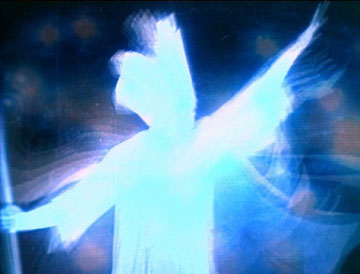
Behind this tongue-twister of a name are Jaime Fennelly and Shawn Hansen, a duo of multi-instrumentalists whose many projects (among which Phantom Limb and Peeesseye) explore the borders of drone, noise and improvisation. With their joint project In Celebration of Knowing all the Blues of the Evening, they examine, both with sound and image, the ephemeral dynamics of twilight, the moments between light and dark, “entre Chien et Loup”. For their performance at Courtisane they’ll use two Hammond organs and a series of images made in collaboration with visual artist Nate Miner.

SCREENING
Jeanne Liotta

Observando El Cielo. 2007, 16mm, colour, sound, 19’
observando_el_cielo_jeanne_liotta.jpg
According to Paul Virilio, “it is no longer only the night sky that is threatened but indeed the night itself, the great night of interstellar space; that other unknown quantity that, nonetheless, constitutes our only window on the cosmos.” What is left to us of the nightly celestial roof after years of light contamination is made clear in this film, the result of seven years of field recordings. The soundtrack, a composition of VLF (Very Low Frequency) radio recordings, is the work of Peggy Ahwesh.

SCREENING
Deborah Stratman

In Order Not To Be Here. 2002, 16mm, colour, sound, 33’
stratman.JPG
A nocturnal study of the suburban and corporate landscapes of the Unites States, revealing how much the collective trust in surveillance and security determines our living environments. An everyday horror film, which mercilessly addresses the feelings of moral failure, spiritual emptiness and isolation-based paranoia which are proper to our post-industrial consumption society. The night has become the perpetual twilight; it no longer reflects the fear of the unknown, but of ourselves.

PERFORMANCE
Pieter Geenen

nightscape (3). 2005, binaural sound, 15’10”

The work of Pieter Geenen focuses on uncanny landscapes that without calling for analysis, emotion or transparence, slowly find their place in the imagination of the viewer. The attention is sharpened, the experience slows down. In nightscape, a series of nocturnal soundscapes, we become – devoid of the usual visual intellectual framework – completely dependent on our hearing. “It is no coincidence that the night seems to be the favorite time of this anti-reporter: in the dark hours, when we have to focus eyes and ears, nothing seems what it is. ‘Believe that anything is real you can imagine’”. (Herman Asselberghs)

PERFORMANCE
Paul Clipson + William Fowler Collins

Lightmaze. Super-8 projections, guitar
withinmirrors.jpg
The ravishing super 8 films of Paul Clipson are lyrical explorations of light and movement. His images, mostly edited in-camera, reveal the energy and sensuality of the everyday that we often fail to see. At the invitation of the Courtisane festival, he has assembled a selection of night shots which will be accompanied live by William Fowler Collins and his pitch black guitar drones. His recent mind-blowing album Perdition Hill Radio was released by the renowned Type label.

SURFACE TENSION

light.jpg

SURFACE TENSION
An evening on… frictions

Friday 19 March 2010, 20:00. Vooruit, Gent.
Program produced by Courtisane as part of the Courtisane Festival 2010 (Gent, 17 – 21 March 2010)

What happens when, before our eyes and ears, an event unfolds in time without simple representation, causality or possibility of identification? We are thrown back upon ourselves, upon the power of our imagination to create mental images. The real is brought back to the possible. In this series of works, most points of reference and information have been reduced to the minimum, as if the outside was folded inside. It’s up to us to break through the surface, to put our imagination to work, to search for connections, to discover what it all can mean…

PERFORMANCE
Seymour Wright, Ross Lambert, Paul Abbott

alto-saxophone, guitar/devices, electronics/light/projections.
abbott.jpg
An encounter between three participants of the weekly workshop led by musician and theorist Eddie Prévost, which during the past decade has left an undeniable mark on the London improvisation scene. The emphasis that Prévost places on the heuristic aspect of free improvisation – as a process of discovery, learning and dialogue – lies close to the heart of these musicians. Both saxophonist Seymour Wright and guitarist Ross Lambert are known for their inter-musical dynamics and exploratory drive. On this occasion, they team up with Paul Abbott, who will focus on working with light and video projections.

PERFORMANCE
Karen Mirza, Brad Butler, David Cunningham

The Space Between. Video projections, guitar

Karen Mirza and Brad Butler make film and video installations and performances that question the filmic, sculptural and architectonic qualities of the moving image. The Space Between brings together a formal approach with an overtly social subject matter. The images of an anonymous housing block in India are the basis for an exploration of a number of “spaces between”, suggested by the motif and its distance from the Western viewer. The complexity of the visual structure, a two-screen projection, will be reflected in the live soundtrack by David Cunningham, who has made a name for himself as an installation artist and musician, often in collaboration with This Heat, David Toop, Martin Creed and Sam Taylor-Wood.

PERFORMANCE
Dominique Petitgand

Séance d’écoute. 1992 – 2009, pièces sonores, parlées, musicales et silencieuses
petitgand.jpg
Voice is central to Dominique Petitgand’s compositions and installations. Sentences are fragmented, words and other articulations are isolated and assembled into “mental landscapes”. The listener is immersed into micro universes that bounce back and forth between an assumption of reality – the recordings in which people speak of their own lives – and a projected and timeless fiction. “For me, the search for form takes place at the level of perception, at the level of what is going on inside the head of the listener. I don’t have the impression of creating an object; rather, I set in motion mental perceptions, acts of reflection, of thinking, memory and imagination.” At the request of Courtisane, he will present a listening session in the dark, structured around silences.

INSTALLATION
Lis Rhodes

Light Music. 1975, 16mm 2 screen, b&w, optical sound, 25’
lightmusic2.jpg
The work of Lis Rhodes is pivotal in the history of British avant-garde film, but in the past decades has also moved on to photography, performance and political analysis. Light Music is one of her earlier explorations in the field of “expanded cinema”. Two 16mm projectors project a varied configuration of straight lines, in which the spacing (frequency), thickness (amplitude), colour and density (tonality) also determine the soundtrack. “It is as much about sound as it is about image; their relationship is necessarily dependent as the optical soundtrack ‘makes’ the music, It is the machinery itself which imposes this relationship.”

Altered States

oreilly2.jpg
Altered States
20 November 2009 20:00, Les Brigittines, Brussels

In the context of Video Vortex V, hosted by Cimatics Festival. Curated by Stoffel Debuysere and María Palacios Cruz, in cooperation with Courtisane.

With the digital invading every creative enterprise and form of expression, pencils have become pixels, dreams have turned into data. While cinema’s obsession with the “holy grail” of photorealism has generated a blizzard of visual extravaganzas aimed at a suspension of the distinction between representation and simulation, a generation of DIY bricoleurs use ubiquitious “tools of vizuality” (Kevin Kelly) to explore alternative viewings and readings of the familiar. Through processes of transference, translation and combination, they encode, reveal or impose layers of information and deceive expectations about visibility and availability. Poking the surfaces of various images, sounds and symbols, their renderings create poetic, playful and often melancholic environments that are both alien and familiar, questioning our relation to images and our imagination.

(Altered States is a reworking of the Imagine programme, which was compiled for the Urban Screens Festival in Amsterdam)

Stephen Gray, Beep Prepared, 2002, 5’
gray2.jpg
“What is Road Runner without Willie E. Coyote, what is a cartoon without protagonists? What remains of the longest running and most existential series of sketches, once the actors have left the stage? Part one of a deconstructivist trilogy.”

Joseph Ernst, Hip-Hop Movie, 2008, 4’
ernst.jpg
Transforming visual imagery into words, this video is a word for word translation of a stereotypical hip hop video. ‘Bling bling’ from a different point of view.

Chirstinn Whyte & Jake Messenger, Text Field, 2002, 1′
textfield.jpg
Chirstinn Whyte’s and Jake Messenger’s work exists in the interstices of dance and the digital world. Using ASCII animation, the two artists created a whirling text-body that is part fluid and improvised and part of an algorithm’s discipline, like a dancer that obeys chaos theory.

Oliver Laric, (>’.’)>=O____l_*__O=<('.'<), 2008, 1’30”
laric.jpg
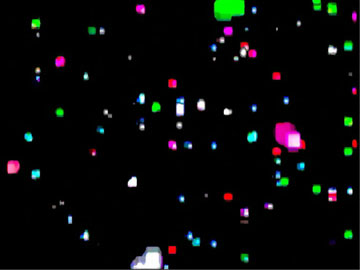
Oliver Laric uses thousands of tiny animated gifs to create an ultra-low-res illusion of cinematic movement, generating a barely discernible compilation of clips from a series of hip-hop music videos.

Max Hattler, Collision, 2005, 02’30”
hattler.jpg
Islamic patterns and American quilts and the colours and geometry of flags as an abstract field of reflection. “It can be interpreted either way: carnage or carnival, it is open-ended. I don’t have the answers, I’m only asking questions.”

David O’Reilly, RGB XYZ, 2005-2008, 13′
oreilly2.jpg
“Discovered in late 2007 when a gardener accidentally dug up a hard drive buried somewhere in central Europe, RGB XYZ found its way to David O’Reilly, who compiled its five incomprehensible episodes into what became perhaps the most enigmatic piece of animation ever to leave a computer.”

Michael Robinson, All Through the Night, 2007, 6’
robinson.jpg
Described by Michael Robinson as a “charred visitation with an icy language of control; there is no room for love”. In this 4 minute digital video sequence, Robinson recontextualizes appropriated animation footage. In doing so, he successfully merges video effects into textures and glacial landscapes and creates his own kind of melancholic magic.

Dave Griffiths, Rogue State, 2003, 02’20”
griffiths2.jpg
Vetoed UN resolutions hand-inscribed onto DV tape using a magnetic quill. Reinterpreted by the digital apparatus, these marks reveal abstract, lawless sonic and visual explosions – a fluid display of synthetic aerial terror. The action alludes to the shared nature of entertainment and military technology in seeking perfect spectacle whilst shunning error or uncertainty. Compressed light and sound are unleashed in volatile glitches to commemorate the abandonment of conventions in both the digital medium and international law.

Jonathon Kirk, I’ve got a guy running, 2006, 7’12”
jonathon_kirk.jpg
In this video, Jonathon Kirk explores the relation between cognition and recognition of war images, a relation that has been severely affected by the influence of simulation, surveillance and real-time media coverage. Images of a precision bombing, released by the U.S. Department of Defense to the glory of the American army and its weapon suppliers, are subject to algorithms, which gradually reveal the reality that lies beneath them.

Dietmar Offenhuber, paths of g, 2006, 1′
offenhuber.jpg
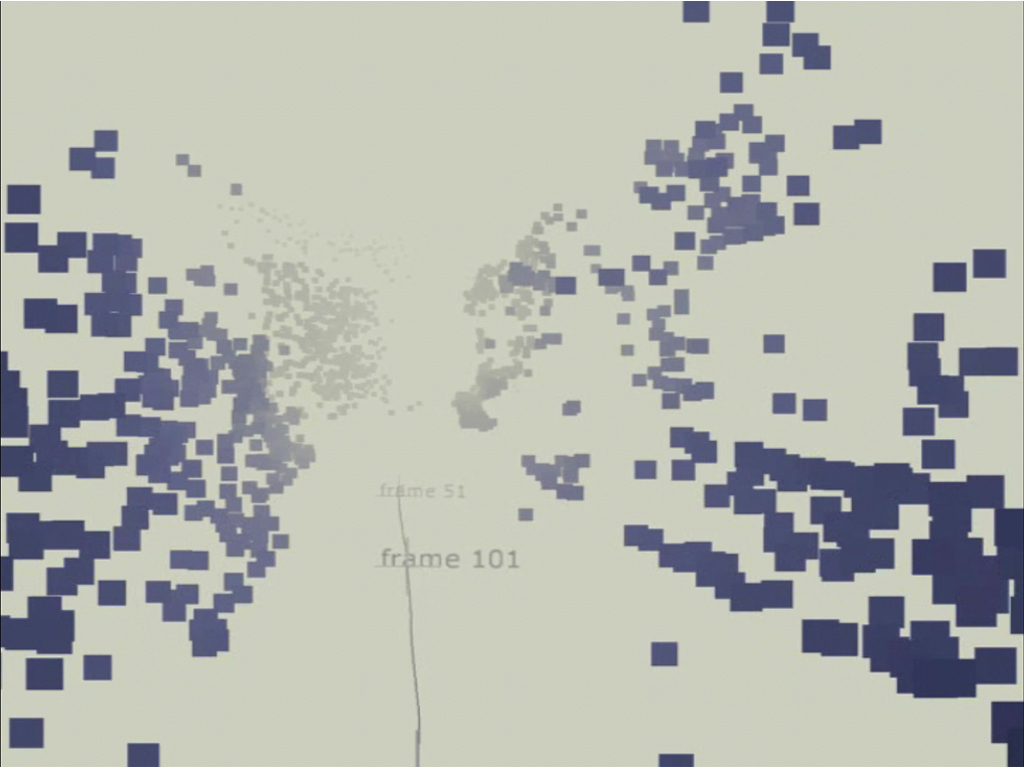
The long backwards tracking shot through a trench in Stanley Kubrick’s WWI drama Paths of Glory (1957) is reduced to pure geometry. Nothing is visible other than a matrix of rectangular figures and a line which follows the movement of the camera and counts off the spent frames. The viewer sees less but learns more.

Rebecca Baron & Doug Goodwin, Lossless #5, 2008, 3′
baron_goodwin2.jpg
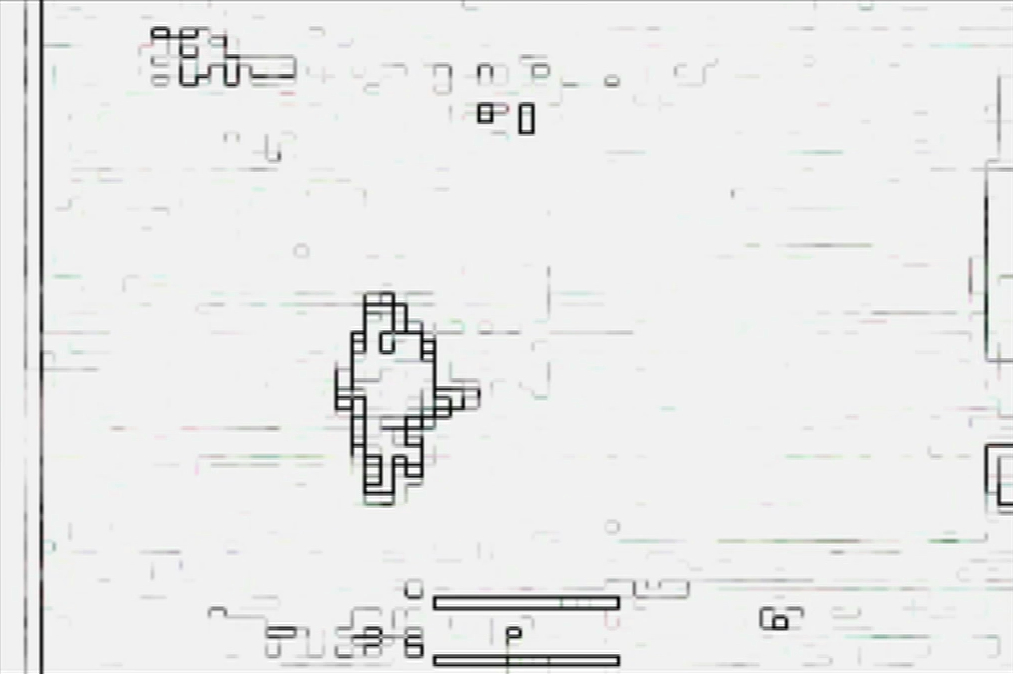
Lossless is a series of works that looks at the dematerialization of film into bits, exposing the residual effects of the process that makes file sharing possible. Baron and Goodwin used several methods to alter these works, either interrupting the data streaming by removing basic information holding together the digital format or comparing 35 mm to DVD and examining the difference between each frame. The project considers the impact of the digital age on filmmaking and film watching, the materiality and demateriality of film as an artistic medium, as well as the social aspects of how the online community functions and the audience for such obscure films.

Nicolas Provost, Papillon D’Amour, 2003, 03’30”
provost2.jpg
By subjecting fragments from the Akira Kurosawa’s film Rashomon (1950) to a mirror effect, Provost creates a hallucinatory scene of a woman’s reverse chrysalis into an imploding butterfly. This physical audiovisual experience produces skewed reflections upon Love, its lyrical monstrosities, and a wounded act of disappearance.

Bernard Gigounon, Starship, 2002, 4′
bernardgigounon.jpg
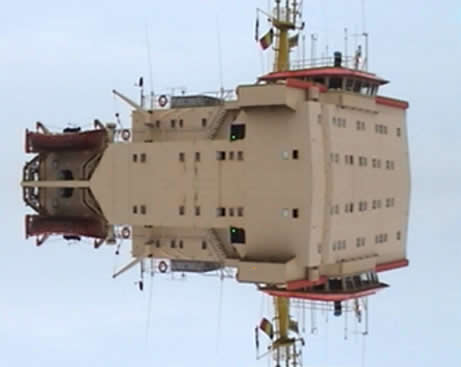
Fantasy worlds are always there, anywhere, just like images, the only thing we need to do as a spectator is to allow our imagination to run free. Gigounon gives us a boost to let go of trivial reality, even if just for a while. This results in tiny phantasmagorias like Starship, a visual investigation of a passing ship, which turns into a weird and estranging object through the juxtaposition of its symmetrical reflection.

Stewart Smith, Jed’s Other Poem, 2005, 3’
smith.jpg
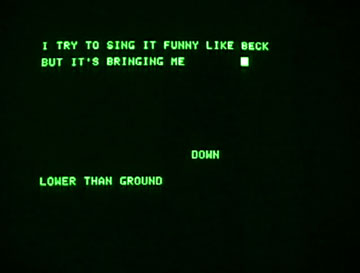
Stewart Smith programmed Jed’s Other Poem, a music video for a Grandaddy song, in Applesoft II on a 1979 Apple ][+ with 48K of RAM. Seriously. Jeddy-3, a humanoid robot built from spare parts, is a recurring character in Grandaddy’s 2000 album The Sophtware Slump. According to Grandaddy, before Jed’s system crashed he wrote poems. Poems for no one.

———————————————————————————————————————————————————————–

LIVE PERFORMANCE
Kurt D’Haeseleer & Tuk

kurt.jpg

In the video works of Kurt D’Haeseleer, the spectator is dropped in a world bombarded with digital fragmentation bombs. People wander through a kaleidoscopic labyrinth of trembling bodies and mutating buildings until they are swallowed by a yawning void. Lost pixels nestle like parasites under the skin and drag them through an everyday world that looks strange beyond recognition. D’Haeseleer regularly collaborates with Guillaume Graux aka Tuk, whose delicate sonic compositions reverberate with the equally uncanny image worlds, like atoms rebouncing endlessly in a hall of mirrors, a collection of stolen dreams melted into a new impressive universe.

On the same night there will also be artist presentations by Constant Dullaart and Albert Figurt. See www.cimatics.com

Morgan Fisher Films

standard_gauge_-_morgan_fisher-1a_1.jpg

Morgan Fisher Films
4 November 2009, Independent Film Show 2009, Napoli (IT)

Introduced by Morgan Fisher. Curated by Stoffel Debuysere and Maria Palacios Cruz.

The 16mm films of Morgan Fisher (US, 1942) – straightforward, elegant, playful – are particularly idiosyncratic; they are situated both outside the film industry and the central developments of avant-garde cinema. Too minimal and conceptual for Hollywood’s taste; too concerned with the specifics of industry procedures for the underground.

Although born in Washington DC, the work of artist and filmmaker Morgan Fisher is essentially Californian. The kind of crossover between avant-garde cinema, film industry and contemporary art in which his films operate could only occur in a city like Los Angeles. After earning an art history degree at Harvard in 1964, Fisher moved West to teach and study at USC and UCLA, where an interest in film was then taking hold. While teaching, he began his career as an editor in the commercial film industry, an experience that would mark his subsequent work as a filmmaker, leading him to examine and deconstruct with wry humour the machinery of cinema in his films. In a sense, Morgan Fisher’s film work is one of the most accomplished forms of filmic meta-cinema. Films that are themselves a discourse on cinema, and which could be understood as “moving” history and theory of film; critical texts in the very form of their object of study. If avant-garde film has always hold this critical function of discourse on film’s history and its possibilities, nowhere it is more apparent than in Morgan Fisher’s oeuvre. And yet, Morgan Fisher’s work has often been marginalised for not fitting neatly into any of the usual avant-garde categories. Instead of avoiding commercial approaches, Fisher uses avant-garde procedures as a way of engaging mainstream film.

Fisher’s films are an exploration of the film apparatus and its physical material, as well as of moviemaking production methods : from film’s standard gauge (35mm) to the use of production stills, the narrative role of inserts and the invisible importance of the projectionist. Fisher plays with the concepts of film, cinema and filmmaking, creating a unique and intimate view of cinema and its physical representation. ” One thing my films tend to do is examine a property or quality of a film in a radical way,” he says. “Being radical is a modest form of being extreme. They each examine an axiom of cinema and say, ‘What if ?'”

This programme brings together a selection of Morgan Fisher’s films, rarely seen in Europe and most of which will be screened in Italy for the first time. Beginning with Fisher’s first work as a filmmaker in 1968, The Director and His Actor Look at Footage Showing Preparations for an Unmade Film (2), the selection spans two decades of work, between 1968 and 1984. In 2003, after a 20 years hiatus away from filmmaking (occupied with painting and drawing) Morgan Fisher completed ( ), a film comprised entirely of insert shots. It will be screened on the (DE)CODING programme on November 5th, together with — ——- by Thom Andersen and Malcolm Brodwick, the title of which ( ) references and pays homage to (Andersen and Fisher are long time friends and collaborators).

fisherhighresproductionst.jpg

The Director and His Actor Look at Footage Showing Preparations for an Unmade Film (2)
1968, 16mm, b&w, sound, 15 min

“The length and straightforward self-reflexivity of the title locate the film outside the commercial cinema, but the specification of the traditional industry situation of the director working with “His Actor” reveals a direct connection with industry procedures unusual for avant-garde filmmakers in the late 1960s”. (Scott McDonald)

A film in 5 sections; each of them is a single roll of 16mm film long. We see a bare room with a young man sitting behind a tape recorder. Another man, played by Fisher himself, busily enters; he tests the recording machine and eventually goes into a back room, which, when illuminated, turns out to be a projection booth. Each section of the film elaborates the situation of the director and his actor working on an unfinished film which gradually becomes the film we are watching, but which is not the film they were working on. Throughout we hear the comments of the two men as they watch the rushes of their film. Watching rushes is part of the necessary procedures of the fimmaking process, which must remain invisible in the finished film. In this work, however, procedure itself is the subject.

Documentary Footage
1968, 16mm, colour, sound, 11 min

“Naturalness wilfully corrupted by inevitable self-consciousness, unwittingly corrupted by unavoidable naturalness, a role played with incredible nuance and complexity by Maurine Connor”. (Mark Toscano)

Just as The Director and His Actor… (made also in 1968) Documentary Footage deals film process, but as the title indicates, it refers to documentary film and not narrative fiction. A single continuous shot of 11 minutes (a 400 foot roll of 16mm, the measure of many of Fisher’s films) in which a naked woman turns on a tape recorder and reads a series of written questions, then rewinds the tape and proceeds to answer to the questions she previously read, all of which concern her body. Documentary Footage reveals the impact of the film process on the woman who is the subject of the film, showing the changes in her manner when she first reads the questions and when she answers them.

Production Stills
1970, 16mm, colour, sound 11 min

As its title indicates, the subject in Production Stills is a series of production stills of a film that was never made, and that at the same time is the film we are watching. Scott McDonald calls Production Stills “the quintessential Fisher film”. A perfectly enclosed narrative of its own production: the image is one long take (again 11 minutes) of a wall on which a hand sequentially pins a number of Polaroids, one after the other. The Polaroids depict the crew making the film; the synchronous sound allows us to hear in ‘real time’, their chatter and the hum of the still camera, so that we can anticipate the photos and assign faces to the voices we hear.

“Production Stills presents the usual Fisher-esque in-version of industry procedures. Normally, production stills are taken while a film is being shot as an aid in marketing the finished film: they are a means to an end. In Fisher’s film, the making and presentation of the production stills is the end, and moments of motion picture illusion–the hands entering the image, the apparent use of sync sound, the making of the film itself-are means for getting the stills mounted so that we can examine them. The film also challenges conventional cinematic categories and terminology. (…) It is an unedited film which, however, provides us with eight different views of the action taking place.” (Scott MacDonald)

Picture and Sound Rushes
1973, 16mm, b&w, sound, 11 min

“Picture and Sound Rushes takes the form of a lecture in which his deadpan discourse describes the various permutations of sound/silence and picture/no picture. These states are demonstrated in the editing, which cuts between them at regular intervals (determined by dividing a roll of film equally by the total number of combinations), with no regard for the audience struggling to follow the dialogue”. (Mark Webber)

Picture and Sound Rushes deploys the various combinations of sound and image in cinema. Again, Fisher unveils and explains film strategies and structures, breaking, and the same time re-imagining, the illusion of cinema. Fisher reads a text that describes the industry procedure of double-system sync sound recording which allows sound and image to be recorded separately but in synced sound. Once again, Fisher approaches a subject unusual for the avant-garde, double system being very rarely used by experimental filmmakers.

Cue Rolls
1974, 16mm, colour, sound, 5min30

“Over the years Morgan Fisher has analysed nearly every aspect of the production and projection process. Cue Rolls appears to be a continuous five-and-a-half-minute shot, the visual subject of which is a synchronizer through which four strands of black and white leader are running continuously. As the soundtrack makes clear, Fisher has applied what once was a standard industry practice (for making colour corrections and other modifications before final prints were struck) to a situation in which it would seem to be entirely irrelevant. Specifically, a single continuous forty-foot shot of four strips of leader moving through the synchronizer was “analysed” into ten-foot segments that were subsequently A and B rolled so that the ten-foot segments could be resynthesized into a convincing illusion of the original, uncut shot. The leader moving through the synchronizer was a plan for the negative cutter who would edit (or who, by the time we see the film, has edited) Cue Rolls“. (Scott MacDonald).

Cue Rolls suggests that the particularity of cinema is its interface of rigorous mechanical equipment and fallible human process, which is dramatised by the juxtaposition of the precision mechanics of the visuals and Fisher’s somewhat halting narration.

Projection Instructions

1976, 16mm, b&w, sound, 4 min

Morgan Fisher makes films that “return you to the here and now, and in so doing give you back the body that all other films take away from you” (Morgan Fisher). With Projection Instructions Morgan Fisher turns his interest to the screening space and the act of projection. Every film must be performed by the projectionist, but generally the projectionist’s job is done correctly when it goes unnoticed. Projection Instructions puts the projectionist at the centre of the work, requiring his full attention, as all the textual instructions on the screen (“Turn sound off”, “Throw out of focus”…) need to be read and respected.

“The projectionist is no longer the means for delivering the performances of actors to the audience; the projectionist is a performer who, at Fisher’s instruction (or, in a sense, at the film’s instruction) succinctly demonstrates (or fails to demonstrate) the various dimensions of the viewing experience controlled from the projection booth”. (Scott MacDonald)

Standard Gauge
1984, 16mm, colour, sound, 35 min

“While on one level, Standard Gauge is Fisher’s homage to 35mm and to the diverse cinematic world it made possible, the irony of its having been filmed in 16mm reveals a conceptual paradox central to the film, and which unites it with the webs of irony and paradox evident in his earlier work. (…) As Fisher explains in his program notes, the thirty-two minute shot “is virtually the maximum length of a scene in 16mm, and is longer by far than 35mm is capable of.” For all its potentials and accomplishments, standard gauge is limited, and in ways that a non standard gauge-a gauge quite marginal to mainstream film history-is not”. (Scott MacDonald)

An autobiographical account of Fisher’s experiences as an editor in the commercial film industry during the early seventies. Filming a succession of divergent film scraps rejected at the editing stage, Fisher comments on the origin and meaning of each image, thus exploring the mechanisms and conditions of film production, in both its materialistic and institutional aspects.

(DE)CODING

morganfisher.jpg

(DE)CODING
5 November 2009, Independent Film Show 2009, Napoli (IT).
Curated by Stoffel Debuysere and Maria Palacios Cruz.

“It’s about the unities of similarities. It’s about sameness in confusion. It’s about logic in chance. It’s about structure and logic”.
(Jonas Mekas on Zorns Lemma)

(DE)CODING plays with cinema’s ability and potential to generate associations, may they be intentional or not. This programme brings together a series of films that explore the capacity of images and words to create meaning, even when attempts are made to release them from the constraint of narrative, or in other words from the constraint of “making sense”. Images and words can’t help making meaning “before our eyes”, for we will always try to look for their sense and purpose.

In cinema, this is very much connected to the idea of montage, the ordering principle that creates continuities and discontinuities between images, sounds and text. But some associations escape the control of the editor. As Morgan Fisher points out “any succession of shots, no matter how disparate, brings into play the principles of montage. That cannot be helped. Where there is juxtaposition we assume specific intention and so look for meaning. Even if there is no specific intention, and here there is none, we still look for meaning, some way of understanding the juxtapositions.”

How does meaning result from a linear organization of images? Is there such a thing as a logic of chance? Does every random succession of film bits imply a unity, an order within chaos, a secret route to the imagination? Is narrative, as Hollis Frampton suggested in his so-called “Brakhage’s theorem”, a fixed axiom in cinema? : “For any finite series of shots (’film’) whatsoever there exists in real time a rational narrative, such that every term in the series, together with its position, duration, partition and reference shall be perfectly and entirely accounted for”.

The works in this programme propose a playful approach to concerns generally associated with “structural film”. On one hand, these are highly structured, quasi hermetic works. On the other, they are full of humour and wit. They ask the viewer to take up, within the practice of spectatorship, an expansive attitude towards the creation of meaning. We are invited to participate and solve perceptual puzzles, interpret them, and above all construct unity out of their diversity.

(DE)CODING is composed of two parts. The first presents four short films by Thom Andersen & Malcolm Brodwick, Morgan Fisher, Robert Nelson (all four Californian) and British filmmaker John Smith. Thom Andersen & Malcolm Brodwick’s — ——- and Morgan Fisher’s ( ) are works that explore the power of a rule as a structuring principle of montage, suggesting the possible new meanings that result of the reordering of images and sounds. Smith’s Associations and Nelson’s Bleu Shut are also works that deal with issues of order, but they are principally concerned with language, and with the confrontation of text (may it be spoken or written) with imagery. These two films serve as a lively introduction to a work both concerned with language and structure, Hollis Frampton’s Zorns Lemma which will be screened in the second part of the programme.

1st part

Thom Andersen and Malcolm Brodwick
— ——- (aka short line long line)

US, 1966-67, colour, sound, 11’

andersen_small.jpg
“A documentary about rock ‘n’ roll. Documentary material organized by a predetermined structure. A sequence of picture-sound equations with randomly chosen terms. Vertically, — ——- is completely structured; horizontally it is completely random. A pastiche of cinematography, a parody of montage. 1:2. 3:7. Right, left. Right to left-left to right. Up-down. Stasis, motion. Orange, magenta. Yellow, blue. Red, green. Magenta, orange. Blue, yellow. Green, red. 1:2, 1,5:3, 2:4, 3:6, 5:10, 8:16 . . .” (Thom Andersen)

Morgan Fisher
( )

US, 2003, 16mm, colour/b&w, silent, 21’

fisher3.jpg
“The origin of ( ) was my fascination with inserts. Inserts are a crucial kind of shot in the syntax of narrative films. (…) I wanted to free the inserts from their stories, I wanted them to have as much autonomy as they could. I thought that discontinuity, cutting from one film to another, was the best way to do this. It is narrative that creates the need for an insert, assigns an insert to its place and keeps it there. The less the sense of narrative, the greater the freedom each insert would have. But of course any succession of shots, no matter how disparate, brings into play the principles of montage. That cannot be helped. Where there is juxtaposition we assume specific intention and so look for meaning. Even if there is no specific intention, and here there is none, we still look for meaning, some way of understanding the juxtapositions. “ (Morgan Fisher)

John Smith
Associations

UK, 1975, 16mm, colour, sound, 7’

associations_small.jpg
“Associations plays with meaning, not in its construction but rather in the absurdity of meaning as a given, of packaged knowledge. Using the text from ‘Word association and linguistic Theory’ by Herbert H. Clarke and images from colour supplements, the film creates, through associations, a rebus where words are replaced by pictures in a seamless continuum of puns.(…) The ubiquitous connections, often humorous, displace meaning in very much the same way as nineteenth-century English nonsense poetry, forsaking understanding for the benefit of a more ephemeral psychological gymnastics where ambiguity becomes the determining factor.” (Michael Mazière)

Robert Nelson
Bleu Shut

US, 1970, 16mm, colour, sound, 33’

bleushut2.jpg
“In Bleu Shut Nelson invented a form which would be capable of holding together many different kinds of film while maintaining their integrity as home movies, advertisements, quotations, etc. In Nelson’s inflection of the participatory form, the very question of synthesizing the materials of the film is handed directly to the viewer. In the ironic structure he provides, all images share a relationship to one minute subsections of the film. Screen time is affirmed in two ways. A small transparent clock appears in the upper right-hand corner of the screen, measuring the minutes and seconds throughout the film. That measurement is reinforced by a number which flashes briefly on the screen at the beginning of each new minute”. (P.A. Sitney)

2nd part

Hollis Frampton
Zorns Lemma

1970, 16mm, colour, sound, 60’

hollisframpton.jpg
Zorns Lemma is arguably the veritable master piece of American filmmaker Hollis Frampton. It combines a number of intellectual and aesthetic issues that Frampton had already explored in his earlier films and photographic work, especially his fascination with epistemology and set theory – the title is a reference to mathematician Max Zorn’s equivalent to the Axiom of Choice. The film is structured according to an axiomatic system, expressed both in ontological and structural codes. The central part consists of images of words, assembled in alphabetical order – a reference to the Encyclopedic movement and the arbitrary tendency to categorize the World on the basis of the first letter of the object name. The ideograms gradually make place for arbitrary images, as a result of which an ingenious game between language and image is installed, inciting the audience to dismantle the control structures and discover the logic of chance.

“For one or more things to be “ordered,” they must share a perceptual (provable) element. So there are many ordered subsets within the set of all elements that make up the film. There is the subset of all “abstractive” elements (the words, if they are seen as merely “list-able”) and the subset of all “fictive” elements (the images, if they are seen merely as deliberately “made”). But what you see (consciously) most of all is the one-second cut, or pulse. So that what I imply is that the maximal fully ordered subset of all film (which this film proposes to mime) is not the “shot” but the cut – the deliberate act of articulation. (…) Zorns Lemma is hierarchic, in that it proposes a possible meaningful “tour” of all elements within a set with regard to only one operation – discernment of their “ordering,” or the relative preponderance of their shared qualities.” (Holllis Frampton)