The Art of Resonance: Mo’Min Swaitat

From November 2024 onward, the research cluster THE ART OF RESONANCE (KASK & Conservatory Gent) is organising a series of informal listening sessions with international artists and researchers, with an eye (and ear) to cultivating a sonic sensibility and relationality.

Kunstenbibliotheek, Gent
5 December 2024 16:00

Mo’min Swaitat is a London-based Palestinian artist, theatre and filmmaker who trained at the Freedom Theatre (Jenin) and arthaus (formerly LISPA) in London/Berlin, specializing in the Jacques Lecoq method of physical theatre, mask work and mime. He is the founder of Majazz Project, an archival platform and record label focused on reissuing Palestinian cassette and vinyl albums and field recordings, with a particular focus on sounds from the 1960s through to the 1990s. As part of the Majazz Project, Swaitat has initiated the Palestinian Sound Archive, which has been shared through NTS radio and was recently subject of an exhibition held at the Southbank Centre. Swaitat comes from a long line of Bedouin musicians and storytellers, and the archive references his rootedness in music as a means of celebrating one’s culture and sense of belonging.

In collaboration with the research project Transnational Solidarity (Mohanad Yaqubi, KASK School of Arts) and the research cluster Archival Sensations.

The Art of Resonance: Salomé Voegelin

From November 2024 onward, the research cluster THE ART OF RESONANCE (KASK & Conservatory Gent) is organising a series of informal listening sessions with international artists and researchers, with an eye (and ear) to cultivating a sonic sensibility and relationality.

Kunstenbibliotheek, Gent
28 November 2024 16:00

Salomé Voegelin is a writer, researcher, and practitioner, who works from the relational logic of sound to focus on the in-between and the liminal, where different disciplines meet to deal with contemporary issues, and where feminist, decolonial, and postanthropocentric demands can engender different and plural knowledge possibilities. She is engaged in the transversal and transdisciplinary potential of the sonic – to listen across disciplines and processes in order to develop a hybridisation of research where music, arts and humanities skills and methodologies can generate a contemporary response to climate, health and social emergencies. As an artistic researcher she focuses on the possibilities of sound and music for knowledge and pedagogy, and is invested in its scope to re-vision the aesthetic to reveal hidden slices of the real. She is the author of Listening to Noise and Silence (2010), Sonic Possible Worlds (2014/21), The Political Possibility of Sound (2018) and Uncurating Sound [2023]. Voegelin is a Professor of Sound at the London College of Communication, University of the Arts London.

Shadows of the Unseen / Movement Radio 42

42nd episode of “Shadows of the Unseen” for stegi.radio Athens. Aired November 2024

1. Bruce Gilbert, Music for Fruit (from the dance piece Fruit, Aletta Collins, 1990)
2. Nika Son, Wildness of Waves II (from the film Drift, Helena Wittmann, 2017)
3. Excerpt from the film L’Ancre (Jen Debauche, 2024)
4. Les Baxter, Frogs Main Title (from the film Frogs, George McCowan, 1972)
5. Alain Pierre, Vase de Noces (from the film Vase de Noces, Thierry Zéno, 1974)
6. Alessandra Novaga, Mein Gott (inspired by the work of Andrej Tarkovsky, 2024)
7. Bruce Gilbert & Graham Lewis, Mzui (from the audio-visual installation Mzui, developed with graphic artist Russell Mills, 1981)
8. Pierre Henry, Le voile d’Orphee (originally composed for an opera by Pierre Henry’s (1951), later used in the dance piece Orphée, Maurice Béjart, 1958)
9. Phillan Bishop, Messiah of Evil (from the film Messiah of Evil, Willard Huyck & Gloria Katz, 1973)
10. Sun Araw, La Luna (from the film Guarda in alto, Fulvio Risuleo, 2017)
11. Paul Schütze, In the Absence of Angels (from the film The Tale of Ruby Rose, Roger Scholes, 1988)
12. Alessandra Novaga, Nostalghia (inspired by the work of Andrej Tarkovsky, 2024)
13. Eiko Ishibashi, Missing V.2 (from the film Evil Does Not Exist, Ryûsuke Hamaguchi, 2023)

Politics of the Voice Documentation

In the context of Courtisane Festival 2024 (Gent, 27 – 31 March 2024), with the support of KASK & Conservatory / School of Arts.

The voice emanates from within.

Here are seven artists who are not afraid of the sound of their own voices — whether embodied, sonic, visual, spoken, recited, conversed, unvoiced, silent.

They do not take their agency or freedom to express for granted.
They know these freedoms have been hard won.

This is the Politics of the Voice.

(Elaine Mitchener)

Curated by Elaine Mitchener. In the context of the research project Echoes of Dissent (KASK & Conservatory / School of Arts Gent).

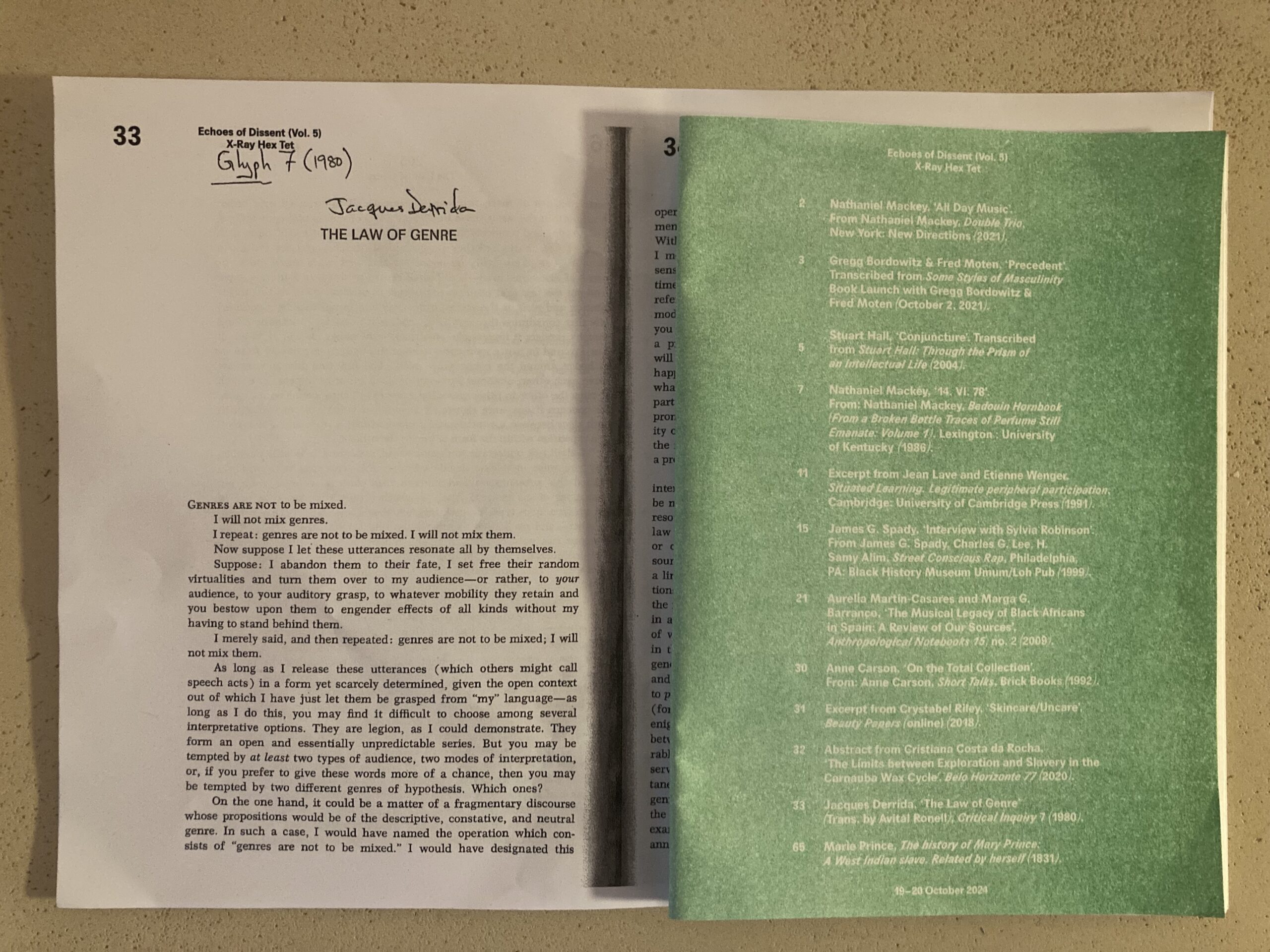
X-Ray Hex Tet Reader

For the programme Echoes of Dissent (Vol. 5) // X-Ray Hex Tet (19 – 20 October 2024, Les Ateliers Claus Brussels) and the research project Echoes of Dissent (KASK & Conservatory / School of Arts Gent), we compiled a reader.
Reader compiled by X-Ray Hex Tet. Edited by Stoffel Debuysere. Design by Ran de Vos (In Vitro). In collaboration with Les Ateliers Claus, Courtisane, Auguste Orts and In Vitro, with the support of VGC (Vlaamse Gemeenschapscommissie) and Q-O2. 
This reader was offered to participants. Please mail me if you want me to send a (digital) copy.

CONTENT

1. Nathaniel Mackey, ‘All Day Music’. From Nathaniel Mackey, Double Trio, New York: New Directions (2021).
2. Gregg Bordowitz & Fred Moten, ‘Precedent’. Transcribed from Some Styles of Masculinity Book Launch with Gregg Bordowitz & Fred Moten (October 2, 2021). https://www.youtube.com/watch?v=udCjZGTEwkw&t=788s (13’08-18’17).
3. Stuart Hall, ‘Conjuncture’. Transcribed from Stuart Hall: Through the Prism of an Intellectual Life (2004). https://www.youtube.com/watch?v=jY4Ve_r1PHU (media foundation transcription).
4. Nathaniel Mackey, ’14. VI. 78’. From: Nathaniel Mackey, Bedouin Hornbook (From a Broken Bottle Traces of Perfume Still Emanate: Volume 1), Lexington : University of Kentucky (1986).
5. Excerpt from Jean Lave and Etienne Wenger, Situated Learning. Legitimate peripheral participation, Cambridge: University of Cambridge Press (1991).
6. James G. Spady, ‘Interview with Sylvia Robinson’. From James G. Spady, Charles G. Lee, H. Samy Alim, Street Conscious Rap, Philadelphia, PA: Black History Museum Umum/Loh Pub (1999).
7. Aurelia Martín-Casares and Marga G. Barranco, ‘The Musical Legacy of Black Africans in Spain: A Review of Our Sources’, Anthropological Notebooks 15, no. 2 (2009).
8. Anne Carson, ‘On the Total Collection’. From: Anne Carson, Short Talks, Brick Books (1992).
9. Excerpt from Crystabel Riley, ‘Skincare/Uncare’, Beauty Papers (online) (2018).
10. Abstract from Cristiana Costa da Rocha, ‘The Limits between Exploration and Slavery in the Carnauba Wax Cycle’, Belo Horizonte 77 (2020).
11. Jacques Derrida, ‘The Law of Genre’ (Trans. by Avital Ronell), Critical Inquiry 7 (1980).
12. Marie Prince, The history of Mary Prince: A West Indian slave. Related by herself (1831)