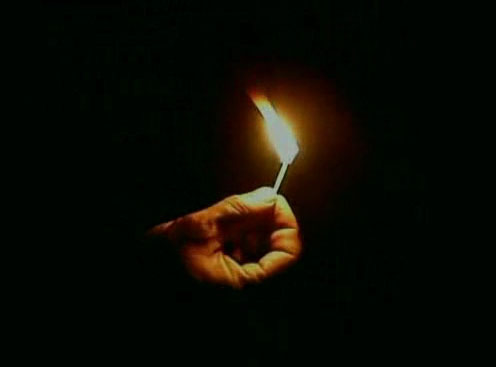
“The daytime to me is about total disappearance, because there is an even light that floods everything out, but at nighttime one can light and spot light. So I see the nighttime as being where I can kind of come into my own, and the daytime is about my absence.”
Jack Goldstein in ‘Wir Männer die Technik so Lieben’ (Stefaan Decostere, 1985)
Jean Fisher about Goldstein:
– To see is that sense of loss, of an appearing disappearance, that is always behind –
“If Goldstein’s spectacle holds us in a thrall that seems both disturbing and imperative, it is because the work’s function is to lay bare the image of the image with all the tyranny that it exerts upon us. Like the prisoners in Plato’s allegory of the cave, we are reluctant to tear our eyes away from our illusions, to break the spell of desire that captures us in its play of nocturnal shadows. Through all the manifestations of the spectacle – the masquerade, the carnivalesque, the cinematic – the immobilized, fascinated subject becomes, in the dark, other than himself. There our fear of the body’s temporality and physicality recedes into forgetfulness, and we can spin our dreams of immortality. To go into the light is to risk the blindness of the absolute insight of the gods.
Such is the paradox of the sublime sensibility alluded to in Goldstein’s painted spectacles: an ecstatic vision of a transcendental self, and an abject self that contemplates the terror of its own effacement by powers beyond its comprehension. In 19thC American art, the sublime was expressed through a landscape of light and space, evoking immensity, silence, and the potentially catastrophic with a tragic theatricality that we find recurring in post-Modernism. For the late 20thC this ambivalence is expressed through the mediated, cinematic spectacle of technology, in the face of which the subject is both remote and anonymous, denied ‘spontaneity’. To image this Heideggerean dread, to use technology’s own devices is, for Goldstein, to exert a measure of ‘control’ over its effect. We may now begin to see the Promethean rather than literal dimension of the artist’s images of impending disasters, warplanes and ‘burning cities’, and their relationship to the cosmic energies described in the more recent paintings of lightning, volcanoes and eclipses.”
Here’s a fragment from ‘Wir Männer die Technik so Lieben’ with parts of interviews with Goldstein and Paul Virilio (see also here). If you’re interested in seeing or showing this (great) video, please contact Stefaan Decostere.
image: Jack Goldstein, Untitled, 1981 (Oil on masonite, 49 x 61 inches)
Here’s a wonderful scene from Abbas Kiarostami’s ‘ABC Africa’ (2001) – the first work he shot with DV, documenting Ugandan children orphaned by the successive disasters of civil war and AIDS – in which the image is wrapped in complete darkness. It is night, and the power has been turned off in the Ugandan city of Masaka, leaving the director and members of his small crew, who had been filming a cloud of mosquitoes, with no illumination. And for about five long minutes, we are also in the dark, listening to idle conversation (in Farsi) as the portable, battery-powered digital video camera keeps rolling. The dark spell ends with a few flashes of lightning briefly illuminating a tree waving in the wind outside the window. The scene doesn’t only call attention to the medium’s limitations (and its power) and to the artifice involved in even its simplest use, but also to the terror of the pitch black (African) night, filled with the unknown. Jonathan Rosenbaum wrote about this scene: “(Kiarostami’s) impressions come to the fore during a lengthy conversation with his assistant in the dark, and this scene evokes a sense of reality in Africa that otherwise would have been impossible to capture. … Creativity – his own joined with ours – winds up playing a role; the lighting of matches and the bursts of lightning and thunder that ultimately lead us out of the darkness are the essence of his art, flashes of illumination in the midst of total uncertainty.”
It’s worth pointing out that Alain Bergala believes this scene was staged, pointing out similar ideas in previous films. In ‘A Taste of Cherry’ (1997), there’s a moment towards the end when the main character lies in his grave at night, sporadically illuminated by ominous bursts of lightning. Adrian Martin wrote: “with its flashes of lightning in the blackout of night, with its sensurround rumbling of thunder, with its unbearably poignant mystery of whether this man will live or die, the scene takes us close to an absolute (and absolutely cinematic) experience of existential negation, more powerfully than any horror movie.”
Apparently, Kiarostami wanted to extend the intermittent darkness that he abandoned the audience in to seven minutes of unbroken black screen in ‘The Wind Will Carry Us’ (1999) but could not sustain it. What remains of this plan is the cow milking scene (the one in which the poem (by Forough Farrokhzad) is quoted that gave the film its title) in which the main character pays a visit to a young woman with the goal of buying some milk. He finds the woman in complete darkness, out of which she emerges with a gas lamp, which she holds down by her side to light the way.
In ‘ABC Africa’, Kiarostami did finally achieve his exercise in darkness.
“When the world of clear and articulate objects is abolished, our perceptual being, cut off from its world, evolves a spatiality without things. This is what happens in the night. Night is not an object for me; it enwraps me and infiltrates through all my senses, stifling my recollections and almost destroying my personal identity. I am no longer withdrawn into my perceptual look-out from which I watch the outlines of objects moving by at a distance. Night has no outlines; it is itself in contact with e and its unity is the mystical unity of the mana. Even shouts or a distant light people it only vaguely, and then it comes to life in its entirety; it is pure depth without foreground or background, without surfaces and without any distance seperating it from me. All space for the reflecting mind is sustained by thinking which relates its parts to each other, but in this case, the thinking starts nowhere.”
Maurice Merleau-Ponty, Phenomenology of Perception, 1945
“Night science, on the other other hand, wanders blindly. It hesitates, stumbles, falls back, sweats, wakes with a start. Doubting everything, it feels its way, questions itself… it is a workshop of the possible… hypotheses take the form of vague presentiments… thought proceeds along sinuous paths, tortuous streets… the mind frets in a labyrinth, deluged with messages.”
François Jacob, The Statue Within, 1987
“The night is not a black mass that stops our sight on the surface of our eyes; our look goes out into the night which is vast and boundless. The sense of sight can be taut and acute in the depths of the dark. The night is not a substance but an event; it pervades a space freed from barriers and horizons. It extends a duration which moves without breaking up into moments; night comes incessantly in a presence which does not mark a residue as past nor outline a different presence to come.”
Alphonso Lingis, The Imperative, 1998
“Throughout the course of the generations
men constructed the night.
At first she was blindness;
thorns raking bare feet,
fear of wolves.
We shall never know who forged the word
for the interval of shadow
dividing the two twilights;
we shall never know in what age it came to mean
the starry hours.
Others created the myth.
They made her the mother of the unruffled Fates
that spin our destiny,
they sacrificed black ewes to her, and the cock
who crows his own death.
The Chaldeans assigned to her twelve houses;
to Zeno, infinite words.
She took shape from Latin hexameters
and the terror of Pascal.
Luis de Leon saw in her the homeland
of his stricken soul.
Now we feel her to be inexhaustible
like an ancient wine
and no one can gaze on her without vertigo
and time has charged her with eternity.
And to think that she wouldn’t exist
except for those fragile instruments, the eyes.”
“- There is also another reversal, that of day and of night. Is there a link to be made between the day-night relationship and the night bombings of the Second World War and the idea of night as a black hole, in ‘Star Wars’ (the Strategic Defense Initiative)?
– There is much to be said here. It is certain that technological war allowed us to continue to make war at night, in other words, we’re performing theatre. Then, after that, in 1914, 1925, those same projectors were used to pick out the planes coming to bomb in order to shoot them down. So here we have a whole light-war; tracer-bullits wil be used to make night-time shooting possible, and flares to light up the troops’ night chargers (flare revolvers and rifles). And I myself saw those special effects in the Second World War. During the bombings of the city of Nantes I saw those projectors, those tracer-bullets, those rocket-parachutes tossed out of bombers to light up the bombing zone. It was a fabulous show of unheard and even tragic beauty. It was Rome burning. So it’s certain the use of new technologies extended war to the totality of time, not only as in the past wars in summer time, but also war in wintertime. In antiquity was was waged starting in march, and then stopped in September-October. The new technologies have allowed us to wage war year round. But up ntil 1914 no one made war at night, they stopped at nightfall. Now, with the new technologies, not only do they make war all the time, in all seasons, but non-stop, day and night. We have a totalising phenomenon that is also a phenomenon we experience daily with live broadcasts from the four corners of the earth, which allow us to watch a festival or ballgame. there is therefore a cancellation of the daytime.”
“For (Ernst) Jünger, there can be no war without photography. This is why the entirety of his writings on photography suggest the ways in which the German war of light and disaster illuminated the links between photographic technology and the techniques of modern warfare. While the English began equipping their bombers with photographic apparatuses, the German blitz flashed its death across the skies and landscape of Europe. Dividing night into night and day, it illumined the space of war. “What had taken place in the darkroom of Niepce and Daguerre,” Paul Virilio explains, “was now happening in the skies of England.” Indeed, we could even say that the blackout that was enforced during the blitz-the event that, according to historian Philip Ziegler, “impinged most forcibly on the life of the average Londonern-transformed the entirety of London into a kind of gigantic darkroom, into a massively photographic space. Like the camera flash that enables the emergence of an image, the Luftwaffe bombers dropped incendiaries both to trace the bombing area in London and to light up nocturnal targets. London became subject to the glare of explosives and the blinding light of the searchlights whose skyward beams traced a kind of luminous cat’s cradle in the night. To say that there could be no blitz (the word “blitz” was taken from Blitzkrieg, “lightning-war”, sd) without the production of images is to say that there could be no lightning war without the flash of the camera.”
“During the WW2 nocturnal Blackout procedures were tantamount to a policy of compulsory mass hyperacusis. Venturing outdoors at night, particularly the urban population, already hypersensitized by fear, found their hearing heightened still further by immersion in levels of darkness which were unprecedented since the introduction of street-lighting. The basic hypothesis here is that the experience of defensively listening, consciously and unconsciously, for the dull-thud of explosions, the whistle of rockets and bombs and the roar of planes is the mechanism by which such autonomic states encode, at a fundamental neurological level, as conditioned, reflexive responses to ambient low frequency sounds. These high states of arousal are necessarily those in which individuals are most receptive to sense-data. These responses are also culturally transmissible – primarily through the medium of cinema. It is worth noting that extreme sensitivity to sound (of the exact sort idealised by the composer John Cage) is not only a state of heightened esthetic awareness, but also a recognised medical condition, often associated with debilitating phonophobia and the onset of conditioned tinnitus – and during the war advertisements in Picture Post magazine suggest there was a roaring trade in sedatives, not only for people but also for household pets.”
Part three in an ongoing series of posts on musical appropriation (see also part 1 and 2), this time mostly consisting of a small selection of the numerous glitchy affairs, cut-ups, mash-ups etc. that have invaded, defined and excited various musical (sub)cultural movements since the end of the previous century (well, before the hype subsumed into the mainstream). These are some of the tracks that still catch my ear, in one way or another.
V/Vm, Lady In Red (Is Dancing With Meat) (with Chris De Burger), 2000
[audio:butcher01_01_vvm.mp3]
V/vm is one of the projects of James Kirby (aka the Caretaker, the Stranger, …). Since 1996 V/Vm has produced stuff on a bunch of labels (notably his own V/Vm Test label), often in collaboration with likeminded musicians ike Speedranch, Jansky Noise and Kid 606. Early releases were situated in the border zones of industrial, playful electronics and fierce individualism, littered with distorted digital noise and tuff beats. In the late 1990’s the V/Vm output saw a shift into the reworking (or butchering, if you will) of pop music – labeled as “bastard pop”. Songs by Robbie Williams, Spice Girls, East 17, Chris De Burgh, Elton John, Alphaville (V/vm’s version of ‘forever young’ was used in a never aired ad for Sony’s Playstation) and countless others – not to forget Aphex Twin, who got a special treatment – were reshaped and renewed. This approach culminated in 2000 with V/Vm achieving single of the week in the NME for this reworking of the Chris De Burgh hit ‘lady in red’ (on the B-side: ‘All Night Long (Butcher All Night)’ (with Loin-El Glitchie)). Though V/Vm “abused” copyright at this time initially no action was taken. Indeed V/Vm has often spoken about meeting Chris De Burgh in person at a TV Station and giving him a copy of his remixed version and surprisingly never hearing from De Burgh or his lawyers. In 2003 the lawyers caught up following the release of several versions of Frankie Goes To Hollywood’s hit ‘relax’ (commemorating its 20-year anniversary). Within weeks of the release V/Vm received legal threats and in the end was forced to legally withdraw the release from sale. Apparently, this forced V/Vm into “hiding” in Belgium, where he rediscovered New Beat, the ultima thule of late-80s dance music (find the releases ‘made in Belgium’ and ‘SABAM’). In 2006 V/Vm spent the whole of the year on his most ambitious and challenging project to date, the V/Vm 365 project. In the words of the man “The idea is basically to create and upload free audio for one whole year and leave a massive big mess behind, warts and all for you to digest as you see fit.” This involved producing 603 audio tracks, 6 video tracks, with a total running time of 52 hours, 3 minutes and 57 seconds, all of which are free to download (via CC licence).
Here’s another, pretty creepy, V/Vm reworking:
Kid606, Straight Outta Compton (MC DSP Mix), 2000
[audio:vvmt11_01_kid606.mp3]
Another classic, released as a 7″ on V/Vm Test Records. I kinda lost track of Kid 606 now, but this track still brings a huge grin to my face. Before he became “the hottest property on the electronic scene stuff”, with releases on the prestigious Mille Plateaux imprint, Kid606 (born Miguel Trost De Pedro) combined his love for industrial music and hip-hop with DIY electronic explorations and an explosive punk attitude, with an irreverent sense of humor thrown in the mix (song titles like ‘Luke Vibert Can Kiss My Indie-Punk Whiteboy Ass’ – itself a wink to Lesser’s 1999 track ‘Markus Popp Can Kiss My Redneck Ass’ – say it all), into some of the most exciting indiepunkgabberidmraverblastbashings of that time. Labeled “the Sid Vicious of Techno” and once named as one of the “100 Most Dangerous Men On Earth” (at number 93 – ahead of Bill Gates and Metallica drummer Lars Ulrich, and just behind former Cheers star Ted Danson), the kid with “a Tourette’s syndrome-like compulsion to deflate the pomposity of electronic music” has “has flouted copyright laws with more glee than anyone since Negativeland and The Bomb Squad” and “consistently sabotaged categorization of his work by remaining true to its core; his violence is against sound, against the sounds of comfort, against the sounds listeners expect.” This track sees Kid606 “drop NWA’s classic ‘Straight Outa Compton’ from the top of a multi-storey carpark and glue the bits together with numb fingers”. Also check out ‘The Action Packed Mentallist Brings You The Fucking Jams’ (2002), on which you hear him trainwrecking pieces of Eminem, the Buggles, the Bangles, A-Ha, Missy Elliot, Jay-Z, Radiohead and Kylie Minogue.
Alan Licht, The Old Victrola, 2001
[audio:Licht_The-Old-Victrola.mp3]
Well, maybe this track doesn’t belong in this list, but I like it so much it couldn’t leave it out. Alan Licht. You might know his work with Love child, Blue Humans, or Run-On, or his solo adventures on albums such as ‘Rabbi Sky’, ‘The Evan Dando of Noise?’ or ‘NY Minute’. You may want to check out his collaborations with Loren Connors, Lee Ranaldo or Aki Onda. You also might have read his critical writings, published in The Wire, Halana magazine or the book ‘Sound Art. Beyond Music, Between Categories’. Some of his writing has helped to create a resurgence of interest in minimalist music, especially thanks to his influential “Minimalist Top Ten,” a list of hard-to-find minimalist albums (see earlier post). His body of work is very much his own, influenced by his intense explorations of free jazz, pop music, minimalism and experimental cinema. This track, from the album ‘Plays Well’ begins with a reworking of Captain Beefheart’s “Well” (from ‘Trout Mask Replica’), drenched in guitar fuzz drone, and eventually dissolves into a hypnoticly looping of a Donna Summers sample (from a live version of “Dim All the Lights”), superimposed with layers of wailing guitars, gradually building the tension until the original disco song explodes in all its glory at the 16-minute mark. This part of the track was recorded live at the Transmissions Festival in July 2000, of which Bill Meyer in Signal to Noise said, “somewhere Andy Kaufman was smiling.” “It’s about recontextualizing”, said Licht. “I heard that song on the radio and immediately connected that section where she holds one note over several bars of changing harmony with similar sections in compositions by Reich and Glass. I knew I had something to work with.” Also great: ‘Twilight of the Idols,’ in which the audio levels of Led Zeppelin’s untitled fourth album are manipulated; “Bridget O’Riley,” a mashup of Blondie and The Who’s ‘We Won’t Get Fooled Again’ and ‘A New York Minute,’ consisting of a month’s worth of weather reports from a New York AM radio station, mixed with an addictive mix of some samples from Don Henley’s “New York Minute” (some of these pieces are available on ubu.com).
Girls on Top, I Wanna Dance With Numbers, 2001
[audio:whitney-vs-kraftwerk.mp3]
This is the single that essentially popularised the whole bootlegging/mashup craze, back in 2001. I still remember the excitement I felt when I heard this for the first time. Working under the name Girls On Top, Richard Philips aka Richard x released a limited 7″ featuring, on one side, the Whitney Houston-meets-Kraftwerk combiné ‘I Wanna Dance With Numbers’. “Whitney’s vocal floats over the proto-electro beats and looped synth pulses, creating a kind of euphoric techno-soul hybrid”. On the other, he placed his all-time favourite track, The Human League’s ‘Being Boiled’, beneath TLC’s ‘No Scrubs’, creating ‘Being Scrubbed’, turning an insouciant funky strut into a “menacingly apocalyptic goth-pop mantra” (NME). “It was kind of a little personal thing at the time”, said Richard. “I just thought, I could listen to this all day. It wasn’t about getting one over on the majors, it was a cheeky irreverence. It was the excitement of the two worlds colliding.” These fresh-sounding R&B anthems took swinging London by storm. Tastemakers raved about them – this was novel, not a novelty. For a month or so, with-it DJs played the tracks to death. A few months later, Girls On Top surfaced again for the second and final time (an all-girl rock group who’d been performing as Girls On Top for a while took umbrage at Richard’s use of ‘their’ name) with another 7″. The A-side was ‘We Don’t Give A Damn About Our Friends’, a version of which the Sugababes would later take to the top of the charts. The flip, ‘Warm Bitch’, married The Normal’s ‘Warm Leatherette’ to Missy Elliott’s ‘She’s A Bitch’. The Face noted at the time: “If talent borrows and genius steals, Girls On Top commits the perfect crime, every time.” Shortly after this, loads of copyright-snubbing mixes started appearing on file-sharing networks, and for a short while I guess there was the slight whiff of freshness about them, although hardly any of these gems still resonate today (then again, perhaps that’s not the point). It didn’t take long before the phenomenon was recuperated by the mainstream. The likes of Madonna, Cher and David Bowie started commissioning what ‘bootlegs’. Universal Records, who were looking to relaunch the Sugababes, contacted Richard X with a view to using his Numan/Adina Howard bootleg, with the girl trio replacing the latter’s vocals. He has now become a successful record producer, producing hit singles for artists including Sugababes, Kelis, and Rachel Stevens.
Cassetteboy, Fly Me To New York, 2002
[audio:Cassette_Boy-Fly_Me_To_New_York.mp3]
In 2002 The UK based duo Cassetteboy – Steve Warlin and Michael Bollen – published their debut album, titled The Parker Tapes. They claim it took them 7 years to finish. It contains about a hundred short tracks, including a cut up of various Jamie Oliver samples, proclaiming himself to be a ‘tosser’ and radical hilarious takes on songs like David Bowie’s ‘Space Oddity’, Stan Ridgeway’s ‘Camouflage’ and Lee Dorsey’s ‘Get Out My Life, Woman’. Other sample sources include The Fall, Doctor Who, Madonna, many television advertisements, Coronation Street, The Smiths, BBC News, and St Winifred’s School Choir, although cataloguing every sample used on the album is a near-impossible task. Casseteboy earned a lot of praise for their satires, which have become their most circulated works. One of their earlier singles, ‘Di & Dodi Do Die’, tore down Britain’s beloved Princess Diana. On this album they also mock ex-Prime Minister Tony Blair, twisting his words to say that the Labour Party will start slashing eleven-year-olds with a knife. The most notorious track is ‘Fly Me to New York’, a satirical political swipe at the 9/11 bombing, which includes Frank Sinatra’s voice cut up to create the dialog. As well as producing two albums of their own, Cassetteboy has appeared on an album with DJ Rubbish entitled Inside A Whale’s Cock Vol 1, which includes humorous cover versions of songs by Alanis Morissette and Jennifer Lopez (a skiffle cover of ‘Jenny from the block’), along with a parodical take on a song by The Streets.
If you enjoy Cassetteboy, you’ll probably dig these videos as well:
DJ Lance Lockarm, S’wash Ya Wart, (release date unknown, I’d say around 2002-2003)
[audio:Lockarm_Swashyawart.mp3]
Let’s face it, most of the output of ‘bastard pop’ and ‘bootleg’ stars like 2 many DJs, McSleazy, Soundhog, Go Home Productions or Party Ben didn’t or won’t stand the test of time. Perhaps they are not meant to – their versions are, after all, just part of a neverending process of musical/cultural mutation. Always in the moment, as a promise (or gift) to an uncertain future. This guy knows that all too well. “NO TRACKS HERE ARE FOR SALE FROM ME — IN ANY FORM — EVER!”, he writes on his website. He just uploads his stuff whenever he feels like it, and doesn’t ask anything in return. The gift economy in its purest form. This is one of his most accomplished tracks – a mash-up of songs by the Beasty Boys, My Bloody Valentine and Schoolly D. Sounds far fetched, doesn’t it? Well, just listen and find out just how much they have in common.
Evan Roth, Explicit Content Only (fragment), 2005
[audio:Fuck_Tha_Police_EDIT.mp3] Evan Roth (aka fi 5e) is an artist with interests in technology, tools of empowerment, open source, and popular culture. Roth’s work with graffiti, open source technology and public space led to him forming the Graffiti Research Lab with James Powderly in 2006. He frequently releases work under the name ‘fi 5e’ and enjoys spending his free time violating laws related to copyright and vandalism. “Explicit Content Only” is an album (first released as mp3s in 2005, rereleased on Vinyl in 2008) in which everything is removed except for the curse words. Side A is the ECO version of N.W.A.’s Straight Outta Compton, and side B is EAZY-E’s EAZY DUZ IT. All radio safe content has been removed from the original albums, leaving a condensed string of content deemed ‘explicit’ by the United States Federal Communications Commission. At the age of 10, Roth bought the Straight Outta Compton album because of his infatuation with curse words. At the age of 27, Roth created this reductive mash-up as a tribute to a piece of popular culture that has had a profound influence on his career path. Despite receiving a RIAA (Recording Industry Association of America) cease and desist notice, the album can still be download for free from evan-roth.com. The intellectual property concerns associated with the project highlight comparisons between the content censorship issues surrounding rap music in the 1980’s and censorship as a side effect of excessive use of copyright law today.
Del Nileppez (Thomas Dimuzio), Yawriats Ot Nevaeh, 2006
[audio:Dimuzio_Yawriats-Ot-Nevaeh.mp3]
Composer, sounddesigner and sampling aficionado Thomas Dimuzio has produced various sound libraries which have been utilized by television programs such as the ‘X-Files’, has done mastering work for the likes of Negativland, Wobbly/People Like Us/Matmos, and GG Allin and has been collaborating with the likes of Chris Cutler, Fred Frith, Matmos, Wobbly and DJ Qbert. For this piece he has taken Led Zeppelin’s ‘Stairway to Heaven’, reversed it, cut it up into quarter-notes and then reassembled it in forward order to retain the melody. Dimuzio claims that the resulting file contains exactly 666 regions (for years there’s been much debate whether the song was in fact a love letter to Satan when played backwards. Check it out for yourself – along with backward versions of Imagine, Another One Bites the Dust, Hotel California and the Pokemon Rap! – here). It’s certainly not the only reworking of the classic rock track – WFMU listed 101 versions – but I find this particular one very addictive. Since this piece has been published, there have been quite a bit of variations on the procédé. You can try it for yourself with the Meapsoft software.
This track also reminded me of Jeroen Offerman‘s hilarious video ‘The Stairway at St. Paul’s‘, in which he sang the song backwards in front of the Royal Albert Hall in London, reversed the tape and added a karaoke track (see below).