Putting the You in Tube

laric.gif

The Berlin-based Serbian artist Oliver Laric is part of a growing community of succesful (not in the least in the contemporary visual arts world) young creative producers (alongside people like Michael Bell-Smith, John Michael Boling and Cory Arcangel, to name just a few) who use digital forms to explore contemporary visual culture and how it is mediated through popular technologies. One of his most interesting projects is ’50 50′ (2007), in which he seamlessly strung together fifty YouTube clips of strangers singing three songs by hip hop artist 50 Cent. The video has received praise around the internet and the art world for its remix of both 50’s music and vernacular video culture. He has now made a recomprised version of the piece (’50 50 2008′) by using all new clips. “The mass availability of videos of people singing these three songs speaks both to the popular appeal of the music and of the act of performing for the home movie camera–thus deepening the initial resonance of Laric’s project” (Marisa Olson).For ‘Touch My Body’, Laric took Mariah Carey’s video for her hit single ‘Touch My Body’ and made a template for chroma-keyed remixes by YouTube users by digitally replacing the background images surrounding the starlet’s body with a flat green backdrop. “The music video begins like many classic pornos: Unwitting nerd rings doorbell, half-naked bombshell babe answers the door, contracted labor assignment is soon interrupted by a romantic interlude with a thumping soundtrack…The song is Carey’s foray into reaching out to the the geek set, and includes references to software upgrades, laser tag, and of course…YouTube! The video millions hits on the video-sharing site and, naturally, all of this makes the piece very attractive to an artist like Oliver Laric, who has a keen interest in digital culture and pop remixes. The artist’s newest piece is an edit of Carey’s video, with everything (the “compunerd,” the house, etc) but the singer masked out in green to encourage chroma-keyed remixes by online vi! ewers. Ironically, Carey’s lyrics speak not only to a mainstream paranoia about surveillance and privacy intrusions, but moreover drops hints about sharing footage online. She sings, “If there’s a camera up in here then it’s gonna leave with me when I do. If there’s a camera up in here then I best not catch this flick on YouTube.” Naturally, this is exactly what Laric is hoping will happen–and no doubt Carey herself. Fame is nothing if not a self-production and Laric’s taken this to heart in leaving the title of the video the same and modifying his YouTube video tags to attract more viewers. His real hope is not that the piece will become an artworld cause célèbre but that the larger public of YouTube surfers will adopt the piece and post remixes of their own. The key point made by removing the superfluous imagery from the video’s 3,000 frames is that, with her “come hither” gestures and the invitation “touch my body,” Carey’s certainly asking for it!” (Marisa Olson). You can a set of remixes watch on Laric’s site. Here’s his Green Screen version.

Also check out his other work, like Message The (2007), in which Laric slices up the video of Grandmaster Flash’s classic “The Message” into its individual words, then rearranges the lyrics in alphabetical sequence (a form of détournement that has been done by other artists as well, see Lenka Clayton’s fantastic Qaeda Quality Question Quickly Quickly Quiet) or (>’.’)>=O____l_*__O=<(‘.’<) (2008), based on thousands of tiny animated gifs that create an ultra-low-res illusion of cinematic movement, generating a barely discernible compilation of clips from a series of hip-hop music videos.

Tales of Mere Existence

simonscat2.jpg

While doing some research on “animation” for our upcoming film program Drawn To Life (more info later), I stumbled upon some great autobiographical-tinted animation series, which are distributed via the net (where these vignettes are phenomenally popular). One is Tales Of Mere Existence by LEV (or Levni R. Yilmaz Esq), a wonderful series of witty (live) hand-drawn self-observations. Taylor Jessen writes: Tales Of Mere Existence is not necessarily about interesting stories, It is what it’s title indicates, anecdotes about the gloriously mundane. Everyday stories told not by the Devil on your right shoulder or the Angel on your left, but the voice in the middle of your head that doubts himself, questions everything, and sometimes doesn’t let you get out of bed. An unseen narrator tells the stories in a monotone voice, while his doodled illustrations come together on the screen. The stories deal with issues such as Sex, identity, and social confusion and just about anything else you would have written in your journal in High School. “Tales Of Mere Existence” goes for laughs in fearless ways that shock you even as you nod your head in recognition”. Take a look on Lev’s website, where you can suscribe to his films and comics. You can watch most of his animations on his YouTube or MySpace pages.
Here are some of my favorites:

A second series is Simon’s Cat by Simon Tofield. As a cat lover I find these Flash animations not only highly recognisable but also simply irresistible. The delightful vignettes (three so far) “accurately depict and exaggerate the comical aspects of nature’s odd couples, humans and felines, living together — especially the parts about ‘FEED ME!'”. One of the episodes has recently won “Best Comedy” at the British Animation Awards. Check out Simon’s Cat on YouTube and Simon Tofield’s work on the website of Tandem Films.

Safe Distance

ac130gunship2.jpg

“For men at war, the function of the weapon is the function of the eye”
Paul Virilio

I’m currently reading a fairly interesting book entitled Witness, Memory, Representation and the Media in Question ( ed. Ulrik Ekman and Frederik Tygstrup, Copenhagen: Museum Tusculanum Press, 2008), based on the proceedings of a symposium held at the European Summer School in Cultural Studies, Copenhagen, August 25, 2004. One of the most striking essays is the one written by Mikkel Bruun Zangenberg, ‘Witnessing at War’. In it he comes up with the term ‘the belligerent gaze’ as “an umbrella-expression designating a diversity of perhaps internally heteregoneous modes of looking in and at warfare”. He focusses on two distinct events, World War I and the incidents in the Abu Ghraib prison, in order to explore the changes in modes and conditions of “witnessing”, referring to the writings of Erich Maria Remarque, Ernst Jünger, Primo Levi, and others. All these authors seem to agree on the “peculiarly aporetic nature of witnessing and trauma: be it in the form of blindness and insight, of a non-coincidence between fact and truth, of the detrimenal and coercive contamination of all on the inside as well as the outside, or of the bleak curse and guilt of the inauthentic survivor.” What is rejected is the ’emperical’ notion of the witness as someone who ‘saw it with his of her own eyes’. Zangenberg’s claim is that the condition of witnessing is evaded and destroyed, circumvented or paralysed. In WWI soldiers were ‘derealized’, turned into some form of ghost – or else, appearing as pilots (see Virilio’s War and Cinema: The Logistics of Perception), in which case their sight is reduced to an exclusively streategic and destructive gaze – they see victims, but never witnesses their obliteration. 90 years later, in the Abu Ghraib case, the conditions of witnessing are perverted and caricatured by the degrading videos of humiliated prisoners. Or the deceased civilians are not seen at all, they literally become invisible (see Judith Butler’s Precarious Life: The Powers of Mourning and Violence).

Zangenberg considers the erosion of these modes and conditions, leading to “the obliteration of witnessing”, in part due to the contemporary role played by media and the proliferation of digital imagery. He refers to the ideas of Virilio, who writes about the dehumanizing, automated appearance of surveillance and seeing in the 20th century warfare and proposes that the emergence of unmanned planes and missiles (“intelligent weapons”) inaugurated the virtual dissapearance of witnessing. In War and Cinema Virilio quotes W.J. Perry, a former US Under-secretary of State for Defense, as saying “once you can see the target, you can expect to destroy it”. Virilio adds: “For men at war, the function of the weapon is the function of the eye””. “Obviously”, Zannenberg writes, “this circumstance is intensified when there is only a machinic eye casting a belligerent, neutral and automated glance at an infrared shape representing a human body” (see Manuel de Landa’s War in the Age of Intelligent Machines). The new kind of automated images have suggested a new surgical precision of warfare. War is the subject of these images, but it is also a means of creating subjects, visual subjects. In the Gulf War strategy, the agency belongs to the “West” seen from the point of view of the weapons themselves. Pictures were transmitted showing their “view” of their targets right up until the moment of impact (see Nicholas Mirzoeff’ Watching Babylon: The War in Iraq and Global Visual Culture). In these shots – according to a theory put forward by the philosopher Klaus Theweleit- bomb and reporter are identical.

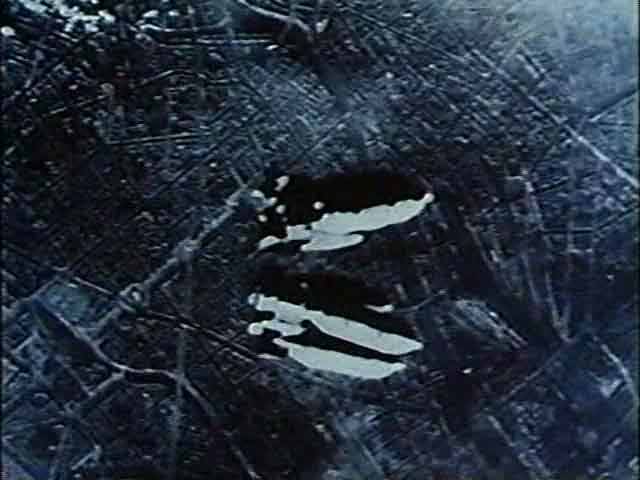
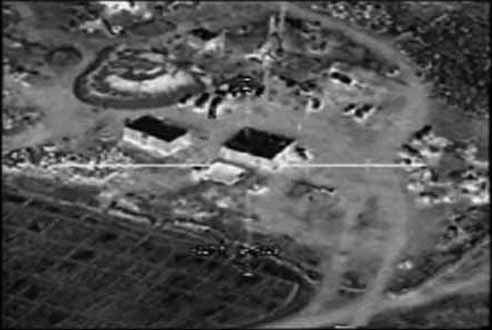
For example, these images were taken in 2002, when about 2.000 troops from the US led military coalition were engaged in close in combat with small pockets of suspected al Qaeda and Taliban fighters in the rugged terrain of northeastern Afghanistan, as part of an operation called Operation Acaconda…. This footage was filmed from US gunship helicopters that were part of this mission. At the same time these pictures show the distance between the pilot and the battlefield. (Found in OVNI’s Babylon Archives. Fragments of these shots were appropriated by Dominic Angerame – in Anaconda Targets – and Christoph Büchel – in AC-130 Gunship Targeting Video (Afghanistan 12/6/2002)).

The images below were recorded during NATO air strikes against former Yugoslavia. There were 4 US AIR Force airplanes flying from a NATO-base in Italy to a destination in Yugoslavia. Mission objective was to bomb several targets in the area around the city of Novi Sad. On the way back, after the mission was completed, one of the planes was shot. This tape was found near the crashed plane in the Fruska Gora mountains in the Srem region. It shows the electronic cockpit with basic graphical interface and voice communication between the pilots. This videotape is a regular flight document used by command structures to analyze its efficiency and success after very mission. It presents the last moments before the plane crashed. The blue image signifies the end for the pilot: no image, no place, no reality. (Found on Kuda.org)

The loss of the ‘genuine picture’ means the eye no longer has a role as historical witness. It has been said that what was brought into play in the Gulf War was not new weaponry but rather a new policy on images. In this way the basis for electronic warfare was created. Today, kilo tonnage and penetration are less important than the so-called C3I cycle, which has come to encircle our world. C3I refers to “Command, Control, Communications and Intelligence” and means global and tactical early warning systems, area surveillance through seismic, acoustic and radar sensors, radio direction sounding, monitoring opponents’ communications, as well as the use of jamming to suppress all these techniques.
Harun Farocki explores these issues in many of his films and installations. In War at a Distance (2003) he focusses on how, since the first Gulf War, it has virtually impossible to distinguish between real pictures and those generated on a computer. The image is no longer used only as testimony, but also as an indispensable link in a process of production and destruction. In Bilder der Welt und Inschrift des Krieges (1989) he researches the interconnection – and at times, disjunction – between cognition and recognition in Images of the World and the Inscription of War. The film is based on an event which took place in 1944, when an Allied aircraft took topographic photographs of Auschwitz during a routine surveillance operation for power plants, munitions factories, chemical plants, and any other industrial complexes that could potentially serve as bombing targets that, in the military’s myopic search for these high collateral targets that would cripple the German war machine, failed to recognize that they had actually taken an aerial survey of the layout of the Auschwitz concentration camp – an explicitly detailed, but mentally unregistered discovery for which the implicit meaning would not be realized until decades later, long after the tragic reality of the Nazi death camps had been exposed. Investigates this conceptual image of a “blind spot” and the binding of the gaze, the film illustrates the conceptual introduction of quantifying images measured from a “safe” distance into discrete elements that can be uniquely identified or accurately reproduced remotely into scale models and detailed simulations. Christa Blümlinger wrote about the film: “one’s thoughts are not free when machines, in league with science and the military, dictate what is to be investigated. This is the essence of media violence, of Paul Virilio’s ‘terrorist aesthetic’ of optic stimulation, which today appears on control panels as well as on television, with its goal of making the observer either an accomplice or a potential victim, as in times of war”.

imagesoftheworld12cd.jpg

For Zangenberg this concerns the duress of being the subject of the belligerent gaze. He writes: “I contend that the one who cast the belligerent gaze, the one who is the subject and master of that gaze, is barred from ever becoming a witness; he may well ‘see everything’, but since he is always at a safe distance, and since he is the one who produces death, he cannot properly turn into a witness. Being the object of the belligerent gaze, on the other hand, is a position of passivity, vulnerability, fear, horror, and suffering, if not being exposed to the numbing effect of alienation and derealization. Either way, war is engaged in a constant process of un-witnessing.”

Abuse of Power

horse.jpg

Just got this message from Emily Foreman via Brian Holmes. “This material from Emily Foreman is important to get out. Despite the good news from the polls we are still living under the boot here in the USA. Poor people’s lives get wasted in the war, and when they try to participate in the democracy they were supposed to be fighting for they get their skull crushed by the police. When is this gonna stop?- BH”

Hello All-

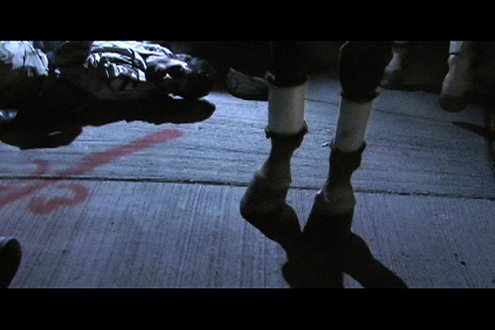
I just wanted to draw your attention to this video, particularly these video stills, that i shot during the Iraq Veterans Against the War protest at the final U.S. presidential debates, last Wednesday, in Long Island, NY. The video is extremely disturbing and clearly shows Iraq War Veteran Nick Morgan at the moment when his head was crushed to the sidewalk under a police horse. This story has been completely ignored in the media. He was legally, peacefully and standing on the sidewalk when the event occurred.

The still images speak volumes to this moment in history, please look at them and please get them to people (journalists, activists, veterans) who can use them!

Last Wednesday October 15th 2008, former Army Sergeant Nick Morgan, a 24 year old veteran of the US war in Iraq, was nearly killed by riot police, his face crushed under a police horse, during a peaceful protest outside the final US presidential debates.

Morgan is a native of Annapolis, MD who spent four-years the US Army and one year in Iraq. He was a participant in the Winter Soldier hearings and is an active member of the Iraq Veterans Against the War (IVAW), a national organization of ‘Global War On Terror’ veterans who had come to the Presidential debates in Long Island, demanding that veterans’ concerns be heard during these nationally televised dialogues.

The IVAW had previously announced, sending a letter to CBS, that two veterans had prepared one question each for Obama and McCain, to be asked during the televised debate. They had also announced that if they didn’t receive a response by 7pm on the night of the debates, that those veterans would enter the debates anyway, in an attempt to be seen, if not actually have their voices heard.

On Wednesday, as the sun was going down, the veterans waited for a response with a crowd of civilian supporters. When no response came from CBS, Obama, or McCain by 7pm, they led a march peacefully to the gate of the debates. Seven veterans were arrested while attempting to enter the gate of the national debates.

Nassau county police immediately began pushing the crowd of media, veterans and supporters backwards and across the street, charging riot cops and horses into the tightly packed crowd. One officer, Officer Quagliano was seen by many witnesses to be driving his horse backwards, in circles and out of control, repeatedly antagonizing Nick Morgan and a group of Iraq War vets who were peacefully holding the front of the line. The IVAW veterans are committed to non-violence and committed to protecting ‘civilians’ that come out to support them. Video shows him swiping Morgan and veteran Carlos Harris with the head of his horse just a few minutes before trampling them on the ground.

After the crowd was divided in two and fully pushed back onto the sidewalk with nowhere to go, Officer Quagliano continued to run his horse into the crowd and in circles ON the sidewalk. Riot police on foot began pulling people from the tightly packed sidewalk and into the way of Quagliano’s out of control horse. At least three civilians and and three veterans were knocked to the ground and trampled in the undertow.

This video clearly shows the moment of impact as Officer Quagliano’s horse backs up and steps on Nick Morgan’s face. He immediately lost consciousness and his lower orbital was shattered in 3 places. After nearly being killed, suffering a concussion and bleeding profusely from the head, police actually refused to allow other soldiers and friends to give him medical attention and to protect him from Quagliano’s horse, still stomping inches from his body.

A police statement later claimed that quote “a ‘person’ may have been injured when their body came into contact with a horse.” While the event happened quickly and in the pitch black, the momentary flashes in the darkness reveal a different story.

Instead, Nick Morgan was flipped, tugged, and dragged by police, bruising and cutting his abdomen. He was pulled from the crowd, face wiped, and thrown in an arrest van with other arrested veterans.

Morgan, who already suffered from Post Traumatic Stress Disorder after his tour of duty in Iraq, was eventually taken to Nassau County hospital where he was handcuffed to a gurney, cat-scanned and given a prescription for antibiotics and Motrin. Ironically, Morgan and other members of Iraq Veterans Against the War had come to the October debates with the intention of asking candidates pointed questions about lack of care for veterans.

A few hours later he was taken to jail, chained to a bench for five hours, and given a November 10th court appearance ticket for a charge of disorderly conduct.

Multiple veterans and civilians were injured by horses. All were given insufficient medical attention at Nassau County hospital. Veteran Carlos Harris had his foot stepped on and was refused an X-ray at Nassau County. IVAW supporter Devra Shore actually heard her foot crack under the hooves a horse, and she too was denied any diagnosis in Nassau County.

Nick Morgan has nerve damage and his vision is still blurry. He underwent facial reconstructive surgery this morning to keep his crushed cheekbone from sinking into his face.

The reality is that American police nearly killed an American vet last week with immunity, and with complete silence from the media, as he peacefully exercised those ‘constitutional freedoms’ he was sworn to protect and was supposedly fighting for across the world. Anti-war Veterans like Nick Morgan have suffered a double betrayal, in Iraq and at home, and their voices deserve to be heard, if not by the presidential candidates, then by the American people themselves.

i witness
Iraq Veterans Against the War
IVAW media contact for Nick Morgan is – matthis(at)ivaw(dot)org
Video and video still requests – Emily Forman – multiplefronts(at)gmail(dot)com

Dust to Digital

blackmirror3.jpg

“What will future generations discover of our music, old busted hard drives?”
Aquarius Records review of ‘Victrola Favorites: Artifacts from Bygone Days’

Yesterday I went to a lecture of Ian Nagoski, musician and music obsessive tout court, who mainly talked about his work as anthologist of early recordings. He recently compiled Black Mirror: Reflections in Global Music, a selection of recordings culled from 78 rpm records that he’s collected throughout his life, all from purchases he’s made from flea markets, thrift stores, or private collections (he claims he spent about 125 dollars for all the recording represented on the disc). They range from a Cameroonian ensemble experimenting with the clavioline in the early 1950’s to the theme song of a Indian thriller flick from 1949, a Lao monk prayer recital from 1928 to a song by a 10 year old Swedish boy playing the zither. In the liner notes he writes about his own experience locating, discovering (not only the records but also the contextual info, which is the most adventurous part of the search), and falling in love with the music. “Compilations of this kind that I really admire the most – three come to mind immediately,” Nagoski said. “Pete Whelan’s Really! The Country Blues on OJL, the Harry Smith Anthology of American Folk Music, and Pat Conte’s Secret Museum of Mankind. Those are documents of a particular man’s obsessions and private sound world and he’s sharing this piece of it with you. So that was the point – this is the sound world that I have occupied. I didn’t make these myself, but this is my life, this is a manifestation of this behavior that causes these problems in my life and creates all this joy in my life, too.” The compilation is published on the Dust to Digital label, who also released Art of Field Recording Volume I: 50 Years of Traditional American Music (other Volumes are comin’ up), consisting of 4 CDs and a 96 Page Book documented by artists/archivists Art and Margo Rosenbaum, as well as Victrola Favorites: Artifacts from Bygone Days, compiled by Rob Millis and Jeffery Taylor (of Climax Golden Twins) from their collections of rare 78rpm records and visual ephemera. Millis (who also produced a few excellent compilations of field recordings via Sublime Frequencies, “a collective of explorers dedicated to acquiring and exposing obscure sights and sounds from modern and traditional urban and rural frontiers ” headed by Hisham Mayet and Alan Bishop of the band Sun City Girls) and Taylor’s interest began when they sampled some 78s in their own music. “We often used other people’s records in sound collages, and 78s seemed like a weirder, scratchier kind of record to be using. After a while, we realised there’s a lot of great music from this era, and we started to look at the records not just as something to sample from, but as beautiful objects in themselves.” The duo started to collect old Victrolas, and scoured hundreds of second-hand shops and jumble sales for records. They found that a well-established collectors’ market had already pushed up prices for jazz and blues 78s, but that, at that stage, country, hillbilly and other music from around the world remained affordable (eBay has now radically transformed this market, and even some of Millis’ acquisitions from Asia now go for $1,500 a pop). That Victrola Favorites has been a labour of love is instantly apparent from the package accompanying the music, which includes a cloth-bound 144-page book filled with gorgeous images of 78s, phonographs and other musical ephemera from the early 20th century. In his accompanying essay, Millis explains how their aim was to see the music “revealed but not deciphered” – that is, not to bombard the consumer with historical information, but merely to access the music and make it presentable to contemporary tastes.

“Pictures of a gone world”, that’s how Pat Conte, who curates the Secret Museum Of Mankind series, describes these transcriptions of ethnic music from 78rpm discs. They are all part of an expanding landscape of anthologies and reissues, which are for the most part products of obsessive record collectors, distributed by small independent labels (not coincidentally, in many cases the record geeks and labels are affiliated with record shops. Nagoski owns one, for that matter) or just free on the Web. One wonderful example is Jon Ward’s Excavated Shellac blog (one of the many “sharity” blogs out there), focusing on ethnic music on 78’s. Ward uploads a new disc every Monday and, as Steve Roden recently commented, “it is always stuff you would never hear anywhere else, nothing here on CD. This is the rarest of the rare and the best of the best”.
All these examples illustrate that archival practices are moving away from – or at least paralleling – the “formal” procedures of memory institutions and instead tend to go into “informal” areas of archiving and dissemination, triggered by subjective interests, by fans, geeks and ethousiasts, who just want to share their own experiences with the rest of the world (I wrote about this in an article titled ‘de tijd van loslaten‘, translated “time for letting go”). There’s an article in this month’s the Wire in which Simon Reynolds comments on this evolution. Taking Mutant Sounds as an example, he writes: “the impetus used to be: I have something that no one else has. But with the advent of sharity blogging that’s shifted to: I’ve just got hold of something no one else’s got. So I’m immediately going to make it available to EVERYBODY.” But Reynolds also points out that there might be a downside to all this. “Perhaps the real danger represented by the sharity scene is actually to music fans. The whole-album blogs – like the web in general, with its vast array of net radio stations, DJ mixes, official giveaways, etc – drastically exacerbates the conditions known as collector-itis whose symptons were recently identified by Johan Klugelberg as “constipation, indegestion, flatulence”. Writing in Old Rare New, an anthology of elegiac paeans to the record shop, he described how the music fan succumbs to “Falstaffian gluttony… eating at the biggest buffet, heaping and piling exotic foodstuffs not only from all around the globe, but spanning history, on your plate” and coating the intestines of one’s hard drive with “noxious build-up””. Touché.

UPDATE (Oct 24): Jon Ward ruminates a bit on the subject
(…) “There is more at work, however, than Reynolds’ assumption that music bloggers use their medium to simply brag about their rare finds and then immediately make them available to the entire world. I’m sure it’s true in many cases (like Mutant Sounds, which is the subject of that paragraph), but I am absolutely resolute in the fact that I use this medium as an exorcism for my own peculiar obsessions. There is no good goddamn reason to be a music collector – they’re a dime a dozen these days. Because being a music collector means that you’ve transcended simply being a lover of music, and moved on to a person who accumulates and obsesses. I am under no allusions that providing music here is some kind of noble act. No way, Ray. But in order to continue to justify this obsession, I must actually do something with it that rewards me somehow – and obviously that is sharing something personal with a listener/viewer.” (…)

btw: also check out the compilations on Honest Jon’s Records, especially ‘Sprigs of Time: 78’s From The EMI Archive’, a compilation drawn from a two-year stint trawling through EMI’s archive of some 150,000 78s recorded in all corners of the world between 1903 and 1957.