Figures of Dissent: John Akomfrah

akomfrah_john_1988_testament.jpg

21 November 2013 20:30, KASKcinema, Gent. A KASK lecture in collaboration with Courtisane.

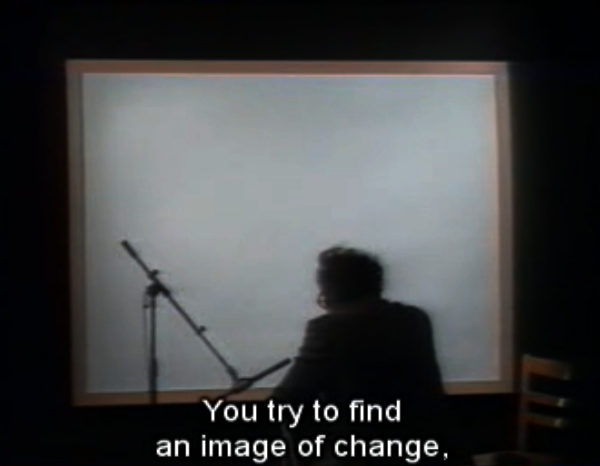
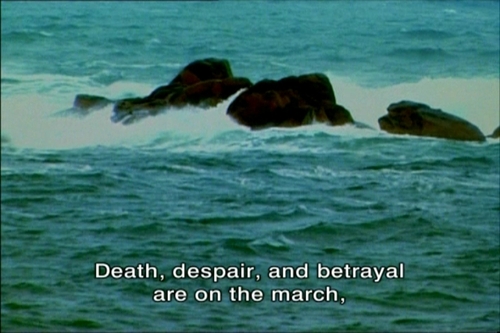
Black Audio Film Collective, Testament
1988, 16mm on video, color, English spoken, 80′

“I think necrophilia is at the heart of black filmmaking. I mean necrophilia not in a literal sense, but in a post-modern sense in which people are invoking figures, there is an act of feeding off the dead… It has to do with getting to the heart of something that is intangible, a memory of ourselves.”
– John Akomfrah

“If we loose the ruins, nothing will be left.” A quote from Zbigniew Herbert sets the tone for this post-colonial trauerspiel, composed as a journey through a “war zone of memories”, a wandering along the rivers of memory in search of the intangible realities of post-colonial trauma. It all begins with a crisis of unknowing, as the exiled Abena returns to Ghana to confront her past, only to find there is no more “home” to go to: the utopian dreams once longed for have been violently shattered, given over to loss and ruination. How to come to terms with a past that has been repressed, a place that has been dispossessed, a memory whose traces have been erased? Just like in his previous film, Handsworth Songs (at show on 20 November), John Akomfrah (then member of the Black Audio Film Collective) addresses the uncertainties of the colonial archive and their effects on the diasporic condition by creating a space of poetic reflection in which the irreconcilable gaps and fissures between history and myth, the imagined and the experienced – there where diasporic histories lie in wait – can be excavated. Responding to the challenge to propose a cinematic form in accordance with this sense of incertitude and absence, Akomfrah constructed a multilayered flow of fictional scenes and archival footage, tinted along the lines of the “colour temperature” that informs Tarkovsky’s Nostalghia, with filters corresponding to the colour symbolism in Ga society. For Akomfrah, whose parents were both political activists supporting Kwame Nkrumah’s pursuit of Pan-African Socialism, returning to Ghana was also a search for ”the emotional core that binds a person to a place;” and just like Abena’s perhaps, a quest to face the unknowing standing in the way of letting go. Only when the forgetting ends, mourning can begin.

in the presence of John Akomfrah. On 20 November he will also be presenting his film Handsworth Songs in Cinematek, Brussels. The visit of John Akomfrah has been made possible with the support of Brussels Arts Platform and VUB Doctoral School of Human Sciences.

In the context of the research project “Figures of Dissent (Cinema of Politics, Politics of Cinema)”
KASK / School of Arts

Rancière and Cinema

satanatango.jpg

How to get a grip on Jacques Rancière’s approach to cinema? Here’s a few pointers, as a modest attempt to put some of his thinking in perspective.

The look of Cinephilia

Where to start? For Rancière, cinema has been an object of interest on different moments of his life. His output ranges from his first interview in Cahiers du Cinéma in 1976 (on the notions of popular memory and the “fiction de gauche”), via his own series of writings for the same magazine between 1998 and 2001, to the publication of La Fable cinématographique (2001) and Les écarts du cinéma (2011). But his affection can be traced even further, going back to the 1960’s, when he was taken in by the wave of cinephilia churning in the Parisian ciné-clubs and Langlois’ Cinémathèque. As Rancière has recounted on numerous occasions, the cinephile passions not only exploded in the midst of the political upheavals that were spreading all over France and elsewhere, but also at the moment when the perception of art was shifting: with the arrival of what he has called the “aesthetic regime” the cultural hierarchies had been disrupted, and at that time the dominant modes of thinking and writing about art were being drastically revised. Cinephilia, as a movement of autodidactic “amateurs” and critics driven by a passionate love for cinema, radically dispensed with the categories of artistic modernity and the traditional hierarchical divisions between popular culture and high art. For them, the output of the European Nouvelle Vagues had no more or less value than the Hollywood products of filmmakers such as Walsh, Minnelli or Mann, or the Japanese cinema of Mizoguchi or Ozu. In completely overthrowing the regular system of legitimization, cinema was made into an art by its spectators themselves, not through a canonization process cultivated by academic or cultural institutions but by the critical appreciation of passionate enthusiasts devoid of any cultural legitimacy. The importance of this movement for Rancière can not be underestimated: by shifting their attention from either the purely plastic aspects of cinema (as celebrated by Jean Epstein and others) and the dramatic developments of the story lines (as advanced by Hollywood’s dream machine), to this strange interconnection between the affect of plots and stories and the splendor of images and sounds, between a recognizable social world and a mythological reign of shadows, the cinephiles pointed out the essential impurity of cinematic art. The cinephile look essentially consisted in taking in consideration the metamorphic power of moving images, the capacity of performing different roles and belonging to several possible worlds at the same time, constantly shifting from one sensible universe to another, as if each representation of a sensible world contained another sensible world. The vague concept of “mise-en-scène” might initially have been largely introduced to obfuscate the intrinsic heterogeneity of cinema, but perhaps, argues Rancière, it is on the contrary more interesting to tie it up with this metamorphic power. Rather than solely ascribing each film to a unique vision of the world, he then chooses to consider the cinematic experience as a perpetual negotiation between what is flickering on the screen and what is done with it.

The Emancipated Spectator

What can be done with cinema? Rancière has always situated himself in the position of amateur, which he considers to be a political and theoretical position, a way of dispensing with the authority of self-appointed specialists by reexamining the ways in which the borders of their domains intersect with the crossroads of experience and knowledge. In many ways, cinema is the domain of the amateur par excellence: it belongs to all those spectators, needless of any particular skillset or training, who are able to re-invent films at each viewing, mixing their own singular perceptions with fleeting memories and wandering dreams. Because cinema itself belongs to the reign of shadows: the spectral realities and fleeting forms on the screen can never be fully grasped, not in their singularity nor in their succession – they can only be sensed. Each viewing of a film constitutes a sensation of an aleatory, enigmatic apparition – which is perhaps what Godard meant when he said that cinema is not an art but a mystery – that takes form in front of our very eyes, and keeps on lingering in the theatre of our memory. It is up to us all to make sense of these forms of existence and set out our own adventurous path through the cinematic landscape, adding to cinema as a world of perceptions, affects and meanings, and keep on exploring it by continuously expanding its borders. The importance of cinephelia, even today, consists in reviving films through writing and talking about them, constantly negotiating between the films themselves and any existing mental images of those films. True, the access to cinema might have changed drastically in recent times, as has the notion of memory, but it can still be said that be cinema only acquires significance through what can be said and thought about it. We all see, feel, understand something in as much as we compose our own cinematic poem. Rancière considers this participatory role of the spectator as an important characteristic of the aesthetic regime of art: because the effect of the aesthetic can never be anticipated, it calls for spectators acting as active interpreters, rendering their own translation, appropriating the story for themselves, and ultimately crafting their own story out of it. This poetic labour of translation and counter-translation through the power of associating and dissociating – in the words of Joseph Jacotot: “learn something and relate everything else to it” – is at the heart of what Rancière calls “intellectual emancipation”, which always begins with challenging oppositions between active and passive, appearance and reality, viewing and knowing. Cinema, precisely because it is not an established language, because it escapes any systematic order of knowledge, as the living art of the democratic age, particularly lends itself to the method of emancipation: looking always also means acting.

Politics of Aesthetics

What does aesthetics mean? For Rancière the term does not refer to a certain idea of the beautiful or a category of art, nor does it align with a certain sensibility. Rather, it is a certain modality, or what Rancière calls a “distribution of the sensible”. This idea can be traced back to at least two texts that have framed the space of aesthetics: Immanuel Kant’s Critique of Judgment on one hand, Friedrich Schiller’s On the Aesthetic Education of Man on the other. In the first Kant defined the object of aesthetic judgment as neither an object of knowledge nor an object of desire; aesthetic apprehension, he argued, rather implied a disconnection from the habitual, socially determined conditions of sensible experience. In the political translation made by Schiller this neither/nor was interpreted as the dismissal of the opposition between those who know and those who desire, between Plato’s class of intelligence and class of sensation. To aesthetics then, corresponds a certain politics, which should not be understood, à la Benjamin, in terms of “the deduction of the aesthetic and political properties of a form of art from its technical properties”, but rather as a way in which aesthetic experience intervenes in the dominant distribution of the sensible that defines the world we live in: the way it is visible and understandable to us, and the capacities and incapacities that reveal themselves accordingly. This intervention takes the form of a neutralization of oppositions between capacities and classes, which can however not be equated with pacification: on the contrary, it stages a certain excess, bringing about a more radical way of considering antagonisms. This is what Rancière calls “dissensus”, meaning a disturbance of the normalized relation between sense and sense, between sensation and signification. In this way, the aesthetic paradigm radically breaks with Aristotle’s representative model: an art work no longer simply makes recognizable, by its resemblance, something that exists outside of it, nor does it correspond to a functional or narrative arrangement of actions in keeping with causes and effects, or means and ends. Not only the logic of representational mediation is ruined, but also that of ethical immediacy, according to which there is a certain continuity between the texture of an artistic work and its efficiency, between the performance of living bodies and its effect on other bodies: art fuses with life, politics and aesthetics vanish together in Ethics. Against all that, according to Rancière, It is precisely the art of mise-en-scène that embodies the whole logic of the aesthetic regime, the way in which the representational and ethical models are doubled, thwarted and overturned by the powers of disconnection and substraction, by means of visual reframings or aberrant, atopic wanderings imposed by characters. “The aesthetic work”, he writes, “has taken the place of the work that would achieve either the law of its medium or the law of pure sensation.”

Cinematic Fables

Is cinema an aesthetic art? It is, but not only. The characteristics of this regime of art – identity of active and passive, elevation of anyone and everything to the dignity of art, a kind of de-figuration that extracts a tragedy in suspense from the dramatic action – are indeed the properties Epstein once attributed to cinema. But it wasn’t for long before the dream of a “cinegraphic art” as the pure writing of light and movement was hijacked by the doctrines of the dream machine, restoring it to the rules of the representational mode. Since then cinema is caught in the tension between the representative and the aesthetic logics. This is where Rancière brings in the idea of the “fable”, as a way to think about this constant ambivalent play of exchanges between the two: between the illustration of a story and its suspension, between the verisimilitude of action and the aimlessness of life, between the fable in the Aristotelian sense, as a dramatic and coherent progression of actions in which the intelligible is contained in the sensible, and the cinema dreamed up by Epstein, as a continuous movement made up of an infinity of micro-movements, in which the sensible and the intelligible remain undistinguished. These two modes are normally used in a complementary way in order to provide a double testimony to the logic of the action and the effect of the real, in a continuous game between effects of recognition and of revelation. But Rancière is more interested in works that open up these gaps and renegotiate their distances and proximities, something that he sees as already present in the most classical of cinematographic forms – in the films of Anthony Mann or Nicolas Ray, for example – but that he today mainly seems to encounter in documentary films. These have the advantage of not having to attest to the real, of not having to create the “as if” of the real of fiction: conversely, when the real is supposedly given, its problem can be invented, allowing more radical experiments with the variable game between action and life, significance and insignificance. They can be made into “fictions of the real”, as Rancière has called them, referring to works by Chris Marker, Claude Lanzmann and Jean-Luc Godard, which he considers to be “new forms of fiction of the aesthetic age”, able to “deploy better than all illustrators of made up stories the polyvalence of images and signs, the potential difference between values of expression – between the image that speaks and the one that silences, between the speech that conjures up an image and the one that is simply enigmatic.” But these new forms of fiction can also be found in the work of Takeshi Kitano, Abbas Kiarostami or Bela Tarr, filmmakers who have been conducting singular explorations of the divide between a cinema of artificial appearance and one of unblemished presence, between an art of movement and one of contemplation. These are filmmakers who are rerouting the roads paved by cinematic traditions towards new horizons, overturning the genres and logics of cinematographic art, and offering resistance to the dominating modes of visibility and the normalized relations between what is seen, heard and understood. In contrast to the tendency bemoaning the end of cinema, Rancière persists in defending the capacity of cinema to reinvent itself, swimming against the tide of consensus. As the title of one of his pieces states: “And cinema continues”.

Wisdom of the surface

Cinema continues, but where to? It has to be said here that Rancière’s approach to cinema owes a lot to his love for literature, especially for the work of authors such as Mallarmé, Conrad, Rilke and Flaubert, which can be considered as emblematic of the art of the aesthetic age. It is in the attention they assign to the molecular equality of micro-events – of which he observed consonant sensibilities during his research in worker’s archives – that Rancière has found the model for his consideration of possible transformations in the landscape of the sensible. In the work of these authors the equality of all subject matter, of everything that comes to pass on the surface, available for everyone to see, hear and sense, negates any relationship of necessity between a determined form and a determined content. Everything speaks: speech is bestowed on all the things of the world, a “mute” speech that no longer aims to instruct or persuade, but that communicates sheer intensity without rhyme or reason. As if the sensible becomes foreign to itself, extricated from its ordinary connections, freed from the empire of meanings. In this way the “splendor of the insignificant” dismantles all the hierarchies that are characteristic of the representative logic, between the distinctive and indistinctive, proper and improper, poetic and prosaic. It is this “indifference” that Rancière also holds dear in cinema: “the adventures of matter lurking beneath the subjects of figuration, the glimmer of the epiphany and the splendor of pure reasonless being glowing just beneath the conflict of wills”. Everywhere, he claims, thought is at work in the very inertia of things. He has called it the “wisdom of the surface”, a term he has used to question the dominant paradigms surrounding the relation between politics and cinema. The surface, he argues, can no longer be considered as something to look behind or beyond in search for the secret depths of truth (Marxist critical tradition), nor is it the superficial space where the image converges with its own lie (Debord / Baudrillard): rather, the surface is a certain distribution of the sensible, a place where a process of transformation can occur that changes the coordinates of the given. Cinema, he writes, “has to consent to be nothing but the surface where the experience of those who have been relegated to the margins of economical circulations and social trajectories, can be organized in new figures.” The political potential of cinema then lies in singular inventions of figures of condensation: figures at the same time given as shimmering shadows and as recognizable characters, figures that can stand in front of their destiny and receive a new power from the glimmering of light and color, the resonance of speech and rhythm, the wanderings of bodies and gazes. It is a politics of aesthetics that Rancière distinguishes in the work of filmmakers such as Pedro Costa and Sylvain George, which does not propose strategies of radical subversion or dialectical demonstration, but rather a poetics of small ruptures in the texture of the sensible; which does not consist of denouncing a certain situation of injustice, but of bringing about the capacity of those who are living through that situation; which does not search for some kind of synthesis of the materialism of their mise-en-scene and the historical materialism of Marxism, but for a sensible materiality of concrete forms, words and bodies that is in concordance with the capacity of anyone and everyone. Their poetics does not assume a determined link between cause and effect, or an efficient bond between revelation and mobilization, it suggests another kind of “efficiency”, one that sidesteps the dilemma of representational mediation and ethical immediacy and has to content itself with a loss of destination, inviting us to reframe the cartography of the perceptible, the thinkable and the feasible. Perhaps this is where the singular power of Rancière’s work on cinema lies: in making us rethink the conjunction of mute speech and organized actions, and renounce the traditional borders between document and fiction, “political” film and “pure” cinema, cinema and the other arts, we are encouraged to explore new roads and forays through the cinematic landscape, rendering a necessary fresh outlook on the coordinates of the possible.
Some Notes on POV

camera-pictures.jpg

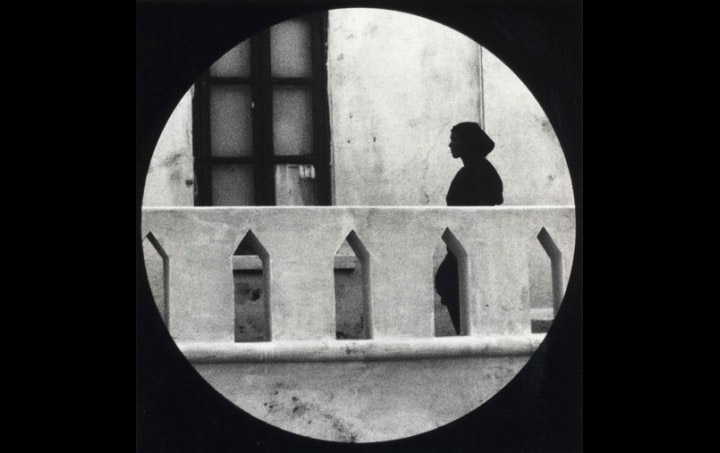
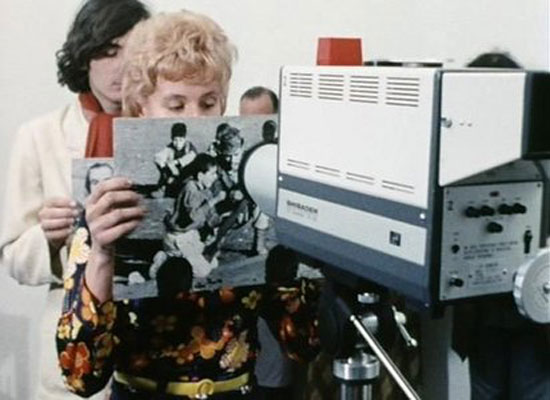
“Know that today’s struggle not only relates to the choice of subject, but also to the point of view” wrote Serge Daney in 1974. What is this notion of “point of view” which seemed to be so central to the film critical discourse of that time? And what has become of it? Daney’s statement is part of a piece in which he tried to redefine the “critical function” of the Cahiers du Cinéma, after having failed to set up a Marxist-Leninist inspired “Revolutionary Cultural Front”. It was the realization that the Cahiers of 1972-1973, this short period when radical politics was the order of the day, had not provided any effective support to the ongoing struggles, that led to a reexamination of the question: “how can we intervene?”. The answer, for Daney and his peers, was to delve deep into the relation between theory and practice, or, to use their favored concepts, between “énoncé” (the enounced statement) and “énonciation” (the enunciation). How could this relation be thought of, both for films in which the first predominated (in traditional television documentaries, for example) and those in which the latter prevailed (particularly in the so-called “films d’auteur”)? Going beyond the typical militant content-based criticism, which mainly consisted in assessing the truth or falsety of given statements, implied rethinking the esthetical dimension, not as something automatically derived from the political (as had been the case the years before), nor as something equivalent to it (as it had been for the first generation of Cahiers writers, for whom “form was never neutral”), but as something “secondary”. The question of the “point of view” then involved a concrete examination of how a political worldview could be conveyed through a chosen cinematic presentation. Against the suppositions surrounding militant cinema, all too often considered as a pretext for debate and cognizance, form once again became something to reckon with.

For quite a while the main concern for the Cahiers du Cinéma was the mise-en aspect of mise-en–scene, which was assumed to be largely obscured by the consistency of the scene. For Pascal Bonitzer, this meant that more attention had to be given to what happens “off-screen”: the blind spot where the power of the invisible lies, or to use Althusser’s expression, “the internal shadows of exclusion.” According to Bonitzer, criticism could not only be a matter of making sense of denotations (what is evident, immediate and functional in the cinematic image), the main challenge was rather to uncover the underlying (often ideological) connotations: “Criticism consists in adding meaning, in exhibiting a latent content, revealing overdeterminations [surdéterminations]: in enunciating – in order to bear judgment on it – what the object of criticism eludes, disavows or half-says.” Or as Daney has written, inspired by Barthes: “every film is a palimpsest.” This implied that one had to look beyond the self-sufficient integrity of denotations (they always loathed the idea of naturalism at Cahiers – as they would say: “the represented is not the real”, and the other way around) and take in consideration the surplus-meaning [un plus de sens] or left-over meaning [un restee de sens]. With this assertion Bonitzer explicitally took position against the legacy of the previous Cahiers generation, who had based their notion of “politique des auteurs” precisely on the rectitude of denotation. What had happened then with denotation? “It ages, fades, changes. What do we see today in the same Hollywood films? Connotations. John Wayne no longer ‘denotes”, he ‘connotes’.” Cleary, in the face of political contestations and in line with the new critical theory of the time (from Lacan to Barthes, from Bataille to Foucault via Althusser), film criticism had to take on another function: it could no longer innocently ponder the surface of cinematic worlds, it had to pierce through it, uncover its veil and reveal the workings of the real world. Always a secret beyond the door.

Not that the “politique des auteurs” was dead and buried. For Daney, by thinking of criticism solely in terms of connotation and denotation, something essential was left out: “By seeing in the iconic content of the image only what can be passed – or decanted – from the realm of connotation to the realm of denotation, one leaves aside the simple fact that in the present of the film projection something (but what?) functions as an instance that says ‘Here it is’ (Voici). Something, someone, a voice, an apparatus gives us something to see.” Here Daney draws heavily from Christian Metz’ Essais sur la signification, in which he pointed out that a shot of a gun would have to be “translated” as “voici, here is a gun”. With this indication the attention is shifted to the subject of enunciation, which is not the same as the subject of the statement. It means there is always a point of view that prevents a cinematic presentation to be reduced to a simple statement (or, in Metz’ logic, to a single word). The question of enunciation is then: who or what is this hidden instance, this voice silently saying ‘here it is’, this “little machine wound up to repeat the Lacanian phrase: ‘You want to look? Well, look at this’”? It is a question that is always connected to one of power: “as long as an image is alive, as long as it has an impact (ideologically dangerous or useful), as long as it hails an audience and gives pleasure, that means that in this image, around it, behind it, something that partakes of enonciation is at work (power + event = ‘Here it is’).” For some time this question of power – Who wants and allows this image? Who does it serve? – was lightly to be answered with “the bourgeoisie”: those who were not only supposed to have the monopoly on images of reality, but also on the pre-existing mise-en-scene of this reality. In line with the Althusserian idea of ideology as a system of representations, reality was considered as always already coded, and the challenge for any filmmaker was to look for a new mise-en scene, a new “point of view”, not to reproduce or naturalize reality but to construct one anew: “realism must always be overcome”.

After the mid 1970’s, when the dreams of many turned out to be shattered, the problematics of the “point of view” persisted, provided that it became once again a question of morality. André Bazin was back in the game, as if he had never been gone. And so was the “author”, with a vengeance: it was no longer what happend on the screen that mattered, as much as what could be recognized as the maker’s intentions. Subsequently, the old denotation-connotation scheme, which had come in handy to decipher over-coded ideological vehicles, no longer was of much use. It was no longer a matter of determining the power in or behind the image, but rather of negotiating the power inherent in the relation between those filming and those being filmed (after all, before it is given to see, an image is taken). The search for a position became one of speaking from the right place, of not speaking in the place of others. It is this problematics that Godard has pushed to its limits in Ici et Ailleurs, which is essentially a film about the act of restitution, about the impossible attempt to return images to those they have been taken of/from. This problematics is also at the heart of the films of Johan Van der Keuken, who has consciously kept on looking for the “wrong place”, for situations in which the “unequal exchange” implicit in any filmic contract, was most tangible. Van der Keuken not only tried to confront the unequal exchange between those taking images and those whose images are taken, but also between two ways of being “too much”: the structural, scandalous excess of the dispossessed, and the individual, contingent surplus of the filmmaker. In contrast to Godard, whose feeling is one of overwhelming guilt, Van der Keuken’s was rather one of shame: shame of being somewhere without a particular reason, shame to disturb those who are there without exactly knowing why. Alain Bergala once wrote that VDK’s practice had “less to do with the famous instant of decision than with a state of indecision.” Taking images, for him, was first of all an arbitrary act, determined by the contingency of his position, more than by the prominence of a subject or an instant. This indecision is balanced by continuously re-adjusting the frame, capturing the subjects in their own disadjustment. It stems from an awareness of the impossibility of capturing everything in the image of others: it always contains too much or too little for sense and presence to concincide. The image always resists, Daney said, the little of the real it contains doesn’t let itself be reduced to the cause it serves or the statements it holds. What can be done, as JVK did, is to make this inability visible: continually framing, never enclosing.

The question of inequal exhange is not about having a good or bad conscience in the face of the misery of the world, it is about showing respect in regards to pain and injustice. Between compassionate representation and estheticising indifferentism, wrote Jacques Rancière, “one has to establish the right interval, to put the right distance in the frame, one that stresses the dimensions of injustice and preserves the civility of pain. The image has to be right in the representation of this injustice that is hidden and this pain that is silent.” The immensity of injustice should not be enclosed in compassionate images, the pain of others should not be used as a mirror: one has to find a intermediary distance “where the image doesn’t promise too much beyond what it can maintain or doesn’t take too much beyond what it can return.” The ethical respect for pain and injustice becomes an esthetical search for the right distance, for a frame that is at the same time fitting and unfitting, adjusted and maladjusted to its subjects. It is always the ethics of the point of view that is at stake, or what JM Straub has referred to as einstellung: “Each image is a frame, and each frame is what the Germans call an Einstellung: which means one has to know how to situate oneself in regards to what is shown, at which distance, and at which distance of refusal and fraternity… It is a point of view on the world, touching upon moral and political opinions. One has to know how to einstell in relation to what one films and what one will show. If not one is just an irresponsable artist.” This ethics not only applies to militant or ethnographic film, as one would think; as Godard and others have persistently tried to tell us, it concerns the very act of filming itself. What else could his famous doxa “a tracking shot is a matter of morality” – later taken up by Daney in his ‘tracking Shot in Kapo’ – mean than the idea that one should never put oneself – filmmaker as well as spectator – where one doesn’t belong. The question today is if cinema can still entertain the issue of “point of view”, in a time when morality is all too often mistaken for moralizing, when faithfulness all too often serves as surrogate for respect, and the art of showing is all too often taken for an act of displaying.

Image of Change

godard-change.png

How to find an image of change? It’s a question Godard brought up three decades ago. More pressingly, how to think of an image of change when change itself cannot be imagined? It’s a question in line with the perceived impasse of our consensual times. If words such as “revolution” and “dialectics” are indeed the remnants of old ways of thinking politics, if names such as “worker” and “proletariat” have indeed lost all meaning, implying a termination of the politics bound to these names, how can we even start to consider what change might actually mean in this instance? If the word “change” itself has been emptied of all revolutionary meaning, smothered in slogans such as “Change we can believe in”, “Le changement, c’est maintenant!” (Change is now) or “Veranderen om te verbeteren” (Change to improve), how can it still be used to invent another future? If, as anyone with the slightest sympathy for Marxist beliefs or convictions would tell you, transformation of society should be our prime concern, what new worlds can be brought into being? It is precisely the absence of any horizon that has plunged the Left in an immobilizing feeling of impotence, inducing an oppressive sense of melancholy and cynicism. Views on the possible future before us have turned towards the catastrophe behind us, a pile of debris incessantly growing skyward, piling wreckage upon wreckage. Any hope of an emanipatory politics has been replaced by a defeatist Realpolitik, affirming that liberal democracy and global capitalism are here to stay, no matter what. In lieu of the grand narratives of yesteryear – or rather because of the inversion of their meaning, pointing only towards the impossibility or resisting – the only thing we can seemingly do is wait, await the safety of an improbable ontological revolution, until we finally become different from what we are.

Godard made Changer d’Images (Lettre à la bien aimée) as part of the series Le Changement a plus d’un Titre, commissioned on the occasion of the one-year anniversary of François Mitterrand’s election in 1981. Although many saw this victory, hinged on an exuberant promise of “change”, as the beginning of a socialist new dawn, it turned out to be quite the opposite. The Mitterrand era came to be known as one which was characterized by consensus-oriented politics, solely in service of the integrity of the social whole and the embrace of financial globalization. This outcome was facilitated by an intellectual climate that was overtly keen on denouncing the revolutionary tradition of the Left and repenting the wreckage it had left behind. The message was clear: the utopias of emancipatory politics, whether under the guises of Marxism or Third Worldism, could only lead to catastrophe and totalitarianism. Any hope there might have been before was violently overtaken be an overwhelming sense of guilt. Not only in France, but elsewhere as well leftist dreams had been crumbling: in Germany, Italy or Japan they exploded under the weight of the violent excesses of the radical left, in Portugal the tides generated by the carnation revolution receded as fast as they had risen, national liberation struggles worldwide were being renounced and surrendered, and in the United States and Great-Britain Thatcher and Reagan were pursuing vigorous programmes of neoliberal economic policy and regressive social agendas. The leftist decade was over, that much was clear, and the dreams of the political creation of a “new man” withered soon enough, only giving way to demands for the conservation of the age-old humanity.

The end of the 1970’s not only marked the expiration of the “red years”, but also of particular forms of militant cinema, as emblematized by the work of Godard’s and Jean-Pierre Gorin’s Dziga Vertov Group. One of their films in particular can be considered as a testimony to this ending: the one that was supposed to be titled Jusqu’à la Victoire, but in time was given another destiny and another name: Ici et Ailleurs. According to Serge Daney this was the last time a great filmmaker joined forces with a political cause: a long period of film history came to a close. But the film also made use of the critical paradigms of that time to witness how difficult it had become to intervene with images. “There are no more simple images… the whole world is too much for an image”, Godard declared, not much later echoed by Daney: an image all too often “takes the place of a link in a chain, preventing all other images from being seen”. Godard was the one who took up the task to put a halt to the circulation, suspend representation and demonstrate its falsehood. The screen was turned into a blackboard, teaching us how to see what there is (just an image) and imagine what is missing (a just image, arguably). But this art of criticism also turned out to be a labor of mourning. Looking back at this period of widespread Althusserian critique, Jacques Rancière wrote : “as if we had started wanting to read and see, started learning to read and see only when such things were entirely taken up in the system of shock and interpretation and already had no more importance.” As indicated in Daney’s last texts, the same forms of critique that claimed to disrupt the circulation of images, might have just been annexed by that circulation. In a sense, Godard’s film already came come too late: criticism was already inherent in the image, affected as it was by a overhanging sense of distance and irony. Perhaps, in all its eagerness to look behind, it forgot to look aside, ending up conforming to the established system of places.

What could an image of change be for those who grew up after the 1970’s, when the bitter end of the revolutionary era accompanied a general suspicion about the political capacity of any image? “The current skepticism”, writes Rancière, “is the result of a surfeit of faith. It was generated by the disappointed belief in a straight line between perception, affection, comprehension and action.” It now appears that mourning is not only Godard’s sensibility, it is also ours. For those of us who “came after”, a search for grounding and orientation commonly seems to result in a fascination for the dreams and energies of this past revolutionary era. It is no coincidence that numerous artists and filmmakers have recently been staging installations, performances and films as nostalgic tributes to a time when there was still something to fight for, and the image was still something to fight with. The optimistic interpretation of this renewed interest could be that there is still life left in the power of these dreams, even though there’s no way of escaping the truism that we are living in a very different world. Perhaps some of these accounts and fictions can act as potential sources of inspiration, historical poems that gives us new courage in a time of deep despair. Or else, they can give insight in the mechanisms that led to cruel failures: ever tried, ever failed, no matter, try again, fail again, fail better. But by any means, let’s try to get rid of any petrifying sense of guilt and mourning. Let’s get rid of the assumptions that images can act as instruments of change, by rendering visible that which is already recognized as possible. There can be no image of change, for the simple reason that change cannot be anticipated, nor can it be identified. However, what could be subject to change is the configuration of what is visible and invisible, thinkable and unthinkable, as a rupture with the very logic of the system of identification, keeping us in our place. And what this change could bring into being is the invention of a new landscape of the possible. Let’s be done with it: an image of change can never be fully captured. In the end, it might be just another commonplace to cancel out the art of the impossible.

Jean-Luc Godard / Changer d’image (To Alter the Image) (1982).

Of Ghosts and Flows

godard-eloge.jpg

How can one consider the relation between cinema and politics today, in an era that has been branded as one of both “post-politics” and “post-cinema”? Even if we for a moment put aside the apocalyptical discourses of today’s cultural and political climates, there is no denying that we experience once again what Hannah Arendt, on the eve of the turbulent 1960’s, called “dark times”, in which ‘”the public realm has been obscured and the world become so dubious that people have ceased to ask any more of politics than that it show due consideration for their vital interests and personal liberty.” No doubt the world we live in is a different place than the one Arendt tried to engage with. Both the geo-political and the socio-economical landscape have been drastically rearranged, and the revolutionary horizons that were once envisaged, are said to have dissolved in a common state of things that carries names such as “neo-liberalism”, “hyper-capitalism” or “liberal democracy”. All of this has greatly influenced the discursive field for thinking about politics. Cinema has gone through quite a few changes as well. What was once thought of as a particular form of individual and collective experience, a way of inhabiting the world and living with images, has been dispersed over various media and contexts, different ways of approaching the art of the moving image. At the same time the film critical discourse which, around the time of Arendt’s reflections, consisted of interrogating works of cinema on what they tend to show and hide, not only of the state of cinema but first and foremost of that of the world, seems to be caught in a haze of mourning and melancholy, just like almost everything else.

But perhaps this pervasive haze conforms all too well to the prevalent narrative describing our contemporary world, which deems that certain things inevitably had their time. Nothing but ghosts, as Pedro Costa said in a recent talk. According to this narrative, It is no longer reasonable to think of politics as a practice of conflict or a horizon of emancipation, just as it is no longer suitable to think of cinema as an art of struggle or a form of politics. This is what “post” is supposed to mean: as if we are living in the time after the end, when a certain way of making sense of things, as promise to another future, is said to be lost. But this loss might in reality rather be a displacement. After all, it’s not that criticism and resistance have all together disappeared, on the contrary: in all domains of art and politics there are still innumerable critical voices denouncing the way in which everything – cinema not in the least – has become mere commodity and spectacle. In order to uncover some truth, the veil of appearance has to be lifted, providing the knowledge which can then be used to challenge the order of things. This critical sense is basically still the same as it was decades ago – when Jean-Luc Godard, in reference to Bertold Brecht, wrote that it’s not enough “to say how things are real”, one has to “say how things really are” – but perhaps what has changed is the sense of the possible that it entails. As Jacques Rancière has suggested, these denunciations might simply have been disconnected from their horizon: the perspective of revolutionary change that made them viable, at least in the collective imagination, as weapons in struggle.

What happens now that this revolutionary horizon has disappeared from sight, now that the struggle for emancipation is said to be no longer universally sustained and the world can no longer be clearly divided into antagonistic political forces? The danger might be that the logic of domination and the logic of its criticism become tied up with one another, until they turn out to be one and the same. Consider, for example, how the everlasting critical discourse about commodification and the spectacle, once proclaimed by the likes of Guy Debord and Jean Baudrillard, has become the resentful denunciation of a world reigned by mass individualism. As recent events have shown, this discourse has been taken up all too easily to stigmatise forms of struggle as nothing but the outgrowth of this so-called “democratic hedonism”. Ultimately what used to be dialectical opposites – protest and spectacle, struggle and consumption, individualism and totalitarianism – are staged as part of the same process, governed by the inescapable commodity law of equivalence. So it turns out that the logic denouncing all resistance to economic liberalism as reactionary and the one denouncing the same resistance as accomplice to its disastrous triumph, just might be two sides of the same coin.

This is what Rancière means with “consensus”: a view of the world preempting all forms of opposition, governed by a law of domination that permeates any will to do anything against it. The model of criticism that once legitimized itself by its effect of empowerment, can now only ascertain and negotiate its own impotence. One can not help thinking that it is this rational impotence that is at the heart of today’s overwhelming sense of melancholia. As Serge Daney, Baudrillard and others have suggested some time ago: the world has become liquid. Everything flows, Costa recently said in turn, and all we can do is peddle, even if we know it doesn’t get us anywhere, at least not anywhere else. Precisely because we know, the mechanism of deconstructive criticism ends up chasing its own tail, playing on the very undecidability of its effect. As Rancière has written: “unmasking the ghosts has turned to be an affair of ghosts”.

This ambivalence is also part of today’s discourse on cinema and politics, that often thrives on both the relevance and the irrelevance of this critical model. As Rancière has noted: “art promises a political accomplishment that it cannot satisfy, and thrives on that ambiguity.” Many works still rely on decade-old strategies, as used by militant filmmakers in the past, to denounce the “society of the spectacle” and the “reign of the commodity”, and many artists and critics still rely on the rhetoric assuming that a critical demonstration and interpretation of our lived world will make us aware of its underlying machinery, inciting the will to overturn it. Political cinema should strive to “understand the law of the objective world in order to explain the world”, Godard wrote in 1970, and making cinema politically means “actively transforming that world”. Today however the same filmmaker can’t help bemoaning the end of these times: it’s not that melancholy has taken the place of denouncement, it rather expands on it.

Don’t these denunciations all too often amount to an disenchanting expression of futility that is at the same time a mournful demonstration of culpability: guilty of knowing, guilty of complying? If indeed the force of unmasking has turned into something of a “ghost”, doesn’t that mean that the workings of the machinery and the workings of its unmasking have become part of the same game, one being the equivalent double of the other? It might be that it’s not so much the hidden secrets of the machine that keep us trapped in our given place, but rather the assumption of its obviousness. “That’s just how it is” is the line that is used to close off any discussion today: there is only one reality, and only one way to make sense of it, no matter what opinions or aspirations we might have, whatever convictions we want to fight for: everything conforms to everything else. How to escape this spiral? How to escape it in cinema? How to construct a cinematic world that contends this consensual frame, reframing the very field of the given, of the sensible and the intelligible, in order to compose a new topography of the possible? How to find or reinvent modes and concepts to think and speak about what might be a cinema of politics and a politics of cinema today, without resorting to an endless unmasking of ghosts and speculating of flows?

Notes based on texts by Jacques Rancière