Figures of Dissent: Allan Sekula & Noël Burch

sekula-burch.jpg

19 February 2015 20:30, KASKcinema, Gent. In collaboration with Courtisane.

The Forgotten Space (2010, NL / AT, 112′)

In the presence of Noël Burch. In conversation with Stoffel Debuysere

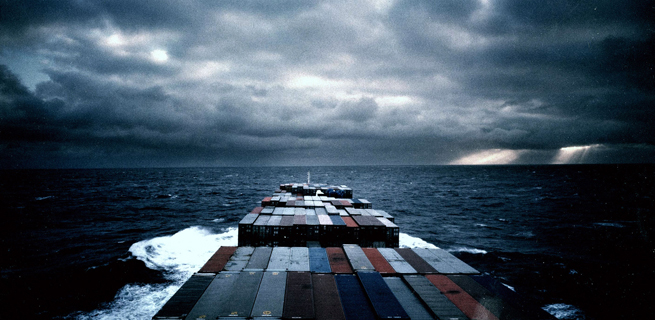
“If there is a single object that can be said to embody the disavowal implicit in the transnational bourgeoisie’s fantasy of a world of wealth without workers, a world of uninhibited flows, it is this: the container, the very coffin of remote labor-power. And like the table in Marx’s explanation of commodity fetishism, the coffin has learned to dance.”
– Allan Sekula

The last paragraph of ‘Dismal Science’*, the essay that is at the heart of Allan Sekula’s legendary Fish Story project – comprising photographs, slide projections and a book – does not provide closure of any kind. Rather, in all its haunting and taunting, it provokes further interactions and interventions. It activates, which is perhaps what all forms of activism aspire to. If the cargo container, this metal box that is at the same time ever-present and never-disclosed, really is the coffin of remote labor-power, then there is still much digging left to do. Sekula himself never abandoned his quest over the world’s oceans and his investigation of the labour aboard its ships and in its harbours: twenty years after commencing the monumental work of Fish Story (1989 – 1995) he made The Forgotten Space, together with fellow companion Noël Burch. While the first project was still haunted by the collapse of the Eastern Bloc, the latter resonated with the economic crisis of 2008. In the aftermath of this crisis it was made clear for all of us that, in twenty years time, capitalism had lost nothing of its “vampiric vitality”. On the contrary: it has learned to make the exploited pay for its crises, all the while rendering the fact of exploitation itself invisible. In the dominant image of the world economy as fully integrated, globalized, dematerialised and “friction-free” there is no place for old industrial relics such as sea trade, this ancient world of rusty metal and creaking ropes, of slow motion and ponderous weight. To all appearances, the “on the waterfront” culture of sailor bars and ship chandlers, as depictured in Elia Kazan’s eponymous film, is now of the past, and so is the class struggle that coincided with it. Who remembers the struggles of dockers, seafarers, and shipyard workers, which were so fundamental to the formation of trade-unionism and labour movements? Watch today’s news and see how easily this world is denounced as an anachronism that merely stands in the way of progress and prosperity. How easily we forget. In these “liquid”, post-industrial times of ours, we have no trouble floating in mid air, riding the global waves of capital, surfing the fluid flows of information, but we forget how globalization wouldn’t be possible if it wasn’t for the forgotten space of maritime realms. And we forget that what the shipped coffins contain is manufactured by workers on the other side of the globe. Because, in contrast to what we are being told, Marx’ gravediggers have never disappeared – they have just vanished from sight, forced into ever more precarious circumstances, oftentimes on the far side of the sea. Should we be surprised to learn that the same shipping containers are increasingly used for human transportation and habitation? No, but we should be all the more outraged. As Noël Burch and Allan Sekula were when they made this film, which can only begin to suggest the extent of the horror caused by globalized capitalism.

Allan Sekula passed away in 2013, but the course he set out will undoubtedly be taken up by others. In all its activating force, The Forgotten Space, as Noël Burch reminds us, “is a film which has to be continued by other means”.

Born in the USA (San Francisco) in 1932, Noël Burch has been living in France since 1951. He graduated from the Institut Des Hautes Etudes Cinématographiques (IDHEC) in 1954. While primarily known for his theoretical writings, he has always positioned himself as a filmmaker and has directed over twenty titles, mostly documentaries. Burch has been publishing since the 1960s. Among his numerous publications are his first and best known book ‘Theory of Film Practice’ (New York: Praeger, 1973) and ‘To the Distant Observer: Form and Meaning in Japanese Cinema’ (Berkeley, 1979), which remains the most robust history of Japanese cinema written by a Westerner. From 1967 to 1972, he collaborated with Janine Bazin and André S. Labarthe for the celebrated series, ‘Cinéastes de Notre Temps’, and directed seven programs which are considered to have renewed the “film-maker portrait” in the heroic years of French public television. It was during that same period that Burch was co-founder and director of the Institut de Formation Cinèmatographique, an alternative film school associating theory and practice.

* The essay ‘Dismal Science’ developed from a paper first presented at the Center for Twentieth Century Studies at the University of Wisconsin, Milwaukee in 1992. Versions of the original paper were subsequently presented over the next two years at various venues. The completed version was included in the book that accompanied the Fish Story project. Unfortunately, the book has gone out of print, and the current cost of copies ranges from $500 to over $1000. However, you can find a PDF copy HERE.

In the context of the research project “Figures of Dissent (Cinema of Politics, Politics of Cinema)”
KASK / School of Arts
DISSENT ! Jacques Rancière

maidan.jpg

POSTPONED UNTILL FURTHER NOTICE

17 December 2014 20:00, Aleppo (bâtiment Vanderborght, rue de l’Ecuyer 50), Brussels. In collaboration with ‘Phd in one night‘ project & Académie royale des beaux-arts de Bruxelles – École supérieure des arts (ARBA-ESA).

“There is no politics of cinema, there are only singular figures according to which filmmakers apply themselves to bring together the two meanings of the word ‘politics’, through which we can consider a fiction in general and a cinematographic fiction in particular: politics as what a film speaks about and politics as the strategy of an artistic approach (…) We could say: the relation between a matter of justice and a practice of justness.”

How to think about the ways cinema can put into action the relation between the certainties of injustice, the uncertainties of justice and the calculation of justness? This question has been stirring Jacques Rancière ever since he was taken in by the wave of cinephilia that churned through Paris in the 1960’s. From his first interview in Cahiers du Cinéma in 1976, via his own series of writings for the same magazine between 1998 and 2001, to the publication of La Fable cinématographique (2001) and Les écarts du cinéma (2011), cinema has been an important strain throughout his work, linking his dwellings on the shores of politics with his ventures into the realms of aesthetics. How can cinema be thought of as an overpass between these two ever shifting landscapes, as a terrain of struggle that bears the original responsibility of politics: the organization of dissent? If it’s true that we can no longer believe in the dreams of cinema as the privileged form of the identification of art and life, or as an enigmatic force that can give us new vision and awaken us to a new consciousness, how can cinema still make a difference? According to Rancière, we need to let go of those persistent expectations that consider cinema as an instrument to inform political strategies and mobilize militant energies. Instead, it has to be regarded as nothing but a surface where experiences can be organized in new figures and relegated into new trajectories, as a “distribution of the sensible” that can evoke a process of transformation, disrupting the dominant logic of representation and changing the coordinates of the given. Any political “efficiency” of cinema cannot be based on a link between cause and effect, or a bond between revelation and mobilization – on the contrary, it has to content itself with a loss of destination, inviting us to reframe the cartography of the perceptible, the thinkable and the feasible. The question that remains is then not what cinema can do for us, but what we can do with cinema… In this DISSENT! session we will take a selection of recent films as starting point for a discussion on how cinema and its culture can contribute to a reinvention of politics.

On 16 December Jacques Rancière will also be speaking at a Post-conference in the framework of the “Phd in one night” project at Arba-Esa, D.A.M. Gallerie (reserved for students of ISAC / ARBA-ESA).

DISSENT ! is an initiative of Argos, Auguste Orts and Courtisane, in the framework of the research project “Figures of Dissent” (KASK/Hogent), with support of VG. The visit of Jacques Rancière is made possible with financial support of Kunstenplatform, Universitaire Associatie Brussel (VUB/EhB).

——————————————————————————————————————————————————————-
About DISSENT!

How can the relation between cinema and politics be thought today? Between a cinema of politics and a politics of cinema, between politics as subject and as practice, between form and content? From Vertov’s cinematographic communism to the Dardenne brothers’ social realism, from Straub-Huillet’s Brechtian dialectics to the aesthetic-emancipatory figures of Pedro Costa, from Guy Debord’s radical anti-cinema to the mainstream pamphlets of Oliver Stone, the quest for cinematographic representations of political resistance has taken many different forms and strategies over the course of a century. The multiple choices and pathways that have gradually been adopted, constantly clash with the relationship between theory and practice, representation and action, awareness and mobilization, experience and change. Is cinema today regaining some of its old forces and promises? Are we once again confronted with the questions that Serge Daney asked a few decades ago? As the French film critic wrote: “How can political statements be presented cinematographically? And how can they be made positive?”. These issues are central in a series of conversations in which contemporary perspectives on the relationship between cinema and politics are explored.

DISSENT ! Ariella Azoulay

nakba.JPG

15 & 18 December 2014 20:00, Galeries Brussels. In collaboration with KU Leuven / Leuven University Press and Aleppo. Ariella Azoulay in conversation with Stoffel Debuysere, preceded by a screening of ‘Khirbat’ Khize’ (Ram Loevy, 1978, 48’) and ‘Al-Midya’ (Dani Gal, 2014, 26’)

“I was born in the early 1960’s, and for years took for granted the existence of the state of Israel. My political consciousness was formed by the 1967 occupation, the injustices it led to and the urgent need to reflect on them. As a young leftist, I was raised to believe that 1948 was a distant disaster, irreversible and less acute than the endless injustices that resulted from the 1967 occupation. Years of research on citizenship and photography made it clear that the occupation was part of the Israeli political regime, and that reconstructing its schema should start in 1948”.

Is it possible to break the deadlock of the present and imagine a different future through a revisiting of the past? The theoretical and curatorial work of Ariella Azoulay is grounded in an exploration of this possibility: using the events that occurred between 1947 and 1950 as a prism, she proposes a civil perspective on the history of the Israel-Palestine conflict, one that turns away from the framework imposed by the paradigm of an unavoidable and irreversible national conflict. It is a perspective that encompasses all the inhabitants of the territory, both Jews and Arabs, which allows to reconstruct the collision between them as a product of the war. The violence inflicted on the Palestinians positioned them as the enemy of the very people with whom they had previously shared their lives, which gave way to two distinct narratives – one culminating in the creation of the state of Israel, the other situating the nakba as the constitutive event of Palestinian identity – both of which are oblivious to the origins of this division. In order to reconstruct this past, Azoulay has created an archive of photographs that have been preserved by the same regime that has previously made great efforts to erase its traces, setting limits on what can be seen and what makes sense. But an image is always more and less than itself: it can not be reduced to the intention that has produced it, nor to the meanings that it supposedly reveals or conceals. The work of Azoulay consists of undoing the dominant connection between these images that speak and the discourse that keeps them silent, by making them speak in another way, linking them with eyewitness accounts, diaries, memoirs, minutes and memoranda. In proposing to think in civil terms about a place steeped in hopelessness, she tries to open up a new horizon of civil living for both citizens and those denied citizenship, as inevitable partners in a reality they are invited to imagine anew.

This Dissent! session takes as starting point a selection of films, chosen by Ariella Azoulay, that deal with the impact of the events of 1948 on Palestinians and Jews. Documenting something that goes beyond the suffering of the victims and the glory of the victors, transcending more conventional expectations to either expose details of the catastrophe or veil it from view, these films enable spectators to witness a variety of forms of Jewish-Palestinian co-existence to which the event of 1948 put an end. These films will be shown on 15 December and 18 December. Ariella Azoulay will attend only on the 18th.

15 December 19:00, Galeries Brussels.

Kassem Hawal, Return to Haifa (1982, Palestine, Arabic spoken with English subtitles, 84’)
Return to Haifa is based on Kanafani’s novel the plot of which takes place in 1967, when Palestinian refugees living in the newly occupied territories had an opportunity to visit the places from which they had been expelled in 1948. Saeed and Safiyya, a Palestinian couple expelled from Haifa in 1948, visit the home that had been their own. Miriam, a Holocaust survivor and now a Jewish Israeli citizen who lives in their house, lets them in. She moved there with her husband shortly after the Palestinian couple had been uprooted. The Palestinian couple returns to Haifa hoping to discover something about their baby, Khaldun, whom they had left at home that April morning in 1948, not realizing that neither of them would be able to return. The abandoned baby had been adopted by Miriam and her husband who gave him a Hebrew name – Dov, now a soldier in the Israeli army. This tragic encounter depicted by the movie emblematizes the Nakba’s being not only the tragedy of the Palestinian people but also of the Israeli Jews who cannot escape confronting this past and becoming accountable for it.

Michel Khleifi, Ma’loul Celebrates its Destruction (1984, Israel/Palestine, Arabic spoken with English subtitles, 30’)
Ma’aloul, located 6 kilometers from Nazareth was destroyed in 1948 and its residents were not allowed to return but rather declared by the State “present absentees,” not allowed to have their property back, just as were Palestinians expelled out of the country. This movie makes even more explicit the assumption that the history of Israel cannot be narrated without acknowledging the Nakba, the expulsion of Palestinians and their dispossession. The movie these internally displaced Palestinians’ testimonies about the destruction of their village Ma’aloul and their dispossession and the curricula taught in a history lesson in Arab schools, compelled by the state to teach the Zionist version of the events.

18 December 2014 20:00, Galeries Brussels. In the presence of Ariella Azoulay.

Ram Loevy, Khirbat’ Khize (1978, Israel, Hebrew spoken with English subtitles, 48’)
Khirbat Khize is a TV drama directed by Ram Loevy in 1978 based on a novel (bearing the same title) by S. Yizhar, published in 1949. The novel is a step-by-step depiction of the expulsion of Palestinians by Israeli soldiers. One of the soldiers repeatedly questions their deeds. The moral voice recurds and so its rejection by the others, in ritual-like form. This ceremonial repetition, which the movie makes more explicit, can be read a a rite of passage through which Jews in Palestine became the masters of the land. Since the 1960s, the novel was included in high school curricula. In 1978, when the film was to be broadcast, the Minister of Education and Culture banned it and the workers of the Israeli TV turned spectators’ screens dark for 50 minutes, the duration of the movie.

Dani Gal, al-Midya (2014, Israel, Arabic/Hebrew spoken with English subtitles, 26’)
al-Midya was chosen as the location for shooting the film Khirbat Khize in the mid-1970s. The villagers did not see the movie until Dani Gal, the director of this film, went to the village and screened it. The film documents the encounter of al-Midya’s residents with the movie, but no less so, the way they experienced in the late 70s the arrival of a troop of actors dressed as soldiers to shoot a movie that revives the expulsion of 1948. In the absence of subtitles in Arabic (in Khirbat Khize) one of the local residents serves as a simultaneous interpreter. The Israeli soldiers’ words dehumanizing the Palestinians, repeated in Arabic by a Palestinian, produce remarkable moments of estrangement.

DISSENT ! is an initiative of Argos, Auguste Orts and Courtisane, in the framework of the research project “Figures of Dissent” (KASK/Hogent), with support of VG.

——————————————————————————————————————————————————————-
About DISSENT!

How can the relation between cinema and politics be thought today? Between a cinema of politics and a politics of cinema, between politics as subject and as practice, between form and content? From Vertov’s cinematographic communism to the Dardenne brothers’ social realism, from Straub-Huillet’s Brechtian dialectics to the aesthetic-emancipatory figures of Pedro Costa, from Guy Debord’s radical anti-cinema to the mainstream pamphlets of Oliver Stone, the quest for cinematographic representations of political resistance has taken many different forms and strategies over the course of a century. The multiple choices and pathways that have gradually been adopted, constantly clash with the relationship between theory and practice, representation and action, awareness and mobilization, experience and change. Is cinema today regaining some of its old forces and promises? Are we once again confronted with the questions that Serge Daney asked a few decades ago? As the French film critic wrote: “How can political statements be presented cinematographically? And how can they be made positive?”. These issues are central in a series of conversations in which contemporary perspectives on the relationship between cinema and politics are explored.

DISSENT ! Eric Baudelaire

letters_to_max.jpg

5 December 2014 20:00, Bozar Cinema Brussels.
Eric Baudelaire in conversation with Stoffel Debuysere, preceded by a screening of ‘Letters to Max’ (2014, 103’)

“My work is definitely more on the side of asking questions than affirming possibilities of solutions, but then you can probably push that a little further and say that the act of asking questions can be the premisse of some form of possible decision on a course forward, and that is definitely the place I would consider myself in.”

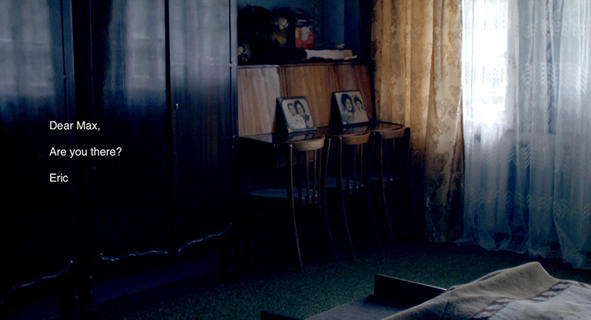
When Eric Baudelaire sent his first letter to Maxim Gvinjia, former Minister of Foreign Affairs of the Republic of Abkhazia, he was sure it would come straight back with a notice saying “destination unknown”. Because Abkhazia does not exist, at least not according to the United Nations and the majority of the world’s governments: it seceded from Georgia during a civil war in 1992-93, but its status remains in limbo, caught in a web of geopolitical interests, ethnic tensions and political unrest. However, the letter did actually arrive, marking the beginning of a long exchange which eventually shaped the fabric of Letters to Max: 74 letters sent over as many days, to which Max responded by recording his comments onto tape. The film became the chronicle of a close friendship, intertwined with the particular history of a stateless state, a place that is both real and imagined. Just like in his previous film works, notably The Anabasis… (2011) and The Ugly One (2013), both made in collaboration with Masao Adachi, filmmaker and former member of the Japanese Red Army movement, Baudelaire’s new film is grounded in a process of interchange and discovery, a process that ineluctably leads to unknown destinations, picking up traces of contested histories and unresolved questions on the way. But in any given space of contestation and invention there is no discovery without a sense of confusion and no interchange without a degree of disagreement. So what forms of cinematic perception and interpretation can be constructed as result of this uncertain hovering between different perspectives and sensibilities? How to find a position between refusal and fraternity? How to define the “point of view” of who or what is inbetween? And what does this enigmatic notion of “point of view” still mean after all, after having done its duty both in the service of Bazinian humanism and of Brechtian verfremdung, after having referred to both the gaze of the filmmaker and the blind spot of ideology, both to the position of the author and what it conceals. What can it possibly mean in today’s cinematic landscape, now that it finds itself permeated with a tendency to either hide behind an adherence to “facts… nothing but the facts” or dwell in a borderless sphere of indefinite ambiguity?

DISSENT ! is an initiative of Argos, Auguste Orts and Courtisane, in the framework of the research project “Figures of Dissent” (KASK/Hogent), with support of VG.

——————————————————————————————————————————————————————-
About DISSENT!

How can the relation between cinema and politics be thought today? Between a cinema of politics and a politics of cinema, between politics as subject and as practice, between form and content? From Vertov’s cinematographic communism to the Dardenne brothers’ social realism, from Straub-Huillet’s Brechtian dialectics to the aesthetic-emancipatory figures of Pedro Costa, from Guy Debord’s radical anti-cinema to the mainstream pamphlets of Oliver Stone, the quest for cinematographic representations of political resistance has taken many different forms and strategies over the course of a century. The multiple choices and pathways that have gradually been adopted, constantly clash with the relationship between theory and practice, representation and action, awareness and mobilization, experience and change. Is cinema today regaining some of its old forces and promises? Are we once again confronted with the questions that Serge Daney asked a few decades ago? As the French film critic wrote: “How can political statements be presented cinematographically? And how can they be made positive?”. These issues are central in a series of conversations in which contemporary perspectives on the relationship between cinema and politics are explored.

DISSENT ! Eyal Weizman

weizman.jpg

8 December 2014 20:00, Aleppo (bâtiment Vanderborght, rue de l’Ecuyer 50), Brussels. Eyal Weizman in conversation with Stoffel Debuysere. In collaboration with erg (école supérieure des arts).

“Consider the term “shooting back” that connects the visual field and the field of combat, the camera and the gun. One might say that all these kinds of techniques of extended testimony and mapping should be abandoned because these are techniques born to serve power; but I think we should rather extract them from the mouth of the beast and radicalize them.”

“Give a voice to the voiceless” is one of the responsibilities that is traditionally associated with political and humanitarian activism: to provide testimony of the concerns and struggles of those who all too often remain silent and invisible, those who are regarded within the global socio-political order as “outside” or “surplus”. Yet the status of testimony has undergone some remarkable shifts in the past decades. First of all, the field of humanitarianism and human rights that served as an independent form of engagement with the pains and sufferings of this world in the 1960’s and the 1970’s, has been gradually pervaded by other kinds of forces and strategies: political-military in the 1990’s, legalistic in the 2000’s. In this context, the role of testimony, whether oral, literal, visual or audiovisual, has been superseded by the use of medical and forensical data, which provide another kind of testimony, one without witness. These entanglements and shifts are all part and parcel of what Eyal Weizman has called our “humanitarian present”, a present characterized by a growing ethical indistinction between fact and law, where all judgement is subsumed to an economy of violence and a systemic logic of “lesser evil”, and all division is replaced by a rationale of negotiation and calculation. In this Dissent ! session Eyal Weizman will talk about this contemporary condition in which technologies of humanitarianism and human rights collude with military and political power, with a focus on the role of audiovisual technologies in relation to the paradigm of victimization and the politics of lesser evil, and the status of forensic aesthetics as site of interpretation and contestation.

Professor of Spatial & Visual Cultures and Director of the Centre for Research Architecture at Goldsmiths, University of London; Princeton Global Scholar Eyal Weizman is an architect, professor of spatial and visual cultures and director of the Centre for Research Architecture at Goldsmiths, University of London. In 2011 he set up Forensic Architecture, a research agency that provides architectural evidence in human rights cases and war crimes trial. His books include FORENSIS with FA (2014), Architecture after Revolution with DAAR (2014), Mengele’s Skull with Thomas Keenan (2012), The Least of all Possible Evils (2011), and Hollow Land (2007).

DISSENT ! is an initiative of Argos, Auguste Orts and Courtisane, in the framework of the research project “Figures of Dissent” (KASK/Hogent), with support of VG.

——————————————————————————————————————————————————————-
About DISSENT!

How can the relation between cinema and politics be thought today? Between a cinema of politics and a politics of cinema, between politics as subject and as practice, between form and content? From Vertov’s cinematographic communism to the Dardenne brothers’ social realism, from Straub-Huillet’s Brechtian dialectics to the aesthetic-emancipatory figures of Pedro Costa, from Guy Debord’s radical anti-cinema to the mainstream pamphlets of Oliver Stone, the quest for cinematographic representations of political resistance has taken many different forms and strategies over the course of a century. The multiple choices and pathways that have gradually been adopted, constantly clash with the relationship between theory and practice, representation and action, awareness and mobilization, experience and change. Is cinema today regaining some of its old forces and promises? Are we once again confronted with the questions that Serge Daney asked a few decades ago? As the French film critic wrote: “How can political statements be presented cinematographically? And how can they be made positive?”. These issues are central in a series of conversations in which contemporary perspectives on the relationship between cinema and politics are explored.