Figures of Dissent : Jean Eustache

numero-zero_0.jpg

8 May 2014 20:30, KASKcinema, Gent. In collaboration with Courtisane.

Numéro zéro (FR, 1971, 35mm, b&w, 107′)

“You have to record things; whether they’re pretty or not, they’re important, they’re essential.”
– Jean Eustache

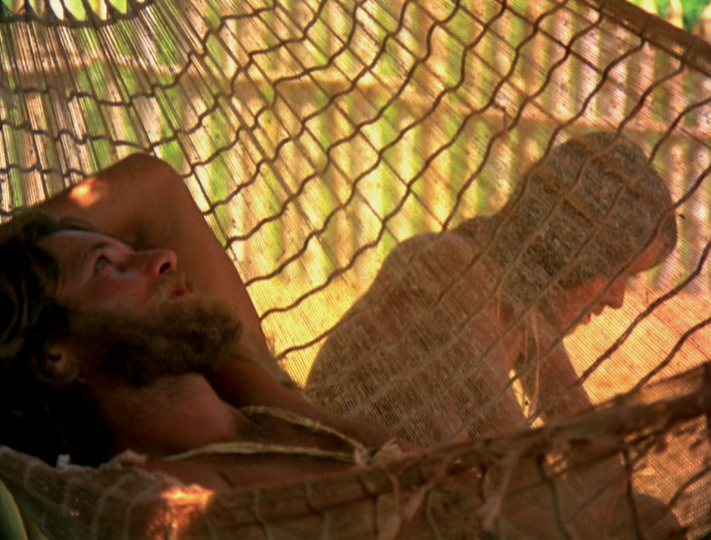
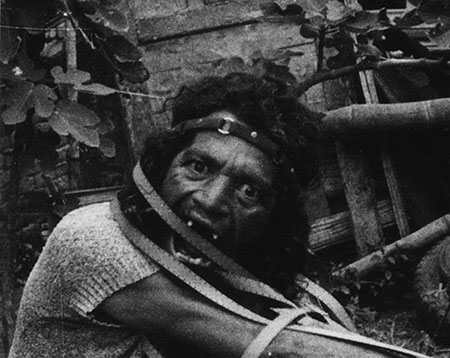
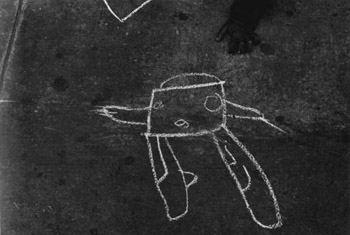
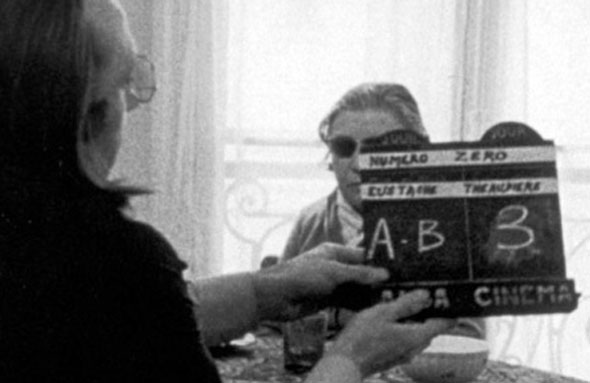
Luc Moullet once described him as a “blue collar dandy”. Legend has it that he aimlessly roamed the streets of Paris, regularly spending his nights in the Montparnasse bars, continually venturing into new romantic liaisons, but the self-conscious Rimbaudian artist was also an autodidact filmmaker whose work was steeped in an artisanal ethos and a penchant for sharp observation and ruthless provocation. This apparent paradox, which was at the heart of many of his films, never sat easily with the French film culture that came after the heyday of the Nouvelle Vague, which all too often succumbed to ideological blindness and bitter antagonism. That is how La Maman et la Putain, arguably his most autobiographical project, was dismissed as “deeply reactionary” on the pages of Cahiers de Cinéma, who put it on the same level as other “petit-bourgeois” movies such as Ferreri’s La Grande Bouffe and Bertolucci’s Last Tango in Paris. But Eustache’s character study of the lost children of post-’68 did not rest on ideological premises, but on his intimate understanding of the tremors of disquiet and anguish that ran through the streets of his city. Always the “ethnologist of his own reality”, as Serge Daney wrote in his obituary. Always the artisan who took on everything as it came, memorized everything as it presented itself. Always the non-conformist whose films followed their material right to where it led them, and never to where conventional guidelines were pointing them to. Always the renegade who resembled his times too much to be comfortable or contended. A constant struggle he eventually ended up losing. The film at show here, which has remained unseen for so long, is what he considered to be his “numéro zero”, his tabula rasa with everything that had come before. A film that is unsure of itself, a manifesto without a program, made without any intent or pretense, only answering to a single desire: the desire for cinema.

“There are many reasons why one makes a film. However, as we proceed with the preparation (calling the technicians together, buying the film, hiring the lighting equipment, deciding the day and time to begin shooting), the actual filming (action, cut), the finishing process (synchronizing the images and the sound, editing, post-synchronizing), ninety nine percent of the time we forget what urged us to make the film in the first place. Sometimes we remember once we emerge from the darkness of the editing room and the film laboratories. Without being able to justify the existence of Odette Robert, I can speak of why I made Numéro Zéro, of which Odette Robert is but a fragment. I don’t know whether Numéro Zéro was a film. To say that I was urged to shoot it by the torment I was enduring at the time is not very revealing. I remember walking through Paris, from Montparnasse to the 17th arrondissement, thinking whilst I walked as if I were walking back through time. When I arrived back home, my grandmother spoke to me for quite a long time, and I had the impression that she was telling me extremely important things. When I said to her, “Listen, we should record this”, she said to me, “But really, these aren’t nice things”. “It doesn’t matter,” I replied, “it’s important to record these things, nice or not, they’re important, they’re essential”.
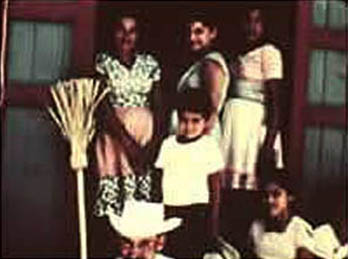
I found a bit of money to buy some black and white 16mm film, hired two cameras, and asked Théaudière to be the cameraman and Jean-Pierre Ruh to do the sound. The duration was as long as the reel of film, with the two cameras working alternately, in relays, without ever cutting. The picture was therefore the story of the film, from beginning to end. At the same time, as I was working as a filmmaker at the time, this was a film by a professional filmmaker, as well as being a family film, like an amateur 8mm film shot on the beach. The two were therefore not compatible. I then asked director Adolfo Arrietta to take a few street shots, and film my grandmother and my son doing their shopping in the nearby street. I wanted this to be the beginning of the film, with no sound or anything, completely separate from the rest, which has sound and where the image remains static.
I had the impression it was a manifesto, but of what, I didn’t know. Perhaps of the fact that, at the time, I couldn’t make films. After this, some well-meaning people introduced me to someone in television who viewed my work. But Numéro Zéro was not suitable for the television of the time, 1971.
To answer the question as to whether Numéro Zéro was a film, I still can’t tell you. I maintained that it was, without actually being very sure of myself.
It is about a journey through time by an old woman, moving between her great grandparents and her great grandchildren, during which we see six generations of
the history of France, told through the eyes of Odette Robert, my grandmother. In the original Numéro Zéro, I didn’t cut anything. As to what I later called Odette
Robert, fragments of the original film, I don’t know whether this has become a film in the meantime. Numéro Zéro was an anomaly, limited by the length of the reel of film. To split it in fragments meant deciding what to edit, as editing implies a choice. I had to decide upon the editing and make a choice. However, I don’t think that the original anomaly has disappeared though. I just cut out a few people, as I had to reduce the length by half. I strongly doubted that it was a film at the time, in February 71, as I had never seen anything like it before. Since then, I have discovered things that resemble it a little, namely Godard’s video programmes, which, a few years down the line, were the only things you could compare it to. Of course, I had no prior intention when making this film, I was simply eaten up with suffering, and this film was a response to that suffering.”
– Jean Eustache

“It happened in 2001. It was a beautiful winter afternoon. At a bistrot Jean-Marie turns to me: ‘There’s this film by Jean Eustache… I was one of the eight chosen schmucks that he invited to the screening… He was always so unsure – he kept telling us how he thought the film was a useless piece of shit… And when the lights came on, we were all stunned! I told him it was one of the greatest films about the history of France, as great as Renoir’s La Marseillaise. Perhaps the only film ever that you can call an important piece of sociology, without trashing the words film and sociology. I think it’s a film for you.’ Well, that did it. Of course, I had always admired and loved Eustache’s films, and out of the blue comes this mysterious Numéro Zéro: I had to find it! One or two months later, a miracle in Paris: Eustache’s son Boris on the phone, ‘Yes, I think there’s a working print of Numéro Zéro under my bed.’ I called my friend João Bénard da Costa, the late great director of the Portuguese Cinémathéque: “Bring it over, ASAP!” So, the Lab at Film Archives in Lisbon proceeded to restore this magnificent 35mm negative and one day we all sat in the theatre to watch it… and it was my kind of movie all right.”
– Pedro Costa

In the context of the research project “Figures of Dissent (Cinema of Politics, Politics of Cinema)”
KASK / School of Arts

Response to an invitation

straub.jpg

One fine day you find yourself being invited to propose some films for a program of screenings and discussions dealing with the “return of Marxism”. How can one who has never read Marx respond to this kind invitation? Indeed, the notion of Marxism seems to have regained a new force of attraction and legitimacy, even – or especially – for those who have come after the insurgence and the subsequent dissolution of the emancipatory movements in the period of the “long 1968”. Even for those who decided early enough in life to dedicate some humble time and energy to the cultivation of cinema, this bastard art that one particular adept of Marxism once proclaimed to be “the most important of all arts”, the time has come when, for them too, politics becomes the order of the day. How does one who has always preferred the darkness and safety of the cinema space to the obscureness and uncertainty of that strange place called society, deal with the realization that this constant struggle that is politics concerns him, and has perhaps always concerned him? You do what you can: you relate everything you don’t understand to what you know and love. And even when so much of what you thought you knew starts crumbling down on you, and your whole world view with it, the love does not wither. It only grows stronger.

One night you find yourself in the company of a great filmmaker, who reminds you that it’s allright to let yourself be vulnerable, that it is something to work with. And he talks about the fear that we are all experiencing, a fear that is caused by that which we are told we do not have and can never have, a fear so great it freezes us away from the things we care for the most. We stall it whenever we can, taking refuge in the certainties that are laid out before us, continually following the paths that define what is generally accepted as common sense, sometimes cuddling up in the dark spaces where fabricated dreams of light and shadow instill us with a sense of comfort. Against the pervasive sense of anxiety and conformity, the filmmaker points out the need to invent other worlds, to take risks and explore pathways that might enable us to exceed our limitations and suppressions. In life as in cinema. And he expresses his love and admiration for two filmmakers who have persevered in doing so, creating an exceptional cinema that makes us perceive life in all its possibilities, makes us feel the torrent of the world in all its intensities. A feeling that is seeing and not only recognizing. One that confronts us with the sense that we do not live in the best of possible worlds. And you start to see that too.

One day you come to realize that your sense of disorientation and disquiet is shared by many, and you begin to understand that the narratives of lost illusions and shattered dreams you have been passed on for so long no longer say much about our world. And you feel that, for those who do not know how to live in this broken world, to act has to become a matter of putting trust in what is uncertain, in that unknown space of possibility for which we desperately want to take responsibility. Realizing that, perhaps, it is the only thing for which we are confident we have a responsibility. To act can no longer start with projecting an ideal destination in some faraway future, but with producing a break in the present, a shift in how we choose to perceive its coordinates. Without maps, without a dictionary or directory to guide our search, we begin to look towards the emotions and sentiments that might comprise a world of affects to be shared, and less at the visual evidence of the state of the world as we know it. This is how cinema can give us courage: by reframing what is given as evident, by proposing a world that resists the pronunciation of the vanity of all action, by participating in the constitution of a new collective sentiment. For those who feel out of place, undignified, exploited, humiliated, a search for trust inevitably involves a negotiation between one sense and another, between the intelligibility of our world and the sensibility of an other. And isn’t that, after all, one of the tensions animating Marxism?

24 April 2014 19:30
Université Populaire de Bruxelles, Brussels.
At the invitation of Arenberg Cinémas Nomades.

Danièle Huillet & Jean-Marie Straub
Sicilia!
IT, 1999, Italian with French subtitles, 66’

Based on Elio Vittorini’s Conversations in Sicily, narrating the return of an intellectual to his native Sicily after a long absence. Moving beyond the original’s immediate context—the increasing oppression of pre-war Italy—Straub/Huillet offer a touching look at the state of permanent exile common to all of those who can’t go home again.

Umiliati (Humiliated)
IT, 2003, Italian with French subtitles, 34′

The survivors of World War II wander throughout liberated Italy, searching for their past and a future. Tired of wandering, a group of men and women who’ve lost everything, decide to try to restore something from among the rubble and to set out on a new life. Based on extracts from Le Donne di Messina by Elio Vittorini.

——————————————————————————————————————————————————————-

Par un beau matin, je me suis vu invité à proposer des films pour un programme de projections et de débats autour du « retour du marxisme »….

Comment quelqu’un qui n’a jamais lu Marx peut-il répondre à ce genre d’invitation ?

Il semble en effet que la notion de marxisme retrouve aujourd’hui une nouvelle force d’attraction, une nouvelle légitimité, même – ou plus spécialement – envers ceux qui sont arrivés après l’insurrection , et la dissolution suséquente des mouvements émancipateurs en ’68.
Même pour ceux qui ont choisi assez tôt dans leur vie de consacrer une humble partie de leur temps et de leur énergie à la culture du cinéma , cet art de bâtard qu’un adepte du marxisme a un jour défini comme « le plus important de tous les arts » , même pour ceux-là, le temps est venu où la politique revient à l’ordre du jour.

Comment, celui qui a toujours préféré l’obscurité et la sécurité d’une salle de cinéma à celle, plus incertaine, de ce lieu étrange appelé «la société », comment peut-il gérer cette prise de conscience que cette lutte constante qu’est la politique le concerne, et l’a sans doute toujours concerné ?
On fait donc ce qu’on peut : on relie tout ce qu’on ne comprend pas à tout ce qu’on apprécie et connaît….et même si beaucoup de certitudes commencent à s’effondrer, et avec elles notre regard sur le monde, notre amour ne se flétrit pas. Il se renforce.

Un beau soir, vous vous retrouvez en compagnie d’un grand cinéaste qui vous rappelle qu’il est intéressant de rester vulnérable, qu’il faut travailler avec cela. Il vous parle alors de cette peur qui nous touche tous, la peur causée par ce qu’on nous dit qu’on n’a pas, et qu’on ne pourra jamais avoir. Une peur si forte qu’elle nous glaçe et nous éloigne de ce que nous avons de plus cher.
Cette peur, nous la mettons de côté et nous nous réfugions dans des certitudes préexistantes, suivant inlassablement le « bon vieux sens commun », doucement bercés dans des espaces sombres, par les rêves d’ombres et de lumières pré-fabriqués qui nous offrent un sentiment de confort. En réaction contre ce sentiment diffus d’angoisse et de conformisme, le cinéaste insiste sur la nécessité d’inventer d’autres mondes , de prendre des risques et d’explorer les voies qui pourraient nous donner la force de dépasser nos limites.
Dans la vie comme au cinéma.
Il exprime alors sa grande admiration pour deux autres cinéastes qui ont choisi cette voie et qui ont créé une cinématographie exceptionnelle, capable de nous ouvrir à une nouvelle perception de la vie et de ses infinies possibilités. Un cinéma qui nous donne à ressentir toute l’intensité de la marche du monde, qui nous donne le sentiment de voir et non pas seulement d’aperçevoir, qui nous montre que nous ne vivons pas dans « le meilleur des mondes »…. Et ça, vous aussi vous commencez à le voir…

Un jour, vous réalisez alors que votre inquiétude et votre impression de désorientation sont partagées par beaucoup. Et vous commencez à comprendre que les histoires de rêves brisés et d’illusions perdues qui vous sont racontées depuis si longtemps ne disent pas grand-chose du monde dans lequel nous vivons. Vous sentez alors que, pour ceux qui ne savent comment vivre dans ce monde déglingué, agir devient une manière de mettre de la confiance dans ce qui nous semble incertain, dans cet espace inconnu de possibles dont nous voudrions tant prendre la responsabilité.
Et vous rendez compte que c’est peut-être la seule chose dont vous être sûrs d’être responsables.

Agir, c’est arrêter de se projeter dans un futur idéal et lointain, agir c’est créer une rupture dans le présent, une manière décalée d’en déchiffrer la carte. Sans plan, sans dictionnaire ou répertoire pour nous guider, nous explorons les émotions et les sentiments et nous partageons ces « affects » plutôt que de simplement proposer une illustration visuelle évidente de l’état du monde que nous connaissons.

C’est ainsi que le cinéma peut nous donner du courage : en recadrant ce qui est donné pour évident, en proposant un univers imperméable à l’expression de la vanité de nos actes et en contribuant à la naissance d’un nouveau sentiment collectif.

Pour tous ceux qui ne se sentent pas à leur place, les indignés, les humiliés, une recherche de confiance implique inévitablement la confrontation des avis et une négociation entre l’intelligibilité de notre monde et la sensibilité d’un autre.

Après tout, cela n’est-il pas aussi l’une des lignes de tension qui anime le Marxisme ?

The Fire Next Time

now__9_-santiagoalvarez.jpg

The Fire Next Time
Afterlives of the militant image

3-4 April 2014. KASKcinema, KIOSK & Minard, Gent, Belgium

“The impossible is the least that one can demand.”
– James Baldwin

There was a time when cinema was believed to make a difference, to be able to act as a weapon in struggle, to operate as a realm of discord. The so-called ‘militant cinema’ was not only considered as a tool to bear witness but also to intervene in the various political upheavals and liberation movements that shook the world in the 1960s and ‘70s. What remains of this unassailable alliance between cinema and politics? After the flames had died down, all that seemed to be left was a wreckage of broken promises and shattered horizons. Today it feels like we have been living through a long period of disappointment and disorientation, while the sense of something lacking or failing is spreading steadily. An overwhelming melancholy seems to have taken hold of our lives, as if we can only experience our time as the ‘end times’, when the confidence in politics is as brittle as our trust in images. Perhaps that is why, for those who came after, there is a growing tendency to look back at an era when there was still something to fight for, and images were still something to fight with. Can a re-imagining of old utopian futures shed a new light on our perceived dead-end present, in view of unexpected horizons? Can an understanding of past dreams and illusions lead to reinvigorated notions of responsibility, commitment and resistance? Can a dialogue with the period in question help us to find the very principles and narratives capable of remedying its impasses? And how can this questioning help us to think about how cinema, unsure of its own politics, can be ‘political’ today? In light of a potential rebirth of politics, would it still be possible for the art of cinema to appeal to the art of the impossible?

In the framework of the research project ‘Figures of Dissent’ (KASK/HoGent) and the EU project ‘The Uses of Art’ (confederation L’Internationale), in conjunction with ‘L’œil se noie’, an exhibition of work by Eric Baudelaire and Mathieu Kleyebe Abonnenc (KIOSK, 05/04 – 15/06/2014) and the Courtisane Festival (02-06/2014). With the support of the research groups S:PAM & PEPPER (UGent), art centre Vooruit, BAM institute for visual, audiovisual and media art, Eye on Palestine, Embassies of France & Mexico.

All events are free admission, except where indicated.

——————————————————————————————————————————————————————-
THURSDAY 3 APRIL
——————————————————————————————————————————————————————-
ici-ailleurs-girl.png

10:00 KASKcinema // Talk-screening

Militant Cinema: from Third Worldism to Neoliberal Sensible Politics
Irmgard Emmelhainz

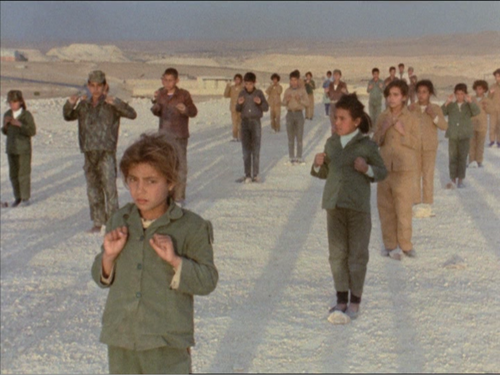
Jean-Luc Godard’s Ici et ailleurs (1969-1974) as well as Chris Marker’s Le fond de l’air est rouge (1977) crystallize the histories of militant engagement and political filmmaking in the 1960s, a time in which Marxism was a vehicle for cultural as well as actual revolution here and elsewhere. From both films, lessons about this era of militantism can be drawn. Moreover, they announce a turn in the 1970s and 1980s toward minority politics (tied to de-colonization struggles) and humanitarization –which implies an ethical, as opposed to political relationship to the elsewhere, as well as the utopia of globalization. Bearing this in mind, Irmgard Emmelhainz will discuss the changes in the meaning of ‘politicization’ and political work from the 1960s from what is known today as ‘Sensible Politics’: a form of politicization active at the level of encoding unstable political acts in medial forms. Taking up Jean-Luc Godard’s plea for texts and poetry (inspired by Aristotle’s and Hannah Arendt’s understanding of political action as speech), in his film Notre musique, she will argue that most of the current politicized images are compensatory devices to the ravages caused by neoliberal reforms implemented worldwide in the past two decades.

Irmgard Emmelhainz is an independent writer and researcher based in Mexico City. In 2012, she published a collection of essays about art, culture, cinema and geopolitics: Alotropías en la trinchera evanescente: estética y geopolítica en la era de la guerra total (BUAP). Her work about cinema, the Palestine Question, art, culture and neoliberalism has been translated to French, English, Arabic, Turkish, Hebrew and Serbian. She is currently co-editing an issue dedicated to Mexico City of Scapegoat Journal, and teaching a course at the Esmeralda National School of Engraving and Painting in Mexico City.

Screening:
Jean-Luc Godard & Anne-Marie Miéville
Ici et ailleurs (Here and Elsewhere)

FR, 1976, 16mm, color, French & Arabic with English subtitles, 53’

A film of the in-between, of the AND. Between then (1970) and now (1976), between here (Paris) and there (Palestine), between what is shown and what is seen, between sound and image. In 1970 Jean-Luc Godard and Jean-Pierre Gorin travelled to the Middle East to shoot a film about the Palestinian liberation struggle, a film that was initially titled Jusqu’à la victoire. A few weeks after returning to France, the Amman massacres took place. After that, it took Godard more than five years to find a form for the images and sounds he had captured, five years to come to terms with a sense of loss and failure, with the death of so many of those he had filmed, with the demise of so many revolutionary dreams. The only way for Godard to escape from the irresolvable contradictions between cinema and politics and the souring dilemmas of the militant filmmaker, was to radically turn cinema in on itself, in a meditation on the power and powerlessness of the image. A labor of mourning, of which we haven’t seen the end yet.

Hito Steyerl
November

DE, 2004, video, color, English spoken, 25’

“My best friend when I was 17, was a girl called Andrea Wolf. She died in 1998, when she was shot as a Kurdish terrorist in Eastern Anatolia… This project tackles the question of what is nowadays called terrorism and used to be called internationalism once. It deals with the gestures and postures it can create, and their relationship to figures of popular culture, namely cinema. Its point of departure is a feminist martial arts film Andrea Wolf and I made together when we were 17 years old. Now this fictional martial arts flick has suddenly become a document. November is not a documentary about Andrea Wolf. It is not a film about the situation in Kurdistan. It deals with the gestures of liberation after the end of history, as reflected through popular culture and travelling images. This project is a film about the era of November, when revolution seems to be over and only its gestures keep circulating.” (HS)

——————————————————————————————————————————————————————-
adachi.png

13:30 KASKcinema // Talk-screening

Landscape/Media – an Investigation into the Revolutionary Horizon, Reloaded
Sabu Kohso & Go Hirasawa

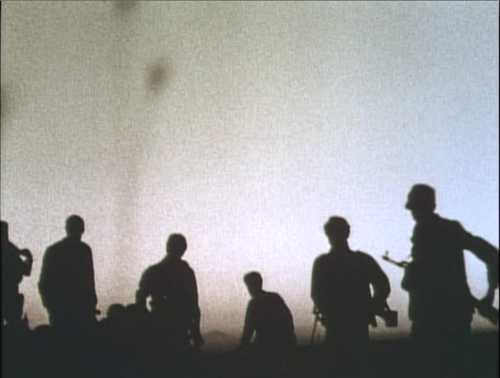
The development of ‘Landscape Cinema’ and ‘Landscape Theory’ took place during the short period between the late ‘60s and early ‘70s in Japan, while the ‘60s movements were declining and the militant line of guerrilla warfare was rising. It embodied a collective effort to grasp a new horizon of revolutionary struggle and the possible location of its agency in the form of film productions and critical discourses. Initiated by an enigmatic film, AKA: Serial Killer (1969), the cinema/theory sought to confront ‘landscape’ as the main terrain for the power operation, seen by the gaze of a migrant worker. Then Red Army/PFLP – Declaration of World War (1971) was produced, embodying the second stage of the development in which tactical uses of reportage were juxtaposed over the everyday landscape of Palestine guerrillas. Although the film was produced in collaboration with Japan Red Army, it involves multiple messages including critical reflections on a broad orientation of Japan’s radical left. Screening the latter film, Hirasawa and Kohso seek to decode the problematic complexity of the cinema/movement, that tackles the mechanism of capture by landscape/media and the resistance therein, in order to approach the apocalyptic feature of planetary crises today.

Sabu Kohso is a writer and translator. Living in New York since 1980, he has published several books in Japan and Korea about urban space, radical politics, and the philosophy of anarchism, and has translated books by theorists such as David Graeber, John Holloway, Kojin Karatani and Arata Isozaki. After the Fukushima nuclear disaster, he co-edited the website jfissures.org, and has written several articles on the problematic of post-nuclear disaster society in English.

Go Hirasawa is a researcher at Meiji-Gakuin University working on underground and experimental films and avant-garde art movements in 1960s and ’70s Japan. His publications include Cultural Theories: 1968 (Japan, 2010), Koji Wakamatsu: Cinéaste de la Révolte (France, 2010), and Masao Adachi: Le bus de la révolution passera bientot près de chez toi ( France, 2012). He has organized several film programs on Japanese Underground Cinema.

Screening:
Masao Adachi & Koji Wakamatsu
Sekigun-PFLP: Sekai Senso Sengen (The Red Army / PFLP: Declaration of World War)

JP/ Palestine, 1971, 16mm to video, color, Japanese & Arabic with English subtitles, 69’

Masao Adachi and Koji Wakamatsu visited Beirut on the way back from the Cannes Film Festival in 1971. In collaboration with the Japan Red Army fighters and the PFLP, they produced the film there, involving styles ranging from manifesto, newsreel, critical reflection (of the Japanese left) to reportage (of everyday activities of the Arab guerrillas). A fusion of ‘Tactical Media’ and ‘Landscape Cinema’ inherited from AKA: Serial Killer (1969), the film was considered an epitome of cinematic engagement in revolutionary practice, along with the works of the Dziga Vertov Group (Jean-Luc Godard/Jean-Pierre Gorin) and Latin American directors including Fernando Solanas and Octavio Getino. In order to break out of the conventional distribution system, Red Bus Screening Troops were organized to travel across Japan. The English and French subtitled versions were produced so that they could be shown across the globe, including in Palestine.

——————————————————————————————————————————————————————-
wifes-tale.jpg

16:00 KASKcinema // Talk-screening

Destroy Yourselves as Our Bosses
Evan Calder Williams & Victoria Brooks

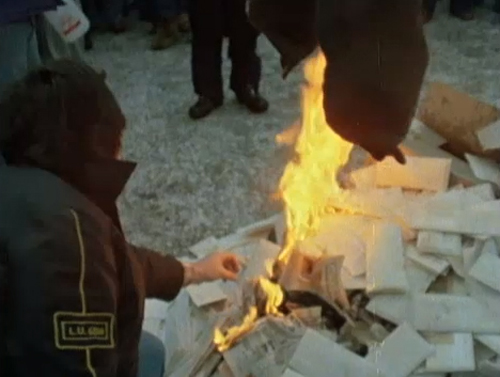
The connected talks of Evan Calder Williams and Victoria Brooks develop a feminist history of, and approach to, militant cinema from 1973 to 1983. In particular, they focus on critiques, both filmed and written, of how even allegedly radical movements reproduced a hierarchy of “legitimate” concerns that consistently framed the issues and modes of struggle posed by women as secondary to the cause at hand. This sidelining and its proprietary relation to politics has a history inextricable from labor movements themselves, but it becomes particularly visible with how practices of cinema directly engaged in social struggles negotiate what is literally foregrounded, drawn forth, or edited out. The first talk focuses on the Italian situation in the mid-’70s, considering “free newsreel” projects and experimental documentaries and reading their recurrent focus on the factory and piazza through the fierce critique articulated by Italian communist feminism in those same years. The second talk deals with films focused on women’s relation to factory and mining struggles in Ontario. These films, including those by Sophie Bissonnette, Joyce Wieland, and Sandra Lahire, developed a complex vision of histories and voices continually pushed to the side of movements fighting for access to basic necessities of survival.

Victoria Brooks is a curator and producer based in Troy, NY. Prior to joining EMPAC (Experimental Media & Performing Arts Centre) in 2013 as curator of time-based visual art, Brooks was a London-based independent curator, co-founding the itinerant curatorial platform The Island, co-curating Serpentine Galleryʼs artist-cinema program, and producing Canary Wharf Screen for Art on the Underground. Together with Evan Calder Williams, she is currently organizing Third Run, a new yearly film journal and colloquium series to be launched in fall 2014.

Evan Calder Williams is a writer, theorist, and artist. He has a doctoral degree from the Literature Department at University of California Santa Cruz, where he wrote a dissertation entitled The Fog of Class War: Cinema, Circulation, and Refusal in Italy’s Creeping’70s. He is the 2013-2014 Fellow at the Center for Transformative Media at Parsons, where is developing a theory of sabotage. He is the author of two books, Combined and Uneven Apocalypse and Roman Letters, has written for Film Quarterly, Mute, La Furia Umana, Viewpoint, and The New Inquiry, and writes the blog Socialism and/or Barbarism.

Screening:
Sophie Bissonnette, Martin Duckworth, Joyce Rock
A Wives Tale

CA, 1980, 16mm to video, color, English & French with English subtitles, 73’

A film about the women who supported the 1978 miners strike against Inco, the multinational which owned the nickel mines in Sudbury, Ontario. “As the women became increasingly involved in the strike, they questioned more and more their traditional supportive role. This provoked many heated discussions among the women and obviously not without upsetting husband, family, union — and company… This situation forced us as filmmakers to find a cinematic approach that could capture this reality. It is difficult (impossible) to take ‘pretty pictures’ under these conditions: kitchens are small and don’t well suit the movements of a film crew; children scream and cry in the microphone, making it hard to hear…we often packed up our equipment and decided not to shoot because we felt it would be a betrayal of the trust we had established with the women. You may perhaps be disappointed not to witness a family feud…So we shot a film that doesn’t in fact show ‘everything.’ hoping that what is not obvious comes from between the lines, between each frame of the film.”

——————————————————————————————————————————————————————-
moglichkeitsraum-melitopoulos-knaup.jpg

20:30 MINARD // Cinema-event

Möglichkeitsraum (The Blast of the Possible)
Angela Melitopoulos & Bettina Knaup

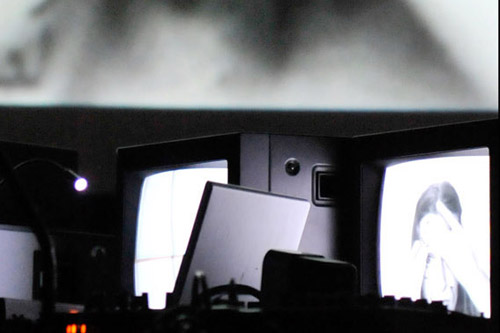
The Blast of the Possible is a project containing the creation of a temporary performance and lecture platform, a space for exhibiting video and film archive materials belonging to the history of activist media since the 1960s. The design of the platform is based on the idea of an extended postproduction studio in that all functions of montage are spatially presented. This theatrical archive space recalls the archaic function of theatre being a switching panel for different modes of language flows that foster potentials of experimentation, learning and the relation and agency between language-modes. The imaginary developing from an index of the databases and from the materiality of the archival documents will be transformed and preformed through the live energy of performance and speech. ‘Language,’ as Walter Benjamin states, ‘is mediating the immediacy of all mental communication, and if one chooses to call this immediacy magic, then the primary problem of language is its magic.’ Angela Melitopoulos & Bettina Knaup propose to concatenate different languages modes and work on their boundaries with performances that mind the gap between memory and matter. The exhibition becomes a place in that we sense the time quality of mediated images, their historical context, their possible figures and pathologies, their spatial order and their construction and segmentation, their open or closed logic of montage. Through these interventions we can re-read documents and documentation, the construction of representation and identity, the imaginary of the past and the potentialities of becoming.

Angela Melitopoulos studied fine arts with Nam June Paik at the Academy of Arts in Düsseldorf. She has been working with electronic media since 1986 and has created experimental single-channel tapes, video installations, video-essays and documentaries, her work of art often based on research and collaboration with other knowledge spheres like sociology, politics and theory. She has recently been appointed professor in the Media School of the Royal Art Academy in Copenhagen.

Bettina Knaup is a cultural producer with a background in political science, theatre, film, TV studies and gender studies. She has been involved in developing or managing a range of interdisciplinary and transnational cultural projects operating at the interface of arts, politics and knowledge production, including the open space of the International Women’s University (Hanover) and the trans-disciplinary Performing Arts Laboratory, IN TRANSIT (Berlin).

——————————————————————————————————————————————————————-
anastasandgabri_3_web.jpg

22:00 MINARD // Cinema-event

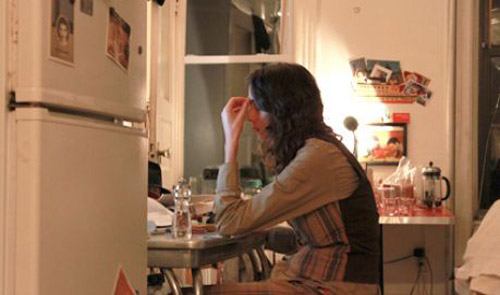
When we act or undergo, we must always be worthy of what happens to us
Ayreen Anastas & Rene Gabri

The militant cinema and image, taken in a more strict sense, have historically tended to push toward the real and toward the truth and toward the overcoming of capitalism, colonialism, and sometimes patriarchy among other things. They have worked to uncover, to lay bare, to expose, to clarify and at times to destroy existing regimes of order and/or truth. Occasionally, there have also been engaged comrades who have chosen the path of militancy as an arena to also investigate the truth claims of the image itself and its production. Of questioning the regimes of images themselves whether as spectacle or as contested fables or fictions. The utopic in the latter camp assumed cinema must be destroyed in the struggle. The more skeptical of this group, (in the philosophical sense not the everyday sense) returned to the cinema as a place of diagnosing the limits and failures of movements, as well as the images movements produced. This film is not about this history and the antinomies of these various modes of militancy in cinema, here reduced to a kind of caricature (quite common in historical accounts). It attempts instead to loiter around the shards and remnants of the processes, struggles and gestures that were produced in these varied forms of militancy in the hopes of discovering the latent forces and insights they may retain for contemporary struggles.

Ayreen Anastas & Rene Gabri work together. Ayreen writes in fragments, and makes films and videos. She is interested in philosophy, literature, the political and the everyday. Rene is interested in the complex mechanisms that constitute the world. He works within the folds of cultural practice, social thought and politics. Ayreen and Rene’s collaborative projects have evolved a great deal through their frequent contributions to the programme at 16Beaver, an artist community that functions as a social and collaborative space in downtown Manhattan, where the group hosts panel discussions, film series, reading groups and more. Ayreen and Rene’s Radioactive Discussion series was a physical counterpart to their fictional Homeland Security Cultural Bureau project. Other collaborations include: Camp Campaign, Artist talk, Radio Active, United We Stand, What Everybody Knows, Eden Resonating, 7X77, Case Sensitive America and more.

——————————————————————————————————————————————————————-
FRIDAY 4 APRIL
——————————————————————————————————————————————————————-
79-primaveras_06.png

10:00 KASKcinema // Talk-screening

Memories of upheaval and tropical insurrection
Olivier Hadouchi, Basia Lewandowska Cummings, Mathieu Kleyebe Abonnenc

At this stalled and disillusioned juncture in postcolonial history, at a time when many anticolonial utopias have withered into a morass of exhaustion, corruption, and authoritarianism, how can we rethink the past in order to reimagine a more usable future ? If the longing for revolution, the craving for the overcoming of the colonial past and the reclaiming of national identity that shaped the ‘cinemas of liberation’ of the 1960’s is not one that we can inhabit today, then it may be part of our task to set it aside and begin an effort of reimagining other futures for us to dream of. But how can we go beyond the nostalgia for past horizons that still (or once again) seems to occupy our contemporary scope of imagination ? Can an answer be found in the work of the contemporary artists and filmmakers who are attempting to reinvent and redirect the legacies of militant culture and ‘Third cinema’ ? How to position ourselves today in view of this large corpus of historical film works in a context that is radically different but at the same time dauntingly close ? A selection of formally and politically bold films from Latin-America will serve as the starting point for a discussion on the relation between our ‘dead-end’ present, and, on one hand, the old utopian futures that inspired it and, on the other, an imagined idiom of future futures that might reanimate this present and perhaps even engender in it unexpected horizons of transformative possibility.

Olivier Hadouchi is a critic, curator and film historian, based in Paris. He obtained a PhD at the University Sorbonne Nouvelle (Paris 3) on Cinema and Liberation struggles around Tricontinental’s constellation (1966-1975). He has written for various publications such as CinémAction, Third Text, Mondes du Cinéma, La Furia Umana and has curated film programs for Le BAL, Bétonsalon. le Cinématographe de Nantes and la HEAD (Genève).

Mathieu Kleyebe Abonnenc is an artist, curator and researcher interested in exploring the history of the colonial encounter and its effects on memory and identity. Amongst others, he is very concerned to engage with film history and the decolonisation of African states in the 1960s. Abonnenc recently took part in the Paris Triennial in the Palais de Tokyo and in group exhibitions in the Fondation d‘entreprise Ricard (Paris) and the ICA – Institute of Contemporary Art (Philadelphia, USA).

Basia Lewandowska Cummings is a writer, editor and film curator, based in London. She has contributed to frieze, The Wire, Contemporary &, and The Quietus and has curated film programmes for Bold Tendencies, Film Africa, the New York African Film Festival, and Gasworks gallery. In January 2014 she became writer-in-residence at Jerwood Visual Arts, London.

Screening:
Santiago Álvarez
Now !

CU, 1965, 35mm, b/w, sound, 5’

A montage film composed of stills dealing with the discrimination against blacks in the United States, rhythmically edited after Lena Horne’s song of the same name.

Ugo Ulive
Basta

VE, 1969, 16mm to video, b/w, Spanish with English subtitles, 14’

“Through the use of violent symbols (loosely associated with Artaud’s notion of cruelty), some of the consequences of the current social organization in Latin-America are exposed: the alienation, marginalization and reification of men, and the continuous presence of imperialism, considered as rape.” (UU)

Santiago Álvarez
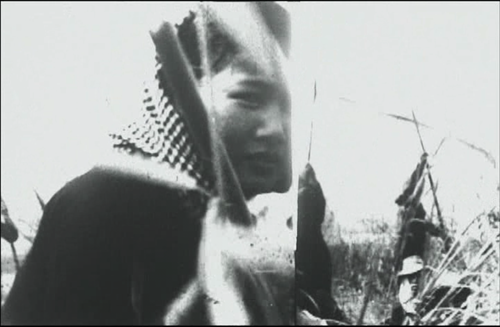
79 Primaveras

CU, 1969, 35mm, b/w, sound, 24’

A tribute to Ho Chi Minh, the revered leader of the Viet Min independence movement who had defeated French Indochina and founded the Democratic Republic of Vietnam. The justly celebrated 12 minute sequence in which newsreel footage of soldiers is destroyed exemplifies Alvarez’s declaration that “my style is the style of hatred for Imperialism.”

Nicolás Guillén Landrián
Coffea Arábiga

CU, 1968, 16mm to video, b/w, Spanish with English subtitles, 18’

The Cuban Film Institute commanded Landrián to make a propaganda documentary to show how to sow coffee around Havana. The result is a didactic film, which at the same time managed to betray the official proposal. The great irreverence: the use in the soundtrack of a forbidden song by The Beatles, The fool on the hill, when Castro walks to a podium for a speech. The documentary was exhibited but banned as soon as the coffee plan collapsed.

Nicolás Guillén Landrián
Desde La Habana ¡1969! Recordar

CU, 1968, 16mm to video, b/w, Spanish with English subtitles, 18’

Steeped in verbal and visual repetitions, the film presents itself as a sort of chronicle of the salient and traumatic events of the 1960’s, but it also points out the oppressive effect of inescapable propaganda on daily existence. It was censured for being “inconsistent with the Cuban context.”

Humberto Solás
Simparelé

CU, 1974, 16mm to video, b/w, Spanish with English subtitles, 28’

Simparelé synthesizes the primary forms through which the Haitian people have expressed themselves in the centuries since the island’s colonization by the French and the massive importation of African slaves to fuel its plantation economy. The film acknowledges the powerful role which Afro-Haitian culture has played in these people’s political struggle as both repository for people’s history and the raw material from which that history can be reconstructed and transformed.

——————————————————————————————————————————————————————-
palestinian-revoluti_b53bdf.jpg

13:30 KASKcinema // Talk-screening

Splicing the Militant Cinema
Subversive Film (Mohanad Yaqubi & Reem Shilleh)

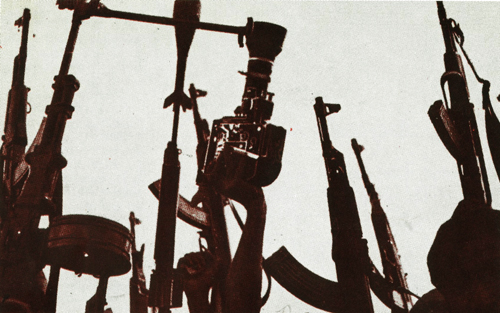
In 1968, a group of young filmmakers decided to establish a film unit affiliated with the Palestinian Revolution newly active in Amman, Jordan. The unit was called Palestine Film Unit (PFU) and was working with Al Fatah, one of the Palestinian Libation Organization (PLO) factions that adopted armed struggle as the only way to liberate Palestine. When the PFU was established, not only did it furnish the revolution with cinematic vocabularies, but it also addressed the decades old dilemma of invisibility of the Palestinian people and would offer apparatus for reclaiming visibility. At a later time the work of the unit became a major part of the Palestinian revolutionary cinema. This presentation tracks life and work of the PFU and its members as an example of a militant cinema practice in the 1960’s and ‘70’s, when filmmakers believed cinema could change the world.

Subversive Film is a cinema research and production initiative that aims to cast new light upon historic works related to Palestine and the region; to engender support for film preservation; and to investigate archival practices and effects. Other projects developed by Subversive Film to explore this cine-historic field include the digital reissuing of previously-overlooked films, the curating of rare film screening cycles, and the subtitling of rediscovered films. Subversive Film was formed in 2011 and is based in Ramallah and London.

——————————————————————————————————————————————————————-
187-ici-rien-7.jpg

16:00 KASKcinema // Talk-screening

Dissident Images
Raquel Schefer, Ramiro Ledo Cordeiro, Daphné Hérétakis

In 1982, in the short film Changer d’Image – Lettre à la bien aimée (To Alter the Image), Jean-Luc Godard reflected upon the difficulty to produce an image of change likely to induce and formally represent change. Can an image of change give rise to change? Must an image of change be an altered image? A politics of aesthetics underlays these questions, as they point out to the poetics and politics of the film image, to the intrinsic articulation of its aesthetic and pragmatic dimensions. Representing current class struggle in Southern Europe, Daphné Hérétakis’ Ici rien (2011) and Ramiro Ledo Cordeiro’s Vida Extra (2013) reclaim a poetic political cinema, leading a formal creative synthesis between historical legacy and emergent audiovisual forms which undermines established categories. Daphné Hérétakis and Ramiro Ledo Cordeiro will be present to show their work, to discuss these aporias of image, aesthetics and politics, and to rethink the relationship between art and politics in the context of an open collective debate.

Raquel Schefer is a filmmaker and researcher. She is presently doing a PHD in Cinema Studies at the Université de la Sorbonne-Nouvelle (Paris 3). Politics of representation, remembrance and oblivion, the acts of telling and re-telling, and the non-coincidence between sensorial memory and audiovisual mnemonics are central issues in her work. Historical episodes are approached through personal and familiar narratives, in some cases embedded in the history of Portuguese decolonization.

Ramiro Ledo Cordeiro works as an independent filmmaker and a film editor. His work, influenced by the thinking of Alain Badiou and Jacques Rancière, reviews political cinema in the light of an overall “redistribution of the sensible”. Vida Extra (2013), inspired by Peter Weiss’ The Aesthetics of Resistance, proposes a cinema praxis based on the recognition and the circulation of new forms of aesthetic resistance. Re-enunciating the novel through refreshed narrative and aesthetic forms, Ledo Cordeiro reverses the relation of facticity and fiction and reconciles the struggle for political emancipation with sensible experience in the time of a returning pavor nocturnus.

Daphné Hérétakis is an independent filmmaker and a student at Le Fresnoy. While studying documentary film at Paris 8 University, Hérérakis directed Ici rien (2011), an experimental film shot in Exarhia, prime centre of social protest in Athens. A collective dialogic portrait of a country in crisis, Ici rien is a major example of today’s experimental political cinema as it points out to a synthesis of historical aesthetic forms and a new horizon of political expectations. Crisis is represented through images of a joie de vivre.

Screening:
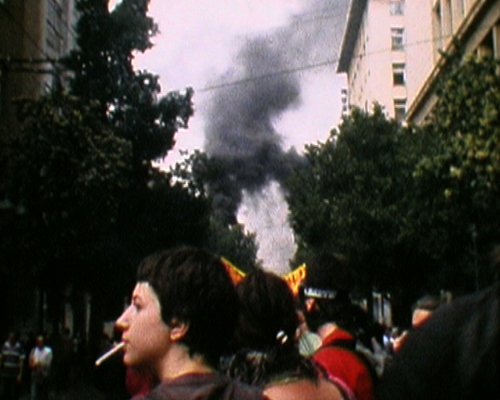
Daphné Hérétakis
Ici rien

FR/GR, 2011, 16mm, Super 8 & Mini DV, color, Greek with English subtitles, 30′

“The shooting of this film started in september 2008, in Exarhia, a major centre of social protest in the heart of Athens. As the months passed and the political situation of Greece evolved, the film became the canvas on which fragments of stories finally found a place, composing the tattered landscape of a country in crisis.” (DH)

Ramiro Ledo Cordeiro
Vida Extra

SP, 2013, video, color, Spanish with English subtitles, 96’

“’The revolution is a game you surrender to for pleasure. Its dynamics are those of the subjective fury of living, not those of altruism’. Almost half a century later, few things seem as far back in time as the International Situationist and its idea of deconstructing the left. However, the current European collapse exposes, now more than ever, the need for new forms of resistance against the strategies of evil and their atrocious advance. In his directorial debut, Ramiro Ledo faces that idea of re-enunciating through the only possible path: self-criticism. First part: an assembly after the occupation of Barcelona’s Spanish Bank of Credit. The images don’t exist, they’re just shadows and flashes that, added to the accumulation of slogans and turns to speak, have the effect of a death certificate. Second part: a table talk, the guests expose their fears and doubts about the indignados, the resistance, the pickets, direct action… Both sides, opposed and indivisible, form what is perhaps one of the most uncomfortable and tough Spanish films in recent memory.” (BAFICI)

——————————————————————————————————————————————————————-
guns_web.jpg

20:00 KIOSK // Exhibition-opening

L’œil se noie
Eric Baudelaire & Mathieu K. Abbonenc

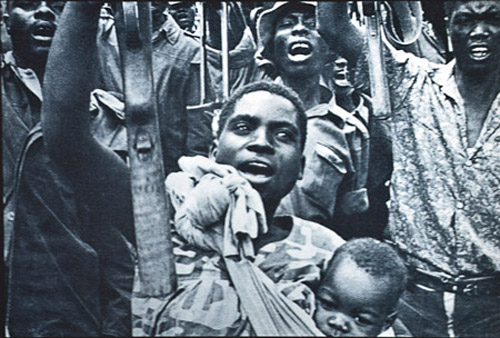
L’œil se noie is the result of an intuitive dialogue between two French artists whose work stems from a shared interest in the gaps and fissures that make up (hi)stories, as well as the challenges and promises they hold. At the heart of their practices is a desire to open up and accentuate the tensions between what has been, what seems to be, and what could have been, to pick up the traces of forgotten and unresolved questions and divert them towards uncertain destinations, out of the dead end circuits where things and thoughts get trapped in their own finitudes. Indeed, this is an exhibition about ‘unfinished business’, as one of the pieces in the show suggests. Sometimes quite literally, as in the case of Mathieu’s search for Sarah Maldoror’s Guns for Banta, a film dealing with the struggle for the Independence of Guinea and Cape Verde that has never seen the light of day, or Eric’s ‘makes’ (as opposed to remakes) of some of Michelangelo Antonioni’s unrealized scenarios. In other cases, their work consists of a rewiring of the connections between one sense and another, or between one time and another, as in ça va, ça va, on continue, which highlights the complications implicit in remembering, representing and voicing distant histories of anti-colonial revolt and revolutionary insurrection, or Chanson d’Automne, an assemblage of clippings from The Wall Street Journal dated September 2008, revealing a poetry of resistance within the fracture lines of a dysfunctional economic order. At odds with all laments of the ‘death and the image’ and the ‘end of history’, the works in this exhibition propose a renewed faith in the hidden potentialities of the present, puncturing the impasses and aporias of finitude, giving way to spaces for wandering and wondering that are bound to remain incomplete.

(RELATED SCREENING on SUNDAY 6 April 11:00 SPHINX: Eric Baudelaire, The Ugly One)

——————————————————————————————————————————————————————-
eastman.jpg

22:00 MINARD // Concert

Crazy Nigger – Gay Guerilla
Julius Eastman

“What I mean by niggers is that thing which is fundamental, that person or thing that attains to a basicness or a fundamentalness, and eschews that which is superficial, or, could we say, elegant… There are 99 names of Allah, and there are 52 niggers.”
– Julius Eastman, Jan 16 1980, Northwestern University

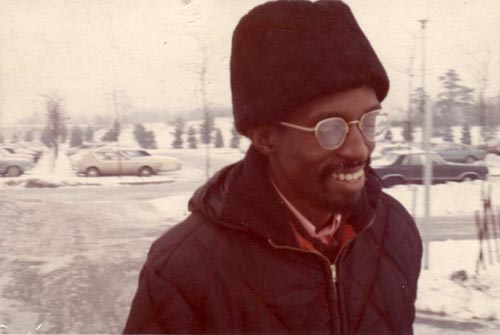
When Julius Eastman took the stage of the concert hall of the Northwestern University to explain the titles of the pieces that he and three other pianists were about to perform, he could not have known that this appearance would be the most lasting statement about his music. Having studied with the likes of George E. Lewis, Morton Feldman and Lukas Foss, all signs pointed towards a bright future for this composer. By 1980 Eastman was performing his music all over Europe and the States and he was an integral part of the thriving Downtown scene in New York, where he recorded with Arthur Russell and Meredith Monk. But for all this promise, his self-destructive behaviour inevitably caught up with him. When he passed away on May 28 1980 in a hospital in Buffalo, the news took more than seven months to reach New York. With the scarce recordings and scores of his music scattered all over the place, attempts to reconstruct Eastman’s output are doomed to remain incomplete. Only fairly recently a selection of his work has been made available, including the trilogy Evil Nigger, Crazy Nigger & Gay Guerilla, which represents in so many ways the intense brilliance of this ‘forgotten minimalist’. These compositions for multiple pianos took the minimalist device of additive process to a whole new structural level, building up immense emotive power through the incessant repetition of rhythmic figures, a composing technique he called ‘organic music’. The titles of the pieces exemplify the rebellious attitude of Eastman, as someone who has always struggled with identity, yet never without casting a new life; someone who has steadfastly eschewed compromise, yet giving rise to a body of work that continues to startle and engage.

Musicians: Frederik Croene, Stephane Ginsburg, Bob Gilmore, Reinier van Houdt
Entrance fee: € 8 / 10

in collaboration with art centre Vooruit.

——————————————————————————————————————————————————————-

Later that night: COURTISANE PARTY with Cooly G, HIELE, Gerard Herman, Phonetics, Simon Hold

More info: www.courtisane.be
Across the Margins, Beyond the Pale

touki-bouki-3-1-g.jpg

Courtisane Festival 2014, 2 – 6 April 2014

“Each generation must, out of relative obscurity, discover its mission, fulfill it, or betray it.”
– Frantz Fanon

An anthropological mockumentary, a baroque anti-symphony, a surrealist counter-ethnography, a revolutionary musical comedy, a porno-misery parody and a cubist road movie. What do all these films have in common? At first sight hardly anything, except for the fact that they all seem to be rooted in a world that is still classified “third”, a world marked by broken promises and shattered dreams, haunted by the spectres of colonialism and the realities of imperialism. These films are distant echoes from a time when a roaring call for a “third” cinema was resounding, one that could expose cruel realities and chase away unwanted ghosts: a cinema of liberation, not owing anything to the workings of the dominant order; a cinema of opposition, found on the outer edges of the overdeveloped world, always South to someone else’s North. These films are all that, and they are not. They do speak of the incoherence of underdevelopment and the discards of colonialism, and yet they refuse to conform to the imperatives of urgency and pedagogy that are bound up with these motives. They do take position against established powers and manifest a desire to overcome the past, but also resist any prescribed directions and prefer to reimagine unforeseen futures. They struggle hard to look for identity, but they do so through the very dismissal of the identities that are imposed by others. Outrageous, hilarious, vertiginous, delirious: this is a cinema that has nothing to lose, and everything to gain; a cinema that chooses to forsake the trodden pathways, only to find itself in a state of complete sovereignty. In all their dislocated intensity, unfathomable glory and impossible hope, this is the stuff that foolish dreams are made of.

In collaboration with the Royal Belgian Film Archive. In the framework of “Figures of Dissent (Cinema of Politics, Politics of Cinema)” (KASK/HoGent).

——————————————————————————————————————————————————————-

Djibril Diop Mambéty
Touki Bouki (The Journey of the Hyena)

SN, 1973, color, Wolof spoken with English subtitles, 35mm (restored), 95’

touki.jpg

“That’s the way I dream. To do that, one must have a mad belief that everything is possible – you have to be mad to the point of being irresponsible. Because I know that cinema must be reinvented, reinvented each time, and whoever ventures into cinema also has a share in its reinvention.“
– Djibril Diop-Mambety

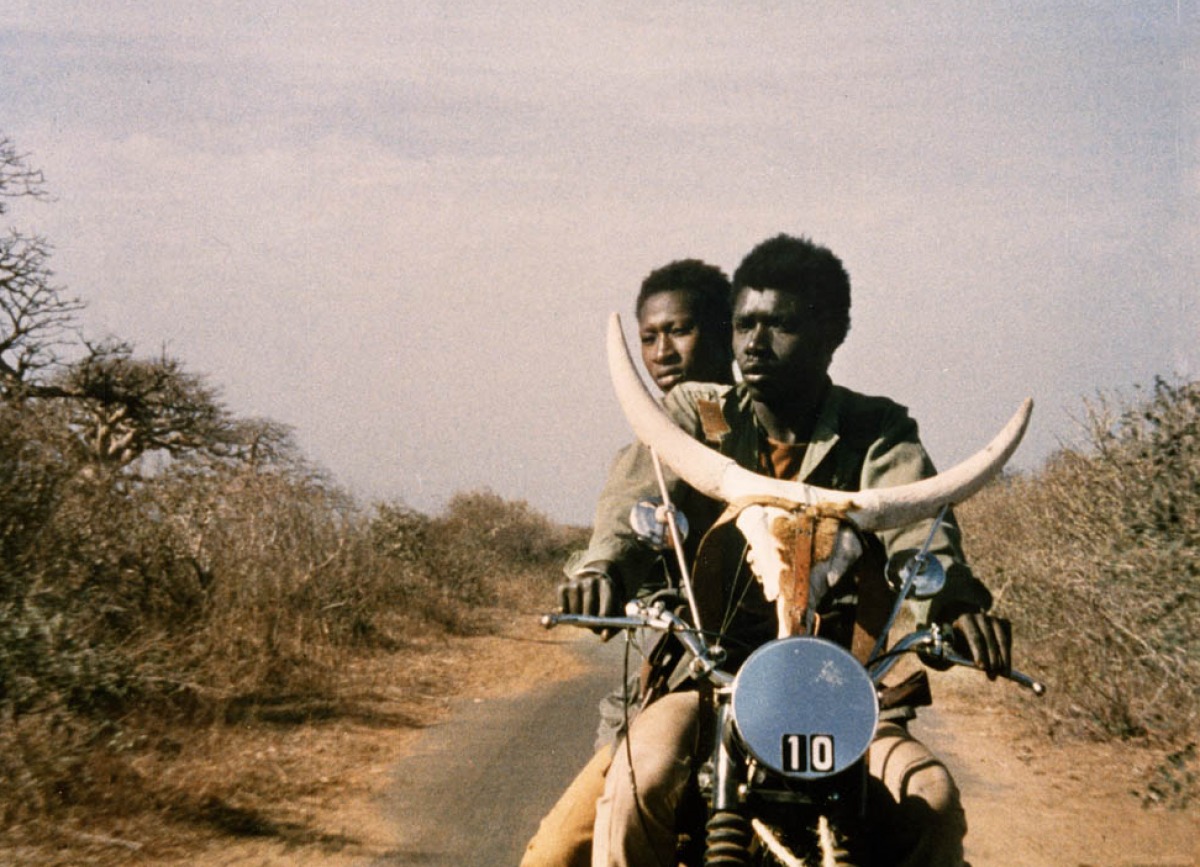
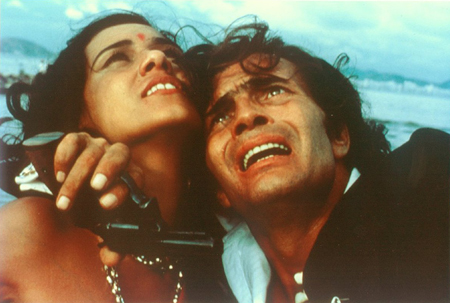
Touki Bouki portrays the wanderings of Mory and Anta, who roam all over Dakar in pursuit of their dream of escaping to France. “The story of Touki Bouki goes back centuries: men have always set out for new lands where they believe time never stops… Only few adventurers seem to make it, but that has never stopped anyone… Djibril left his country with the dream of finding success and solace in Europe. He soon discovered, however, the cruelty of life. While his dream fell apart little by little Djibril found he was unable to leave “Europe”, his host country. That was when returning to Africa became the real dream for him. Ending his days in Africa was a dream he would never fulfill. Touki Bouki is a prophetic film. Its portrayal of 1973 Senegalese society is not too different from today’s reality. Hundreds of young Africans die every day at the Strait of Gibraltar trying to reach Europe (Melilla and Ceuta). Who has never heard of that before? All their hardships find their voice in Djibril’s film: the young nomads who think they can cross the desert ocean and find their own lucky star and happiness but are disappointed by the human cruelty they encounter.” (Souleymane Cissé)

——————————————————————————————————————————————————————-

Kidlat Tahimik
Mababangong Bangungot (Perfumed Nightmare)

PH, 1977, color, Tagalog spoken with English subtitles, 16mm, 93’

perfumednightmare.jpg

“Maybe I’m just an accumulator of images and sounds and then I make a tagpi-tagpi [patchwork] and sew them together. I just work with images and I put my sounds on them and then I release a flow of thoughts and start juggling the sequences back and forth. I don’t try to find surrealist images even in the way as it happened in Perfumed Nightmare. I was a madman when I was making that film and I still am.”
– Kidlat Tahimik

For his first film, Kidlat Tahimik (meaning “quiet lightning” in Tagalog) drew on his own experience living “in a cocoon of Americanized dreams” for this tale of a village jitney driver, faithful student of Voice of America and its many lessons, and founder of his local Werner Von Braun fan club. Kidlat hopes to become an astronaut, or at the very least to strike it rich in the promised land. He makes it as far as Europe, where a series of rude and comical awakenings unfolds and Kidlat learns that the modern Western world is far from paradise. Tahimik, who later became a protégé of Werner Herzog in Munich, is a faux naif who uses the genuine naiveté of his hero – like Chaplin’s Little Tramp – to inscribe a powerful portrait of the American colonization of Filipino dreams. But, like the charming, festooned “jeepny” Tahimik constructed from an abandoned U.S. Army vehicle, the film creates something wholly original and imaginative from the discards of colonialism. In the words of Susan Sontag: “ Perfumed Nightmare makes one forget months of dreary moviegoing, for it reminds one that invention, insolence, enchantment – even innocence – are still available on film”

——————————————————————————————————————————————————————-

Arthur Omar
Triste Trópico

BR, 1974, color, Portugese spoken with English subtitles, 16mm to video, 75’

triste.png

“I am fascinated by sound interference and remixes, ultra-editing, blending, everything that goes beyond the immediateness of the image and the verbal. Words, depositions, speech; for me it’s all raw material to be modulated. I’m not interested in anything that preexists the images, but the production of an experience through the image, in the image, like a chemical reaction in the brain, that can only occur there.”
– Arthur Omar

The biography of an imaginary doctor who left Brazil to study in France where he became friends with André Bresson, Max Ernst, and Pablo Picasso, and somehow ended up as an indigenous messiah. “A galaxy of discontinuous images. With a new presentation of the conflict between the coast and the sertão, Triste Trópico proposes a criticism, full of irony and hallucination, of the anthropological discourse in the tropics. Its main character, a surprising petit bourgeois doctor, embarks on a journey that will invert the sense of Levi-Strauss demarche, as expressed in his book Triste Tropique. The allegory of Cinema Novo was conceived as an unveiling, whereas the allegory of Triste Trópico is a movement towards opacity, and what poses a problem is the very act of reading. Triste Trópico is meta-cinema and, from this point of view, it is different from the forms of anti-colonialism of the 70s in Brazil”. (Ismail Xavier)

DUE TO THE UNAVAILABILITY OF A COPY OF ‘TRISTE TROPICO’, THE FILM WILL BE REPLACED BY ‘HOW TASTY WAS MY LITTLE FRENCHMAN’
——————————————————————————————————————————————————————-

1312258945how_tasty_was_my7.jpg

Nelson Pereira dos Santos
Como era gostoso o meu frances (How Tasty Was My Little Frenchman)

BR, 1971, 35mm, Tupi, French and Portuguese spoken with English subtitles, 84’

“The government broadly financed historical films, but it wanted the history to be within official parameters – the hero, the father of the country, all those things we have been told since elementary school. I made How Tasty Was my Little Frenchman, which does not correspond in any way to the official vision of history, under these circumstances. The film was not even considered to be historical, but rather purely fictional, as if official history were not fiction.”
– Nelson Pereira dos Santos

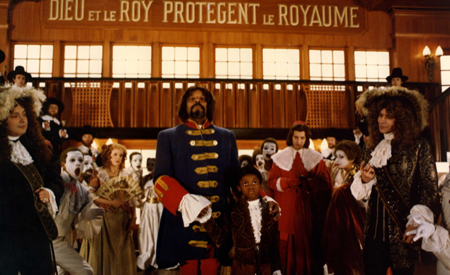
Jaundiced cultural allegory dressed up as anthropological re-creation, How Tasty Was My Little Frenchman slyly links Montaigne’s who-are-the-real-savages query to Brazil’s military dictatorship. Pereira draws from multiple historical sources—especially German explorer Hans Staden’s 1557 memoir—to tell the story of a French soldier’s experience as a captive of the cannibalistic Tupinambá tribe. “Pereira constructs a comic horror film in which sixteenth-century intertexts are read as current events in an analogy of colonialism with global capitalism. This film is Pereira’s response to Brazil’s building of the Trans-Amazon Highway, in the course of which contact with indigenous communities was made that threatened them with near extinction. The current destruction of habitat and native populations recalled to Pereira the traumas of colonization…The ingesting of foreign invaders thus becomes for Pereira a metaphor for indigenous resistance to global capitalism, the most recent form of economic colonization.” (Virginia Higginbotham)

——————————————————————————————————————————————————————-

Carlos Mayolo & Luis Ospina
Agarrando pueblo (The Vampires of Poverty)

CO, 1977, color & b/w, Spanish spoken with English subtitles, 16mm to video, 28’

agarrandopueblo_luisospina.jpg

“In the early 1970’s there appeared a certain type of documentary that superficially appropriated the achievements and methodologies of independent film to the point of deformation. In this way, poverty became a shocking theme and a product easily sold, especially abroad, where it is the counterpart to the opulence of consumption… We made a kind of antidote or Mayakovskian bath to open people’s eyes to the exploitation behind the miserabilist cinema which turns human beings into objects, into instruments of a discourse foreign to their own condition”.
– Carlos Mayolo & Luis Ospina

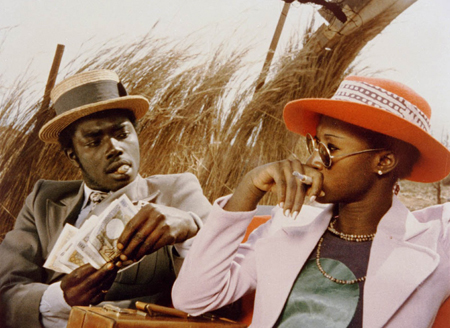
Filmed in Cali and Bogotá, Agarrando pueblo follows an unscrupulous film director as he and his cameraman wander around the cities looking for unwilling subjects for a documentary commissioned by German television. “Deliberately detached from the accusatory militant left, Luis Ospina and Carlos Mayolo launch in 1978 what could be called their cinematic-political thesis: Agarrando Pueblo (The Vampires of Poverty), an outrageous protest of national and international documentary models, which at the time – and even today – shamelessly exploited all kinds of third-world suffering (referred to by the directors as “poverty-porn”) and exported it to European television stations and festivals. Counterinformative from beginning to end and in every sense of the word, the film mixes staged and real scenes of a typical film crew commissioned by a Germany television channel to seek out archetypical social horrors, trampling over the basic principles of professional ethics, the meaning of information and – naturally – sociological research.” (Isleni Cruz Carvajal)

——————————————————————————————————————————————————————-

Med Hondo
West Indies (ou les nègres marrons de la liberté / The Fugitive Slaves of Liberty)

MR/DZ, 1979, color, French spoken with English subtitles, 35mm, 113’

west-indies-640-3.jpg

“For too long a time, African cinema has been conceived as a poor cinema, a cinema of approximations where techniques did not match ideas … Militant cinema can thus be beautiful and rich … Indeed, West Indies … is no more a West Indian film than an African film. It is a film which summons all the people whose past is made out of oppressions, whose present is made out of aborted promises and whose future is left to be conquered.”
– Med Hondo

A single-set color musical tracing the history of the West Indies through several centuries of French oppression. “Med Hondo’s West Indies is a revolutionary musical in both senses of the word. This witty, scathing production offers an angry view of West Indian history, using imaginative staging and a fluid visual style. The film’s single set is an enormous slave ship [built in an unused Citroen factory in Paris]. Mobile camerawork and frequent narrative shifts take the actors through various vignettes about French colonialists invading the Indies, Carribean natives lured to Paris, the process by which the islands were first settled and a lot more. The material has the potential for overbearing irony but Mr. Hondo has a light touch. With cast members rotating their way through many different roles (the same actors may play slaves, then worried island villagers, then displaced West Indians)… Mr. Hondo leads the film through a long series of well-connected tableaux, culminating in an almost joyous call to arms.” (Janet Maslin)

——————————————————————————————————————————————————————-

Glauber Rocha
A Idade da terra (The Age of the Earth)

BR, 1980, color, Portugese spoken with English subtitles, 35mm, 152’

aidadedaterra1.jpg

“The film develops the same ways, principles, lines, desires of justice and humanism in a world getting more and more destroyed by violence. The film is a barbarous mass, not a civilized mass. Because in substance of cinematographic language, montage, structure, everything was remade, subverted, reorganized. It is a baroque, reconstructivistic style, a very new thing that the Brazilians who saw the film adored.”
– Gauber Rocha

Catholic rituals and Afro-Indian gods, rural mysticism and revolutionary politics, Brahms and Villa-Lobos: this last film by Glauber Rocha, angel-demon of the Brazilian “Cinema Novo”, defies every attempt at unequivocal classification or definition. “It’s not to be told, only to be seen”, he said. A torrential, hallucinatory anti-symphony, a terrifying cry of desperation, a destruction in progress. “He hit himself against the impossible, the impossibility of being a great filmmaker of the Third World, a great black filmmaker. The Age of the Earth is the film of the Third World, there is no other. The others are films that join other films. The Age of the Earth is a great impossibility, a passage through world and time, a discovery of America on the opposite lane, a black Battleship Potemkin, or rather, it informs, full of gestures and rhythm, an extreme anti-classic – a spitting of blood in the face of the current cinema, dominated by sweetness.” (Pascal Bonitzer)

Alexandra Cuesta: Films & Influences

hombre-hr.jpg


17 February 2014 20:30, OFFoff Cinema Gent

At the invitation of art cinema OFFOff, Courtisane is very happy to present a program composed of films made and chosen by artist and filmmaker Alexandra Cuesta (EC/US). Inspired as much by Walker Evans‘s reticent street photography as by Bruce Baillie’s sensuous film poems, her work manages to strike a delicate balance between the mundane and the poetic, the material and the intelligible. Public places and urban landscapes are observed in their splendor and singularity through the abstract and vernacular figures of everyday life, exploring the constructions of space and structures of time that can be found in the order and disorder of people’s daily movements and environments. These filmic portraits in motion, elegantly composed of textures of light and fragments of bodies, are reminiscent of an approach that Flaubert once referred to as an “absolute way of seeing things”, manifesting the sensible intensities of the most ordinary things, on the point of disentangling the connections that make them into functional objects. It is precisely in this point of tension that the sensibility of Alexandra Cuesta’s work is situated, perpetually oscillating between a fleeting play of correspondences and a surface of percepts and affects that is there for us to engage with.

Helen Levitt, James Agee & Ed Howard
In the Street

US, 16mm, b/w, sound, 13’

in-the-street.jpg

“In The Street is reportage as art. It reports the facts, but for their useless beauty above all. While it could be argued that the film tells us how working class residents of Spanish Harlem lived in the 30’s and 40’s – how they looked and behaved, the addition of expository narration could have told us so much more. Statistics and other facts could have helped us put what we see into context and multiplied the use-value of the film. The absence of narration or other texts proves the artist’s intent that we are intended to enjoy the film as a collection of beautiful appearances.” (Roy Arden)

Alexandra Cuesta
Recordando El Ayer

16mm, color, sound, 8’

tren.jpg

Shot in Queens, NY in 2004. Memory and identity are observed through textures of everyday life in a portrait of Jackson Heights, home to a large Latin American immigrant population. Images of street, people, and daily rituals render passing of time in a neighborhood that becomes a mirror not just of another place, but also of the past. The landscape visually reflects the space as a creation of a new home while revealing displacement within the new condition. The meaning of home is explored and built upon collective recollection.

Robert Fenz
Soledad (Meditations on Revolution, Part III)

US, 16mm, b/w, silent, 14’

part_3_soledad_image_two.jpg

Part three of Robert Fenz’ silent black and white series of films that explore the meaning and the resonance of the word “revolution”, shot in Mexico and New York. “The films of Robert Fenz can never be subject to the principles of static analysis: their potential of subversion is always at work. However some traits are common to his entire oeuvre: the critical conscience, the political engagement (which differs from militantism), the desire to know what the shadows withhold, the passion for the other. Fenz reaffirms these prominent traits of his artistic humanist heritage innovating in the construction of a visual sensitivity which opens up elemental questions of idealism from concrete, sensitive and physical observation. Following the path of rhythm, creative improvisation and kinetic description, his cinematographic oeuvre develops a style that is founded on a profound faith on the power of the image – as a source of communication, as a critical tool, as an interior necessity.” (Gabriella Trujillo)

Bruce Baillie
Valentin de las Sierras

US, 16mm, color, sound, 10’

valentin.png

“I just shot simply but used a telephoto lens with an extension tube on the back, which gives you a very limited focal plane, a few inches. No one I know ever uses it with a long lens, especially with a moving subject, but I really liked the way it looked. I had to get into the flesh of that town, with the merciless sun beating into the bricks of the street and all the death-every night there’d be something or somebody killed, lying in the street in the morning. I had met up with this (archetypal) young girl, riding her pony. And I was afraid to meet her father. I’d sent word out trying to see her, and he sent word back to come meet him, and I thought, “Oh, God!”. But he turned out to be a very nice fellow: Manuel Sasa Zamora, of Jalisco. They were very poor and lived behind a big gate and had a horse and a dog named Penquina. That horse didn’t like me and would not let me film. I had to give it up for a while. Later, I named my horse after the film – Valentina.”

Alexandra Cuesta
Piensa en Mi

16mm, color, sound, 15’

carreterahr.jpg

Moving from east to west and back, the windows of a bus frame fleeting sections of urban landscape. Throughout the day, images of riders, textures of light and fragments of bodies in space come together to weave a portrait in motion; a contemplative meditation on public transport in the city of Los Angeles. Isolation, routine and everyday splendor, create the backdrop of this journey, while the intermittent sounds of cars construct the soundscape.

Ernie Gehr
Passage

16mm, color, silent, 14’

passage.jpg

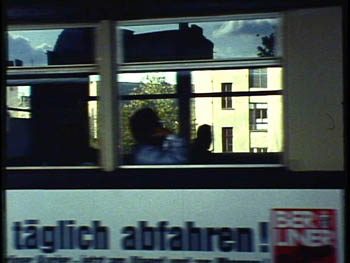
Composed of two intercutting shots of the S-Bahn elevated train through former East Berlin taken before and after the fall of the Berlin Wall, Gehr presents a mundane, yet illuminating glimpse of the profound cultural and economic changes in his ancestral homeland as seen through the city’s transformed – and almost unrecognizable – urban architecture.

Alexandra Cuesta
Beirut 2.14.05

16mm, color & b/w, sound, 7’

moto.jpg

Shot in Beirut, Lebanon during the filming of Ca Sera Beau, From Beyrouth with Love by Wael Nourredine.

Leandro Katz
Los Angeles Station

US, l6mm, silent, 10’

losangelesstation.jpg

“Leandro Katz’s simplest, most direct and probably least ambitious film and yet in many ways it is his loveliest. The results of the systematically structured material is unexpectedly stirring. Because of the impersonal method of construction, the freeze frames are not the result of sudden sentimental tugs. The count sometimes falls very conveniently on an image of natural poses, strikingly set against the backdrop; but just as often, the freeze frame is of a bare wall or an alleyway. The mechanical tension between the handheld camera’s panning and the systematic stops creates disarmingly simple, evocative effects. The freeze may halt a pan or simply congeal an already held moment. In the first case, an image often ends up de-centered, highlighting the broadside of the shack-like dwellings with their inhabitants crowded at the edge. Or, alternatively, a smiling boy, full of animate life and sensuousness, suddenly becomes an anthropological document, frozen evidence of a time, a place, and a culture.” (Tony Pipolo)

Alexandra Cuesta
Despedida (Farewell)

16mm, color, sound, 9’30

field.jpg

Shot in Boyle Heights in East Los Angeles, this neighborhood historically formed by cultural transition resonates with the poetry of local resident Mapkaulu Roger Nduku. Verses about endings, looking and passing through open up the space projected. A string of tableaus gather a portrait of place and compose a goodbye letter to an ephemeral home.