DISSENT ! John Akomfrah

handsworthblog.jpg

20 November 2013 20:30, Cinematek Brussels. In collaboration with le P’tit Ciné.
Talk with John Akomfrah proceeded by a screening of Handsworth Songs.

Black Audio Film Collective, Handsworth Songs

1986, 16mm, color & b/w, English spoken, French subtitles, 60′

“People assume that there are certain transcendental duties that Black filmmaking has to perform. They assume that and because of that Black filmmaking has to work with the understanding that it’s in a state of emergence. And because it is in a state of emergence its means always have to be guerilla means, war means, signposts of urgency. When that begins to inhibit questions of reflection- doubt, skepticism, intimacy and so on- then the categorical imperative does exactly what it is supposed to do- it imprisons.”
– John Akomfrah

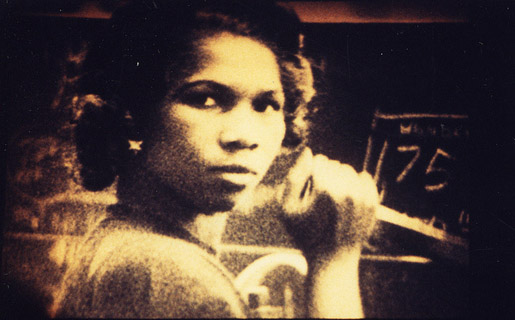
“There are no stories in the riots, only the ghosts of other stories”. The phrase lingers over the film like a haunting refrain, reverberating across and between the ghostly traces of lived moments floating over the surface of the screen, somewhere between faded history and tainted memory, between the historical and the allegorical. Handsworth Songs was the first film John Akomfrah made with the Black Audio Film Collective, a group of artists, critics and filmmakers who set out to intervene in the cultural debate about black identity and representation that was raging all over Britain in the 1980’s. The spark that lit the fire was arguably the “civil disorder“ of 1981, when a wave of violent unrest swept through some of England’s inner cities. It was this event that painfully exposed the gap between the dominant discourses on ethnicity and “Britishness” and what was intimately felt and experienced by the “bastard children of 1968”, those who were profoundly shaped by what Derek Walcott called “the absence of ruins”. The challenge then, became one of generating counter-narratives, to look for aesthetical forms which would allow for a space to deconstruct the hegemonic voices and articulate states of belonging and displacement in dissensual ways. The question of form turned out to be one of dealing with absence: the lack of “ruins” made it necessary to look into the dark mirror of the past in search of images, words and sounds to attest to the intangible presence of diasporic histories. In Handsworth Songs, a response to the second Handsworth riots in 1985, Akomfrah discards the didactic panoptic impulse of the documentary film tradition in favor of a polytonic structure in which eye-witness accounts, mediated voice-overs and a mosaic of sounds intersperse with a poetic montage of archival footage. It is here, in unearthing the phantom narratives of the past to give them a new place in the present as a promise to the future, that can be found the essence of john Akomfrah’s work, up until this day.

DISSENT ! is an initiative of Argos, Auguste Orts and Courtisane, in the framework of the research project “Figures of Dissent” (KASK/Hogent), with support of VG & VGC.

On 21 November John Akomfrah will also be presenting his film Testament at KASKcinema, Gent.

The visit of John Akomfrah has been made possible with the support of Brussels Arts Platform and VUB Doctoral School of Human Sciences.
——————————————————————————————————————————————————————-
About DISSENT!

How can the relation between cinema and politics be thought today? Between a cinema of politics and a politics of cinema, between politics as subject and as practice, between form and content? From Vertov’s cinematographic communism to the Dardenne brothers’ social realism, from Straub-Huillet’s Brechtian dialectics to the aesthetic-emancipatory figures of Pedro Costa, from Guy Debord’s radical anti-cinema to the mainstream pamphlets of Oliver Stone, the quest for cinematographic representations of political resistance has taken many different forms and strategies over the course of a century. The multiple choices and pathways that have gradually been adopted, constantly clash with the relationship between theory and practice, representation and action, awareness and mobilization, experience and change. Is cinema today regaining some of its old forces and promises? Are we once again confronted with the questions that Serge Daney asked a few decades ago? As the French film critic wrote: “How can political statements be presented cinematographically? And how can they be made positive?”. These issues are central in a series of conversations in which contemporary perspectives on the relationship between cinema and politics are explored.

Possessions: Mother Dao

mother_dao_young_indonesian_boy.jpg

29 November 2013, Magic Cinéma, Paris.
In the context of Possessions, organized by Khiasma in collaboration with Phantom, 14 Novembre – 7 December 2013. A proposal by Stoffel Debuysere.

Vincent Monnikendam
Moeder Dao, de schildpadgelijkende (Mother Dao, the Turtlelike)

NL, 1995, 35mm, b/w, Indonesian spoken, French subtitles, 89′

How are we to look at these images of a faded past, a far away land, a forgotten people? How are we to approach these fleeting impressions without a commentary to guide our gaze, deprived of a message to arouse our consciousness? At the outset, we are informed that the film consists of footage shot in the former Dutch East Indies (now Indonesia) between 1912 and 1933, footage destined to legitimize the workings of the colonial system and exhibit the civility of the colonizers. Images of petrified forests and bucolic landscapes give way to scenes of manual labor and illustrations of the ruler’s mission of enlightenment. Not once are we explicitly reminded of the violent exploitation and repression exercised under Dutch colonial rule, not once are we confronted with testimonies of cruelty and revolt. Instead, what we get to hear are voices murmuring ancient and modern poems and songs of the Niassers, the Toradjas and the Sundanesians. But what these laments of sorrow attest to is not only the struggle and hardship lived through but above all the capacity of those deemed without capacity to recount their own story, to account for their own situation and the will to change it. And what these voices help to bring to the surface of the images is not so much the revelation of the face of oppression, but rather a change in appearance, displacing the imagined figures of subordinate blessedness with manifestations of dignity, contemplation and the equal aptitude to think and live in accordance with the injustice suffered. Because something in the image always resists: something that escapes the look of the beholder handling the camera and the powers guiding it, something that goes beyond the inherent inequality between those filming and those being filmed, between the active and the passive. The lens captures all without conscience or calculation: the dominated and the dominator, the intended and unintended all share the same image. It is this undecidability that allows for a change of view that is also a refiguration of the possible: each representation of a world holds another world.

In the context of the research project “Figures of Dissent (Cinema of Politics, Politics of Cinema)”
KASK / School of Arts

In collaboration with Courtisane

Figures of Dissent: Ritwik Ghatak

jukti2_lowres.jpg

3 October 2013 20:30, KASKcinema, Gent. A Courtisane event.
introduced by Stoffel Debuysere

“I believe in committed cinema… committed to that contemporary reality, to the daily acts of heroism in that reality. No important work can be created without this commitment, I think… Because this commitment presupposes a desire for change of that reality.”
– Ritwik Ghatak

Jukti Takko Ar Gappo (Reason, Debate and a Story)
1974, 35mm, b/w, Bengali with English subtitles, 120′

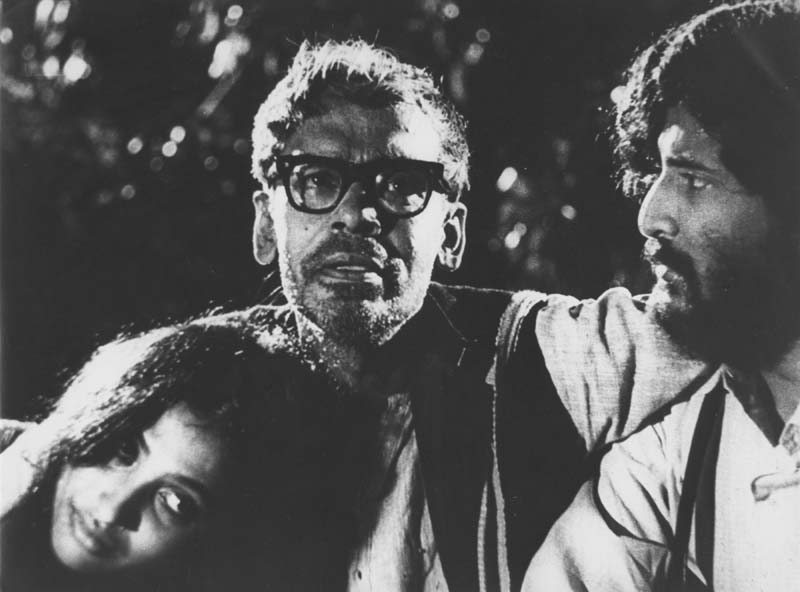
In 1947 Ritwik Kumar Ghatak (1925–1976) was one of the over 10 million refugees who left behind their homes in East Bengal, fleeing from the surge of communal violence and human devastation that erupted in the aftermath of the Bengal famine and the partition of India. The terrible specter of this tragedy would continue to haunt Ghatak’s life and work, until his body and mind finally gave up thirty years later, ravished by illness and alcohol. Thirty years of struggle, against the postcolonial establishment, against the political and intellectual corruption of the middle class, against the crumbling appearance of a divided Bengal, against a world denying its own people their dignity and humanity. A struggle he began in the realms of literature and militant theatre, before taking up the camera and making his foray into cinema, the only medium he saw capable of reaching a mass audience – a wish that, in regards to his own work, sadly never came true during his lifetime. In his quest to express his pangs and agonies about his suffering people and reawaken the suppressed powers of Bengali culture and history, he chose to experiment with one particular form: the epic melodrama. But rather than looking towards the obvious example of Hollywood for inspiration, Ghatak found his touchstones in the cinema of Sergei Eisenstein and Ray Satyajit, the theatrical traditions of Bertold Brecht and Constantin Stanislavski, and especially the poems and songs of Rabindranath Tagore, considered by many as the pinnacle of Bengali culture. One of the most accomplished and heart-rending uses of Tagore’s music can surely be found in Jukti Takko Aar Gappo, Ghatak’s final, most autobiographical and allegorical film, in which he himself played his own role: that of a tormented leftist intellectual, burdened and ultimately broken by the weight of history.

In the context of the research project “Figures of Dissent (Cinema of Politics, Politics of Cinema)”
KASK / School of Arts

Figures of Dissent: Nagisa Oshima

deathbyhanging.jpg

2 May 2013 20:30, KASKcinema, Gent. A Courtisane event.
introduced by Stoffel Debuysere

“Rather than being our own, the labors of our days are merely a series of things we are made to do by those outside ourselves. We live lives that are even more evanescent than the bubbles floating along the stream – and even more meaningless. The reason we show an abnormal interest in crime and scandal is that a life, which usually drifts by, thereby appears caught up by a pole in the river’s flow. A drowning man grasps at straws. For we find, in crime and scandal, a tiny trace that reminds us of human dignity.”
– Nagisa Oshima

Kôshikei (Death by Hanging)
1968, 35mm, b/w, Japanese with English subtitles, 119’

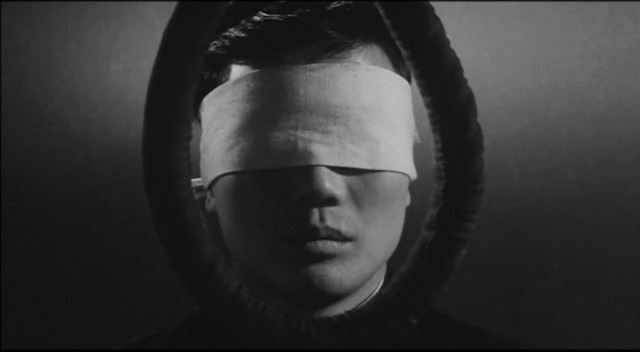
“I must cultivate this painful bitterness and make it explode”, wrote Nagisa Oshima (1932 – 2013) in 1965. And so he did. The filmmaker who would later gain worldwide fame with films such as Ai no Korīda (In the Realm of the Senses) and Merry Christmas Mr. Lawrence, witnessed with great disquiet how postwar Japan, under the guise of nationalism and conformism, rendered itself increasingly guilty of imperialism and racism. His boundless outrage resulted in a series of fiery cinematographic accusations, in which he mercilessly dispensed with the hypocrisy of the Japanese “police state”. The eternal recalcitrant hardly found support or congeniality within the bastion of his native cinema – which he despised – but it didn’t take long before he was taken in by the movements that were emerging in the European film landscape. No wonder Oshima was called the “Japanese Godard” (a platitude he wittily countered by calling Godard “the French Oshima”) and his films were catagorized as part of the Japanese “New Wave” (a label he obviously rejected). However, he himself rather found inspiration in the Japanese underground theatre (“Ungura”), which tried to reconcile the politically engaged ideas of Vsevolod Meyerhold and Bertold Brecht with premodern Japanese traditions. The majority of Oshima’s films from the 1960s are the result of his efforts to translate the characteristic game with constrained space and dynamics between language and form, to cinema. Of these films Kôshikei (Death By Hanging) is undoubtedly his most “Brechtian” work, not only by implicitly refering to the Threepenny Opera, but also in making extensive use of “Verfremdung” techniques. Not for nothing this radical and complex indictment of the Japanese legal system, based on the so-called “Komatsukawa incident”, was called “the most fantastic scenario in the history of cinema” by Luc Moullet. Oshima described the stakes of the film as follows: “As long as the state makes the absolutely evil crime of murder legal through the waging of wars and the exercise of capital punishment, we are all innocent.”

In the context of the research project “Figures of Dissent (Cinema of Politics, Politics of Cinema)”
KASK / School of Arts

ARTIST IN FOCUS: Leslie Thornton

peggy.jpg

In the context of the Courtisane festival 2013 (Gent, 17 – 21 April)

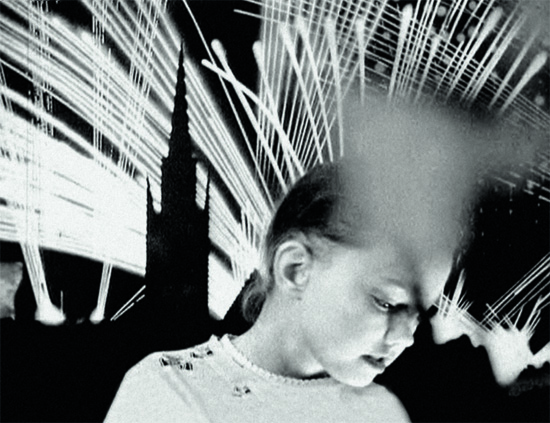
Our culture is a culture of fear, or so it is said : the fear of uncertainty, of otherness, of everything that stands in the way of consensus. It is a fear that is not least cultivated by the mass media, driven by a logic of anticipation and premediation. It is a culture that was already anticipated a few decades ago in the form of a remarkable science-fiction parable: Leslie Thornton’s Peggy and Fred in Hell. This consecutive series of films, whose first episode dates from 1985, portrays the lives of two children, the only survivors in a post-apocalyptic landscape, who create their own imaginary world in the midst of the debris of the 20th century. The relationships between technology, identity and subjectivity that characterize today’s media culture are no longer applicable here, but they shimmer and reverberate in the form of shadow images and echoes. In the meantime, the children have grown up, the future has become part of the past, analogue became digital: reality seems to be catching up with Thornton’s fiction at an ever increasing rate, but it continues to steadily mutate, ceaselessly assessing the remains of a human culture in an expanding body of raw data. It is this critical perspective of the relationship between society and technology that forms the consistent thread throughout the entire oeuvre of Leslie Thornton, whose father and grandfather both worked on the development of the atom bomb during World War II. The awareness of the ambivalences between the personal and cultural, the local and the global, forms the basis of her far-reaching and profound investigation into the aporias of language and media, one that moves on from where the tradition of the American avant-garde left off.

——————————————————————————————————————————————————————-

fred-sings.jpg

20 April 2013 20:00 Paddenhoek

Leslie Thornton
Peggy and Fred in Hell

US, 2013, 16mm, video, b&w, colour, 95′

A unique screening of the completed cycle of Thornton’s epic serial, ending with the world premiere of the closing episode, The Fold. The presentation will include both film and video running simultaneously, in a recreation of its original form as a multi-screen, multiple format event.

“Peggy and Fred in Hell is a very strange project. I don’t think there’s anything else in the world quite like it. From the beginning I knew I was doing something strange. I was very turned on by the two children when I first met them. They were my new neighbors and it was love at first sight. I had already conceived of the project but intended to shoot with two adults, an eccentric couple actually named Peggy and Fred. Meeting the children changed my plans and my approach. With the adults I would have developed a loose script. But with the children that wouldn’t work and I needed to invent a motivation that would allow me to shoot freely, to capture whatever might unfold between us. I saw myself as the eye of an Artificial Intelligence (AI) entity. They were the sole survivors in a post-apocalyptic world, and I was observing them, studying them, to learn about this thing called “human,” this thing that made both “me” (AI) and them (…) Then one day recently I just woke up and wrote the end, in which the entity reveals itself. It explains that it has been studying human emotion. It tells jokes and is its own judge and jury. It is completely alone, except for these children, these images of two children. It may even know enough to realize it is alone, lonely, because it has been teaching itself how to learn. So it is the-robot-that-feels, in the end, a common science fiction pretense. What is different, though, is that you don’t know it was there all along, running the show. This final episode will provide closure for Peggy and Fred, in a twisted, self-reflexive act of revealing “the maker” who is also the fictional audience or voyeur, an audience of one.” (from an interview with Katy Martin, 2011)

——————————————————————————————————————————————————————-

21 April 13:30 SPHINX cinema

The Most Impossible Work

Leslie Thornton
((((( )))))

US, 2009, HD, colour, 9′

“((((( ))))) derives its title from the obsessional punctuation of Raymond Roussel, the parentheses within parentheses, worlds within worlds, housing a tunnel space of endless imbeds. (((( ))))) — reflections in a golden eye. The glass menagerie of the vitreous humor from both sides of the glass, an active gaze “on location” that cannot be penned… ((((( ))))) is a cycling of regenerative ingestion, devouring radiance. A porthole, a portal, mimicking wellspring. In this terraced lapidary setting where any object could substitute for another we sense the governing madness in the ordained order. Or in reverse, a lucid logic wormholing through quotidian chaos. Every habitat rendered into Dioramas of the natural world, an accordion expansion of consciousness and the cosmos, all under observation by something, somewhere, sometime… As in Peggy and Fred in Hell we feel the operations of an artificial or outside intelligence, a god machine dealing shuffled hands from the infinite playing deck, as indicated by the Upanishads: “Wise intelligent, encompassing, self existent, it organizes objects throughout eternity.” (Mark McElhatten)
saharamojave.jpg

Leslie Thornton
Sahara/Mojave

US, 2007, HD, colour, 12′

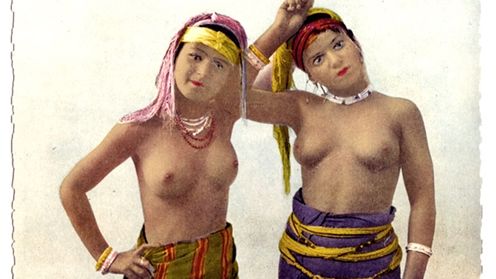
Thornton describes Sahara/Mojave as a “little trip to Hollywood via North Africa, circa 1900. I hone an ‘aesthetics of uncertainty’ to question our understanding of the real.” Here Thornton pairs two disparate media sources, a collection of vintage erotic North African postcards and video footage that she shot at Universal City, Los Angeles. The images are overlaid with a dense audio collage that includes the narration from an archival documentary on the Sahara and the Bedouin people of North Africa. The result is in an elliptical inquiry into culture, history and representation.

A reading by Leslie Thornton of her text, “Philosophers Walk On The Sublime” (2013)
warhol-vinyl.jpg

Andy Warhol
Vinyl

US, 1965, 16mm, b&w, excerpts

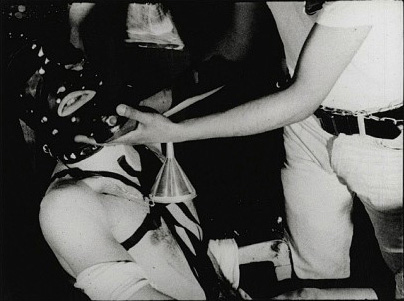
Warhol bought the rights to Anthony Burgess’s novel A Clockwork Orange six years before Stanley Kubrick made his Clockwork. Warhol’s film features Factory star Gerard Melanga as a juvenile delinquent who undergoes “reprogramming” by the welfare state, a process that reads as a metaphor for trying to convert gays into straights. Edie Sedgwick, added to a tableau for compositional balance, steals the movie.

songs-woman-smiling.png

Leslie Thornton
SONGS One Two Three

US, 2012, HD, colour, 14′

Orientalism, photography, and “unknowing” are recurrent obsessions in Leslie Thornton’s work. SONGS One Two Three embodies all three in what seems at first a cinéma verité style toss-off of a strange touristic site in Western China, at the massive sand dunes near Dunhuang. That it also looks like a set for a science-fictional thriller, but not quite, adds to the mystery. A woman leaps into the frame, poses, and others show up, also posing, all wearing neon orange boots. Everyone is in neon orange boots, some are wearing cowboy hats, and soon the camera is surrounded by others with cameras and more people in boots, posing, yelling, laughing, indifferent to the camera through which we see this spectacle—”our” camera. As this strange choreography unfolds the camera begins to make noise, to compose and correct itself, but it remains no more than an ignorant eye, stealing a show. Our camera retains its distance while it is swallowed up by indifference, until finally the most beautiful woman there (she must be the most powerful) looks back. She asks our camera to film her beauty and power. We walk away afterwards, caught in the suspension of invisible thoughts.

——————————————————————————————————————————————————————-

21 April 21 15:30 SPHINX cinema

What Helps
great-ecstasy-of-woodcarver-steiner.jpg

Werner Herzog
Die große Ekstase des Bildschnitzers Steiner (The Great Ecstasy of Woodcarver Steiner)

DE, 1974, video, colour, 45′

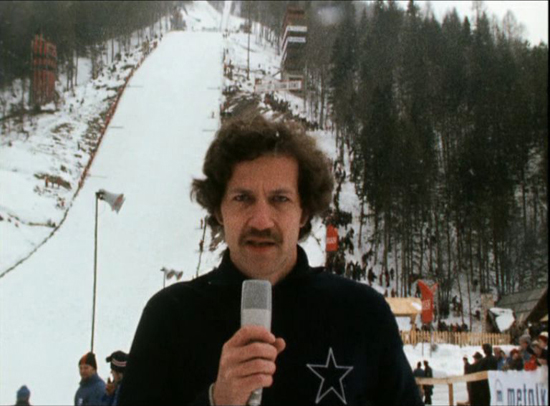
“Most documentaries set out to represent reality, but Herzog, as the best of all non-fiction filmmakers, understands that a documentary must transform reality and present it to viewers in a way they had never before imagined. The protagonist here is Walter Steiner, Swiss ski jumping world champion. Herzog uses high-speed cameras that slow down the action to one-twentieth of its normal speed. But this isn’t a sports film; it is rather a film about isolation, about human limitations and obsessions. Herzog watches and films Steiner jumping 179 meters (ten more than the previous world record, and ten short of what could have been a certain death), but what Herzog really sees a lonely visionary artist (a woodcarver) and a curious Human phenomenon that simply must be explored. The film’s images beg the question of whether this man turns away from society because of his passions, or has instead chosen his passions as a way of isolating himself from the rest of humanity. There, floating in the air, with his feet far off the solid ground, the look on Steiner’s could be one of horror or ecstasy. A mere sports film becomes a mystical experience.” (Carlos Reviriego)

A reading, by Leslie Thornton, of a short piece on Steiner and Herzog
herzog_shoe.jpg

Les Blank
Werner Herzog Eats His Shoe

US, 1980, video, colour, 20′

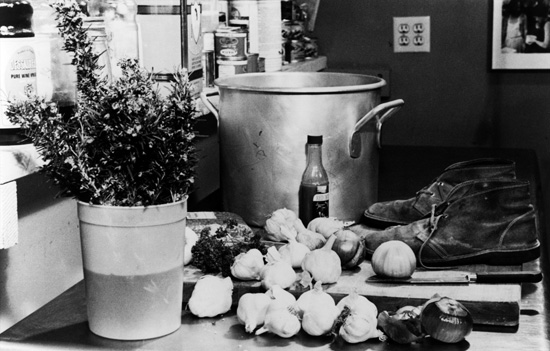
German film director Werner Herzog made a bet with fellow director Errol Morris (a film student at the time) that, if Morris finished a movie on pet cemeteries, Herzog would eat his shoe. Morris went on to film Gates of Heaven so Herzog kept his promise. While eating the boiled shoe, Herzog carries on a dialogue on film, art, and life with the film premier audience. The shoe was boiled with garlic, herbs, and stock for five hours. He did not eat the sole of the shoe, however, explaining that one does not eat the bones of the chicken.
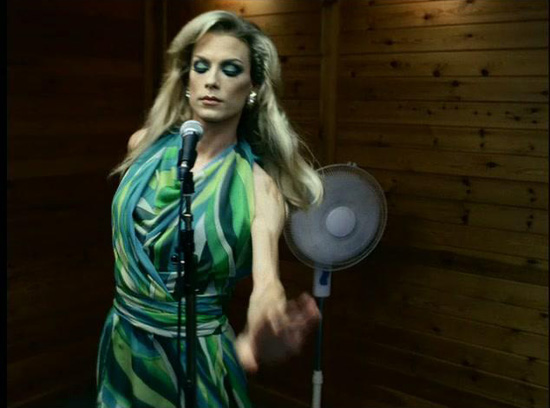
johan-renck-pass-this-on.jpg

Johan Renck
Pass this On (music video for The Knife)

SE, 2003, video, colour, 3′

It is the annual meeting for the local football club, yet the entertainment turns out to be not quite what was expected.

——————————————————————————————————————————————————————-
leslie-bino.jpg

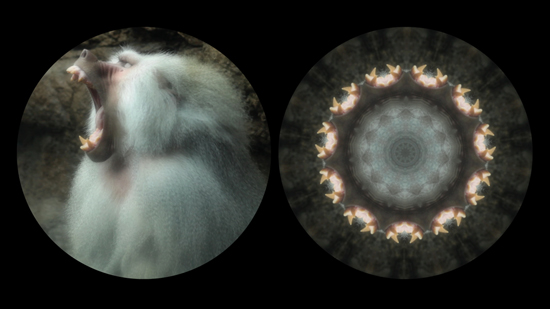
Binocular Series

Selections from Thornton’s gallery based installation series will be running during the festival.

“It makes sense that today a number of artists and writers are examining the animal world and our relation to other living beings. Animals are the new “Other” and the new victims, post multi-culturalism and globalization. But it’s all the same thing in a way; discourse on power, vulnerability, the unknown, the oppressed, difference, loss, growth, resilience. For me, there is just so much to learn here, so much to care about, and I approach my new subjects in complete and utter awe, with a sense of heightened awareness.”