
Ken Jacobs in 2007 in Brussels, for a programme organised by Argos and Bozar Cinema.
Ken Jacobs in 2007 in Brussels, for a programme organised by Argos and Bozar Cinema.
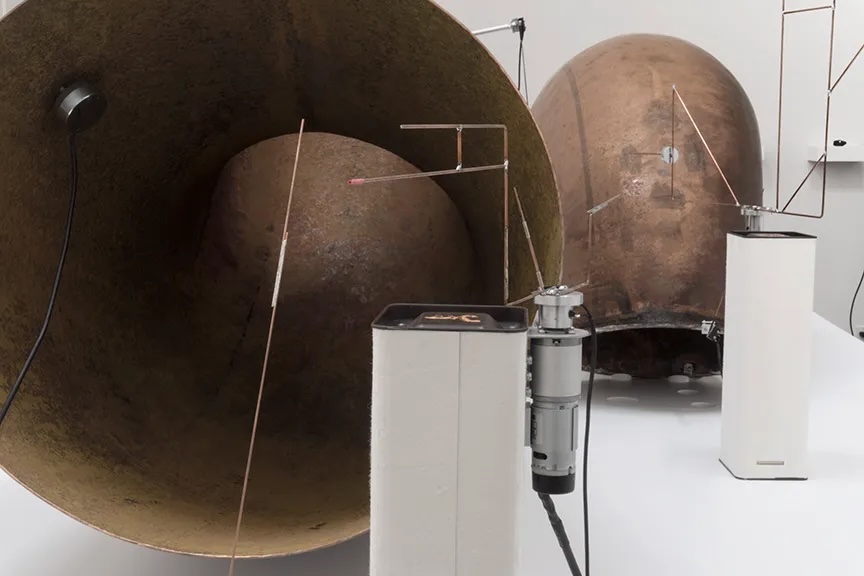
The research cluster THE ART OF RESONANCE (KASK & Conservatory Gent) is organising a series of informal listening sessions with international artists and researchers, with an eye (and ear) to cultivating a sonic sensibility and relationality.
Herculeslab — KASK & Conservatorium / School of Arts Gent
Wed 12 November 2025 16:00
Marla Hlady and Christof Migone each have long-standing individual artistic practices. Marla Hlady’s work moves across and in-between sculpture, site, performance, kinetics, sound art and music performance. She is interested in how media variously function, systematically and culturally, and how these functions can be critically and productively re-imagined. Christof Migone works as an artist, teacher, curator, and writer. His research delves into language and voice, bodies and performance, intimacy and complicity, sound and silence, rhythmics and kinetics, translation and referentiality, stillness and imperceptibility, structure and improvisation, play and pathos, pedagogy and unlearning, and failure and endurance. They started to collaborate in 2015 in joint projects that combine pre-existing solo concerns and recurring strategies into works that accent site and sound space.

Programme composed for 25fps festival, Zagreb 23 – 27/09/2025
It’s not a little ironic that I ended up naming this program after a song by The Smiths. We used to loathe Morrisey. I mean, some of us even wore t-shirts defiantly brandishing the print “Morissey is a Twat”. Though that didn’t stop us from quietly mumbling along with Schneider™ & Kpt. Michigan’s understated elegant version of “There is a Light that Never Goes Out”. Or secretly admiring Johnny Marr’s swirling guitar sound on “How Soon Is Now?” But Moz? No, too lofty for our taste. Too pompous for our post-punk, post-rock, post-everything sensibility. Too much faff and bore and chaff and chore and ego. We preferred our music frail and resilient, gritty and unsettling. We sought out the “noise, warmth and unassuming grace” (the title of an obscure single of one of our darling bands at the time). We aligned with the freaks and geeks, the outsiders and dilettantes, the bedroom tapers and studio alchemists.
It was not a big leap then to discover the world of what is commonly known as “experimental” cinema. When one of my housemates – who later became my colleague at Courtisane – introduced me to the work of Bruce Conner and Frans Zwartjes and Abigail Child and many others, two worlds merged into one.
It’s not that sound and cinema were ever separate entities in my mind. I remember repeatedly listening with my grandmother to one of her favorite records, the soundtrack to Sergio Leone’s Once Upon a Time in The West, starting an Ennio Morricone infatuation which continues to this day. I remember walking to my 24h video store after my night shifts to compulsively look for films by Jean-Luc Godard and Satiyavit Ray, and realizing that they are both tremendous sound artists in their own right. I remember discovering Toru Takemitsu’s soundtrack for Woman in the Dunes, or Alan Splet’s for Eraserhead, or Mario Nascimbene’s for The Night of Counting the Years, or Eduard Artemiev’s for Solaris, and not believing my ears: sound works so ahead of the curve that their force was only recognised decades later, if at all. Pretty soon it became clear to me that some of the greatest sonic explorers of the 20th century did some of their most innovative work for cinema or television: Vladimir Ussachevsky, Bernard Parmegiani, Ornette Coleman, Terry Riley, Klaus Schulze, Haruomi Hosono, Delia Derbyshire… Too many names to list.
The world of “experimental” cinema upped the ante. For some artists (Tony Conrad, Michael Snow, Trinh T. Minh-ha) a clear separation between experimentation in sound and cinema was just non-existent. Others found their match in creative friendships (Toshio Matsumoto & Toshi Ichiyanagi, Stephen Dwoskin & Ron Geesin, Sally Potter & Lindsay Cooper, Peter Forgaćs & Tibor Szemzö, John Akomfrah & Trevor Mathison) or romantic partnerships (Patrick & Michèle Bokanowski, Henning & Ursula Reuter Christiansen, Maya Deren & Teijo Ito, Carolee Schneemann & James Tenney). Some have made groundbreaking work by way of collage (Arthur Lipsett, Betzy Bromberg) or optical sound (Guy Sherwin, Paul Sharits). Others found a singular approach to sound tinkering and layering (Will Hindle, Jane Arden) that far surpassed established codes and practices, even for today’s ears.
I feel there is a multiplicity of histories here that still need to be told. This program only gives a modest taste of some of the adventurous sonic approaches that can be found in the experimental terrain of cinema. Its composition is not unlike that of a mixtape, in that it is based on an intuitive, handpicked selection of films whose soundtracks excite me for one reason or another. I know some of these films only through their sound, so I am thrilled to discover them with you in all their audio-visual glory.
All of these soundtracks have featured in Shadows of the Unseen, a series of mixes I have based on sound and music made for film or stage. This series was started during Covid and now has its own life on the online stegi.radio platform. In the meantime, I have also set up Echoes of Dissent: a project (at KASK School of Arts) that aims to counter the hegemony of the eye and the subsequent disregard for the ear by considering the relationship between cinema and politics from the perspective of sound. After many years of reluctantly having had to approach cinema and sound as two different worlds, it seems I have finally come full circle. Morrisey, on the other hand, doesn’t seem to have circled much at all: more than ever, he’s still a twat.
Gunvor Nelson, My Name Is Oona (1969, 10’. Sound by Steve Reich & Patrick Gleeson)
My Name Is Oona is based on optically printed footage of Gunvor Nelson’s daughter, Oona. Inspiration for the film’s soundtrack came when Nelson attended a Steve Reich performance in which he taped and processed comments and utterances by people who arrived at the gallery. A few years earlier, Reich had already taken part in the making of several films by her husband, Robert Nelson, for which he experimented with the same principles that would become central to his pioneering minimalist phase-pieces: “It’s Gonna Rain” (1965) and “Come Out” (1966). For this film, he worked with recordings of Oona saying her name and repeating the names of the days of the week, looping and phase-shifting the phrases into a mesmerizing multi-rhythmic structure. Throughout the film, the reverberating polyphony intensifies before gently disappearing to give way to the lullaby sung by the loving voice of a mother humming to her child. Gunvor invited Patrick Gleeson – who later made a great score for Bruce Conner’s Crossroads (1976), amongst others – to create the final audio track, which she used to edit the image track. The result is a complex meditation on childhood, memory and identity, in which the interplay of sound and image generates something truly unique.
Werner Nekes, Hynningen (1973, 20’. Sound by Anthony Moore)
You might know Anthony Moore as member of the avant-pop ensemble Slapp Happy, or even from his minimal classics, Pieces from the Cloudland Ballroom (1971) or Secrets of the Blue Bag (1972). These records were produced by the legendary cultural insurgent Uwe Nettelbeck, who was once described as “the Godard of Krautrock”. Moore met Nettelbeck during his stay in Hamburg, where he also developed a long-lasting relationship with the filmmaker-couple Werner Nekes and Dore O. While Moore made soundtracks for other filmmakers, notably for David Larcher’s Mare’s Tail (1969) and Klaus Wyborny’s Chimney Piece (1969-71), his works for Nekes and Dore O stand out the most. On these soundtracks, he further developed the experiments with tape recorders and permutatory compositions that can be heard on his first albums. For Hynningen, which is the fifth instalment of Nekes’s film anthology Diwan, Moore layered shimmering, weeping drones of sine tones and processed acoustic elements, which aligned with his growing interest in Folkways recordings and minimalist music. The beguiling audio assemblage complements Nekes’s extraordinary multiple exposure composition, suggesting the complexity and depth of an enchanting dream state.
Akiko Limura, Mon Petit Album (1973, 10’. Sound by Jacques Bekaert)
One of my all-time favorite Belgian records must be Jacques Bekaert’s self-titled album, originally released in 1981 by the Igloo label. Featuring luminary musicians such as Maggi Payne, “Blue” Gene Tyranny, Georges Lewis, David Rosenboom and David Behrman, the record consists of three delicate configurations of acoustic instrumentations and field recordings, two of which were created for film works by Akiko Limura. I could have easily chosen films by her life partner, Takahiko Limura, a filmmaker who worked with some of the greats of the Japanese sonic avant-garde, such as Yasunao Tone, Takehisa Kosugi or Yoko Ono. But I feel that the work of both Akiko and Bekaert has been historically undervalued and that their collaborative efforts need to be heard – and seen. I haven’t seen it yet myself, so I’m really looking forward to it! A rare review of Mon Petit Album describes it as a “layering of experimental imagery over a natural setting, folding sprawling, overlapped film footage of a pastoral scene under an original soundtrack by Jacques Bekaert combining flute and violin phrasings atop subtly processed sounds. Iimura herself drifts in and out of the frame, making direct eye contact with the camera while embedded in the landscape—a powerful act asserting autonomy over her own image as a woman.”
Rei Hayama, Kodomo Ga Mushi No Shigai Wo Umeni Iku / A Child Goes Burying Dead Insects (2009, 11’)
Another film I haven’t seen before. I discovered its soundtrack when it was released on the wonderful Belgian label Ultra Eczema. According to the label’s promo blurb, “the soundtrack is driven by a beautiful Japanese folk loop, blown over by a HNAS type of sound collage, primitive in its set up, and sliced open by Rei’s own angel type of vocals, like a creepy lullaby.” I couldn’t describe it better myself! The film, structured around a repeated sequence of a young girl burying dead insects in a forest, concerns death, rituals, and lamenting loss. Hayama notes that the burying of dead insects was just one of the ceremonies she developed as a child, which functioned for her to find a sense of order in a chaotic world. In the film, however, we see this ritual repeated over and over. he Single-8 film stock is degraded through exposure and manipulation time and again until the deterioration of the image drains all colour from the screen. As the film progresses, the cycle becomes more abstract and illegible. The cycles of life and death, of nature and rituals are found in the materiality of the film itself, suggestive of a blurred line between animals and humans, man and technology. It was previously shown at 25FPS, but it’s in dire need of a comeback!
Frans Zwartjes, Achter je Muren / Behind Your Walls (1970, 12’)
Praised as “the great magician” or on one occasion even as “the most important experimental filmmaker of his time” (Susan Sontag), Frans Zwartjes produced, directed and edited his own films; but more importantly, he created and improvised the soundtracks too. When my former housemate showed me Zwartjes’ Living (1971) many decades ago, I was immediately entranced by the combination of the visual bravura of a fantastically mobile camera, swooping and swirling with extraordinary elegance, and the sonic delicacy of an electronic organ generating drifting and oscillating chordal tones. The soundtrack, it turned out, was the result of an improvisation by Zwartjes himself along with Michel Waisvisz (a great pioneering inventor of experimental electronic musical instruments). The soundtrack of Behind Your Walls was made in collaboration with his brother Rudolf and features a collage-like assembly of processed sound textures and bruised melodic figures, adding a hypnotic layer to a hallucinatory kammerspiel of feminine estrangement and isolation. In 2013, a few years before he sadly passed away, Stanley Schtinter located Zwartjes and uncovered a rich archive of unheard music. To release a selection of this collection, Schtinter founded purge.xxx, which is surely today’s best soundtrack label. Let’s hope we get to hear more of Zwartjes sonic treasure trove!
Jeff Keen, Marvo Movie (1967, 5’. Sound by Jeff Keen, Annea Lockwood, Bob Cobbing)
“Noise Art” is a posthumous collection of Jeff Keen’s sound work, comprising cassette recordings created during the 1980s for his expanded cinema shows. That phrase fits Keen’s films very well. Their strobe-like barrage of imagery impacts the eye like visual noise, while the soundtracks feel like aural blatz-poems, combustible palimpsests of voice and noise, hiss and fizz. The late Mark Fisher once enthusiastically wrote that one of his films, Rayday Film (1968–70), “is soundtracked by an exhilarating roar of abstract noise that possesses a pleasure-in-pain jouissance worthy of Merzbow. A collage of manipulated voice, chopped and chomped so that it’s devoid of any sense, it resembles a dada chant, or Damo Suzuki being tortured, or a swarming buzz of malign spirits being routed by an exorcist.” Keen’s breakthrough film Marvo Movie is no less of a cineblitz. A rapid-fire montage of sequences of Keen and friends dressed in a variety of costumes and masks are superimposed over cuttings from newspapers and comics and various moving toys. The wildly incantatory soundtrack was recorded in a quick afternoon (just in time for a screening in Liverpool) by Keen, sound artist Annea Lockwood and concrete poet Bob Cobbing. Upon seeing Marvo Movie, filmmaker Ken Russell was famously quoted as saying, “It went right over my head and seemed a little threatening, but I’m all for it.”
Derek Jarman, Pirate Tape (1982, 10’. Sound by Psychic TV)
Derek Jarman is surely the artist-filmmaker who was the closest to the subterranean cultural movement that David Keenan has coined “England’s Hidden Reverse,” involving avant-garde, industrial, and experimental music scenes that emerged from the 1970s onwards. In 1980, Jarman invited Throbbing Gristle to provide a soundtrack for In the Shadow of The Sun. The collaboration started long-lasting relationships with members of TG, Psychic TV and Coil. In 1982, Jarman filmed William S. Burroughs during his first visit to London, where he made a cameo appearance for Jürgen Muschalek’s film Decoder (featuring Genesis P-Orridge) and attended the legendary Final Academy events, curated by Psychic TV. Jarman’s film shows Burroughs on Tottenham Court Road signing autographs with fans and inside a shop buying alcohol. The soundtrack by Psychic TV is a magical-industrial dreamscape of broken transmissions, arcane whispers, and psychic residue, featuring a sample of Burroughs repeating “boys, school showers and swimming pools full of ’em'”. Additional footage shot by Jarman during Burroughs’ visit is reported to have been confiscated by Scotland Yard in 1991 and remains lost. Jarman and Psychic TV would continue to collaborate (“magic bound us together,” Jarman wrote), with Jarman directing the music video for Catalan and starring as the spokesperson in the Psychic TV video A Spokesman for the Temple of Psychick Youth.
Stan Brakhage, I… Dreaming (1988, 7’, Sound by Joel Haertling)
Stan Brakhage was always intensely dissatisfied with the conventional uses of sound and music in cinema. He studied with John Cage and Edgard Varèse, searching for a new relationship between image and sound and with the idea of, thus, “creating a new dimension for the soundtrack.” However, the more informed he became of the aesthetics of sound, the less he began to feel any need for an audio accompaniment to the visuals he was making. Instead, he developed a concept of music as the “sound equivalent of the mind’s moving.” Out of nearly 400 films made between 1952 and 2003, I… Dreaming is one of around only 30 which have a soundtrack. The rest are silent. It is set to a sound piece by Joel Haertling, member of the experimental music collective Architect’s Office (also featuring Rick Corrigan, another Brakhage collaborator). The piece is a melancholic collage based on recurring fragments of songs by Stephen Forster, referring to loss of love in the popular “torch song” mode. The film, described by Brakhage as “my self-in-crisis portrait”, envisions a re-awakening of such senses of love as children know best, as it posits – along a line of words scratched in the film – the maddening experience of waiting and longing.
Echoes of Dissent (Vol. 7): Fred Moten & Brandon López / Zara Joan Miller & Ute Kanngießer
29 April 2025, Brussels
Conversation with Fred Moten and Brandon López at Pianofabriek (free entrance)
Performances at Les Ateliers Claus

In the context of Courtisane Festival 2025 (Gent, 2 – 6 April 2025).
I was describing the garden to Maggi Hambling at a gallery opening. And said I intended to write a book about it.
She said: “Oh, you’ve finally discovered nature, Derek.”
“I don’t think it’s really quite like that,” I said, thinking of Constable and Samuel Palmer’s Kent.
“Ah, I understand completely. You’ve discovered modern nature.”
Derek Jarman, 3 February 1989
In Modern Nature, a volume of his journals written between 1989 and 1990, Derek Jarman’s narrativisation of the process of tending his garden eschews the romantic predilection for nature’s pristineness and focuses instead on the survival of herbs and flowers in a place where they should not thrive. The allegory is palpable here, for just as violets and daffodils and poppies bloom among the stones in the shadow of the nuclear plant which overlooks his cottage, Jarman and the marginalised communities he invokes in his work also demonstrate their struggle and their resilience in the face of the personal, cultural, and social crisis of Thatcherite Britain. In light of Jarman’s work, tending nature can be seen as an emergency praxis whose imperative opens onto a consideration of the relationships between time and community, human and other-than human life, inviting us to rethink the possibilities for worldmaking in times of crisis.
The legacy of Derek Jarman, especially his garden at Prospect Cottage, provides us with a variety of entry points through which we can think through questions of interspecies relationality and affective ecology. This programme brings together a wide variety of cinematic approaches that seek to understand and respond to these questions and inspire an ecopolitics accentuating pleasure, play or improvisation within and among species. A series of films that engage in and with practices of gardening, seeding, re/wilding or foraging, while challenging the dominant politics of extraction and extinction associated with the imperatives of perpetual growth and expansion. Film works that evoke the tangled and venturesome histories that we need to imagine in order to become again of and from the world — to sow worlds beyond oppressive boundaries and binarities. As Jarman noted in his diary: “There are no walls or fences. My garden’s boundaries are the horizon.”
to whom it may concern
in the dead stones of a planet
no longer remembered as earth
may he decipher this opaque hieroglyph
perform an archaeology of soul
on these precious fragments
all that remains of our vanished days
here — at the sea’s edge
I have planted a stony garden
dragon tooth dolmen spring up
to defend the porch
steadfast warriors
Derek Jarman, 13 February 1989
With the support of the French Embassy in Belgium and the Institut français. As part of EXTRA, a program that supports French contemporary creation in Belgium.
Thanks to all the filmmakers and distributors, Teresa Castro, Ricardo Matos Cabo, Nicolas Feodoroff, Kristofer Woods
——————–
SCREENING 1
4 April, 2025 – 19:30
Sphinx Cinema – zaal 3

Sept promenades avec Mark Brown
Pierre Creton, Vincent Barré, FR, 2024, 16mm to digital, 104′
Nearly twenty years ago, Pierre Creton and Vincent Barré searched for wild flowers in their natural environment in Northern India in L’Arc d’iris, souvenir d’un jardin (2006). After seeing the film, British botanist Mark Brown, who has devoted his life to recreating a primeval forest in his own garden in Normandy, expressed the wish to collaborate with the filmmakers on a similar project. Sept promenades avec Mark Brown makes this idea a reality a year after Creton’s Un Prince (2023), in which Brown appeared speaking to students (including Antoine Pirotte, the young cinematographer of both films). Divided in two parts, this “phytocentric road movie” first includes seven sequences where Brown casually leads a small group who are scouting for Indigenous plants in places abandoned by human activity while sharing his ecological knowledge and convictions with them. Shot digitally, it naturally transitions into a second part shot on 16mm entitled “Herbarium”, which showcases the previously collected plants and flowers. It is strangely moving to see Creton, whose body of work is associated with digital images, tap into celluloid and thus the origins of cinema, like plants turning toward the light and blooming in pure photochemical delight. (Antoine Thirion — Viennale)
In the presence of Pierre Creton & Vincent Barré
——————–
SCREENING 2
6 April, 2025 – 17:30
ARCA
Black Pond
Jessica Sarah Rinland, UK, AR, 2018, 16mm to digital, 42′
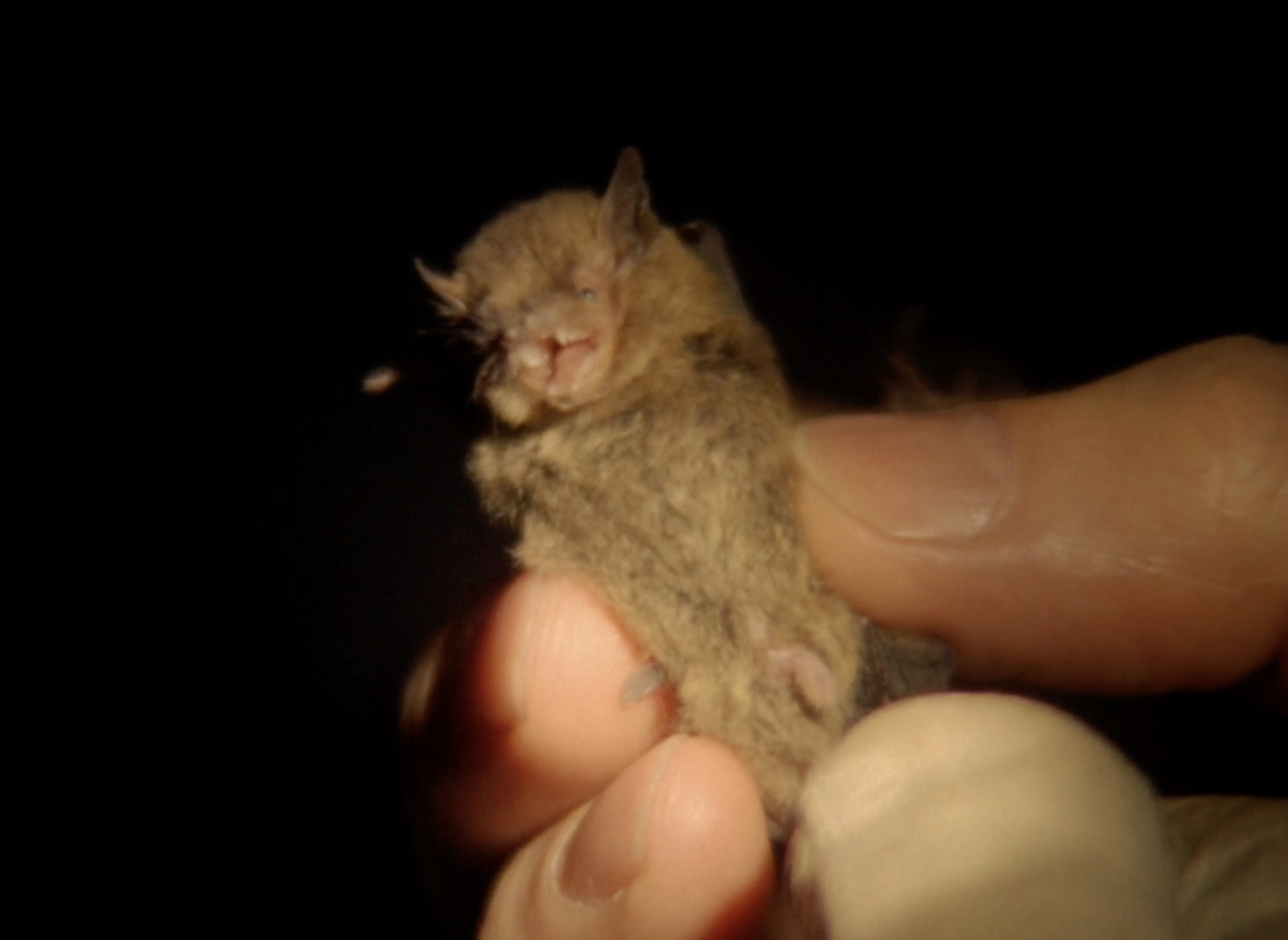
Black Pond explores the activity within a common land in the south of England. Previously occupied by the 17th century agrarian socialists, the Diggers, the land is currently inhabited by a Natural History Society whose occupations include bat and moth trapping, mycology, tree measuring, and botanical walks. After two years of filming on the land, the footage was shown to the members of the Society. Their memories and responses were recorded and subsequently used as part of the film’s narration. The film does not offer a comprehensive record of the history of humans within the area. Instead, it explores more intimately human’s relationship with and within land and nature. “Humanity is in symbiosis with its surroundings, and the open wings of a moth rest in the open hand of its researcher, as if his body was an extension of the landscape; another cut down tree, or another boulder, maybe. This common effort is a testimony in itself, but combined with the oral narration of the film, it becomes a double strategy where language is also the protagonist of the movie itself, rendering its condition of documentary in 16mm to a different piece of moving image akin to a pulsing metaphor, a manifestation in the materic support of celluloid, a call to arms of sorts, the necessity of listening with our own eyes to achieve a further understanding.” (José Sarmiento Hinojosa)

Black Pond: The Society
Jessica Sarah Rinland, performance
A performance which further explores the process of research undertaken for Black Pond, an odyssey across a common land in the south of England told through the hands of the members of the local Natural History Society. The performance uses yearly town hall meetings, historical maps and laws, letters of complaint, e-mails, and footage shot in the same location years before, to paint a wider picture of the social history of the area and the relationship between the artist and the Natural History Society.
In the presence of Jessica Sarah Rinland
——————–
SCREENING 3
5 April, 2025 – 22:30
Sphinx Cinema – zaal 3

The Secret Garden
Nour Ouayda, LB, 2023, 16mm to digital, 27′
The inhabitants of a city awake one morning to find that never-before-seen trees, plants, and flowers suddenly erupted throughout the streets and in the squares. Strange and mysterious events start taking place as Camelia and Nahla investigate the origins of these new and peculiar creatures. “The image that inspired the film was that of a plant in the dark illuminated by a flashlight. I think there was something about the appearance and disappearance of the plant under the movement of the flashlight that captivated me. It was also an image that made me feel that something mysterious was about to happen. So I started making images of plants at night, plants that I found in the streets of Beirut. I took these images with my mobile phone. Little by little, I found myself collecting images of plants that I came across here and elsewhere, night and day. It became an obsession. I noticed the way they occupied the space. I had the impression that they were coming from somewhere else, that they weren’t part of the urban fabric of the city but were intruding on it. I grew up with the image of Beirut as a concrete city with no trees or plants. This is true, in the sense that there are no green spaces such as parks, gardens and woods. It’s true that concrete takes up a lot of space, but the flora exists, it’s just that it’s wild and not really organised. That’s all I could see in the city: trees, plants and flowers. This stubbornness created in my imagination the story of a hidden garden that would be the origin of the presence of plants in this concrete city.” (Nour Ouayda)

Foragers
Jumana Manna, 2022, digital, 64′
Moving between scripted scenes, documentary and archival footage, Foragers explores how the traditional Palestinian practice of foraging wild edible plants — namely ’akkoub and za’atar — is criminalised by the Israeli government. For Palestinians, these laws constitute an ecological veil for legislation that further alienates them from their land while Israeli state representatives insist on their scientific expertise and duty to protect. Following the plants from the wild to the kitchen, from the chases between the foragers and the nature patrol, to courtroom defenses, Foragers captures the inherited love, joy and knowledge in these traditions alongside their resilience to the prohibitive law. By reframing the terms and constraints of preservation, the film raises questions around the politics of extinction, namely who determines what is made extinct and what gets to live on. “As much as the film is about all of the legal battles that Rabea has worked on, the starting point was a place of joy, from really loving to be out in nature finding, picking, and learning about all of these different plants. I mean, it’s quite an incredible feeling in the springtime in Palestine. You don’t really need to go to the supermarket. There are so many wild-growing edibles, it is magical. That was very central when I started working on the film, and I wanted it to remain central. I wanted joy to be felt as much if not stronger than the anger towards the criminalization of the practice.” (Jumana Manna)
In the presence of Nour Ouayda, Jumana Manna
——————–
SCREENING 4
3 April, 2025 – 17:00
KASKcinema

Les Jardiniers du Petit Paris
Sophie Roger, FR, 2009, digital, 34′
Through her window, Sophie Roger films her neighbours tending a community vegetable garden as seasons pass by. At the same time, she reads passages from Tristes tropiques and regularly abandons her observation post to enter the frame, meet her neighbours, ask them to pose for filmed portraits. “I hate voyages and explorers”, as Claude Lévi-Strauss warns the readers of his Tristes tropiques. A warning that caused quite a stir given that his book looked back on his stay in Brazil and developed a reflection on his first anthropological experience among the Bororos, Nambikwaras and Tupi-Kawahibs. And, importantly, it was written in 1954–1955, fifteen years after his return. A matter of distance. How can we read this text today? What does it mean to read in the present? Thanks to Sophie Roger, we are safe and sound. For her first film, no distant expedition. Her anthropological gesture combines the inside and outside, what is said and what is seen. Where? In France, in a place known as “Little Paris”, a community garden is observed from a window. Outside: as seasons change, gardeners of all ages come and go, wait, pace up and down their furrows, bustle about and also have fun. Inside: a whispering voice reveals the book, chapter by chapter, in the confines of the invisible house, where we hear only discreet noises, the creak of footsteps in a stairway, the rustle of pages being turned, muffled snippets of music. The words from far away and yesterday resonate with the images of here and now. Far from the tropics, a gaze filled with wonder is being constructed. One that involves each of us cultivating our attention like a fragile plant, far from the monoculture foretold by the worried anthropologist. (Nicolas Feodoroff — FID)

Hic Rosa, partition botanique
Anne-Marie Faux, FR, 2006, 35mm, 57′
Hidden behind the name of the most famous of flowers there lies a homage. To what? To the colour red, to flushing women. To women enraged by justice like Rosa Luxembourg; to women engaged in the austere precision of an art of truth like Danièle Huillet. Because — it is quite clear and the dates in the subtitles in the credits confirm it (1916/1936/2006) — the voices of one or the other cross the “botanical symphony” that reveals the images in sequence. It is the latter’s concern for precision that is heard in the diction of the letters written in 1916 by the former. While Rosa Luxembourg is known for having been the heroic organiser Spartacist, who was assassinated by the police in 1919, it is another timbre than that of combative militant that resonates here. “Do you remember what we were planning to do when the war is over?” she writes to one of her correspondents. Such is the subject matter of these letters: the certain memory of the future. The hauntingly insistent reminder of the causes for which the struggle must be led. If a revolution is to be undertaken, and with all the necessary devotion, it is, to exclude oneself from a project bound to the rational. To what end then? To rediscover the gracious and inconsequential innocence of the original garden. To become animal or plant again, nature without fatality. Return, all in all and according to a familiar messianism, to Master Eckhart’s famous mystical programme “the rose does not have a why”. In this first long film, Anne-Marie Faux celebrates the passion of unhindered floral existence without yielding anything to the demands that such an ambition requires. (Jean-Pierre Rehm — FID)
In the presence of Sophie Roger
——————–
SCREENING 5
5 April, 2025 – 16:00
Sphinx Cinema – zaal 3

Le Jardin
Frédérique Menant, FR, 2019, 16mm to digital, 16′
Thérèse cultivates a Creole garden in Guadeloupe. She resists invisible poisons. Her hands merge with the earth. Her face with the light. “The garden was part of a decolonial activism for Thérèse, as it was a means of cultivating the land by her own means and cleaning it up in the face of widespread pollution. Historically, chlordecone is an insecticide used on a massive scale in the French West Indies and placed on the market in an abusive manner at the beginning of the 1970s, by dispensation of the Minister of Agriculture at the time, Jacques Chirac. Intended to combat banana parasitism, its industrial and colonial use led to pollution of natural environments and poisoning of plant, animal and human life. Frédérique Menant’s film places eco- logical awareness at the heart of the ecofeminist and post-colonial question: the garden becomes a utopian land of rewilding, of regaining power, of regeneration. By placing the relationship between the cultivated and the wild within the same filmic and agrarian perimeter, the filmmaker leaves behind Western dualism to reclaim the idea of continuity: ‘Recognise the culture that has been denied in the sphere conceived as pure nature, and recognise the nature that has been denied in the sphere conceived as pure culture.’” (Elio Della Noce)

Shape Shifting
Elke Marhöfer, Mikhail Lylov, DE, JP, 2015, 16mm to digital, 18′
In order to challenge the understanding of nature situated apart from human, Shape Shifting suggest another arrangement where human and nonhuman join relations and productively interact. It outlines an affective cartogra- phy of a specific landscape, which exhibits a high natural diversity and is called “satoyama” in Japanese.“Mapping onscreen the enmeshments and intimacies that bind together humans and other-than-humans such as weeds — what Shape Shifting does by delving into the Japanese satoyama (the border zone or area between mountain foothills, yama, and the arable flat land next to the villages, sato) — Lylov and Marhöfer show us that exploring the other-than-human by means of film is already a means of shaping affective relationships encompassing human and machinic fellows. The joyful myriad of other-than-human agents potentially implicated are far from being limited to organic actants… Shape Shifting reminds us that other-than human subjects hint at specific modes of sensing, feeling, affecting, and being affected. Filming here means attuning human makers and human spectators to the sensibilities of the soil, weeds, and wind. In this sense, the film is an experiment in becoming with, a matter of alliances and counter-encounters.” (Teresa Castro)

Accession
Tamer Hassan, Armand Yervant Tufenkian, US, 2018, 16mm to digital, 49′
Shot over a period of five years in 13 locations around the U.S, Accession traces an intimate collection of letters, originally written to accompany seed packets sent between friends and family across the United States, which date as far back as 1806, and are poetically narrated as reflections of life in rural America. “Heirloom seeds and 16mm film embody memory in a becalmed epistolary tour of American experience. Read aloud in mellifluous regional accents, letters between ‘seed-savers’ suspend us in a fading vision of an agrarian nation, where generation after generation has handed down and cultivated the same peas, gourds, marigolds, and hyacinths. The places across the United States where Hassan and Tufenkian shot their film over several years—the same origins and destinations for the letters we hear — contain not just timeless farmlands but also cars and railroads of contemporary vintage (as well as, oddly enough, a couple of performers in a historical reenactment). The effect is a kind of secular prayer and a paean to decency and communal duty, as the diversity of the seeds and weathered film stocks feed a soulful sense of continuity that stretches from the 1800s up to now. “It doesn’t seem right to throw away [experience],” one correspondent writes, and in the silences between the letters (passing through states such as Oklahoma, Mississippi, and Louisiana), the filmmakers create a space for unhurried contemplation of what lies before us.” (Nicolas Rapold—Viennale)
In the presence of Frédérique Menant, Elke Marhöfer, Tamer Hassan & Armand Yervant Tufenkian
This screening is followed by a conversation between Teresa Castro and Frédérique Menant, Elke Marhöfer, Tamer Hassan & Armand Yervant Tufenkian.
Teresa Castro is Associate Professor in Film Studies at the Université Sorbonne Nouvelle — Paris 3. A significant part of her recent research has focused on the links between cinema and animism, on forms of plant life in visual culture and on the environmental histories of film and photography.
——————–
SCREENING 6
5 April, 2025 – 11:00
Sphinx Cinema – zaal 3

Glimpse of the Garden
Marie Menken, US, 1957, 16mm, 5′
In this brief film, Marie Menken carefully probes the layers of a lush garden, shifting from the macro to the micro and then back again. “Marie’s films were her flower garden. Whenever she was in her garden, she opened her soul, with all her secret wishes and dreams.” (Jonas Mekas)
Garden Pieces
Margaret Tait, UK, 1998, 16mm, 12′
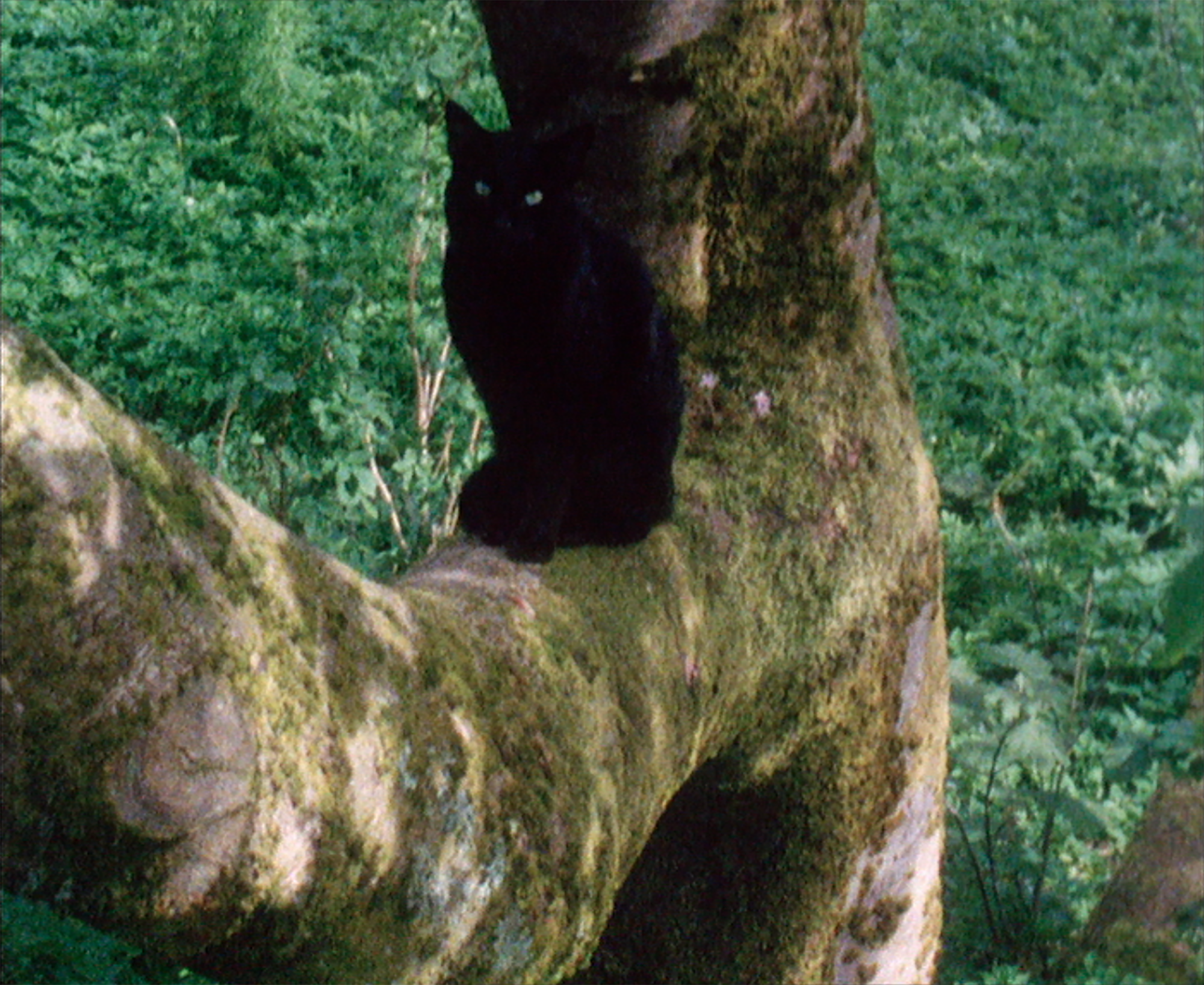
A set of three ‘film poems’ composed around the theme of the garden — the central one featuring hand scratched animated drawings. Margaret Tait described them as follows: ‘Round the Garden’ — right round and round again, ‘Garden Fliers’ — flighty cartoon and a stunner of a piano piece and ‘Grove’ — grave and sonorous.

True to Life
Gunvor Nelson, SE, 2006, digital, 38′
True to Life was shot in my garden in Kristinehamn in Sweden. I had bought a few closeup lenses for my camera, and when I put them together I discovered another world and started filming it. Then I amplified the sound of the camera brushing against the vegetation. (Gunvor Nelson)

Gesamthof / A lesbian garden
Anne Reijniers & Eline De Clercq, BE, 2022, digital, 15′
Gesamthof / A lesbian garden is an art — nature project that lives between the walls of an old Antwerp monastery. We follow gardener and artist Eline De Clercq as she relates the garden to topics such as botanical colonialism, the ambiguity of naming, the social expectations of women and the search for a lesbian identity.

Wenn du eine Rose siehst
Renate Sami, DE, 1995, 16mm, 4′
Under the spell of Cathy Berberian’s voice, scraps of melodies and poems in my head. In love with spring and summer’s flowers I walked through streets and gardens, pastures, fields and forests and by the end of that summer 1995 I had a little film which ends somewhat melancholically with some chords of Gustav Mahler’s Traveling Journeyman‘s Songs. (Renate Sami)
In the presence of Anne Reijniers & Eline De Clercq
——————–
SCREENING 7
3 April, 2025 – 14:00
KASKcinema

The Magino Village Story — Raising Silkworms
Ogawa Productions, JP, 1977, 16mm, 112′
Raising Silkworms, shot in 8mm, was made when the Ogawa Productions group (whose work was presented at Courtisane festival 2017 and at Cinematek in 2019) was invited to settle in Magino, a village in the mountainous region of Yamagata in northern Japan. They moved into a barn lent by a farmer-poet which they converted into a home and film studio. Their first film there was made under the direction of Shiraishi Yoko, Ogawa Shinsuke’s wife, and draws us into the world of raising silkworms under guidance of Sato Kimura, a woman who has spent half her life with the silkworms.
“The film was originally meant to be a loose collection of visual notes on 8mm, a moving image supplement to their elaborate scrapbooks. Along the way, they could train members to operate the camera and learn other aspects of film production. However, Ogawa thought the footage was good enough to convert into a documentary. They edited the footage together, blew it up to 16mm, and it eventually became what they refer to as the Magino Village Story’s Silkworm Chapter, or Yosan-hen. Silkworms entered the village economy in Magino as late as the 1950s; however, the filmmakers mostly ignore the economic materiality of silkworm farming for process. Silkworm farming was primarily women’s work. The men would only occasionally lend a hand, which is why their film prominently features Ogawa’s wife, Shiraishi Yoko, as she learns the ins and outs of silkworms from neighbor Hatsu Kimura. The film describes every step of the process.” (Markus Nornes)
——————–

WORKSHOP: On grafting and pruning
Laura Palau Barreda
4 April, 2025 – 10:00
KASKcafe – Terrace
It is often said that those in glass houses should refrain from throwing stones. A reminder that spaces of privilege, frequently quick to critique, must instead cultivate self-awareness and transform wounds into moments of reflection and change. As Donna Haraway wisely notes, “It matters what ideas we use to think other ideas (with).” My ongoing research, Glass-House & Soft Stones at KASK, proposes not merely to think about nature but to think with it. In this context, I propose a series of experiential learning activities focused on apple tree care at the Bijloke site. Here, participants, whom I intentionally refer to as scholars in the broad sense of anyone engaged in the process of learning, will be invited to practice grafting and pruning.
For the Courtisane festival, our collective practice draw from the traditional Catalan practice of parany, where trees were pruned into conic shapes to trap birds. In this reinterpretation, we will become ensnared, forced to slow down and attune with the tree’s listening presence asits sap flows. An invitation to reflect on our intentions as practitioners and deepen our connection with Bijloke’s living archive with an essence of its fruit lingering on our tongues. (Laura Palau Barreda)
For this walk / workshop reservation is required.