The demise of film critical thinking

daney2.jpg

By Serge Daney

Originally published (without title) in ‘L’exercice a été profitable’ (Paris: POL). Written in 1991.

1. THE DEFEAT OF (CRITICAL) THINKING

Why do people like me, film critics – tardy heirs of a world of light and shadow – find themselves so quickly in a state of unemployment, early retirement or in the position of the last of the Mohicans? It’s a question. Why did I stop playing film critic, although I largely wrote what I wanted in a magazine which was spontaneously “cinephile”? It’s my question. I remember that when I left Cahiers du Cinéma for Libération in 1981, for the first time I had the feeling that the discourse on the “crisis of cinema” – which had always left me indifferent – would end up being true and that the countdown undoubtedly had already begun. It was at the time of Diva (Jean-Jacques Beineix, 1981)*, a film which inaugurated the eighties rather well, being at the same time vacuous and insular and in the end without any grandeur.

As there were a lot of things I was not able to do at Cahiers, those years at Libération were at first euphoric: I made up for my own lateness, I recycled all the prolongated experiences – rather radical, rather rough – of the seventies. I was being served well by the exigencies of the daily, the talent of the newspaper and the maneuvering space it permitted me at the time. But all the same I became, bit by bit, a sort of moral consciousness of the film criticism that once was – melancholic, dignified and finally grouchy. Indeed, it’s difficult to maintain the idea of a common thread, of a “follow-up”, of a memory, in the voluntarily amnesic world of media.

I started – it was my luxury – asking myself if the place accorded to cinema in the media (especially in France) wasn’t more extensive than the real need for cinema in people’s lives, a need that has become rather weak. It was the era when we started talking about “the death of cinema”, like we nowadays talk about the “end of history”. What became clear is that since some time films no longer generate debate, they don’t leave a lot of traces, and the cinephiles themselves infuse them with a disenchanted loyalty rather than a tormented passion. In short, in the expression “coup de coeur”*, so typical for the cynicism of those years, it’s the word “coup” (punch) that counts, because in regards to “coeur” (heart), it’s rather a leukaemic state of affairs.

Once passed the euphoria, I continued to talk about cinema, but in an attempt to relate it to something else that extends it or perhaps even denies it – I didn’t know very well: television, publicity, communication, the idea of information etc. I had to get away from the rancid self-satisfaction of the “big family of cinema” and the bad habits of the cathodic communication’s parvenus. This permitted me to write little amusing day-to-day chronicles, to become a professional “zappeur” for a while, critic of films “on television”, observer of televised info etc. It was a rather special shuttle in which I ended up finding myself a bit too lonesome. When one doesn’t belong to the César family or the 7 d’or family*, the people who actually do belong to those families take pleasure in going through your pockets without mentioning your name or setting up a pedestal for you in the back in the garden, where nobody goes. It’s normal, since we are in a period in which families – all families – take revenge for the past twenty years in which they have been put to challenge.

Still there is a very simple thing I have finally understood: criticism can not justify itself unless it responds to a desire, most likely that of the author. Where there is a rather strong desire (and desire is always violent), the critic has to answer present. It’s like in tennis: we don’t hit back all the balls under the pretext of them “being symptomatic”, but we are forced to react to the serves. Yet, the phenomenon typical for our societies is that the border between desire, caprice, whim, hobby and parlor game is being recomposed. A lot of the current films no longer stem from a desire to make a film but rather from the desire of being a filmmaker at least once in a lifetime. Why not? Me, I don’t mind Jean-Philippe Toussaint making Monsieur* but I don’t see how or why I will criticize this film, because it doesn’t entail a “follow-up” for anyone.

Criticism was necessary when, in society, there was a place where violence, sense, the need to say or make, made some kind of bond, some kind of abscess. But it looses this necessity from the moment when “the right to create”, as the communists used to say, is open and acknowledged to everyone. Criticism provided news from certain high-risk travelers: Tarkovski, Godard, Cassavetes, Fassbinder, people like that were all travelers. Criticism is of no use now that all that has been replaced by the touristic auto-programmation of the individual. A film like L’ours (Jean-Jacques Annaud, 1998)* doesn’t appeal to film criticism, it only appeals to some big competition giving as first price the right to assist to the shooting of the film, because the shooting itself is undoubtedly the only adventurous thing about the project. The critic is a “passeur” between two poles: between those who make and those who see what has been made. What has to clear is the order of priorities. For me, the critic first sends an open letter to the author and this letter is then read by the possible audience of the film. The critic represents the interests of those who “make” on the side of those who don’t. Like some kind of lawyer. This seems to me at the same time normal and moral. But for others, it’s the contrary: they represent the interests of the audience on the side of the creator. They rather act like judges. Some function rather well following the model of criticism which sorts out “what passes“ and doesn’t. It’s the consumer guide, even enlightened, even insolent, or pretending to be.

This quickly leads to pure and simple conformism because, by definition, every audience, even enlightened, even adult, wants consensus. But it’s perhaps more profitable today to only see in a film the “societal phenomenon” aspect and fly to the assistance of “what works” – just a matter of adding one’s supposedly “personal” opinion.

What I’m saying is of course very debatable. It all goes back to never taking the side of the group against the individual. But I think that the beauty of the cinema of the 20th century was it being a gigantic asocial machine that has, paradoxically, taught millions of people to live with one another, thus as a society, while never forgetting that there is more than the society in the world. But when there is only the horizon of the social, when the world has disappeared, we find ourselves cemented to the mediocrity of the global village and even if this village is ultra-communicative, it remains a village. And a village doesn’t need criticism, it needs griots, supporters, rural sheriffs; in short it needs television.

2. THE DAWN OF CINEMA

When I was a child, in the 1950’s, at the beginning of “The Glorious Thirty”*, cinema was the luxury of the poor. It told us that we were poor while, at the same time, showing the rich. It was a strange art, perhaps not even an art but certainly an unique moment in history: the right blend between shadow and light, the individual and the collective, an art that was popular and elitist, the beginning and the end of the 20th century, with on one hand the “science for all” aspect, and on the other bodies stemming from the circus.

Cinema has great difficulties accompanying the current age, which it has partly aspired and nourished. Perhaps it’s normal. The modern individual lives in a society with an “abundance of choice” and cinema is only one of the possible choices, prestigious certainly, but a bit too heavy. The modern societies have become unstable organisms, transparent for themselves, and the “social” is, thanks to the artificial respiration of surveys, what we consume, market share by market share. As for approaching the “truth” of beings and things, art has stopped replacing religion. So, on one hand, art becomes ornamental again, and on the other, religion reclaims its old debt in post-modern guises (“new age”, tele-evangelists , fundamentalism and other doldrums). Cinema was a collective way of camping between faith and believe, without being scorched by faith or vegetating too much on believes.

Naturally, it is television which, in its resistible ascension, has been impelled to destroy all of that. The attentive traveler: that was yesterday. The blasé tourist: that is today. It suffices to watch Paris-Dakar. We are shown some roaring racing cars in the desert and we are told: see, the proof that this race exists lies in the fact that you get to see some fragments of it on television, believe us on our word but don’t ask about the story of the African kid who was run over, that of father and son Sabine*, or that of the small-time amateur who saves up for one year in order to be able to participate: these experiences are not to be communicated anymore.

So, when by contrast I see an old Hawks film from the 1930’s about car racing, The Crowd Roars with Cagney, I see very clearly that there was still a simple contract with the public of that time: Hawks, who was a pilot, tried to share – by way of cinema – a bit of his experience. That is what “access to the world” was all about: this idea that experiences, even distant ones, could all the same be communicated. Today, the only experience that television communicates to us is that of the American tourist behind the windows of his motorcar, with tinted glass and air conditioning. It’s nice but is a bit meager and it ends up with CNN.

3. THE GIRL, HER PIMP AND THE PLAIN-HEARTED

I’m told that the media are the first propagandists of cinema. Not really. The media function by way of “Misters”. They need to have a “Mister books”, a “Mister weather forecast”, a “Mister tomato juice”, a “Mister cinema”. As soon as they’ve found their personage and warmed him up, that’s it, that’s enough. I remember that Godard blamed Claude-Jean Philippe* for always smiling when he presented Ciné-club, as if cinema was so derisory, minor and futile that it felt as if we had to squirm on our seats under the mocking gaze of (Bernard) Pivot, who was so convinced of his superiority that he quickly got rid of this cumbersome object: “the love for literature”*. For my part, I was ashamed of us, former rats of the cinemathèque who were definitely not presentable for normal people (and who is more normal than Pivot?).

Why this shame? Because there is something taboo on television and this something is the familiarity that someone can have with what one loves and what one knows. It’s this idea that when we love and know something very well, we have a chance that we can talk about it well. It’s particularly painful for cinema because – especially in France – cinema would have never constituted a culture if it hadn’t been endowed with a veritable oral tradition, one of the only ones still alive. Like a dream, like poetry, like everything that shrouds time, film is difficult to summarize, hence difficult to mediatize. This tradition went as far as inventing, hallucinating shots, entire scenes, but it preferred to dream them collectively rather than to re-vision them solitary on videotape.

Things won’t work out well. Nowadays, Philippe would have been a transitory and useful figure, but considering the way television evolves, I think it will soon do without this kind of “passeurs” and that it will likely use its “house” staff – thus ignorant – to cover it all. And the more they are ignorant, the better it will be because their ignorance will be the same that we suppose from the public. I say “that we suppose” because in the end celebrity presenters are like pimps who earn royalties from the supposed pleasure of the client, pleasure of which they know nothing (they don’t know anything but “satisfaction rates”). It’s the girl who knows but she doesn’t tell, otherwise she would get killed. The girl – who experienced so much and aged so well – is cinema and today she only serves to dredge clients towards the display window of the audiovisual shop. And when the client goes in, he’s hardly informed anymore, he is just being sold something else, cinema is not being talked about at all.

3. ART IS DEAD, LONG LIVE CULTURE?

Perhaps we are at the end of a process, a sort of wrestling fight between art and culture which started in the 1960’s. In 1968, a lot of people of my age experienced this in a reactive and ambiguous way. We considered art as a second religion, superior to the old religion because it was much more emancipatory, and we considered culture as a venture which recuperated all this emancipation by way of Capital. And at the same time – funny contradiction – we were fighting for access to cultural goods for all.

Culture has finally won out and the likes of Barthes, Bourdieu and all those semiologists, sociologists, cultural animators, young wolves, advertisers and communication experts have marked out the economical field of culture. This has developed from what I mentioned earlier: the explosive extension of the “market of cultural goods”, “added value” as it is horribly called, and the apparition of the new hero of our times: the consumer. Not the one to whom an experience has to be transmitted, but the one who is solely asked to buy and who, in the best case, can be guided through the abundance of consumable choices. What is forbidden is to question the real “freedom of choice” of the consumer, to suspect that behind the fiction of five million unique and singular consumers, a real though soft conformism continues to exist (provoking boredom and gloom all around).

4. THE AMNESIC IMAGE

Let me come back to this idea of “experience”, which I found rather rancid when I was younger but now seems to have become useful again. The question to be asked in regards to modes of audiovisual expression is “what can we share with the characters”? Me, I have never carried a gun in my life but in the course of viewing police flicks, I have developed a right intuition for the moments when “it has to be like that” and moments when it’s obviously stylized show-off. Cinema has given me a second experience, not completely concrete nor completely dreamed, which permits me to separate the true lies from the false lies. Cinema is on the side of the true lies, television on the side of the false lies. Knowing when we are being lied to is perhaps our minimal definition of spectator. It’s not enough but it’s under this condition that we remain human.

One of the exigencies of an individualist society based on the market is that experiences remain personal property, the individual’s possessions which shouldn’t be brought up in public space. On one hand, I don’t have the right anymore, as a critic, to complain about the decorative embellishment of public space. On the other, I don’t have the right anymore to interfere in the private space of “personal experiences”.

And yet, when I see Le Grand Bleu (Luc Besson, 1988), I don’t see the sea, I see an advertising concept of the sea that has once and for all replaced the sea*. At the same time, when Besson sells me – by way of advertising – the idea that he has dived in person and that it’s an extraordinary experience, I am supposed to believe him on his word. At a pinch, the real criticism of the film consists of the list of diving clubs. We could say: here are the addresses, you will have a ball, we won’t tell you anything. Moreover the typical catch phrase of youngsters nowadays is “I won’t tell you”. At a glance it means “I could talk about it for hours” but in reality it means what it says: no more narration, no more sharing by way of narration, by way of talking cinema. So, the illustrious “crisis of the scenario” we are pestered with is there: in the privatization of experience and the aphasia it produces, especially among the youngsters.

5. THE SILENT STORY

Here’s a funny paradox. On one hand, the history of the 20th century merges with the history of cinema. On the other, the history of cinema can hardly be told anymore. In spite of enormous gaps and dead-ends, someone like me could still – but almost in extremis – have the feeling that this history has started with his grandparents when they were still alive. My grandmother has always told me about a silent film series that petrified her as a child and that I later identified as Feuillade’s. When we went to Chaillot, at Langlois’, we were likely going to dream an ideal history but at the same time we also dreamed about those of two generations before us. Today this history is as hard to bear as the century that is drawing to an end – a bit in the spirit of “save while you can”, considering its millions of deaths. We can see that television, fifty years old by now, plays no role at all in the construction of whatever collective memory. Students of cinema almost have to be begged to go to the cinema once in a while, only by swearing that that they wouldn’t regret it. Something has broken in the idea of transmission itself, and not only in cinema. The proof is that the great French tradition of art criticism, that has begun in the XVIII century and that has never ceased since, seems to be wasting away. It’s a tradition of the artist-critic, that of Baudelaire, Berlioz, Delacroix, Proust, Malraux, Breton, and in cinema, it went as far as the Nouvelle Vague: Godard, Truffaut, Rohmer, Rivette, etc. They must have been the last, because although we have tried to continue with dignity, we didn’t add anything decisive to what they have said, and today it’s still Godard who tries, alone, to propose a shattering “History of cinema and television”, which doesn’t interest a great deal of people. Is this weight too heavy? Since some time, we see reemerging in France the profile of the filmmaker who says nothing, doesn’t theorize anything, doesn’t write and is all proud of it. For me, this elegy of lobotomy in the country of critical talent is anything but reassuring.

6. THE OCCUPIED IMAGINARY

The French cinema is not the American cinema. It’s a cinema in which reflection always prevails somewhat over practice. It’s like that. It’s even for this reason that in France, the “author cinema” has been able to resist longer in the international marketplace. Today I have the feeling – see the Gulf War – that the world of the image has completely tilted towards the side of power. And the desire of submission to power. Today, all power (economical, military, sportive, religious) has “its visual” and what else is the visual than an image purged of all risk of meeting with the experience of the other, whatever it is*. Evidently, there are magnificent resistances, small films (Recordações da Casa Amarela, João César Monteiro, 1989) and even big films (The Godfather: Part III, FF Coppola, 1990) of which we don’t speak anymore. Or it’s done in a bad way, like our bluestocking colleagues of Teléramucha (sic) or Le Monde, with their Madame Verdurins-like* flutters defending the courageous author cinema in the same way we deplore the Kurds on television. But it’s normal that in a period of occupation there is no talk of those who resist. And media is occupation. A very soft and livable occupation, that consist of occupying the screens and the people, leading them towards a dead end. Still there is also the memory of the only occupation that France has never forgotten, that of ’40-’45, which is now coming back from all sides: in its third age form with Uranus (Claude Berri, 1990), in its modern art form with Merci La Vie (Bertrand Blier, 1991), with its post-modern look in Delicatessen (Jean-Pierre Jeunet and Marc Caro, 1991). We can hardly say that this encourages us to put out our flags.

I wrote the Libération article on Uranus* a bit for my own amusement, to remind this journal that it was still possible to perform an independent task of film criticism. I was naive. I was not surprised by the weakness of the film but it brought back a lot of questions with which some people of my generation have never really reconciled, even if it concerns the biography of their parents. Histories of mourning, more or less. Histories of transmission, once again, transmission by way of cinema. Because cinema is not an art like the others. It is the only art in which, when a filmmaker admires another, he can ask him to feature in his film, in flesh and blood. When Godard, who made all the decisive gestures before anyone else, invited Fritz Lang for Le Mepris, this was an unique moment (1963!). But when Bertolucci wanted Sterling Hayden for Novecento (1972) it was because he wanted living proof of Johnny Guitar and McCarthyism. But when Wim Wenders accompanied Nicholas Ray towards his death in 1980 (Lightning Over Water), he closed the loop. All this means that cinema has a completely original connection to filiation and when this connection ceases to exist, like today, cinema risks to cease as well, finding itself replaced overnight by images of another country, by a genetically produced visual.

Loving cinema is loving this idea that we always make do with bodies that have already served, that have existed for others. Maybe there is an insuperable contradiction between the exigencies of the market (which wants to turn us into proprietors of our own life) and those of cinema, which forbids us to have the monopoly on what we film and what we see.

——————————————————————————————————————————————————————-
Translated by Stoffel Debuysere (Please contact me if you can improve the translation).

translator’s notes
* Diva inaugurated what Daney famously dubbed “le cinéma du look” — a lovingly art-directed, style-overscript aesthetic of which Beineix and Luc Besson were the prime movers. Daney wrote that “Diva‘s success stems from Beineix attempt to moralise the publicity legacy by proposing a new way of combining the unsellable (soul, creation) and the presold (objects, clichés)”.
* The expression ‘coup de coeur’ is quite often used in consumer guides, indicating “favorite” products.
* The Césars and the 7 d’ors are the prices awarded for respectively the best French films and television products.
* Jean-Philippe Toussaint is a Belgian writer. He made a film version of his novel Monsieur (1986) in 1990.
* According to Daney, films such as L’Ours marked the beginning of the era in which “the dominant form of cinema (the kind that ‘works’) reached a post-advertising stage. Cinema now inherits prefabricated shots, ready-to-use ‘cliches’, in short – immobile images.”
* Les Trente Glorieuses (“The Glorious Thirty”) refers to the thirty years from 1945-1975 following the end of the Second World War in France.
* Thierry Sabine was a racer and founder of Paris Dakar. He was killed when his helicopter crashed into a dune in Mali during a sudden sand-storm on 14 January 1986. After the accident his father Gilbert took over the helm.
* Claude-Jean Philippe has presented “Ciné-Club” on France 2 from 1971 till 1996. In 1976 he also created the weekly radio programme ‘Le Cinéma des cinéastes’, which was succeeded, in 1984, by Daney’s ‘Microfilms’.
* Bernard Pivot is a journalist, interviewer and host of French cultural television programmes, notably ‘Apostrophes’, an hourlong show devoted to literature which ran until 1990, on Antenne 2.
* In regards to Le Grand Bleu Daney wrote that a new hero had emerged within the sea of images. In the film Besson invented a “self-legitimating automaton”, who dives into the big blue with nothing to assist the viewer in the task of seeing. All that has happened is the elaboration of a “promoter’s film”.
* See also Daney’s article ‘Montage Obligatory‘: “Where there is also the other, that’s the cinema image. And where there is only One (neither small nor large but swiftly ‘gross’, swollen, full of itself), that’s the ‘visual’ of television. And if the visual is taking over today, that is because the more or less well-negotiated return of identity phantasms has happened everywhere. So not only is the image becoming rare; it is also becoming a form of stubborn resistance, or a touching memory, within a universe of pure ‘signalisation’.”
* Madame Verdurin is a character from Marcel Proust’s À la recherche du temps perdu. In the novel she owns a bourgeois salon, where she assembles a clan of “loyals” around her, on whom she wants to impose her own artistic taste.
* In Uranus Daney saw the return of the ‘retro-style’ which was already present in films such as Louis Malle’s Lacombe Lucien (1974) which presented French history in such a way that it countered the posing of the right questions in regards to the occupation and all forms of struggle in general. Daney wrote that even a statement that is politically true can be “taken over, carried, by its worst enemy on a terrain where it can have no impact at all”. The foundations of his distaste for this so-called “vichyssois” aroma were laid by Michel Foucault’s response to Lacombe Lucien and Cavanis II Portiere di notte, which appeared in 1974 in Cahiers du cinema during Daney’s tenure as editor. This disdain is in part founded on the analogy, in an extension of the Foucauldian commentary, whereby: “France is occupied and the studio represents the Occupation in the field of cinema”.
Politics and Aesthetics in the Straubs Films

straubhuillet2.jpg

Jacques Rancière, Philippe Lafosse and the public in conversation about Straub-Huillet’s work after a screening of ‘Dalla nube alla resistenza’ (‘From the Clouds to the Resistance’, 1979) and ‘Operai, contadini’ (‘Workers, Peasants’, 2001) on February 16, 2004, in the context of a Straub-Huillet retrospective in Nice, France. Translated by Ted Fendt (2011). Found on mubi.com.

PHILIPPE LAFOSSE: It seemed interesting to us, after having seen twelve films by Jean-Marie Straub and Danièle Huillet and talked about them together, to ask another viewer, a philosopher and cinephile, to talk to us about these filmmakers. Jacques Rancière is with us this evening to tackle a subject that we’ve entitled “Politics and Aesthetics in the Straubs’ Films,” knowing that we could then look into other points.

JACQUES RANCIERE: First, a word apropos the “and” of “Politics and Aesthetics”: this doesn’t mean that there’s art on the one hand and politics on the other, or that there would be a formal procedure on the one hand and political messages on the other. I will define these terms first. Politics is certainly ideas about the way to organize a community, but it’s also a real community, a certain distribution of spaces, bodies, words, capacities… As for aesthetics, it isn’t form. I would say that, there too, it is a visible distribution of time, spaces, bodies, voices… A film by the Straubs is always a way of placing bodies that recite texts in a space; bodies, texts and spaces being almost inseparable. A film by the Straubs is always characters who recite texts: none of them speak in a traditional manner—in order to express feelings, for example—or in a reaction to fictional situations. They recite texts and sometimes in the most radical of ways, like in Workers, Peasants, with a notebook in front of them. These texts are strong, literary texts, thus never sketches, never scripts. The people always recite texts that talk about community, power, people, property, classes, the shared world, and communism. Also, what I, the spectator, see in a film by the Straubs is a mise en scène that is always a mise en commun of bodies and texts, texts that concern these bodies themselves. The Straubs reject everything in the order of mediation, what happens through story, characters… Traditionally, a political film is a film where you are lead to make political judgments through stories, situations, characters’ reactions to events. Now, there is never anything like that in their films. For them, everything must be present in the relationship of bodies to these texts that talk about ordinary things. They also exclude all forms of representation, representation in the sense of a relationship between something that is there, present, and another thing that is elsewhere, absent, represented by what is there. That does not mean that there’s no absence, even if it seems to me that there is less and less in their films. When there is absence, it can be said to be inscribed in the shot itself, in the film itself, and that it is never situated in a supposed “inside-outside” relationship: in Othon, to only take one example, the absence of the citizenry is in the film itself. After all, there is always a privileging of the direct, the present, which is marked in the treatment of time and space, in the treatment of the texts: space and time are always real spaces and times. To put it differently, they are never presented as fictional constructions and the characters say their texts over the noises of cars, insects, or variations in the light, of the air with time… Workers, Peasants is, from this point of view, exemplary of their methods: they remove blocks from a text that are theatrical blocks, blocks of dialogue. In this instance, these blocks are lifted from a book by Elio Vittorini, Women of Messina: these are four chapters of an eighty chapter novel, a novel made of assemblages and using different types of narration. In the book, these four blocks are stories that the people tell to someone who was absent from the community during winter. The entire context disappears in the film so that only the stories remain. In general, the modifications that the Straubs bring to the texts are very limited, but we can say that they consist of two kinds. Firstly, and this is also exemplary in Workers, Peasants, one goes from prose to a type of versification: with the actors, they transform Vittorini’s prose, which is written in continuity, into verses. Secondly, they always go from an indirect style to a direct style: for them, there must never be quoted words, they suppress everything that is in the third person, quoted voices or narratives, they don’t tolerate such things. There are never stories, but only dialogues, meaning uniquely words that are words performed and always kept in the first person. From which maybe sometimes come certain problems…like in From the Clouds to the Resistance, adapted from César Pavese. While the first part, consisting of dialogues taken in blocks, is perfectly satisfying, to my eyes the second part is less so: in only wanting to keep what can be put in the direct style, they eliminate a whole part of the novel, which is essentially a flashback. And, in this case, eliminating what can’t be treated in a direct style is to my eyes regrettable because this has the consequence of narrowing the novel and concentrating on the explicitly political issues, such as the priest’s speech or the statements of the reactionaries at the bar, which ends up losing something from Pavese. But let’s say that it’s their point of view: they don’t like narratives, everything must be direct. With the notable exception, it’s true, of Not Reconciled and Chronicle of Anna Magdalena Bach.

operai-contadini.jpg

LAFOSSE: That is the aesthetic position that, for you, proves a political position true…

RANCIERE: One could say that in general their dispositif (1) contains a bit of open-air theater, with characters that may be in togas or in ancient garb in an open space. And this basically reflects a certain type of political utopia: one might think of the public festivals of the French Revolution or the Greek theater as it was dreamed of during the German Romantic period. It’s the idea of a people’s theater. The people are both in the audience and on stage. There is a similarity between theater and democratic assembly. At the same time, there is this culture-nature relationship, this myth of the Greek theater as the city-state in the middle of nature, nature being both its location and its foundation. For the Straubs, there is always this relationship reflected between three things: bodies, texts, and what the texts talk about. And the texts themselves, what do they talk about? They talk about people, about nature, and the relationship of one to the other. There again, it’s particularly striking in Workers, Peasants where, precisely, the community is not in the past: these are stories and yet one could say that everything is in the present, one could say that the community remains in the present in the text that talks about it. I think they made this film in opposition to another film with a similar subject: Jean-Louis Comolli’s La Cecilia, a film from 1976 on a utopian community of Italians in Brazil who dissolve a bit like the community in Vitorrini’s book dissolves. There are outside events, new things, the newly founded Republic, and the community falls apart. Comolli tells the story, we see people leave, we witness their misfortunes, their contradictions, and we see, finally, how this crumbles. And that is what the Straubs absolutely refuse. In their films, the community may be done with, but it is always there and it will always be there. It’s like kinds of visible blocks of intensity that are always present and always in the present. That’s the overall dispositif of the political aesthetic in the Straubs’ films.

history_lessons.jpg

LAFOSSE: We were able to see the films they directed in the 1960s and 1970s as well as the recent films. Do you consider this dispositif to be found in all of their films, from Machorka-Muff to Workers, Peasants?

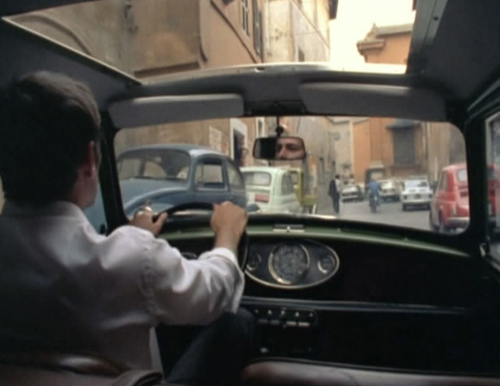
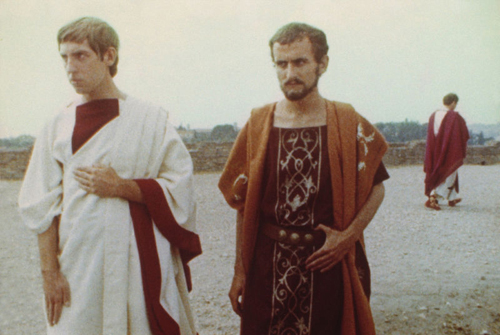
RANCIERE: There is most certainly an important evolution over time. I would say that, if an open-air theater is involved, we nevertheless pass from a one kind of theater to another: let’s say from Brecht to Hölderlin or, if you prefer, from a dialectic dispositif to a lyrical dispositif. This is a change of the dispositifs meaning that, I believe, is also a change of Marxism and of Communism between the films of the 1960s and their latest films. In the first configuration, what I’m calling the dialectic configuration, at the center there is a relationship of tension and opposition between words, what the words mean, and those who say them. I’m thinking in particular of Othon and History Lessons, films from 1969 and 1972. History Lessons is based on Brecht’s text The Business Affairs of Julius Cesar, a book that also presents itself in the form of interlocked narratives: supposedly living a bit after Cesar, the narrator goes to interview a witness, a witness who is getting rid of a manuscript of the freed slave who took care of Cesar’s accounts. Already at that time, and a bit like in Workers, Peasants, the Straubs made a selection: they take the dialogues, the characters’ discussion about Cesar’s career, etc., so that the film is a straightforward political lesson. Finally, these distinguished people, seated in a garden, make us understand that the logic of profit, the permanence of economic interests and class struggle underlies wars, revolutions, changes of leadership or forms of government. It is a straightforward lesson given across a series of processes of disassociation, gaps between bodies, texts and space. These dialogues borrowed from Brecht are recited by figures in Roman togas, who talk of Julias Cesar’s business affairs the way we talk about those of Jean-Marie Messier, except that they are in the garden of a villa in the present, arrived at by car. Moreover, their conversations are cut up by long sequences where people drive in the packed streets of Rome. A question: what relationship is there between traffic jams, the world, car horns, noise and the rest, between this contemporary urban city and the conversations in togas? It seems to me that there is an almost automatic distancing effect here. A game of current events is set up, a distance is created. It’s always the same and, at the same time, precisely, the distance is marked, the strangeness of this business is marked. After all, these car rides that have a pointless feeling are a way of miming the dialectic exercise. It’s a way of telling us to pay attention to the text, to those who recite it, and that it is necessary to learn to read reality on the model of the attention that one brings to the hazards of driving. It’s a bit of the same thing in Othon, Corneille’s tragedy recited in its entirety and recited on Mount Palatine, in the ruins of ancient Rome that overshadow modern Rome. It’s based here again on a system of gaps in the topography and gaps in the diction of the text. At the topographic level, first… This tragedy about clashes for power after Nero’s fall, this text, in sum, about Rome’s destiny is filmed on Mount Palatine between two Romes that are both absent: one is only ruins and the other is below. In most of the film, we hear, sometimes we discover, far below, modern Rome, with its cars and aggressive noise.

othon2.jpg

LAFOSSE: A modern Rome that has nothing to do with all these stories…

RANCIERE: Also, you could say that the text is situated in a space presented twice as inadequate. If we consider the diction of the text now… We notice that it is said by mostly Italian actors and in a monotonous and accelerated manner, as if the overall meaning was more important than the exactness of the text. It’s very different than what we saw this evening. In Othon, the talk is fast, a part of the text is chewed up, and we understand well that it is a supplementary demonstration that all these beautiful words are after all great intrigues between them, distanced from the people, and behind their backs. In these films from the 1970s, the dispositif that I’m calling dialectic makes it so that the texts are directed by their differences—the collision of words and things, the collision of the past and present…the collision of the working class and the nobility. And this collision is supposed to have a revelatory function; it is supposed to show the contradictions inherent to social reality. We therefore have a theater for a spectator Brecht dreamed of: the actor in social conflict is supplied the means to read reality, given the knowledge of what the words mean and so on. It is political cinema that operates the basis of demystification, of unmasking…of disrespect, and that allows a certain state of the world to be understood, meaning the state of the class struggle. The second dispositif, that we find later, for example in Workers, Peasants, is in my opinion completely different, even if there are still rather immobile bodies in a large, natural space. In Othon, Corneille’s text was sort of made into prose. Now, what is striking in Workers, Peasants is that there is, instead, a sort of versification of Vittorini’s text, like a desire to magnify each word, almost every syllable, and this is notably thanks to a kind of over-articulation. I would also say that their recent films substitute the dialectical dispositif of the past, made of disagreements and disassociation, with a lyrical dispositif of agreement between text, body, and place. In regards to the story, for example, it is now no longer about revealing the more or less seedy reality of the business affairs of the elite, but it is now about demonstrating in a directly visible manner the way in which people deal with their own business affairs. At its core, it is about directly demonstrating the power of a communism that is not a goal to obtain by arming oneself for a future battle, which is also not a past, nostalgic episode, but that is already and still here, and that, in a sense, is here forever. Therefore, there is a dispositif of agreement between what is said and the words that express it: we are no longer in the dissociation between words and the visible but rather in the relationship between equality itself in the visible—that is there, this stays, this continues—and speech, both dramatic and lyric. By dramatic speech, I mean words exchanged by characters in conversation. The construction of Workers, Peasants is remarkable from this point of view. Groups oppose one another: workers and peasants, leaders and masses, men and women… Each speaks in turn, lays out his or her problem. Each is in his own shot—it is very rare in the Straubs’ films that partners in an exchange are in the same shot; when they are, it’s generally from behind. Each one reads his text or looks at it or looks in front of him in an undetermined direction. None of the characters look at those that they are talking to. It’s like a kind of absolutizing of words, it’s as if everything was in the words. And these discussions between workers and peasants, between leaders and masses, between men and women, between the faithful and deserters, etc. are not heartrending dramas like in Comolli, for whom these conflicts are dissociated elements; in the Straubs’ films, these are, to the contrary, elements of consistency. This communist people exists. It exists in its own division and, at its core, by its capacity to affirm the division.

sicilia2.jpg

LAFOSSE: Ah, dialectics…

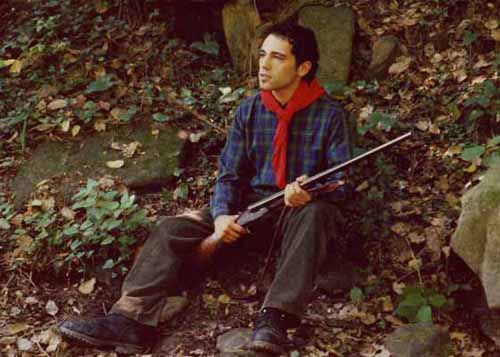
RANCIERE: Yes, we find there their dialectical side. For there to be a community, it must be divided. One exists by two. And it is dramatic speech that speaks of this division, but not in the style of a story because they don’t recount: they declare. Thus to declare is the occasion to demonstrate capacity for communism, to begin by an ability to speak. And, on this subject, what is remarkable is that the working class characters are played by non-professional actors who do not speak a working class language: they speak a kind of poetic language, it’s practically Virgil. In such a way that there is something like a game, something like a jumbling of hierarchies. The more humble the characters are, the more grandiose their language and tone. Think of the widow Biliotti, a country character played by Angela Nugara, who plays the mother in Sicilia!: she incarnates the nobility of the poor, a nobility of speech, an ability to elevate herself and to speak by bringing the greatest attention to language itself. There is nothing of a working class language; it consists, on the contrary, of a magnification. We can think of Carmela too, the one who does the accounts in Workers, Peasants and who says who leaves, who returns: everything is performed in her mouth; we constantly see her try to be at the height of the situation by her speech. We have before us the affirmation of a capacity for elevated language. And, as this speech is deployed, I would say that we pass from the dramatic content—in the sense of the exchange of arguments and disputes—to a common lyric power of words that affirm the community as it is. This culminates in the Ricotta episode and the episode of the departure to go looking for laurel, which are such great utopias staged through speech. Let’s take the Ricotta episode… She tells how it is made, how they come together around her, how it is shared, and we see that all the power of the community is put in three things: first, the savoir-faire, in the sense that, for the Straubs, there is a peasant savoir-faire that is opposed to a vision of socialist engineers or technicians; secondly, the grandness of the ceremony of sharing to which this savoir-faire leads; thirdly, language itself. This is interesting because an elevated culture—which is the culture of speech or based on speech—is often opposed to a working class culture—which is based on gesture and artisanal, manual savoir-faire. Now, here, this opposition is refuted absolutely: the same power is in the Ricotta and in the speech that talks about this Ricotta. There are no working class arts and, opposite them, bourgeois arts or arts cultivated by speech, but a shared intensity to words and what words says. At this moment, communism becomes an intensity, a degree of intensity of perceptible experiences. There is equivalency between Ricotta, sharing, and eloquent speech. It’s almost the same thing in Sicilia!, when the mother evokes the past. She is seen preparing her small dinner, there are long shots of the fish cooking, then she gets up and starts to talk of the lovers she has had, evokes the grandfather who was socialist but who nonetheless led the St. Joseph’s Day parade, and all of this is like a kind of working class grandeur that is found at all levels: in savoir-faire, in language, in storytelling, in tradition. But let’s go back to Workers, Peasants: there, Ricotta is like a communist Eucharist…like a consecration of the community. And I believe that that is an illustration of the reversal of the Straubs’ initial dispositif: the dialectical theater of the past becomes the theater where the dialectic is judged for its pretension to judge. Let’s look at Umiliati, which is in a way the sequel to Workers, Peasants, and let’s examine its dispositif. These are also short extracts from the end of Vittorini’s book—if it is only from there—it’s the end of the community, the moment when it explodes, through contact with the outside. A more or less enigmatic character who serves as prosecutor explains to the people that the world is a world of properties and that, consequently, they do not have the right to settle like this on a small bit of earth in order to make a community. There are also three characters, who are hunters in Vittorini’s book and partisans in the Straubs’ film. And the prosecutor and the partisans explain to the others that they are rather backward: together, they form the tribunal of history. The partisans are comfortably set up in the shade, in the ravine, while the members of the community are up high, under the sun, filmed like prisoners about to be executed. They teach them the lesson, they explain to them the laws of the economy like Brecht explained them in The Business Affairs of Julius Cesar. Except here the mise en scène itself refutes these economic laws. Visually, for example, it is apparent that this discourse and these lessons bore the peasants, the worker peasants of this commune. You can see how much the mise en scène refutes them, in the smallest gestures, such as that of the old peasant who lends a hand when another is speaking in order to finish off by simply saying, “Here, it’s another affair.” What other affair? We don’t really know, but a distance and a refutation are created, a refutation of the triumphant discourse of the laws of history and progress. Likewise, when the one who I’m calling the prosecutor explains these rules to them, it is a speech worse than a legal speech, and he delivers it with a wild look and a ventriloquist’s manner of talking, which makes what should be a brief statement become a funeral dirge, so that the dialectician clearly refutes himself. And then there’s obviously the last shot: Siracusa, the leader’s companion, is prostrated on the doorstep of the house, her head in her hands, it’s over but, when the camera lowers, her hand becomes a tight fist. That is a final gesture, a final image that comes to refute the tribunal of history.

humilies.jpg

LAFOSSE: Space plays a very important role in the system the Straubs set up…

RANCIERE: We can talk a bit about that if you want. What is striking in Workers, Peasants, as in their latest films, is that the place of the characters is more and more nature itself. First, nature is the subject of the discussion—hence the argument in Workers, Peasants: on one side, there are workers and what one could call the soviet ideology that wants to put nature to use, to make roads, to transform it and so on, and to order total mobilization, and, on the other side, one finds peasants, those who agree on the time of germination, of waiting, of the harvest, of rest, of respect for the earth. That is the first aspect. Next, there is nature, which is before speech, and which eventually gives up its place and its power to speech. It’s what is there, what is always there without reason, before all reason, and what does not stop acting, reproducing itself and altering itself at the same time. From which comes the importance of the continual agitation while the men and women are talking: nature doesn’t stop moving. These are insect noises, bird songs, the effects of light on the plants, the trees, on the moss-covered rocks and the dead leaves… The activity of this undomesticated nature is constant. You’ll note that we’re talking about a peasant community but that at no time do we see it in the shot, for example: this is clearly voluntary. The partner is the wild nature, the ravine, undomesticated nature; and, after all, communism, for the Straubs, in this last part of their work, must necessarily be linked to a nature without rhyme or reason. There is also a dispositif that pronounces a rupture with the idea of nature that accompanied Marxism for a long time: nature as transformable material that man must model in his image and the idea of history as the humanization of nature. One could say that, now, the Straubs’ politics and mise en scène stands up for a certain inhumanity of nature. Nature is like a continual power and rumble that limits humans.

clouds1.jpg

LAFOSSE: In your opinion, this change, this reversal can be situated at a precise point in their work?

RANCIERE: I would say that the film that is the turning point is From the Clouds to the Resistance, a film from 1978 adapted from Pavese, that I’ve already talked about and that has two parts: first, six of the Dialogues with Leucò, then very selective extracts from The Moon and the Bonfires. I believe that this meeting of the Straubs with these Dialogues is very important. Pavese wrote Dialogues with Leucò early in the post-war period, at the time when he rejoined the Communist Party and when he was writing a novel to announce this conversation, The Comrade. But, while rejoining the Communist Party, Pavese took a considerable theoretical distance not only vis-a-vis contemporary political and social events, but also from the technical tradition of Marxism. Thus, what he wanted to do with Dialogues with Leucò was to root what had been fascism, war, resistance, and communism in a much older drama of the relationship between culture and nature. This is why he went and looked at ancient mythology and, basically, what he recreated is a drama about the origins of tragedy: we can think of the original proceedings of Greek tragedy with the quarrel between the old and new gods, the establishment of justice, the passage from a maternal time—of the time of mother earth, the titans, the monsters—to the order of the Olympian gods. In 1978, the Straubs directed these six Dialogues with Leucò on the theme of the creation of a universe of justice and, consequently, on the time of the differentiation of gods and men, on the end of the religion of the earth. But, while they directed these dialogues, I believe that they placed themselves in a drama that marks their political aesthetic more and more. At this moment, the relationship of bodies to space becomes more and more this relationship to an inhuman nature, an inhuman nature that is the basis of another idea of culture. We move to a peasant or ecological communism, opposed to the communism of Soviet engineers. After all, this nature has no pastoral qualities. It is an ancient nature: a play of forces, a play of conflicting elements. One thus finds in their work what one could call an ancient philosophy of the elements of nature—water, earth, fire, air—and their conflict. To put it differently, with this film in 1978, there is a division between the heavy elements—water, earth, elements of heaviness, duration, secretiveness, waiting—and the light, volatile elements—brightness, light, elevation, air and fire. In a sense, Workers, Peasants is a discussion between men of fire and men of the earth, and everything plays on this war that also takes places in this setting. All the elements intervene all the time. You can think of the roles that water and air, insects, and wind play, the role that fire (meaning the sun) plays. The film is a war of elements that arrives at a reconciliation: the story of the Ricotta, the story of the fire, how to make the fire… The reconciliation of the elements is conceived as an apotheosis of the community, knowing that, at the same time, nature is also what is there before all arguments, as what is nameless. That’s why I say that for me, at a point, there is in their films a reversal of the dispositif between two communisms and two mise en scènes. In the first period, what was important in their work was the power of words over images—think of Moses and Aron, with Moses as the man of words and Aron the man of images, and the Straubs who, in this conflict, are on Moses’ side—and, this period is followed by a lyrical model where the power of what precedes words affirms itself over words, when something unnameable appears that gives words their meaning, all while imposing on them a form of respect. I have voluntarily opposed these two models in a rather blunt manner here, but I think that this opposition exists.

moses-aaron.jpg

LAFOSSE: What you’re saying, and what you’ve shown with these examples is that at a certain moment, there is an ideological reversal for the Straubs: they move from a worker’s communism to a peasant’s communism, they move away from a Marxist dialect à la Brecht, to get closer to a “defense of the earth” communism.

RANCIERE: That’s the general context, but when I say that there is a dialectical model and a lyrical model, or a model of dissociation versus a model of agreement…at the same time, of course, the mise en scène only exists in so far as it works these two logics. And, there again, one could say that films like Workers, Peasants and Umiliati are a way of putting these two logics in the same space. In both, there is this play between a dramatic, dialectical dispositif of exchanges and a lyrical dispositif of affirmations…

LAFOSSE: And of movements of nature, as if everything was also in agreement: the respiration of the men, the vegetation and things.

AUDIENCE: You’ve talked about singing, but never of operatic singing, while sometimes there are poses that could make you think that the Straubs think of themselves like that. Is the presence of singing a new element in the Straubs’ films or has it always been there?

RANCIERE: If we talk about the direction of the music, in the literal sense of the word, it is certain that music has always been present in the Straubs’ film. Proof of this is that the first film of theirs that was seen—even if it isn’t the first that they made—was Chronicle of Anne Magdalena Bach, in 1967. Then, in 1974, there was Moses and Aron and, in 1996, From Today to Tomorrow. Thus, there is a very strong relationship with music. But, to respond to your question, we also note a stronger and stronger relationship to a form of total spectacle. I talked in regards to them about the Greek tragedy as it was thought about during the Romantic era, and we know that at first, opera wanted to be a recreation of Greek tragedy. This idea of a total spectacle is there, a complete spectacle that is a hymn. In regards to their films, you could therefore talk about operatic qualities. To this is added a displacement of the status of speech itself, an obvious displacement when you see Othon—with its delivery and way of talking that make it so the close relationship between language and speaker does not exist at all—and Workers, Peasants—where Vittorini’s sentences are treated like tragic verse, indeed as an operatic element. In this sense, there has also been an evolution and you could say a new element.

AUDIENCE: In Workers, Peasants or films like that, the actors sing the text…

RANCIERE: I wouldn’t say that they sing the text. They don’t sing it literally, but let’s say that they utter it in the fashion of poetry which implies the idea of singing: in the vein of lyrical poetry. The reference to a language that would not separate prosaic speech from song is very present. In that film, one finds the utopia of the Romantic period when speech and song formed a primary entity.

operai-1-2.png

LAFOSSE: Over the course of these days we’ve thought about the coexistence in the Straubs’ films of materialism and spirituality. Could we address this question?

RANCIERE: It’s a bit complicated and rather dangerous. Basically, in their work there is a kind of radical materialism in the mise en scène that wants to eliminate every representational element and that wants everything to be shown, direct, present. And there is equally an idea of communism as an entirely material matter: in the place of relationships of production and productive forces, there is the Ricotta, snow, ice, stars… So there is this aspect that can be qualified as materialistic. But, at the same time, this materialism recalls the dream of the Romantic era (and that’s due to their proximity with Hölderlin and German Romanticism), meaning to the idea of a world where there would no longer be on one side the intelligible world, thought, and law and, on the other, the visible world, but a world where a common law would be incorporated in the visible world itself and where there would no longer be any opposition. This is what gives the Ricotta a Eucharistic quality, a desire to transform everything—gesture, human speech—into a sacrament. In a way it means uprooting sacraments to the heaven in order to now consecrate human bread and blood in place of the bread and blood transformed by the son of God. It is in this way that a materialism that is not against idealism, against spiritualism, is found in the Straubs’ films. There is also a second aspect that responds to this question but that, for me, is less interesting. It’s an aspect that’s a bit provocative and fashionable: you constantly are meeting people who explain that Marxism is religion, that Brecht was Catholic and Claudel a materialist… For me it’s a game, a rather simple reversal and, if it occurs to the Straubs to sometimes concede this, it remains secondary. What is essential in my eyes is really the refutation of the opposition itself that we talked about, it’s the fact that the spiritual is found entirely in the gestures, in the consecration of gestures. It’s the fact that thought is entirely found in the materiality, not in the Soviet vein of transforming of the world by thought, but by a realization of thought as in accord with the rhythm of nature.

AUDIENCE: Aside from the question of the opposition between materiality and spirituality, what I found interesting in their work is that there is maybe a mystical approach which leads them to do radical things, including in the vein of representation and form.

RANCIERE: There are different ways to overcome an opposition. One can overcome it by the classical model of thought that realizes, that transforms the world in its image, or by an inverse model of thinking that puts itself in agreement with nature. I don’t know if you can call that mystical. What is certain is that it is a matter of going back to a religion of the earth that existed under diverse forms during the Romantic era. The Straubs’ Marxism has more and more of a tendency to move towards Heidegger and to distance itself from the Brechtianism of thirty or forty years ago.

AUDIENCE: I remember in a film a scene of a supposed fusion of the hero with nature, with the stars. But the way in which the Straubs talk about the stars has nothing to do with the way in which Goethe, Novalis or Hölderlin do. For Goethe, Novalis, and Hölderlin it is always upward, while there, to the contrary, it’s downward: the hero sees the stars almost below, it’s absolutely amazing…and there is nothing inseparable about it. The relationship with nature is not inseparable at all. Also, I agree with you when you’re talking about another relationship to nature—fire, not electricity—, but not when you talk about fusion with nature. It’s also for this that the relationship with German Romanticism, it seems to me, needs to be used with a bit of precaution.

RANCIERE: It isn’t me who’s making this relationship, it’s them. It’s maybe not your Hölderlin, but it’s theirs. As for the fusion, I would say that it is without a doubt more at the level of the relationship between nature and culture than at the level of an inseparable relationship of men with nature. The fusion with the stars is one thing. But what is at the heart of German Romanticism is the idea of a visible world that would no longer be opposed to an intelligible world. And it is this idea that the Straubs take up, the reference to Hölderlin being massive.

AUDIENCE: But Hölderlin isn’t a Romantic!

RANCIERE: You can say of anyone that “he isn’t a Romantic.”

LAFOSSE: A question of fusion, and even if Hölderlin’s Empedocles is unfinished, his goal is nonetheless to melt himself in the volcano, and totally. At its heart, it is also a question of that kind of fusion.

RANCIERE: Yes, of course.

AUDIENCE: Don’t you think that the connection you’re making between the Straubs and Heidegger distances them from any idea of progress?

RANCIERE: From progress surely, but they are deliberately anti-progressive! They want to be in this anti-progressive revolutionary tradition, in the way Benjamin criticized progress. They are developing an idea of progress completely at odds with an idea that would inscribe it in the continuity of the development of the sciences and social relationships. There is a “back to the earth” quality, in their work. This is seen in the layout itself, in the distribution of characters between high and low, between light, brightness, and appearance, and withdrawal, the earth… And this is a dramaturgy very close to Heidegger, a dramaturgy that corresponds to a certain form of contemporary thought that draws from Hölderlin a model of revolution and communism separate from progress. You may find this paradoxical but they take up this paradox with the same willfulness that Benjamin had in breaking the course of history and advocating a return to the past. Like Pavese going back to myths to re-interrogate and question the relationship between nature and culture in order to re-situate and re-think communism, the Straubs are radically isolated from the tradition that links communism to Enlightenment thought, progress, and scientific development. They demand it.

AUDIENCE: When one talks about progress or development, it is important to know what one puts into those words. What is progress and development in the Western world? Today, these are things that are questioned, outside of all dogma, and including by those who want to be considered progressives. It seems important to me to add nuance to it and say that the notions of progress and development do not come down to certain harmful models that wanted to be imposed as universal standards. The progress of knowledge is not necessarily the progress of techniques, the ravaging of the quantitative and the increasing of production!

RANCIERE: In the strongest sense, progress is the idea that all developments work in unison. If we leave behind the rather ordinary usage of the term “progressive,” meaning someone who is rather to the left, on the side of the people and for justice, if we try to give a more precise meaning to the word, progress means an idea of history as going straight forward and with all developments contributing to one effect. It is this type of progress that is at the center of Marxism.

AUDIENCE: Maybe, but that doesn’t sum up progress, progress doesn’t reduce to that!

RANCIERE: No, but it is always necessary at a given moment to make summaries. One makes choices and, when one makes choices, one makes summaries. It’s what the Straubs do in this case.

LAFOSSE: You’ve talked about story, about narrative. You say that plot never really interests the Straubs. On the choices precisely, there is something striking in their work: the position of the bodies in relationship to the narrative. The narrative advances through the bodies but at the same time there is a force that could be qualified as a refusal. In their films, don’t the bodies also go against the narrative?

RANCIERE: Bodies put everything that is narrative in the present. Said differently, they appropriate the text. In Vittorini for example, there are people who, in contrasting manners, tell what happened to them over a period of six months. But in Workers, Peasants, that’s not what it is: there are groups who confront their past and this past is absolutely present. So, basically, the bodies are there, upright with their text, with the reasoning of their arguments, and, as they speak, everything that was narrative, becomes direct speech, dialogue, affirmation. This doesn’t mean that they make the past into a blank slate, but the film is always in the present tense. Also, bodies take possession of the text, putting it entirely in the present tense. If we don’t forget that, fundamentally, narrative doesn’t interest them, that they don’t want that, and that, everywhere that it is, they eliminate it—as in From the Clouds to the Resistance with the examples of the flashbacks that I was talking about, a flashback necessarily being narrative—, well, you realize that speech has to unceasingly re-conquer its power over everything that puts it in the past tense, that makes it not current, outside of reality. Of the narrative. And, as you said, bodies that take possession of the text through speech are therefore also going against the narrative.

AUDIENCE: Can one not think that everything must be in a film and that a film doesn’t have to need ulterior explanations?

RANCIERE: It’s a choice. What is a film? A film is something that one sees like this, that one sees once and, often, it’s over for a long time. A film is an extremely volatile object that does not necessarily need to constantly be explained or commented on, but extended. In any case, films continue to live within us, even without commentary: we make our own commentaries on them. In eight or ten days, this film that you have seen this evening will become another thing. Shots, words will leave; a new film will be constructed. You can’t ignore this extension. Memories of films are not uniquely memories of what has been before our eyes at a given moment. Memories of films are memories of everything that, afterward, gets buried. The cinema is made of this sedimentation. Also, if I don’t think that films have to be explained, I believe that one can try to extend them outside of all commentary, interpretive aims. Cinema needs to have created for it a space for speech that is a space of sedimentation: that’s the role of talking about films. Personally, when I see a film, I want to read the things behind it. Not to explain it to myself, but so that it resonates differently, so that other connections are created, so that the film is made to live in a larger space.

amb-lyt.jpg

LAFOSSE: This extension through words is something very present in the cinephilic tradition starting at the end of the 1940s and the beginning of the 1950s. If we look into everything that made up the New Wave, we see that for those filmmakers it was indispensable that there was, after the film, an extension via words that could be even more important than the film. It was the period of film clubs, of repeated viewings of films. To associate vision with talking is something that is linked to cinephilia, which was part of the resistance, a counter-cultural network, and a parallel society, places where one thinks and debates as well. And that was a discourse that was not really on the level of explanation but in the order of exchange and of another life for the film. Films don’t die after the words “The End,”—for them, at least, I’m sure of it. Outside of their body, they can still unfold.

AUDIENCE: I think that this is part of this genre of films. The Straubs’ films are made to be thought about and to incite people to think. You think and afterwards you talk, it can’t stop there. It’s made for thinking.

LAFOSSE: To think, to feel… The fullness of the idea in the colors: it’s what Cezanne says of Véronèse.

AUDIENCE: I’m discovering the Straubs here. And I’ve asked myself about the place of children in these films because the only one that I saw was this evening in From the Clouds to the Resistance and I have the impression that they were embarrassed to film him, a bit like Godard. Could you talk to us about their experience with children? Are there many of them in their films?

RANCIERE: There aren’t a lot, and it seems to me that there is no problematic of childhood. There are two children in From the Clouds to the Resistance because they are in Pavese’s book and his novel is also a story of transition, transmission and passage from an old order to a new order. In The Moon and the Bonfires, there is the story of the deformed boy, and that of the father and son, where a relationship between an old world and a new world is expressed, and where the child brings a negative judgment on humanity, and in En rachâchant, a film from 1982, a child resists his teacher… Does this mean that there is a child figure in the Straubs films, indeed a figure of resistance? Never forget that they work from texts that are addressed to an adult community to ask it where it is with itself, with its past, with its future and, if there aren’t children in these texts, there aren’t any in the films. It happens that the child serves certain questions but it is rare that he is really put in the foreground and treated as a character. For the Straubs, the child is not the future of the world.

LAFOSSE: Would you say that this cinema treats a sort of lost innocence?

RANCIERE: Can one speak of innocence? Maybe. There again, from the turning point that is From the Clouds to the Resistance, we notice a nostalgia for a certain innocence, not in the sense of lost purity but of a world before good and evil. It is present in Pavese and even Hölderlin: there is a confrontation with a world in which the gods no longer exist; there is a relationship between man and nature before the division of good and evil. This could be called innocence in the sense that Nietzsche talks of the innocence of becoming, of a world that is beyond good and evil. However, I’ll say it again: the Straubs’ nature is absolutely not a pastoral nature, it is savage, worrisome, cruel and inhuman. It is not idyllic.

LAFOSSE: We’ve sometimes asked here how we’ve come to the Straubs’ films… Can you, Jacques Rancière, tell us how you came to their films?

RANCIERE: A bit in a zigzag. I first saw Chronicle of Anna Magdalena Bach when I was young. I was happy to see it but I can’t say that it marked something specific in my life. After that—it was the period of an extreme left—, the people at Cahiers du cinéma recommended I go see History Lessons. I’ve always had a bit of an imposed relationship with the Straubs: “go see it and come talk to us about the Straubs,” they’d say to me. So I saw History Lessons for the Cahiers and I remember that it rather depressed me. It’s true that next I immediately loved the magnificent way that they treated Dialogues with Leucò in From the Clouds to the Resistance: it’s fabulous. Even if I continue to hold it against them for, in The Moon and the Bonfires, completely avoiding the three girls who are the body of Pavese’s novel and having instead made a sort of easy bit of anti-clericalism by giving a spectacular visualization of a priest’s speech that is only mentioned in the book. At other times, I saw a film that I liked, then films that I didn’t like at first but that I liked afterwards. Let’s say that I saw in a rather chaotic manner certain films at very different moments, without at all feeling myself to be an aficionado of the Straubs. And then, two or three years ago, some young, fanatical Straubians told me they wanted to unite their two passions by hearing me talk about the Straubs. To do this, they sent me to see Workers, Peasants so that I would talk about it at a philosophy convention in Nantes. I went to see it, saying to myself that it wouldn’t necessarily be very amusing, but I was seized by its lyrical power. I talked about it, this pleased the Straubs. And there you have it. Afterwards, I was asked to write about Umiliati and Pedro Costa’s Where Lies Your Hidden Smile?. So you could say that I found myself as an accidentally inundated specialist of the Straubs. There are things that I love tremendously in their work, there are other things that I like less, and, finally, there are films that I don’t like at all. In any case, I didn’t have an epiphany with their films, I had a relationship spread out over time with considerable variations in approach and feeling. And I’m trying to talk about all this.

——————————————————————————————————————————————————————-

See also this film made on the occasion of the Straub-Huillet retrospective in Paris (November, 2007 – March, 2008), organised by Philippe Lafosse.

And this debate with Jacques Rancière after the projection of Europa 2005, Joachim Gatti, Corneille-Brecht and O somma luce, in Paris, January 2011.

The non-legendary period of Cahiers

jancso.jpg

By Serge Daney

Originally published as ‘La période non légendaire des “Cahiers”. Pour préparer la cinquantième anniversaire’. In ‘L’exercice a été profitable’ (Paris: POL).

1. For a long time I kept a bundle of “internal texts”, as were common, until the mid 1970’s, among militant groups, circles or cells – such as Cahiers du Cinéma which at one time wanted to “organize” itself in a revolutionary cultural front. It was a poor bundle of critical pieces, auto-criticism, assessments and quotes, responses and resolutions, in between theory and practice, a bit along the lines of the Chinese model of “individual perfecting” (line of Liu Shaoqi*).
I had skimmed through them so much that it was hard not to find these texts silly; the kind of silliness you can also find in the films of Godard and Gorin from that period (the Dziga Vertov group*). I kept them with a vague idea of making them into a comedy one day. Indeed, what comedy is more beautiful than that of the ideal? What failure is more pathetic than that of the Militant, this frail being which finds itself regularly inept and duped and often has blood on its hands? Which groups of actors are more hilarious, because of their seriousness, than those filmed by Oshima, the Taviani brothers, Kramer and, of course, Moretti? And what a silly group, this Cahiers of the 1970’s: “deranged” enough to form a splinter group, but also clever enough to work together, which allowed each of its members to smother their own distress in that of the last Parisian avatars of the communist idea. Haven’t we decided, one day at Cahiers, to pay ourselves according to the principles of the Da Zhai model, that is to say “according to merit”*? I even remember being granted 900 francs (in those days).

2. Time passed and I lost the bundle. Who would have laughed at those excesses anyway? Not us, who saved our skin, one by one, without laughter. Not those who, after us, have and would make the Cahiers. It was before that we should have laughed, even hollow, even alone. The truth is that the priceless seriousness of the French political theater, with its revolutionary and/or snobbish draping, certainly was not a subject for comedy. I should have know, me who was part of the comity who “took over” the Odéon (which was open anyways) in 1968, even if I didn’t like theater. Also true was that this Cahiers generation was not really a generation of filmmakers and that in a more general way the stars of ’68 wouldn’t create much except for communicative know-how.
The truth, finally, is that we didn’t do anything but reliving, in extremis and in vitro, the intimate remake of the rancid great passions that the PCF (French Communist Party) had conducted for fifty years (so the PCF grew tired and we blamed them for it). From guilty delights of bad faith to the utopia of the counter society already realized in the group, from rites of exclusion to homegrown doublespeak: we haven’t invented a thing. It didn’t last long (’72-’74) and didn’t cause many deaths. It even hardened us (“The heart has to break or to gild”, according to Corneille)

3. When I was asked, at the occasion of the 40th birthday of the old magazine, to write a text about these years – the “non-legendary years” (not to say “shameful”) of the Cahiers, I said yes, then no, then yes, then I diagonally read eighty editions and decided to make what one always makes in such cases: a witty and elliptic dictionary. I had a go at it and didn’t find it funny at all. It’s not easy to answer a question that isn’t posed anywhere (that of the heritage of the seventies) and even less easy, twenty years later, to continue to say “us” and to continue to say it as “me”. The history of these fifteen individuals who, for ten years, have made Cahiers into their beacon, scalpel and anguish: it’s up to the historian – Antoine de Baecque* – to tell it, if he wants. For me, if this text is still written under the sign of an unobtainable “us”, you can rather consider it as my farewell to the first person in the plural.

4. And then there’s the spirit of the era. Observing the way in which the despicable BHL (Bernard-Henri Lévy*) recently buried a century of thinkers of the French intelligentsia on television, I was appalled by the way in which, once more, the mediatized forty-somethings of my generation behave badly when they have to hold up in public a certain image of them “thinking”. That the baby gets thrown out with the bath water is one thing but perching on the bathtub, posing on television to say that there was no thinking at all: that is too much. From Lacan to Barthes, from Bataille to Foucault via Althusser: the Cahiers’ “non-legendary” years carry their signature and it seems to me that this theoretical theater, with its seductions and its terror, hasn’t been replaced by another, more normal and smart, but has rather become gradually disused.
That’s why, when I reread the Cahiers from the seventies, I’m less struck by the jargon, the arrogance, the ukazes, the dubious mockup, the lack of photos and the overflow of quotation marks, bolds and italics, than by the certainty we felt (and that I miss now) that cinema was worthwhile thinking about – thinking hard about. So, I don’t feel like apologizing anymore because once, fifteen years ago, we lacked the good manners of some bourgeois wanna-bees. For the first time, I rather feel like pleading pro domo.

5. Why is this era so hard to apprehend? In 1970 we published a long series of hard-wrought articles on Jancso’s film The Confrontation (aka Sparkling Winds, ‘Fényes szelek’, 1969). But it’s not so much these texts that have disappeared than the film itself, which served as collective pre-text. Who remembers Jancso’s films anyway? Do they even exist outside of the encyclopedias of cinema? The question is obviously more general: the liberty of tone, the crazy rhythm of storytelling, the polite but total indifference for the “taste” of the audience and the box office, the desire to mark out, willingly or not, a road for cinema that diverges from the route held in place by the American model: it wasn’t only Jansco, it was all those global “new cinemas” from the post-Nouvelle Vague years (’65-’75), a continent that by now has almost vanished. That’s why the seventies are in purgatory: most of the film that made us write are no longer part of the collective memory, nor part of the video libraries or the dominant discourses. We thought of everything except this: that these films could disappear.

6. That cinema is not longer where we found it, that is to say “in the middle of the world”, is not necessarily a sad thing but it’s all the same quite something. Rereading the non-legendary Cahiers, I have the impression that we were like students of Latin who were not able to accept – like grumpy buffoons, always first-in-class – that it had become a dead language, something from the past. Cinema is the art of the present, that’s what Bazin used to say, and there are axioms that we recognize, in this period of ten years, in all styles and forms, in all theoretical bindings, in every editorial, under every guise, be it in the rags of militant cinema or the unisex uniforms of today’s television. And Cahiers’ axiom was that cinema has a fundamental rapport with the real and that the real is not what is represented – and that’s final.
And that the real doesn’t wait. And that time is not given, that it has to be invented, created, earned. Even the wavering time of the magazine, when Serge Toubiana and me asked ourselves in all seriousness if we had enough “of ourselves” to quickly make a simple issue or if we had to wait a month so we could make a double. And at the same time, as soon as there was an unforeseen film that we liked, we started from scratch, we remade the theory, the grammar, we launched new ukazes and established new gateways, because we needed to have Straub, Godard, Syberberg or Kramer on one side and always Lang, Hitchcock, Eisenstein and Rossellini on the other. That gives way to a chaotic functioning, a not very gracious shuttle where the revelations were always staggering, the new line immediately impaired by receding lines, the time to calm down regularly lacking and impatience the common lot.

7. Looking back, obviously, we see how the decade, at Cahiers as well, is divided in two parts: before and after 1975. Up to 1975, we felt like we had to answer “present” to politics. But afterwards? Politics passed, the present stayed. I don’t find unworthy, certainly not after the Golf War, our special issue about “Images de marque” (76), nor the first texts about television (that we amiably called “answering machines”), about films shown on television, nor the texts written by Rancière about the spirit of the “communal programme” in cinema, nor the reflections on cinephilia. Always this idea of the present and finally of journalism. That’s undoubtedly why I’m not able to write this text “in the past”. Because, me too, I had to answer present when, at the end of ’73, the magazine was left to whoever wanted to pick it up. For seven year, I felt like one of those mock-heroes who try to land with the whole cargo, without loosing or forgetting anything, even without owning a license to fly.

8. But there were some good sides too: we didn’t believe much in the division of work, we knew that the great directors had written often and we were happy to transform Duras, Godard and Syberberg into Cahiers’ “chief editors” for one issue each. The alliances were tough but the one tougher than all the others was the alliance between the image and the word, our raison d’être, nothing less. The non-legendary Cahiers wanted to be written, and often they were.

9. Finally one has to imagine that the era was harsh. The sixties had grace, the eighties grease, the seventies were nasty and meager. Everywhere we sensed a dry fury and a relentlessness which nobody found therapeutic. In France, the golden age of the Nouvelle Vage was behind us and weighed heavily on us. Elsewhere, it was intractable and atrocious: Fassbinder doesn’t get off, Pasolini is murdered, Oshima excites and astonishes, Cassavetes resits in some corner, Ferreri makes some teeth grind, Syberberg provokes crudely, Godard continues recto tono and Ici et Ailleurs must be the film I have shown the most (from New York to Damas, from Porto to Brussels).

10. It isn’t very hard to put a date, between ’73 and ’75, on the caesura of the decade. Petroleum crisis, beginning of unemployment, end of the ORTF*, return of consensus (not yet “weak”) and, in cinema, of the “Qualité Française”, of its professionals and their palinodic césars*: objectively it wasn’t cheerful, objectively there was “rage”.
Cinema too had to run into a limit, like a boat scraping the bottom of the river and, in our proper jargon, we felt it. Afterwards, under surveillance of the media, cinema has remade itself into a body of legend and has turned to the supplement of soul*. It’s the history of the eighties. In 1970, we were those (we called it materialism then) who claimed that this soul had a body and that we knew it. In this sense, the non-legendary Cahiers resemble their time, which still couldn’t care less about the legend.

——————————————————————————————————————————————————————-
Translated by Stoffel Debuysere (Please contact me if you can improve the translation).

In the context of the research project “Figures of Dissent (Cinema of Politics, Politics of Cinema)”
KASK / School of Arts

translator’s notes
* Liu Shaoqi: Soviet-educated Communist organizer and theorist, author of How to be a Good Communist (1898-1969).
* The Dziga Vertov group was formed in 1968 by politically active filmmakers including Jean-Luc Godard and Jean-Pierre Gorin. The group, named after 1920s-’30s Soviet filmmaker Dziga Vertov, was dissolved soon after the completion of 1972’s Letter to Jane.
* Dazhai: the name of a mountainous North China village of several hundred farmers in Xiyang, Shanxi, in the People’s Republic of China. Dazhai had been an ordinary village until the 1960s, when Mao Zedong published his Supreme Directive, “Learn from Dazhai in agriculture” and set up Dazhai as a national agricultural model for all the farmers across the country.
* Bernard-Henri Lévy: French public intellectual, philosopher and journalist. Often referred to, in France, simply as BHL, he was one of the leaders of the “Nouveaux Philosophes” (New Philosophers) movement in 1976, hated by Cahiers du Cinéma.
* ORTF: The Office de Radiodiffusion-Télévision Française was the national agency charged, between 1964 and 1974, with providing public radio and television in France.
* césars: the national film award of France, first given out in 1976.
* The expression “supplément d’âme” is taken from Henri Bergson’s ‘Les Deux Sources de la morale et de la religion’ (1932). Bergson’s thesis was that mankind, enlarged in its scope of action by technology, needs to achieve a corresponding spiritual growth: “In this body, disproportionately enlarged, the soul remains as it was, too small to fill it, too weak to direct it. Hence the gap between them. Hence the daunting social, political, and international problems… Let us add that the swollen body needs a supplement of soul, and the mechanical demands a mystique.” The expression is fairly well known in French intellectual discourse – the theme having been taken up by Derrida (who appropriated the notion of ‘supplement’) and others.

The noise of people, the image of art

rosetta6.jpg

About Rosetta and L’Humanité

By Jacques Rancière

Originally published as ‘Le bruit du peuple, l’image de l’art. A propos de Rosetta et de L’Humanité’, Cahiers de Cinema, No. 540 (November 1999)

What is it that Rosetta and L’Humanité have in common, besides the fact that they were both presented at the Cannes festival, where they were as acclaimed by the jury as they were dismissed by a large part of the professionals and critics? What makes them both symbol or symptom, although Bruno Dumont’s wide shots, distanced view and esthetico-spiritualist discourse seems to be completely opposite to the panting camera, the lens glued to the characters and the denunciatory tradition characterizing Rosetta? That Bruno Dumont continues to film the lower class people of the North and the brothers Dardenne the slums and wastelands of Wallonie, that this same North and these same people have also featured in La Vie Rêvée des Anges: for some this seems to be enough reason to proclaim – and generally deplore – a new wave of “realism” and a new compliance of art with the “social”. These judgements themselves can be understood on two levels. In one sense, they offer support to the dominant ideas of a time and an intelligentsia who think that, when it comes to the people, we have definitely given enough or even too much. In another sense, they adjoin a problematic esthetic belief that bestows on art the properties of the featured subjects. The poor, the North: of course this goes back to Zola (specifically Germinal) – this is realistic art, social or “committed” art, and all of this has had its time.

The problem, of course, is knowing if Zola’s art is more realistic and more “social” when he describes the heat of the mines than when he describes the heat of the greenhouse of hotel Saccard at Parc Monceau*. Apparently more than one critic seems to think wholeheartedly that a film is a pure form of art when it develops a Marivaux-like intrigue situated around the Passy subway station* and that it commits itself to the social when its characters live in a suburb and are poorly housed or unemployed. As a matter of fact, this way of thinking still belongs to the era when Monsieur de Pontmartin opposed the villagers’ platitudes of Madama Bovary with an analysis of fine and complex sentiments of this “exquisite world” from the times of Princcess de Clèves who “only beheld the lower class people through the door opening of her stage coaches and the countryside only through the window of her palaces”*. And we could be tempted to remind those critics what Flaubert meant to demonstrate: that modernity, when it comes to art, resides precisely in this: in regards to the absolute of style, there are no more beautiful or ugly subjects, Yvetot is as good as Constantinopel*, a farmer’s daughter is as good as a society woman. We could conclude that, as for cinema, true heir of the 19th century novel, the issue was settled before its birth and that the art of Bruno Dumont or the brothers Dardenne is no more or less social that the one of Eric Rohmer or Raoul Ruiz, just as A la recherche du temps perdu is no more or less than the one of Madame Bovary.

humanite2.jpg

This response would however fall a bit short. What Madam Bovary showed us, was not simply that all subjects were worthy and that only the style of the artist could make the difference. It was the paradoxical identity between the “realist“ insignificance of the subject and the autonomous splendor of “art for art’s sake”. The representative art of former days demanded to choose “noble” subjects and to adapt the adequate genres and forms accordingly. The new antirepresentative art imposed another form of identity between form and content. From then on, the supreme mark of art was to reach the point of identity between the determined and the undetermined, of sense and non-sense, human and inhuman, where the style of the artist identified itself with the subject’s way of being. Flaubert called this point stupidity. “Masterworks are stupid” he said and his contemporaries, reading his novels, felt that something exceeded their understanding in this implacable power which did not work in spite of but because of the nullity of the action and the stupidity of the characters, because of the excess of their brutal and stubborn presence, in defiance of all codification of social species, fictional types and narrative plausibilities.

Today the lesson is at once well assimilated and subject to caution. On one hand, we could say that the Rosetta effect or the Humanité effect are strict applications of the Bovary effect. Rosetta is not a representative of the sous-proletariat whose misery, defined by the close-ups of the camera, moves us and makes us aware of the condition of her peers. The close-ups of faces in Rosetta and l’Humanité don’t bring us closer to the human face and suffering. On the contrary, they exert the function that is superbly described by jean Epstein and covered by Gilles Deleuze: to transform a part of the human body in strange reliëf or monstrous animal. Rosetta’s stubborn obstinacy, her punches or her belly contracted by pain, just like the tired redness of Domino’s enjoying face or the sweat on the policeman’s bloated face are not the revealing properties of a social state to be experienced in all its cruelty. They are properly the subject of art, the brutal presence, the “stupidity” in which the will of art realizes itself as art while canceling itself as will. In this, despite appearances, they pertain more to the esthetic tradition than the elegant variations used by Rohmer to adjust the scenarios and the codes of classical sentimental intrigues to the observation of new social types and behaviors.

rosetta2.jpg

But the formula has also lost its innocence. On one hand, it works too well for it not being manipulated to excess. On the other, we question its bare efficiency and we look for supplements. One on hand, we add to the rawness. And this is the point where the Dardenne’s punchy camera meets with Bruno Dumont’s entomological camera. The first adds to Rosetta’s obstinacy while rattling our view, which is condemned to follow the swirl of the mobile camera running behind her, gluing us body-to-body to the alcoholic mother, opening our ears to the gasping of her efforts to survive, the punches she gives at every object within reach and the obsessive fear of motor noises besieging her. The second adds to the anguish of Pharaoh while aiming the lens at a hand starting up, on the car radio, harpsichord music with a paroxystic sound, or at the brutality of Joseph and Domino’s coupling, planting the camera at a distance and a height that inflame the ugliness of the postures and the pure mechanics of the masculine effort, and while putting in our ears, along with Domino’s wild screams of pleasure, the hyper-realistic hammer sounds of Joseph’s punches. This is how the Bovary effect finds itself transferred to a point of excess where it turns over to its opposite, where the “effect of art”, coupled with the demonstration of the world’s absurdity, reintroduces a caricature social typecasting. The Dardenne’s projecting camera and Dumont’s distancing camera make us pass the wall of the image in order to enclose us in a sonorous universe, a rumbling of origins where it is imposed that, like the sweat of the proletarians is a property of their skin, their breathing is noisier and their sex action louder than that of the bourgeoisy.

But this excess is also a duplicity. Both films apply the original formula of esthetic “modernity”. But none of them want to limit themselves to its powers. In Rosetta the identification between the obstinacy of the fictional character and the panic of the image and sound plays with the boundaries between two poetics and two politics: on one hand, the racing camera conforms itself to the pure vital energy of the wild child, to the pure non-sense of a universe of sound and furor, situated beyond all social representativeness. But Rosetta’s obstinacy is not only that of the little wild child fighting for her survival. It is an illustration of a classical topos of proletarian dignity: Rosetta wants to have a “real” job and place in society, even if it means using all kinds of cunning to assure herself this place to the detriment of others. The pure scrolling of chases and punches of the wild child is also a Brechtian fable: Rosetta is a “courageous child”, attesting to the dehumanization a society inflicts on people. And the perpetual camera movement gluing us to her body enhances the classical gesture of the militant or the sociologist and obliges us to share the sensorial experience of the inhabitant of this world, so close that we would rather not see it. Rosetta accumulates the power of the art of what doesn’t wanna say anything and the overwhelming force of the testimony that doesn’t need words.

humanite.jpg

Dumont’s strategy is more insidious. He places himself resolutely beyond the era of social struggles and militant denunciations. And he affirms that he makes art and only art. But this affirmation passes through a double road. On one hand it makes use of the classical forms of quotation and auto-demonstration. The body of the girl, turned towards the same posture as the mannequin in (Duchamp’s) Etant donné… seen through the door opening of the Museum of Philadelphia, warns us, with its celluloid texture, the make-up red of her blood and the very pictorial ant, that “this is art”. The visit to the museum, the perspective of the road and the church, the look on the long beaches of the North and Domino’s gesture, arranging her clothes in the same way as Rembrandt’s Swimmer, this we remember before the close-up of the heroine’s sex identifies with Courbet’s Origine du Monde. But this simple “aesthetization” is not enough for the auto-affirmation of art. This goes through a way more complex operation on the ”subject” of the film. One has to bring back the proletarian work and pleasure to the sound of an original humanity. One has to undo the action, replace the police fable, reconstituting the crime and tracing the guilty, with its strict opposite: the march in place of the a-typical policeman, whose difficult speech, static voyeurism and derisory inquiries have only one goal: showing us he has nothing to look for. Because the criminal and the victim, the lawman and the witness are one and the same person: this suffering and savoring “humanity”; stubborn – from the child persisting in silence to the mechanical sex athlete – in the perpetuation of its destructive “vouloir-vivre”. This Schopenhauer-like humanity of which Pahraon is representative and witness: criminal disguised as policeman, innocent idiot endorsing the misery and the cruelty of the world, Christ or Muychkine offering the guilty witnesses of this perpetually innocent game the only possible remedy: the gesture of compassion. The “spirituality” of L’ Humanité is not a strange body wrongly veneered onto the rough life of the people of the North and the geometric clearness of the shots. Since art has put the breath of its proper power into the diapason of the world’s misery, it hasn’t stopped oscillating between three modes: the exposure of the wounds and symptoms of misery for those who did not know or didn’t want to see; the assimilation of the monotonous sound of its insignificance to the glorious non-sense of art; the conversion of its features and stigmas into signs of a more essential mystery. It also hasn’t stopped being tempted by the accumulation of effects. Rosetta plays on the first two tableaux, that is to say, politically speaking, on the border – Brechtian – of the observation of bare absurdity and militant denunciation. L’Humanité want to play on all the tableaux; the exposure, for ignorant eyes, of people as they are and the pictorial splendor untouched by grey strikes; the in-sensible racket of Joseph and Domino’s lovemaking and the Spirit blowing in the voids separating Pharaoh’s laborious words or in the solemnity of his gestures of compassion; But the law of the Spirit means that who wants to save his life – or art – will loose it. Wanting to gain too much, Dumont’s disdainful aestheticism ends up being a bit too much in consonance with its time, in which politics is substituted with “the humanitarian”, celebrating as ultimate virtue of the community this “compassion” that the time of Wagner and Dostoievski at least reserved for art or religion.

——————————————————————————————————————————————————————-
Translated by Stoffel Debuysere (Please contact me if you can improve the translation).

In the context of the research project “Figures of Dissent (Cinema of Politics, Politics of Cinema)”
KASK / School of Arts

translator’s notes
* There is a famous description of hotel Saccard in Zola’s Novel La Curée (‘The Kill’).
* Pierre Carlet de Chamblain de Marivaux (1688 – 1763), commonly referred to as Marivaux, was a French novelist and dramatist whose comedies are, after those of Molière, the most frequently performed in today’s French theatre. Passy is a transit station in the 16th arrondissement of Paris.
* The criticism of Armand de Pontmartin (1811-1890) on Flaubert’s Madame Bovary, was discussed in Ranciére’s Politics of Literature. “The cluttered space of Madame Bovary is the opposite of the well-cleared space that the aristocratic order granted to novels in the days of La Princesse de Clèves. In those novels ‘the human personality represented by all the superiorities of birth, mind, education and heart left little room, in the economy of the tale, for secondary characters, still less for material objects. This exquisite world only looked at the little people through the doors of its carriages, or at the countryside through the window of its palaces. That left a great space, admiravly filled, for the analysis of feelings finer, more complicated, harder to disentangle in elite souls than in the vulgar’. (Armand de Pontmartin, ‘Le Roman Bourgeois et le Roman Démocrate‘)”.
* Flaubert: “There aren’t good subjects for art in literature, and Yvetot (small village in the west of France) is therefore as good as Constantinople; and therefore you can write anything at all quite as well as any other subject you may think of.”

Something happened to the real

nadiaetleshippopotames.jpg

By Jacques Rancière

Originally published as ‘Il est arrivé quelque chose au réel’, Cahiers du cinéma, n° 545 (April 2000)

What makes the vision of Nadia et les hippopotames (Dominique Cabrera) so hard to tolerate? The film whispers us its response: simply the “hippopotames”, those syndicalists who are caught in their archaic stereotypes of justice and social struggles against which, in november 1995, a big part of the progressive intellectual opinion voiced their agreement with Alain Juppé. The response is hardly convincing. We don’t feel such embarrassment while watching the young associate workers in Charbons Ardents (Jean-Michel Carré), although their arguments, characters and story repeat a scenario that has been playing out, almost invariably, since one hundred fifty years. The intolerable is not in the militant outdatedness but in that which pretends to make it look anew: this turn, typical of militant fiction, that wants to redeem politics with the real and humanize the actors of social conflicts, while enumerating the real-life contradictions separating the militant from his partisan identity: men and women, politics and sex, militantism and everyday life, real-life contradictions emblematized in the figure of the lumpen-proletariat, opposing the stubborn strength of day-to-day life with all collective undertaking. Nadia and her baby showing up at a militant meeting is the most recent incarnation of this character of which disenchanted-militant (Georg) Büchner’s Marie was the prototype, and splendorously illustrated by perverse-militant Bertolt Brecht’s Groucha or Mother Courage. The vain gesticulation with which Nadia wants to manifest her existence and attest to the humanity of her companions presents us with something like the brain-dead coma of this glorious figure.

la_vie_moderne.jpg

What is at stake here is not the “end of politics”, but rather the end of a certain idea of political film – a certain entanglement of the real and the fictional. The paradox of the militant genre is this: it’s fiction that has to receive the marks of reality rendering it credible. The double ricochet of militant fiction (politics and life) is opposite to the double recourse that gives fiction its consistency. In fiction the real is attested to in two ways; by the recognition of the typical traits that compose the characters who look like those we know; and, on the contrary, by the effect of surprise, the aberration of characters and adventures imposing their reality by the fact that they’re unexpected. This double ricochet is at the heart of what we can call “minor fiction”, the kind that French cinema holds high, in the shade of big stories of intrigue, power and terror. A film like La Vie Moderne (Laurence Ferreira Barbosa) illustrates this formula well: characters stuck in their contemporary ethos; seized in a moment of crisis submitting them to a double confrontation: meeting several typical social figures, and the pure call of the unforeseen delivering them to chance meetings or embarking them in the intrigue of a beautiful mythomaniac. Nadia’s nocturnal escape of militants belongs to the same logic as Claire’s Parisian escapade or Jacques’ delirious search in La Vie Moderne. The same double game of the real of recognition and the real of surprise structure the indubitably militant scenario showing the contradictions of the people and the more likeable scenario of the family fiction, seized at the point of “disjunction” of characters, between socio-cultural identity and fantastic tale. This is the real of fiction: this game of complementarities and displacements between the familiarity of signs of recognition and the invention of moments of madness, thats seem to be paralyzed today. And the television broadcast of a few emblematic films of the nouvelle vague permits us to see this. The success of these films has held up in the way that the subversion of the characters and intrigues of the big genres has been able to identify with the explosion of new ways of thinking and feeling. The liberty taken by Michel Poiccard (in À bout de souffle) in regards to the normal behavior of fictional characters engaged in similar situations identified itself with the real of the behaviors of a new generation. This understanding between two “nouvelles vagues” remains the paradise lost, the fabulous body of which the minor fiction doesn’t stop putting together or taking apart the parts, looking for, like some piece of eistensteinian gold, the exact measure of sociological proximity and fantastic distance that can extract from the real of fiction a never before seen face and tone.

histoires.jpg

Between the paradise lost of the Nouvelle Vague and the ordinary of the new French quality that emerged from it, between the militant euphoria of the 1960’s and the exhausted fictions of militantism, it’s too convenient to say that the difference is made out of the end of political utopias and historical promises. Those who compare (Jean-Luc) Godard’s A bout de Souffle with Histoire(s) du cinéma or (Chris) Marker’s Joli Mai with Level Five will draw another conclusion. It’s not us who no longer tolerate politics. It’s politics which no longer tolerates the remnants of the real of fiction. Perhaps because some filmmakers have in the meantime invented a new mode of fictioning appropriate for denouncing the socio-fictional compromise that links the minor fiction to modes of presentation of a depoliticized politics. The socio-fictional compromise is the complicity between the pseudo-evidence of the separation between document and fiction, and the perpetual exchange of the forms of belief they give rise to. Against the real of fiction that support this compromise, the political fictions of the real have succeeded in exploiting the paradoxical advantage that is proper to the documentary genre: where the real is taken as an acquired given, there is no need to attest to it fictionally, no need to produce the sentiment. Where it is supposedly given, one can invest in rendering it problematic, one can invent its problem. Reprise (Hervé Le Roux) gives a clear demonstration of this privilege. This woman’s face, in which we can’t make out if the cries of anger express a militant conviction or a visceral reaction, this lost face whom Claire, the militant, and Nadia, the uncultured, share features with, is not there to be composed. It is already there in the film-as-witness. And the only interesting thing to do from then on is finding out how the meeting between the voice and this communal history that has taken place in this space, during this time, is done and undone. Because the face and the voice are already there, the search for the character or the lost object can become the invention of a new object. The real of fiction ties politics and fictional narrative together in the consensual circle of mutual attestations of reality and signification. Political fictions of the real, released from the duty of attestation, can tie hem together on a more radical level: that of forms structured from the search for truth. And they can tie hem together in a mode that is no longer consensual but polemical, in the struggle for the appropriation of forms. This is what emblematizes, in Histoire(s) du cinéma or Level Five the reference to “I shall never forget…” that opens Otto Preminger’s Laura. This impossible sentence, because it is spoken by someone who dies at the end of the story and who thus cannot narrate it, symbolizes this mode of fictional research which creates, from the supposition of a reality simply recalled, a completely new object, resting on its only proper logic. In order to research a century, stalinism, the constrained suicide of the habitants of Okinawa or the extermination of the Jews in Europe, Histoire(s) du cinéma, Le Tombeau d’Alexandre, Level Five or Shoah have to overtake, from some great literary or cinematographic fictions, this form of inquiry that creates its own object.

reprise.jpg

In these films, and some others, something has happened to the real. It doesn’t recognize itself anymore. This loss of signs of recognition has nothing to do with what we keep on hearing: that the real is dissolving in pure image, in itself swallowed up by virtual screens and digital code, or that the real has definitely become irrepresentable of the century’s horrors. A recent debate on Shoah (Claude Lanzmann) and the “absent archive” has shed some light on the terms of the problem. The “absent archive” designates two things: the traces destroyed by the exterminators, but also the “historical documents” of which the filmmaker has deliberately refused the effect of the real, in order to construct another reality with the here and now of places and words. It’s not that the extermination is irrepresentable and that its horrors forbid fiction taking the place of absent images. It’s that it’s not representable as if, by way of fictional bodies giving a human face and historical credibility to the executioners and the victims. What has to be represented is not the executioners and the victims, but the process of extermination and the elimination of its own traces. And this representation is not an attestation. It’s not a matter of proving that it has taken place, but of showing, by way of a singular research, how it has taken place.

srebnik1.jpg

“The story begins in the present..”. The provoking sentence opening Shoah means this: the real of this how is always yet to come, the archive doesn’t stop constituting itself on a terrain that is always blank, like the clearing of Chelmo which represents the extermination by way of the pastoral tranquility resulting from the ultimate camouflage of the massacre, by way of the silence resonating with that of the process itself. Schwer zu erkennen says the survivor Simon Srebnik: hard to recognize, but it was here. This here is manifested in the present by a quality counter to all marks of recognition: by the calmness and the silence resembling those of yesterday (Das war immer so ruhig hier), by the fact that yesterday, when bodies were cremated, like today, in the present of the filming, everyone is doing their work. This similitude, opposed to the as if of the real of fiction, is obviously not indifferent to it being spoken in German. The German, with a bit of yiddish mixed in, of the Polish Jew who has become citizen of Israel, this Jewish German, more wobbly than the language of Unterscharführer Franz Suchomel, indicates by contrast what is most unacceptable in La vita è bella (Roberto Benigni). The inadmissible is not in the fictionalization of what shouldn’t be, in the story of this father who convinces his son that it’s all just a game. It’s that the ricochet is precisely the relation between languages. The fiction of Benigni has a double function. It clears itself from its own risk, identifying the opposition of executioners and victims with the evident opposition between two sound worlds – the world of those who know how to smile and the world of those who can only cry – concentrating the real of the extermination in the materiality of the language, the “guttural” language that seems to be made up all naturally in order to make up the executioners. What makes the “fantasy” of Benigni unbearable is not the suffering of the exterminated Jews. It’s the German of the survivors that a filmmaker has made us listen to.

levelfivelg.jpg

Something has happened to the real. It hasn’t moved towards the image. It has doubled itself. On one hand, it has moved towards its singularity without images, moved back to its distance and its opacity. On the other hand, it has moved closer towards the images that are present, staging the process. This re-staging of proximities and distances also dictates the more complex or sophisticated fictions. We can analyze this in the steps executed by the heroes in An American in Paris, in the Histoire(s) du Cinéma dealing with a Spanish republican victim, as well in the fictionalization of the computer reinventing the battle of Okinawa in Level Five. The problem here is not a matter of comparing methods and merits. It’s about finding out how some political fictions of the real have shattered the relations between the real and the fictional, past and present, History and the (hi)stories that at the same time dictated the separation of domains and their exchange of services. What has been challenged is the real of fiction. If the “militant film” genre is most obviously affected, it’s not because politics has ended. It’s because its non-naturality has become more evident, and because of the official attempts to dismiss it, and because of the new fictions that have measured up to its non-evidence. The minor fiction lives off the remnants that the official “end” and the new fictions of politics have left it. This form of vitality could reveal itself as precarious.

——————————————————————————————————————————————————————-
Translated by Stoffel Debuysere (Please contact me if you can improve the translation).

In the context of the research project “Figures of Dissent (Cinema of Politics, Politics of Cinema)”
KASK / School of Arts