Restoring the quality of realness to the cinema

bitomsky.jpg

Harmut Bitomsky interviewed by Theo Bromin. Originally published in ‘Hartmut Bitomsky: Retrospective’, Goethe Institut München, 1997. As found in the Doc’s Kingdom 2010 catalogue. Hartmut Bitomsky will be our guest for the next DISSENT ! session, on March 28.

You have been classified among those referred to as essay film-makers.
Perhaps that is a misunderstanding. I make documentary films, and the documentary film is for me still a useful concept, which covers a very large number of possibilities. An essay film creates its own subject; in a way it invents its subject in the process of making the film. It establishes and determines the subject.

Whereas the documentary film refers to a subject that exists independent of it and has been established by reality. But can you clearly separate the two?
That’s a very good question. They can’t be clearly separated because film is not a science and it’s not literature. I recall something that Pavese wrote in his diary, a demand he made on writing which film is actually much better capable of satisfying. He demands that the analysis should not be openly pronounced, but rather it should be allowed to develop, in a rhythmic way, from an intricate, connected grasp of reality. Intricate and connected! The analysis must be included in life.

Sometimes life is also enveloped by the analysis… I’m thinking about Chris Marker.
Nothing against Chris Marker, Joli May is a wonderful film. Even if everything in it really refers to Sans Soleil.

At first sight Joli May appears to be quite formless.
The film is actually a deterioration of form.

It is a television documentary, a film made of compiled material, a report, a travel film, a documentary film, a propaganda film, a newsreel, an essay…
… And a film d’auteur, mixed with the author’s own private mythology. All of this can be discovered in it. It creaks at the joints and bursts at the seams, like an animal before shedding its skin. And the flow of speech of the commentary, enhanced and inspired by the pictures, is spoken over it, here it is spoken over the pictures, yes, and at the same time it is a bit like reflecting in public.

And he has a political passion, an absolute, unbroken vote, and he speaks out.
Then there is the unforgettable scene of the man painting the mountain while hanging from a rope, as if the rock were a canvas – the painter is sitting down below in the valley on the veranda with a microphone in his hand and is giving him instructions over the loudspeakers. His orders are heard echoing throughout the valley.

There is also something that recalls your films – the compilations, quotations from other films, found footage that was reactivated, Castro in the Sierra Madre. And comics, animated freeze frames, just for fun in between times.
You won’t find comics in my films…

But the commentary sometimes comes like a speech balloon, and then it floats like a strange distortion, as imagination above the pictures.
Hmm.

Did Chris Marker influence you?
Yes, he did, but only later. Of course the French cinema of the sixties influenced me. Going to the cinema back then meant coming to terms with the Nouvelle Vague.

That was A bout de souffle, Les Quatre Cent Coups, Godard. Truffaut…
And Le Petit Soldat, Carabineri, Nana S., and Chabrol – Les Bonnes Femmes, and a couple of people in the wrong place like Rouch and Rozier. The Nouvelle Vague turned the whole of the cinema, as it had been viewed up to then, upside down. We had to approve of it and also to deny it. All of a sudden everything appeared to present itself to our view as something new and unscathed. And this view divided the cinema. Depending on your position, you had to say yes to one thing but then also say no to something else.

As a general fact you could rediscover that the basis of film is the camera shot. A film is a series of camera shots that sometimes hang together and sometimes move apart from each other. That is a lesson that I’ll never forget. Unfortunately, the camera shot has sort of got lost in the documentary film, under the influence of the Direct Cinema in the United States.
The Americans have said that it should be thrown out, that nothing should indicate that a film is being made, and everything should appear as if at the moment of filming no camera had been at hand. First and foremost, I view myself as a film-maker, as someone who takes pictures of things and deals with pictures of things.

What other lessons did you learn from the Nouvelle Vague?
That you have to keep pace on an intellectual level with what you do as an artist; that you have to know that every story has already been made into a film and that only new variations are being told; that a camera shot in a film not only forms the one situation that has taken place in front of the camera, but it also forms other camera shots that come from other films. Pictures are made from things, but they are also made from other pictures. A film, I once wrote, is the struggle between reality and symbol.

A view that Bazin and Rossellini would attack…
I know. They have not considered that there are lost forms, which are destroyed when they are removed from the cast.

Is not the scene in Viaggio in Italia overwhelming, where Ingrid Bergmann breaks down crying and runs away when in Pompeii the lovers, in a nocturnal embrace, are removed from the two thousand-year-old ashes covering them? That is one of the greatest moments that there has ever been in film. Because Rossellini doesn’t tell you this, you have to learn to understand yourself what you are seeing on the screen. You have to experience despair yourself.

I don’t quite follow you. Do you mean that there is an unconscious film story which is lost in every new film and yet is kept and reproduced? And does that mean that every new film is nothing more than a new form that will become lost?
That’s right. Most of the time it is even an undeserved favor when a film is lost and no one can remember anything about it, not even all the reasons why it was once showered with praise.

Rossellini…
This is the warm current that went through the Nouvelle Vague. Without his films the cinema would have got stuck in the B-pictures in Hollywood or with Hitchcock. Rossellini gave back to the cinema concreteness and realness, the material namely that photography and cinematography need. Now you have to ask me about my documentary method.

Your films have always been solidly researched.
First of all, you have to press forward and reach the object – it doesn’t just present itself on a silver platter, but rather it needs to be conquered. First you have to develop knowledge, study things from all angles and then accumulate ideas, accumulate them and forget them and then discover them again. There are no rules written down somewhere, and this is how the work on a documentary film begins.
From this, some draw the conclusion that it would be best to know nothing at all in advance, so as to approach the subject with a totally unbiased attitude and to put oneself and the film at its mercy. However, I believe that every kind of ignorance is dreadful and leads to nothing but stupidity.

With a documentary film there is no script, at least not beforehand. Doesn’t this mean that you are necessarily stupid and ignorant?
You don’t yet know the script – it has to be developed during the filming. The author of a film writes his script from the future back into the present time of the filming. You shoot the film, but you don’t know what you’re creating. In a certain sense the film is buried in all the material that is acquired when filming, and later during editing it first has to be dug out again from among all the pictures and sounds that are all rolled up in those cans and boxes. This leads then to this other idea, that actually every documentary film is made twice. First if is made during shooting – that which in the moment of filming you have access to, that which offers itself to the camera and which is the situation. And finally when the material is edited, a very specific version is worked out. When editing, all the material is found footage, that is, pictures that were made for a specific purpose, intended for specific contexts and provided with a meaning and an idea – but all this doesn’t necessarily mean that this has been accomplished in the material. Maybe there’s a totally different film buried in the material than was envisaged during the shooting, and this film first needs to be discovered. When editing, I treat everything that I’ve filmed like a quotation, like a film clip that has been passed on to me, and now I first have to look at what it wants to show me.

Every documentary film thus becomes a compiled film, one that is made of found material.
Exactly. So, when in a documentary film there is the chance to cast an innocent look at the object, a look which approaches it in a completely unbiased manner, then it is when the film is being edited. Unfortunately, most of the time an attempt is made through the editing to make the evidence conclusive that usually the film-maker has already offered before shooting the film, regardless of whether the material can provide this or not. Sometimes a completely different film was made than the film-maker thought and wanted to admit, and then this film is suppressed in the editing room.

I have noticed that your films always embark on a path. The subjects suggest a distance, and they have an extended way, a route, which the film then follows.
The connecting thread, the narrator that is worked into the story, the guide. Dante needs Vergil in order to show us what hell looks like. I think that every film is a map on which a way has been marked out. In a good film a clever way has been chosen, which leads us past a number of places that invite us to cast a look aside. That is why I look for subjects that mark out this path for us, like the production lines in The VW Complex. When the subject has this sort of extending movement, then the film sets, so to speak, itself in motion. It’s like a river that passes by the camera.

Something burning within the shot

straub-huillet.jpg

Jean-Marie Straub and Danièle Huillet in conversation with Alain Bergala, Alain Philippon and Serge Toubiana on ‘Class relations’. Originally published as ‘Quelque chose qui brûle dans le plan’ in ‘Cahiers du Cinema’ no. 364, October 1984. Translated by Ted Fendt.

Jean-Marie Straub: We began by wanting to make a short film that actually turned into the first reel of the film and that corresponds to the short story that Kafka published in 1913 and to the first chapter of the novel. It was only after I looked at what he had added to this short story that I said to myself, “We could try to do the whole thing.” But I wasn’t sure we’d be able to. If it had been The Castle, which I’m just now reading and which I consider to be one of the most important books in contemporary literature, I would have held onto my short film because I find that it’s so literary, The Castle, it exists so much on its own that I would have abandoned it.

Cahiers: But where did the desire to make a film of the first chapter of Amerika come from?

J.-M. Straub: It came from the desire to make a film in German because it had been clear right away that we didn’t want to shoot it in the United States. And then we always go back and forth a bit between films where there is less fiction and those where there is more fiction. After History Lessons, we made Moses and Aron, after Moses and Aron, we made Fortini/Cani. Then, after Too Early, Too Late, we wanted to do another fictional film and to go back to the tone of Machorka-Muff, with an element of Ubu. The back and forth is also between 16 and 35mm and between large and small budgets.

Between Too Early, Too Late, which is by all appearances our least fictional film, and this one, which really is a return to fiction, there was the short, preparatory exercise of En rachâchant, which was like an instigator for Amerika. But the Kafka was the extra push and firm return to the beginning, Machorka-Muff.

Cahiers: Amerika is a pre-war novel since for the most part it was written between 1912 and 1914. You’ve called your film Class Relations. For you, what is similar between the period in which the text was written and today?

J.-M. Straub: The economic crisis. We wanted to make a film that confronted the period in which Kafka wrote with our own, to see how things are similar and how they are different. Alas, they are too similar! That’s why we immediately threw out the idea of doing a period film. And that’s something that I’m very proud of in this film, this equilibrium between old things, like the police officer costumes, the cars, the sets, and the architecture, and things that are entirely modern like electric trains, telephones, and modern typewriters.

Kafka, for us, is the only major poet of industrial civilization, I mean, a civilization where people depend on their work to survive. That’s why there is this permanent fear of losing your job, there are traces left by the fact of having been afraid, and there is constantly misery that appears and is threatening.

Danièle Huillet: It’s a world where a sense of justice has no place. It isn’t the fact that Kafka didn’t go to America that made us not want to shoot in the US. It’s because in this book the relationships between people are much more German than American. For Germans, Karl is a “Tor,” a fool, not in the clinical sense but like in Parsifal.

J.-M. Straub: A fool in Hölderlin’s sense of the word. It’s a voyage across communities of German immigrants in the United States. Even their linguistic community is German.

Cahiers: There’s something profoundly democratic about the way that your film poses the question of main character/secondary characters. When a character that Karl meets appears, he exists in a whole and immediate manner, the film takes him completely into consideration until he leaves the screen and we meet another one. In your film you also chose to get rid of groups and masses of people. In Orson Welles’ The Trial, on the contrary, we often see Anthony Perkins in the foreground and masses of people behind him.

J.-M Straub: When Kafka talks about 40 girls typing, he puts his camera on the ceiling and he films 40 of them.

D. Huillet: It’s true that there’s a choice there: we show one elevator and not 40. In fact, there is one filmmaker who could have shown 40 elevators, he’s dead, and the machine that would have helped him to do it is dead as well. It’s not Welles, it’s Stroheim.

J.-M. Straub: That’s how Amerika had to be done; the way Stroheim reconstructed Monte Carlo. But since we weren’t able to do that, it was more worthwhile to go entirely in the opposite direction.

Cahiers: Apart from that choice, you also took out the scenes with groups, like the ones in the bellhop’s quarters.

D. Huillet: We tightened certain scenes, like the first conversation with the head cook. At that moment, in the book, he was turned towards a very dirty, smoky bar where people were on top of each other. There were spectators, extras, and we didn’t want to show any extras.

J.-M. Straub: We also got rid of what happens after the audition for the Oklahoma Theater where there was a banquet before they get on the train. And in the train there’s a compartment where the people he’s with are smoking, playing cards, making noise, and where they are so close together that Karl has trouble getting to a window to see the landscape. None of that is in the film.

D. Huillet: But that’s an old thing for us since already in the Bach film we were reproached for not showing the people who were listening, below, in the church. When we saw Heaven’s Gate, we said that audiences have even learned to see clearly and that you can no longer “sell” them the extras. But filmmakers are no longer able to film scenes like that because one no longer manages to bring back to life…

J.-M. Straub: The other day, at the Cinematheque in Beaubourg, we saw a film by Stroheim that we didn’t know, Hello Sister. It’s great to see all that we’ve lost, in cinema, along the way. Because democracy shouldn’t only play a part among the characters but also at the equilibrium between the characters and the space in which they are shown. When Stroheim shows a street, the street exists. When a character crosses a street, it’s terrifying; you feel the danger of a street, the traffic, and a human being in a street. And the human being isn’t more important than the traffic, the traffic isn’t less important than the human being. And when you see a dog who throws himself against the curb – it’s a shot that lasts only a moment – it’s really terrifying. There are very few people who are still able to do that. I think that Kafka has that sense and it’s what interested us and what we modestly tried to do, not as well as Stroheim, with other means, but in that way.

Cahiers: Two things that have practically disappeared in most films are the sets, because television has none of that…

J.-M. Straub: Even space has disappeared. Today spectators are shown a space that doesn’t exist. It’s what bored me so much in Fassbinder’s last films, except maybe Querelle: we no longer know that we have two feet on something or on what planet we were on. Today, in films, you know longer know that it’s a wall or a door that opens. To film doors that open, to put people in a car, to film them in the street is very difficult. You have to pose the question of what three dimensional space is. In films made for TV, it’s cleared away, it isn’t necessary for it to be there, if so it’s a bad TV movie.

Cahiers: Concretely, what does it mean for you to pose that problem?

J.-M. Straub: Well, at the editing phase we find ourselves with 25 hours of synched film. We’ve burned 245,400 ft. of negative.

D. Huillet: Which makes the shooting ratio 1:20.

Cahiers: Why so much?

D. Huillet: Because it’s short shots. That’s when you realize that Bresson isn’t crazy.

J.-M. Straub: Neither was Chaplin, who shot even more still. Because he filmed action. If you film action, either the first take is good or you have to shoot 30 more, and it’s only the 27th that’s good. Sometimes with a guy who opens a door, sits down and moves a pinky, it’s only on the 27th take that he manages to do it freely in a frame, that’s the rhythm (partition) that imposed itself and that we discovered with him. And that, that is never produced before the 13th take. We noticed during the editing – it’s a bit pretentious to say it like this but it also brings us back to the question of democracy – that that’s how Sade should be filmed if you were filming Sade. We thought about that while looking at Klara and Karl’s relationships in particular. This film could have been called Karl Rossmann or the Misfortunes of Virtue.

Cahiers: You’ve made the character of Karl a figure that is a bit blank, he isn’t characterized…

D. Huillet: I believe that the fact that he wasn’t characterized is what seduced us, at the beginning, in the choice of this actor and it’s what then scared us a bit. But at the same time – and I hope that this is felt in the film – he always judges what happens to him.

J.-M. Straub: It’s true that you could talk about a blank slate there…What happens, I believe, is that he has no specific social existence.

D. Huillet: Except for when he is with people who are below him on the social ladder.

J.-M. Straub: In his relations with the stoker, for example, it’s a sentimental petit-bourgeois side that comes out.

Cahiers: At the end of the film, there is this amazing shot on the train where, for once, Karl is entirely equal, in the image, with the boy who is seated next to him.

J.-M. Straub: If that shot is impressive, it’s because for once there is no longer the third dimension. And moreover, it’s the only handheld shot.

Cahiers: Do you consider this ending to be the end of the novel or not?

J.-M. Straub: Max Brod says that Karl had to find his parents, that he would find them in heaven, so to speak. Others claim that that’s not true. I don’t know, but for me it stops there. I was totally incapable of inventing a utopia. The ending is the moment that he gets out of this mess and goes to a place where he will finally no longer be threatened, where the machine of lies will cease to function (we’ve never invented a character where the steam roller, the spiral of lies goes as far as in the extremely strong arguments of the hotel manager: it’s horrifying). At the end, he’s sitting with someone who will no longer threaten him and he is going towards a place where one hopes everything will be different.

Cahiers: If you consider that the whole film is a descent, then at the end we rediscover a kind of innocence.

J.-M. Straub: Yes, the whole film could be a vertical line and there, on the contrary, is the first time that you are on the planet. Everything becomes horizontal. Or should become so.

Cahiers: At that moment there is also the rediscovered innocence of the countryside.

D. Huillet: It’s funny. For this shot of the landscape seen through the train window, Jean-Marie was disappointed, he had imagined a sort of flash of the landscape…

J.-M. Straub: Let’s say that I didn’t want to do a “Straubian” shot. We had filmed entire reels of the landscape but I thought I was going to only use a few seconds. Danièle said to me, “There’s nothing you can do, this landscape supports itself.” Finally I let myself be convinced by Danièle and by the material.

Cahiers: This moment where Karl Rossmann begins to escape the steamroller of lies is the moment that you chose to inscribe the truth of the landscape, since you actually shot those shots in America.

J.-M. Straub: Yes, it’s no longer a set at all there, the United States of 1920 in Germany today. They take off for a new world, towards possible utopia.

Cahiers: Why did you shoot in Hamburg?

J.-M. Straub: When I left France in 1958 and I had been sentenced to a year in prison, I wanted to live in Hamburg. And that’s where I had been, after Amsterdam (where Gustav Leonhardt, who we wanted to act in our first project, Chronicle of Anna Magdalena Bach, practically ready in 1959, lives) and after East Germany (where most of Bach’s manuscripts and partitions were located). But we said to ourselves that it would possibly be easier to find money in Munich. So we had lived in Munich and we shot Chronicle in 1967!

I really loved Hamburg. When we thought of the Kafka film, I immediately thought of the house where Karl makes himself put back the letter from his uncle. That’s a house where we already shot some shots from Chronicle. Once the permission to shoot for 10 nights in this house was obtained – which was not certain – we abandoned the idea of Berlin as a possible location and we began scouting locations in Hamburg. Why Hamburg? Because it’s a port, and it’s from there that he leaves. What you see at the beginning and what should help the projectionists to find the frame before the opening credits is a monument in the port of Hamburg, a pirate who had his head cut off with several others in 1411 by the patricians in Hamburg, because he threatened the nascent business of the Hanse. Let’s say that it’s the last image that Karl Rossmann has of the old continent.

Cahiers: What determined the choice of the black and white?

J.-M. Straub: At first, I wanted to return to black and white, that’s why in between we did En rachâchant in black and white, a bit as an exercise. Then I had to give it up, saying to myself, “Orson Welles shot The Trial in black and white, why does Kafka have to necessarily be in black and white?” Finally, I came back to it, a bit impulsively…

D. Huillet: It was important in facilitating the back and forth between the present and the past.

J.-M. Straub: Especially in Germany, where everything is so American, colors aren’t American.

Cahiers: How did you do the subtitles?

J.-M. Straub: Danièle worked on her translation, all alone for 3 years, every time she had a free moment during the rehearsals, the location scouts, etc…

D. Huillet: I must say that in French, Kafka doesn’t exist. It’s extremely difficult to translate into French: it becomes too weighty or unfaithful. When you do the subtitles, you’re lucky because the text is there. The subtitles are only an aid to hear the text. I don’t translate everything but what I translate I translate as literally as possible.

J.-M. Straub: The untranslated things never interrupt the continuity of the discourse. What is missing is often purely descriptive. But what is translated respects the spoken rhythm as much as possible. People have to be able to see the image without spending their time reading subtitles and those who don’t know German have to hear a bit of German for once, without being there to catch any concepts from the reading.

Cahiers: What does this film represent, for you, in your cinematic progression?

J.-M. Straub: What we try to do, with each film, is to open up a whole range. In From the Clouds to the Resistance, we tried to open the range of feelings as much as possible, from extreme horror to the extreme joy of life. Here we tried to open up the range of emotions as much as possible…

I believe that what we’ve looked for, consciously since Moses and Aron, is monumentality (that’s Seguin’s word). The monumentality of the character in relation to the set, the monumentality of the set in relation to the character. Something that in the spirit of two painters who I never think about while shooting but who I think about while imagining. The first is Giotto, not Giotto in general, but the one who I discovered in 1951 by riding my bike to Scrovegni Chapel in Padua. Films don’t have anything worthwhile if you don’t manage to find something that burns somewhere in the shot. And most filmmakers no longer have any relationship to the language they were born into, in which they work. There are films where the manner that people talk has nothing to do with the house in which they were born which is the same as their mother tongue. A specific language, not a universal language, because cinema is not a universal language the way the Italians, Lizzani and others pretend. Speech is a touchstone for judging films: there are films where the German or Italian language becomes sick (those by the Taviani brothers or Francesco Rosi, for example). The other aspect is that at each second of each shot, what Renoir called the magical, the magic of reality, must be felt. And that’s why Stroheim is the most important, more important than Griffith and John Ford, even though for me the most important thing that I know is Civil War in How the West Was Won. That everything you show is both magnificent and the opposite must be felt. Bunuel’s idea that we don’t really live in the best of all possible worlds, but that in spite of everything it’s the best of all possible worlds because we haven’t yet found a better one… The other painter is the one who painted Montagne Sainte-Victoire so often and who said “Look at this mountain.” He was trying to capture it as a mountain and not something else. It wasn’t abstract painting although it already went beyond that, it was already cubism and something that was richer than cubism. He said, “Look at this mountain, it was once fire.” And that, that goes for everything that we show: it’s like this but it could be different, it’s magnificent and horrible, man is not the center of the universe. Or again Rosa Luxemburg’s idea: the death of an insect is no less important than the death of the revolution.

Trás-os-Montes

reis.jpg

by Serge Daney and Jean-Pierre Oudart

Originally published in ‘Cahiers du Cinéma’, no. 276, May 1977. Translated by Kelsey Brain, Ted Fendt, Bill Krohn. ‘Trás-os-Montes’ will be shown during the Courtisane Festival (17-21 April 2013), as part of the programme “Once Was Fire”.

Cahiers: What can you tell us about the shooting, about the conditions in which you worked with the peasants of Trás-os-Montes?

A. Reis: I can tell you that we never shot with a peasant, a child or an old person, without having first become his pal or his friend. This seemed to us an essential point, in order to be able to work and so that there weren’t problems with the machines. When we began shooting with them, the camera was already a kind of little pet, like a toy or a cooking utensil, that didn’t scare them. So using their lights in their homes or setting up reflectors in the fields to have indirect light wasn’t a problem. It was a sort of game at the same time. So it was possible to insist on certain things, most often with tenderness. And if we were having a problem, they understood very well. A very important thing: they were able to confirm from our work that we were also “peasants of the cinema,” because it sometimes happened that we were working sixteen, eighteen hours a day, and I think that they liked seeing us working. And when we needed them to continue working with us, even while leaving the animals without food or the children without care, they didn’t feel, I think, it was a constraint. It was admirable to see this.

You know, I don’t have a tautological conception of people, but I believe that in the Northeast, they have a very special way of treating people. If you arrive – suddenly – they greet you, they open their door to you, they give you bread, wine, whatever they have. At the same time, they are not “kindness personified” because they are also very hard. Only they go abruptly from gentleness to violence.

Cahiers: What relationship did they have with cinema, or television?

A. Reis: In the village where we shot, I can tell you that there was neither cinema nor television. (He makes a drawing on the paper tablecloth.) Portugal is like this, Spain is like this, the Northeast is here. Here, there is a town named Bragança and, there, another named Miranda do Douro. All the villages we shot in are situated near the border and in the vicinity of these two towns. So the peasants know that there’s cinema and television in Brangança, but that’s all. In many of the villages, there is still no electricity. The connection to cinema is still a connection to photographs, quite simply.

Cahiers: How, as soon as you had had the idea and the project of the film, had you thought to avoid looking at these peasants through an ethnographic lens?

A. Reis: You know, I believe that the ethnographic way of seeing is a vice. Because ethnography is a science that comes afterwards. Similarly, we did not see the people of the Northeast from a picturesque or a religious point of view. We were obviously very interested in the
anthropological problems posed by the region, in Celtic literature, etc. We read all of your Markale (the French writer -Ed.), because the Celts are still there. We studied Iberian architecture because the architecture of the homes there was not born by spontaneous generation. But it was always with the aim of choosing, of intensifying. Because if we read a landscape solely from the point of view of “beauty,” that’s not very much. But if you can read at once the beauty of the landscape, the economic aspect of the landscape, the geographical-political aspect of the landscape, all that is the reality of the landscape. The integrated land, without any transformation, the cultivated land, etc. So, on the subject of the Northeast, we treated dialectically everything we knew, everything we learned from the people, everything we discovered ourselves. Because it was also possible to discover things. Margarida was born in the most violent part of the Northeast. Even today, she remembers the taste of the wine, the childhood legends and the nightmares. All this became material, with a certain depth.

Cahiers: But for someone who lives in Lisbon, what is the Northeast?

A. Reis: It’s very far. It’s from there that electricity, almonds, good sausages, hams, iron, etc, comes. What the peasants of the Northeast say about the capital is what is said about the Northeast in Lisbon , except for emigrants from the Northeast in Lisbon. To them, even if they’ve lived for twenty or thirty years in Lisbon, if you say the name of a tree in their subdialect, they still tremble.
trasosmontes2.jpg

Cahiers: Something that’s striking in the film is the absence of the Catholic Church, of religion. Because according to what we know in France about Portugal after April 25th, and particularly about the North, it seems to us that the Church played an important role…

A. Reis: I can tell you that on this subject, we adopted, Margarida and I, a principle of tabula rasa. In the film, we never deal with institutions. Because Catholicism is a very recent religion there. You sense in the film that there are much older religions and among the people themselves, Christianity is a very superficial thing. It’s not an exaggeration or a poetic liberty to say that they are druids. If you hear them talk about trees, about how they love them…there is there something very old that has nothing to do with Christianity, which had to be made present through its absence. The film is a fresco, an epic of the Northeast, it’s vaster than a small chapel in an artificial world, with the village priest, etc. I think that a film with all that as a subject should to be made differently than the one we made, with other implications.

Cahiers: But you can’t deny the Church’s influence recently in the North of Portugal. What did it use among the peasants in order to make them move politically?

A. Reis: You know as well as I the priest’s game with the peasants. He manipulates them with death, the afterlife, he scares them. He uses the fact that the people, for the time being, need certain fetishes, so it’s easy to impress them. But does this mean that deep down the people are what they say to the priest, what they do with him? No. All that we feel, when we’re in contact with the peasants, about their revolt, about their philosophy, about their daily life, is that there are very different religions, more ancient…

Cahiers: That would be in keeping with the feeling at very the beginning of the film where we see a child, a shepherd, who sees an inscription on a rock, an inscription that refers to a very distant past.

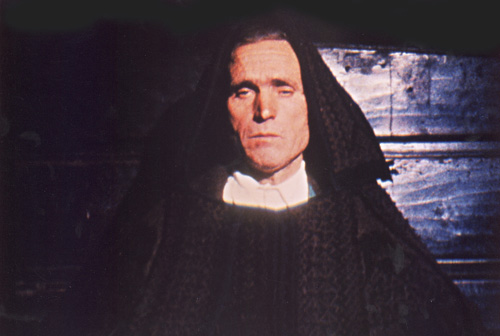
A. Reis: You know, there are three shepherds in the film. All three are different. The first, the one you’re talking about, is a force of nature. He is like a Fulani in Africa or a shepherd in the Middle East, a shepherd who has a profession, a code with his sheep, who walks in the night, who still belongs a bit to the Neolithic age. What he says to his sheep is a code where it is difficult to separate the music, the phonetic and lexical aspects: you feel a shock between these elements. And he speaks a subdialect older than Portuguese. He is very different from the last shepherd. He’s a primitive in the good sense of the term.

Cahiers: How did the idea of the film come to you?

A. Reis: I’ve already said that Margarida was born there. As for me, I was born in an already eroded province lacking force, lacking beauty, lacking expression, 6 km from Porto. So inside me I had the desire to be reborn somewhere else. And the first time that I went to Tràs-os- Montes with an architect friend, I felt that I was born there. So, I’d known the province for several years and, in working with Margarida, in going there often, I said to myself that it would be nice to make a film there because everything came together in a cinematographic sense. To the point that when we began shooting, a lot of location scouting had been done long before. That doesn’t mean that we didn’t plan things, but it was a flexible plan. In many scenes, for example, it is very difficult to distinguish what was filmed en direct from what was not. The dialectic of these two aesthetic positions was hellish for us. But we believe we’ve succeeded in making, not a synthesis, but a confrontation of contraries. Even en direct, on the one hand, we needed all the speed and all the surprise but, at the same time, we cleaned up some parasitic things that didn’t make sense or that were gratuitously populist. And for that, we needed an insect’s eye.
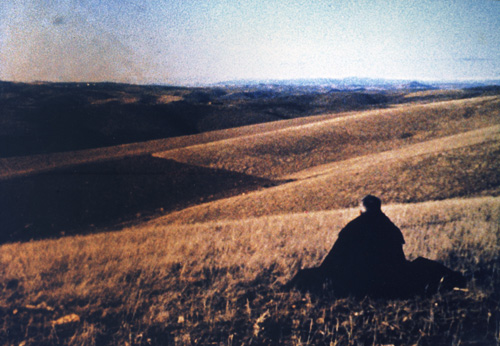
trasosmontes1.jpg

Cahiers: I had the feeling that, during the whole first part (the one with the children), you were using the fiction to progressively bring out more naked information, more closely related to what one expects from a documentary.

A. Reis: But when the mother is telling the story of Blanchefleur, is it fiction or documentary? It’s both. In a village it can happen that an event is fiction. So what is surprising about a village is that if you are there, you see only the golden dust, animals at the spring, etc. But if we can go from one house to another, then to a river, then through a door, things become so complex that you can no longer talk simply about fiction and documentary.

In this house, you can hear, precisely, that mother telling the story of Blanchefleur orally, while working. And the children of the middle ages are like Blanchefleur in images. What you understand with these Portuguese villages is that it’s a vice to separate ancient culture, the
civilizations that came after, and everyday life today. It is there precisely, in this refusal to separate, that I find a progressive and revolutionary element. Because I think that the masses there know how to assimilate from a critical point of view of the forms of life that owe nothing to the city. Because these people aren’t inclined to always lose. They begin to realize, seeing their sons returning from Europe, that that doesn’t make up for anything. The sons who return from Europe build a house “next to” the others, fence it in, and the parents think, “My son has gone mad!” And so it arises that the old disagree with their own children. They know very well that they have a richness and that there is a genocide against them. This is why, at those times, they can say, “We’re going to cut off all the supplies, the food for Lisbon.” It’s not only to be reactionary; it’s that they want their hands and their heads to still have value.

Going back to what you said: in fact, there is a turning point in the film. This turning point is the lyrical quality that is always threatened. Even when the children amuse themselves at the river, they discover death with the frozen trout. The big dusty house or the deaths or the child who plays with the top (who is the one who goes to the mine), it is always a threatened world. I believe that the film is always transforming. The so-called “finale” has to act like a boomerang: viewers need to be compensated by the lyrical space and time of the first part in order to support what follows. When the blacksmith regrets that people are leaving the village, this refers precisely to the mutilated children and the deaths from the colonial wars, these are them. Those who are going to come to Lisbon, to Europe, in the slums, in the factories, etc. That’s why we treated these young children with so much intensity. If you go there, you’ll see, they’re like that, there’s no naturalism, they’re still sort of angels.

Cahiers: There’s also the feeling that it’s them who are the link with the past. The adults are kind of in the background. They appear through the voice over, not onscreen.

A. Reis: Because there are no adults there. The voice over you hear, a little violent, a little oppressed, is the voice of a character who we see for a brief moment in the film. It’s a miner’s son, an executive. His father spent fifty years at the mine. The voice of this man is traumatized. He speaks of the old community of miners who were former peasants. Never in our film do we talk about the communities of villages, but you have to feel that they exist. We do the dance, we walk in the dark communally. The voice over counterpoints the life of the miners like the train whistle counterpoints Pergolesi’s music that we hear for a moment. There is always a crossing, a dialectic of the sound with the image that interests me a lot more than all these stories of connections, of ellipses and other rules from film manuals.

Cahiers: At one point in the film you quote a text by Kafka which says that people are far from the Capital, therefore from the Law, which they try to guess but which they never manage to do because the Law is possessed by a small number of people, etc. Can we consider that this is shorthand for the historical situation of Tràs-os-Montes in relation to Lisbon?

A. Reis: Yes. We translated the text by Kafka into the subdialect and, as a result, this text became very guttural, very expressive, endowed with an extraordinary force. They have a marvelous word designating the manner in which the nobles use the Law to their benefit: “baratím.” Because the laws of the community are flexible, they are transformed by historical change. These are of course oral laws, they aren’t made once and for all, they are flexible. And it is precisely because of this flexibility that they were liquidated by the written Laws. One day, it is such and such a shepherd who leads all the sheep to graze, another day it’s another shepherd. There’s a sort of primitive communism in this region. And we feel that at times they are closer to the future than people in the city. For example. if Lisbon lacks water for twenty-four hours, there is a collective neurosis! How, given the toughness of his life, does a peasant face snow, fire, heat, etc. With what endurance. Even when certain peasants were imprisoned by the PIDE [1], they succeeded at resisting. Why? And how many friends have I known in Porto who spoke a lot and very loftily and who, when they were imprisoned… I don’t want to say that the peasants are more courageous and the other more cowardly. But why, for example, when the peasants of Baixo Alentejo were arrested, did they have an endurance that people from the cities did not have?

Cahiers: We get the feeling that your film is made of image-sound units against which you refuse all cheating…

A. Reis: We have made the sound synchronous, obviously. We have, like you say, organized the units, as if it were possible to have a symphonic sound. These are units which will sometimes echo further on. I’ll give you an example: when the old woman in black has just told the child who has fallen, “Do not cry I’m going to sing ‘Galandun’ (a song from the Medieval Ages) to you,” there is a voice that says, “the dancers who rise up, who rise up…” And she is already working to memorize what she has lost and we see then the men who dance close up, blurred, and then from far away, like on a postcard. We allow the spectator the attention to think: “Look, a postcard!” Because the peasants never actually danced at that place. It’s what we ourselves imagine today. But pay attention: you have to to wait until the end of the film to really give that shot meaning. Because later, we see the old woman who watches and you might believe that she watches the dancers, but that’s not true. These are successive disillusions, but not traps. Often people say of the film: the rhythm is too slow. This is because you have to wait until the end of the film to say certain things. And how the different units proceed dialectically, for us, is very important. What’s bothered us a lot is that we edited in black and white and we haven’t had enough time afterwards to work on the color. Working twelve months at an editing bench assembling in black and white a film that we should have seen in color!

Cahiers: Who has the film been shown to? What reactions has it provoked?

A. Reis: First we showed previewed the film to the peasants who we shot with. In general, they liked the film, they reacted very well, including to the “connotations.” We’ve had some negative criticisms but they were from reactionaries like the kind you find in Lisbon or Porto. They reproached the absence of the Christian religion, of not having shown dams, the traditional cuisine, the poverty, etc. They even wanted to burn the film and to destroy the negatives. But that’s a very limited reaction, coming from people I know and who spend their lives in cafes. The important thing, for us, was the peasants…
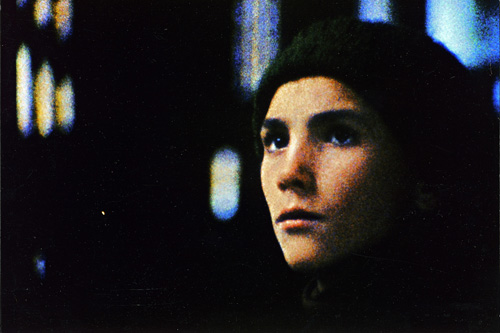
trasosmontes3.jpg

Cahiers: But exactly how can a film contribute to helping these peasants who are otherwise so cut off from film?

A. Reis: Of course, there are cinematic language problems. They don’t possess this language there. But there are elements which are very important in their everyday lives, things which relate to the theater of the middle ages. They live in a space, at home or in nature, that is already cinematic. I’m certain that if they study film, they will become filmmakers. A peasant said to me one day, “What? You’re leaving for Lisbon without ever having seen the light which goes from such-and-such kilometer to such-and-such kilometer? How can you?” With difficulty I find people in Lisbon who talk to me about the light on the bricks or on the streets. So when the peasants saw the film, they recognized these things they liked and that belonged to them, even if sometimes our imagination or our freedom of expression bewildered them. For example, the snow scene. They’ve never eaten snow like you see in the film but they’re affected by snow, by the beauty of snow, by the glare of snow. So, as there are people who eat dirt or straw, I made them eat snow.

Cahiers: I would like to ask you a more general question about the cinema of Portugal. First, does a “Portuguese cinema” exist? Then, what has changed since April 25th? And you, what do you think is working and not working?

A. Reis: My position on this subject is somewhat like that of Seixas Santos. We think that there’s no “Portuguese cinema.” We ourselves manage, whether during fascism or after April 25th, in a situation which is characterized by a lack of connections with world cinema, a lack of control over our means of production, a lack of real and sufficient experience. There are isolated cases, like the case of Portugal since the 19th century. We have some quality but we don’t have quantities of quality. In that sense, you can’t talk about a Portuguese cinema. Even the generation of 1962, whose efforts were very important, knows very well that these efforts have been very individual. Sometimes they unite in order to defend themselves, in the name of a certain political engagement and not in the name of romanticism. I don’t believe that things have changed much since April 25th. These are cooperatives and independent filmmakers, but it’s still with money from the state. We make films which are neither seen, nor sold and we don’t have any more money to make others. It is regrettable that we work like this, always wondering: “are we going to be able to make another film?”

Cahiers: What kind of reactions did your film provoke amongst filmmakers?

A. Reis: On this subject we rather like enfants terribles. Margarida and myself. We don’t recognize any influences. Even when people want to compare us to Manuel de Oliveira, we refuse it, even if we have great respect for him. Even if it’s only for the way he works, for his standards. Otherwise, the films that we want to make are perpendicular to those of Manuel de Oliveira. Because there is a tendency leaning towards the metaphysical in his films, remnants of Jesuitism, which don’t interest us.

Cahiers: What is striking is that Manuel de Oliveira and you, you have a point in common, you are both from the North, from Porto. And not from Lisbon. Is there not, in the cinema as well, a sort of overdevelopment of Lisbon which doesn’t produce great things…

A. Reis: I believe so. I think that the life in Lisbon doesn’t leave filmmakers a lot of time to go deeper into what they say. I don’t want to be hard on them because they’re my friends, but I believe that sometimes their way of life blocks them. I think they’re adult enough to know the fundamental reasons for why we are engaged in cinema. I believe that cinema is a matter of life and death. For us, we can’t cheat.

[1] Polícia Internacional e de Defesa do Estado (International and State Defence Police)
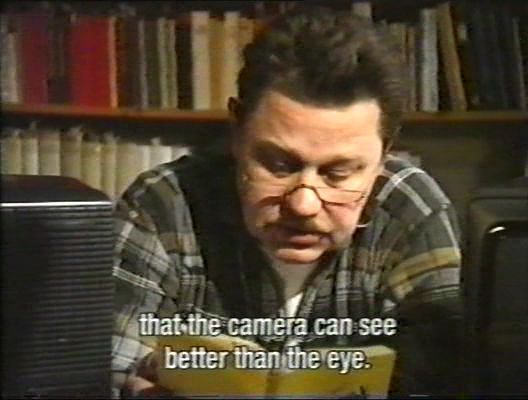
Having an Idea in Cinema

classrelations.jpg

by Gilles Deleuze

Transcription of a Lecture Deleuze gave in May 1987 at the FEMIS school. Published in ‘Deleuze & Guattari: New Mappings in Politics, Philosophy, and Culture’ (eds. E. Kaufman and K.J. Heller, University of Minnesota Press, 1998). Translated by Eleanor Kaufman.

I too, would like to pose some questions. Pose them to you and to myself. They would be in this vein: What exactly do you, who do cinema, do? And for me: What exactly do l do when l do, or hope to do, philosophy?

I could pose the question otherwise: What is having an idea in cinema? If one does or wants to do cinema, what does having an idea mean? What happens when one says: “Wait, I have an idea’? For, on the one hand, everyone clearly knows that having an idea is an event that rarely takes place; ‘it is a sort of celebration, very uncommon. And then, on the other hand, having an idea is not a general thing. One does not have an idea in general. An idea – like the one who has the idea – is already dedicated to this or that domain. It is sometimes an idea in painting, sometimes an idea in fiction, sometimes an idea in philosophy, sometimes an idea in science. And it is certainly not the same thing that can have all that. ldeas must be treated as potentials that are already engaged in this or that mode of expression and inseparable from it, so much so that I cannot say that I have an idea in general. According to the techniques that l know, I can have an idea in a given domain, an idea in cinema or rather an idea in philosophy.

What is having an idea in something?

So I begin again with the principle that l do philosophy and that you do cinema. Given this, it would he too easy to say that since philosophy is prepared to reflect on anything at all, why wouldn’t it reflect on cinema? This is ridiculous. Philosophy is not made for reflecting on anything at all. In treating
philosophy as a power of “reflecting on,” much would seem to be accorded to it when in fact everything is taken from it. This is because no one needs philosophy for reflecting. Only filmmakers or cinema critics, or even those who like cinema, can effectively reflect on cinema. These people have no need of philosophy in order to reflect on cinema. The idea that mathematicians would need philosophy to refiect on mathematics is comical. 1f philosophy had to serve as a means of relectíng on something. it would have no reason to exist. If philosophy exists, it is because it has its own coment.

What is the content of philosophy?

It is very simple: philosophy is a discipline that is just as creative und inventive as any other discipline. And it entails creating or even inventing concepts. And concepts du not exist ready-made in the waiting for a philosopher to seize them. Concepts must he made. To he sure, they are not made just like that. It’s not that one just says one day, “Look, I’m going to invent such and such a concept,” no more than a painter says one day, “Look, I’m going to make a painting like this,” or a filmmaker, “Look, I’m going to make such and such a film!” There must be a necessity, as much philosophy as elsewhere, for if not there is nothing at all. A creator is not a being who works for pleasure. A creator does only what he or she absolutely needs to do. The fact remains that this necessity – which, if it exists, is a very complex thing – makes a philosopher (and here, l at least know what the concerns of the philosopher are) propose to invent, to create, concepts und not to concern himself or herself with reflecting, even on cinema.

I say that l do philosophy, which is to say that I try to invent concepts.
What if I say, to you who do cinema: What do you do?

What you invent are not concepts – which are not your concern – but blocks of movements/duration. If one puts together a block of movements/duration, perhaps one does cinema. It is not a matter of invoking a story or of contesting one. Everything has a story. Philosophy teils stories as well. Stories with concepts. Cinema tells stories with blocks of movements/duration. Painting invents entirely different types of blocks. These are neither blocks of concepts nor blocks of movements/duration, but blocks of lines/colors. Music ìnvents other types of blocks, equally specific. Beside all this, science is no less
creative. l don’t really see oppositions between the sciences and the arts.

If I ask a scientist what he or she does, the answer is that the scientist also invents. He or she does not discover – discovery exists, but it is not what
defines scientific activity as such – but rather creates just as much as an artist. It is not complicated: a scientist is someone who invents or creates functions. And the scientist is the only one. A scientist as such has nothing to do with concepts. On the one hand, it is precisely- and fortunately – for this that there is philosophy. On the other hand, there is one thing that only a scientist knows how to do: invent and create functions. What is a function? There is a function as soon as at least two wholes are put into correspondence. The fundamental notion of science – and not just of late but for a long time – is the notion of the xhole. A whole has nothing to do with a concept. As soon as you put wholes into correlation, you obtain functions and can say, “I do science.”

If anyone can speak to anyone else – if a filmmaker can speak to a scientist, if a scientist can have something to say to a philosopher and vice versa – it is according to and by function of each one’s creative activity. It is not that talk of creation took place – creation, to the contrary, is something very solitary but it is in the name of my creation that I have something to say to someone. If I lined up all these disciplines that are defined by their creative activity, l would say that there is a limit common to all of them. The limit common to all these series of inventions – inventions of functions, inventions of blocks of movements/duration, inventions of concepts – is space-time. If all the disciplines communicate together, it is on the level of that which never emerges for itself, but which is, as it were, engaged in every creative discipline, and this is the constitution of space-times.

An example of a cinematographic idea is the famous sight-sound dissociatìon in the relatively recent cinema of Hans-jürgen Syberberg, the Straubs,and Marguerìte Duras, to take the best-known cases. What is common to these, and in what sense is this dìsjunctíon of the visual and the auditory a properly cinematic idea? Why could this not take place in theater? Or at least if this happened in theater, if the theater found the means, then one can say without exception that the theater borrowed it from cinema. There is nothing necessarily wrong with this, but the operation of disjunction between sight and sound, between the visual and the auditory, is just the sort of cinematographìc idea that would respond to the question, What, for example, is having an idea in cinema?

A voice speaks of something. Something is spoken of. At the same time, we are made to see something else. And finally, what is spoken of is under what we are made to see. This third point is very important. You can tell that here is where theater cannot follow. Theater could take up the first two propositions: something is spoken of, and we are made to see something else. But at the same time what is spoken of is placed under what We are made to see – and this is necessary since otherwise the first two operations would have no meaning or interest whatsoever. This can be restated: speech rises into air, while the visible ground sinks farther and farther. Or rather, While this speech rises into air, what it speaks of sinks under the ground.

What is this, if only cinema can do it? I am not saying that cinema should do it but that cinema has done it two or three times; I can merely say that it was the great filmmakers who had this idea. This is a cinematographic idea. It is extraordinary in that it provides a veritable transformation of elements at the level of cinema, a cycle that in one stroke makes cinema resonate with a qualitative physics of elements. This produces a sort of transformation, a great circulation of elements in cinema, beginning with air, earth, water, and fire. All that I say does not diminish the story. The story is always there, but what strikes us is why the story is so interesting if not for the fact that all of this is behind it and with it. In this cycle that I have just defined so rapidly -where the voice rises while what it speaks of flees underground – you can recognize most of the Straubs’s films, their great cycle of elements. Deserted ground is the only thing that can be seen, but this deserted ground is heavy with what lies beneath. And you respond: But what is known about what lies beneath? It is precisely of this that the voice speaks. It is as if the ground buckles with what the voice tells us, and with what comes, in its time and place, to reside underground. And if the voice speaks to us of corpses, of the whole lineage of corpses that come to reside underground, at this very moment the slightest quivering of wind on the deserted ground, on the empty space under your eyes, the slightest hollow in this ground – all of this becomes clear.

I would say that, in any case, having an idea is not on the order of communication.

This is what I’m getting at. All that we speak of is irreducible to any form of communication. This is not a problem. Which is to say what? In the first sense, communication is the transmission and the propagation of a piece of information. But what is a piece of information? As everyone knows, this is
not very complicated: a piece of information is a grouping of order-words. When you are informed, you are told what you are supposed to believe. In other words, informing is circulating a keyword. Police statements are aptly called communiqués. information is communicated to us; we are told what we
are supposed to be ready or able to do or what we are supposed to believe. Not even to believe but to act as if we believed. We are not asked to believe
but to behave as if we believed. That is information, communication, and apart from these order-words and their transmission, there is no information, no communication. All of which underscores that information is precisely the system of control. This is clearly of particular concern to us today.

lt is true that we are entering a society that can be called a society of control. A thinker such as Michel Foucault has analyzed two types of societies that are rather close to us. He calls the former sovereign societies and the latter disciplinary societies. He locates the typical passage of a sovereign society to a disciplinary society with Napoleon. Disciplinary society is defined – and here Foucault’s analyses are rightly famous – by the accumulation of structures of confinement: prisons, schools, workshops, hospitals. Disciplinary societies require this. This analysis engendered ambiguities in certain of Foucault’s readers because it was believed that this was his last thought. This was certainly not the case. Foucault never believed and indeed said very precisely that disciplinary societies were not eternal. Moreover, he clearly thought that we were entering a new type of society. To be sure, there are all kinds of things left over from disciplinary societies, and this for years on end, but we know already that we are in societies of another sort that should be called, to use the term put forth by William Burroughs – whom Foucault admired greatly- societies of control. We are entering into societies of control that are defined very differently from disciplinary societies. Those who look after our interests do not need or will no longer need structures of confinement. These structures – prisons, schools, hospitals – are already sites of permanent discussion. Wouldn’t it be better to spread out the treatment? To the home? Yes, this is unquestionably the future. The workshops, the factories – they are falling apart everywhere. Wouldn’t systems of subcontracting and work at
home be better? Aren’t there means of punishing people other than prison? Societies of control will no longer pass through structures of confinement. Even the school. The themes that are surfacing, which will develop in forty or fifty years and which indicate that the most shocking thing would be to undertake school and a profession at once – these themes must be watched closely. lt will be interesting to know what the identity of the school and the profession will be in the course of permanent training, which is our future and which will no longer necessarily imply the regrouping of school children
in a structure of confinement. A control is not a discipline. In making high-ways, for example, you don’t enclose people but instead multiply the means of control. l am not saying that this is the highway’s exclusive purpose, but that people can drive ìnfinitely and “freely” without being at all confined yet while
still being perfectly controlled. This is our future.

So let us consider information as the controlled system of order-words that are used in a given society.

What does the work of art have to do with this?

Let us not speak of the work of art, but let us at least say that there is counterinformation. There are countries ruled by dictatorships where, under particularly cruel and difficult conditions, counterinformation exists. ln the time of Hitler, the jews who arrived from Germany, and who were the first to inform us of the existence of extermination camps, engaged in counterinformation. It must be noted that counterinformation was never sufficient to do anything. No counterinformation ever disturbed Hitler. Except in one case. What was the case? And here lies its importance. The only response would be that counterinformation only effectively becomes useful when it is – and it is this by nature – or when it becomes an act of resistance. And the act of resistance is neither information nor counterinformation. Counterinformation is effective only when it becomes an act of resistance.

What is the relation between the work of art and communication?

None whatsoever. The work of art is not an instrument of communication. The work of art has nothing to do with communication. The work of art strictly does not contain the least bit of information. To the contrary, there is a fundamental affinity between the work of art and the act of resistance. There, yes. It has something to do with information and communication as acts of resistance. What is this mysterious relation between a work of art and an act
of resistance when men who resist have neither the time nor sometimes the necessary culture to have the least relation to art? I don’t know. André Malraux develops a beautiful philosophical concept; he says something very simple about art; he says it is the only thing that resists death. Let’s return to where we began: What does one do when one does philosophy? One invents concepts. I think this is the basis of a beautiful philosophical concept. Think –
What resists death? One need only see a statuette from three thousand years before our time to find that Malraux’s response is a rather good one. From our point of view, we could then say, rather less elegantly, that art is what resists even if it is not the only thing that resists. Where does such a close relation between the act of resistance and the work of art come from? Each act of resistance is not a work of art while, in a certain sense, it is all the same. Each work of art is not an act of resistance and yet, in a certain sense, it is.

What is having an idea in cinema?

Take the case, for example, of the Straubs when they perform this disjunction between auditory voice and visual image, which goes as follows: the voice rises, it rises, it rises, and what it speaks about passes under the naked, deserted ground that the visual image was showing us, a visual image that had no direct relation to the auditory image. But what is this speech act that rises in the air while its object passes underground? Resistance. An act of resistance. And in all of the Straubs’ oeuvre, the speech act is an act of resistance. From Moses and Aaron to the last Kafka film (Class Relations) and passing through – now this is not in order – Not Reconciled or The Chronicle Of Anna Magdalena Bach. Bach’s speech act is his music, which is an act of resistance, an active struggle against the partitioning of the profane and the sacred. This musical act of resistance culminates in a cry. Just as there is a cry in Woyzeck there is a cry in Bach: “Outside! outside! Go on, I don’t want to see you!” When the Straubs underscore the cry, that of Bach or that of the old schizophrenic in Not Reconciled, thìs reveals a double aspect. The act of resistance has two sides. It is human, and it is also the act of art. Only the act of resistance resists death, whether the act is in the form of a work of art or in the form of human struggle.

What relation is there between human struggle and the work of art?

It is the strictest and for me the most mysterious relation. Precisely what Paul Klee wanted to say when he said: “You know, the people are missing.” The people are missing while at the same time they are not missing. The people are missing: that means that this fundamental affinity between a work of art and a people who do not yet exist is not, and never will be, clear. There is no work of art that does not appeal to a people who do not yet exist.

The documentary world

boots_evans.jpg

By Hartmut Bitomsky

Originally published in ‘Hartmut Bitomsky: Retrospective’, Goethe Institut München, 1997. As found in the Doc’s Kingdom 2010 catalogue. Hartmut Bitomsky will be our guest for the next DISSENT ! session, on March 28.

Films are not alone. They live in an environment of wonderful moments. One, for example, is in Flaherty’s The Land, when a child takes a little piece of bread and wipes the last remaining bit of sauce from his plate. There is the scene of a sandstorm in Turksib by Viktor Turin: the figures are seen crouching down behind the bodies of the camels, and the bulging bales of cotton burst open. The sand buries and suffocates a whole caravan. At the end only a couple of pieces of white fluff remain, which are blown about over the dunes by the wind.
We know nothing about the people nor about the covering letters that they were carrying under their jackets. The greatest tragedies always probably occur in a state of anonymity; it is not necessary to have individuals and persons in order to speak about the human condition.
There is the smile of Nanook, the Eskimo whom Flaherty got to play himself, but who in smiling into the camera stepped out of his role, and in doing so created what many would like to call the documentary moment, the moment of truth that only cinematography can create.
There is the circle of faces that Eisenstein in The General Line has gathered around a separator, the device that removes cream from milk. In the spinning movement of critical emotions a clarity shows in the faces of the farmers. One can see the smoothness of the features, the swaying of firm opinions and the hardness of the singular character.
Another film is Las Hurdes [Land Without Bread], which impresses me because of its incorruptible pitilessness. It does not ally itself with poverty, nor does it blur the difference between film-making and the filmed subject
There is the bird that flies up from a branch, startled in anticipation of the pealing of a bell, which Basil Wright only includes later in the film when he adds the sound track to Song of Ceylon.
From Franju we learn that even in the cruellest moments, there is something like a condition of mercy in which everything has a part – people and things – even in the shabbiest and most despicable state.
There is Vigo, who during every take in A propos de Nice cannot conceal how filming has made him so excited, and the cheerfulness that overcomes him in view of the fact that someone with a maimed hand takes part in a game that nonetheless requires dexterity.
In Forest of Bliss Gardner describes to us the world in its total unintelligibility and incomprehensibility. People develop activities, carry out plans and ritually obey regulations and laws, and yet there is no real reason why things have to happen the way they happen.
Nothing must be the way it is.
In a Kinopravda [cinema-truth] by Vertov, a person is seen crossing the wide street, and the camera moves with him showing his movement in great detail, in order to let us see exactly how crossing a street takes place – as if this walking movement were the most important event happening at this moment in the world. There is Grierson, who in Drifters, as sailors at sea wake up in the morning blinking their eyes, inserts shots of houses situated on the beach, as if the seamen with a feeling of longing are trying to salvage their last dreamy thoughts or home from the depths of sleep into the reality of the day.
And there is also the cheerfully light, almost carefree film-making style of Jean Rouch in Chronique d’un Été, with his nearly brazen use of an obsolete grammar of film to treat a unsuitable subject.
We also have the media of film to thank for showing us that people are no more than masks, masks that bear an extraordinary resemblance to themselves. What they do in film are simply attempts to acquire a physiognomy through their work – one could also say, attempts to make a grimace at the world.
That is the society in which I see my films.

1.

The work of an artist, says Lévi-Strauss, is engaged in a threefold dialogue. First of all there is the dialogue with the audience or, as it is referred to these days, with the user, which is a halfway acceptable term. However, when we consider the many misunderstandings, the wrongly understood and forgotten and rediscovered works, the outrage of scathing reviews, the condemnations, the attacks of the censors, the scandalous events, the ridiculing and mutilation, then it becomes clear how difficult and controversial this dialogue is. And perhaps it must be this way, confused and erratic. This illustrates clearly the extent to which indeed all communication also contains an element of unreconciled opposition and conflict. In a work of art this might even appear to be enlarged.
The reason for this seems in part to lie in exactly the other two dialogues that the work maintains. One of these dialogues refers to the depicted things, the represented objects, the model (Lévi-Strauss uses the term model here, because he is referring to paintings and sculptures in the fine arts; for similar reasons Bresson, incidentally, also calls his actors and actresses models). From a broad perspective this is a dialogue with the world and with reality, which the artist confronts together with his work of art, and which attempt to gain entry to the work in various ways.
Finally, the third dialogue deals with the artistic material that the artist has, or does not have, at his disposal the material that he must select or master. For the filmmaker this artistic material consists of the camera, the lens, filters, light, sound and editing, and the whole history of film and all methods of making a film that exist or that do not yet exist.

2.

In the dialogue with the artistic processes there appears something that in another place would be called the aesthetic resistance. The work of art gives to things a particular form, one that they do not bring with them naturally – it first has to be given to them, and sometimes in a really violent way. A situation is not simply filmed; the images, the shots have to be worked out. Eisenstein speaks of the film shot, and thus of filmmaking in general, as knocking out a piece of reality by means of the lens. This is related to Michelangelo’s dictum, according to which the statue may indeed already be contained within the block of marble, but the superfluous parts would still have to be hammered away. In Man of Aran Flaherty shows how a small boy catches fish from high above in the cliffs. The boy is wearing a balloon-like cap. He smiles as he removes it, and he has to take it off because under the cap he keeps his bait – live shrimps. Having no fishing rod, he extends his leg outward and lowers the line down to the water between his toes.
In order to show all of this, perhaps three of four shots would have sufficed. One long shot for general information, a close-up of the boy, another one of the foot, then another long shot and the episode would have been clear to anyone. Flaherty, however, shot the scene from all sides, from the front, from the side, from the back and again from the front, from above and from below; he repeats takes, re-edits and cross-edits them. He really has the boy work in front of the camera.
This method has, of course, a delaying effect, completely in the style of Flaherty’s slow procedure, referred to as slight narrative. This can be called the putting up of aesthetic resistance. Just as in music a phrase is modulated again and again, the film images, as if they wanted to be heard from all sides, spread out in every conceivable direction, until it becomes evident that here Flaherty is comparing the work of the boy with that of film-making, and that the one type of work is just like the other, as if there is a close affinity between them.

3.

The third dialogue is the dialogue with the subject, with the object in the lens, with reality, the dialogue with the world. What happens in front of the camera at the moment of filming is the domain of the documentary film. The camera is aimed at objects that exist independent of it and of the situation in which the filming is taking place. It is fixed on the material world, in a visibility of its own.
With a certain justification it can be assumed that the documentary film works with ready-made objects: things that already exist, that are prefabricated in a particular, already developed form and state, and with a separate history; things that have their own distinctive right to exist, that have developed in a specific (even if perhaps unknown or only vaguely suspected) context to become what they are. I call this development a primary production, by which I also truly understand the process of a person’s life, the production of his biography and physiognomy, his individuality, his character and his fate.
The film-maker – by making a picture and by recording a sound – tears the subject out of its original context, sometimes in quite a violent way but sometimes without leaving behind a distinct mark (which is what happens with ready-made objects in the strict sense of the term), and places them in a new context and into another structure. This is what I term secondary production or the aesthetic production (it can well be minimalist or, in accordance with the theories of Direct Cinema, consist more of an avoiding of the aesthetic element)
Grierson once defined the documentary film as a creative treatment of actuality – whereby creative treatment could indeed refer to what has here been called the second aesthetic production and should certainly be associated with Levi-Strauss dialogue with the artistic material. Behind the concept of actuality there appears once again the completed substance of reality, as it is also suggested in the term ready-made object. It is from this consideration that the idea of the primary production was developed
In keeping with this idea Siegfried Kracauer in his most important work, Theory of Film (which bears the subtitle “The Redemption of Physical Reality”), distinguished between the two fundamental categorical functions of film, namely a recording function and a revealing function. This certainly goes along with Dziga Vertov’s dual appeal to film: it is to capture the world as it is, and at the same time it must decipher it.

How can, however, this registering and the revealing, the reproduction and the deciphering tally in this equation? When Joris Ivens unexpectedly encountered difficulties during the production of a film a while ago, he believed to have discovered that the aesthetic production was definitely derived from reality. The task involved filming some workers as they were in the process of moving basalt rocks, but somehow Ivens was not able to correctly capture the work in pictures. So, he looked for a way of gaining access to the action in that he performed the work himself, and this gave him information about how to go about filming the subject: “I noticed that the greatest exertion was in the shoulder muscles and in the chin. Thus, to film this action, these places had to be emphasised because they are an organic part of the work. From then on the camera, the angle of shooting and the composition of the picture were all determined by these muscles and the chin. They became something like two focal points of the action. The photography is determined by reality and not by my aesthetic efforts to obtain a well-chosen balance between line and light. But then it was precisely this realistic viewpoint that was the most beautiful one. I could not film the stoneworkers before I had understood the physical exertion involved in their work.”
Although it cannot be denied that Ivens insight has a certain, almost touching persuasiveness about it, nevertheless there are doubts that the standpoint of the work and the standpoint of the film-making could simply coincide. The reason for this is that pictures do no just come from the things they depict; they also originate from other pictures, and this origin cannot be placed in a picture.

4.

Another film by Ivens, namely De Brug (“The Bridge” was his first film, which one notices because of his particular fascination with pictures) elucidates the problem from another point of view. The film, as the title indicates, is all about only one thing: a bridge. The one here is a lift bridge, which is raised so that large ships with high superstructures can pass under it.
The film shows all views and aspects of the bridge, every single element and each individual function during the construction of the bridge. One would almost like to say that each detail corresponds to a camera shot, just as the bridge itself corresponds to the engineers’ detailed plans according to which it was constructed. Indeed, one could say that the film is a blue print of the bridge – it is created before our eyes a second lime, and this time it is not to be used by pedestrians or by railway passengers, but rather to be looked at.
This leads us to consider that a documentary film does not simply reproduce reality, but rather causes it to be created visually once again: it shows us how reality is created. What we perceive is the creation of reality, the creation of a second reality.
Jean Rouch, who with his cinéma vérité worked on exactly the problem of how to record and reproduce reality, was incidentally led to the concept of cinétrance by a similar realisation. The concept cinétrance describes the fact that when a piece of reality and a camera are brought together, something new is created, something that would not exist if the camera were not present.

5.

This conclusion causes, of course, a certain uneasiness and invites us to contradict it. With the documentary film there is an almost yearning expectation of reality, enlightenment and truth. In the same way there is also its opposite, namely a disappointment and a discontent of all those truths and realities that are brought to the surface in the documentary idiom.
Chris Marker once described this conflict as two fundamental ways of behaving, which the documentary film synthesises. On the one hand the film-maker behaves in a modest way towards reality and accepts it as it is. On the other hand, however, he determines beforehand what reality has to be – and when in fact it does not correspond to this, then reality is just wrong. In other words, first reality is accepted, and even more than that, it is held as if in a tender embrace; then it is rejected and denied.
In Let Us Now Praise Famous Men written by James Agee there appears a photo of a pair of torn-up shoes, which was taken by Walker Evans. This photograph puts the observer in an almost paradoxical situation. It is apparent that the shoes have reached the end of their usability, and they are looked upon as someone’s wretched belongings, as poverty that is naked and above all dispossessed of its usefulness. We revolt at the sight of them.
Nevertheless, at the same time these shoes have a unique preciousness: they are real shoes and they have a true life-story. They were not devised nor specially produced for the picture: they are not props, not part of the scenery, and they have not been made instruments of something. They simply are what they are. And they are beautiful, with an unmistakable beauty all their own. Finally, it should definitely be added here that the shoes in the photo no longer exist. They have rotted. The pictures show a reality that does not exist. Perhaps the documentary is nothing more than a place of exile for reality, a home away from home.
What I am getting at is that the documentary, because of its subject, is a critical genre. It is the expression of a crisis, because that which we call reality is itself something that is in a crisis. This realness is always in the process of dissolving, breaking apart, breaking down and breaking through, of developing and changing, of slipping away and of crossing over. The concept of reality itself indeed concerns an object in its crisis.

6.

Franju, whose film Sang des Bêtes will remain unforgotten, although the slaughterhouses in Paris no longer exist – they are now art exhibition halls – and although the animals in the meantime are slaughtered in a completely different, namely industrial, way, Franju in a discussion once emphasised the artificial aspect of realness as it appears in film. He said that with a film the world had to be created again, because it was constantly running away from us. “Reality denies reality” – this is the formula he reduced it all to, and for this reason the artist always has to give reality an aspect of artificiality. Reality is always on the run. A documentary film cannot keep a firm hold on it; it can only create it again.
In a metaphorical way Fellini once evoked this loss of reality as a wonderful albeit wistful moment: In the film Roma, when a catacomb is opened during excavation work for an underground, frescos are discovered which have survived there in the darkness for two thousand years, but in that moment through the fresh air that streams in and the daylight that filters in they are destroyed and vanish from the walls before our eyes.

7.

New York, N.Y. is a film whose subject refused being captured by the camera in another, perhaps even more extreme way. It is an almost inconspicuous, casual little film by Raymond Depardon, who made it in New York at the beginning of the eighties, and it consists of only three albeit long shots.
The first one is a travelling shot high above the East River along a bridge full of traffic, taken from the gondola of a cable railway that passes over the river at that location. The second shot shows a street intersection in Manhattan in the twilight – a couple of pedestrians are crossing the street. The third shot is again a travelling shot over the river, although in the opposite direction and at a later time of day.
In a voice-over during the first shot Depardon says a few sentences about how the film came about: A few years before, he had stayed in New York for a couple of weeks, and every day he had set out with his camera to take shots of the city. After finishing he had gone into a little café and looked out of the window at the intersection. At some point in time he had discontinued shooting the film, had returned to Europe and had totally forgotten the film about New York until he discovered these three shots during an occasional examination of his film material.
These three shots became the film, but it is not about New York: it is the film that New York made against the film-maker. He looked at the subject, but it did not look back at him; it merely turned its back on him.
The filming was done in New York, but what it shows is not this city but rather a hazy diffusion, which softens the three pictures with shadows, as if perceived through the unwashed windowpane of a café. The passers-by at the street intersection are nothing else but strange, anonymous silhouettes, who are wandering through a Nietzschean metropolis. No one sees anyone else, and everyone is alone.

This film sticks like a thorn in the flesh of documentary film-making. It instantly caused all other documentary films to age, so that the whole genre, in its self-confidence of being able to capture what is real, has something strangely old-fashioned clinging to it. This is because the documentary film has always seen itself as a driving force in the salvation of reality, and in this regard it was always certain at the affirmation of the real object.
Here, however, the object manifests itself through its absence. It has vanished from the film.

8.

In order to continue developing the concept of disappearing reality (of the reality of disappearing), we should remember the fact that there are astonishingly few film recordings of the Gulf War. The explanation given is the rigid censorship of the military. The Vietnam war had been accompanied by a flood of pictures – it has even been suggested that this flood of pictures was a decisive factor which contributed to ending the war. This time history was not to repeat itself, and thus the entire press coverage of the war was put under the massive control of the military. In a way the censors functioned like a photo agency, which at their own discretion did or did not make their material available to the press.
As a consequence the visuality of the Gulf War remained rather meagre. When new material was released recently, which until then had been kept under lock and key, it was possible to view scenes like the following: A group of tanks moving at high speed through the flat desert (this shot was fairly long) suddenly came to halt and then fired a series of rounds in an undefined direction. No target could be seen, and for that reason it was not possible to determine what damage the barrage of cannon fire had caused. Finally, the tanks turned around and returned in the direction from which they had come. Then there is a cut to General Schwarzkopf, who said that they had hesitated for a long time before attacking the heavily fortified lines of the Republican Guard, but then finally decided to proceed, and in fifteen seconds the job had been completed.
What took place cannot be called a battle of tanks. To identify this event as a conflict between two opposing military forces who resolved their differences with the use of weapons is simply impossible. The kind of weapons and strategies used make traditional war invisible. The soldiers are no longer engaged in action; they fight each other over enormous distances, and instead of making contact with the enemy, they sit down in front of television monitors on which combat targets appear as small dots of light.
Other pictures of this war – but should we not call them pictures? – were made by cameras mounted on missiles, which glided through a milky darkness until the missile hit the target and the transmission on the monitor died because the missile and with it the camera exploded. Nothing was seen of what took place. It was necessary to resort to one’s imagination in order to recognise again a reality in this softened representation, a reality that at one time was powerful but now has been done away with.
In the television series Heimat [“Home”] by Edgar Reitz there was an aerial shot of Hunsrück, which was supposed to show in one take the entire area where the action with its stories would cover. The shot was filmed from a jet fighter, which flew at the speed of sound. It lasted, I don’t know, for about two minutes, and what there was to see can no longer be called a picture: it was a trembling, blurred shaking movement of visually perceived elementary particles, crashing into each other grey in grey. Such enormous speeds disconnect the cinematographic picture from every object, and the unit of measurement of twenty-four frames per second can no longer capture it. Virilio will probably not have seen this shot. Otherwise he would have rewritten his book Cinema and War. Modern war and cinematic pictures do not go together any more.

9.

With the advent of digitalised pictures, the detachment of reality from the cinematographic and photographic image has again continued at an accelerated pace. Every digital element can be substituted for another digital element without leaving any trace of this substitution. A photograph (or what looks like a photograph) does not necessarily have to refer to a real model, at least not entirely. Then we would be at the end of the age of a consubstantiality of photography and object. The technique of retouching – for which photography in the Soviet Union was condemned and ridiculed – has become a generally used, accepted and commended process (Forrest Gump was still a bit chubby, but that will improve).
This situation is a challenging one. In the future the documentary film will have to change in order to survive and to have new definitions for itself to develop. It will no longer be able to exist by guaranteeing a truth that is based on the mechanical reproduction technology of the camera and the film material. Authenticity has held the documentary film in shackles long enough, and consuming reality instead of producing it more than ever will not be sufficient. And it will become evident that the reality even of something documentary is not to be found somewhere beyond the pictures but rather in them.