Together in electric dreams

futuro1.jpg

Supposedly unable to change the times we are in or to depart from them in any way, we continue to take them in, observing and figuring this world in which we find ourselves. We have increasingly become aware that we are mostly being fed things we already know, things we have been told so many times before and we will be told many times again. Most likely that is why so many of us, in our crucial search for a displacement of thought or a blurring of vision, tend to rely less and less on the visual evidence of this world, and look more and more toward the emotions that remain unrepresented by noisy broadcasts and unsignaled by loud headlines. This world might be impossible to capture in words or images, but they can be deployed to reveal the complexity of our contemporary experiences of disappointment and predicament, offering a sensible world that somehow responds to it. It is this sense of exploration that can be felt when looking at the work of many young filmmakers, at least for those who are willing to spend some precious time in the cinema spaces or on the festivals that choose to avoid the trodden paths and refuse the dead ends that are customarily ascribed to contemporary cinema. At the recent edition of FID Marseilles there were more than a few films that gave rise to the tantalizing feeling that cinema still has something to say about our world, for better or for worse.

It is a barren emotional state in which we find ourselves moving through the clutter of this world. In our incapacity to escape from the deepest depths of the spectacle of consumption, which now feels like the only way of living, it seems as if we can only continue to manage our suffering as something ever attached to the colonized body of our life. We are so sucked out and scared we wear it like a fashion, topped off by an acute lack of orientation. Impossible to know which way we walk, impossible to know if we walk at all upon the earth below us or if there is in fact an earth or a below upon which we might walk. Uncertain about who we are and where to go, what we know better is all that we are strange to: the radiant smiles and comforting words of those who continue to celebrate the logic of accumulation by dispossession, those who choose to join the hallucinatory dance of the global financial elites, gliding between the whirls and twirls of virtual credit and the sweeps and flows of transnational capital, surrounded by crawling governments, drunken with the maddening wine of liquid power and stealthy control, while so many are standing around in anguish, waiting for the lights to come up, roaming in the dark in wait for an all-encompassing whirlwind to put an end to this mad, ever rotating danse macabre.

And so we rage. We rage all the more because we don’t know what to do with our rage, we don’t know how to use it to make a difference, we don’t even know who or what we are raging against, causing us to feel that we ourselves might be the wrong being done to us, we who find ourselves caught up in an addictive frenzy of compulsion and frustration, at the same time spinning on the hamster wheel and stuck in the rat race, we who feel utterly confused by the dialectical ambivalence of fascination and condemnation for the swag and swank of capital, we who can’t help being mesmerized by the blinding glitter of bling-bling, drawn in by the neon melancholy of anonymous hotels and shady lounges, in awe of the slow-burning beseech of fast food chains and lifestyle brands, propelled by the mindless circulation of money flows and info bits. Isn’t it this two-faced ambivalence that is brimming in Harmony Korine’s Spring Breakers or, elsewhere, Kayne West’s Jeezus, two mutant fever dreams – somehow bridging the candy colored bombast that tinted the 1980’s and the shredding dystopian visions that shook up the 2000’s – that seem to lay waste to all divides between obsession and scorn for capitalism’s excesses ? And couldn’t this also have something to do with the unability of many to recognize the sense of irony that permeates Martin Scorsese’s The Wolf on Wall Street ? Our landscape of desire has never been so deranged and schizophrenic, torn as it is between seduction and repulsion, between complicity and guilt.

“Everybody’s got a hungry heart”, the Boss sings, “Lay down your money and play your part”. Cropping up at the end of Cantine / Transept, the debut film by Benjamin Klintoe & Dan Perez, the song hits you like a kick in the chest: its snappy rhythm and infectious mood can no longer obscure the bleak narrative of loss and failure contained in the lyrics. It’s a heart-wrenching clincher for a merciless take on some of those who are left dabbling in an all-consuming absence of affect, caught up in a never ending war against the urgency of their own boredom – “some kids lost in the sauce”, as the character of Joe Killer recounts, who “just want to have fun screwing the world”, who only know they “don’t want the life of others“ and count the whole world as their enemy. There is nothing to hold them while they fall into the ruins, nothing to soothe their anxiety as they plunge through the rubble in search for another high, another score, another distraction. No inhalation, no blow, no whack, no fast sex or easy take comes even close to matching the intensity of the fall, and no grunts of fury or whispers of fear can give vent to the tremendous desire burning inside, so desperately clamoring for articulation. As if the only way to not give up on desire, the only way left to exist, is to plunge ourselves into the chaos. As if the refusal to yield to the trials and tribulations of society, so uncompromising in its ambivalence, carelessness and hostility toward us, comes at the high price of becoming outcasts in our own time.

So many filmmakers seem to be drawn to the physiological and psychological chaos generated by frustration and excess, to the space of loneliness and disorder that is nourished by the frantic search for those intensities that could lead us into unknown territories where we could loose ourselves, even just for a while. Their universe is inhabited by fools, madmen, misfits and night-ark drifters roaming in Cimmerian wastelands and fluorspar twilight zones, where they often go in hiding from the yellow of gaudy urban lights that makes them feel so vulnerable and exposed. In Virgil Vernier’s Mercuriales the fractured landscapes of the Parisian banlieues are used as the hallucinatory backdrop for a twisted fairy tale on the spectres of legend futures past. Looking over these suburban landscapes are the cold shadows of the abandoned twin towers of Bagnolet, sad totem poles of an era gone by, dream residues of a world from before the future vanished from sight, when it was still conceivable to imagine a world different from the one in which we live. Guided by James Ferraro’s hypnagogic incantations and mutations of our wretched throwaway culture, like a nebula of free-floating memories slipping in and out of focus, one has a sense of plugging into the underground currents that expose the loops and fuses of past reveries and delusional fantasies. As the characters wander through a scattered world of dead end streets and cul-de-sacs, endless runways and gateways covered with bright graffiti that only seems to conceal misery and anonymity, what is laid bare is the festering wound of the present, this age of wreckage from which we need to salvage what remained unimagined, in order to fill up the void of the future.

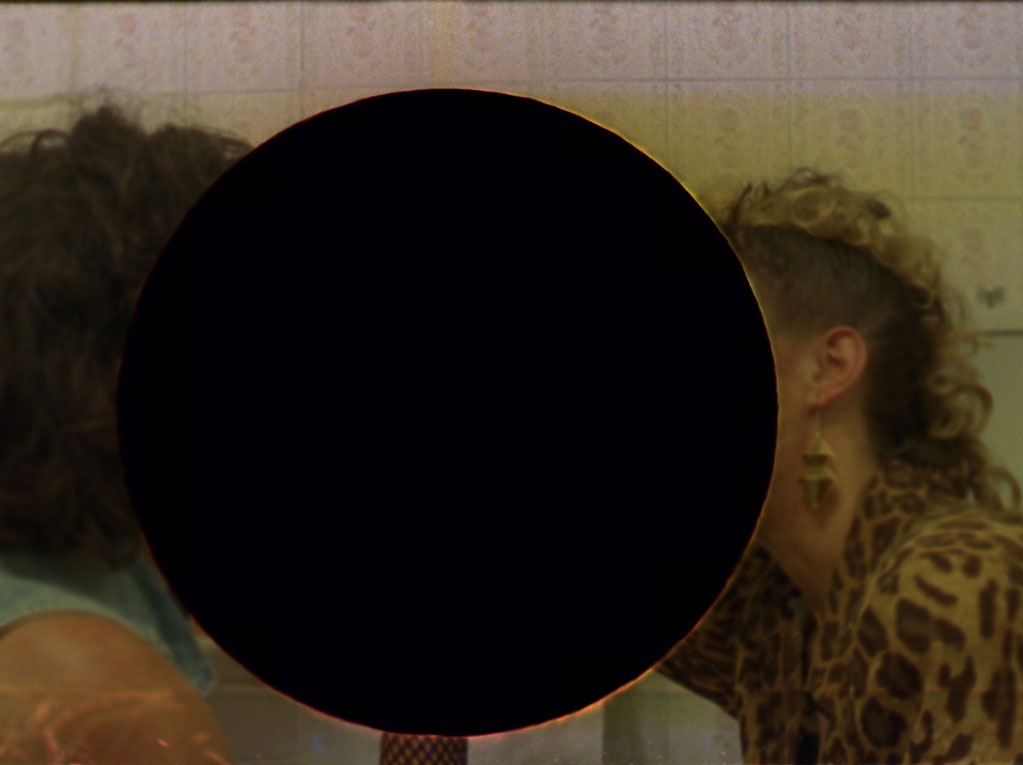
Attempting to refuse resignation, we look for some recognition in the faces of others, reaching out in the darkly lit dream lands for other bodies, those imagined and imperceptible as well as those actual and perceivable, in the hope of transforming into animated coexistent bodies, improbably shared. But how can we, in all our reaching and touching, avoid losing our desire in the obscure mists of the nirvana principle, where all life tension dissolves into thin air ? Watching Luis López Carrasco’s El Futuro, it appears as if we can only wake up from the hangover of neo-liberalism by going right into another one, dancing and fucking the pain away until we are left dwelling in nothingness. How can we find a way to persist and insist beyond this gape into the void, against the lethargy of endless deferral and the ordeal of unliving ? How can we, sentient in our dance of death, continue to fight to come to exist, to be the future that happens ? What these films draw out, in a very tentative way, is perhaps not only an unfinished cartography of the wastelands of frozen imagination and thwarted desire, but also a map of how to perceive, amidst the darkness, this light that tries to reach us but never will. Perhaps being able to act in the present requires to live all that is left unlived.

Benjamin Klintoe & Dan Perez, Cantine / Transept (FR, 2013, 32′)

CANTINE, TRANSEPT from Dan Perez on Vimeo.

Virgil Vernier, Mercuriales (FR, 2014, 105′)

MERCURIALES – VIRGIL VERNIER (EXTRAIT 1) from Kazak Productions on Vimeo.

Luis López Carrasco, El Futuro (ES, 2013, 67′)

TEASER EL FUTURO from Sergio Jiménez on Vimeo.

Some notes are borrowed from Rachel Levitsky’s The Story of My Accident is Ours.

The politics of mourning

testamentb.jpeg

Talk with John Akomfrah. November 21 2013, Gent. In the context of the DISSENT ! series. Moderated by Stoffel Debuysere.

This talk took place on the second day of John Akomfrah’s visit to Belgium, after a screening of his second feature film, Testament (1988). “If we loose the ruins, nothing will be left”: the quote by Zbigniew Herbert which opens the film sets the tone for this post-colonial mourning play, composed as a blend of lyrical drama and archival documentary. There are no heroes in this “war zone of memories”, only ghosts, drifting through history as if through an arbitrary world. One of them is Abena, a reporter returning to Ghana after being sent to exile following the 1966 military coup that overthrew the continent’s first independent government led by Kwame Nkrumah. Taking grief by the hand, she wanders through scarred landscapes in search for remnants and companions of her past, only to find there is nothing to return to, no epitaphs for those who were left behind, no records that document the pursuit of the first experiment of Pan-African Socialism, no ruins that can testify to the struggle to escape the grip of colonialism. The absolute dream of the diasporean, the return to a place called home, turns out to be an impossible dream.

“This film is personal in very concrete terms. All the events in it are the events that made the flight from Ghana possible. Had the coup not happened, I would probably have been somewhere in Moscow, East-Germany or some communist shit hole. Because my parents were both involved with the party, my mom was at the school teaching there, so everything that happened to my life is as a result of those events. At that time I was groping for something that has now become, in the 26 years since we did the film, almost like a genre. I’ve must have seen at least fifteen films dealing with west-African people who go back for death, in search for something or someone, in the process of discovering that the person is not there or the place is gone. But this was not a certainty when we made the film. Most of us, even in the early 1980’s, still believed that the diaspora was a kind of temporary zone. The making of this film emotionally convinced me that there is some legitimacy in thinking about diasporisation as a what Stuart Hall calls a “permanent disturbance”. There is really no other space before it to return to, because the process of the flight so transforms you, and by implication you can never go back to the place that you’ve left behind. When you go, what you’ll see will be skeletons but not much else. Which is usually the sign that you should move on. There’s only death here, you must go forward.

It is a very painful memory because my father is buried in that cemetery you see at the end of the film. At the time there were lots of lootings of gravestones and you know that there is something really wrong in a place where one starts robbing the dead, something seriously profoundly wrong. But there was a more serious robbery of the dead happening at that time and that’s why the film took the form that it did. In 1987 I was in Burkino Faso where I met some of the great African filmmakers, who all seemed to know that Werner Herzog was in Ghana making a film, and they would say “you should go to Ghana and make a counter-film – tell them about the real Ghana!” Part of the reason why I finally went was because that Herzog story provided a sort of impetus, but the real reason was to try to make a film on Nkrumah and the party. At the time however the theft of that memory was almost complete: it was illegal to talk about Nkrumah, one couldn’t even mention his name, it was illegal to make a film about the CPP, the party that he led. There was a guy from the ministry of information standing next to me during every scene, to make sure we didn’t talk about Nkrumah. So the allegorical form that the film took was partly an attempt to deal with the policing of it. You have to remember this is late 1980’s: everything, including the rhetorics of the coup, had been played out. The coup happened because the military and its supporters abroad – America, France, the usual sources – said that Nkruma was running the country down and that what was needed was this dose of realism from the military, who would bring prosperity etc. In 1987, twenty years after the military experiment, it was sometimes possible to buy fish which had worms in it, things had gotten that bad. All the rhetorics, including that of African-socialism, had been played out and we were coming in at the end of the utopian pronouncement, both of the original anti-colonial figures as the people who replaced them. So it really was a kind of war zone of memories.

I literary went there to make more of a standard left-wing type of film. There was always this idea that there was this woman who would go back, but I thought it would be possible to talk more openly, so the film was going to be a kind of debate-driven, much more vibrant, Eric Rohmer-like talkie about Nkrumah and African Socialism. But it became clear very quickly that this was not a possibility, so I really found myself being forced to deal with the folkloric resources that the country had. When the film was shown in Cannes, a lot of European writers would say to me “oh, this is very avant-garde isn’t it, how would Africans take it?”, and I said “listen, this is one of the few films I’ve made, that when you show it to a ten year old in Ghana they’ll know exactly what the film is about!” Especially if they’re Ga from the coast side. Because, in that part of the world, we have a very regimented, in fact the most ordered approach to death, more than we do to life. Every color of mourning – black, white, red, blue – means something very specific. It means there’s a certain proximity of the person to death. You’re either, in case of red, angry, black, you’re resigned to, white, you’re definitely very depressed, and blue, you feel a mixture of anger and depression. So every color in the film is coded in the folk psyche. All across Ghana, every kid will know exactly what the colors mean. When you start to refer to allegory as a means by which you get to the source, this is a very standard West-african device. So people might not understand exactly what all those allegorical shifts mean, but they know you don’t mean that. They know you mean something else. The space of narration is empty. Because they know the actual story is elsewhere. It’s like when you mourn, its not about a specific thing, it’s not about details about a person’s life, you’re mourning the absence of that figure.

screen-shot-2014-06-25-at-80854-pm.png

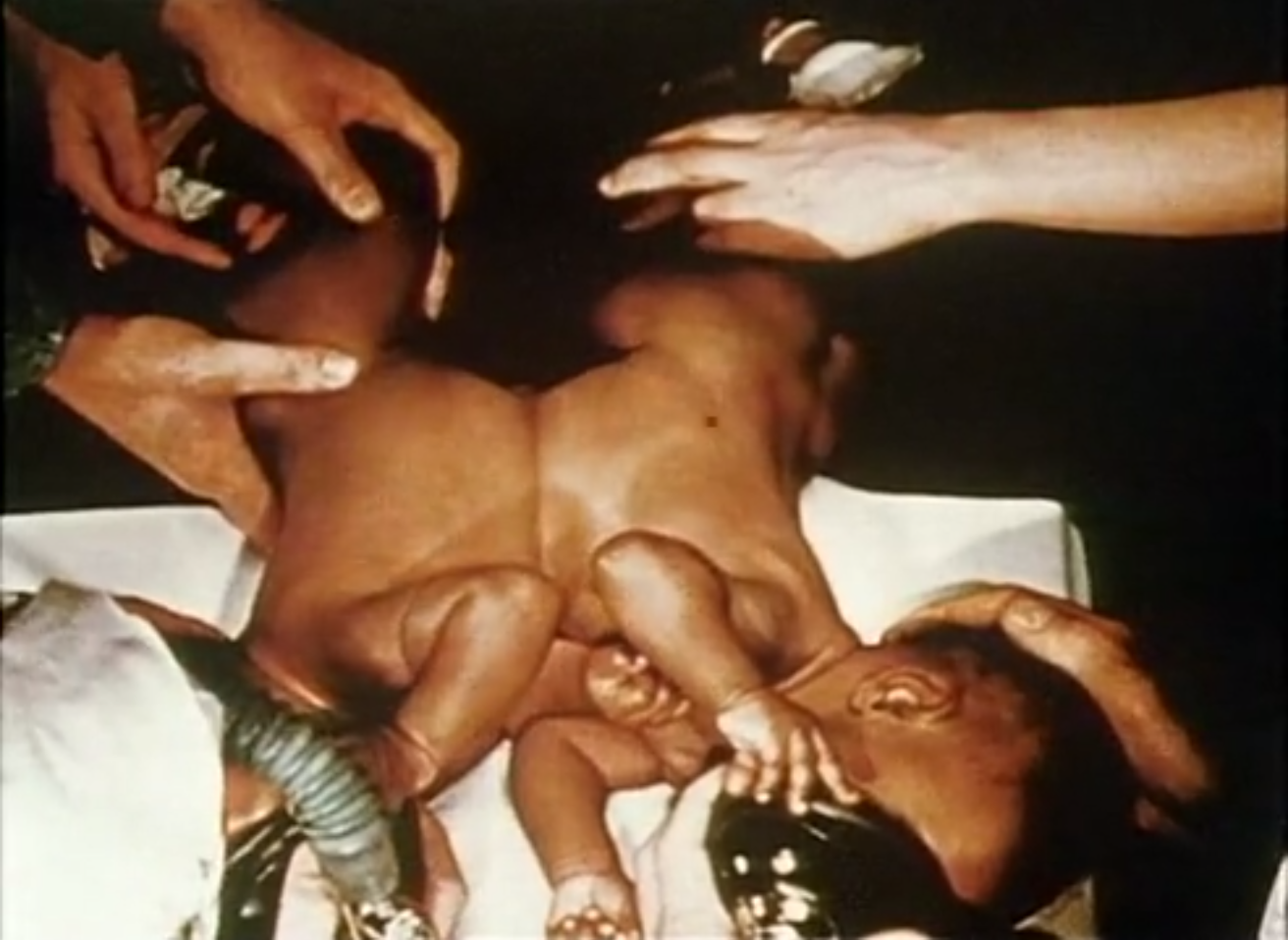
The image of the baby twins in the film is connected to this. There’s a kind of cult of twins across West-Africa. They are sort of omenic: they are both harbingers of something good, but also something not very good. I didn’t want to make something that is all symbolic, I wanted something which is not a metaphor but an actual metonymy. I was searching for material and I just came across these archive images of twins conjoined in the 1950s. And you watch the film and they do the operation and you think “ok they’ve got everything they need to both stay alive”. Bit there was one organ that they didn’t know about, that one didn’t have, so one died. And this sense of twinning is something I have been preoccupied with a lot, it’s something I just made a piece about called Transfigured night. It’s based on a piece by Schönberg, Verklärte Nacht, based on a poem which pretty much tells you everything about my obsession with twins. The poem is about two lovers who are walking through the woods on a moon lit night and the woman says to the man “my love, I am yours but I need to confess to you on this night that I’m carrying someone’s child and it’s not yours”. The man says “ok, my love, do not worry because tonight the moon will transfigure our love. From this moment, we will be one and this love will bring this child into the world”. Something about the nature of the postcolonial movement reminds me of that. The postcolonial state goes to the postcolonial subject and says “I love you, were gonna be together but I carry these weird postcolonial elements inside and I promise you they won’t get in the way”, and the citizen says to that “we love you too”. Of course this love doesn’t last. The dream of unity, of being twin, of being identical, having an interest that is absolutely the same, seems to me to mark that moment of independence. For that reason I have always been fascinated, other than for folkloric reasons, in twins and especially because these are siamese. They really are joined, but they can’t survive without that space of relative autonomy.

I think necrophilia is absolutely central to how the diasporic imaginary works, and by implication for its filmmakers. When you think about it, in everyday speech, part of the urgency that informs black militancy – “Ahm shoutin, you fucked my people, and now we need justice” – the invocation of the dead made in this speech is one that requires endlessly to look to the dead for sustenance, for legitimation. For me that is a kind of feeding off the dead. And it is there throughout, it is part of the diasporic imagination, because you are aware of this moment of rupture and break, and if you are a new world diasporic figure that moment of rupture is marked by the triangle. If you listen to the spirituals and the gospels, they are infused with this necrophiliac imaginary. But I think filmmakers become even more in tune with it – so much of what I’ve done is about the dead. Figures who are no more. So much of the authority of the films comes from this act of mourning. Which in visual terms is a kind of consumption of those figures.”

In the beginning of the 1980’s, it became clear that the legacies of the Bandung moment and its varied postures of nonaligned sovereignty had effectively come to an end, and the narratives of liberation and overcoming, as well as their underlying mythologies, could no longer hold the critical salience they once had. This shift also had an effect on the counter-models of cinema, particularly those categorised as ‘Third Cinema’, an ambiguous term which referred to the forms and practices that were cultivated in subaltern cultures in response to the hegemony of Western cinema, as dialectical weapons in the process of decolonisation. “Inscribed in the militant and nationalist pretensions of the term ‘third cinema’,” wrote Akomfrah in 1988, “is a certainty which simply cannot be spoken anymore. A certainty of place, location and subjectivity. What now characterizes the ‘truths’ of cinema, politics and theory is uncertainty. “ In times of uncertainty one can no longer hold on to stories of salvation and redemption, depending upon a utopian horizon or a prospect of homogeneous collectivity toward which the emancipatory history is imagined to be moving. In times of uncertainty, other fictions tend to be created, reports of wanderings without preconceived maps or destinations, forms of inquiry that are not in search for the one and only Truth, but for a sincerity of small truths; fictions that embrace the “unknowing” and oppose the view of history as a chain of events on a ‘road to salvation’ with that of a discontinuous drift through uncharted territories, in which action is ever open to unaccountable contingency, chance and peripeteia . In Testament the fiction takes on the tentative form of a “trauerspiel”, which Benjamin identified as fitting for a time “turned unheroic, requiring no redemption and no ultimate order”. In contrast to the dominant cultural form of tragedy, which relies on the illusion of totality or wholeness – of which the typical Hollywood spectacle is today’s prime manifestation – the allegorical trauerspiel brings life to experiences of absence and failure, the spaces in between that cannot be captured by the pursuit for an imposing knowledge of the absolute and the determined.

“A lot of the cinema I was schooled on was not only the European art tradition or even the Asian one – Mizuguchi, Ozu etc. For a cinephile the central supplement to the art cinema was the militant “third cinema” tradition, premised on the idea that the machinery, this indexical machinery of narrative filmmaking could participate in a project of social transformation of a utopian kind. I think there was a sense in which for three or four decades that was true. But if you’re making films in the 1980s this was a very tough call to make, a very difficult proposition, because the very language vernacular of the utopian was itself now in flux and in doubt in some way. So certainly the thing that a number of us started to try to do was redefine “third cinema”, to move it away from the militant posture. The need for an “imperfect cinema”, the need for a national address, the question of minorities, etc: all these things are important but they don’t need to be attached to some eschatological religious teleological narrative, which says if you have those things you will automatically go to nirvana. … it’s an impossible demand: if your films haven’t participated fully in this project of national renewal in the utopian kind, if you haven’t gone to the promised land, that by implication means you fail, because if the cinema only exists to verify those utopian horizons and we don’t have it, theres no raison d’être for your being. So the intent to break this limb was in part, not for the political project, but for the cinema itself. To save it from itself. Sometimes the filmmakers from themselves. So for Glauber Rocha you don’t have to do too much, but for someone like Solanas you really have to work hard, because The hour of the furnances is an extraordinary formal project by any definition. The fact that he didn’t need to socialise Argentina is neither here or there as far as I’m concerned. The effort in itself was fine. The desire to find a language to speak is worth applauding, I think, even if you don’t get utopia at the end. So that was what the project was about. We took a lot of criticism… just this real need to give legitimacy to a moving image culture spread across various continents, which had been growing for 40 years … if that’s the only way of calling itself real, the wall is gone. You should bury it all. You could see the wall coming down. You could see this was where we were heading, trying to disentangle the two, to disengage them. That was a worthwhile project.

There are two films, the openings to which I absolutely love: Far from Vietnam and the Hour of the Furnaces. The first five minutes of both films are extraordinary. Syncopated, energetic, “this is going somewhere, this is gonna happen”. “We can see the bombs, are we gonna stop them?” As exercises in cinema they were fantastic. The Hour of Furnaces: I would happily give up next hour and a half because I think the essential work is done literally in those minutes. Nobody had done it before, not even the great Cubans. Fantastic images, but they don’t need to be attached to projects of aspirational fantastic utopian possibilities. For example, what utopian projects are you guys gonna make a film about: overthrowing the Belgian state? … It used to be like that: we watched The hour of the furnaces and we thought we should be in Angola fighting. We wrote, four our us, to ask if we could join. The fact that you would have been dead in two minutes didn’t enter our mind… If the cinema’s model for agency was that you imitated and mimicked what was going on in the film then we’re gonna loose. A lot of the films that were inherited from the radical tradition were made it that spirit, but they don’t have to be consumed in that spirit to be of value. So the question really was about this notion of use value. How one could re-calculate use value in their light, in what appears to be a failure, both in terms of the ambitions of the film as well as the content. And that was really what we were grappling with in the eighties.”

Watch Testament here.

DISSENT ! is an initiative of Argos, Auguste Orts and Courtisane, in the framework of the research project “Figures of Dissent” (KASK/Hogent), with support of VG & VGC. The visit of John Akomfrah has been made possible with the support of Cinematek, le P’tit Ciné, Brussels Arts Platform and VUB Doctoral School of Human Sciences.

The violence of the gaze

denieuweijstijd-johanvanderkeuken-eye.jpg

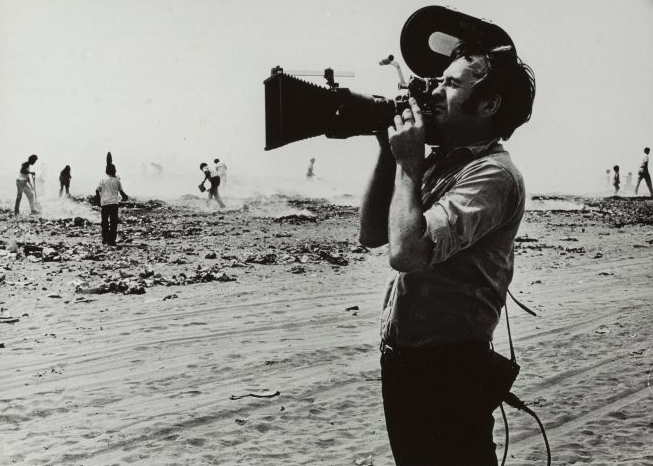
by Johan van der Keuken

Excerpt from a conversation with Robert Daudelin in Cinématheque Quebecoise, Montreal, October 1974.

As a filmmaker, I thus inhabit the world of the image, a world halfway between myself and reality. I believe that, ideally speaking, the film viewer is in a comparable position. For a variety of reasons, we have abandoned the idea of reality as a self-contained entity existing outside and independently of us. So if you don’t wish to take the position of someone watching an external reality from the outside, but rather of someone who is observer and participant at the same time, then you’re facing the problem of how to define yourself as an individual, or how, as an observer, you are to see yourself. Who is the person who makes, and who is the person who sees?

Of course you can not deny that there is subject matter. A film is about very clear things, living conditions, modes of production, power relations. . . . But they are not established facts that you then simply translate into a film. On the contrary, whatever knowledge there is, is acquired by making the film. So there is no point in asking me anything else about the subject matter, since everything I know is already in the film. The film is the result of the learning process. And the learning process, you might say, repeats itself in the viewer. The viewer is to the film what the film is to reality. Reality consists of infinite numbers of images, infinite numbers of lives. And yet there are long passages in my films where hardly anything happens at all, the long shots of the windows at the end of The Spirit of the Time, the long corridor in Diary, the endless observation of three beds in The New Ice Age. To me, those are very important moments, because the film no longer provides information at a “normal” rate, and the viewer is left to his own devices.

He has to realize he is looking at a screen. He has to define his own position. I think the viewer faced with this situation–if and when he is willing to go along with it–is able to acquire a kind of knowledge that differs, in its very essence, from the kind of knowledge acquired in conventional education. There the knowledge comes ready-made from an outside source, whereas here the viewer can go look for it himself by consciously taking a stand with respect to the reality of the film. To me it has to do with the idea of “democracy at the basis,” where everyone occupies an approximately equal position regarding the knowledge available. Knowledge does not come from above, everyone can go for it.

The complete interview (in French) can be found in ‘Voyage à travers les tours d’une spirale‘ (dossiers de la cinématheque Quebecoise nr. 16, 1984)

A Discussion with Johan Van Der Keuken

palestinians-the-1975-001-stern-faced-old-woman.jpg

In conversation with Ron Burnett. Published in Cine-Tracts, Vol. 1, No. 4. (Spring-Summer, 1978)

So much of what you are trying to do in your films is a response to the history of the documentary . . . the way in which the documentary has tried to set up a false window/mirror on the world and presumes itself to be showing what is happening in the reality around us but never really trying to bring out the complexity of what it is showing, never bringing out the political, economic and social context and conjuncture of which it is a part. The window presumes a clarity on the part of the filmmaker, a unified view of the world, a homogeneity, a lack of contradiction — all these are perspectives which I think you are trying to work against. There are two levels at which we perceive you operating. One is at the level of the reality that you are trying to depict and show and the other is a level of discourse in which you try to comment upon and politicize the way reality is understood and seen. We would like to understand how you are affected by what you are filming and how you feel you are affecting, politically, that which you are showing. You are trying to include two sets of complex elements simultaneously in the act of filming, does the history of representation, the history of the documentary, the way television works for example — television news — overwhelm the spectator’s capacity to recognize the level of critique which you are trying to construct?

In Springtime, the economist Claude Ménard plays a crucial part. The documentary for me is only part of what I am trying to do. I am trying to account for a thinking process. The portrait of Claude Ménard is a double process: my inquiry into a certain set of problems and his self-reflexive attempt to formulate an answer to these problems. Film as a finished product only presents, the strongest stages, the most effective moments, of a long process; that is, it puts together strong points, and this does not allow for insight into the whole itinerary. Claude Ménard’s interview-section in the film contains moments of uncertainty, where you may feel that he is not in the right setting perhaps, but I include that uncertainty so that the spectator may see where the whole process comes from — mine and his. Everytime I watch Springtime with an audience I get tense because I don’t know if it works, whether or not people will accept this intrusion on their normal viewing
experience. Audiences expect results, polish, they cannot accept weak phases in a product. This is where the history and ideology of representation is so strong. To me it was important to evolve the process and go through these uncertain phases and try and give them a place in any discussion of the film.

Shouldn’t the audience be allowed to have that desire for a finished product?

That depends on the phase you are in yourself as a filmmaker and for me it changes from film to film. Springtime brought resistance when it was shown on T.V. and in the Cinémathèque in Holland, but my next film was well-received. All my films have breaks within them to try and alert the audience to the fact someone, in this case a filmmaker, is presenting them with a point of view but the images also have to touch the audience.

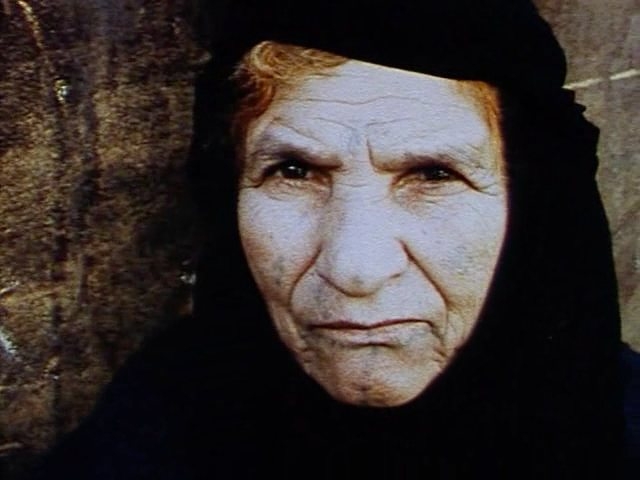
Do you try and provide the audience with tools to unravel the ideology of the documentary? Or do you think that it is the way that the film structures its meaning, frames its enunciations that determines the unraveling? In The Palestinians there are a lot of events presented in terms similar to what we might see on television. How do you try and make the audience understand that what you are doing is a construct — your construct — and not just an objective representation of reality? Is there a means within the film itself for understanding the woman who stands besides her bombed out house for examp le? (ed. note : there is a crucial scene in the film during which the camera examines a bombed out house in Lebanon; we see some older women crying and moaning, they talk of having once lived in a house that is now rubble; the shot is a relatively conventional one and seems derived from cinéma-vérité.)

From one film to another you may even diametrically change your own point of view. I feel there is a strong theme of unity between my films. In fact I sometimes get the feeling that I am doing the same thing in all my films! Always the same story, but taken in different directions, from different viewpoints, and even different viewpoint inside my self . . . although each new film starts at a point opposite from the last one. My film on the Palestinians was responding to the immediacy of the situation and was therefore less concerned with itself at the level of self-reflexivity. And this is an important moral choice and perhaps also an important political choice. Whereas in Springtime it seemed necessary to be outspoken thematically and restrict feeling, in The Palestinians there was certain need to make the film available to a specific group of people . . . the committee in support of the Palestinian cause in Holland. . .a country by the way that has never understood its guilt as being a major cause in its lack of understanding about the Palestinians. . . a guilt, the result of Holland’s policies during the Second World War …

With The Palestinians the play between the representation and what is being shown, between the filmmaker seeing and reproducing, is now shifting to the level of politcal utility. What is the utility of these images in relation to the overall Palestinian situation? Can you ever escape the problems of representation, that is, fictionalizing every situation you enter into?

I fictionalize in order to arrive at truth. In Springtime you have people speaking. There is the pretension of truth — because that is the commitment of the filmmaker — to go and see these people, listen to them talk etc. . . . I cannot guarantee that what they are saying is true but I can establish relationships between the people speaking. In this way I try to create a comprehensive framework for the different speeches. But where the framework is brought in the use of the means is made clear. I mentioned, in relation to The Palestinians that at the beginning of the film there is a photo of an old Jew in the Ghetto. I had each frame printed five times. It is on the screen for two minutes with a small text and phase-like music. I think that this in itself goes against the ethos of the documentary tradition. Here the image is totally flat, it cannot deliver more information than it did at first glance. So you are presented with an image that empties itself out so to speak, and the text that is spoken by me has the characteristic of being a text spoken by a person. I think that in this way you establish a very different relationship to the documentary. It is quite clear that the photo is not there for two minutes to prove anything. It only gives a material basis, an image and a text to the spectator. It also leaves things open, it leaves things unsaid which the spectator can fill in and which establish a framework in which the more truly recorded elements find their place. Also, what I have tried to do in The Palestinians with the commentary was never to present commentary as such over a determined action but to make a separate place for the commentary, so that it would speak over the more aesthetic, passive elements in the film — not dynamic elements. In this way the commentary itself would never interfere with the action itself. In the whole construction (but I think this is more hidden to the audience) there is one important aspect on the level of the didactics of the film, that is, that all the things which are said to people by people somehow refer to spots in the general commentary. The schoolmaster goes over the history of Palestine, the coming of the Jews and the policy of the British — this all reflects back to a commentary spoken much earlier in the film. So you have different angles, mine which is fictional in a way (and the fiction becomes fiction because this guy is telling the same things out of his practice) — the understanding of what is happening is quite different from my enumeration of these facts, or supposed facts in a commentary, which never coincides with an image. The image is a limited set of stock shots which have been designated by a printing process and which are repeated, and to some extent do away with the historical or supposed historical chronology…. I think these are some tools which may enable an audience to see that here there is no pretense to a claim to history or authenticity.

The very crucial difference between The Palestinians and the films that I did before is that with a subject like The Palestinians your moving space is much smaller. In a more pretentious film there is an element of play — the game between the filmmaker and every spectator which is much more in the forefront than the documentary content itself. In The Palestinians the element of play is at a less powerful level than the element of direct speech by the people concerned — and that is a moral choice. It is important to talk of reality in terms of relationships and not just facts. Normally they would be formal relationships, but here the form has shifted in some senses to the content — so that they become relationships of content. So the film has to deliver a set of relationships to the audience which make sense and I think that at that level the film works. As a film it is not authoritarian. It is not saying to the audience, you have been misinformed, this is the way it is. But it brings out a set of more or less disconnected images in a certain structure/construction of relationships and an audience can make sense, or get a certain tone out of it. That’s more important than what is being told exactly. Because I believe that lists of facts — and this is my experience when I see documentary films — are useless, hard to remember. But an overall image stays. To be able to communicate what is happening you have to downplay the facts somewhat to get people to realize that they are looking at a construct; the construct is there and if the spectator is interested or aware, he will see the constructs.

The problem of how you establish the overall tone . . . The desire on the part of many political filmmakers has been to collapse the multiplicity of meanings that are possible or desirable in imagery into one flat directed statement so that all the complexities which make up the process of coming to an understanding of something — all of the complexities making up the process of looking at a moment in history and trying to understand it — all that is collapsed into what appears to be a pure statement of and about reality. And that bind, the political filmmakers bind of, in the one instance wanting in one or two hours to convince an audience of something which has perhaps taken the filmmaker himself or herself many years to arrive at — that desire to completely obliterate all the mediators is a dangerous desire because it is ultimately a desire to objectify the audience.

In The Palestinians the aesthetic is fully there. It is not being collapsed. It is more hidden, more subdued perhaps, but this has to do with a feeling towards the outside world you are dealing with. It is not the result of a calculation towards the audience but it is more or less an intuitive reaction towards the people and the reality in front of the camera . . . formal play should be there to help the communication but a film like The Palestinians is not the arena for me to discover and play with the aesthetic questions.


The Palestinians, by Johan van der Keuken… par medicitv

The tradition of the documentary can be turned around to work in your favour. One has to get away from over-emphasizing the actual effect of the aesthetic and begin to understand that there is a play between the aesthetic and between the history of the conventions of the documentary and a play between what is being represented and the history of representations. It is still possible as a result of the medium itself to use the power of duplication in a positive and political manner. To move too far to the other side has its dangers to, which is that one can over-emphasize, fetishize the way the aesthetic is operating and the way the medium is determining the enunciation. This can dilute the powerful effects that the tradition of the documentary film has had. And it is within that effect, that tradition, that one begins to change the rules of the game. But it can only be done to a point. It can’t be shifted entirely. It’s a really difficult problem. If you negate it entirely you end up with a film which is essentially incapable of moving beyond a limited group of people. If you shift it too much the other way you end up with a collapsing of all the mediators. In between these two poles is the place to be, but not to try and become fetishistic about the necessity of keeping the representation visible as representation all the time.

Whether or not it is possible, with The Palestinians you are faced with making a moral choice . . . Le film ne peut jamais dépasser le public. . . . The film can never get over reality. We can never make a better model than the realities that we are faced with. If we put form as a strong fence before the screen, in front of the audience, we still put it as a fence that shows the audience and ultimately ourselves as ourselves — our own limits of perception. This is also a moral choice. With The Palestinians we had to open up the possibility of perception to people who, up until that point were closed to any communication with anything that had to do with Palestinians. On the level of the écriture of the film, what is very strong are the images of the airplanes, machine-like and unnaturalistic. This image, cannot, within a certain style of writing of a film, be directly connected with the scenes that follow, where people tell how they have been bombed out etc. The truth of people’s speeches is almost naively accepted. I came here to take in what they had to say. It was a primary relationship. But the whole thing in its working, its mechanism as a dramatic representation is questioned by the shots of the airplane in black and white, while the other scenes are in colour. Many people in any given audience, are not consciously looking at what they see, concepts are linked up in the mind of the audience such that the planes are associated with bombing the people. What we deconstruct the audience reconstructs. On the level of what is there materially, you have two realities which on the one hand flow over, one into another and on the other hand are strongly separated from each other. I think these are the tools we use to make clear what we want to do. We came to take in what they (the Palestinians) had to say and not to question whether or not the bombed-out kitchen was in fact the kitchen of the woman showing it to us . . . and that framework in which we organized all these images remains the framework of a conjecture. . . . At times the film is on a more far away level which permits us to see the images which come most strongly towards us in another perspective. It can never be a game which is played, a game of signs or of interpretation of signs which can be separate from our particular attitude towards the subject matter at a given moment.

The way we experience films, or the forms of films that we have seen, particularly in the documentary tradition, is that the flow of rhythms generally speaking, is very difficult to contradict, mainly because even if one is conscious in the making (of a film) of a series of relationships of écriture, that the viewing somehow seems to collapse difference into unity, collapse obvious contradiction into homogeneity and so forth . . . and the problem then rises to another level which is: is it possible to build into the structure of relationships enough of a space, a gap between those relationships so that homogeneity is impossible to arrive at as a spectator? It is not now a question of aesthetics, it is now a question of the politics of communication. If the rhythm of the relationships ends up nevertheless generating unity, then the capacity to recognize it as text for example is lessened, the capacity to recognize the profundity of the work which has gone into generating difference; each coupe is pushed to the side. It is a question that political filmmakers have been struggling with for a long time. And it seems fundamental to film because in the theater at least you can open up those spaces, you can generate that silence, the silence that you try to generate for example in parts of The Palestinians, with the scene around the campfire . . . the moment of silence, which is one of the gaps that we are looking for. (Ed. note: the scene being described has the camera circling a group of Palestinians as they silently eat and rest around a campfire. . . the camera focuses in on their gestures, looks and reactions to each other . . . not a word is exchanged.) But that gap has to be a constant part of the way in which the film enunciates itself, so that it becomes a primary element of the enunciation, as important as the images of the reality being shown.

In response to what was said about silence: to me the silences are there in all my films. If I were able to take all my films some of these silences would be inescapable. Spectators are not accustomed to seeing films which are either silent or contain moments of silence within them. They are unaccustomed to hearing themselves breathe. What happens in front of a piece of silent film is that the audience becomes present again. You go into an inner space somehow by observing the outward appearance of someone in silence. The spectator who is willing to get into it has to project his own feelings into this silent image. It is a silence which represents a possible level of content — of what was already there. Before, I used to use silence in a kind of academic way, and at a certain moment you could state it as a problem of “lecture” — of the presence of a text. But it can also be the statement that goes beyond the overall communication of the film. For me, and this might be a false hope or a false justification, but I now experience it a small step to maturity that I don’t need to make statements separate or apart from the situations I am in. I don’t have to proclaim any philosophy over the heads of the palestinians for example, and Springtime is the most rigorous cut-back of left-over aesthetic, and may be even too much of a cutback. But I can always broaden up in the next film. There were weak moments in certain discourses, Claude Ménard’s for example where I felt the most tension between the fullness of what he has to say and the weak moments before he can say it . . . this is the same dialectic: fullness and emptiness, sound and silence. There the silence is not really silence but maybe a defect, something missing which might be filled in. With regard to the second part of the comment that you made if you could have the same thoughts expressed by someone who had an outward distance towards the role of the person — an actor for example — I’m not sure but I think that the portraits were more or less successful in that each person revealed himself through the process — again Ménard is a good example: In the beginning he is a person who is out of touch with his surroundings, he is pretty much an actor on the wrong stage, and you feel uneasy. Is this guy going to tell me how society functions? And then I think by the third day, he picks up a certain rhythm when he is bringing together different ideas and speculations he develops a certain type of continuity. I used to think of this part of the film as the situation of an actor really getting into his role and finally finding the right approach to that role. This ties into what I feel about the fiction of the documentary. Once he has found his rhythm, then the play of angles of the camera becomes very natural with respect to what he is doing — and the music kicks him in the ass from time to time. Further on I ask him a question and he gets a bit angry. It’s what we needed. These things are not predictable but they put the whole fiction as it were in its place. There is a shot of a cradle which turns out to be an advertising billboard in the street — one moment you are in one space — a huge image of a cradle — and suddenly the noise of the street breaks in. Once more we perceive the poster but this time we perceive it to be convex — it is not flat — it is convex. This also represents the different possibilities of the different degrees of reality of one single image. In Springtime each portrait was located in a definite space mostly enclosed ones. With Ménard a certain void or barrier was part of the portrait, as it was part of the portrait of the German girl. In Springtime you have compartments, there is a kind of overflow of meaning; the earlier stages of the film may seem the more insecure or weaker parts, but as they become retrospective, they work.


Springtime, Three Portraits par medicitv

There is a lyricism which seems to pervade all of your films, a lyricism born out of passion/conviction. It is more sometimes than what the film is trying to say . . . what is the specific kind of relationship which you want to establish with your audience?

What can I say about the level of meaning? To me it is hard to talk about . . . why would a piece of music move you? A marxist analysis is the most valid tool for understanding . . . to talk about reality . . . why is a painting, a song, a film, to some extent understandable to so many people? Another thing about my work, is that I find reality or the experience of life very bewildering. I think that the activity of making films is also the need to create some kind of order in all of this and to find some entry into reality, ways of understanding. Sometimes this happens more on an intellectual sometimes more on the level of intuition. . . or of construction. For me the element of construction is very strong, whether it be the verbal approach or let’s say, relationships of connotation or expected meaning. All that works together to make a construction. The experience of time has always been important to me.

What I am striving for in Filmmaker’s Holiday for example, as far as I am concerned as a person is to get to something which will explain the relativistic aspects of my life. On that level the problem is to have this possibility of relativity without stopping to speak socially — which is also a conflict. Because if you take a stand politically or socially you cannot afford relativity too often. On the other hand it is true that in the development of the individual he should acquire a certain degree of relativity in order to develop or see. Showing a clock is a matter of relativity. Putting it there and seeing that it is only a clock — and in between having the joy of speculation as to what it might mean. Also it’s fun. We shouldn’t forget that an element of play is important even in the most serious of subjects.

I want to see film aesthetics as a relative thing. If I have an aesthetic it functions in a relative way. It is a set of relationships — but as related to outside reality, its quite relative too. This is the core of the matter. The problem is not to annihilate yourself when you are confronted with ugly reality, but sometimes accept the fact that you do not have the power to solve all the problems — or make all the relationships come off. Paradoxically, my main problem as a filmmaker is to overcome the fact that for an audience acceptance of what the filmmaker is saying is fundamental to their experience of the film.


The Filmmaker's Holiday, by Johan van der… par medicitv

That is the bind that Godard got into, which is in evidence in much of his work of the early seventies — the bind of the recognition of the contradiction and yet the desire to suppress that contradiction for the audience. Part of the whole process has to be not fearing the visibility of that contradiction for the audience. For example, in Numéro Deux there is an intensity in the way in which he begins to try and talk about the media, about film, which in one sense becomes demagogic. He seems unable to avoid it and yet he is trying to move away from it. The demagogic becomes a way of continuously re-affirming one’s own statements, of validating one’s, premises. . . .

I saw Numéro Deux as being of the utmost honesty and modesty trying to show what was going wrong with western capitalism.

It seemed more complex than that, in which the image ceases to be an image and becomes a series of signs. Each inner frame is its own sign, becomes its own symbolic expression, its own system of meaning, inter-related to the others but now separate, possibly read as separate, possibly read as part of. . . and that complexity doesn’t deal with the fact that the audience is placed in a difficult position. You have the overall frame operating as a meaning and in it is an implicit narrative; and then you have the subdivisions of the frame which begin to comment on the narrative and comment on the framing itself of the narrative. Then you have the double exposures and the splitscreen which comment on the relationship of exterior and interior space — the relationship of meaning to expression. You have all these things happening, and guiding all if it is the relationship of the typewriter to the written word-langue-parole. It was hard to see within all that how Godard was attempting to make contradiction evident and obvious. It seemed that he wanted to, in a sense, come to a statement as fully as possible, and even though it is the play of a puzzle, it ultimately becomes too powerful.

I still felt that the fragmentation was stronger than the unity of the whole construction . . . the point that he couldn’t get it together was to me the strongest impression. . . the relationships were there but they were breaking off at the same time.

In regards to Filmmaker’s Holiday, I wonder if it is possible to recover the purity of one’s own experience — my experience of making the film is now in the past but my seeing the film recovers the past — and recreates it, constantly negating to generate a new present — this for me is fundamental to film.

Yes, in fact no political film can expect to interact with an audience without dealing with the circuit of exchange of memory and the present. Subjective history is a part of the film both in the filmmaker and in the spectator.

I was looking at it from another angle which is complimentary. Film is completely different in different contexts. Some French critics found Filmmaker’s Holiday to be the example of what my work was about. Dutch audiences were very touched by it. A kind of relief operated, as if to say, he can also be like this. This seemed to be a response to what a lot of people consider the lack of subjectivity in political film…. You can only be objective if you include the subjective moment. Claude Ménard in front of the window is a moment of subjectivity during which I cut in to say, well I’m here too. . . . . I interfere with his speech. I flatten him out literally! The same goes for the use of music . . . someone watching the film once said, Hey someone is playing a piano in the other room! That is the effect. I did go out of the room and play piano, metaphorically. . . . In Filmmaker’s Holiday I ultimately appear as a middle class person — given to middle class pleasures — going out on holiday in more or less touristic setting. I think it is important to show this because it is an important level of my existence . . . it influences what I say elsewhere. . . to negate it would be to negate that level of my films which is always defined by an absence.

—————————————————————————————————–

VAN DER KEUKEN ON SPRINGTIME

“In surveys of the economic situation one is very seldom confronted with the effect it has on the individual, on his perceptions and emotions. I wanted to give a personal dimension to this rather abstract economic situation, which is often perceived by the public as a kind of natural phenomenon. I wanted to show how isolation and loneliness, inherent to our production system, make themselves more painfully felt in a period of crisis.

In the films which I have made over the past few years, the problems caused by the prevailing economic system, capitalism, are shown in a world-wide perspective. In this film Springtime I wanted to see things on a smaller scale and look more closely at a few characters within the somewhat more homogenous society of Western Europe. Without neglecting the cultural differences in this smaller field, I wanted to show that the contrasts between rich and poor, between powerful and powerless, though they may be much smaller in absolute terms, also lay a great strain on the people. . . .

While in most of my films I have used the image and spatial sound as driving forces, in the present film I have mainly worked on the basis of the spoken word. In my view anything can serve as the basis or material for a filmic composition: in this case words.

Thus in Springtime we have five characters, each in his own surroundings. Three Dutchmen and two foreigners, three workers and two intellectuals; together they make an overall picture that could be endlessly enlarged. Technically it is not without interest that I was doing the interviews while holding the camera. But while I was working in this very direct manner I wasn’t out to take reality by surprise. I was rather trying to construct a viewpoint through a series of definite visual compositions that were found spontaneously: a kind of instant shooting script, between vérité and fiction.”
Disappearance of the fireflies

fireflies.jpg

by Pier Paolo Pasolini

Originally published as ‘Il vuoto del potere in Italia’ (The Power Void in Italy) in ‘Corriere della sera’, 1 February 1975. Translated by Christopher Mott.

“The distinction between adjective and substantive fascism goes back to nothing less than the newspaper il Politecnico, in other words, directly after the war”. Thus begins Franco Fortini’s work on fascism (l’Europeo, 26-12-1974), a writing based on principles that I fully and completely subscribe to. I cannot, however, agree with his tendentious beginning. Indeed, the distinction between the “fascisms” made in il Politecnico is neither pertinent nor current. It was still valid up until some ten years ago, when the Christian-Democrat regime was the pure and simple extension of the fascist regime.

However, ten or so years ago, an “event” occurred. It was something that did not exist, nor was it foreseeable, not only in the Politecnico era, but even up to a year before the thing happened, or in fact, as we shall see, while the thing was happening.

The true confrontation between the two fascisms cannot therefore chronologically be the fascist fascism in the form of Christian-Democrat fascism, but the confrontation between fascist fascism with a fascism that was born of this event, a totally, radically and unforeseeably new type of fascism that occurred some ten years ago.

Since I am a writer and I get involved in controversy, or at least in discussions with other writers, allow me to provide a poetic-literary definition of this phenomena that occurred in Italy during that time. This will serve to simplify and shorten our sunject, and probably to better understand it.

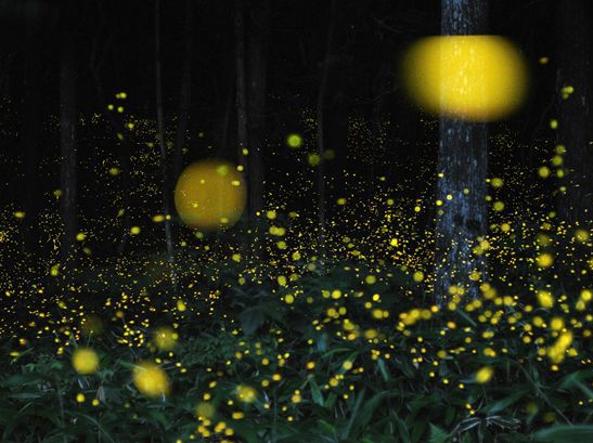
At the beginning of the sixties, the fireflies began to disappear in our nation, due to pollution of the air, and the azure rivers and limpid canals, above all in the countryside. This was a stunning and searing phenomena. There were no fireflies left after a few years. Today this is a somewhat poignant recollection of the past—a man of that time with such a souvenir cannot be young among the young of today and can therefore not have the wonderful regrets of those times.

The event that occurred some ten years ago we shall now call the “disappearance of the fireflies”.

The Christian-Democrat regime passed through two completely different phases that not only cannot be set off against each other—which would imply a certain degree of continuity between them—but which also have become flatly immeasurable, from an historic viewpoint.

The first phase of this regime, which the radicals have always rightly called it, is the phase beginning with the end of the war and extending to the extinction of the fireflies. The second goes from the extinction of the fireflies to the present day. We shall discuss them in order.

Before the extinction of the fireflies.
Christian-Democrat fascism is a total and absolute extension of fascist fascism. I will not deal with certain subjects which were discussed at the time, perhaps in Politecnico. They include the lost opportunity for purification, the continuation of the codes [1], police brutality and disregard for the constitution. In addition, I will stop at that event that subsequently passed for a retrospective historical conscience, which was that the democracy that anti-fascist Christian-Democrats put forth in opposition to the fascist dictatorship was unabashedly categorical.

It was based on an absolute majority of votes obtained from wide strata of the middle classes and huge masses of the peasantry, oriented by the Vatican. This participation by the Vatican could only be possible if it was based on a totally repressive regime. In this type of world, the “values” that counted were those upheld by fascism, meaning Church, family, country, obedience, discipline, order, saving and morality. These values, as under fascism, were “genuine”, in other words they formed part of the specific and concrete cultures that were the basis of the ancient agricultural and palaeo-industrial traditions in Italy. However, from the moment they were elevated to the status of national “values”, they lost all reality, becoming atrocious, stupid and repressive State conformity characteristics, the conformity of fascist and Christian-Democrat power. We are not speaking of provincialism, of the vulgarity and ignorance of the élites [2] who, on a level different from the masses, were the same throughout fascism and the initial phase of the Christian-Democrat regime. The paradigm of this ignorance was the pragmatism and the formalism of the Vatican.

All this seems clear and uncontestable today because intellectuals and the opposition of the period cherished ridiculous illusions. They hoped that all that they were seeing was not completely true and that true democracy really counted for something.

Before moving to the second phase, I must devote a paragraph to the transition.

While the fireflies were disappearing.
During this period, the distinction between fascism and the Politecnico fascism was still in effect. Neither the large country that was forming within the nation, that is, the peasant and working class masses being organized by the PCI (Italian Communist Party) nor the most advanced and critical intellectuals saw that the fireflies were becoming extinct. They understood sociology quite well—which during those years had caused a crisis in the Marxist analytical method—but their understanding was not yet tested by life experience and was essentially theoretical. No one could perceive what historical reality concerning the immediate future was evolving, nor link what was then called well-being with the development concept which was to bring about for the first time fully in Italy the ‘genocide’ described by Marx in his Manifesto.

After the extinction of the fireflies.
The nationalized and therefore falsified “values” of the old agricultural-based and palaeo-capitalistic world suddenly were no longer important. Church, country, family, obedience, order, savings, morality, none of it was important any more. They didn’t even survive in the form of false values. They remained within the reduced clerical-fascism order and even the M.S.I. repudiated them. “Values” for a new type of civilization replaced them, which were completely apart from the peasant and palaeo-industrial society. This phenomena had already been experienced by other countries. However, in Italy, it was completely unique because it involved the first true unification of our country. In other countries this unification was superimposed logically over monarchic or bourgeois and industrial revolution-imposed unifications. Perhaps the only precedent to the Italian trauma produced by the clash between pluralist archaism and industrial equalization was pre-Hitler Germany. In that country also, the values of different specific cultures were destroyed by the violent recognition process of industrialization, with the consequence of producing those gigantic hordes who had neither the ancient peasant or artisan roots or not even a modern bourgeois background, and who made up the savage, abnormal and unpredictable bodies of Nazi troops.

Something similar is now occurring in Italy, with even greater violence in that the industrialization of the sixties and seventies was also a decisive mutation compared to that in Germany fifty years ago. As we all know, we are not now facing a new age, but rather a new era of human history, with human history seen in periods of one thousand years. The Italian people could not have behaved worse than they did in confronting this historic trauma. Over a period of several years they have become, especially in the Center-South, a degenerate, ridiculous, monstrous and criminal population – one need only go into the street to understand this. Of course, in order to understand the changes in people, you have understand the people themselves. To my detriment, I liked them, the Italian population, both outside of the power systems—in fact in desperate opposition to them—and outside of populist and humanitarian systems. I felt real love for them, rooted in my personality. I could see with my “senses” how the power of a consumption-based society modeled and deformed the conscience of the Italian people, finally arriving at an irreversible degradation. This was something that did not occur in the fascist fascism period, during which individual behavior was totally disassociated from the conscience. The totalitarian power repeated incessantly its injunctions on behavior modification in vain, since the conscience no longer entered into play. The fascist models were only masks that were donned and removed in turn. When the fascist fascism movement fell, everything returned to its previous order. This occurred also in Portugal. After forty years of fascism, the Portuguese celebrate D the 1st of May as if the last one celebrated was the preceding one.

As such it is ridiculous for Fortini to backdate the distinction between fascism and the fascism prevalent to directly after the war. The distinction between fascist fascism and the fascism of the second phase of the Christian-Democrat regime has no grounds for comparison in our history, and not only in our history but probably in all history.

I do not write this article to debate this subject, even though it is one very near to me. I write for a very different reason, which I will now outline.

All my readers will certainly have observed change in Christian-Democrat officials. Over several months they have become funereal. It is true that they continue to dispense radiant smiles of an incredible sincerity. Their eyes exude an honest, blissful spark of good will, when they aren’t betraying a mocking, spirited cunning. This, apparently, pleases voters as much as genuine good will. Furthermore, our officials continue imperturbably to release incomprehensible verbiage into the atmosphere, or float the flatus vocis of their habitual stereotyped promises.

In reality, all these things actually are masks. I am sure that, if they were removed we wouldn’t even see a heap of bones and ashes. There would be nothing, just emptiness. The reason for this is simple because in Italy today, there is a dramatic power void. However, the important thing is that the void is not of a legislative or executive nature, it is not a void in the power of governing or even in political power of any traditional description. It is a power void in itself.

How did this void come about? Or rather, “How is it that the people in power came to this?”

The explanation for this is also simple. The Christian-Democrat power base went from the “fireflies” stage to the “fireflies extinction” phase” without realizing it. However quasi-criminal this may appear, their unconsciousness in this matter was based on one absolute issue, which was that they had no inkling that the power that they held and exercised did not follow a normal pattern of evolution but rather was undergoing a radical change of form.

They were deceived into thinking that in their regime nothing would really changed and that, for example, they would always be able to rely on the Vatican’s support. They didn’t realize that the power they continued to exercise had no further use for the Vatican, which was a center of the poor, backward peasantry. They had the illusion that they would always be able to count on a nationalist army, just as their fascist predecessors did. They did not see that the power that they continued to exercise was already maneuvering to establish the basis for new transnational armies, almost like a technocratic police force. The same can be said with regard to the family, which was relegated to saving and upholding morality and which had no means of maintaining these traditions during the transition from fascism. Today the power of the consumer society has imposed radical changes on this institution, with the acceptance of divorce and now potentially anything else without limit, or at least within the limits allowed by the the permissiveness of the new power scheme, which is more totalitarian because it is violently aggregate.

Christian-Democrat politicians accepted all this, all the while believing that they were administrating it. They did not realize that it amounted to “something else” that was not only immeasurable with respect to themselves but also with all forms of civilization. As always (see. Gramsci), the only symptoms of this occurred in language. During the transition phase – meaning, the “extinction of the fireflies” – Christian-Democrat rulers changed their way of communicating almost abruptly, adopting a completely new language that was as incomprehensible as Latin. This was especially true of Aldo Moro. Through a puzzling correlation, the one who seems to be the least involved of all in the horrible acts perpetuated between 1969 to the present, whose purpose was to retain power at all costs. Up to now, this goal has been formally achieved.

I say ‘formally’ because, and I repeat, in reality, Christian-Democrat officials are keeping the void hidden behind their smiles and automated movements. The real power works without them and they hold in their hands only a useless apparatus. The only real thing about them are their mournful three-piece suits.

Nonetheless, in history the void cannot remain in existence. The only way to assert it is in the abstract or reasoning on the basis of absurdity. It is likely that the void that I speak of is already being filled by a crisis or an event that cannot avoid ravaging the entire country. The morbid expectation of a coup d’état is a hint of this. As if it amounted only to replacing a group of people that have governed us terribly for thirty years, bringing Italy to economic, ecological, urban and anthropological disaster! In reality, the false replacement of these “pig-headed people” by other “pig-headed people”—who will be not less, but more lugubriously carnavalesque—brought on by the artificial reinforcement of the old fascist apparatus, would do nothing. Should this occur, it is clear that the “troupe” would be Nazi, virtually be its composition. The real power, which for ten years the “pig-headed people” have exercised without comprehending reality, that is something that could already have filled the void. This would also render useless the possible participation in the government of the greater communist country that evolved during the degradation of Italy, because it is not a question of governing. We formulate abstract images of this real power, which are basically apocalyptic. We have no idea what form it would take in directly replacing those who used it and took it for a simple modernization of techniques. At any rate, as for me, should that interest the reader, let it be clearly understood. I would give the entire Montedison, even though it be a multinational company, for a firefly.

notes
1. Allusion to the Rocco code (translator’s note)
2. In French in the text