notes on courtisane

quixote.jpg

Time and time again we are asked the same questions: what is this thing called “Courtisane”? What exactly is it that you are proposing? And every time our response falls short. Because the honest answer is that we don’t know very well either, and that, perhaps, we don’t really want to know.

Time and time again we are told that we need to define ourselves. Communication specialists have been saying for years that we ought to think of a “unique selling proposition”. Specialists of whatever kind have urged us to be clear about our “identity”. And yet we feel increasingly incapable of coming up with the right words, words that somehow feel right.

Surely, we whisper hesitantly, it must have something to do with “cinema”, as a configuration of images and sounds, an experience of seeing and listening, a surface of percepts and affects, a construction of a sensible world for us to engage with. And yes, there was a moment when we proclaimed that we were defending “cinema at the margins”. As if that in itself meant something. As if defining oneself as the other of the same, as the outside of some inside, could really make a difference.

And yes, there were moments when we foolishly fell into the trap of some kind of sectarian academism, considering films as scientific or historical objects, testimonies of all that was other or all that had come to pass, museum pieces to behold in all their rarity and sterility. It’s not that we were all that wrong, it’s just that we didn’t say what needed to be said: that what you are seeing up there, flickering on the screen, are not some dead objects. That they are very much alive, alive with sensation, affect, thought.

And that they can make us feel alive in return. Isn’t that what matters most after all? In a world where it feels as if our places have always already been decided on and our paths have been set out for us, where we are constantly dared to be different and perform our own little micro-revolutions, without ever being able to question “the way things are”, isn’t it this aliveness that can give us the energy and courage to trust in what we do not know, in this as yet unknown place of possibility for which we crave to take responsibility?

Glauber Rocha once recalled a Portugese saying: we don’t know where we are going, but we know we can’t get there this way. Perhaps that is the choice we are trying to make: to leave the safe grounds and start trusting in what we see in front of us, even – especially – when shrouded in darkness. To leave behind the categories pinpointing us to places that could be easily recognized and identified. To put our confidence in what resists us, what forces us to think anew. To realize what we have been sensing all along, that there is something else at stake. To let go, slowly, of the certainties of knowing and accepting one’s place. To get lost.

How utterly naive, you say. We don’t even disagree. In light of the all too contemporary mindset of rationalism, cynicism, and common sense realism, we prefer to be naive. It’s not that we are turning our backs to the world – that would be plain nihilism, and there’s too much of that already. We certainly do not want to turn a blind eye to the petrifying darkness surrounding us, nor revel in fantasies of colored rainbows and shiny meadows. But we do need to allow ourselves to dream, dream out loud, dream with our eyes open.

Our “proposition” is perhaps just that: to give you some things to wonder about, things that, maybe, just maybe, make you want to wander yourself. That is all we can do, the rest is up to you.

Apart, Together, or the other way around –
we get there when we do.

(Courtisane festival 2014, 2 – 6 April)

Across the Margins, Beyond the Pale

touki-bouki-3-1-g.jpg

Courtisane Festival 2014, 2 – 6 April 2014

“Each generation must, out of relative obscurity, discover its mission, fulfill it, or betray it.”
– Frantz Fanon

An anthropological mockumentary, a baroque anti-symphony, a surrealist counter-ethnography, a revolutionary musical comedy, a porno-misery parody and a cubist road movie. What do all these films have in common? At first sight hardly anything, except for the fact that they all seem to be rooted in a world that is still classified “third”, a world marked by broken promises and shattered dreams, haunted by the spectres of colonialism and the realities of imperialism. These films are distant echoes from a time when a roaring call for a “third” cinema was resounding, one that could expose cruel realities and chase away unwanted ghosts: a cinema of liberation, not owing anything to the workings of the dominant order; a cinema of opposition, found on the outer edges of the overdeveloped world, always South to someone else’s North. These films are all that, and they are not. They do speak of the incoherence of underdevelopment and the discards of colonialism, and yet they refuse to conform to the imperatives of urgency and pedagogy that are bound up with these motives. They do take position against established powers and manifest a desire to overcome the past, but also resist any prescribed directions and prefer to reimagine unforeseen futures. They struggle hard to look for identity, but they do so through the very dismissal of the identities that are imposed by others. Outrageous, hilarious, vertiginous, delirious: this is a cinema that has nothing to lose, and everything to gain; a cinema that chooses to forsake the trodden pathways, only to find itself in a state of complete sovereignty. In all their dislocated intensity, unfathomable glory and impossible hope, this is the stuff that foolish dreams are made of.

In collaboration with the Royal Belgian Film Archive. In the framework of “Figures of Dissent (Cinema of Politics, Politics of Cinema)” (KASK/HoGent).

——————————————————————————————————————————————————————-

Djibril Diop Mambéty
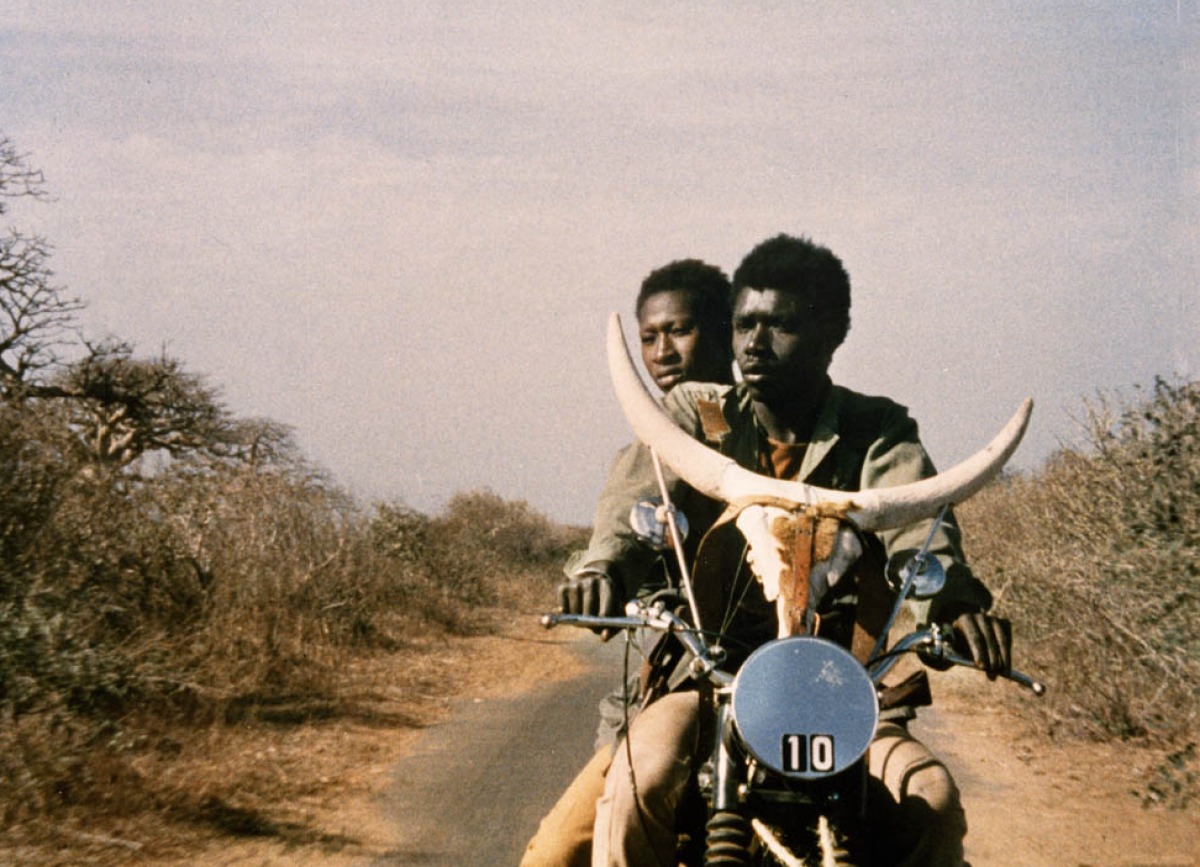
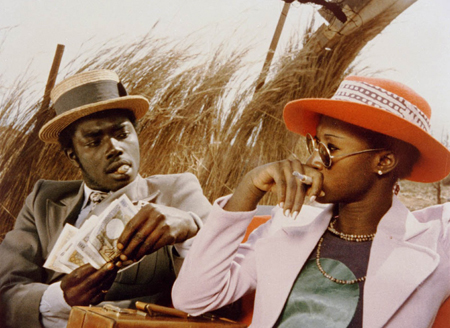
Touki Bouki (The Journey of the Hyena)

SN, 1973, color, Wolof spoken with English subtitles, 35mm (restored), 95’
touki.jpg

“That’s the way I dream. To do that, one must have a mad belief that everything is possible – you have to be mad to the point of being irresponsible. Because I know that cinema must be reinvented, reinvented each time, and whoever ventures into cinema also has a share in its reinvention.“
– Djibril Diop-Mambety

Touki Bouki portrays the wanderings of Mory and Anta, who roam all over Dakar in pursuit of their dream of escaping to France. “The story of Touki Bouki goes back centuries: men have always set out for new lands where they believe time never stops… Only few adventurers seem to make it, but that has never stopped anyone… Djibril left his country with the dream of finding success and solace in Europe. He soon discovered, however, the cruelty of life. While his dream fell apart little by little Djibril found he was unable to leave “Europe”, his host country. That was when returning to Africa became the real dream for him. Ending his days in Africa was a dream he would never fulfill. Touki Bouki is a prophetic film. Its portrayal of 1973 Senegalese society is not too different from today’s reality. Hundreds of young Africans die every day at the Strait of Gibraltar trying to reach Europe (Melilla and Ceuta). Who has never heard of that before? All their hardships find their voice in Djibril’s film: the young nomads who think they can cross the desert ocean and find their own lucky star and happiness but are disappointed by the human cruelty they encounter.” (Souleymane Cissé)

——————————————————————————————————————————————————————-

Kidlat Tahimik
Mababangong Bangungot (Perfumed Nightmare)

PH, 1977, color, Tagalog spoken with English subtitles, 16mm, 93’

perfumednightmare.jpg

“Maybe I’m just an accumulator of images and sounds and then I make a tagpi-tagpi [patchwork] and sew them together. I just work with images and I put my sounds on them and then I release a flow of thoughts and start juggling the sequences back and forth. I don’t try to find surrealist images even in the way as it happened in Perfumed Nightmare. I was a madman when I was making that film and I still am.”
– Kidlat Tahimik

For his first film, Kidlat Tahimik (meaning “quiet lightning” in Tagalog) drew on his own experience living “in a cocoon of Americanized dreams” for this tale of a village jitney driver, faithful student of Voice of America and its many lessons, and founder of his local Werner Von Braun fan club. Kidlat hopes to become an astronaut, or at the very least to strike it rich in the promised land. He makes it as far as Europe, where a series of rude and comical awakenings unfolds and Kidlat learns that the modern Western world is far from paradise. Tahimik, who later became a protégé of Werner Herzog in Munich, is a faux naif who uses the genuine naiveté of his hero – like Chaplin’s Little Tramp – to inscribe a powerful portrait of the American colonization of Filipino dreams. But, like the charming, festooned “jeepny” Tahimik constructed from an abandoned U.S. Army vehicle, the film creates something wholly original and imaginative from the discards of colonialism. In the words of Susan Sontag: “ Perfumed Nightmare makes one forget months of dreary moviegoing, for it reminds one that invention, insolence, enchantment – even innocence – are still available on film”

——————————————————————————————————————————————————————-

Arthur Omar
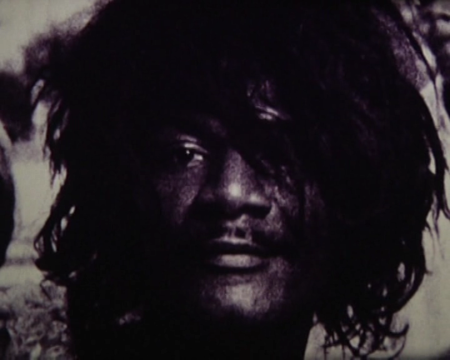
Triste Trópico

BR, 1974, color, Portugese spoken with English subtitles, 16mm to video, 75’
triste.png

“I am fascinated by sound interference and remixes, ultra-editing, blending, everything that goes beyond the immediateness of the image and the verbal. Words, depositions, speech; for me it’s all raw material to be modulated. I’m not interested in anything that preexists the images, but the production of an experience through the image, in the image, like a chemical reaction in the brain, that can only occur there.”
– Arthur Omar

The biography of an imaginary doctor who left Brazil to study in France where he became friends with André Bresson, Max Ernst, and Pablo Picasso, and somehow ended up as an indigenous messiah. “A galaxy of discontinuous images. With a new presentation of the conflict between the coast and the sertão, Triste Trópico proposes a criticism, full of irony and hallucination, of the anthropological discourse in the tropics. Its main character, a surprising petit bourgeois doctor, embarks on a journey that will invert the sense of Levi-Strauss demarche, as expressed in his book Triste Tropique. The allegory of Cinema Novo was conceived as an unveiling, whereas the allegory of Triste Trópico is a movement towards opacity, and what poses a problem is the very act of reading. Triste Trópico is meta-cinema and, from this point of view, it is different from the forms of anti-colonialism of the 70s in Brazil”. (Ismail Xavier)

DUE TO THE UNAVAILABILITY OF A COPY OF ‘TRISTE TROPICO’, THE FILM WILL BE REPLACED BY ‘HOW TASTY WAS MY LITTLE FRENCHMAN’
——————————————————————————————————————————————————————-
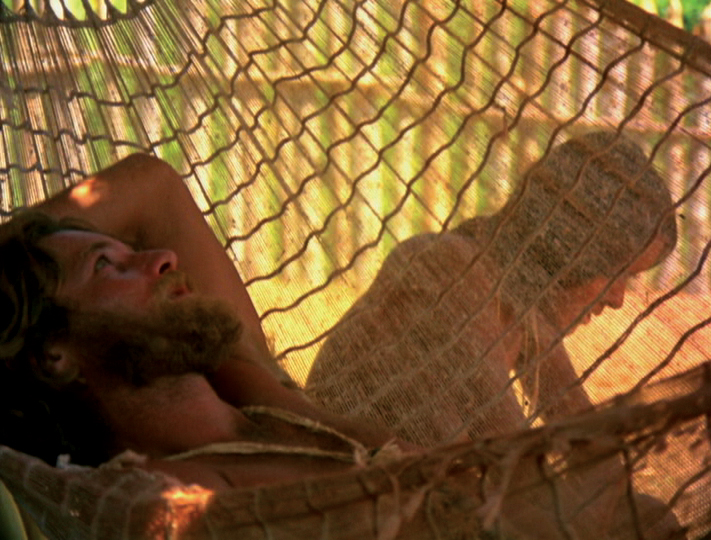
1312258945how_tasty_was_my7.jpg

Nelson Pereira dos Santos
Como era gostoso o meu frances (How Tasty Was My Little Frenchman)

BR, 1971, 35mm, Tupi, French and Portuguese spoken with English subtitles, 84’

“The government broadly financed historical films, but it wanted the history to be within official parameters – the hero, the father of the country, all those things we have been told since elementary school. I made How Tasty Was my Little Frenchman, which does not correspond in any way to the official vision of history, under these circumstances. The film was not even considered to be historical, but rather purely fictional, as if official history were not fiction.”
– Nelson Pereira dos Santos

Jaundiced cultural allegory dressed up as anthropological re-creation, How Tasty Was My Little Frenchman slyly links Montaigne’s who-are-the-real-savages query to Brazil’s military dictatorship. Pereira draws from multiple historical sources—especially German explorer Hans Staden’s 1557 memoir—to tell the story of a French soldier’s experience as a captive of the cannibalistic Tupinambá tribe. “Pereira constructs a comic horror film in which sixteenth-century intertexts are read as current events in an analogy of colonialism with global capitalism. This film is Pereira’s response to Brazil’s building of the Trans-Amazon Highway, in the course of which contact with indigenous communities was made that threatened them with near extinction. The current destruction of habitat and native populations recalled to Pereira the traumas of colonization…The ingesting of foreign invaders thus becomes for Pereira a metaphor for indigenous resistance to global capitalism, the most recent form of economic colonization.” (Virginia Higginbotham)

——————————————————————————————————————————————————————-

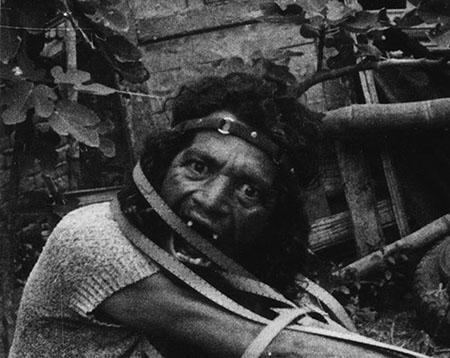
Carlos Mayolo & Luis Ospina
Agarrando pueblo (The Vampires of Poverty)

CO, 1977, color & b/w, Spanish spoken with English subtitles, 16mm to video, 28’
agarrandopueblo_luisospina.jpg

“In the early 1970’s there appeared a certain type of documentary that superficially appropriated the achievements and methodologies of independent film to the point of deformation. In this way, poverty became a shocking theme and a product easily sold, especially abroad, where it is the counterpart to the opulence of consumption… We made a kind of antidote or Mayakovskian bath to open people’s eyes to the exploitation behind the miserabilist cinema which turns human beings into objects, into instruments of a discourse foreign to their own condition”.
– Carlos Mayolo & Luis Ospina

Filmed in Cali and Bogotá, Agarrando pueblo follows an unscrupulous film director as he and his cameraman wander around the cities looking for unwilling subjects for a documentary commissioned by German television. “Deliberately detached from the accusatory militant left, Luis Ospina and Carlos Mayolo launch in 1978 what could be called their cinematic-political thesis: Agarrando Pueblo (The Vampires of Poverty), an outrageous protest of national and international documentary models, which at the time – and even today – shamelessly exploited all kinds of third-world suffering (referred to by the directors as “poverty-porn”) and exported it to European television stations and festivals. Counterinformative from beginning to end and in every sense of the word, the film mixes staged and real scenes of a typical film crew commissioned by a Germany television channel to seek out archetypical social horrors, trampling over the basic principles of professional ethics, the meaning of information and – naturally – sociological research.” (Isleni Cruz Carvajal)

——————————————————————————————————————————————————————-

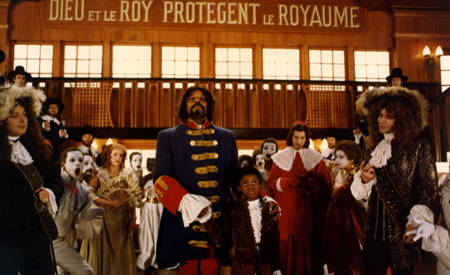
Med Hondo
West Indies (ou les nègres marrons de la liberté / The Fugitive Slaves of Liberty)

MR/DZ, 1979, color, French spoken with English subtitles, 35mm, 113’
west-indies-640-3.jpg

“For too long a time, African cinema has been conceived as a poor cinema, a cinema of approximations where techniques did not match ideas … Militant cinema can thus be beautiful and rich … Indeed, West Indies … is no more a West Indian film than an African film. It is a film which summons all the people whose past is made out of oppressions, whose present is made out of aborted promises and whose future is left to be conquered.”
– Med Hondo

A single-set color musical tracing the history of the West Indies through several centuries of French oppression. “Med Hondo’s West Indies is a revolutionary musical in both senses of the word. This witty, scathing production offers an angry view of West Indian history, using imaginative staging and a fluid visual style. The film’s single set is an enormous slave ship [built in an unused Citroen factory in Paris]. Mobile camerawork and frequent narrative shifts take the actors through various vignettes about French colonialists invading the Indies, Carribean natives lured to Paris, the process by which the islands were first settled and a lot more. The material has the potential for overbearing irony but Mr. Hondo has a light touch. With cast members rotating their way through many different roles (the same actors may play slaves, then worried island villagers, then displaced West Indians)… Mr. Hondo leads the film through a long series of well-connected tableaux, culminating in an almost joyous call to arms.” (Janet Maslin)

——————————————————————————————————————————————————————-

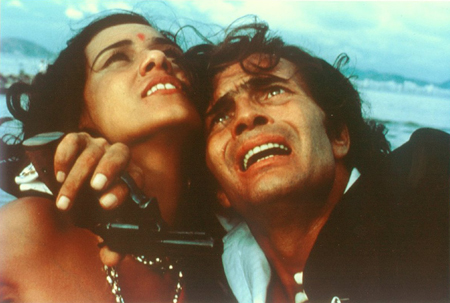
Glauber Rocha
A Idade da terra (The Age of the Earth)

BR, 1980, color, Portugese spoken with English subtitles, 35mm, 152’
aidadedaterra1.jpg

“The film develops the same ways, principles, lines, desires of justice and humanism in a world getting more and more destroyed by violence. The film is a barbarous mass, not a civilized mass. Because in substance of cinematographic language, montage, structure, everything was remade, subverted, reorganized. It is a baroque, reconstructivistic style, a very new thing that the Brazilians who saw the film adored.”
– Gauber Rocha

Catholic rituals and Afro-Indian gods, rural mysticism and revolutionary politics, Brahms and Villa-Lobos: this last film by Glauber Rocha, angel-demon of the Brazilian “Cinema Novo”, defies every attempt at unequivocal classification or definition. “It’s not to be told, only to be seen”, he said. A torrential, hallucinatory anti-symphony, a terrifying cry of desperation, a destruction in progress. “He hit himself against the impossible, the impossibility of being a great filmmaker of the Third World, a great black filmmaker. The Age of the Earth is the film of the Third World, there is no other. The others are films that join other films. The Age of the Earth is a great impossibility, a passage through world and time, a discovery of America on the opposite lane, a black Battleship Potemkin, or rather, it informs, full of gestures and rhythm, an extreme anti-classic – a spitting of blood in the face of the current cinema, dominated by sweetness.” (Pascal Bonitzer)

Alexandra Cuesta: Films & Influences

hombre-hr.jpg


17 February 2014 20:30, OFFoff Cinema Gent

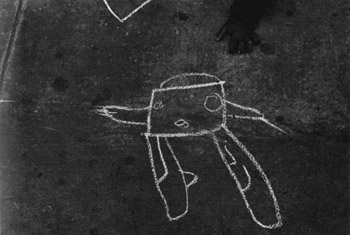
At the invitation of art cinema OFFOff, Courtisane is very happy to present a program composed of films made and chosen by artist and filmmaker Alexandra Cuesta (EC/US). Inspired as much by Walker Evans‘s reticent street photography as by Bruce Baillie’s sensuous film poems, her work manages to strike a delicate balance between the mundane and the poetic, the material and the intelligible. Public places and urban landscapes are observed in their splendor and singularity through the abstract and vernacular figures of everyday life, exploring the constructions of space and structures of time that can be found in the order and disorder of people’s daily movements and environments. These filmic portraits in motion, elegantly composed of textures of light and fragments of bodies, are reminiscent of an approach that Flaubert once referred to as an “absolute way of seeing things”, manifesting the sensible intensities of the most ordinary things, on the point of disentangling the connections that make them into functional objects. It is precisely in this point of tension that the sensibility of Alexandra Cuesta’s work is situated, perpetually oscillating between a fleeting play of correspondences and a surface of percepts and affects that is there for us to engage with.

Helen Levitt, James Agee & Ed Howard
In the Street

US, 16mm, b/w, sound, 13’

in-the-street.jpg

In The Street is reportage as art. It reports the facts, but for their useless beauty above all. While it could be argued that the film tells us how working class residents of Spanish Harlem lived in the 30’s and 40’s – how they looked and behaved, the addition of expository narration could have told us so much more. Statistics and other facts could have helped us put what we see into context and multiplied the use-value of the film. The absence of narration or other texts proves the artist’s intent that we are intended to enjoy the film as a collection of beautiful appearances.” (Roy Arden)

Alexandra Cuesta
Recordando El Ayer

16mm, color, sound, 8’

tren.jpg

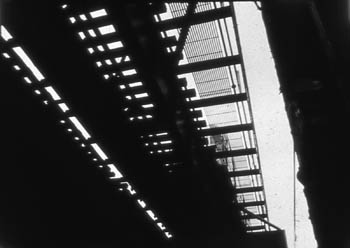
Shot in Queens, NY in 2004. Memory and identity are observed through textures of everyday life in a portrait of Jackson Heights, home to a large Latin American immigrant population. Images of street, people, and daily rituals render passing of time in a neighborhood that becomes a mirror not just of another place, but also of the past. The landscape visually reflects the space as a creation of a new home while revealing displacement within the new condition. The meaning of home is explored and built upon collective recollection.

Robert Fenz
Soledad (Meditations on Revolution, Part III)

US, 16mm, b/w, silent, 14’

part_3_soledad_image_two.jpg

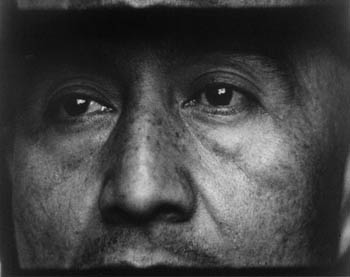
Part three of Robert Fenz’ silent black and white series of films that explore the meaning and the resonance of the word “revolution”, shot in Mexico and New York. “The films of Robert Fenz can never be subject to the principles of static analysis: their potential of subversion is always at work. However some traits are common to his entire oeuvre: the critical conscience, the political engagement (which differs from militantism), the desire to know what the shadows withhold, the passion for the other. Fenz reaffirms these prominent traits of his artistic humanist heritage innovating in the construction of a visual sensitivity which opens up elemental questions of idealism from concrete, sensitive and physical observation. Following the path of rhythm, creative improvisation and kinetic description, his cinematographic oeuvre develops a style that is founded on a profound faith on the power of the image – as a source of communication, as a critical tool, as an interior necessity.” (Gabriella Trujillo)

Bruce Baillie
Valentin de las Sierras

US, 16mm, color, sound, 10’

valentin.png

“I just shot simply but used a telephoto lens with an extension tube on the back, which gives you a very limited focal plane, a few inches. No one I know ever uses it with a long lens, especially with a moving subject, but I really liked the way it looked. I had to get into the flesh of that town, with the merciless sun beating into the bricks of the street and all the death-every night there’d be something or somebody killed, lying in the street in the morning. I had met up with this (archetypal) young girl, riding her pony. And I was afraid to meet her father. I’d sent word out trying to see her, and he sent word back to come meet him, and I thought, “Oh, God!”. But he turned out to be a very nice fellow: Manuel Sasa Zamora, of Jalisco. They were very poor and lived behind a big gate and had a horse and a dog named Penquina. That horse didn’t like me and would not let me film. I had to give it up for a while. Later, I named my horse after the film – Valentina.”

Alexandra Cuesta
Piensa en Mi

16mm, color, sound, 15’

carreterahr.jpg

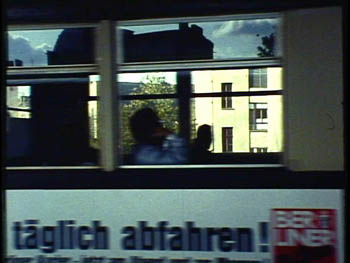
Moving from east to west and back, the windows of a bus frame fleeting sections of urban landscape. Throughout the day, images of riders, textures of light and fragments of bodies in space come together to weave a portrait in motion; a contemplative meditation on public transport in the city of Los Angeles. Isolation, routine and everyday splendor, create the backdrop of this journey, while the intermittent sounds of cars construct the soundscape.

Ernie Gehr
Passage

16mm, color, silent, 14’

passage.jpg

Composed of two intercutting shots of the S-Bahn elevated train through former East Berlin taken before and after the fall of the Berlin Wall, Gehr presents a mundane, yet illuminating glimpse of the profound cultural and economic changes in his ancestral homeland as seen through the city’s transformed – and almost unrecognizable – urban architecture.

Alexandra Cuesta
Beirut 2.14.05

16mm, color & b/w, sound, 7’

moto.jpg

Shot in Beirut, Lebanon during the filming of Ca Sera Beau, From Beyrouth with Love by Wael Nourredine.

Leandro Katz
Los Angeles Station

US, l6mm, silent, 10’

losangelesstation.jpg

“Leandro Katz’s simplest, most direct and probably least ambitious film and yet in many ways it is his loveliest. The results of the systematically structured material is unexpectedly stirring. Because of the impersonal method of construction, the freeze frames are not the result of sudden sentimental tugs. The count sometimes falls very conveniently on an image of natural poses, strikingly set against the backdrop; but just as often, the freeze frame is of a bare wall or an alleyway. The mechanical tension between the handheld camera’s panning and the systematic stops creates disarmingly simple, evocative effects. The freeze may halt a pan or simply congeal an already held moment. In the first case, an image often ends up de-centered, highlighting the broadside of the shack-like dwellings with their inhabitants crowded at the edge. Or, alternatively, a smiling boy, full of animate life and sensuousness, suddenly becomes an anthropological document, frozen evidence of a time, a place, and a culture.” (Tony Pipolo)

Alexandra Cuesta
Despedida (Farewell)

16mm, color, sound, 9’30

field.jpg

Shot in Boyle Heights in East Los Angeles, this neighborhood historically formed by cultural transition resonates with the poetry of local resident Mapkaulu Roger Nduku. Verses about endings, looking and passing through open up the space projected. A string of tableaus gather a portrait of place and compose a goodbye letter to an ephemeral home.

Passion for the Impossible

rimg0293.jpeg

A well-known art critic and historian recently wrote: “At least for the time being, any redistribution of the sensible through contemporary art is a mirage and, when pitted against the capitalist transformation of things into signs, it is little more than the opiate of the artworld left.” An old sour exposed. At a time when the weakening of the political theatre is forcing art to take the upper stage again, at a time when it is increasingly under pressure to make itself “useful” in light of the local and global struggles that are raging all over the world, we are once again confronted with some of the fundamental challenges surrounding the tensions between art and world, form and life, appearance and reality. The problem has been roaring its ugly head ever since the current paradigm of art has been defined. “In how far is appearance allowed in the moral world?”, asked Friedrich Schiller more than two centuries ago. Disenchanted with the French revolution and its failure to come to terms with social inequality, the German poet proposed another revolution: a revolution of the sensible. For him, the banishment of the hierarchy of classes, founded on the domination of the men of culture over the men of nature, manifested itself in the aesthetic experience. It was through this experience that the partition of the sensible sustaining this domination could be dismantled, giving way to a new kind of “equality” – an equality in the realm of appearances, an equality that could ruin all hierarchies between matter and form, passivity and activity, feeling and thought. The potential of art, he argued, is not based on its alliance with reality – how art affects reality and the other way around – but conversely on its independence from it. Against the critics who, even then, complained that all solidity had disappeared from the world, that all reality had dissolved into appearance, he answered: the power of art can only be fully appreciated as long as it is first and foremost considered as appearance, not because it is held to be something that could supplant or influence reality. We can only experience it as such as long if we stop looking for ends and means, as long as we do not grant imagination a prescription of its own. Indeed, if art can be considered to have a political dimension, it’s perhaps not so much due to the commitment invested, but because of the “indifference” experienced; it’s not due to its ability to transmit messages through a certain suitable form, but because of its promise of “freedom”, which is itself its own end and means.

But this promise of freedom – “to grant freedom by means of freedom” – also involves a strange paradox. On one hand, art is put forward as a sphere of autonomy and self-containment indifferent to any association of cause and effect, an embodiment of freedom unassignable to any single desire or interpretation. On the other hand, it is through the experience of “free play” in front of the “free appearance” of art, this strange appearance out of reach from fixed aspirations and interpretations, that another promise is made: that of another form of life. Indeed, the solitude of art, in all its inexplicability and unavailability, holds the possibility of a another future. Jacques Rancière has argued that this paradox is in fact constitutive of a whole regime of identification of art and its politics: the autonomy of aesthetic or artistic experience is at the same time the principle of the formation of what Schiller described as a new “art of living”. Rancière writes: “the aesthetic education thus is the process which transforms the free appearance into a lived reality and the aesthetic free play into an agency of the living community.” This implies, however, that the separations between art, life, and politics are lifted, which essentially entails the emergence of two opposed types of politics, which are in effect two vanishing points: on one hand the logic of art becoming life at the price of its self-elimination, on the other the logic of art getting involved in politics on the condition of not having anything to do with it. The politics of art actually thrive on the tension between these two logics, on the undecidability between art and non-art. The dominant paradigm of what is called “critical” art for example combines the sensible heterogeneity from the first logic with the political intelligibility from the latter, in view of provoking a break in our perception and mobilize our political energies. It is a formula that it is still very much on our agendas nowadays, although it seems to have lost most of its political force – mainly due to the loss of the emancipatory perspective that sustained the dialectical clash of heterogeneous elements. It has even been overturned: whereas the strategies of critical art were predicated on the effort to reveal the reality beneath appearances, some critics – from Debord to Baudrillard – have advocated that all is appearance, that everything is is equivalent with its image, and every image with its own lie. What these arguments, still very much inherent to our zeitgeist, leave us with is either a deep-felt melancholy or a numbing irony, suggesting that through our own continuous “consumption” of commodities, spectacles and demonstrations, we do nothing else but contributing to the reign of commodity equivalence: as if the world of consumption and the world of struggle have become one and the same.

If the traditional modes of critical art have lost their legitimacy, it’s certainly not because the forms of domination and oppression they opposed have disappeared, but rather because the critical worldview that nourished these modes and the political struggles based on this vision have lost much of their credibility. How to think differently then about the “usefulness” of art, without having to rely on a revolutionary horizon to look forward to? What would it mean to think critically without “a darkened mirror to be made clean by a critical operation which makes it declare all that there is to say”? How to think about the potential of art forms that do not depend on demystification, asking us “to discover the signs of capital behind everyday objects and behaviors,” but in so doing only confirming the “transformation of things into signs”? In practice, the foundering of the critical system into this vicious circle has led many contemporary artists to invest directly in political activism, which has its own value and significance, but at the same time this involves a certain de-neutralization of the idea as art as we know it: art steps in for politics. For his part, Rancière proposes another way of thinking about the relation between politics and art, as alternative for the critique of appearances in the name of an underlying reality and the hermeneutics of suspicion that accompanies this critique. It involves, first of all, the acceptance of the condition of appearance and illusion, as it functions as a condition for the possibility of what Schiller has defined as a kind of “freedom”, which is not abstract but entirely sensible. Rancière: “It is in the moments when the real world wavers and seems to reel into mere appearance, more than in the slow accumulation of day-to-day experiences, that it becomes possible to form a judgement about the world”. It follows that political effects can never be located in the artwork itself, nor in the intention or commitment of the artist. It is exactly by not assigning a specific role or destination to the work and leaving it to their own idleness (as Mallarmé upheld, the works must “prove themselves”), that it may become susceptible to a multiplicity of unforeseen appropriations.

Secondly, there is still something in the dispositive of critical art that has political potential, which is what Rancière calls “dissensus”, meaning a disruption of a given organization of the relation between sensible presentations and forms of meaning, put forward as a challenge to the “reality of the real”. The idea of disturbance has been hailed as a political-artistic strategy for a long time now – think of Eisenstein and Brecht who have both, in different ways, played on the element of “strangeness’, either as “verfremdung” or “eccentrism” – but in this approach the disturbing element leads to no specific form of awareness or mobilization. Art can redraw the borders of the possible and the impossible, oppose the singular outlines of a landscape of the sensible to all the forms of banalization unleashed by the dominant regime of information and explanation, but only on the condition that their meaning or effect is not anticipated. That is how art continuously oscillates between autonomous form of life and the promise of political emancipation, between shuddering point of arrest and explanatory instrument of transmission, between the “naive” (in tune with the world) and the “sentimental” (at a distance from everyday life), but these possibilities in themselves can never be integrally fulfilled except at the price of abolishing the singularity of art, that of politics, or both at once. Following Rancière’s reasoning, the issue at hand is thus not whether the work that artists do is political or not, but rather what work we can do with it as political subjects; the question is not whether art can intervene in the social world and construct better relations between existing communities, but how it can shape new communities of sense that can put to work a new sense of community. If it’s important to try to understand and engage with this utterly “foolish” (Rancière’s own word) proposition today, it’s because it is grounded in a much needed intuition of hope and trust, opposing all ideas of necessity and legitimacy with the contingency of social order, opposing all sense of distrust and fatalism with the unrealized potentials borne by the capacities shared by all. It is then up to us to take up this foolishness and exchange our compulsive passion for the real with a wholehearted passion for the impossible. It is time for us to start dreaming, dreaming out loud, dreaming with our eyes wide open.

DISSENT ! Akram Zaatari

still_from_al_shareet_bi_khayeer_all_is_well_on_the_border_front_0.jpg

16 February 2014 18:00, Wiels Brussels

“There are works interested in the representation of war, whether fiction or documentary, and others interested in the tectonics of storytelling, writing history, and identifying and producing documents taking the war situation as a case or a base, because war is one of rare situations where notions of common logic collapse, and the notions of evidence in relation to documents and history have to be challenged.”
– Akram Zaatari

How to represent the ongoing struggles in the Middle East, a region in the throes of successive wars, excessive division, and abundant stereotyping? How to displace the dominant vision of never-ending violence, destruction, occupation, resistance, suffering, deeply entangled in what Jean-Luc Godard has referred to as the endless circulation of “brand images”? In his work Akram Zaatari tries to provide some possible responses to this challenge, particularly in regards to the legacy of conflict in his home country, Lebanon. Like many other Beiruti artists who have grown up during the Civil War (1975-1991), Zaatari is concerned with the construction and narrativization of its history and its present day reverberations. A substantial part of his work in film, photography and performance investigates the multiple tensions between memory and history, fiction and document, the public and the private, as a way to intervene in the dominant representation of history. With the use of archival images – partly drawn from the collection of the Arab Image Foundation, which he co-founded – attention is drawn to its constructedness, as well as to its gaps and fissures. In this Dissent! session we will mainly discuss Akram Zaatari’s cinematic work and his use of counter-narrative and docu-fictional strategies, which tend to prompt a fresh perspective on the forms and politics of fiction itself. Perhaps, as Jacques Rancière has suggested, it is above all in situations of radical uncertainty that “the real must be fictionalized in order to be thought.”

Akram Zaatari has been invited by Wiels in the context of his forthcoming exhibition (21.02 – 27.04.2014)

DISSENT ! is an initiative of Argos, Auguste Orts and Courtisane, in the framework of the research project “Figures of Dissent” (KASK/Hogent), with support of VG & VGC.

——————————————————————————————————————————————————————-
About DISSENT!

How can the relation between cinema and politics be thought today? Between a cinema of politics and a politics of cinema, between politics as subject and as practice, between form and content? From Vertov’s cinematographic communism to the Dardenne brothers’ social realism, from Straub-Huillet’s Brechtian dialectics to the aesthetic-emancipatory figures of Pedro Costa, from Guy Debord’s radical anti-cinema to the mainstream pamphlets of Oliver Stone, the quest for cinematographic representations of political resistance has taken many different forms and strategies over the course of a century. The multiple choices and pathways that have gradually been adopted, constantly clash with the relationship between theory and practice, representation and action, awareness and mobilization, experience and change. Is cinema today regaining some of its old forces and promises? Are we once again confronted with the questions that Serge Daney asked a few decades ago? As the French film critic wrote: “How can political statements be presented cinematographically? And how can they be made positive?”. These issues are central in a series of conversations in which contemporary perspectives on the relationship between cinema and politics are explored.