The Order of Sounds

cage-williamsmix.jpg

“If this word ‘music’ is sacred and reserved for eighteenth and nineteenth-century instruments, we can substitute a more meaningful term: organisation of sound.”
John Cage, ‘The Future of Music: Credo’ (1937)

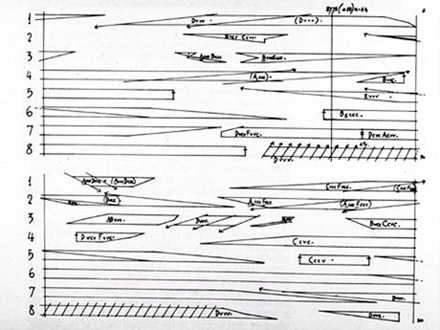
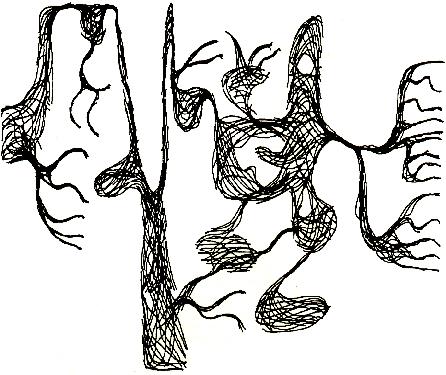
Just some notes on the (dis)organisation and classification of sound. I’ve been researching this a little bit in the context of the ‘Order of Things’ project, and became intruiged by some historical pieces. The score above is from John Cage’s ‘Williams Mix‘ (1952), which is constructed from recorded sounds divided into six types:

A. city sounds
B. country sounds
C. electronic sounds
D. manually-produced sounds, including the literature of music
E. wind-produced sounds, including songs
F. small sounds requiring amplification to be heard with the others

Sounds were further categorized by the predictability or unpredictability of their frequency, timbre and amplitude. These parameters could be “controlled” (predictable) or “variable” (unpredictable). So: Acvc = city sound, controlled frequency, variable timbre, controlled amplitude. The process of creating this piece, as Cage explained, involved the precise cutting/splicing of recorded sounds to create eight separate reel-to-reel, monaural, 15-ips magnetic tape masters for the 4-minute 15-second, octophonic tape piece. The 192-page score is, as Cage referred to it, a kind of “dressmaker’s pattern–it literally shows where the tape shall be cut, and you lay the tape on the score itself.” Cage explained further in a published transcript of a 1985 recorded conversation with author Richard Kostelanetz that “…someone else could follow that recipe, so to speak, with other sources than I had to make another mix.” Later in the conversation, Kostelanetz observed, “But, as you pointed out, even though you made for posterity a score of Williams Mix for others to realize, no one’s ever done it,” to which Cage replied, “But it’s because the manuscript is so big and so little known.”

This kind of “Sonic Taxonomies” were also used by Futurist Luigi Russolo, who organised sounds in six families of noises of the futurist orchestra. In his ‘Art of Noises’ (1913), Russolo wrote: “In this inventory we have encapsulated the most characteristic of the fundamental noises; the others are merely the associations and combinations of these. The rhythmic movements of a noise are infinite: just as with tone there is always a predominant rhythm, but around this numerous other secondary rhythms can be felt.”

1. Roars, Thunderings, Explosions, Hissing roars, Bangs, Booms
2. Whistling, Hissing, Puffing
3. Whispers, Murmurs, Mumbling, Muttering, Gurgling
4. Screeching, Creaking, Rustling, Humming, Crackling, Rubbing
5. Noises obtained by beating on metals, woods, skins, stones, pottery, etc.
6. Voices of animals and people, Shouts, Screams, Shrieks, Wails, Hoots, Howls, Death rattles, Sobs

Later, Stockhausen also made a classification of 68 sound types for the 33 “moments” that comprise his piece Mikrophonie I (1966):

ÄCHZEND: groaning, creaking; BELLEND: baying, barking; BERSTEND: bursting; BRÜLLEND: bellowing, bawling; BRUMMEND: growling (low buzzing); DONNERND: thundering; FAUCHEND: hissing, spitting; FLÖTEND: fluting; GACKERND: cackling; GELLEND: yelling; GERÄUSCH: noise; GRUNZEND: grunting; HAUCHEND: exhaling (like a breeze); HEULEND: howling; JAULEND: wailing; KLÄNGE: pitched sounds; KLAPPERND: clacking; KLATSCHEND: clapping; KLIRREND: clinking, jingling; KNACKEND: cracking; KNALLEND: banging, clanging; KNARREND: grating; KNATTERND: chattering, flapping; KNIRSCHEND: crunching, gnashing; KNISTERND: crisping, crinkling; KNURREND: grumbling, snarling; KRACHEND: crashing; KRÄCHZEND: cawing; KRATZEND: scratching; KREISCHEND: shrieking, screeching; LÄUTEND: pealing, tolling; MURMELND: murmuring; PFEIFEND: piping, whistling; PIEPSEND: cheeping; POSAUNEND: tromboning; PRASSELND: spattering, jangling; PRELLEND: slapping, rebounding; QUAKEND: croaking, quacking; QUIETSCHEND: squeaking, squealing; RASCHELND: crackling; RASSELND: clashing, clanking; RATTELND: rattling; RATTERND: clattering; RAUSCHEND: rushing, rustling; REIBEND: rubbing; RÖCHELND: choking (rattling in the throat); ROLLEND: rolling; RUMPELND: rumbling, thumping; SÄGEND: sawing; SCHARREND: scraping; SCHLÜRFEND: shuffling, slurping; SCHNARCHEND: snorting, snoring; SCHNARREND: twanging, rasping; SCHWIRREND: whizzing, whirring; SINGEND: singing (whining); TÖNEND: ringing, resounding; TOSEND: roaring; TRILLERND: trilling, tinkling; TROMMELND: drumming; TROMPETEND: trumpeting; TUTEND: hooting; UNKEND: keening (or mourning with “u”-timbre); WINSELND: whimpering; WIRBELND: whirling; WISCHEND: wiping, swishing; WISPERND: whispering; ZIRPEND: chirping; ZUPFEND: plucking.

micorphonie.jpg

Holger Czukay (who was once a student of Stockhausen, before he started with CAN) wrote about this piece: “Four musicians were standing at a huge tam-tam with some “creation tools” and a microphone in their hand. The tam-tam was prepared at parts with chalk or colophony so that a hard paper bucket for example could scratch upon the chalk- or colophony field (The material which a violinist is contacting his bow to before he starts playing so that he is able to create a tone). Or an electric razor was another device which created a rich world of sounds, when it was touching the surface of the tam-tam. Two microphones was scanning the different sound areas of the tam-tam and got connected with 2 Maihak W49 radio play Eq’s, passive filters with a strong cutting characteristics (years later I was able to get hold of them at an undertaker’s shop). Stockhausen was sitting in the audience at a little mixer and created something like a “tam-tam live dub mix”. If you are able to attend such a performance these days, it still would sound completely up to date. Such a thing together with a right DJ could perfectly fit into the end of the nineties.”

(I always wondered if and how composers such as John Oswald and John Wall classified their sounds…)

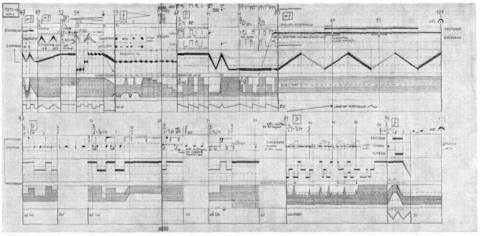
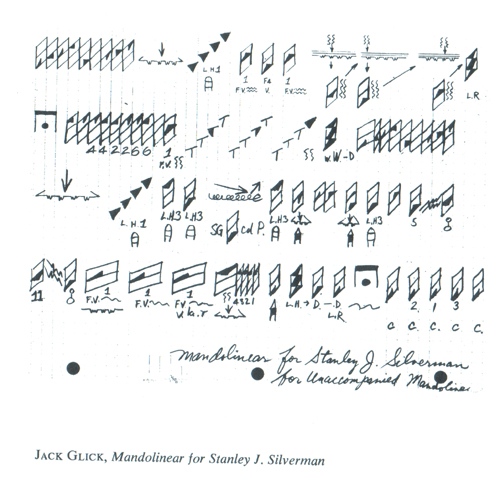
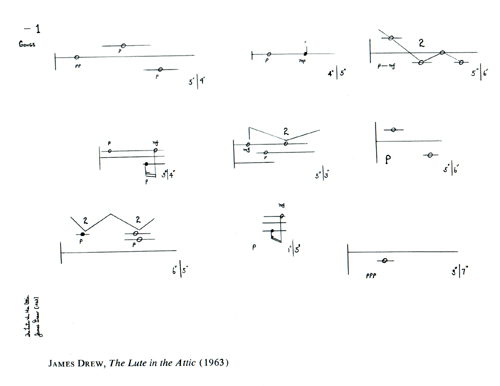
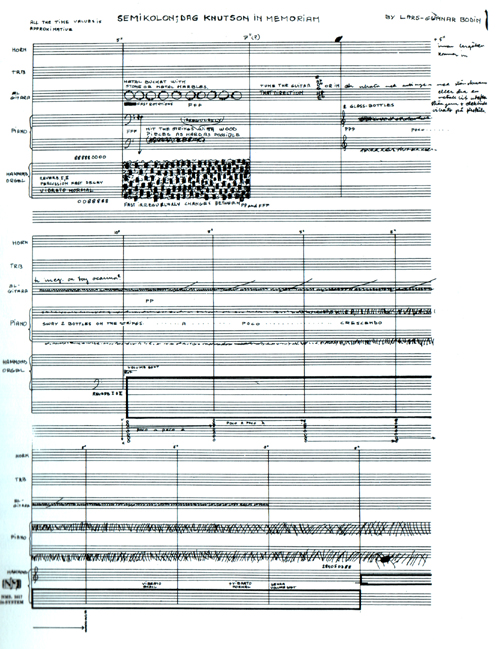
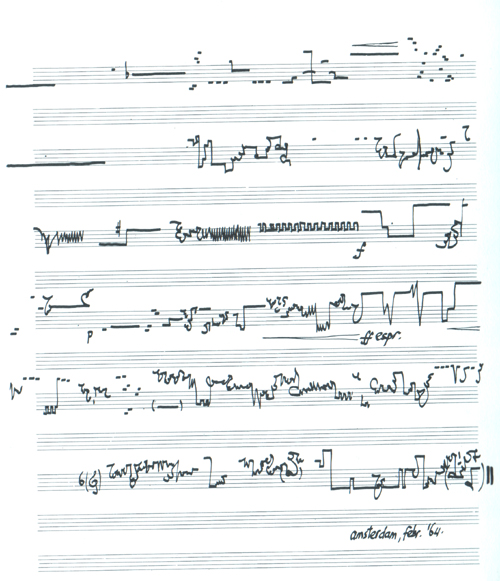
Below are also some really nice notations I found on the net, starting with Varèses’s classic ‘Poème Électronique’, created for the Brussels’s World’s Fair of 1958, in collaboration with Le Corbusier and Xenakis. The technology available to Varèse at the time he created Poème Électronique was out of reach for most of his life, forcing him to realize his unique vision through conventional instruments. When early electronic instruments became available, Varèse was quick to use it towards his goal of “organized sound.” Varese’s intention – as stated in “the Liberation of Sound” – was “Liberation from the arbitrary, paralysing tempered system; the possibility of obtaining any number of cycles, or, if still desired, subdivisions of the octave, and consequently the formation of any desired scale; unsuspected range in low and high registers; new harmonic splendours obtainable from the use of subharmonic combinations now impossible; the possibility of obtaining any differential of timbre, sound-combinations and new dynamics far beyond the present human powered orchestra; a sense of sound projection in space by the emission of sound in any part or in many parts of the hall as may be required by the score; cross rhythms unrelated to each other, treated simultaneously, or to use the old word, ‘contrapuntally’, since the machine would be able to beat any number of desired notes, any subdivision of them, omission or fraction of them- all these in a given unit of measure of time which is humanly impossible to attain.”

varese.jpg

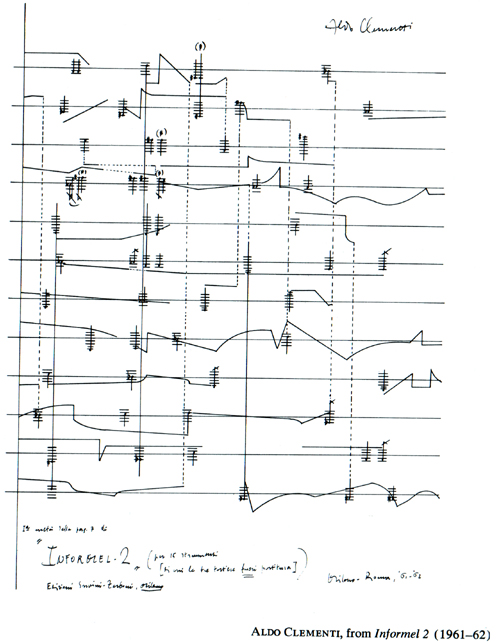
Aldo Clement, ‘Informel
order_aldoclement_informel2.jpg

Jack Glick, Mandolinear
order_jackglick_mandolinear.jpg

James Drew, Lute in the Attic
order_jamesdrew_luteintheattic.jpg

Lars Gunner, Demikolon
order_larsgunnerbodin_semikolon.jpg

Lois Andriessen, A Flower Song
order_loisandriessen_aflowersongii.jpg

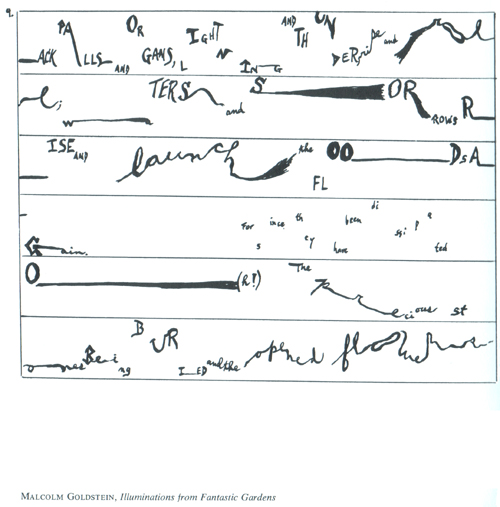
Malcolm Goldstein, Illuminations
order_malcolmgoldstein_illuminations.jpg

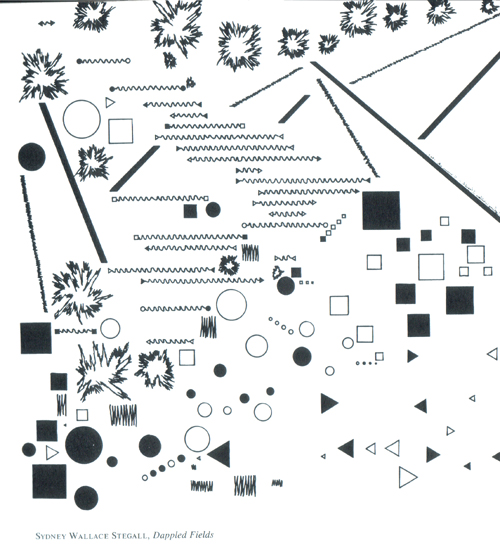
Sydney Wallace Stegall, Dappled Fields
order_swstegall_dappledfields.jpg

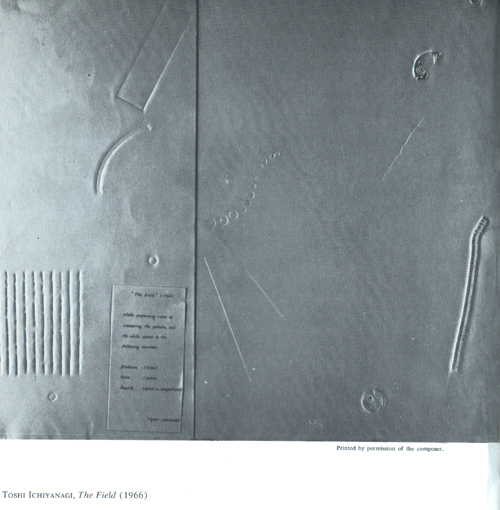
Ichiyanigi, The Field
order_ichiyanagi_thefield.jpg

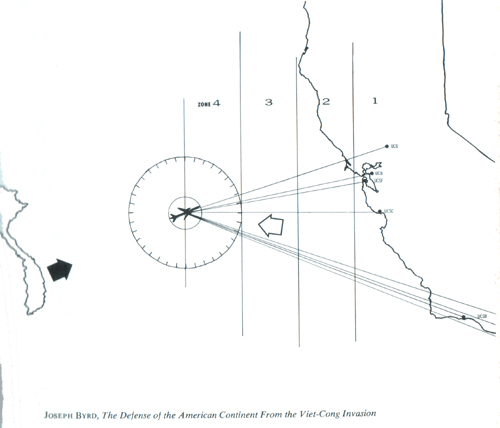
Joseph Bird, Defence
order_josephbird_defence.jpg

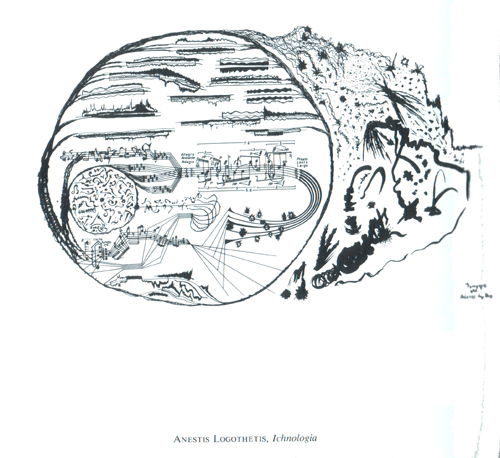
Anestis Logothetis, Ichnologia
order_anestislogothetis_ichnologia.jpg

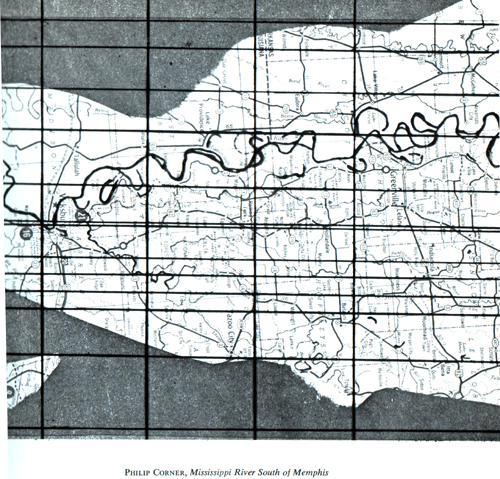
Philip Corner, Mississippi River
order_philipcorner_mississippiriver.jpg

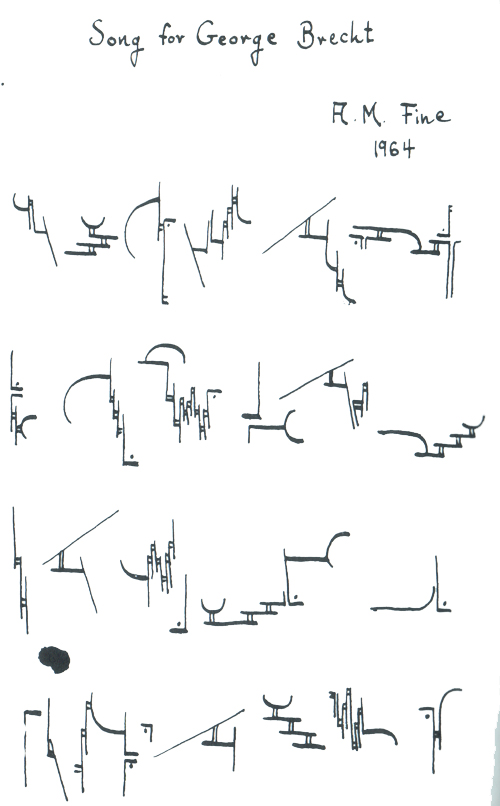
AM Fine, Song for George Brecht
order_amfine.jpg

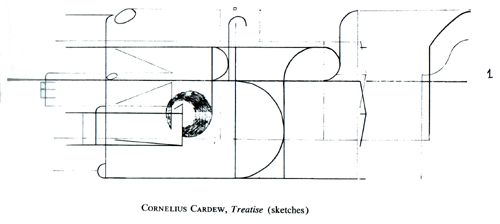
Cornelius Cardew, Treatise
order_corneliuscardew_treatise.jpg

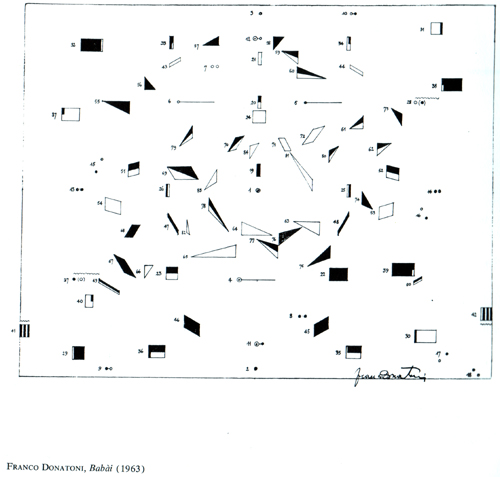
Franco Donatoni, Babai
order_francodonatoni_babai.jpg

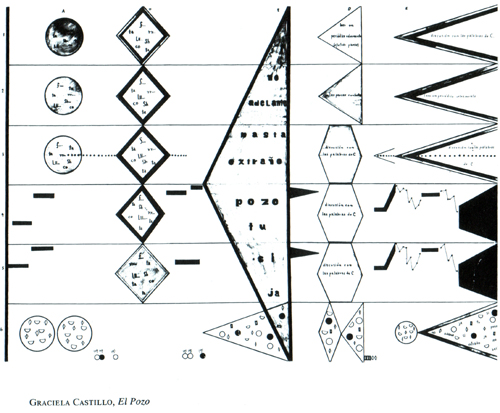
Graciela Castillo, El Pozo
order_gracielacastillo_elpozo.jpg

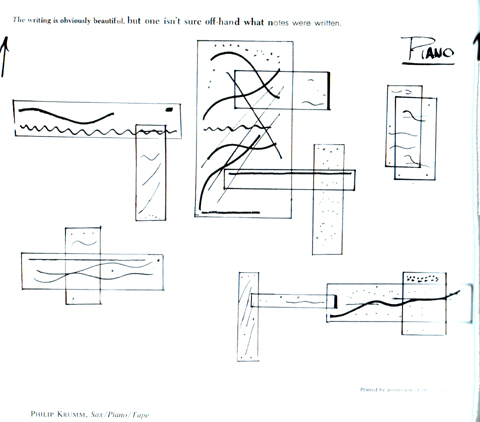
Philip Krumm
order_philipkrumm.jpg

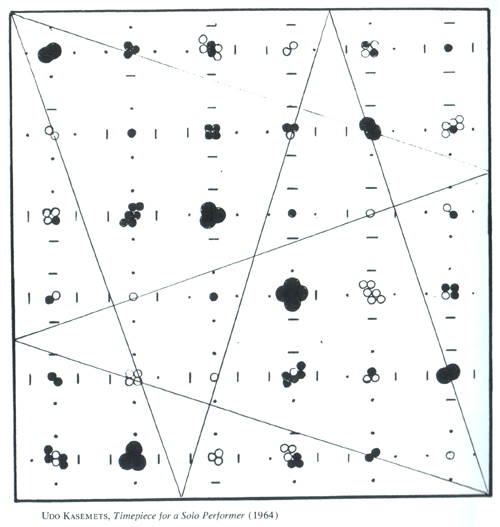
Udo Kasemets, Timepiece for a Solo Performer
order_udokasemets.jpg

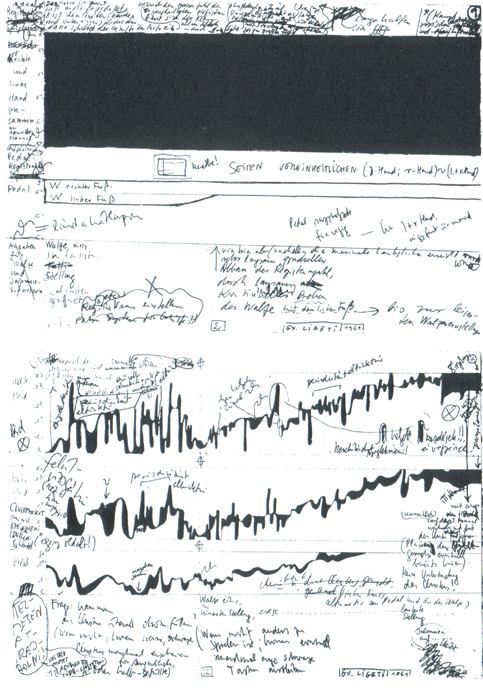
Ligeti
order_ligeti.jpg

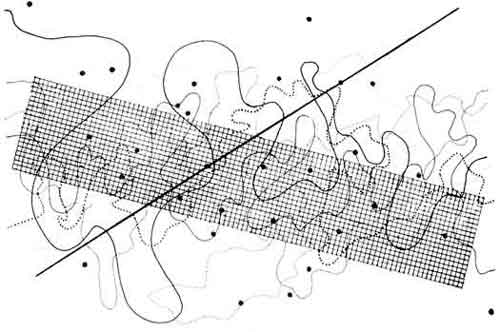
John Cage, Fontana Mix
order_cage_fontana_mix.jpg

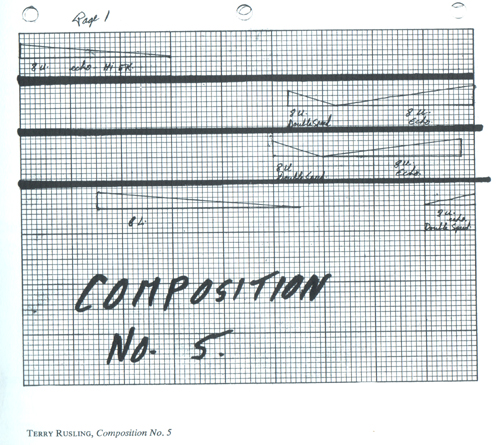
Terry Rusling, Composition no 5
order_compositionno5.jpg

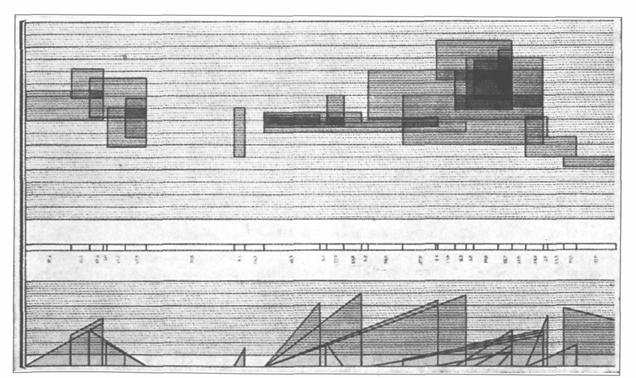
Stockhausen, Studie 2
order_stockhausen_studie2.jpg

Xenakis, Mycenae Alpha
order_alpha_xenakis.jpg

(This music is created using the UPIC which makes sound based on drawings that Xenakis made).

Can I Get An Amen?

nate.png

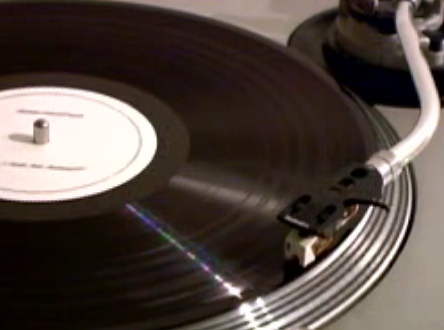
Nate Harrison‘s Can I Get An Amen? is a nice audio installation (now part of the exhibition ‘Anna Kournikova Deleted By Memeright Trusted System – Art in the Age of Intellectual Property’, presented by Hartware MedienKunstVerein) that unfolds a critical perspective of perhaps the most sampled drums beat in the history of recorded music, the Amen Break. It begins with the pop track ‘Amen Brother‘ by 60’s soul band The Winstons, and traces the transformation of their drum solo from its original context as part of a ‘B’ side vinyl single into its use as a key aural ingredient in contemporary cultural expression. The work attempts to bring into scrutiny the techno-utopian notion that ‘information wants to be free’- it questions its effectiveness as a democratizing agent. This as well as other issues are foregrounded through a history of the Amen Break and its peculiar relationship to current copyright law.

Also check out Bassline Baseline, Harrison’s documentary about the history of the Roland TB-303 Bassline Synth. “The dead-panned ‘documentary’ video attempts to explore how and why creative tools fail and how increasingly more options, parameters or intermediaries devised during a tool’s research and development phase don’t necessarily lead to increased expressivity or virtuosity during the tool’s lifetime of actual use, unless the super-structure of its cultural context is dramtically reconsidered.”

La Lutte Finale

debord_game2.jpg

Auch. Just dug up some horrible stories from the (anti)copyright front.
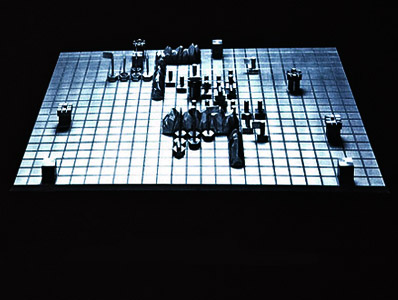
The RSG collective, led by Alexander Galloway, NYU assistant professor, founding member of the Radical Software Group and author of the inspiring book ‘Protocol‘, has been working some years now on an online version of ‘Le Jeu de la Guerre’ (the Game of War), a board game created by Guy Debord in 1978. Described by McKenzie Wark as “a diagram of the strategic possibilities of spectacular time” inspired by the military theory of Carl von Clausewitz and the European campaigns of Napoleon, Debord’s game is a chess-variant played by two opposing players on a game board of 500 squares arranged in rows of 20 by 25 squares (see image). Thirty years later RSG resurrected this largely forgotten game, translating the game instructions from French to Java and releasing it as an online computer game (what Galloway calls “a massively two-player online game”), titled ‘Kriegspiel‘, which can be downloaded for free. With this re-interpretation, RSG wants to research how antagonism is simulated in war games and computer games and at the same time “explore the contradiction between Debord, a symbol of radical politics and art in 1960s France, and the Napoleonic war game he created. In Debord’s own words the game was the only thing in his entire body of work that had any value. Was it nostalgia, or a vision of things to come?”. Unfortunately, a few months ago Galloway received a letter from a lawyer representing the widow, Alice Becker-Hoa, regarding possible infringement of the rightful owner’s intellectual property. Despite Galloway’s insistence that an “idea for a game” or its “rules” are “not subject to copyright,” there’s a similar recent case, involving the Facebook-based word game Scrabulous, that might pose a dangerous precedent. The Cease and desist already had its effects: when the Columbia University’s Buell Center, where Kriegspiel was on display, along with one of Debord’s games, recieved a letter asking that the curators “suppress any connection with the work of Guy Debord,” where Kriegspiel was concerned, they complied. Whatever reasons one might have to pursue these copyright claims (both claims are likely without merit, by the way), it’s a both horrible and absurd idea, considering how Debord oppossed copyright and (some forms of) intellectual property.

Another equally bizar case happened a few years ago, following the publishing of Pierre Merejkowsky’s film Insurrection résurrection (2004), in which he whistles ‘l’Internationale’ for just about seven seconds, as an act of improvisation. The production company, Les Films sauvages, subsequently recieved a stiff note, return receipt requested, from the Company for the Administration of the Right of Mechanical Reproduction of Authors, Composers and Publishers (SDRM), which manages author’s rights in film media. “In the course of an audit in the movie theaters, our musical inspectors have observed that the work The Internationale was reproduced in the film without authorization. The SDRM therefore demands 1,000 euros for having failed to declare this whistling, which constitutes an illegal usage of a piece of music published by the company Le Chant du Monde (Song of the World)”. It seems that ‘L’Internationale,’ written by Pierre Degeyter (1848-1932), with words by Eugène Pottier (1816-1887), is not in the public domain – not in France, anyways, where they add on 12 years for “les années de guerre” – so whistlers are on the hook until 2014. Besides the horrifying notion that a hymn to the rising up of the proletariat to overthrow existing conditions of exploitation should be subjected to them, it’s also interesting to note that Degeyter himself died in acute poverty. During his lifetime, nobody paid him royalties for all the tens of millions of times his song was used at countless communist and socialist events. In an article in Le Monde Nicole Vulser asks ironically why Pierre Degeyter didn’t die rich: every time that the Internationale was sung in public, he should have gotten royalties, no? SDRM answered: “The Soviet Union violated the law in not redistributing anything to the rights holders”.

On Rules and Monsters

freecoop.jpg

“On the one hand, cooperation doesn’t seem to make us free. On the other hand, living without cooperation doesn’t make us free, either. How can we stay free in cooperation? What is free cooperation?”
— On Rules and Monsters, Chapter 3: Taking off the mask

I just stumbled upon the video ‘On Rules and Monsters: An Introduction to Free Cooperation’, by Christoph Spehr and Jörg Windszus. It’s a great addition to ‘On Blood and Wings – A Study on the Dark Side of Cooperation’, which I saw some months ago (thanks to Brain Holmes). The video was made for the ‘Networks, Art & Collaboration‘ Conference, held at SUNY in Buffalo, 2004 and features the voice-over of Stephanie Rothenberg and Tony Conrad (yes, that one).

Christoph Spehr is a political theorist and organiser who gained some attention with his theories on “free cooperation”, which he introduced in 2000 in his essay ‘Gleicher als andere’ (More Equal than Others – awarded with the Rosa-Luxemburg-prize). The concept of free cooperation is an attempt to base emancipation, political theory and left politics (once more) on free negotiations and equal negotiating power. Spehr doesn’t believe in simple “non-hierarchical” or “free” structures – there are always rules, responsibilities, structures of decisionmaking and so on… the question is, which ones. He insists on the option of refusal and the right of withdrawal from cooperation, as well as negotiation and renegotiation with corporate or state monsters, and explores how ideas of independence, equality, and freedom can be useful for alternative networks of learning (in or outside the institutions). To explore these issues, Spehr refers to Science-Fiction, drawing on the language of this genre which, by changing and shifting the face of reality as we know it, highlights the underlying structures of this reality. In his view this language is a powerful vehicel to talk about possibilities, desires, emancipation and social change because it’s “very open for dialogue, for collective arguments, and relatively non-restrictive in its access”.

In his book, ‘The Aliens are Amongst Us!‘ (1999) – a classic in politcal underground literature – Spehr makes a distinction between three social categories: aliens, maquis and civilians. Here the alien is “a metaphor for the experience of a ruling other that is able to shape its form and uses the power of looking just like normal human beings to extend its domination; it’s a metaphor for a very sophisticated cruelty and domination, and for governance in the democratic era”. While typical aliens would be intermediates such as cultural enterpreneurs, social democratic welfare state officials, NGOs or (ruling) green party members that all live of movements, events, ideas and expressions of others, the ‘maquis’ (a term used by the French resistance to describe zones not occupied by the Nazis) are the antagonists of the aliens, those who experiment with post-economic models of ‘free cooperation’, which, as suggested by Geert Lovink, are really the ‘multitudes’. Spehr’s videos draw on these theories and use fragments of sience-fiction films (in On Rules and Monsters) or (in the case of On Blood and Wings) vampire movies, combined with a new background voice, to talk – not without a sense of humour – about the struggle between the multitude and capitalism, unveiling the crucial mechanisms of capitalism (“to make more and more blood out of blood”), and showing how it is being opposed by spontaneous, voluntary, egalitarian human agencies – the specters of free cooperation. As stated in an introductory text: “Why the hell does every monster want to go to Tokyo and stamp on it? Why do we feel sorry if the monster gets shot at the end? Why does it always return?”

Check out some interviews Geert Lovink did with Spehr: here (2003) and here (2006). A DVD of On Rules and Monsters is published as part of The Art of Free Cooperation, which also includes texts by Christoph Spehr, Brian Holmes, Geert Lovink, Howard Rheingold, and Trebor Scholz.

intro

Chapter 1: Every monster wants to go to Tokyo

Chapter 2: The very thing that makes you rich (will make you poor)

Chapter 3: Taking off the mask

Chapter 4

Outro

Grab the rules, play it hard. Basic rules for free cooperation

WOMAN (off): So on the one hand, cooperation doesn’t seem to make us free. On the other hand, living without cooperation doesn’t make us free, either. How can we stay free in cooperation? What is free cooperation? To learn about free cooperation, we first must understand the three basic principles of forced cooperation.

The first principle of forced cooperation is: KEEP OFF THE BASIC RULES!

(The Time Machine) The big gate is slammed shut. George tries desperately to open it again.

MAN (off): Forced cooperation is not tyranny — or, more precisely: it is not something that looks like tyranny at first sight. But the basic rules will not give way to anybody. They are not negotiated between the members of the cooperation — be it the workers of a factory, the employees at an office, the women and children in the patriarchal family, the people affected by the decisions of a given institution. The basic rules are kept behind iron gates. People and positions may be changed; some distribution of value may be negotiated; smaller rules may be changed and altered or even accepted to be refused. But the core of the cooperation, its basic rules, are not to be tackled by the real members of the cooperation.

WOMAN (off): The second principle of forced cooperation is: NEVER STOP THE ENGINE!
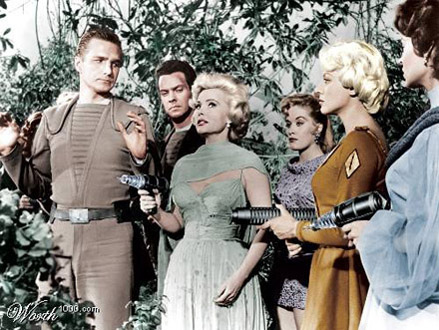
(The Trollenberg Terror) The group is sitting in the gondola of the cable lift and is taken up the mountain. They see the >cloud< floating into the valley, closing in the houses. The >cloud< enters the downward station and freezes the cables. The gondola stops, goes on, stops again. MAN (off): Forced cooperation doesn't turn people into robots -- or, more precisely: it doesn't turn people into something that looks like robots at first sight. You may talk. You may quarrel while working. You may make proposals or even hand small protest notes. Some forced cooperations even allow you to vote or take part in participatory systems or in so-called >speech situations< where you may argue that some rules are irrational and that you could work better without them. But never, never must you use material power to push your interests. Do not freeze the cables. Do not stop the gondola. Do not go on strike, do not withdraw your workforce while talking. This is doomed and criminalized as monstrous behavior. If you try, you will get bombed for it. WOMAN (off): The third principle of forced cooperation is: SERVE OR PAY! (The Day the Earth Stood Still) KLAATU: I came here to give you these facts. It is no concern of ours how you run your own planet. But if you threaten to extend your violence, this earth of yours will be reduced to a burned-out cinder. Your choice is simple: join us, or pursue your present course and face obliteration. We'll be waiting for your answer. The decision rests with you. MAN (off): Not every forced cooperation uses the whip -- or, more precisely: not every forced cooperation uses a whip that looks like a whip at first sight. In many forced cooperations, we are not forced openly to do what we are told. Only that it doesn't really make sense to deny. Because if we don't cooperate, if the cooperation splits, or gets spoiled, we are the ones to pay. If we disagree with our boss and split, he still keeps the enterprise, while we leave with empty hands. It's serve or pay: that makes choices so simple in forced cooperation. WOMAN (off): Having understood how forced cooperation works, we can now articulate the three basic principles of free cooperation. The first principle of free cooperation is: GRAB THE RULES! (Attack of the Crab Monsters) A man is walking down the dunes to the beach. Out of nowhere, a huge crab appears and grabs him. He cries. MAN (off): In a free cooperation, all rules can be changed. Every member is free to challenge any rule, and the members of the cooperation decide about their rules. There are no >holy rules< that are barred behind iron gates and cannot be changed by the members of the cooperation. WOMAN (off): The second principle of free cooperation is: PLAY IT HARD! (The Time Machine) While George is fighting a Morlock and gets attacked by more Morlocks, one of the Eloi is considering his hand, deep in thought. Suddenly he makes a fist and knocks down the Morlock. MAN (off): In a free cooperation, all members have the same power to influence the rules. This power is not given by any formal structures of decision-making: talking or voting is not enough. Real power comes from the freedom and ability to withdraw one's cooperative activity, to hold back, to quit, to give limits and conditions to one's cooperative activity. To say or to signal: >No, if not.< (World Without End) The commander comes in from the negotiations. He is angry. OFFICER How was it? COMMANDER They won't cooperate! WOMAN (off): The third principle of free cooperation is: STAY ONLY WHERE YOU CAN LEAVE, AND WHERE YOUR LEAVING IS MEANINGFUL. (The Time Machine) George notices the Eloi for the first time. Suddenly there are cries: Weena is drowning in the river. GEORGE: Why are you sitting by? As nobody moves, George leaps into the water and pulls her out. GEORGE: You're all right? Without a word, Geena gets up and leaves him. MAN (off): In a free cooperation, the >price< of the cooperation being split up, coming to an end, somebody going away, the cooperation becoming looser or being not fully working, is similar (and bearable) for all members of the cooperation. Only under this condition, withdrawing one's cooperative activity is not blackmailing the others. Only under this condition, all members of the cooperation have the same bargaining power. That means: each member can actually leave the cooperation, without paying too high a price; and the leaving of each member will have an actual effect on the others, will be experienced by them as some price they are paying, so that this negative prospect may trigger new negotiations. Because you do not only wish to be allowed to do this or that; you also want to make others do this or that, or do this or that not. For this, you need equal bargaining power. Without bargaining power, they will just let you drown. (The Time Machine) Weena and George are sitting on the stairs. GEORGE: I did it to save your life. That doesn't seem to mean much to you or anybody else around here. WEENA: It doesn't. GEORGE: Do you realize there were about 20 of your friends watching you drown, not one of them so much as lifting a finger to save you? Ain't that a curious attitude? Very curious world. Aren't you the least bit interested in who I am? Where I'm from? WEENA: Should I? Getting bargaining power usually means getting organized, too. Without the solidarity of others, you cannot level bargaining powers in many cases. In a free cooperation, there has to be a constant re-arrangement of rules, individual appropriation and solidarities to keep bargaining power equal between the members of the cooperation. Making bargaining power equal -- through changing rules, individual appropriation, solidarity -- is the core business of any emancipatory politics, and the basic definition of what is left politics. It is also the core definition of being someone, of being amongst others who really recognize you. (The Time Machine) George comes from the rotten books and addresses the sitting Eloi. GEORGE: You! All of you! I'm going back to my own time. I won't bother to tell anybody about the useless struggle, the hopeless future. But at least I can die among men! You ... ah! He runs out. WOMAN (off): Doing free cooperation means no less than taking off the mask, and demanding the others to bear that. Because most cooperations look okay as long as you are wearing the mask that was designed for you; as long as you fit into what others think is appropriate for you; as long as you do what others want you to do. But you only see what a cooperation is worth when there is conflict, when you demand change, when you take off the mask. (Queen of Outer Space) A spacewoman with a mask on her face and an earthman are sitting on a couch. SPACEWOMAN: You'll have to suffer the consequences for your planned attack. EARTHMAN: There is no plan of attack! She goes to a monitor and turns it on. SPACEWOMAN: Let me show you what happens to those who oppose. Look, Captain! The disintegrator. EARTHMAN: This is what destroyed the space station! SPACEWOMAN: And it will destroy the Earth, too. EARTHMAN: The people! The lives of those countless billions! I admit that men on earth have been ... quarrelsome and foolish in the past. But we're no harm to your work! I swear! (He takes her at her shoulders.) I understand you better than you do yourself. You're denying man's love, for that hatred and for that monstrous power you have. SPACEWOMAN: Monstrous? EARTHMAN: You're not only a queen, you're a woman, too. And a woman needs a man's love. Let me see your face! (He takes off her mask.) I'm sorry. I didn't understand! SPACEWOMAN: Radiation burns. Men did that to me. Men with their wars. You told me that women need love. Now that you know, would you give me that love? She offers him a kiss. He turns away. EARTHMAN: I -- I didn't realize. SPACEWOMAN: You didn't realize! - Guards! The (female) guards enter and take the earthman with them.

The Order of Things / Program

ordersmall_frampton.jpg

THE ORDER OF THINGS
12, 19, 26 september 2008, Muhka_Media, Antwerp

Film program in the context of the exhibition with the same title at MuHKA, Museum of Contemporary Art Antwerp (11th September 2008 > 4th January 2009). Curated by Stoffel Debuysere and María Palacios Cruz.

From September 11th until January 4th MuHKA presents The Order of Things, an exhibition about the uses of image archives and other manifestations of a classificatory or “encyclopaedic” impulse in contemporary art. Within this context, MuHKA_media will host six screening programs dealing with the recuperation and reconfiguration of “found” images in film and video. The makers of these works use bits and scraps from the media reality surrounding us as a basis for the construction of new meanings, in search of a poetry of movement, a syntax of fragmentation, bringing divergent elements together in a system of construction in which they belong: cinema. Based on a series of codes and axioms, cinema can be subject to multiple forms of ideological appropriation, both cinematographic and meta-cinematographic, as well as on a micro-level – each shot is itself a succession of frames. In these film and video works the meaning and the hierarchy of images become subordinated to a new logic, a subversive, narrative or totalizing order taken out of the ‘infinite cinema’, the world in/as images.

ordersmall_lipsett.jpgordersmall_lipsett5.jpg

  • 12.09.2008: THE ORDER OF THINGS 1
  • ABOUT TIME
    Arthur Lipsett retrospective

    Introduced by curator and filmmaker Brett Kashmere

    Canadian filmmaker Arthur Lipsett (1936-1986) is a key figure in post-war avant-garde cinema. Through his kaleidoscopic collages of “found” images and sounds, he configures his reluctant vision of the ‘condition humaine’ – a view of the world scarred by the alienating effects of science and technology. The juxtaposition of divergent pieces of socio-political history and popular culture of the 20th century unfolds itself as a symbolic representation of the collective (sub) conscience of Western society.

    20:00 LOST & FOUND

    This program brings together Arthur Lipsett’s first, and better known, five films, produced at the National Film Board of Canada across the 1960’s. His stimulating collage strategies, associating image and sound in both ironic and ambiguous ways, would become a source of inspiration for filmmakers such as Stanley Kubrick, George Lucas and Stan Brakhage.

    Very Nice, Very Nice
    1961, 16mm, b&w, sound, 7’

    Lipsett’s first film received an Academy Award nomination in 1962. A collage of sounds and images, found as well as shot by Lipsett himself, which reads as a sardonic interpretation of 1950’s consumerism, mass media and popular culture, punctuating the often over-looked damage left by both war and technological progress.

    A Trip Down Memory Lane
    1965, 16mm, b&w, sound, 12’

    A surrealist time capsule combining fifty years of newsreel footage, this film constitutes a brief, but explosive, tour of post-war technocracy. Lipsett’s first pure collage film, composed exclusively from stock image and sound from the National Film Board archives.

    21-87
    1964, 16mm, b&w, sound, 10’

    A wry comment on a machine-dominated society, filled with dystopian symbolism. This film conveys Lipsett’s concern for an increasingly de-humanized civilization, foreshadowing his embryonic agoraphobia and subsequent withdrawal from public life. The title would be cited more than once in George Lucas’s work, serving, for example, as Princess Leia’s cell number in Star Wars.

    Free Fall
    1964, 16mm, b&w, sound, 9’

    Using a brisk “single-framing” technique, dazzling pixilation effects, in-camera superimpositions and syncopated rhythms, Lipsett attempts to create a synesthesic experience through the intensification of image and sound. The soundtrack was intended as collaboration with composer John Cage, who withdrew from the project fearing Lipsett would attempt to control and thereby undermine the aleatory organization of audio and visuals.

    Fluxes
    1968, 16mm, b&w, sound, 24’

    Lipsett completed this film during a period of declining institutional support and increased psychological stress, which would result in more pessimistic, diffuse work. A “phantasmagoria of nothing”, based on a series of creative frictions between military motif, religious rhetoric, newsreel footage and obscure science fiction film dialogues.

    ** 65’, prints courtesy National Film Board of Canada

    ordersmall_lipsett3.jpgordersmall_lipsett4.jpg

    22:30 HEAVY MAGIC IS COMING

    Two seldom screened works from Arthur Lipsett’s late-career, closer to the Beat ethos of previous decades than to the acerbic collage style that made him famous. The title of the program is borrowed from the fragmentary notes and diagrams that Lipsett made for Strange Codes, evincing his debilitating paranoia and isolation, as well as an urgent faith in magic.

    N-Zone
    1970, 16mm, b&w, sound, 43’

    Lipsett’s most personal film and a departure from his associative montage style. Found images are alternated with scenes of Lipsett and his friends alone and in casual conversation, enacting an unspoken confrontation between unbridled individuality and social conformity. Whereas his older works shaped the dull remains of documentary outtakes into a razor-sharp satire of Cold War suspicion, repression and nuclear escalation, N-Zone documents a private quest for spiritual transcendence.

    Strange Codes
    1972, 16mm, b&w, sound, 23’

    Lipsett’s last completed project is both a riddle and “an index to his other films”. The artist’s apartment becomes the stage for a disjunctive, live-action self-portrait, intensified with numerous costume changes, masks, constructed props and sets, as well as references to his earlier films. The result is a looping concoction of serious play and light mysticism.

    ** 70’, prints courtesy National Film Board of Canada & La Cinémathèque québécoise

    ordersmall_conner.jpgordersmall_berliner.jpg

  • 19.09.2008: THE ORDER OF THINGS 2
  • DE/CODING
    Poetics of Collage

    A series of films in which found footage – submitted to various realignments, interruptions and interpolations – has been reorganized in a poetical form. How can putting together fragments of the world create new meanings, new ways of thinking, looking and listening? For what purposes were these images originally created and constructed, and what new vitality, force and desire might erupt by deconstructing them? How to connect elements distant in time and space, in an attempt to take a grasp on the world we live in, dig below and behind the surface, in search of the unspoken, the suppressed, the innate?

    20:00

    Abigail Child
    Surface Noise

    2000, 16mm, colour, sound, 18’

    Abigail Child’s complex audiovisual sonatas investigate, interrogate and interpret contemporary social realities; mainly the construction of gender identity and behaviour in public and private spaces. Deploying a number of strategies – vertical montage, asymptotic convergence, sound and noise juxtapositions – she recycles meaning out of the informational chaos and dismantles predetermined notions and narratives, drawing the attention to what happens in the margins, the gazes, poses and gestures we ourselves are hardly aware of. The sound montage was created in collaboration with New York musicians Zeena Parkins, Christian Marclay, Shelley Hirsch and Jim Black.

    Alan Berliner
    Everywhere at once

    1985, 16mm, colour, sound, 10’

    A musical montage, a synchronised symphony composed from an infinity of elements taken from Berliner’s own personal archive of cultural artefacts and residues: piano cords and cable cars, cocktail jazz and broken glass, loony tunes and telephones, elephants and xylophones, violins and vultures, orchestras and roller coasters… A journey in images at the rhythm of sound. With this sort of “bricolage”, Berliner attempts to bridge a wide range of poetic horizons: the actual with the possible, pre-history with science fiction, magic with science fact, the medium with the message.

    Frank & Caroline Mouris
    Frank Film

    1973, 35mm, colour, sound, 9’

    Frank Mouris’s animated autobiography composed of more than 11.000 images collected from magazines and catalogues, which shift and mutate across the screen as Mouris recites a list of words beginning with the letter ‘f’. The words bounce off the images and generate an associative flow of memories, which Mouris recounts on a second track, interwoven with the recitation. The result is an obsessive and mesmerizing collage, which film critic Andrew Sarris described as “a nine-minute evocation or America’s exhilarating everythingness”. This film won the Academy Award for Best Animated Short Film in 1973.

    Bruce Conner
    A Movie

    1958, 16mm, b&w, sound, 12’

    The debut film of Bruce Conner, recently deceased, and an undeniable cornerstone in the art of collage filmmaking. Inspired by the surrealist poetry of zapping, the aesthetics of film trailers and the use of archive material in the Marx Brothers comedy Duck Soup, Conner spent many years working in what he would call a “universal film”, the world reflected in a compendium of symbolic images from newsreel, fiction films, educational material and softcore porno. As Patricia Mellencamp has pointed out, it’s “a history of cinema as catastophe” that “becomes the history of Western culture or the United States – a history of colonial conquest by technology, resolutely linking, sex, death, and cinema – questioning our very desire for cinema.”

    Chick Strand
    Loose Ends

    1979, 16mm, b&w, sound, 25’

    A collage film about the process of internalizing the information that bombards us through a combination of personal experience and media in all forms. These fragmented images of life, sometimes shared by all, sometimes isolated and obscure, but with common threads, speed through our senses in large numbers and complicated mixtures of fantasy, dream and reality. Chick Strand leads us to a state of psychological entropy tending toward a uniform inertness … an insensitive lack of involvement in the ‘condition humaine’ and our own humanity.

    William Farley
    Tribute

    1986, 16mm, b&w, sound, 7’

    An affirmative vision of life and death, in memory of the artist’s brother, built entirely out of archive images from the 1950’s and 1960’s – a ship launching, a tree falling, a woman dancing, …, impersonal subjects that become icons and metaphors for our most personal thoughts. Image after image emerge from darkness, reminding us of the purity and conflict that are always part of our collective experience of existence. The Music is by David Byrne.

    ** 81’

    ordersmall_pummell.jpg

    22:30

    Simon Pummell
    Bodysong

    2003, 35mm, colour, sound, 83’

    Simon Pummell’s first feature film is an epic story of love, sex, violence, death and dreams: the story of human life, told by means of an impressive collage of images from around the world and across 100 years of cinema history. A seemingly endless succession of fragments of silent films, newsreels, documentaries and home movies serves as a meditation on the micro and macroscopical order of people’s lives. The hypnotic soundtrack is by Radiohead’s Jonny Greenwood. An interactive version of this work is available on www.bodysong.com.

    ** 83’

    ordersmall_pfaffen.jpg

  • 26.09.2008: THE ORDER OF THINGS 3
  • DIS/ORDER
    On Axioms and Images

    A series of films that explore the conceptual space of “compilation films” at the same time that they question the conventional ordering principles of montage. How does meaning result from a linear organization of images? Is there such a thing as a logic of chance? Does every random succession of film bits imply a unity, an order within chaos, a secret route to the imagination? Is narrative, as Hollis Frampton suggested in his so-called “Brakhage’s theorem”, a fixed axiom in cinema? : “For any finite series of shots (‘film’) whatsoever there exists in real time a rational narrative, such that every term in the series, together with its position, duration, partition and reference shall be perfectly and entirely accounted for”.

    20:00

    Thom Andersen & Malcolm Brodwick
    — ——-

    1966-67, 16mm, colour, sound, 11’

    Images from the rock ’n’ roll world of the 1960’s, organized according to a predetermined structure. A sequence of picture-sound equations with randomly chosen terms: vertically, it is completely structured, horizontally, it is completely random. « A pastiche of cinematography, a parody of montage ». With this film Thom Andersen demonstrates the power of a rule as a constructing principle, thus undermining the conventional codes of montage and documentary filmmaking. The result is a stimulating mosaic that ignores the urge for representation and topic information, but instead, as crystallization of an era, tends towards the functioning of the human memory.

    Morgan Fisher
    ( )

    2003, 16mm, colour/b&w, silent, 21’

    A film that originates in Morgan Fisher’s fascination with inserts: close-ups of newspaper headlines, letters and similar sorts of significant details that have to be included for the sake of clarity in narrative films, indispensable and marginal at the same time. With () – the title is a reference to — ——- by Thom Andersen and Malcolm Brodwick – Fisher has made a film entirely composed of inserts, as a way of making them visible and releasing them from their ungrateful instrumental role. The shots, extracted from a variety of films, were organized according to an arbitrary (and never explained) rule. Freed from their servitude to stories, the inserts are given a new freedom, as components of a fictitious array, an organizational model that attempts to escape the linearity of cinema: like an arrangement in space, which is scanned in time.

    Norbert Pfaffenbichler
    Mosaik Mécanique

    2007, 35mm, b/w, sound, 9’30”

    The third part of Pfaffenbichler’s ‘Notes on Film’ series, which borrows its title from a combination of Fernand Leger’s Ballet Mecanique and Peter Kubelka’s Mosaik in Vertrauen. All the shots of the slapstick comedy A Film Johnnie (USA, 1914) are shown simultaneously in a symmetrical grid, one after the other. Each scene, from one cut to the next, from the first to the last frame, is looped. Spatialization takes the place of temporality, synchronism that of chronology. A polyrhythmic kaleidoscope is produced as a result (reflected in Bernhard Lang’s music), tearing the audience back and forth between an analytic way of seeing rhythmic patterns and the impulse to (re)construct a plot.

    Christoph Girardet
    Random Cuts

    1993, video, colour, sound, 3’20”

    This video work is composed of 12 film clips, each 1.6 seconds long, cut and mounted according to a certain mathematical principle. The images show “cuts” of a cockfight, a samurai duel, a cartoon battle – signs of aggression, which simply flashed up in the original material, gradually reveal their violent content. As the segments unfold in 12 consecutive phases, a certain logic is formed. Everything is assigned its place, and order is re-established.

    Lenka Clayton
    Qaeda Quality Question Quickly Quickly Quiet

    2002, video, colour, sound, 20’

    Lenka Clayton’s work is an exploration and interrogation of the “natural” order of things. Using organising systems and interventions to disrupt accepted modes of language and behaviour, she questions the authority of all forms of documentation as a referent of the original events. The concept for this ‘mash up’ video is a simple one: Clayton took the 4100 words from George W. Bush’s infamous ‘Axis of Evil’ speech and edited them in alphabetical order. The result is a powerful dissection of the posturing, rhetoric and obsessions dominating the post 9/11 American politics.

    ** 65’

    ordersmall_frampton2.jpgordersmall_frampton3.jpg

    22:30

    Hollis Frampton
    Zorns Lemma

    1970, 16mm, colour, sound, 60’

    Zorns Lemma is arguably the veritable master piece of American filmmaker Hollis Frampton. It combines a number of intellectual and aesthetic issues that Frampton had already explored in his earlier films and photographic work, especially his fascination with epistemology and set theory – the title is a reference to mathematician Max Zorn’s equivalent to the Axiom of Choice. The film is structured according to an axiomatic system, expressed both in ontological and structural codes. The central part consists of images of words, assembled in alphabetical order – a reference to the Encyclopedic movement and the arbitrary tendency to categorize the World on the basis of the first letter of the object name. The ideograms gradually make place for arbitrary images, as a result of which an ingenious game between language and image is installed, inciting the audience to dismantle the control structures and discover the logic of chance.

    ** 60’

    Thanks to : Brett Kashmere, the National Film Board of Canada, the Belgian Royale Film Archive, Mike Sperlinger & Benjamin Cook (LUX), Christophe Bichon (Lightcone), Lauren Sorensen (Canyon), Michaela Grill (Sixpack), Tessa Williams (Pathé UK), Ann Schepens (A-film), Janine Marmot (Hot Property Films), Morgan Fisher, Simon Pummell, Frank & Caroline Mouris, Abigail Child, William Farley, Edwin Carels, Pieter-Paul Mortier (STUK), Dirk Deblauwe (Courtisane).