The pursuit of trivial men

clown.jpg

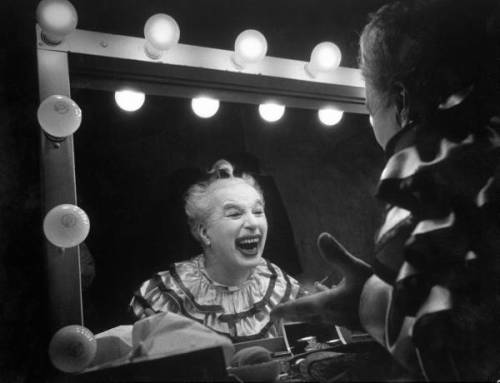
“Russell Brand may have started a revolution”, a headline reads. “Brand nails the political zeitgeist”, says another. Why is it that Brand’s recent interview on BBC’s Newsnight sparked so much attention? A video of his discussion with Jeremy Paxman went viral overnight, popping up all over the global infosphere. Why is it that so many who otherwise would not even think of striking up a conversation about the necessity or possibility of change, seem to get all worked up when seeing a “trivial man” like Brand call for revolution? After all, he is not saying anything we don’t already know: indeed, the world is full of dark shadows, terrible injustices, growing social and economic inequalities; yes, in the name of the crisis, all aspects of life have increasingly been submitted to the laws of the market; yes, the notion of liberal democracy is hollowed out by an excessive diet of cynicism, corruption and indifference; surely, many of us feel afflicted with a wearying syndrome of apathy, impotence and nihilism; and yes, this sense of political disappointment has been appropriated equally by right-wing and left-wing discourse, the first driven by outright rage, the latter steeped in dreary melancholy. These are not trivial matters, nor, by any means, should they be trivialized. But isn’t this just what is happening, Paxman seems to suggest, when they are being taken up by a buffoon – he who can never resist a joke, he who lacks good taste and refinement – who is really “out of place” and “out of line” when trying to voice political concerns? But perhaps what strikes us is not what the celebrity fool is “inexpertly” saying for our own amusement, but precisely the out-of-placeness of his voicing, and the condescending attitude with which it is being condemned.

Perhaps, we too, are tired of hearing how unrealistic and utterly naive it is to try to think about change without being able to put forward a well-defined alternative. Perhaps we are just affected by the proclamation that this man, however vain he may be, just doesn’t know either. And perhaps we are slightly tantalized by the thought that it is not the point of knowing where to go, as long as we dare to take a leap of faith, led us lead by what the act itself holds as possibility. For how long now have we been hearing the rhetoric of illusion and incapacity coming from the mouths of the so-called specialists? “Forgive them, for they don’t don’t know what they do” is the never ending mantra preached by those who, yesteryear, claimed to know what was needed to break with the dominant ideological illusions, and today, complain that there are no ideologies left to guide the quest for change. To take action, so the argument goes, only makes sense when there is a sense of direction. If there is no direction, there is no point in mobilizing for change. It implies that “realistic” and “democratic” politics can only be a matter of creating alliances, setting out strategies and managing common economic interests, all univocally in the name of a non-conflictual principle of community or identity. That is what the political horizon of the thinkable is today, defined by the logics of what is called capitalism and liberal democracy. Without a view on another future, we can only keep circulating, or as the police always says in case of disturbances: “move along!” It really means that change can be nothing else but moving in place.

But do we really need what Badiou has called “the existence of the inexistent” to give sense to political processes? Is framing a future not part of (political) invention itself rather than being its condition of possibility? In the words of Rancière: “if people are moving today we don’t quite know what we are moving towards, which perhaps obliges us to shift the question into the logic of what we said earlier about the fact of ‘coming after’ – namely that, perhaps now more than ever, the meaning or direction [sens] of the action is given by the potentialities of the action itself.” We have seen in recent years how sentiments that were deemed useless and senseless have led to a renewed trust in political action. What was important in these cases was not so much the attempt to unveil the illusions and laws of the system in name of a better future, but precisely the emergence of a new collective sentiment, based on a certain intolerance with the dominant order and, at the same time, of a communal trust amongst those who are searching for a way out, unsure of their orientation. Perhaps this is what is appealing in Brand’s plea for “revolution”: not the spectacle of a clown whose only concern should be to amuse others, deliriously ranting about what is obviously not his to talk about, but the recognition of a “trivial man” who speaks out about what is, more than anything else, ours to say and do. Perhaps the court’s jester is, after all, not betraying our grievances, but urging us to all play the fools at the king’s table.

The Art of Getting Lost

europa51.jpg

“No doubt there are more and less painful ways of getting lost… But at the very least they all lead one who has left behind the categories of what can be said about society… to the point where what comes back to us from what we say is that no one can see where we’re going.”
— Jacques Rancière

“I don’t know where I’m going, but I know that you can’t get there that way”
— Glauber Rocha recalling a Portuguese saying

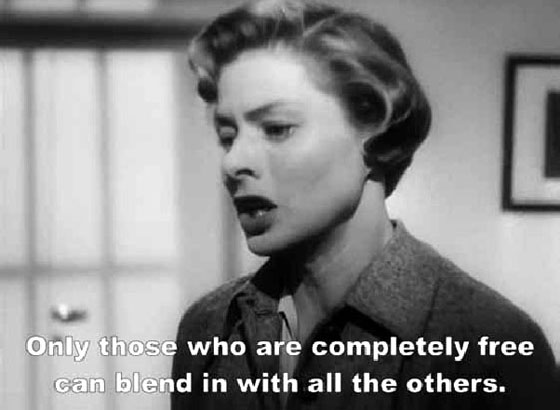
A tale of getting lost, letting go, setting forth without turning back. ‘A Child Kills himself’ feels like one of the most personal pieces Jacques Rancière has ever written. It does not only come across as a touching account of how his view on Roberto Rossellini’s Europa ‘51 has changed over time, but also of how his fundamental way of thinking has taken shape, much against the grain of the times. Indeed, when he describes the erratic wanderings of Irene, the character played by Ingrid Bergman, he might as well be referring to some of his own experiences. In Europa ’51, the complacent bourgeois lifestyle of Irene is violently overturned by the suicide of her young child. This traumatic event leads her astray through the outskirts of Rome, where she hopes to find some answers to the impassable questions which haunt her. This “voyage to the land of the people” is guided by her friend Andrea, who attempts to give meaning to Irene’s desperate search by situating it within the framework of Marxist thought: behind every individual agony, he suggests, we find an instance of a great social misery. What is hidden needs to be uncovered, what is unfamiliar needs to be explained, what is disordered needs to be cured. But there comes a time when the explanations given by others no longer suffice, when one needs to look elsewhere and see for oneself. That is how Irene’s progression towards (class) consciousness leads her ever further away from the trodden paths where things can supposedly be healed and revealed by the rules of knowledge, further down the shores of the river towards the barren wastelands where she starts nursing a tubercular prostitute, towards the cement factory where she takes the place of a worker and the steps of the church where she discovers a new faith. Instead of an act of “consciousness”, what takes place is a process of conversion. Irene’s own unplanned exploration turns out to be a deviation which displaces her from the system of explanations and motivations that determines what the proper rules of conduct and models of social behaviour are, the common sense that defines what is “sensible”. In letting go of all chains of causes and effects, knowledge and truth, she becomes a stranger who no longer has a valid place in the layout of paths and traces that others make up to be “reality”; a foreigner out of place and out of reason, lost in the void of uncertainty, in the niente, the nothingness that silently lingers throughout the film.

Rancière readily admits that when he first viewed the film during the 1960s, his Marxist-inspired critical expectations were frustrated by Irene’s retreat into religious idealism, which seemed to contradict the first, “realist” half of the film. This part presented itself as a perfect marriage between Marx’ historical materialism that provided the theoretical foundation of the workers’ struggle and the materialism of the relation between bodies and spaces that defines the mise-en-scène. But as the main character ventures from the world of labor and oppression to the spiritual path towards sainthood, the materialist connection is radically severed. In order to reconcile the two seemingly opposing views, “it then became necessary to say”, writes Rancière, “that the materialism of the mise- en-scène had been diverted by the personal ideology of the director.” In the same way as Marx once praised Balzac, the reactionary realist, for unwillingly revealing the truth of the capitalist world, Rancière argued that Rossellini, the Catholic idealist, showed something other than what he intended: in her inability to achieve an understanding of the social formations in which she found herself caught, Irene did not find salvation, but utter “madness”. Still not content with this interpretation, it took Rancière twenty-five years years to change his view on the film: more than two decades of digging in the archives of proletarian dreams and aesthetic experiences, where he took flight from the Althusserian science of the hidden that he had denounced so fiercely after the events of 1968. “For one who had been invited to look behind things, the break comes from looking to the side instead,” he writes. With that in mind, Irene’s conversion no longer indicates a lack of ”consciousness”, but a departing from it: it does not stem from a revelation, but from an alteration that leads her towards places where she is not supposed to be, where all certainties are put into question. A world without coordinates where nothing is identifiable as such any longer. “Irene bids farewell to this consciousness in the Socratic manner: she lets it go.” This is the Socratic atopia that characterizes Irene’s wanderings: a being out of place that originates in an act of trust. Trust in what we see, in what lays before us and the uncertain paths that we may have to walk.

It is an idea that runs through all of Rancière’s work, ever since he parted from Louis Althusser, his former teacher: the denunciation of all narratives of historical necessity and teleologies of “coming-to-consciousness”, which are always based on a certain distribution of sense: there are some who need to speak for others who know not what they do, because they know not how to see. Such is the position of Andrea, Irene’s well-intentioned guide: he is there to point out what is to be revealed, to make knowledge out of what others do not know. It is a position of basic mistrust, inherent in the Marxist critical tradition: truth can only be found behind appearances. But in the process of uncovering, the truth only gets reduced to the certainty of place, the only “right” place, the place of knowing. According to Rancière however, “the problem is not that of knowing what one does… The problem is to think about what one does, to remember oneself… ” Remembering oneself by becoming foreigner, by refusing the dominant interpretative schemas that connect sense with sense: this is the fundamental idea which underlies Rancière’s thinking. The challenge is not one of unveiling, he suggests, but of “encircling”. That is what Irene’s gaze does: an indeterminable encircling that unlocks the settled system of places excluding all forms of atopia, that undoes the certainty of social identities by exceeding everything that they are supposed to be one with. It is a matter of establishing a logic of “heterology”: one that denies given identities that pin down people to certain names, relations, times and places; one that disturbs the fabric of the sensible sustained by the dominant network of meanings, one that unsettles and undermines the system of coordinates that determines where and what we are supposed to be. It is the foreigner’s gaze that puts us in touch with the world, not the view of those who decide to stay on safe grounds, who stop looking, who cease to put their trust in what they see and sense. Irene, like Rancière, knows what to respond to all those who claim to be in the know, all those who designate what is meaningful and worthwhile and what isn’t: there is something else to be done, something that is not determined, and will perhaps never be. Something that defies the reasoning behind the choices we all have to make at one time or another, we who are painfully torn between fragile sensitivity and common sensibility, mindless longing and mindful sustaining, between knowing and unknowing, holding on and letting go.

(For B)

No Sir, it’s still not over

harmonies-werckmeister-01-g.jpeg

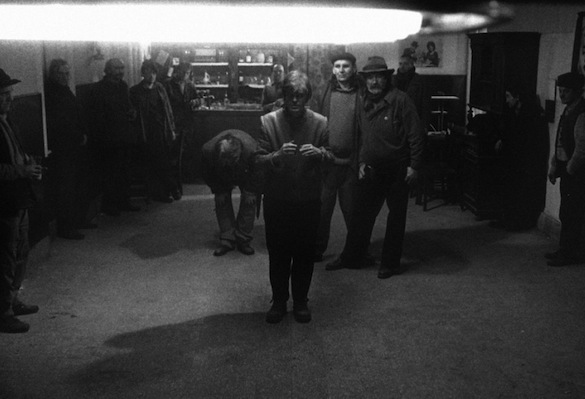
“There is a whole history of idiocy as a figure apt to blur the game of explanations and strategies. Of course Dostoyevsky comes to mind and there is something of Myshkin in the Valuska of Wreckmeister Harmonies. Dostoyevsky constructed the figure of the idiot as an antidote to the progressivist-socialist view of history that he saw emerging. In contrast to Béla Tarr, who arrived after the historical sequence of ‘real socialism’, he sought in the figure of the idiot to preserve a figure of refusal, to save it from the disaster of the system. The question that traverses Béla Tarr films and is emblematized in these figures of idiocy is to know whether one draws from the communist failure a simple lesson of the nihilist equivalence of everything with everything else or whether one extracts figures of refusal out of nihilism. What appeared clearly at the time of the collapse of the Soviet Bloc is that the supposed ‘ideological cement’ linking individuals to a system of domination was nothing other than people consenting to pay lip service to the official lie. Against this consent to the lie, Béla Tarr sets figures of idiocy that do not accept that the promise of words is only consent to lying and the madman that does not renounce the promise of harmony present in the celestial system. This attitude can be defined as proto-political, in the sense that through their stubbornness these characters radicalize a decision prior to all political action – the decision to verify through one’s own actions that not everything is a lie. But it scarcely makes sense to oppose this ‘stupid’ stubbornness to the intelligence of a strategic aim. Only things that actually stand opposed really ought to be set against one another. And the complement that Valuska lacks that would allow a real political subject to emerge is not some strategic aim. All that he stands opposed to is general cowardice and petty individual arrangements.”

“If we leave the context of Béla Tarr’s films, we come across an analogy in the arguments used by strategists of anticapitalist combat against the ‘indignant’, who are ‘without project’. The problem is that these strategists don’t have any project either. What they do have is imply the ability to explain endlessly that a project is required. The opposition is in fact an opposition between two sorts of obstinacy: the obstinacy to turn around in the circle of explanation, which is part and parcel of the consensus: and the obstinacy to mark a distance that at least conserves the possibility of dissensus.”
– Jacques Rancière in conversation with Oliver Davis, 2013

standing-man.jpg

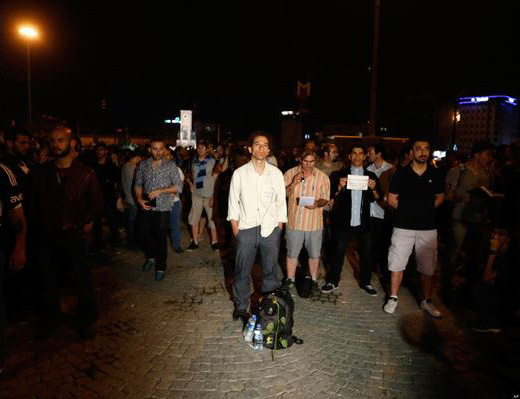
“The police are not the law that interpellates the individual (the “hey, you there” of Louis Althusser) unless we confuse the law with religious subjection. The police are above all a certitude about what is there, or rather, about what is not there: “Move along, there’s nothing to see.” The police say there is nothing to see, nothing happening, nothing to be done but to keep moving, circulating; they say that the space of circulation is nothing but the space of circulation. Politics consists in transforming that space of circulation into the space of the manifestation of a subject: be it the people, workers, citizens. It consists in refiguring that space, what there is to do there, what there is to see, or to name. It is a dispute about the division of what is perceptible to the senses.”
– Jacques Rancière, Aux bords du politique (1998)

“We would do better to ask what is a subjective or implicit presupposition: it has the form of ‘Everybody knows .. .’. Everybody knows, in a pre philosophical and pre-conceptual manner … everybody knows what it means to think and to be. … As a result, when the philosopher says ‘I think therefore I am’, he can assume that the universality of his premisses – namely, what it means to be and to think … – will be implicitly understood, and that no one can deny that to doubt is to think, and to think is to be …. Everybody knows, no one can deny, is the form of representation and the discourse of the representative. When philosophy rests its beginning upon such implicit or subjective presuppositions, it can claim innocence, since it has kept nothing back – except, of course, the essential – namely, the form of this discourse. It then opposes the ‘idiot’ to the pedant, Eudoxus to Epistemon, good will to the overfull understanding, the individual man endowed only with his natural capacity for thought to the man perverted by the generalities of his time. The philosopher takes the side of the idiot as though of a man without presuppositions.
(…) At the risk of playing the idiot, do so in the Russian manner: that of an underground man who recognises himself no more in the subjective presuppositions of a natural capacity for thought than in the objective presuppositions of a culture of the times, and lacks the compass with which to make a circle.”
– Gilles Deleuze, Difference and repetition (1968)

Politics of Uncertainty

handsworth-songs-1986-002-00o-9fd-two-black-heads-rear.jpg

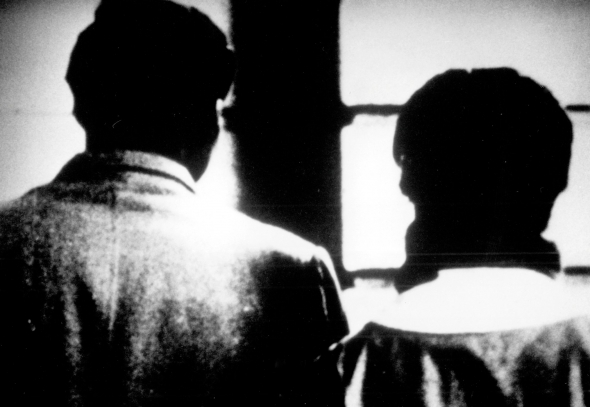
“Inscribed in the militant and nationalist pretensions of the term ‘third cinema’ is a certainty which simply cannot be spoken anymore. A certainty of place, location and subjectivity. What now characterizes the ‘truths’ of cinema, politics and theory is uncertainty.“
– John Akomfrah, Black Audio Film Collective (1988)

Uncertainty. Radical uncertainty. In economic theory the term refers to a lack of knowledge concerning the set of alternative outcomes of a choice and of alternative options for choice. It indicates a situation in which the possible states of the world cannot be imagined. Is this what we are experiencing right now? A predicament based on the idea that there is only one viable option left, that the choice has already been made, that the outcome is out of our hands? Is this a time for dreaming, dreaming the impossible, refusing what is refused, so to reshape desire and reorient hope?

In his talk Akomfrah was not invoking this particular conception of uncertainty. His statement corresponds to a time when notions of subjectivity and location were being thorougly re-examined, leading to the long debates on multiculturalism and identity politics that are still dominating our political landscape today (the “culturalisation of politics” that Slavoj Žižek and others have criticized). What was at stake at the end of the 1980’s, particularly in the discursive practices in the UK and US, was the coming to terms with the rise of so-called new subjectivities, identities and ethnicities, as well as the kinds of racism and xenophobia that had grown in response to them. For those living “diasporic” lives, there was the feeling that what Akomfrah called the certainty of subjectivity that once characterized the discourse around “third cinema”, this wide range of militant film practices mainly associated with the liberation struggles in subaltern regions, had given way to a non-unitary vision of subjectivity, one in constant flux, never complete, always in the process of becoming. The conception of cultural identity in terms of a shared culture and history that informed the various manifestations of “third Cinema” and played a vital role in the post-colonial struggles, was increasingly met with an alternative interpretation, focusing on an identity living with and shaped by, rather than despite of, “difference”. Soon terms such as “hybridization” and “creolisation” teamed up with the jargon that claimed the prefix “post”: postmodernity, postidentity, posthumanity. The notion of “heterogeneous” identity has of course been countered with vigorous critique, especially in view of the Benetton-style commodification of “difference” and the identity-consumerism promoted by the liberal-pluralist version of multiculturalism, but some have also been looking for affirmative interpretations. In a rapidly changing world, so the argument goes, where worldviews are crumbling, bodies circulating, old identities dissolving and new connections arising, the question is no longer to know who we are, but what we want to become. It is no longer solely a matter of living with the past, but also of imagining the future. Or, in Foucault’s terms: we need to refuse what we are, and imagine what we could be.

It is in this discursive context, concerned with the unsettling interplay between being and becoming, past and future, sameness and difference, that the work of Black Audio Film Collective has to be situated. “A diasporic cinema”, as Reece Auguiste has written, “which has a multiplicity of configurations, of identities and histories, of rewriting visual styles.” Kobena Mercer called this form of dialogue a “’syncretic’ dynamic which critically appropriates elements from the master-codes of the dominant culture and ‘creotizes’ them, disarticulating given signs and rearticulating their symbolic meaning. The subversive force of this hybridizing tendency is most apparent at the level of language itself where creoles, patois and black English decentre, destabilize and carnivatize the linguistic domination of ‘English’ – the nation-language of master-discourse – through strategic inflections, reaccentuations and other performative moves in semantic, syntactic and lexical codes”. The interstitial experience of diaspora and hybridity is put forward as a productive and even “subversive” space, in which possibilities still lie open, where awareness is still fully in the making and has not yet become solidified. It is a space of uncertainty, where the relation between sense and sense is unhinged and unsettled, where the dialogue between past and present, between the time of utterance and the space of memory, is unfinished or severed, leaving room for revision and initiation; a space that allows one “to think through and move across established categories and levels of experience: blurring boundaries without burning bridges” (Braidotti). It can also be considered as a space of marginality and minority. Not a minority as a category that is differentiated and defined by the majority, but as a process of becoming, a zone of indiscernibility (Gilles Deleuze). And not a marginality one wishes to loose or surrender as part of moving into the centre, but rather as a site one clings to, because it offers the possibility of radical perspectives from which to imagine new worlds (Bell Hooks). The margins, as the motor of active processes of becoming, taking place in the uncertain space between multiplicities.

What shape could an account of this becoming take? “Thinking in movement”, according to Cyrille Offermans, is what characterizes the “essay”, which he sees as a “product of uncertain times”. The essay, he says, is the report of a journey without preconceived maps or goals, a form of inquiry that is not in search for the one and only Truth, but for a sincerity of relative and tentative truths that are bound to a certain location in time and space. But what is the location one is speaking from? Rosi Braidotti has stressed that the process of becoming ought to be grounded in a “politics of location” (a term she borrowed from Adrienne Rich), in a “situated knowledge” (a term coined by Donna Haraway) as opposed to the universalistic nature of statements. “In its political applications the politics of location determines one’s approach to time and history. The sense of location, for me, has to do with countermemory, or the development of alternative genealogies. In other words, it means that it does make a difference to have the historical memory of oppression or exclusion, rather than being the empirical referent for a dominant group… The politics of location functions as a strategy of resistance.” A location then as an embedded and embodied memory, as a set of counter-memories and genealogies activated against the grain of dominant representations, as part of a passage between the no longer and the not yet, between letting go and becoming “other”. It is easy to see why the so-called “essay”, in cinema and elsewhere, is taken up as the ultimate figuration of this space of transformation and uncertainty: as an unclassifiable category that continues to grope for its own position and form, it is well suited to the exploration of dislocated cartographies of location. Writing about the work of Chris Marker, Claude Lanzmann and others, Jacques Rancière proposed another term: “the struggle for the appropriation of forms”, he writes, is what characterizes the “political fictions of the real”, that he opposes to the “real of fiction” which “ensures the mirror recognition between the audience in the theaters and the figures on the screen, and between the figures on the screen and those of the social imaginary”. Rather than attesting to the real, the fictions of the real problematize what is given as such, and in doing so shatter the relations between real and fictional, past and present, History and histories, the individual and the collective. In a time when the “real” goes by largely unchallenged, it is up to politics and art alike to produce “fictions”, undo the connections between signs, images, spaces and times, that frame that existing sense of reality, and instead propose new configurations of the visible and the thinkable.

Memory too is a work of fiction, an arrangement of relations between one time and another, one place and another, between what is seen and said, between what has been done and what can be done. Especially for those whose history has been denied, excluded, silenced, for those whose past is determined by “an absence of ruins”, it is not a matter of preserving memory, but rather of creating it. It is not a matter of claiming a place within the continuity of history, but of evoking its gaps and discontinuities and questioning its dominant representations. Before being able to let go of fixed or forged identities, it is necessary to recreate, “fictionalise” them (in an “act of fabulation”, as Deleuze would say). It does not involve overcoming the past in order to live in the present, but owning the past in order to overcome the present. What memory, in this sense, connects with is not a static holding stock of past experiences, but a continuously recomposing configuration of the past and the present, the present and the absent. Refering to Deleuze’s “minoritarian” interpretation, Braidotti describes how memory, in stringing together these virtual possibilities in an unstable fashion, works to destabilize identity: “Like a choreography of flows or intensities that require adequate framing in order to compose into a form, memories require empathy and cohesion between the constitutive elements. It is like a constantly reshuffling that yearns for the moment of sustainable balance or expression, before they dissolve again and move on.” Identity is always retrospective, according to Braidotti: it is a map of where one has already been, but no longer is. The cartographies need to be redrafted constantly, as a set of steps in an ever changing itinerary, a constant becoming that isn’t going anywhere, at least not anywhere in particular. It is this in-between that the work of John Akomfrah and Black Audio Film Collective engages with: these undetermined spaces of uncertainty and contingency where identities and identifications are unsettled and reordered. In a time of moralistic depolitisation, when politics is increasingly identified with the “self” of a community, when our relation to the “other” can only seemingly be one of contempt or compassion, reviewing their work reminds us that we need to let go of the idea of uncertainty as a liability, and start validating it as a requisite for active imagination and imaginative action, to create spaces of invention and dissension where new forms of visibility of the common can be shaped. Politics, according to Rancière, is always a matter of putting other worlds in the same world: a politics of emancipation which is ultimately a politics of the self as an other.
DISSENT ! Avi Mograbi

once_i_entered_a_garden.jpg

13 November 2013 19:30, Flagey Brussels.
Talk with Avi Mograbi proceeded by a screening of his latest film.

Once I Entered a Garden
FR/IL/CH, digital video, color, Hebrew & Arab spoken, English subtitles, 2012, 97’

“Quand vous faites du documentaire, vous devez accepter que la réalité influe en tant que réalité. Cela signifie: accepter d’être surpris, avoir son propre input, ne pas imposer ses propres idées sur la réalité même si on impose ses choix. Je ne prétends pas être un reflet de la réalité, c’est un reflet de ma façon dont la réalité doit être montrée. La question centrale, c’est celle de intégrité.”
– Avi Mograbi

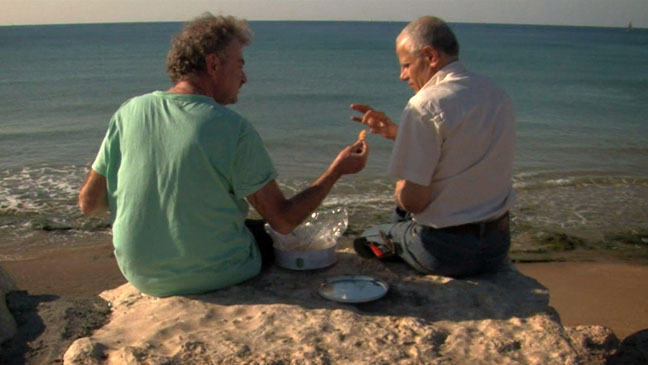
“Once I entered a garden to smell the scent of the flowers, and distract my sad soul.” So begins the song that gave Avi Mograbi’s latest film its title. Crooned by the Syrian singer Asmahan, it tells the story of a love that has withered, of hearts that have been violently broken with little hope of mending. The garden in the title turns out to be not a promised land of dreams, but a forbidden garden with no room left for the other. It is this irresolvable tension between dream and reality, hope and impossibility, that lies at the very heart of the film; a tension that goes to the core of the enduring conflict between Israel and Palestine, the issue Mograbi’s work has been fervently dealing with for over two decades. But in contrast to his previous films, here he does not start out from a situation of opposition and antagonism, but one of participation and complicity; and the search that drives him and his companion is not one for agitation or revelation but rather for consolation. A whisper, rather than a cry. As is true of all memorable journeys, its path was not the one initially chosen. In wanting to make a film about some of his family members who used to openly cross the border between Israel and Lebanon, Mograbi calls upon his friend Ali Al-Azhari, a Palestinian who has been living most of his adult life in Tel-Aviv. As their partnership develops, the family tale of crossing borders makes way for a story about crossing identities: between “me” and “we”, “us” en “them”, Arab and Israeli. The bittersweet account of “sad souls” seeking refuge – at one point quite literary – in a forbidden garden prompts a surge of hope, as a bilingual dialogue on a history in common leaves us pondering the possibility of a common future. Perhaps that is what makes this, as Mograbi himself has argued, his most radical film yet: one proposing, like all tender tales of love and friendship, an experience of a world lived through the perspective of difference, rather than identity.

DISSENT ! is an initiative of Argos, Auguste Orts and Courtisane, in the framework of the research project “Figures of Dissent” (KASK/Hogent), with support of VG & VGC. The visit of Avi Mograbi was initiated by KASK/Hogent.

As part of a Avi Mograbi programme, Flagey will also be showing Z32 (2008) and Avenge but one of my two eyes (2005).
——————————————————————————————————————————————————————-
About DISSENT!

How can the relation between cinema and politics be thought today? Between a cinema of politics and a politics of cinema, between politics as subject and as practice, between form and content? From Vertov’s cinematographic communism to the Dardenne brothers’ social realism, from Straub-Huillet’s Brechtian dialectics to the aesthetic-emancipatory figures of Pedro Costa, from Guy Debord’s radical anti-cinema to the mainstream pamphlets of Oliver Stone, the quest for cinematographic representations of political resistance has taken many different forms and strategies over the course of a century. The multiple choices and pathways that have gradually been adopted, constantly clash with the relationship between theory and practice, representation and action, awareness and mobilization, experience and change. Is cinema today regaining some of its old forces and promises? Are we once again confronted with the questions that Serge Daney asked a few decades ago? As the French film critic wrote: “How can political statements be presented cinematographically? And how can they be made positive?”. These issues are central in a series of conversations in which contemporary perspectives on the relationship between cinema and politics are explored.