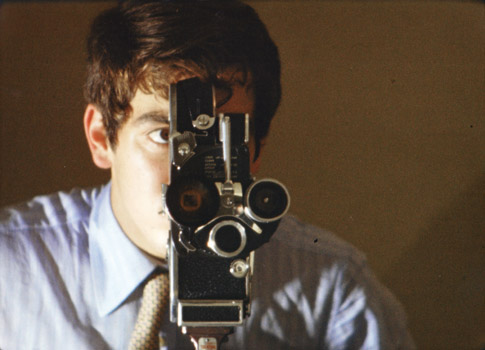
Figures of Dissent : Pasolini

pasolini-web.jpg

Figures of Dissent : Pasolini
8 – 9 June 2011, KASKcinema, Gent. A Courtisane programme.

“It has been said that I have three heroes: Christ, Marx and Freud. This is reducing everything to formulae. In truth, my only hero is Reality. If I have chosen to be a filmmaker as well as a writer it is because, rather than expressing reality through those symbols that are words, I have preferred the cinema as a means of expression – to express reality through reality…”
— Pier Paolo Pasolini

“Maintenant, avec le recul, je me dis que la mort de Pasolini est une bonne date pour dire que, à partir de là, le cinéma a arrêté d’être explorateur, d’être lui-même, c’est-à-dire apprenti sorcier.”
— Serge Daney

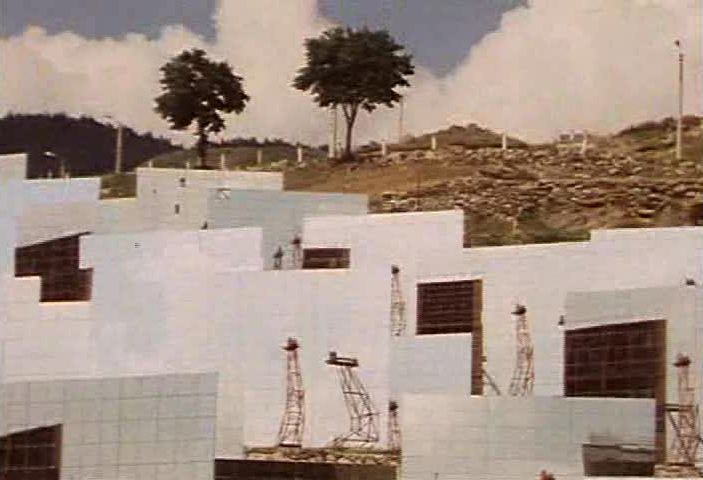
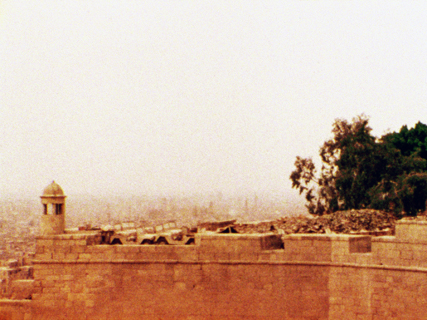
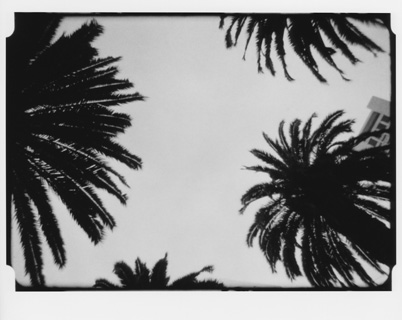
The death of Pier Paolo Pasolini (1922-1975), as Serge Daney once suggested, marked the end of an era: a certain history of cinema seemed to tiredly come to a halt. Cinema understood as a communal place where to come together and disagree, as an open space for exploration and confrontation (mise-en-scène as well as mise-en-crise) is no more – or at least no longer with the scope of former days. However, the critical and polemical tone that once indicated the vitality of the seventh art has always continued to resonate in Pasolini’s work. Today, in the grooves of the 21st century, his voice appears to resound with the same vigor of old, when he sent cold shivers to the world of the 1960’s and 1970’s. The recent wave of retrospectives, restorations, updates and reprises proves how strongly the countertone of Pasolini – filmmaker, poet, author and true dissenter at heart – is to be missed more than ever before in today’s consensual times. Pasolini’s self proclaimed role, in the words of art critic Guy Scarpetta “was to subvert conceptions of the dominant world, to explore all that is not said by conventional representations, to uncover all that is repressed in the social and cultural consensus.” This programme celebrates his outspokenly rebellious character with the screening of two rarely shown and recently restored documentaries by Pasolini, as well as works by two contemporary artists who each in their own way reinvigorate his legacy: Alfredo Jaar and Ayreen Anastas.

——————————————————————————————————————————————————————-

Wed 08.06.2011, 20:30: PROGRAMME 1

pasolini-jaar-web.jpg

Alfredo Jaar
Le Ceneri di Pasolini (The Ashes of Pasolini)

IT/CL, 2009, video, b/w & colour, stereo, Italian with English subtitles, 38’
Copy courtesy of the artist

“The Ashes of Pasolini is a modest film about the death of an extraordinary intellectual. It is mostly based on documentary material discovered after 1975, the year of his death, and before. As you know, it is still unclear who killed him. But for me, it has always been clear why: it was because of fear. Fear of his voice, fear of his life style, fear of his ideas, fear of his opinions, fear of his intellect. Pasolini was the complete intellectual: a filmmaker, a poet, a writer, a journalist, a critic, a polemicist. He was totally involved in the cultural and political life of his time. As an artist he took risks, broke the rules, he created his own rules. Pasolini wrote one of the most beautiful poems of the 20th century titled ‘The Ashes of Gramsci’ (1957), a eulogy to another great Italian thinker, Antonio Gramsci. The title of my film is based on this poem by Pasolini but I chose it to write a eulogy to Pasolini himself. In these dark times in which Italy finds itself, Pasolini’s voice is sorely missed.” (Alfredo Jaar)

“Why a tribute to Pasolini in 2009? … In the middle of the Berlusconi era? The answer is in Pasolini words, in his voice. It’s such a contemporary voice that we can hardly believe that these words were pronounced almost half-century ago. We are surprised when we realize how his words are directly pertinent, not just to Berlusconi’s Italy but to our current condition. […] My short film The Ashes of Pasolini it’s a montage of excerpts of his films and interviews, as well as RAI news footage. Also, I have included images shot in Casarsa, the small village where he was buried. My main aim was to revive his voice in the XXIst century, where it belongs.” (Alfredo Jaar)

pasolini-rabbia-web2.png

Giuseppe Bertolucci & Pier Paolo Pasolini
La Rabbia di Pasolini (The Rage of Pasolini)


IT, 1963/2008, 35mm, b/w and colour, stereo, Italian with English subtitles, 83’

Print courtesy of Cineteca di Bologna

“In 1962, Pasolini was invited by an Italian newsreel producer to create a feature-length film essay from his company’s library of footage. Inspired by diverse wealth of imagery, Pasolini set out to make a film as ‘a show of indignation against the unreality of the bourgeois world.’ Assembling images from the Soviet bloc and various anti-colonial movements as complement and contrast to the newsreel footage, Pasolini crafted a remarkable tour de force of politically trenchant commentary on the modern world, climaxing in a moving meditation on the death of Marilyn Monroe. Fearing controversy and box-office failure, the producer ordered Pasolini to cut the original version to less than an hour and then promptly added a right-wing counterpart by the filmmaker Giovanni Guareschi, packaging the two parts as one film. Disowned by Pasolini, this version was indeed a failure. Although Pasolini’s original version remains lost, an ambitious reconstruction was recently completed by Giuseppe Bertolucci and the Cineteca di Bologna using the shot list and a dialogue transcript from the first version, as well as Pasolini’s notes on music for the film.” (Harvard Film Archive)

“A hundred elegiac pages in prose and verses, and a texture of moving images, photographs and painting reproductions: in the laboratory of the film La Rabbia, Pier Paolo Pasolini experimented for the first time with a narrative style different from the traditional and conventional documentaries of the time. His intention was – in his own words – to create a ‘new cinema genre. An ideological and poetical essay through new sequences.’ La Rabbia had to be ‘an act of indignation against the unreality of the bourgeois world and its consequent historical irresponsibility, to testify to the presence of a world that, unlike that of the bourgeoisie, is deeply rooted in reality. And reality implies a true love for tradition that can only be achieved through revolution.’ (…) The project was born from the proposal of a small producer, Gastone Ferranti, who entrusted Pasolini with the file material of a newsreel called ‘Mondo libero’, which he had directed and produced for a number of years. During an interview with Maurizio Liverani (‘Paese sera’, April 14th, 1963), Pasolini declared: ‘I pulled vision out of that material. It was horrendous, wretched, a depressing portrait of international populism, the triumph of the most trivial reactions. However, in all this terrible squalor, every now and then, beautiful images would grab my attention: the smile of a stranger, two eyes expressing joy and sorrow, and interesting sequences rich with historical significance, visual fascination in black and white’.”(Roberto Chiesi)

——————————————————————————————————————————————————————-

Thu 09.06.2011, 20:30: PROGRAMME 2

pasolini_notes_web.jpg

Pier Paolo Pasolini
Appunti per un’Orestiade Africana (Notes for an African Orestes)


IT, 1970, 35mm, colour, stereo, Italian with English subtitles, 63’

Print courtesy of Cineteca di Bologna

“While shooting Medea, a film about the subjugation of the ancient world to an alienating modernity, Pier Paolo Pasolini developed the idea to make a companion piece about another Greek myth – the story of Orestes. This story would end more happily, with the archaic making way for a different kind of modernity, built not on exploitation but on communalism. Encouraged by emerging socialist governments in post-colonial Africa, Pasolini hoped to shoot his film there, and so he went to Uganda and Tanzania to scout for locations and actors. That footage became the basis for this film, with Pasolini explaining his ideas on the soundtrack. A perfect example of leftist intellectual auto-critique, the film climaxes with Pasolini discussing his plans with a group of African students in Rome. The discussion hovers somewhere between tragedy and farce as one by one, the students calmly and kindly offer numerous reasonable objections to Pasolini’s idea, all of which he seems to take in stride. The Oresteia project was never made. Little-seen and little-discussed, the film is essential viewing for understanding Pasolini’s political thinking and his attachment to myth.” (Harvard Film Archive)

“Orestes synthesizes African History over the last hundred years: the sudden and almost divine passing from a ‘savage’ state to a civil and democratic one. The series of kings, who dominated the African lands (and who in their turn were dominated by the dark Erinyes) in the atrocious and century-old stagnation of a tribal and prehistoric culture, have suddenly been swept away. And Reason, almost motu proprio, has established democratic institutions. We must add that now, in the sixties, the years of the ‘Third World’, the years of ‘negritude’, the burning problem and question is the transformation of the Erinyes into Eumenides. Aeschylus’ genius foreshadowed all of this. All advanced people today agree that archaic civilizations – superficially referred to in terms of folklore – must not be forgotten, despised, or betrayed. Rather, they ought to be absorbed within the new civilization, integrating it, making it specific, concrete, historical? The terrifying and fantastic divinities of African prehistory should undergo the same process as the Erinyes, they should become Eumenides.” (Pasolini)

pasolini_anastas_web.jpg

Ayreen Anastas
Pasolini Pa* Palestine

US/Palestine, 2005, video, colour, stereo, Arabic with English subtitles, 51’
Copy courtesy of the artist

“Pasolini Pa* Palestine is an attempt to repeat Pasolini’s trip to Palestine in his film, Seeking Locations in Palestine for The Gospel According to Matthew (1963). It adapts his script into a route map superimposed on the current landscape, creating contradictions and breaks between the visual and the audible, the expected and the real. The video explores the question of repetition. For Heidegger Wiederholung ‘repetition, retrieval’ is one of the terms he uses for the appropriate attitude toward the past. “By the repetition of a basic problem we understand the disclosure of its original, so far hidden possibilities.” The project ventures a conversation and a dialogue with Pasolini, especially his ‘Poem for the Third World’. Discutere ‘to smash to pieces’ is the Latin source of dialogue, discussion. The piece does not criticize Pasolini, but reveals unnoticed possibilities in his thought and works back to the ‘experiences’ that inspired it.” (Ayreen Anastas)

“From: Ayreen Anastas
Sent: Dec 2, 2003 4:22 PM
To: Pier Paolo Pasolini
Subject: Sopraluoghi in Palestina per il film “Vangelo Secondo Matteo”

Dear Pier Paolo,

I am writing to ask your permission to repeat your seeking in Palestine film 40 years ago in the film: Sopraluoghi in Palestina per il film ‘Vangelo Secondo Matteo’.*

In this repetition, I would like to find in that landscape what you have not found in your film. Your refusal of the Palestinian landscape makes me sad: a refusal that is a negation and affirmation at the same time: it is a negation because you did not execute ‘The Gospel According to Matthew’ in Palestine, and an affirmation in the sense of the necessity of a repetition of this venture, trip, seeking etc… only in that gap of not finding the location in Palestine in your film 40 years ago, I can start seeking them in the new film today.

So it is not a real sadness if I say: I am sad that you did not decide for this landscape and for locations there. It is rather a symbolic sadness, that will help me find an unnamable (an unknown that actually motivates the project) in that landscape I grew up in. It is a sadness of love, a double love, for you as a director and for this landscape.
(…)

* Seeking Locations in Palestine for ‘The Gospel According to Matthew'”

In the context of the research project “Figures of Dissent (Cinema of Politics, Politics of Cinema)”
KASK / School of Arts

VIDEOEX

ve_afterempire.jpg

In the context of the Videoex Festival (21-29 May 2011, Zürich (CH)), on the occasion of this year’s special focus on “guest city” Brussels, Courtisane presents four programmes of Belgian works. Curated by Stoffel Debuysere & Maria Palacios Cruz.

Here and Elsewhere
Between here and there, between near and far, lies a world of difference, delineated by an immeasurable horizon. One must overcome the distance, scan the horizon, interrogate and broaden up one’s perspective. The five video essays in this programme each in their own way reflect on the encounter with the other and the unfamiliar. At the same time, the gaze is directed into the outer world and onto oneself, slowly surveying the impenetrable and complex reality that surrounds us all.

Johan Grimonprez
Kobarweng, or Where Is Your Helicopter?

1992, video, colour, sound, English text, 24’30″

ve_kobarweng.jpg
Pepera, Indonesia. Less accessible areas in the highlands on the island aren’t visited by the white outside world until the war in the South Pacific, when a plane skims over or crashes in the forest. Around 1959 a child sees how a helicopter drops food parcels over the region. Years later he asks the filmmaker who visits him in the OK Bon Valley: “Where is your helicopter?”. Combining found footage, tense silence, text quotes from the ethnographical classics and his own account of this surreal encounter Grimonprez deconstructs the anthropological notion of ‘first contact’”.

Els Opsomer
imovie[one]_: THE AGONY OF SILENCE

2003, video, colour, sound, English text, 13’

ve_agony.jpg
Ramallah – Gaza city – East-Jerusalem, Palestine. After a short visit to the Occupied Territories, the artist sits at her computer and she ‘writes’ a video-letter with the amateur-software iLife to the people she got to know. She films the images she photographed: her own souvenirs are subjected to a detailed investigation, her own considerations are closely scrutinized. Subtitles show the content of the letter in which she asks questions, contemplating and in a quiet voice, about the preservation of human integrity in an area where physical and psychological violence takes place every day”.

Vincent Meessen
L’empiètement du coton graine (the Intruder)

2005, video, multiple languages spoken, English subtitles, 7’30”

ve_intruder.jpg
Ouagadougou, Burkina Faso. Meessens’ ‘document brut’ records his actions in the busy streets of the African capital with a candid camera. Dressed and masked in a cotton tuft costume he silently moves between the crowds. The reactions soon follow: the white man as a strange, primitive apparition is faced with indifference, mockery and amazement. His use of Burkinabese ‘white gold’ as a garment turns the public space into a magnetic field,charged with poetry based on unspoken symbolical, political and economic meanings

—

Sarah Vanagt
Little Figures

2003, video, b/w, sound, multiple languages spoken, English subtitles, 15′

ve_figures.jpg
Three statues on the Mont des Arts in Brussels: a king, a queen and a medieval knight. Three newcomers to Brussels: a Philippino boy, a Rwandan refugee girl and a Moroccan boy. Three statues, three children; an imaginary conversation.” In ’Little Figures’ Sarah Vanagt once again plays with her passion for history, perspective and social commitment. Setting out from a location, the ‘Kunstberg’, but specifically the three statues located there, Vanagt puts together a story in which migrant children stir up a conversation between the statues, in an often surprising and witty tone, being (un)able to situate them historically. It is no coincidence that colonialism and the crusades emerge as references. The scene has a decelerated, halted aspect, which reinforces the feeling of recollection, and allows for associations to surface.”
Florence Aigner & Laurent Van Lancker
Disorient

2010, 35mm, 16mm & Super8 on video, colour, English and French spoken, English subs, 36’

ve_disorient.jpg
A polyphony of tales by migrants who return to their homeland after having lived abroad. Whether they are Vietnamese, Indian, Syrian, Iranian, Chinese, Pakistani, academics, contract workers, political refugees, businessmen or students, they all are confronted with a second exile: coming home. They also share the capacity to analyse the differences between the cultures they have lived in with humour, critical distance and lived experiences. This experimental documentary moulds this polyphony of tales in a minimalist, impressionistic form. Only a few traces of images, of travelling, of material culture, appear above the voices and soundscapes, just as there remain only shadows and memories of their presence abroad. This film is the condensed result of a long-term project – around twenty interviews conducted in different Asian countries and a series of subtle laboratory work including scratching the film tape – which evokes the reminiscences of the memories and traces of life of the encountered protagonists.

——————————————————————————————————————————————————————-

Politics of Perception
Contemporary image culture is marked by an ubiquitous preoccupation with transparency and signage: between image and signification there is no longer room for doubt, let alone for void. To look means in first place to decode, to intuitively verify clichés, stereotypes, visual information that refers to nothing else than to itself. Today showing and seeing cannot be regarded as self-evident anymore. What we are left with is merely a ghost of the image: imagination.

Annik Leroy
Cellule 719

2004, video, colour, sound, English text, 14’30”

ve_cellule719.jpg
In ’Cellule 719’ there is hardly an image to be seen, sometimes we catch a glimpse of water in some corner, but for the most part this film is black. The lines appearing on-screen in grey are derived from ‘Ein brief Ulrike Meinhofs aus dem Toten Trakt’, a letter written by member of the RAF Ulrike Meinhof in 1972 when she had just been emprisoned. In 1976 she was found dead in her isolation cell with the number 719. From the lines an enormous disenchantment and signs of depression become apparent, but at the same time they have great poetical value. Because of the consistent blackness, the undefinable sound in the background and the concentration on the probing lines, the spectator penetrates into Meinhof’s head for over fourteen minutes.

Pieter-Paul Mortier
In the Midst of…

2005, video, colour, sound, English text, 19′

in-the-midst-of-08.jpg
Seeing is above all a matter of recognition. Mortier manipulated amateur images by a tourist to the extent that it becomes hard to identify anything. Fragments, shadows, echoes, doubled images, distortion of sound: never the pictorial impact is stable or complete. The same technology that produced the image, also deconstructs it. One of the sources of inspiration is a quote from ‘The Elementary Particles’ (Atomised)’ by Michel Houellebecq: “Natural forms are human forms. Triangles, interweavings, branchings, appear in our minds. We recognize them and admire them; we live among them. We grow among our creations human creations, which we can communicate to men-and among them we die. In the midst of space, human space, we make our measurements, and with these measurements we create space, the space between our instruments.”

Pieter Geenen
atlantis

2008, video, colour, sound, 11’

ve_atlantis.jpg
‘atlantis’ shows a nocturnal landscape being scanned by a lightbeam. The searchlight of a boat on the Chinese Yangtze river explores the banks of the Three Gorges Reservoir, which came into existance due to the construction of the controversial Three Gorges Dam. Just before it would flood up to its final level of 175m this lightbeam reveals what soon is going to disappear below water level. Referring to the concentrated lightbeams in typical images of underwater discoveries and explorations, this video seems to explore a sunken universe, a land of which people seem to have left, with demolished and abandoned buildings, desolate forests and ghost ships.

—

Herman Asselberghs
After Empire

2011, HD video, colour, sound, English spoken, 52′

ve_afterempire3.jpg
A search for the alternative to an image of meaning, inspired by Antonio Negri’s and Michael Hardt’s ‘Empire’. The insights from this politico-philosophical study on the contemporary world serve as a starting point for a reflection on positive forms of collective resistance and emancipatory representations in times of war. An adaptation that doesn’t aim to be an illustration of Empire but that reworks it in the light of the 9/11 heritage. After Empire considers a possible alternative for the iconic image that our collective memory has kept as the quintessential moment of recent history: the hijacked plane hitting the second tower. The alternative: the 15th of February 2003. On that day 30 million citizens across the planet marched against the unilateral decision by the American government to start a pre-emptive war against Iraq under the auspices of “the war on terrorism”. 2/15 was the greatest peace demonstration since the Vietnam war and probably the biggest protest march ever to take place. The war did happen, but this world day of resistance could very well mark the beginning of the 21st century. 2/15 instead of 9/11: a key date in the writing of a history of global contestation in the struggle between two superpowers: the United States against public opinion worldwide.

——————————————————————————————————————————————————————-

Defining Features
Five intimate observations, meticulously sculpted from time and space, resonating between perception and sensation. Cinematographic portrait as evocation, rather than reproduction. The face, the body and the voice as landscapes of the possible, as entry points into mental spaces that go beyond every enclosed form of representation. It’s the tangible gaps between presence and absence, gesture and lack, expression and silence, which throw us back onto ourselves, to the question of what it means to be human, body and spirit, existence and substance.

Chantal Akerman
La Chambre

1972, 16mm, colour, silent, 11’

ve_chambre.png
In ‘La Chambre’ (shot by Babette Mangolte), the camera takes in a room in 360-degree pans; a woman (Akerman) lies eating an apple. Offscreen voices reflect, in a kind of verbal counterpoint, the “mirror” into which the young woman informs us she is looking. A film of enclosure and repetition. Adrian Martin writes: “Akerman provides a mirror for our own activity as spectators, as we negotiate the illusions and lures of narrative.”

Manon de Boer
Sylvia Kristel – Paris

2003, Super8 to video, colour, sound, French spoken, English subtitles, 40’

ve_kristel.jpg
‘Sylvia Kristel – Paris’ is a portrait of Sylvia Kristel , best known for her role in the 1970’s erotic cult classic ‘Emmanuelle’, as well as a film about the impossibility of memory in relation to biography. Between November 2000 and June 2002 Manon de Boer recorded the stories and memories of Kristel. At each recording session she asked her to speak about a city where Kristel has lived: Paris, Los Angeles, Brussels or Amsterdam; over the two years she spoke on several occasions about the same city. At first glance the collection of stories appears to make up a sort of biography, but over time it shows the impossibility of biography: the impossibility of ‘plotting’ somebody’s life as a coherent narrative.

—

Eric Pauwels
Violin Fase

1986, 16mm to video, colour, sound, 12’

ve_violin.jpg
A solo in two movements, dance and camera. Eric Pauwels twirls the camera around the body of Anne Teresa de Keersmaeker. What we see is not the geometrical and minimalist choreographic structure, but a possessed woman, bathing in sweat, exploring the boundaries of physical exhaustion. A solo in two movements: the dance and the camera. Four uninterrupted takes. Pauwels is constantly looking for the essence, the soul of cinema. In its explicit presence the camera is also driven to its extreme, perspiration, hardship. Pauwels is not concerned with beautiful shots, but with the investigation.

Olivier Smolders & Thierry Knauff
Seuls

1989, 35mm, b/w, sound, 12’30”

ve_seuls.jpg
“’Seuls’, consisting of portraits of a few children encountered in a psychiatric institution, breaks with all language constituted in discourse. This short film treats autism in a moving and violent way. The children are approached with a total respect of their integrity. The opacity of their story remains intact. We will only know of them the intensity of devouring gazes, the wavering of bodies, the schock of a head hitting the wall. And it makes us tremble inside. Maybe there is in this documentary fiction the warm apprehension of a silent fire, the paradoxal but simply human approach of communication.” (Serge Meurant)

Sven Augustijnen
Johan

2001, video, colour, sound, Dutch spoken, English subtitles, 24’

ve_johan.jpg
’Johan’ is a purely documentary film that shows the therapy undergone by a patient suffering from aphasia. Aphasia is an illness that affects the language centres of the brain and that can be generated by, amongst other things, a brain-tumour or -haemorrhage. Patients suffering from aphasia are often subject to chronic memory loss, and due to the ensuing semantic or interpretative disturbances they cannot recognise as such or correctly categorise certain specific objects. With the beginning of Sven Augustijnen’s film, the camera and the filming process themselves go to comprise some aspect of the therapy, thereby itself functioning as feedback for these media.

——————————————————————————————————————————————————————-

Forgotten Frontiers
Far too often forgotten in their own country, ignored in their time: this has been the fate of the rare manifestations of “avant-garde” film in the history of Belgian cinema. And yet, many of these films display a cinematographic insight and creativity that have nothing to envy to the canonical masterworks of the European art scenes. The ideas and formal considerations cultivated by the different avant-garde movements were not simply imitated, but ingeniously appropriated and transcended, resulting in singular and uncompromising film studies which combine formal experiment with poetic sensibility.

Charles Dekeukeleire
Combat de Boxe

1927, 35mm, b/w, 7’30”

ve_combat.jpg
When Charles Dekeukeleire makes ‘Combat de boxe’ (Boxing Match), he is 22 years old and obsessed with cinema. He immediately aligns himself with the defenders of pure cinema, Germaine Dulac, Jean Epstein, Marcel L’Herbier, Louis Delluc. He also admires Vertov and his conception of the Kino-Glaz, the cameraeye. A poem by Paul Werrie served as starting point for this film which is based on a high-speed montage, close-ups, superimpositions, the successive use of the negative and positive image and the principle of rhythm. The violence of the fight, the presence of the audience, the tension between the crowd and the ring are swept up in a dazzling choreographic montage.

Henri Storck
Sur les bords de la caméra

1932, 35mm, b/w, 10′

ve_bords.jpg
Just like he did for ‘Histoire du soldat inconnu’ (Story of the Unknown Soldier), Storck uses newsreels from 1928, which he distorts, although in a more humanistic and slapstick way. He combines images of the crowd, police repression, explosions, riots and fire with images of gymnasts, music halls, models and sea lions, which make it all the more disturbing.

Charles Dekeukeleire
Impatience

1928, 35mm, b/w, 36′

ve_impatience.jpg
An introductory title informs the spectator that the film will be composed of four series of images, “the motorbike, the woman, the mountain and abstract blocks”, elements which serve as the starting point for Dekeukeleire to construct his film according to very precise parameters. The rhythm is given by a mathematical fragmentation of the film’s running time, divided up into temporal segments where the four repertories of images succeed each other in every possible combination with no respect for either melodic line or dramatic tension.

—

Henri Storck
Images d’Ostende

1929-1930, 35mm, b/w, 12’

ve_ostende.jpg
One of Storck’s early films. It is structured in visual chapters: the port, anchors, the wind, the spray, the dunes, the North Sea … a series of images that have nothing to do with anecdote or explanation. Each shot is at the very heart of the definition of the word involved. It could be said that this is the first film of conceptual experimentation. Shot after shot (the montage is quite rapid), Storck offers a glimpse of a fragment, an aspect that orders its multiple constitutive elements. They invoke their cinematographic equivalents, light, framing, the scale of the shots, movement, rhythm. The water, the sand, the waves are an integral part of a cinematic language. This is what Germaine Dulac and her friends would have called pure cinema. A poetic and kinetic shock, without fiction or sound, which relieves film from its narrative obligation and restores it to the world of sensations that it alone is able to carry. An immediate masterpiece that was one of the foundations of Storck’s way of seeing things.

Edmond Bernhard
Dimanche

1962, 35mm, b/w, 20′

“’Dimanche’ was supposed to be a didactic film, intended to evoke the problem of leisure. Bernhard diverts the order and outwits the trap of the ‘thematic’ film. Without resorting to any form of commentary, making use of extraordinary images subilimating common spaces (the boredom of Sundays, the changing of the guard, children playing, a runner in the woods, a football match, …), he constructs with a nifty montage an exceptional work dealing with the sense of void and the fossilisation of the world.” (Boris Lehman)
Chantal Akerman
Saute Ma Ville

1968, 16mm, b/w, 13’

ve_saute.jpg
Chantal Akerman’s world is hermetic and private, but scenic. Especially the home is often the closed space where her characters (all of them women) become visible unto themselves, and are confronted with their own obsessions. Akerman was merely 18 years old, when she in 1968 made her debut with the anarchistic ‘Saute ma ville’, where she herself performs as a housewife on thin ice in the cheerful kitchen, in a revolutionary teenage parody of the cramped conditions of petit-bourgeoisie. With Chaplin and Godard as role-models, the young Chantal throws everything overboard, but at the same time navigates squarely towards the disaster of her own disintegration. Reality is looming outside the four walls of the home, with a force that really becomes visible in her later works. But a surprisingly large number of her constant topics can already be discerned in this film. The objective everyday formalism of the black-and-white images contain a feminist critique of domestic routines, which reduce the existence of a housewife to a clumsy and lonely ballet of habits and repetitions, and which are unbearable to observe with others, which Akerman ends up turning into the main principle a few years later in her chief work ‘Jeanne Dielman, 23, quai du Commerce, 1080 Bruxelles’ (1975)’.

——————————————————————————————————————————————————————-

The Videoex festival will also present works by many other Belgian filmmakers, including Marcel Broodthaers, Boris Lehman, Anouk de Clercq, Kurt D’Haeseleer, Nicolas Provost, Bernard Gigounon, Olivia Rochette & Gerard-Jan Claes, Potential Estate and others. Full programme: www.videoex.ch

ARTIST IN FOCUS: Robert Beavers

beavers-early.jpg

ARTIST IN FOCUS: Robert Beavers
03.04.2011 – 09.04.2011, Courtisane Festival 2011 (Gent) & Cinematek (Brussels)

Robert Beavers (1949, Brookline, Massachusetts) is one of the most influential avant-garde filmmakers of the second half of the 20th century. Although born and raised in the United States, he has been living and making films in Europe since 1967. His 16mm films, at the same time lyrical and rigorous, sensuous and complex, are inhabited by the landscapes, the architecture and the cultural traditions of the Mediterranean and Alpine cities and countryside where they are filmed, and yet reveal deeper personal and aesthetic themes. As he acknowledges himself, he strives “for the projected film image to have the same force of awakening sight as any other great image.” He regards filming as part of a complex procedure, which begins in the eyes of the filmmaker and is shaped by his gestures in relation to the camera. Beavers’s attention to the physicality of the film medium is evident also in the editing, a fully manual process that leads to a unique form of phrasing. Harry Tomicek calls it a form of “cinematic breathing”: “an exchange of speech and silence, emergence and concealment. Robert Beavers might be the only filmmaker in the world whose works announce the mystery of this process.”
Until the late 1990s his films were very rarely shown, but recent retrospectives at the Tate Modern London, the Whitney Museum in New York, Berkeley Art Museum & Pacific Film Archive in Berkeley and the Austrian Film Museum in Vienna have finally brought to his work the attention it deserves. Courtisane and Cinematek will join forces to present his oeuvre in Ghent and Brussels, a city Beavers has a strong attachment to but where his work hasn’t been screened in several decades. Brussels was not only the first European city where he settled together with his partner filmmaker Gregory Markopoulos (1928-1992) after leaving the United States but also where his film culture and cinephilia developed, thanks to Jacques Ledoux, the then curator of the Royal Belgian Film Archive. Ledoux also encouraged Beavers to continue making films, and is one of the protagonists of Plan of Brussels (1968). From his Early Monthly Segments to his most recent work The Suppliant (2010), this selective retrospective in Brussels and Ghent covers more than 40 years of work and represents for Beavers an occasion to return to the scene of his beginnings as a filmmaker, the Brussels Cinémathèque.

On the last day of the Courtisane festival, April 3, Robert Beavers will present a selection of films of his own as well as by other filmmakers in Ghent. The following week, four more screening programmes will follow in Cinematek, the film theatre of the Belgian Royal Film Archive.

With the support of SWISS FILMS

——————————————————————————————————————————————————————-

PROGRAMME 1
Film-Plateau, Gent (Courtisane Festival)
Sun 03.04.2010, 15:00

Ruskin
1975/1997, 35mm, b/w & colour, sound, 45’
Filmed in Italy (Venice), Switzerland (the Grisons) and England (London).

beavers-ruskin.jpg
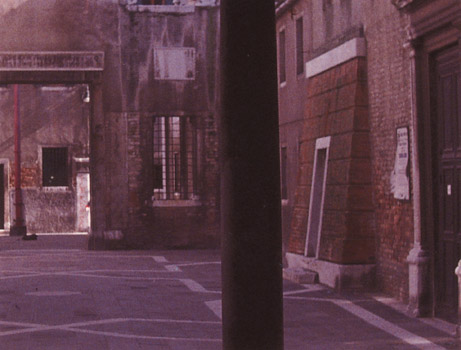
“Ruskin visits the sites of (art critic) John Ruskin’s work: London, the Alps and, above all, Venice, where the camera’s attention to masonry and the interaction of architecture
and water mimics the author’s descriptive analysis of the ‘stones’ of the city. The sound of pages turning and the image of a book, Ruskin’s Unto This Last, forcibly reminds us that a poet’s perceptions and in this case his political economy, are preserved and reawakened through acts of reading and writing”. (P. Adams Sitney)

The Suppliant
2010, 16mm, colour, sound, 5’
Filmed in USA (New York)

beavers-suppliant-1.jpg
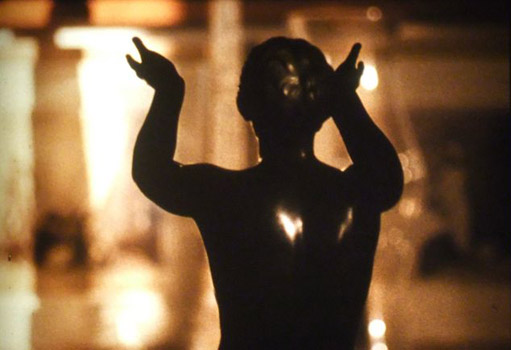
”My filming for The Suppliant was done in February 2003, while a guest in the Brooklyn Heights apartment of Jacques Dehornois. When I recollect the impulse for this filming, I remember my desire to show a spiritual quality united to the sensual in my view of this small Greek statue. I chose to reveal the figure solely through its blue early morning highlights and in the orange sunlight of late afternoon. After filming the statue, I walked down to the East River and continued to film near the Manhattan Bridge and the electrical works; then I returned to the apartment and filmed a few other details. I set this film material aside, while continuing to film and edit Pitcher of Colored Light, later I took it up twice to edit but could not find my way. Most of the editing was
finally done in 2009 then I waited to see whether it was finished and found that it was not. In May 2010, I made several editing changes and created the sound track with thoughts of this friend’s recent death.” (RB)

Pitcher of Colored Light
2007, 16mm, colour, sound, 23’
Filmed in USA (Falmouth, Massachusetts)

beavers-pitcher.jpg
“…The shadows play an essential part in the mixture of loneliness and peace that exists here. The seasons move from the garden into the house, projecting rich diagonals in the early morning or late afternoon. Each shadow is a subtle balance of stillness and movement; it shows the vital instability of space. Its special quality opens a passage to the subjective; a voice within the film speaks to memory. The walls are screens through which I pass to the inhabited privacy. We experience a place through the perspective of where we come from and hear another’s voice through our own acoustic. The sense of place is never separate from the moment.” (RB)

CARTE BLANCHE TO ROBERT BEAVERS

Marie Menken
Bagatelle for Willard Maas

US, 1958/1961, 16mm, colour, silent, 5’30”

www_menken_bagatellemaas1.jpg

Ute Aurand
India

DE, 2005, 16mm, colour, sound, 57’

dscf3151.jpg

“The first time that I viewed a film program by Marie Menken, I dismissed it; the same happened with my first viewing of a film by Ute Aurand. These filmmakers were opposite poles to my own way of filmmaking, and, in selecting this carte-blanche program, I reflect how my experience of their films has changed. Fortunately I had other occasions to see their films. The initial irritation and uncertainty suddenly opened to recognition. To experience discontent can be a sign of growth, a turning point in (my) appreciation of a film, a piece of music or a poem. Filmmakers, like Menken or Aurand, hide themselves in their directness and simplicity. Their use of handheld camera and their awareness of rhythm create a vision that draws its strength from their surroundings, but the vitality of this open embrace contains a genuine shyness or reticence. It was not until I recognized this that I could see how their lyric contains a depth.
Marie Menken’s Bagatelle for Willard Maas is a clear example. It possesses the qualities of angularity, rhythmic emphasis, sensitivity to surfaces and other means to express sensuousness, and through her spontaneity, she carries her film from one mood to the next until we reach the conclusion. And she is a collaborator; she allows Teiji Ito’s music an equal place. The film appears to meander, the way that a visitor to Versailles might, but I believe that in the change in moods there are elements of a story, one is the encounter of a gentle sphinx with a wounded slave and the other is the revolution.
Using a different metaphor to introduce Ute Aurand’s India, I could say that it is a ‘symphony’, and that her three visits to Pune are its three movements. The basic rhythm is established through her filming short clusters of images, often with camera movements that are like “little side steps,” and sometimes these clusters develop into complex rhythmic variations on the sights that she discovers as she walks, rides or drives through the city. This kaleidoscope of impressions, both of sound and image, is punctuated by pauses in which the filmmaker inserts her own presence through details of a shirt, a coffee cup, a notebook, an earring or other self-reflections in her room.
Some images have an animistic power; I remember a cluster of three small leaves at the base of a giant tree. They shiver in the wind to the sound of drums and that precedes a truly ecstatic dance-procession, one of an entire series of dances in the film.
Aurand also has the courage to approach children’s faces. She has said, “Even though I am living through what I see, what I want to reach is the invisible. The screen is a doorway; it is like my relation to the children, also a vehicle to the beyond.”
Returning once more to her camera’s “side steps”, I have only recently noticed how these movements allow her a beautiful ease and swiftness in transitions. These transitions from one subject to the next are also like music, but a music that incorporates qualities that are less dualistic than our own.
We see in these films two filmmakers using the very common opportunity of filming their travel; one is a ‘tourist’ visiting Versailles, the other is in India. But for the spectator who will look carefully, there is a generosity and probity that reaches through the surface pleasure to the embrace of life and mortality.” (RB)

——————————————————————————————————————————————————————-

PROGRAMME 2
Cinematek, Brussels
Tue 05.04.2011 19:00 (in the presence of Robert Beavers)

Early Monthly Segments
1968-70/2002, 35mm, colour, silent, 33’
Cast: Robert Beavers, Gregory Markopoulos, Tom Chomont.
Filmed in Switzerland, Germany (Berlin), and Greece.

beavers-early2.jpg
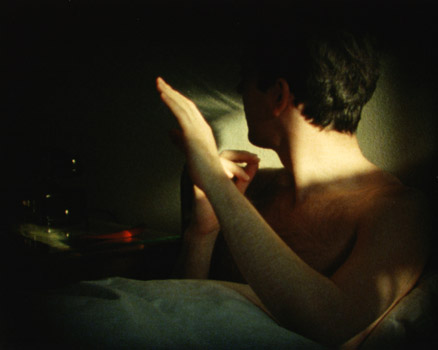
“Early Monthly Segments, filmed when Beavers was 18 and 19 years old, now forms the opening to his film cycle, “My Hand Outstretched to the Winged Distance and Sightless Measure.” It is a highly stylized work of self-portraiture, depicting filmmaker and companion Gregory J. Markopoulos in their Swiss apartment. The film functions as a diary, capturing aspects of home life with precise attention to detail, documenting the familiar with great love and transforming objects and ordinary personal effects into a highly charged work of homoeroticism”. (Susan Oxtoby)

Work done
1972/1999, 35mm, colour, sound, 22’
Filmed in Italy (Florence) and Switzerland (the Grisons).

beavers-work-done.jpg
”Bracing in its simplicity, Work done was shot in Florence and the Alps, and celebrates an archaic Europe. Contemplating a stone vault cooled by blocks of ice or hand stitching of a massive tome or the frying of a local delicacy, Beavers considers human activities without dwelling on human protagonists. Like many of Beavers’ films, Work done is based on a series of textural transformative equivalences: the workshop and the field, the book and the forest, the mound of cobblestones and a distant mountain”. (J. Hoberman)

AMOR
1980, 35mm, colour, sound, 15’
Cast: Robert Beavers.
Filmed in Italy (Rome, Verona) and Austria (Salzburg).

beavers-amor.jpg
“AMOR is an exquisite lyric, shot in Rome and at the natural theatre of Salzburg. The recurring sounds of cutting cloth, hands clapping, hammering, and tapping underline the associations of the montage of short camera movements, which bring together the making of a suit, the restoration of a building, and details of a figure, presumably Beavers himself, standing in the natural theatre in a new suit, making a series of hand movements and gestures. A handsomely designed Italian banknote suggests the aesthetic economy of the film: the tailoring, trimming, and chiseling point to the editing of the film itself.” (P. Adams Sitney).

——————————————————————————————————————————————————————-

PROGRAMME 3
Cinematek, Brussels
Thu 07.04.2011 18:00

Winged Dialogue
1967/2000, 16mm, colour, sound, 3’
Cast: Gregory Markopoulos, Robert Beavers.
Filmed in Greece (Island of Hydra)

Plan of Brussels
1968/2000, 16mm, colour, sound, 18’
Cast: Robert Beavers, Giséle Frumkin, René Micha, Jacques Ledoux, Pierre Apraxine, Dimitri Balachoff and others.
Text: “Duvelor” by Michel de Ghelderode.
Filmed in Belgium (Brussels).

Note: The final edit combines both films on a single reel.
beavers-winged.jpg
“Winged Dialogue details with growing clarity the desperate beauty and sexuality of the body animated by it’s soul, essence blindly reaching out, touching, in brilliant patterns through and beyond those of the vanishing images, expressed vividly in the after-image on the mind, on the soul’s eye”. (Tom Chomont).
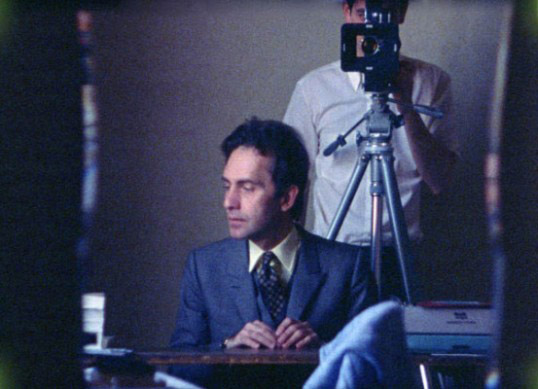
“Shedding all traces of narrative in Plan of Brussels, Beavers filmed himself in a hotel room, both at his work desk and lying naked on the bed, while in rapid rhythmic cutting, and sometime in superimposition, the phantasmagoria of people he met in Brussels and images from the streets flood his mind”. (P. Adams Sitney).

From the Notebook of …
1971/1998, 35mm, colour, sound, 48’
Cast: Robert Beavers, Gregory Markopoulos and others.
Filmed in Italy (Florence).

beavers_fromthenotebook.jpg
“From the Notebook of … was shot in Florence and takes as its point of departure Leonardo da Vinci’s notebooks and Paul Valéry’s essay on da Vinci’s process. These two elements suggest an implicit comparison between the treatment of space in Renaissance art and the moving image. The film marks a critical development in the artist’s work in that he repeatedly employs a series of rapid pans and upward tilts along the city’s buildings or facades, often integrating glimpses of his own face. As Beavers notes in his writing on the film, the camera movements are tied to the filmmakers’ presence and suggests his investigative gaze”. (Henriette Huldisch)

The Painting
1972/1999, 16mm, colour, sound, 13’
Cast: Robert Beavers, Gregory Markopoulos.
Filmed in Switzerland (Berne) and USA (Boston).

beavers-painting.jpg
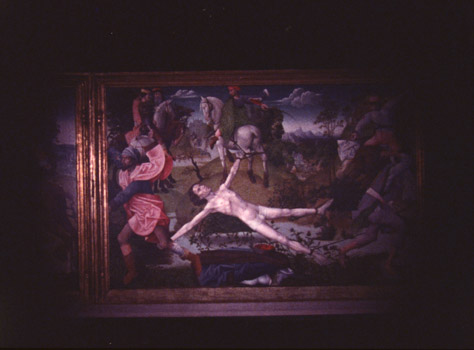
“The Painting intercuts shots of traffic navigating the old-world remnants of downtown Bern, Switzerland, with details from a 15th-century altarpiece, “The Martyrdom of St. Hippolytus”. The painting shows the calm, near-naked saint in a peaceful landscape, a frozen moment before four horses tear his body to pieces while an audience of soigné nobles look on; in the movie’s revised version, Beavers gives it a comparably rarefied psychodramatic jolt, juxtaposing shots of Gregory Markopoulos, bisected by shafts of light, with a torn photo of himself and the recurring image of a shattered windowpane”. (J. Hoberman)

——————————————————————————————————————————————————————-

Programma 4
Cinematek, Brussels
Fri 08.04.2011 20:00

Wingseed
1985, 35mm, colour, sound, 15’
Cast: Arno Gutleb. Filmed in Greece (Anavvysos, Lyssaraia).

beavers-wingseed.jpg
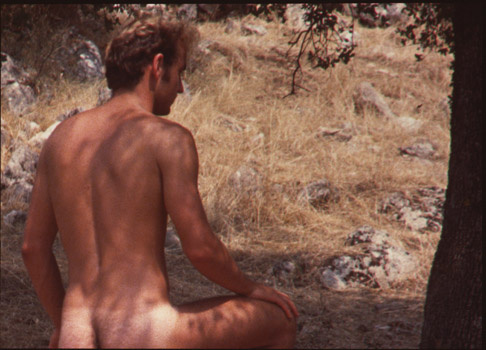
“A seed that floats in the air, a whirligig, a love charm. This magnificent landscape, both hot and dry, is far from sterile; rather, the heat and dryness produce a distinct type of life, seen in the perfect forms of the wild grass and seed pods, the herds of goats as well as in the naked figure. The torso, in itself, and more, the image which it creates in this light. The sounds of the shepherd’s signals and the flute’s phrase are heard. And the goats’ bells. Imagine the bell’s clapper moving from side to side with the goat’s movements like the quick side-to-side camera movements, which increase in pace and reach a vibrant ostinato”. (RB).

Sotiros
1976-78/1996, 35mm, colour, sound, 25’
Cast: Robert Beavers, Gregory Markopoulos.
Filmed in Greece (Athens, Sparta, Leonidion), Austria (Graz, Rein) and Switzerland (Berne).
Note: Three films are now combined within a single work.

beavers-sotiros.jpg
“In Sotiros, there is an unspoken dialogue and a seen dialogue, The first is held between the intertitles and the images; the second is moved by the tripod and by the emotions of the filmmaker. Both dialogues are interwoven with the sunlight;s movement as it circles the room, touching each wall and corner, detached and intimate”. (RB).

Efpsychi
1983/1996, 35mm, colour, sound, 20’
Cast: Vassili Tsindoukidis.
Filmed in Greece (Athens).

beavers-efpsychi.jpg
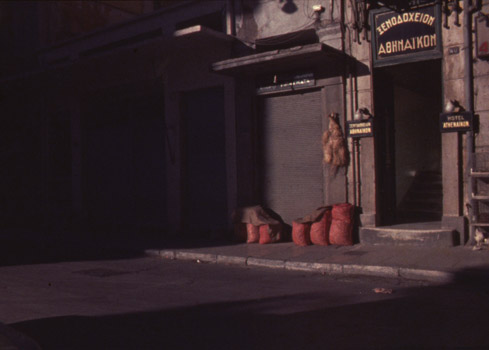
“The details of the young actor’s face – his eyes, eyebrows, earlobe, chin, etc. – are set opposite the old buildings in the market quarter of Athens, where every street is named after a classic ancient Greek playwright. In this setting of intense stillness, sometimes interrupted by sudden sounds and movements in the streets, he speaks a single word, “teleftea”, meaning the last (one), and as he repeats this word, it moves differently each time across his face and gains another sense from one scene to the next, suggesting the uncanny proximity of eroticism, the sacred and chance”. (RB).

——————————————————————————————————————————————————————-

Programma 5
Cinematek, Brussels
Sat 09.04.2011 18:00

The Hedge Theatre
1986-90/2002, 35mm, colour, sound, 19’
Cast: Robert Beavers, Gregory Markopoulos.
Filmed in Italy (Rome, Brescia).

hedgetheatre1.jpg
“Some years after filming AMOR, I returned to Italy and found the source for a new film in the architecture of Borromini and in a grove of trees with empty birdcages. (A grove of trees, a rocolo, in which hunters would set out cages with decoys, called richiami, whose song attracted other birds.) The buoyant spaces of these cupolas, the sewing of a buttonhole, and the invisible bird hunt are all elements in the sustained dialogue of The Hedge Theatre”. (RB).

The Stoas
1991-97, 35mm, colour, sound, 22’
Cast: Robert Beavers.
Filmed in Greece (Athens, Gortynia).

“The title refers to the colonnades that led to the shady groves of the ancient Lyceum, here remembered in shots of industrial arcades, bathed in golden morning light, as quietly empty of human figures as Atget’s survey photos. The rest of the film presents luscious shots of a wooded stream and hazy glen, portrayed with the careful composition on 19th century landscape painting. An ineffable, unnameable immanence flows through the images of The Stoas, a kind of presence of the human soul expressed through the sympathetic absence of the human figure”. (Ed Halter).

The Ground
1993-2001, 35mm, colour, sound, 20’
Cast: Robert Beavers. Filmed in Greece (Island of Hydra).

beavers-ground1.jpg
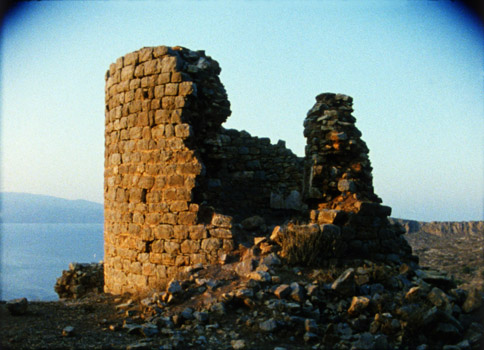
“What lives in the space between the stones, in the space cupped between my hand and my chest? Filmmaker/stonemason. A tower or ruin of rememberance. With each swing of the hammer I cut into the image and the sound rises from the chisel. A rhythm, marked by repetition and animated by variation; strokes of hammer and fist, resounding in dialogue. In this space which the film creates, emptiness gains a conour strong enough for the spectator to see more than the image – a space permitting vision in addition to sight”. (RB).

Figures of Dissent

sylvain-george-qrer-doigts-brules.jpg

Notes on cinema and politics

It’s not enough to make political films, films must also be made politically. This dictum by Jean-Luc Godard reflects the longstanding tension between politics and cinema. It’s part of the introduction to his “What is to be done?” manifest from 1970, a sharp-toned piece which references Bertolt Brecht, Dziga Vertov and Vladimir Lenin, summarising the fundamental differences between the two above-mentioned notions in forty points. “For the first”, writes Godard, “it is enough to only open the eyes and the ears. The second means to be militant”. The combative tone illustrates the attitude of the French cinephile milieu at the time, which after the revolutions of May 1968 and the following disenchantments would see the need of taking an outspoken political role, parallel to a growing realisation that cinema – their idea of cinema –had become a shadow of what it once had been, or could have been. This was the time during which Godard and the editorial staff at Cahiers du Cinéma sought solace in Maoism; a short-lived impulse that would later be dismissed as “naive”, but which is indicative of the perceived failure of the great utopias that had characterised French left-wing thinking since the Liberation. The Prague Spring, Salvador Allende’s “Chilean experiment” and the Soviet version of communism had all failed and the idea of revolution seemed to be reduced to a selling slogan in the capitalist mindset. What was left was a great open void that seemed to be filled with nothing but bursts of violence, trivialisation and narcissism. The existing theoretical paradigms did not stand a chance: the interventions in the dialectic between ideology and representation, that had dominated the pages of Cahiers du Cinéma for years, came to nothing. The tragic events of the time demanded other forms of action and reflection, which more than ever needed to be directed to exploring and cultivating the political potential of cinema. In his first article as editor in chief of Cahiers in 1973 Serge Daney wrote: “For film-makers of all leanings, in this near-open battle, in their very craft of film-making, a single problem emerges: How can political statements be presented cinematically? How can they be made positive?”.

fenzsmall1.jpg

The critical attention of Daney and many others close to Cahiers, did not go out to the verification of the effectiveness of a given “militant” cinema (“all films are militant films”) but to the exploration of the relation between filmmaker and filmed subject. The favoured term was “point de vue” (point of view), which was interpreted in at least two different ways: on the one hand, as the application of a political discourse – which thus already exists before the film is made; on the other hand, as the position taken by the filmmaker, his crew and equipment during the shooting. In the context of a demonstration, a politically committed filmmaker will for instance always film from within the crowd, with the camera among the limbs, the flags and the cries of the demonstrators, contrary to the police or television, who tend to film the crowd from above (as if in order to count or – imaginary – machine-gun). The temptation was always high to dismiss that fundamental distinction as “political”, an argument that doesn’t hold up. What is here at stake is a question of morality: is the filmmaker aware of the camera’s power of intervention, interference and provocation? Can he be truthful to his ideas and yet be respectful to the images that he has made? This accent on the idea of the “point de vue” aligns with the long-time cinephile tradition of Cahiers du Cinéma, based on the idea that each cinematographic work represents a voice and a standpoint, a vision of the world that at the same time legitimises and organises the work. It is not enough to simply emphasize what is being told in a film, it is at least as important to lay bare where, when and by whom it is told. There can be no “énoncé” (statement) without “énonciation” (enunciation). In other words, the unquestioning belief in the intrinsic power of an idea is under no circumstances enough to settle a (political or ideological) argument. In Daney’s words: “We have to know that today the struggle must encompass point of view as well as choice of subject. As our Italian comrades of La Commune remind us: ‘It is not enough to counter the false statements of the bourgeoisie. In and through our own statements we must convey a different view of the world.”

je-me-suis-arme-contre-la-justice-3.jpg

In the light of this understanding of the notions of politics and cinema, the traditional distinctions between documentary and fiction can no longer be sustained – the “framing” of reality always implies a form of fiction – but neither can the distinction between “mise en scène” (as in: staged, constructed) and the so called “direct” filmmaking (as in: from “real” life). For Daney, “bourgeoisie does not only hold the monopole of the images of reality, it also has the monopole of the mise en scène of that reality. A city, a film theatre, a public space… are already ‘mises en scène’. There is already a given use of time and space that is laid out by obligatory paths to be followed, thresholds, out of bounds”. There is no “real” world, only a configuration of what is established as real, a system of coordinates that philosopher Jacques Rancière refers to as a “police order”: an order of bodies that defines what we do and what we don’t, and assigns those bodies to a particular place and function. It is an order of the visible and the sayable that sees that a particular activity is visible and another is not, that one speech is understood as discourse and another as noise. It’s this “mise en scène”, more powerful because we are barely aware of it, that inevitably predetermines and conditions how and what to behold and film. The opposite of a mise en scène is thus not a pure, non-manipulated, direct take, but another mise en scène. The opposite of a direct take is not a mise en scène, but another take. “Another” in the sense that it makes a new perception possible. “Another” in the sense that the filmmaker takes a new position – spatially, morally, politically – in regards to what he films. It’s here that the potential of true politics resides: in breaking with the self-evidence of the “natural” order – that pushes people and things to certain positions, pins them down on a determinate time and space, assigns them to specific ways of being, seeing and saying – by reframing the given mise en scène, in search for alternative partitions of time and space, new configurations of the visible and the invisible, of speech and noise. Rancière has a word for this: dissensus.

part_4_greenville_ms_fenz.jpg

The greatest danger of our time, according to Rancière, is consensus. The term does not simply mean the agreement of political parties or social partners about the common interests of a community, it implies the resolute abolition of every form of political subjectivity, of every possibility of breaking through the dominant categories of classification and identification. By objectivising the conditions of any possible collective situation, every dispute is fundamentally neutralised: what is left are endless arguments over the administration and configuration of who and what has already been given a place and function. In other words, consensus is what reduces politics to police. Consensus, as a form of government, reduces the role of the state to that of regulating and controlling identities, space and movements, a stalemate which is greatly determined by the global economical order. As states have less control over the circulation of capital, they fall back on what is still within their power: the circulation of persons. This control, in permanent conflict with all the identities that it has not created itself, is today not only one of the principal tasks of the state; it is becoming its essential raison d’être. The recent hardening of immigration policies in many European countries and its resulting forms of stigmatisation and discrimination illustrate what has grown to become the ultimate trading mark of the consensual state: the management of (in)security. Only in the moments when the ranks are broken, when those who don’t have the right to speak raise their voices (“Nous ne sommes pas en trop, nous sommes en plus” – “We are not surplus, but a plus”), when those who don’t count make their existence known (“On est ici, on est d’ici” – “We are here, we are from here”), on those moments when the dreadful contradictions and logics of the dominant order are brought to light, only then politics becomes possible. In that sense politics always implies resistance. A resistance that is born in the refusal to accept the place that has been assigned to people and things. Politics assumes dissensus: two worlds in one.

npsvn-victoire-poing-croise.jpg

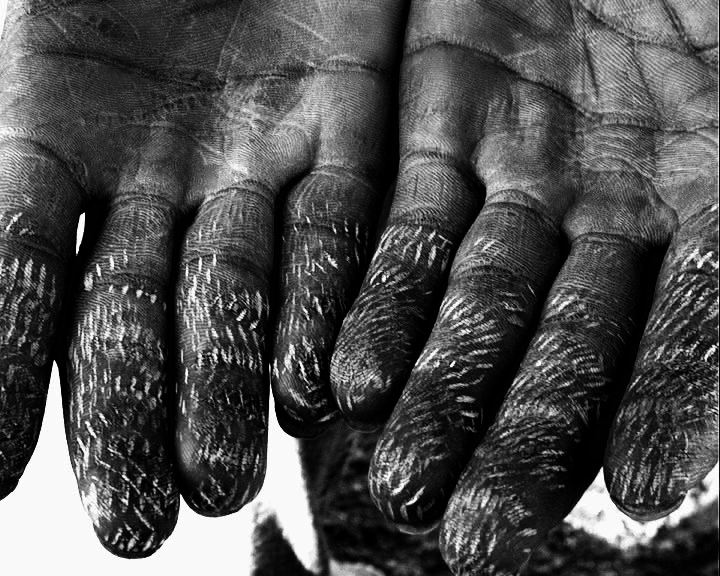
Politics situates itself not in the administration and the demonstration of the apparatus of power but in the gestures, glimpses and cries of those who are not recognised by the same apparatus. It’s in this intersection of politics and aesthetics that the work of French filmmaker Sylvain George is to be found: in the struggle of the “nouveaux damnés” (“the new damned”), trapped between the rule and the exception: the outcasts, the unemployed, the “sans papiers”, the young with no voice and even less perspectives; they who are regarded within the dominant socio-political order as “surplus”: included but not belonging. But George is not the sort of filmmaker to embellish his sympathy with an overflow of commentary and explanation, nor to fall into a pedagogical ceremony of misery and sorrow. Instead of organizing his formal strategies around the worn out strategies of causality and narrative, structure and texture are put in the service of allegorical examinations where people and things have their full potential restored. Rancière writes that cinema “must agree to be the surface upon which the experience of people relegated to the margins of economic circulations and social trajectories try to be ciphered in new figures”. It is not the task of art and cinema to endorse the self-evidence of the “real”, but to seize the relation between reality and signification, between appearing and being. In the words of filmmaker Philippe Garrel, there is certainly “a solidarity between real artists and revolutionaries, because they both refuse ordinary identifications.” In the films of George representation tears itself off from itself, in search for new figurations, new trajectories between what we see and what we know. Fable-like figures, worn faces, burned hands: the body constantly takes up the space of the image, but always resisting recognition, always on the verge of disappearance. It is the perceptible tension between the visible and the invisible, presence and absence, individual and collective, that leads us to a confrontational awareness: here is life.

sylvain-george-qrerjeune-homme.jpg

“Ce qui n’a jamais été vu, n’est pas reconnu” (“What hasn’t been seen, cannot be recognised”) wrote once Daney. The consequence is clear: “on a un manque d’image” (“we have a shortage of images”). The problem is not, as it’s generally considered, that there are too many images; on the contrary: there can never be enough. The problem is that there are too few images that contest the dominant mise en scène, too few that give visibility to what is ignored by the dominant order; too many of the same, too little of the “other”. It’s not that there are no images of grief, violence, injustice and revolt; on the contrary, we get to see them regularly in the countless news reports and current affairs television shows self-evidently presenting us the state of the world. But they are always overshadowed by the faces and the voices of those who fabricate the news, those who speak with authority, the newsmakers, politicians and specialists. These are their images: their effigies that validate their words, their selection of visibilities that their words designate as relevant and in turn validate the same words. It isn’t that we don’t get to see any suffering or struggling people. But what we see are far too often bodies without a name, too many faces that do not return the gaze that we direct at them, too many voices that are spoken about, but who don’t get the chance to speak themselves. What Sylvain George’s images do is let these bodies speak for themselves: words of fire and dream, gestures of rage and despair. The spontaneous outbursts of resistance in a Paris neighbourhood in N’entre pas sans violence (2007), the voicing of hope and desperation in the harbour city of Calais in Qu’ils reposent en révolte (des figures de guerre) (2010): these are the stories of a few, who stand for the stories of many. For if there is something that we should retain, this is it: everyone has a story.

ea06-figure-5.jpg

“Aesthetisising” is a grievance often heard referring to the portrayal of misery. Making “beautiful” images in the light of the intolerable can only indicate indifference, or even worse, a gesture of “populism”. This line of thinking is the consequence of using simplistic oppositions between wealth and misery, between passivity and involvement, between what is given and what is seized. The question of aesthetics is not a matter of choosing a certain formula in order to grasp the hard “reality”. It’s a question of searching for a relation to the configuration of space and the rhythm of time, a question of experiencing and grasping the energy that space and time hold, a question of “point de vue”. This is the attitude that is imbedded in Sylvain George’s images. There is no trivial formalism hidden in the way he pays attention to the wealth of the landscapes surrounding the refugees in Qu’ils reposent en révolte; there is no cheap populism hidden in the patience with which he listens to their stories. Everything that is seized, is given back: the misery of the world, the power of speech, the possibility of resistance. This is a poetry of exchange that is also present in the films of American filmmaker Robert Fenz. His work displays a conviction that the real is not a “given”, the real can only be “framed”. That’s why the inclination to naturalism is foreign to him, as it would only be a confirmation of the dominating mise en scène. The challenge is to break though this order, to disclose it, to fracture it. “Realism must always be won”, according to Daney. Hence Robert Fenz’s preferred use of grainy black&white 16mm film, against the naturalistic impulses of the audiovisual industry. Hence his restless passion for the frame – the passion of a cameraman who understands that filming amounts to choosing. The frame, in André Bazin’s words, is a “mask”, hiding all what happens outside of it. But in Fenz’s films, the frame is much more than a delimitation of the visible: it’s an invitation to the invisible.

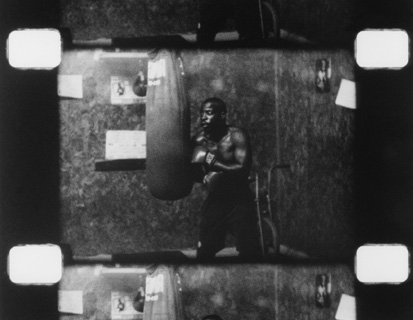
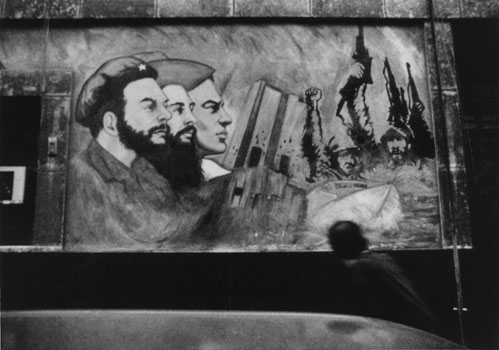
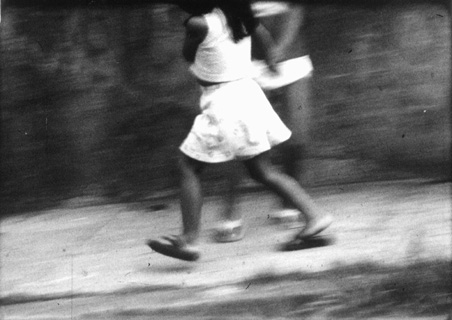
fenzsmall4.jpgMeditations on Revolution (1997- 2003) is the title of a series of films that represent the heart of Fenz’s oeuvre. “Revolution” does not refer here to the overthrow of a form of state, but to the countless nameless revolutions inscribed in rural and urban spaces, steeped in hollowed and smiling faces, dancing on the rhythms of a world in constant transition. “Revolution” takes here the form of a sensible world. A dance lesson in the bustling streets of Havana, children playing in a shanty town in Rio de Janeiro, the hard-trained torso of a boxer in Greenville, Mississippi, the proud but fatigued monologue of a jazz musician (the late Marion Brown) in New York: the politics of Fenz’s films does not lie in lecturing on economical or geo-political issues, but in the reframing of bodies, the world they live in and the place that they take in that world. Politics resides in the confrontation of power and impotence, reality and possibility, inside and outside, “here” and “there”. It lies in the way films are made. “Say how things are real”, as Godard proclaims, is what making political films implies. Making films politically: “to say how things really are”.
Sylvain George and Robert Fenz are two of the “Artists in Focus” on the Courtisane Festival 2011.

Translated from Dutch by María Palacios Cruz
Images are taken from various films by Robert Fenz and Sylvain George

ARTIST IN FOCUS: Robert Fenz

part-2-the-space-in-between.jpg

ARTIST IN FOCUS: Robert Fenz
In the context of the Courtisane Festival 2011 (Gent, March 30 – April 3 2011)

Robert Fenz (1969, Ann Arbor, Michigan) is one of the most singular and committed filmmakers breathing new life to avant-garde film traditions today. Fenz’s films, mostly shot in black and white 16mm, have a rare energy and restless beauty that recalls both the jazz-inspired imagery of New York School photographers such as Roy DeCarava, but also the landscape films of one of Fenz’s former teachers, Peter Hutton, and the documentary work of Johan van der Keuken and Chantal Akerman, some of whose recent film works have actually been shot by Fenz himself. His films are personal and poetic portraits of people and places he encountered during his many travels in countries such as in Cuba, Mexico, Brazil and India. “Though they can be viewed as non-fiction works, objectivity is not one of their pretences. Images not words are central and the primary means by which their ideas are articulated. In each case, meaning is determined by three factors, ‘intention, circumstance and chance’ ingredients filmmaker Robert Gardner describes as central to the making of a non-fiction film.” Fenz’s attitude towards filmmaking has also been greatly influenced by jazz improvisation, especially by the work of trumpeter Wadada Leo Smith, under whom he studied. “Studying music with Leo reinforced my belief that I needed to go into the world with an idea – do research on a subject and arrive at a place where I would be prepared to adapt and change the film completely, in the moment”. The most celebrated result of this approach is Meditations on Revolution, a series of five films made over seven years (1997-2003), exploring the basic theme of revolution in its purest qualities: the revolution inscribed in rural and urban spaces, steeped in hollowed and smiling faces, dancing on the rhythms of a world in constant transition. Robert Fenz has just completed one new film which will have its European premiere at the festival: The Sole of the Foot.

——————————————————————————————————————————————————————-

SCREENING-PERFORMANCE
Robert Fenz / Wadada Leo Smith
Kunstencentrum Vooruit, FRI 01.04.2011, 20:30

part_1_lonely_planet_fenz.jpgwadada3.jpg
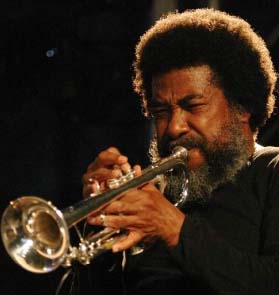
The paths of Robert Fenz and trumpeter/composer Wadada Leo Smith (1941, Leland, Mississippi) crossed ways for the first time when Fenz decided to study musical improvisation at the California Institute of the Arts. The lessons he received from Leo Smith who teaches “African-American improvisation music” there still resonate today in the films of Robert Fenz. Smith’s influential ideas go beyond the strictly musical: what matters most is the creative and subjective exploration of connections between colour and rhythm, sound and space, texture and style. It’s a philosophy that he developped in the 1960s when, together with Anthony Braxton, Leroy Jenkins and other members of the ‘Association for the Advancement of Creative Musicians’ (AACM), he transferred the focus of the American Free Jazz to an outspoken intellectual research on music as language and system. Smith introduced at the time the concept of “rhythm units”, which would be later formalised as a graphic notation system known as the “Ankhrasmation”. “I was never interested in metrical or harmonic progression. I always looked at how you make music without all those things everybody has inherited.” It’s this singularity that has established him as one of the most respected musicians of his generation and has led to affinities with Cecil Taylor, Marion Brown and many others. With his unique, lyrical form of phrasing in which what can’t be heard is as important as what is heard, he has left an indelible and unmistakable mark on the jazz music of the past decades. This performance offers a unique chance to see him at work in one of his favourite settings, the combination of an orchestration of light with a new dimension of sound.

The Sole of the Foot
US, 2011, 16mm, colour, sound, 34’

fenz_france_1.jpg
ubiety [juːˈbaɪɪtɪ]
n the condition of being in a particular place
[from Latin ubī where + -ety, on the model of society]

Origin of the English word “PLACE”:
“Middle English, from Anglo-French, open space, from Latin platea meaning broad street, from Greek plateia (hodos), from feminine of platys broad, flat; akin to Sanskrit prthu broad, Latin planta sole of the foot. Latin planta sole of the foot is ultimately from an Indo-European word meaning ‘to spread,’ which is also the ancestor of the English word place. [Pre-12th century. – Latin plantare ‘plant in the ground’ – planta ’sole of the foot’]”

“Borders (and all the politics attending the drawing of borders) exist to keep some people in (citizenship) and others out. This film is an attempt to capture the presence of people otherwise denied the political right to be at home in some place that is their home, where they have their roots, where they have their being…. (Palestinians and Israelis; North Africans in France, Cubans on the island of Cuba (their right to rule themselves denied by foreign powers).” (RF)

Meditations on Revolution
Part I: Lonely Planet

US, 1997, 16mm, b/w, silent, 12’
Part II: The Space in Between
US, 1997, 16mm, b/w, silent, 8’
Part III: Soledad
US, 2001, 16mm, b/w, silent, 14’
Part IV: Greenville, MS
US, 2003, 16mm, b/w, silent, 29’

part_4_greenville_ms_fenz.jpg
The first four films of series of five (the last one will be screened on Saturday) in which Fenz searches for the meaning and the resonance of the word “revolution” in Cuba, Brazil, Mexico and the Mississippi. “How can it be that this myth, that the entire history of the 20th century should have eliminated, hasn’t lost its power of evocation? (…) The revolution carries in itself the tireless influence of dreams, ideals and struggle. The films of Robert Fenz can never be subject to the principles of static analysis: their potential of subversion is always at work. However some traits are common to his entire oeuvre: the critical conscience, the political engagement (which differs from militantism), the desire to know what the shadows withhold, the passion for the other. Fenz reaffirms these prominent traits of his artistic humanist heritage innovating in the construction of a visual sensitivity which opens up elemental questions of idealism from concrete, sensitive and physical observation. Following the path of rhythm, creative improvisation and kinetic description, his cinematographic oeuvre develops a style that is founded on a profound faith on the power of the image – as a source of communication, as a critical tool, as an interior necessity.” (Gabriella Trujillo)

Crossings
US, 2006/07, 16mm, colour, sound, 10’

crossings.jpg
“Crossings is an abstract portrait of the border wall. Both sides are confronted. The film is a short installment on a larger project that investigates insularity in both geographical and cultural terms. It isalso my short reflection on From the Other Side, a film I worked on in 2002 by Chantal Akerman (filmed at the United States- Mexico border).” (RF)

——————————————————————————————————————————————————————-

SCREENINGS
FILM-PLATEAU, Sat 02.04.2010, 20:30

20:30 ROBERT FENZ SELECTION PART 1

Robert Fenz
Meditations on Revolution, Part V: Foreign City

US, 2003, 16mm, b/w, sound, 32’

part_5_foreign_city_image_one.jpg
The final film in Fenz’s series Meditations on Revolution. Dedicated to the director’s father, who immigrated to the United States after WWII and died in 1999. Foreign City studies New York as a place of immigration and displacement. Using abstract black and white images and actual city sounds which come in and out of synch, Fenz creates a magical foreign landscape in which the city is reconstructed through an imaginary plan, built on sensation. At the film’s center is a monologue by recently deceased artist-musician Marion Brown 11931-2010), whose proud, fatigued monologue fuses with haunting imagery of an alienating landscape.

Ken Jacobs
Perfect Film

US, 1986, 16mm, b/w, English spoken, 22’

perfect.jpg
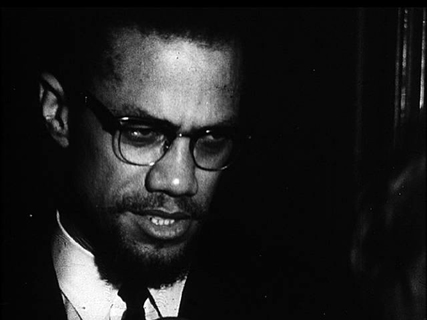
The rushes of a news report on the assassination of Malcolm X, just as they were found on a bin. “A lot of film is perfect left alone, perfectly revealing in its un- or semi-conscious form. I wish more stuff was available in its raw state, as primary source material for anyone to consider, and to leave for others in just that way, the evidence uncontaminated by compulsive proprietary misapplied artistry, ‘editing,’ the purposeful ‘pointing things out’ that cuts a road straight and narrow through the cine-jungle, we barrel through thinking we’re going somewhere and miss it all.” (KJ)

Johan Van der Keuken
Vakantie van de Filmer (Filmmakers Holiday)
NL, 1974, 16mm, colour, Dutch spoken, English subs, 38’

vakantie.jpg
“In a small, depopulated village of the Aude province of France, an elderly couple confides to the ‘vacationer’s camera their memories of the past: war, illness, death… 
The film is put together as a collection of autonomous images which, once combined, make up van der Keuken’s mental universe: family happiness, fragments of some of his earlier films, a homage to the saxophonist Ben Webster, two poems by the great contemporary poets Remco Campert and Lucebert, a portrait of the director’s grandfather, who taught him photography at the age of twelve… One of those small masterpieces one encounters by surprise…” (Jean-Paul Fargier)

22:30 ROBERT FENZ SELECTION PART 2

Jean-Marie Straub & Danièle Huillet
Trop tôt, trop tard (too early, too late)

FR, 16mm, colour, French spoken, English subs, 1981, 105’

tttt-ville.jpg
“Opening upon one of the most memorable shots ever filmed, Trop tôt, trop tard is an essay on the often tentative, yet urgent conditions of revolution. Shot in France and Egypt, the film employs a diptych structure as it attempts to (quite literally) catch the wind of past revolutions, using the writings of Friedrich Engels and Mahmoud Hussein. Shooting first in the busy roundabout of Paris’s storied Place de la Bastille, then in the outlying countryside where the seeds of revolution were once sewn, Straub and Huillet describe how the French peasants revolted ‘too early’ and succeeded ‘too late’. Alongside landscapes shot near the Nile and its delta, an Arab intellectual relates the history of the peasant resistance during the occupation by the British, who similarly employed bad timing. Much has been written about the film’s ebb and flow structure, especially by Serge Daney, who observed its musical and ‘meteorological’ play not seen since the silent era. ‘Trop tôt, trop tard is, to the best of my knowledge, one of the rare films, since Sjöström, to have filmed the wind’.”(Cinematheque Ontario)

——————————————————————————————————————————————————————-

OPENING NIGHT OF THE FESTIVAL
KASK, Wed 30.03.2011

Amongst others, Robert Fenz’ Vertical Air will be shown on the opening.

Robert Fenz
Vertical Air

US, 1996, 16mm, b/w, sound, 26′

vertical_air.jpg
The result of an experiment with sound and image, composition and improvisation, in collaboration with Wadada Leo Smith, who will perform live at Vooruit on Friday. “The musical system in Vertical Air allows not only the predetermined to blossom but also the improvised to emerge. Improvisation and its cinematographic equivalent manifest themselves from the moment of shooting, and through the composition of the frame to the editing process itself. Verticality is drawn from the simultaneity of both arts, the creation of independent melodic lines that are echoed by the editing of images traversing in a bird’s eye view the vastness of the North American territory”. (Gabriela Trujillo)