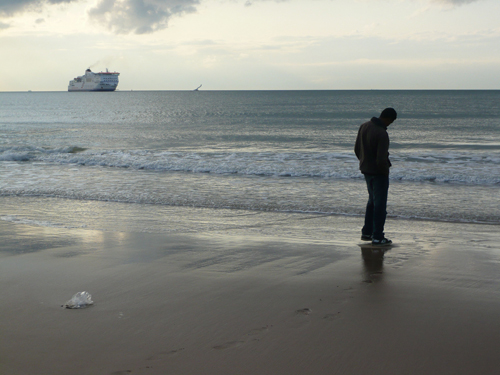
ARTIST IN FOCUS: Sylvain George

sylvain2.jpg

ARTIST IN FOCUS: Sylvain George
In the context of the Courtisane Festival 2011 (Gent, March 30 – April 3 2011)

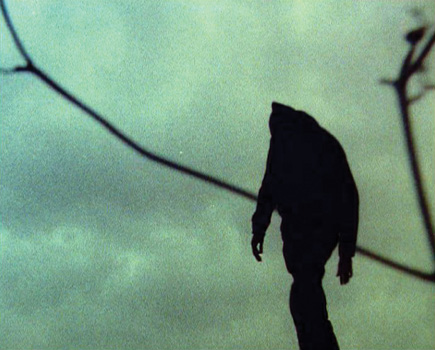
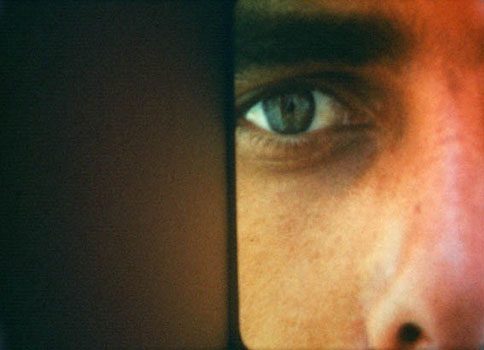
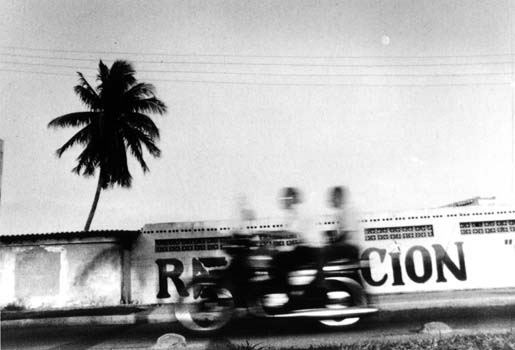
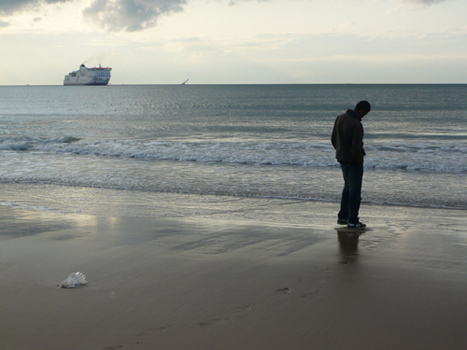
Sylvain George (1968, Vaulx-en-Velin, France) studied philosophy and worked as a social worker until he turned to filmmaking in 2004. His work, influenced greatly by the thinking of Walter Benjamin, combines militant commitment with formal experiment. “The idea”, he says, “is to make films that take a stand and assert a political position, and at the same time not to separate content from form; to be formally demanding and to manage to define an own view and grammar as a filmmaker.” Far away from any form of didacticism or dogmatism, his films – from short “contre feux” filmed with a mobile phone to elaborate feature-length documentaries – depict and allegorise the struggles of the “nouveaux damnés”, trapped between the rule and the exception: the stateless, the clandestine, the precarious. His most recent work, the impressive Qu’ils reposent en révolte (des figures de guerre), gives an account of the living conditions of migrants in Calais over a period of three years (2007-2010). “Politically speaking, it is about standing up, contesting these grey zones, these spaces or cracks like Calais standing somewhere between the exception and the rule, beyond the scope of law, where law is suspended, where individuals are deprived, stripped off their most fundamental rights. And that while creating, through some dialectic reversal, the ‘true’ exceptional states. Space-time continuums where beings and things are fully restored to what they were, are, will be, could be or could have been”. Rebellion and emancipation are at the heart of George’s films, which find true politics in the gestures, cries and bodies of those who are within the dominant socio-economical order considered as “surplus”: Included, but not belonging.

——————————————————————————————————————————————————————-
SCREENING-PERFORMANCE
Sylvain George / William Parker
Kunstencentrum Vooruit, Thu 31.03.2011, 20:30
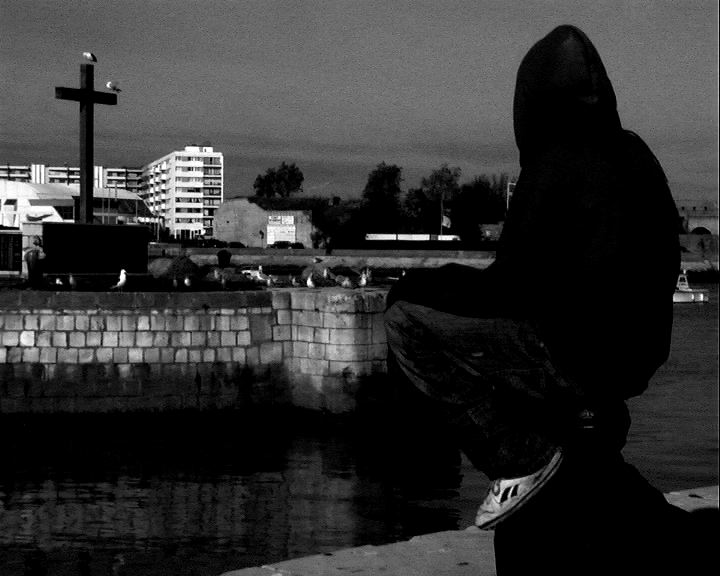
sylvain-george-qrer-hamid-croix-2.jpgwilliam_parker.jpg
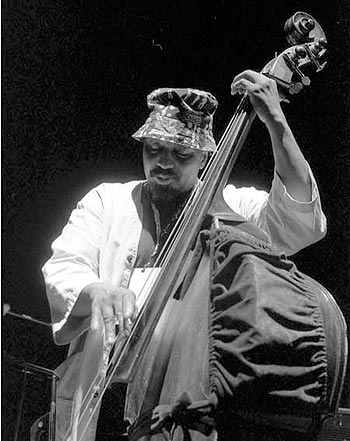
At the occasion of the Courtisane Festival, Sylvain George’s film Qu’ils reposent en révolte (des figures de guerre) will be presented for the first time with a live accompaniment by jazz legend William Parker (1952, New York). Widely acknowledged as one of the most important musicians to emerge from the experimental jazz scene in New York, Parker’s impressive career spans several decades. A master of bass improvisation, he has collaborated with musicians such as Alan Silva, Rashid Ali, Cecil Taylor, Peter Brotzmann, Derek Bailey and Hamid Drake, played in many configurations, led a number of ensembles and composed music for opera, dance and film. Cinema is one of the pillars of his musical vision – he counts among his sources of inspiration avant-garde filmmakers such as Bruce Baillie, Stan Brakhage and Jonas Mekas. He writes in one of his texts : “it is the role of the artist to incite political, social and spiritual revolution. To awaken us from our sleep and never let us forget our obligations as human beings, to light the fire of human compassion”. During this performance Parker will play the bass solo, rooting the musical spaces between bow, fingers and strings, in a dialogue between hearing and seeing, in search for a pure experience of beauty and energy. Or as a spectator to one of his concerts once described “as if his bass were raw wood he was using to light an internal fire”.

Qu’ils reposent en révolte (des figures de guerre)
FR, 2010, b/w, various languages spoken, English subs, 150’
sylvain-george-qrer-doigts-brules.jpg
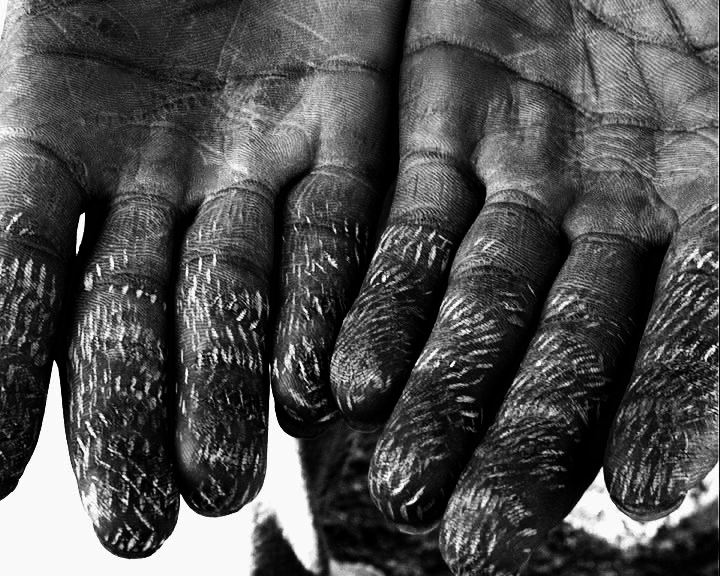
“Composed of fragments that refer back and become mixed up with each other, thus creating multiple games of temporality and spatiality, this film shows the living conditions of migrant persons in Calais over a period of three years (July 2007 to November 2010). In so doing, it shows how the policies engaged by modern police States extend beyond the law, and cause grey areas, cracks, zones of indistinction between the rule and the exception. Individuals (and primarily as enunciation of the ‘defeated,’ pariahs or contemporary plebs: refugees, displaced persons, undocumented immigrants, but also unemployed workers, young people of the poor suburbs…) see themselves thus treated like criminals; they are stripped, divested of the most elementary rights that make of them subjects of law and are reduced to the state of ‘pure bodies,’ or ‘bare lives.’ “ (SG)

——————————————————————————————————————————————————————-
SCREENINGS
FILM-PLATEAU, Sat 02.04.2010

13:00 : SHORT FILMS BY SYLVAIN GEORGE

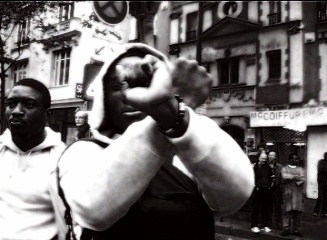
N’entre pas sans violence
FR, 2007, video, b/w, French spoken, English subs, 20’
npsvn-victoire-poing-croise.jpg
“Rage in the heart. Head-on. The mouth agape. Raids. October 2005. A neighbourhood in Paris revolts, spontaneously. Only the injustice which befalls its inhabitants day after day is equal to the echo of their despair and anger. Historical gestus which recalls the most beautiful, fragile and resistant popular fights: Spartacus’s slaves, the insurgents of the Paris commune, blacks, Latinos… Worlds that are like tighten fists, beating hearts, just as the chests rise up.” (SG)

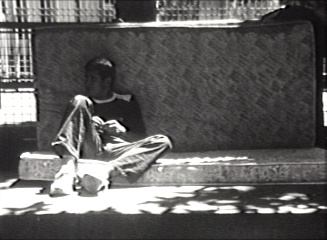
No Border
FR, 2007, Super 8 to video, b/w, French spoken, English subs, 23’
no-border-assis-sur-un-matelas.jpg
“Paris, open city. Dizziness of commemorations. Ruins. Winds. Tides. Naked eyes. The young migrants – Iraqis, Afghans, Iranians – wander in the streets, between soup kitchens and fortune camps. As they leave, they provoke a crisis of the order of things and bourgeois society. A movement of emancipation arises, profoundly melancholic, elegiac : to redefine the concept of revolution through a new concept of History”. (SG)

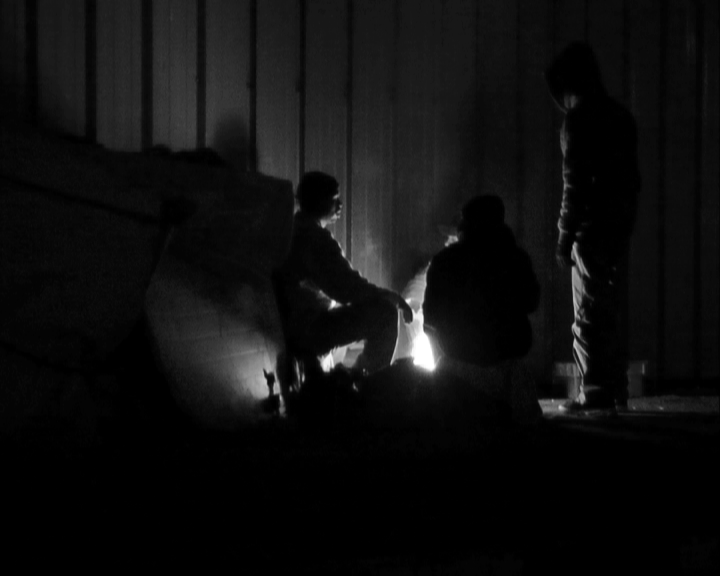
Ils nous tueront tous…
FR, 2009, video, b/w, sound, French spoken, English subs, 11’
ils-nous-tueront-tous-2.png
Part of Outrage & Rébellion, a collective film made for Joachim Gatti, a filmmaker who was badly hurt by the policie during a peaceful demonstration in Montreuil in July 2009. “Description in the dark of the night of a raid against migrants near the Calais harbour. Description, in the dark, of a political night. To choose one’s side” (SG)

14:45 : “LES JOURS DE COLERE”
compiled and presented by Sylvain George


“Every epoch dreams the next one”

— Walter Benjamin

“This world is half the devil’s and my own”
— Dylan Thomas

René Vautier
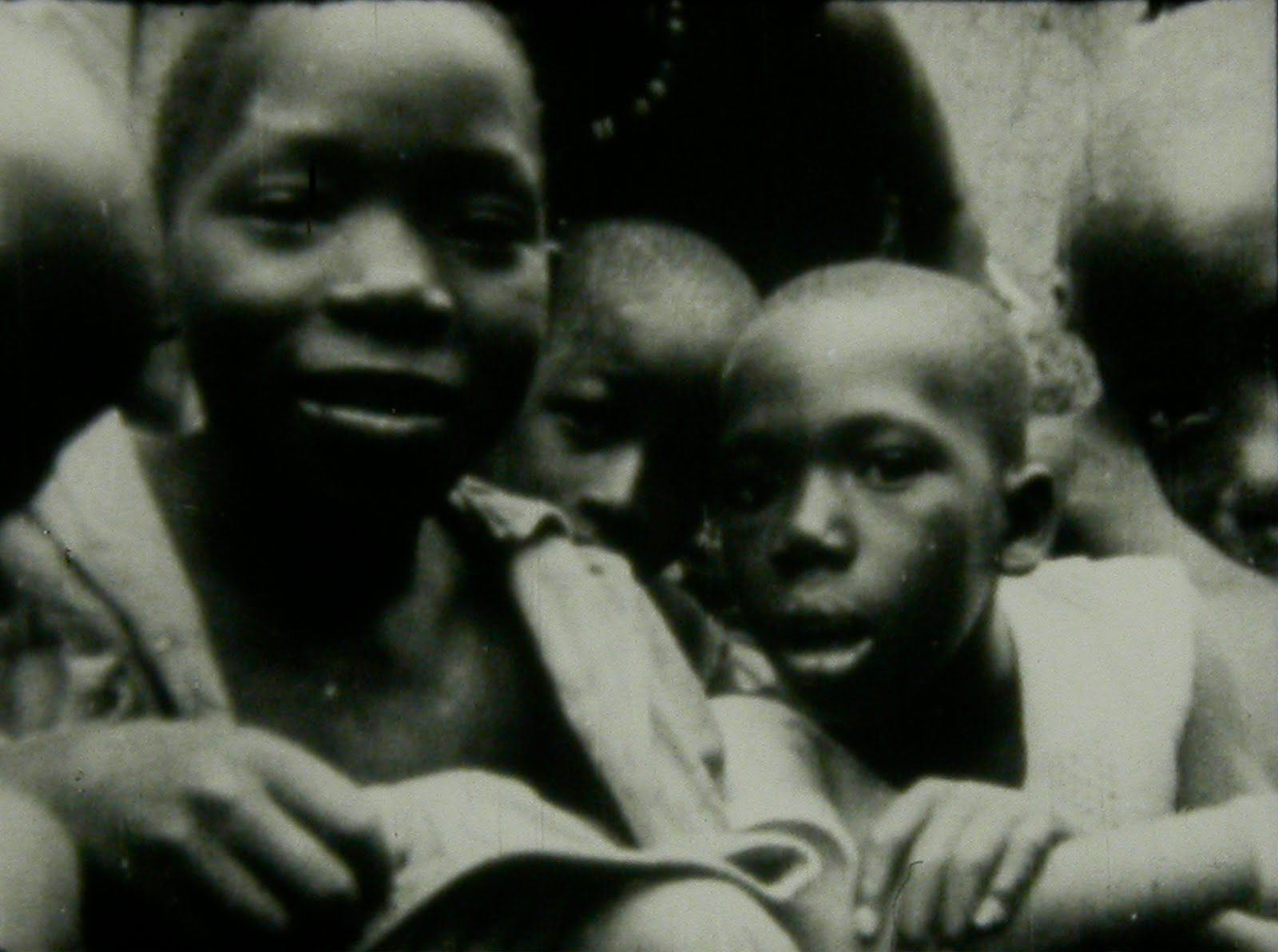
Afrique 50

FR, 1950, 16mm, b/w, French spoken, English subtitles,17′
image_afrique_50-small.jpg
“The Empire is waiting. Get involved in the colony.
Mali, the High Volta, Ivory Coast, Ghana, Burkina Faso… hunting playgrounds for the West, experimental fields for colonial, racial and economical wars. From yesterday to today, and until the revolts – isolated voices, stolen films, collective choirs – burn the arrogance of the powerful, with a roar resonating in History.” (SG)

Manoel de Oliveira
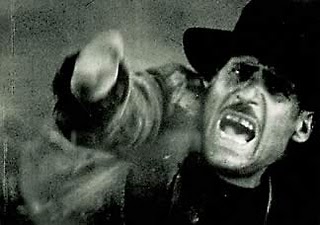
A caça

PT, 1964, 16mm, color, sound, Portugese spoken, French subtitles, 21’
a-caca-manoel-de-oliveira.jpg
“Have the wolves ever howled ?
On hunting, without fire weapons nor victims, and quicksand as conditions of common living.
Fear, destruction, the “everyone against everyone war”, mythical and dreadful nature, act here as conceptual lures, presenting the world as it doesn’t work: it’s always constructed. Men have to face themselves.
Of a film facing dictatorship.
Of revolution as gesture.”
(SG)

Angela Ricci-Lucchi & Yervant Gianikian
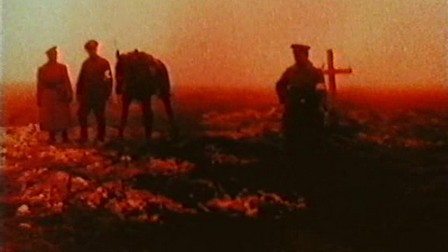
Prigionieri della guerra

IT, 2004, colour & b/w, sound, 71’
gianikian.jpg
“To resist. On the frontlines.
Soldier-men tracked down, hunted, prisoners, exhibited as trophy, deportations and working camps in Siberia and Austria, cities in ruins, scars, mass graves… Prigionieri della guerra is the first chapter of the “trilogy of war” devoted to the first world war as a “forgotten war”. Or how to wake up from the dream of an “European era” : industralised mass massacres, fascism, control societies, violence inflicted to nature, failure of classical humanism.
On the burning becoming of memory.”
(SG)

16:45 L’IMPOSSIBLE
je-me-suis-arme-contre-la-justice-3.jpg
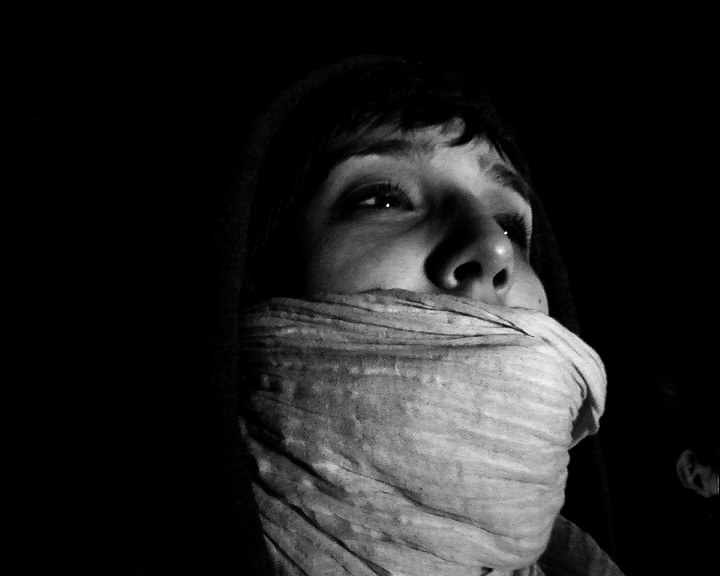
L’Impossible – Pages arrachées
2009, Super 8, DV, 16mm to video, b/w & colour, French spoken, English subs, 135’

A film in five chapters, with titles inspired by figures such as Rimbaud, Lautréamont, Dostoïevski and Benjamin, that oscillates between Calais and Paris, black&white and colour, sound and silence. “To pan wide, to gather food for eye and mind, such is the project. Because Sylvain George, as we have come to understand, perceives his film-making activity as a mission with at least a dual purpose. To claim, on the one hand the avant-gardes’ formal inheritance, drawing on the unbridled vigour of their “logical revolts”. On the other hand, get these manifestations to testify for those who cry out for justice and justly call for shots other than those laid down by prevailing standards. Evocative, though with precise dates and references, silent while at the same time in quest of the most just eloquence, this cinema seeks to bring together both the past and what is as yet unnamed.“ (Jean-Pierre Rehm)

——————————————————————————————————————————————————————-
OPENING NIGHT OF THE FESTIVAL
KASK, Wed 30.03.2011

Amongst others, Sylvain George’s contre feux n° 3 & 4 will be shown, a selection of what he considers “petites formes”, excerpts from a series of intervention films.

Europe année 06 (Fragments Ceuta)
FR, 2006 – 2008, video, French spoken, English subs, 21’

ea06-figures-3.jpg
“Rimbaud/Genet/Buñuel/Rossellini/Pasolini… A group of Algerian teenagers survive in an abandoned warehouse in Ceuta, waiting to reach Europe. A certain idea of youth is at stake. Of youth as migration, and of migrations as the spring that occurs every new year. The spring or the awakening of sexes as would say Pasolini, the art of encounter and a vagabond heart, forcing Europe and the established order to reflect on what they are: old (Postures of withdrawal. Self preservation. Fear). You will never be able to escape them anymore.” (SG)

Un homme idéal (Fragments K.)
FR, 2006 – 2008, video, French spoken, English subs, 12’

un-homme-ideal-image-tv.jpg
“A man walks in the city. Paris. Mister K. Just like the 30.000 families who have put their last hope in the circular of S., Mr K. waits and waits and waits… And while he waits, we discover a petrified face, that of French society in state of war…” (SG)
Change the World

tunisia-riots-17012011-03.jpg

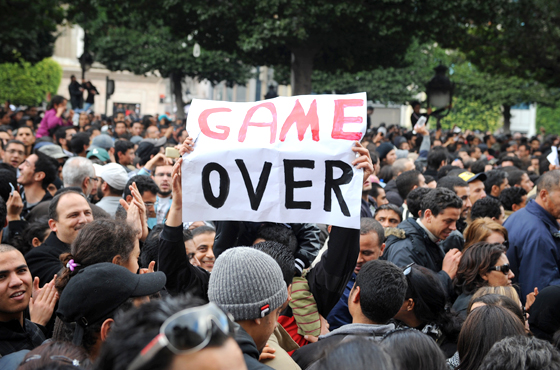
Are we in a time of riots? Below you’ll find a rough translation of Daniel Fischer’s transcription of the 19 January 2011 session of Alain Badiou’s seminar Que signifie « changer le monde » ? (What does “change the world” mean?), as found on Jonathon Collerson’s blog. “It is not something Badiou has written out. Nevertheless, it gets across his, apparently, impromptu comments on Tunisia, riots and revolution. It appears that Badiou correctly places the riot at the gateway of revolution and, in calling Tunisia “the weakest link” (Lenin re. Russia 1917), correctly notes the beginning of massive change in the Middle East. Daniel Fischer’s excellent notes are great resource on Badiou’s developing thought.”

Today I’ll talk to you about the riots in Tunisia. We won’t leave the subject of this year’s seminar — What does “change the world” mean? – an expression whose ambiguous character I’ve already described to you.

If by “riots” we mean the street actions of people who want to overthrow the government by means of varying levels of violence, we must at once emphasise what makes these Tunisian riots rare: they have been victorious. A regime seemed securely in place for 23 years and here it is overturned by a popular action which, ipso facto, retroactively establishes it as the “the weakest link”. Why should we analyse this phenomenon, when we could just let ourselves rejoice? A vague uneasiness makes itself felt in the requisitely contented character, let’s call it a consensual character, that must be displayed in spite of the inherent illegality of the events concerned. Today it isn’t easy to declare: “I love Ben Ali, I’m truly heartbroken that he must leave power.” When one says that, one finds oneself in a very bad position. The reason we must pay tribute to minister Alliot-Marie, who publicly regretted her delay in putting the “know-how” of the French police force at the service of Ben Ali, is that she expressed aloud what her political colleagues only whispered. Next to her, Sarkozy is a hypocrite and a coward. Just as everyone, Right and Left, who, in only a few weeks, were congratulating themselves on having Ben Ali as a solid bulwark against Islamism and an excellent pupil of the West, are today forced, because of a consensus of opinion, to pretend to rejoice in his departure, tail between legs.

Once again: a government overthrown by popular violence (and in particular by the young, who spearheaded it) is a rare event for which you must go back thirty years if you want to find a comparable precedent, namely to the Iranian Revolution (1979)*. Thirty years during which the dominant conviction was that such events were no longer really possible. The thesis of “the end of history” made this claim. That thesis obviously didn’t mean that nothing more would happen: “the end of history” meant “the end of events in history [l’événementialité historique]“, the end of a moment where the organisation of power could be overthrown in favour of, as Trotsky said, “the masses entering on the stage of history”. The normal course of things was the alliance of the market economy and parliamentary democracy, an alliance that was the only tenable norm of the general subjectivity. Such is the meaning of the term “globalisation”: this subjectivity became global subjectivity. Furthermore, this wasn’t incompatible with punitive wars (Iraq, Afghanistan), civil wars (in dysfunctional African states), repression of the Palestinian Intifada, &c. So what is fascinating above all else in the Tunisian events is their historicity, they demonstrate that the capacity to create new forms of collective organisation is intact.

The ensemble formed by the market economy and parliamentary democracy, an ensemble given as an insuperable norm, I propose to name: “the West” – and this is what it calls itself. Among the other names in circulation, we note “international community”, “civilisation” (where it is opposed to, as its right, the diverse forms of barbarism, cf. the expression “clash of civilisations”), “Western powers” … Remember that more than thirty years ago the only group who claimed this name — “Occident” — as their standard was a small group of fascists weilding iron bars (with whom I had to deal in my youth). That a name’s referent can change so dramatically can only mean that the world itself has changed. The world no longer has the same transcendental.

Are we in a time of riots?

You could think that, seeing recent events in Greece, Iceland, England, Thailand (the coloured shirts), the hunger riots in Africa, the considerable workers’ riots in China. Also in France, there is something like a pre-riot tension; through phenomena like the factory occupations, people are on the verge of accepting riots.

As an explanation, there is of course the systemic crisis of capitalism that became visible two or three years ago (and is far from finished) with its procession of social impasse, poverty, and the growing feeling that the system is not viable nor as magnificent as was previously said; the vacuity of political regimes has become manifest, service to the economic system is their only purpose (the “save the banks” episode was particularly demonstrative), which contributes greatly to their discrediting. In the same period, and precisely because they are the operators of systemic survival, states have taken dramatically reactionary measures in more and more areas (railways, post, schools, hospitals…).

I’d like to try and locate these phenomena in the framework of a historical periodisation. In my opinion, the rioters’ disposition arises in interval periods [périodes intervallaires]. What is an interval period? There is a sequence in which revolutionary logic is clarified and where it explicitly presents itself as an alternative, succeeded by an interval period where the revolutionary idea has not been passed on to anyone [déshérence], and in which it hasn’t yet been taken up, a new alternative disposition has not yet been formed. During such periods the reactionaries can say, precisely because the alternative is impaired, that things have returned to their natural course. Characteristically, this is what happened in 1815 with the restorers of the Holy Alliance. In interval periods, discontent exists but it can’t be structured because it is unable to draw its force from a shared idea. Its power is essentially negative (“make them go away”). This is why the form of mass collective action in an interval period is the riot. Take the period 1820-1850: it was a grand period of riots (1830, 1848, the revolt of the Canuts of Lyon); but it doesn’t mean they were sterile, they were haphazard [aveugle] but very fertile. The great global political orientations that were the hinge [vertébré] of the next century emerge from that period. Marx says it well: the French workers’ movement was one of the sources of his thought (beside German philosophy and English political economy).

What are the criterion for evaluating riots?

The particular problem of the riot, in as much as it calls state power into question, is that it exposes the state to political change (the possibility of its collapse), but it doesn’t embody this change: what is going to change in the state is not prefigured in the riot. This is the major difference with a revolution, which in itself proposes an alternative. That is the reason why, invariably, rioters have complained that a new regime is identical to an old one (it’s model, after the fall of Napoleon III, is the constitution on 4 September of a regime made up of the old political staff). Notice that the party, of the type [concept] that was created by the RSDLP then by the Bolsheviks, is a structure explicitly designed to constitute itself as an alternative power in place of the state. When the figure of the rioter becomes a political figure, i.e. when it has in itself the political body that it needs and recourse to an inveterate politics [aux vieux chevaux de la politique] becomes useless, we can say that that moment there is the end of the interval period.

To return to the Tunisian riot, it is very likely that it is itself going to continue – and divide itself – by proclaiming that the figure of power that will be in place is so disconnected from the popular movement that it doesn’t want it either. On what criteria, then, can we evaluate the riot? In the first place, one must have a definite empathy towards the riot, this is an absolutely necessary condition. Another criterion is the recognition of its negative power, the hated power collapses at least symbolically. But what is affirmed? The Western press has already responded by saying that what was expressed there was a desire for the West. What we can affirm is that a desire for liberty is involved and that such a desire is without debate a legitimate desire under a regime both despotic and corrupt as was that of Ben Ali. How this desire as is a desire for the West is very uncertain.

It must be remembered that the West as a power has so far given no proof that it cares in any way at all about organising liberty in the places where it intervenes. The account of the West is: “are you walking with me or not?”, giving the expression “walk with me” a signification internal to the market economy,** if necessary in collaboration with counter-revolutionary police. “Friendly countries” like Egypt or Pakistan are just as despotic and corrupt as was Tunisia under Ben Ali, but we’ve heard little expressed about it from those who have appeared, on the occasion of the Tunisian events, as ardent defenders of liberty.

How can we define a popular movement as reducible to “a desire for the West”? We could say, and this definition applies to any country, that it involves a movement that realises itself in the figure of the anti-despotic rioter whose negative and popular power takes the form of the crowd and whose affirmative power has no other norm than those the West invokes. A popular movement meeting this definition has every chance of ending in elections and there is no reason for another political perspective to develop. I claim that at the end of such a process, we will have witnessed the phenomena of Western inclusion. For what we call the Western press, this phenomena is the ineluctable result of the riot’s development.

If it is true that, as Marx predicted, the space where emancipatory ideas are realised is a global space (which, incidentally, wasn’t the case with the revolutions of the Twentieth Century), then the phenomena of Western inclusion cannot be part of genuine change. What would genuine change be? It would be a break with the west, a “dewesternisation”, and would take the form of an exclusion. A dream, you are thinking; but it is precisely a dream typical of an interval period like ours.

If there were a different evolution than the evolution toward Western inclusion, what could that attest to? No formal response can be given here. We can simply say there is nothing in the analysis of the state’s process which, through long and torturous necessity, will eventually result in elections. What is required is a patient and careful inquiry among the people, in search of that which, after an inevitable process of division (because it is always the Two that carries a truth, and not the One), will be carried by a fraction of the movement, namely: declarations [des énoncés]. What is stated can by no means be resolved within Western inclusion. If they are there, these declarations, they will be easily recognisable. It is under the condition of these new declarations that the development of the organisation of figures of collective action can be conceived.

We return, to conclude, to empathy. The lesson to draw from the Tunisian events, the minimal lesson, is that what appears as unfailing stable can itself in the end collapse. And that is reassuring, very reassuring (Et ça, ça fait plaisir, et même très plaisir).

— Badiou ended the lecture with a poem by Bertold Brecht’s “In Praise of Dialectics”:

Today, injustice goes with a certain stride,
The oppressors move in for ten thousand years.
Force sounds certain: it will stay the way it is.
No voice resounds except the voice of the rulers

And on the markets, exploitation says it out loud:
I am only just beginning.

But of the oppressed, many now say:
What we want will never happen

Whoever is still alive must never say ‘never’!
Certainty is never certain.
It will not stay the way it is.

When the rulers have already spoken
Then the ruled will start to speak.
Who dares say ‘never’?

Who’s to blame if oppression remains? We are.
Who can break its thrall? We can.

Whoever has been beaten down must rise to his feet!
Whoever is lost must fight back!
Whoever has recognized his condition – how can anyone stop him?
Because the vanquished of today will be tomorrow’s victors
And never will become: already today!

(Translation: David Riff)

* The fall of the communist regimes of Eastern Europe 20 years ago is not comparable. They fell with the consent of the USSR, this was symbolised in a meeting between the East German leader Honecker and his Russian guardians: when he asked their permission to fire on the crowd (a necessary step for him), he was refused this permission. Change to the communist power structure was made by the same apparatchiks who installed themselves at the head of what remained of their system before it imploded.

** [trans.] The French verb ‘to walk’ is marcher and the French for Market Economy is l’économie de marché; Badiou is playing on marcher and marché here.

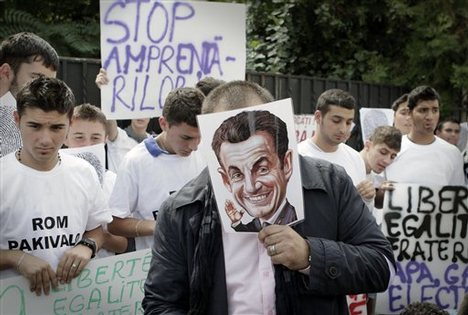
Racism: A Passion from Above

roma.jpg

“Il serait peut-être temps de réorienter la pensée et le combat contre une théorie et une pratique de stigmatisation, de précarisation et d’exclusion qui constituent aujourd’hui un racisme d’en-haut: une logique d’Etat et une passion de l’intelligentsia”
– Jacques Rancière, 11 September 2010

This is a thought-provoking piece by Jacques Rancière, based on a talk he gave during the conference ‘Les Roms, et qui d’autre?‘ (“The Romas, and Who Else?”. Montreuil, 11.09.2010), which was organised in response to the French government’s expulsions of Romas from its territories, as well as the broader processes of ethnicisation, racialisation and securitization enforced by the French political administration. Both this translated version and the original French text (“Racisme, une passion d’en haut”) were published by Mediapart.

“I would like to propose a few thoughts concerning the notion of “state racism,” which is on the agenda for our meeting today. These thoughts counter a very widespread interpretation of the measures recently taken by our government, including the law [of 2004] banning the Islamic headscarf in public schools and the deportations of Romas in summer 2010. That interpretation sees in these measures an opportunistic exploitation of racist and xenophobic themes for electoral purposes. This purportedly critical attitude thus clings to the premise that racism is a popular passion – the frightened and irrational reaction of the reactionary strata of the population, which is unable to adapt to the new mobile and cosmopolitan world. The state is accused of betraying its principles by indulging those populations. Its position as the representative of rationality in the face of popular irrationality is thereby consolidated.

Now, this view of the game adopted by supposedly leftist critics is exactly the same one the right has used to implement certain racist laws and decrees over the last 20 years. All these measure have been taken in the name of the same rationale: there are problems of delinquency and other threats because of immigrants, including illegal immigrants, and these are in danger of unleashing racism unless measures to restore order are taken. Consequently, this delinquency and these threats must be subject to the law’s universality so that they do not create racist disturbances.

That’s the game that has been played out on the left as well as the right ever since the Pasqua-Méhaignerie laws of 1993. It consists of counterposing the universalist logic of the rational state to popular passions, that is, giving racist state policies anti-racist credentials. It’s high time to turn the argument around and note the close correspondence between state “rationality” used to justify these measures and the convenient “other” or complicit adversary the state proposes as a foil: popular passion. What we see in fact is not the government acting under the pressure of populist racism and in reaction to the so-called populist or far-right passions. Rather, it’s state policy that fosters the image of this “other” to which it confides imaginary responsibility for its real legislation.

Fifteen years ago, I proposed the term “cold racism” to designate this process. The racism we are dealing with today is a deliberate racism, an intellectual construction. It is primarily a creation of the state. In this gathering, we’ve discussed the relationship between the rule of law and the police state. But it’s in the very nature of the state itself to be a police state, that is, an institution that determines and controls identities, space and movements – an institution in permanent struggle against any surplus of identities beyond those it creates, and thus, as well, against the surplus of identity logics affirmed through the action of political subjects. The global economic order only makes the state’s labors in this area more insistent. Our states are ever less able to counter the destructive impact of the free circulation of capital on the communities for which they are responsible. They are all the more unable in that they have no desire whatsoever to do so. They, therefore, fall back on what is within their power: the circulation of persons. They make the control of this other circulation their specific object, and define as their objective the security of their nationals threatened by these migrants. In more precise terms, they are engaged in the production and administration of insecurity, this work becoming more and more their raison d’être and the means of their legitimation.

Hence their use of the law fulfills two essential functions: an ideological function, which is to constantly provide the subject that threatens security a face; and a practical function, which is to constantly reorganize the border between the inside and the outside and to constantly create floating identities, which can make what was once inside fall outside. Legislating on immigration meant, first of all, creating a category of sub-French and making people who were born on French soil of French-born parents fall into the floating category of immigrants. Legislating on illegal immigration meant making legal “immigrants” fall into the category of illegals. It’s the same logic again that dictated the recent use of the notion of “French of foreign origin.” And it’s the same logic that targets the Romas today, by creating – against the very principle of free circulation of persons within the boundaries of Europe – a category of Europeans who aren’t really Europeans, just as there are French who are not really French.

To create these suspended identities, the state does not trouble itself about contradictions, as we’ve seen with its measures concerning “immigrants.” On the one hand, it creates discriminatory laws and forms of stigmatization based on the idea of citizen universality and equality before the law. Those whose practices are said to oppose citizen equality and universality are, thus, punished and/or stigmatized. On the other hand, within this citizenship – supposedly identical for all persons – it creates discriminatory categories such as those that distinguish French “of foreign origin.” Consequently, on the one hand, all French citizens are the same and woe to anyone who is not; on the other hand, all citizens are not the same and woe to anyone who forgets it!

Thus, today’s racism is a rationalization of the state and not a popular passion. And this state logic is sustained in the first place not by who-knows-what retrograde social groups, but by a good portion of the intellectual elite. The most recent racist campaigns were not at all the product of the so-called “populist” far right. They were conducted by an intelligentsia which claims to be leftist, republican and secular. Discrimination is no longer based on arguments about superior and inferior races. It is supported on the basis of the struggle against “communitarianism” [i.e. the particularism of ethnic or religious communities] on the basis of the universality of the law, the equality of all citizens in the eyes of the law and equality between the sexes. Here again, its proponents don’t trouble themselves too much over the contradictions; they don’t otherwise show much concern with equality or feminism. In fact, the argumentation has the effect above all of creating the composite stereotype necessary to identify undesirable subjects: thus, the conflation among migrant, immigrant, reactionary, Islamist, male chauvinist and terrorist. The reference to universalism is, in fact, manipulated to the benefit of its opposite: the establishment of a discretionary state power to decide who belongs or doesn’t belong to the class of those who have the right to be here – the power, in short, to confer or cancel identities. Correlative to this power is the power to force individuals to be identifiable at all times, to confine themselves to a place of full visibility by the state. It is worth reviewing from this perspective the solution the government found to the legal problem posed by the prohibition of the “burqa” or “full Islamic veil.” It was, as we saw, difficult to enact a law that specifically targeted a few hundred people of a particular religion. The government found the solution: a general prohibition of covering one’s face in public through a law that simultaneously targets the woman wearing a full veil and the demonstrator wearing a mask or a scarf. Thus, the headscarf becomes the common emblem of the backward Muslim and the terrorist agitator. It was “republican” thought that provided the formula for that solution, adopted – like a great many other immigration measures – with the benevolent abstention of the “left.” Let us remember the furious diatribes of November 2005 against masked and hooded youth acting by night. Let us also remember the triggering event of the Redeker Affair, in which philosophy professor Robert Redeker was threatened by an Islamic “fatwa.” His pretext for his vehement anti-Muslim diatribe was … the ban on wearing g-strings when Paris turned the banks of the Seine into a public beach. In this prohibition by Paris city hall, Redeker detected a measure of deference to Islamic fundamentalism and to a religion whose potential for hatred and violence was supposedly demonstrated by its prohibition of being naked in public. The noble talk of secularism and republican universalism in the end boil down to the principle that one ought to be entirely visible in public space, whether it’s paved or sandy.

In conclusion: much energy has been spent combating a certain kind of racism as embodied in particular by the National Front, and a certain conception of racism as the expression of white “rednecks” (“petits blancs”) representing the backward strata of society. A good part of that energy has been channeled into constructing the legitimacy of a new form of racism: state racism and “left” intellectual racism. Perhaps it’s time to direct our thought and struggle against a theory and practice of stigmatization, marginalization and exclusion that today constitute a top-down racism (“un racisme d’en-haut”): a rationalization of the state, a passion of the intelligentsia”.

Courtisane 2011 Artists in Focus

aifsylvain3.jpg

I’m very happy to announce we will have three amazing “Artists in Focus” as guests on next year’s Courtisane Festival, which will take place from Wednesday March 30 until Sunday April 3 2011, in various locations in Ghent (Belgium). These artists-filmmakers will present a combination of their own work – as screening and/or performance, in collaboration with selected musicians – and their personal sources of inspiration.

Here’s a preview. More news on the full programme will soon be available on www.courtisane.be.

aifbeavers.jpg

Robert Beavers (1949, Brookline, Massachusettes) is considered as one of the most important avant-garde filmmakers from the second half of the 20th century. He’s also the most European of American artist filmmakers, since he has been living and working in Europe since 1967, shooting most of his films travelling between Italy, Greece and Switzerland, where the Temenos Archive is located. Founded by Beavers and the late Gregory Markopoulos, this archive preserves the entirety of their film oeuvre as well as all related documentation material. Until the late 1990s, Beavers rarely presented his films, but recently restorations of his films have been shown at the Austrian Film Museum in Vienna, Tate Modern in London, the Berkeley Art Museum and Pacific Film Archive in Berkeley and the Whitney Museum of American Art in New York. Having lived briefly in Belgium in the late sixties, this will be the first time in several decades that his work is screened here. “Since leaving the USA in 1967, Robert Beavers has laboured in relative isolation on works whose goal ‘is for the projected film image to have the same force of awakening sight as any other great image.’ His meticulously crafted films are at once lyrical and rigorous, sensuous and complex. Whilst communicating his response to the landscapes, architecture and traditions of the Mediterranean and Alpine countries in which they were filmed, they also incorporate deeply personal and aesthetic themes. Rarely seen in public, Robert Beavers’ remarkable body of work is a celebration of light, life and colour.” (Mark Webber)

A selection of Robert Beavers’ work will be shown as part of the Courtisane festival in Ghent. The week after he will present several programs of his films at Cinematek, the screening theatre of the Belgian Royal Film Archive in Brussels.

Some texts, essays and interviews are available here and here

aiffenz.jpg

Robert Fenz (1969, Ann Arbor, Michigan) is among the more exciting and original young filmmakers working in and against the avant-garde tradition today. Fenz’s films, mostly shot in black and white 16mm, have a rare energy and restless beauty that recalls both the jazz-inspired imagery of New York School photographers such as Roy DeCarava and Aaron Siskin and the landscape films of one of Fenz’s former teachers, Peter Hutton. An inveterate traveler, Fenz has made films in Cuba, Mexico, Brazil and, more recently, India and France. His most celebrated work is the film cycle Meditations on Revolution, filmed over seven years (1997-2003), exploring the basic theme of revolution in its purest definition: the radical transformation of a subject from one state to another, and the various forms that transformation can take. Fenz has also worked as a cinematographer on several films including Chantal Akerman’s Là-Bas and De l’autre côté (From the Other Side) . He has recently finished two new films, one of which engages the cinematic legacy of anthropological filmmaker Robert Gardner.

Fenz’ cinematographic approach has been greatly informed by music, especially by jazz improvisation. One of his inspirators was composer and master improvisationalist Wadada Leo Smith (1941, Leland, Mississippi), whose incredible forty-year career has included performances and recordings with legendary musicians Anthony Braxton, Don Cherry and Cecil Taylor. “Studying music with Leo”, said Fenz in an interview,”reinforced my belief that I needed to go into the world with an idea – do research on a subject and arrive at a place where I would be prepared to adapt and change the film completely, in the moment”. The two met when Smith, who helms the CalArts program in African American Improvisational Music, taught the filmmaker. Later the trumpeter provided the soundtrack for Vertical Air (2000), one of Fenz’s best-known films. On the occassion of the Courtisane Festival, Wadada Leo Smith will perform live with a selection of Robert Fenz’ films.

Read an interview with Fenz and Smith here

aifsylvain2.jpg

Sylvain George (1968, Vaulx-en-Velin, France) started making films in 2004, after his studies in philosophy. His work, influenced in particular by the thinking of Walter Benjamin, combines formal experiment with militant commitment. “The idea”, he says, “is to make films that take a stand and assert a political position, and at the same time not to separate content from form; to be formally demanding and to manage to define an own view and grammar as a filmmaker.” Far away from any form of didacticism, his films depict and allegorise the struggles of the “nouveaux damnés”, trapped between the rule and the exception: the stateless, the clandestine, the precarious. Most of his films explore issues related to immigration. His most recent work, Qu’ils reposent en révolte (des figures de guerre), gives an account of the living conditions of migrants in Calais over a period of three years (2007-2010). “Politically speaking, it is about standing up, contesting these grey zones, these spaces or cracks like Calais standing somewhere between the exception and the rule, beyond the scope of law, where law is suspended, where individuals are deprived, stripped off their most fundamental rights. And that while creating, through some dialectic reversal, the “true” exceptional states. Space-time continuums where beings and things are fully restored to what they were, are, will be, could be or could have been”. Rebellion and redemption are at the heart of George’s films, which find, beyond the dominant order of the visible, true politics in the gestures, cries and bodies of those who are excluded.

Music is an important factor in the films of George, who especially likes to draw upon the ethos and energy of free jazz. On the occasion of the Courtisane Festival Qu’ils reposent en révolte (des figures de guerre) will be accompanied live by William Parker (1952, New York) for the first time. One of the most vital musicians in the experimental jazz scene in New York and beyond, Parker has played with various musicians such as Alan Silva, Rashid Ali, Cecil Taylor, Peter Brotzmann, Derek Bailey and Hamid Drake. His compositional skills span a range including operas, ballets and film scores. On the festival, Parker will play the double-bass solo, exploring the interface between bow and strings. As one commentator noted: “as if his bass were raw wood he was using to light an internal fire”.

More info on George can be found here

— The two performances are produced in collaboration with art centre Vooruit —

Staring Back

chris-marker-demo18paris2006.jpeg

“The heart of the aporia seems to me to lie precisely in the necessity we face, and the impossibility we struggle against, of collectively inventing a new image of a people, a new image of the relation between membership in historical communities (ethnos) and the continued creation of citizenship (demos) through collective action and the acquisition of fundamental rights to existence, work, and expression, as well as civic equality and the equal dignity of languages, classes, and sexes.”
— Etienne Balibar, ‘We, The People of Europe? Reflections on Transnational Citizenship.‘

In a recent edition of the Oxford Art Journal I found an interesting thinking piece about Chris Marker’s Staring Back, titled ‘Towards a New Image of Politics‘, written by Vered Maimon. As in the recently published Communities of Sense – a book Maimon co-edited – the article attempts to plug into critical discourse about politics and aesthetics, put forward by Jacques Rancière (see earlier post) and Etienne Balibar, amongst others. As it happens, Rancière himself mentioned Marker’s remarkable project, consisting of a series of still black and white photographic portraits documenting his long standing engagement with political resistance and the human face, in an insightful interview with Fulvia Carnevale and John Kelsey (published in Art Forum, March 2007):

“If there is a circulation that should be stopped at this point, it’s this circulation of stereotypes that critique stereotypes, giant stuffed animals that denounce our infantilization, media images that denounce the media, spectacular installations that denounce the spectacle, etc. There is a whole series of forms of critical or activist art that are caught up in this police logic of the equivalence of the power of the market and the power of its denunciation. The work of dissensus is to always reexamine the boundaries between what is supposed to be normal and what is supposed to be subversive, between what is supposed to be active, and therefore political, and what is supposed to be passive or distant, and therefore apolitical.”

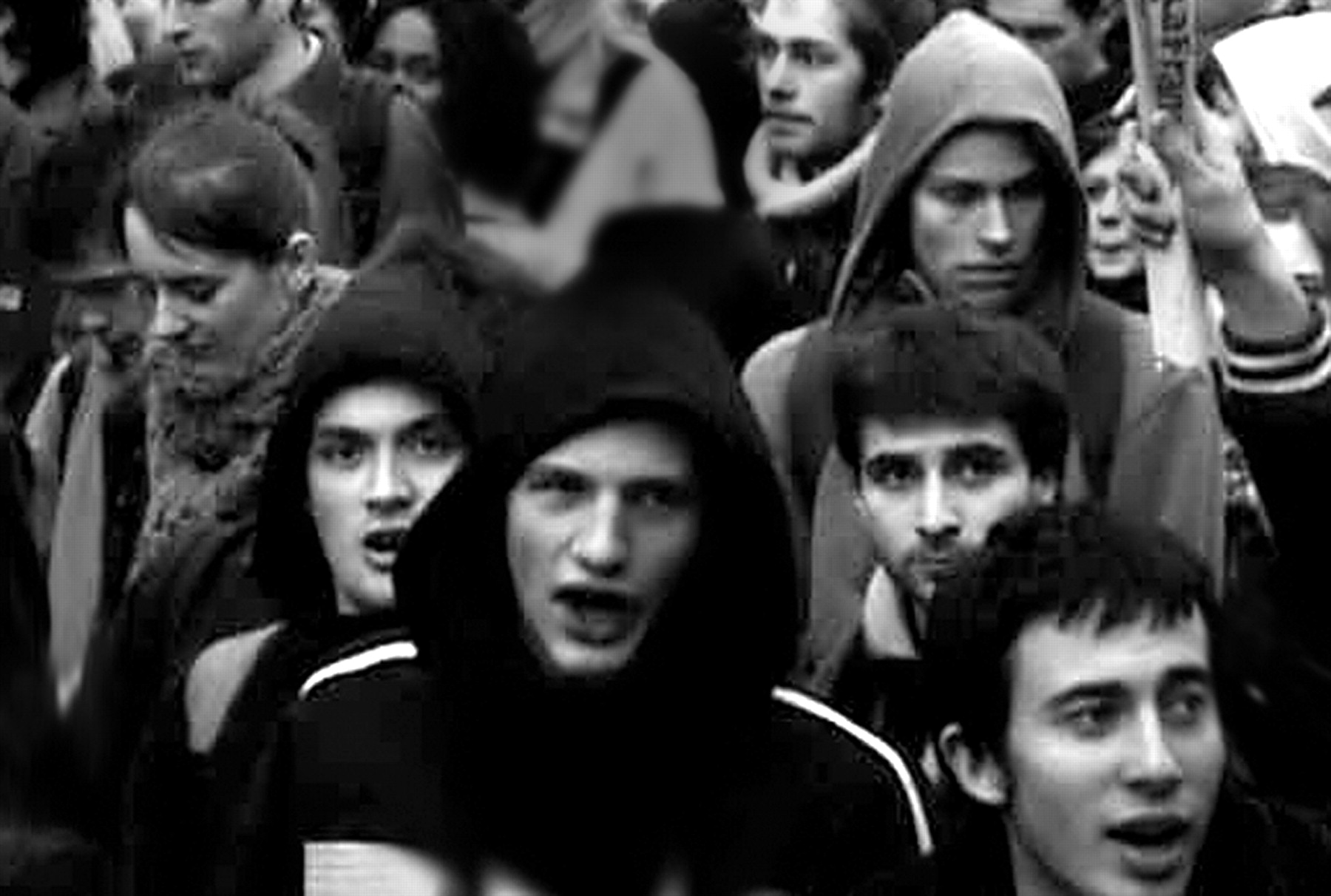
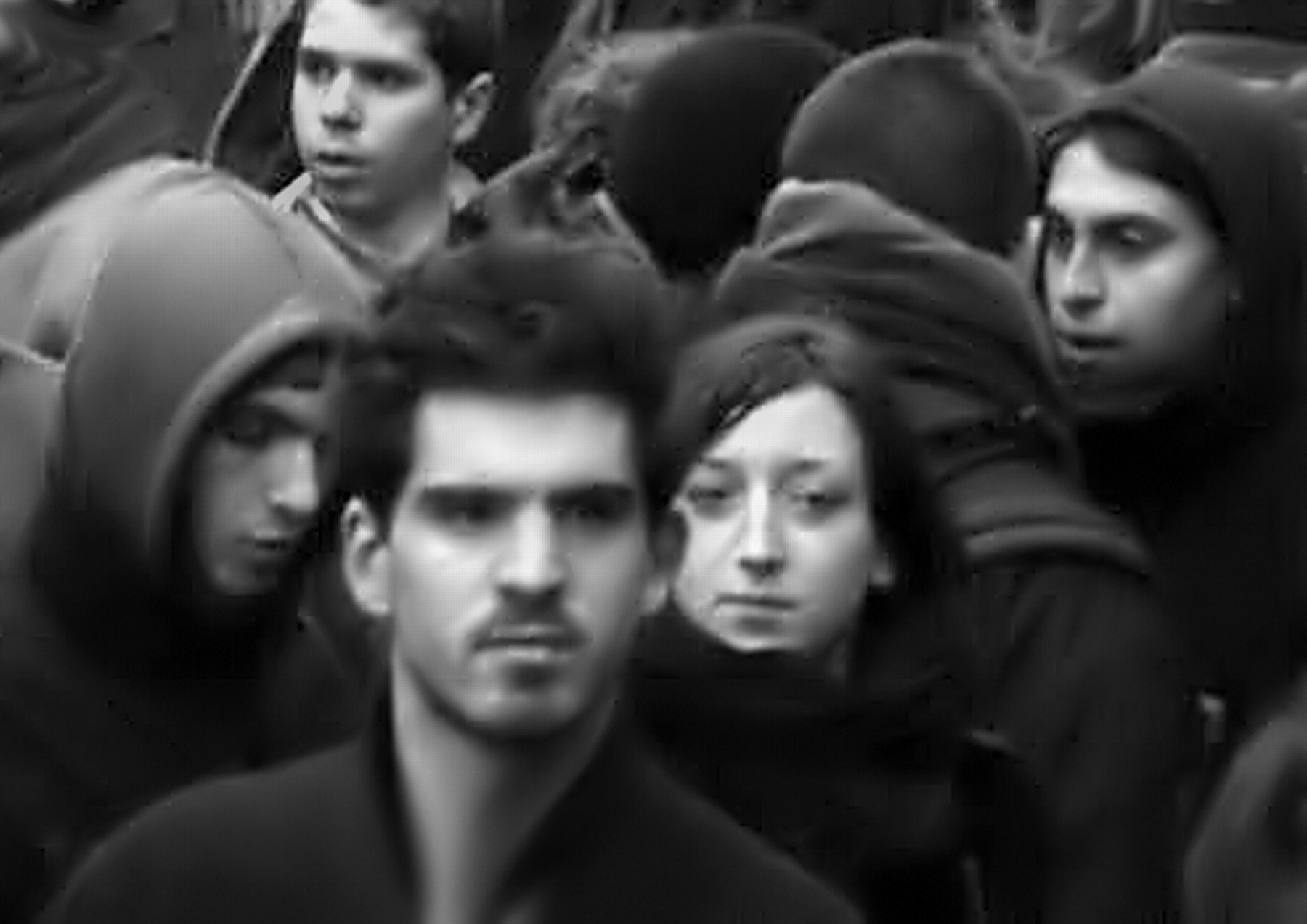
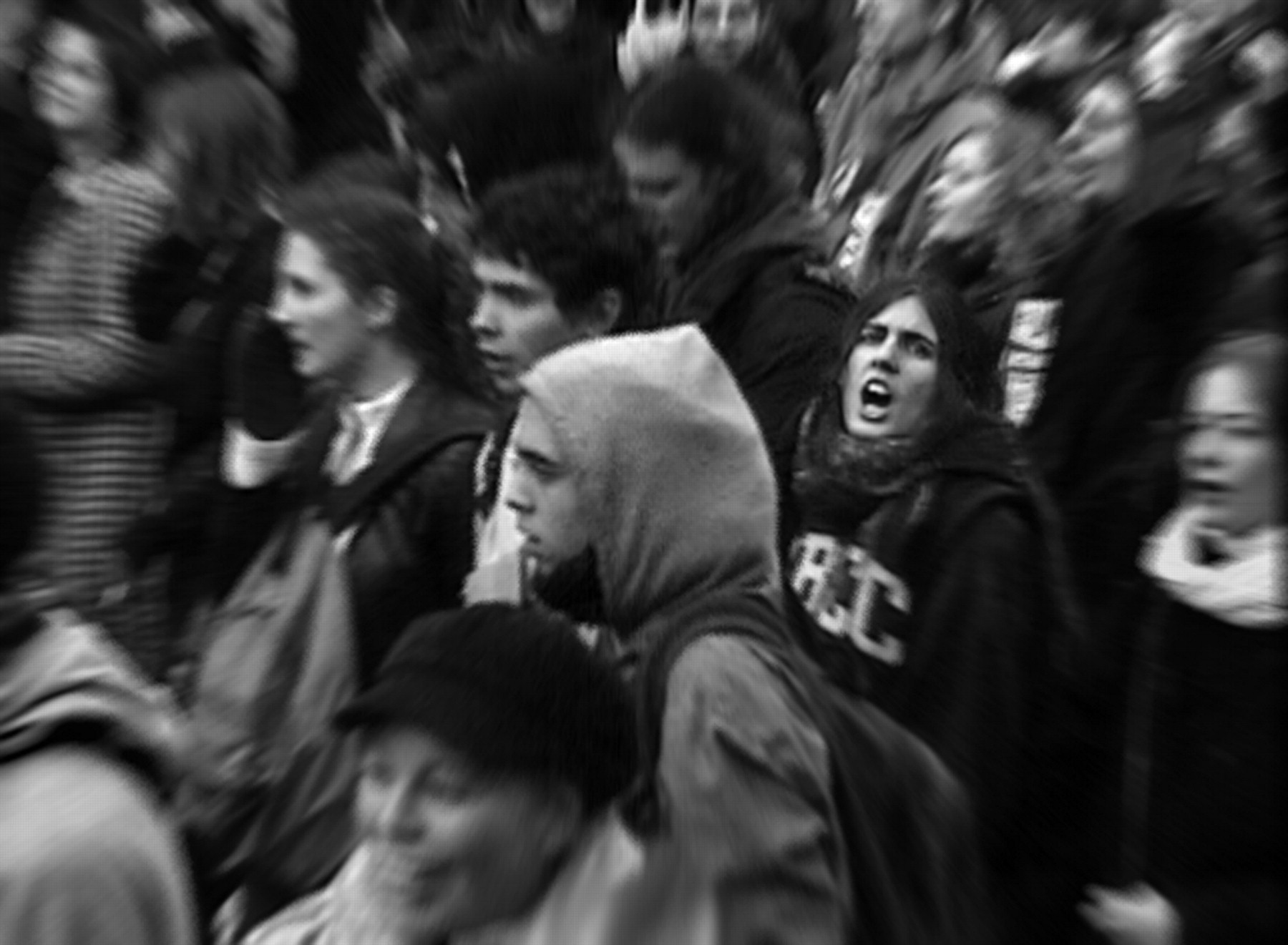
“(…) I was also thinking of the portfolio of images by Chris Marker published recently in these pages [‘The Revenge of the Eye,’ Artforum, Summer 2006]–pictures of French students in the spring of 2006 protesting against a law that would have made working conditions for young people less secure. By proceeding in two modes, through filming and through manipulated screen captures from the video footage, Marker created a sort of fabulous population out of groups of real protesters. I’m thinking in particular of an image of a group of young people in hooded sweatshirts. During the riots in the Parisian banlieue in the fall of 2005, these hoods, covering the heads of Arab and black youth, became a stigma: They were compared both to terrorists’ masks and to Muslim girls’ veils. The hoods became the symbol of a population locked up inside its own idiocy. Now, in ‘The Revenge of the Eye,’ they transform the young people into medieval monks, bringing to mind Saint Francis’s companions in Rossellini’s film. The protestors become a “fabulous” population in Deleuze’s sense. It’s as if the capacity of art brought to bear on the figures were actually a property of the figures themselves. That’s an example of a reversal of perspective. And I think what art can do is always a matter of the reversal of perspectives. Police consists in saying: Here is the definition of subversive art. Politics, on the other hand, says: No, there is no subversive form of art in and of itself; there is a sort of permanent guerrilla war being waged to define the potentialities of forms of art and the political potentialities of anyone at all.”

chris-marker-demo17.jpeg

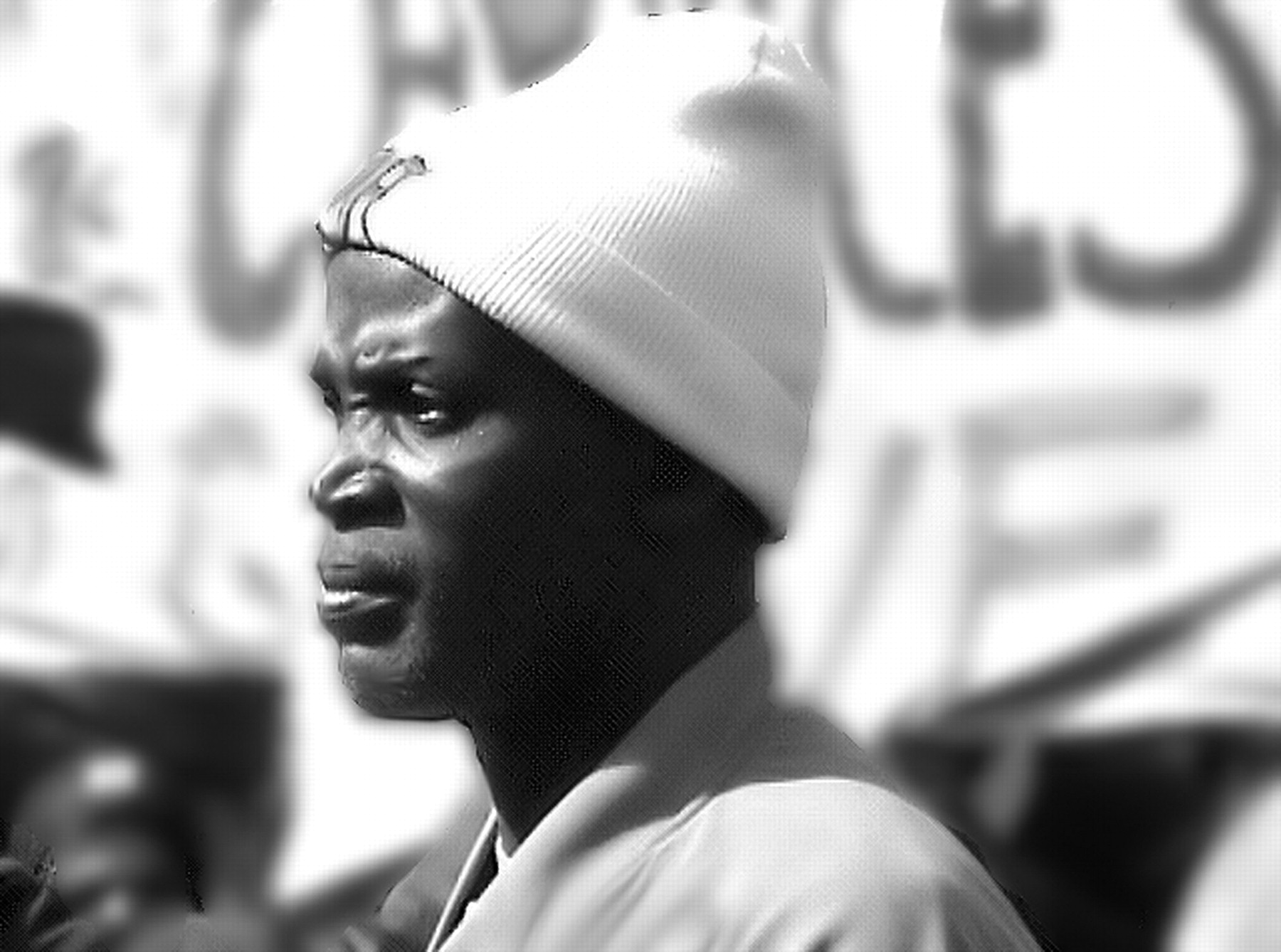
The ‘Revenge of the Eye’ portfolio that Rancière refers to consisted of some of the most recent images in Marker’s Staring Back book and exhibition project (of which I saw a version in Antwerp in 2008). The images were taken during the tumultuous 2006 anti-CPE (‘contract première embauche’) demonstrations protesting against the French government’s employment policies. Marker wrote: “The fight isn’t any longer against a largely imaginary fascism, neither is it about changing the world. Today’s mottoes deal with unemployment, income, fears of uncertain retirement (at 20… and yet in the long run they’re right). As my lens slips inside the crowd like an inquisitive snake, what it frames is, despite the apparent cohesiveness of the groups, the everlasting face of solitude.” Staring Back also features images of other political demonstrations – most of them extracted from his films – beginning with the notorious Charonne affaire in 1962 (some rendered from his film Le Joli Mai) to the actions against the Pentagon in 1977 (La sixième face du Pentagone), to May 1968 in Paris (Le Fond de L’air est Rouge), to various demonstrations in Paris in the period 2002-2004 (Chats Perchés). But in many ways it’s really the 2006 images that are the most striking. These images are not “bona fide photographs,” as he puts it, but frame captures from his video footage, studied in slow-motion playback to stem the otherwise “inordinate flow of video and television.” Working in this “superliminal” mode (Marker: ““If subliminal refers to the object the eye doesn’t catch but the brain does, Superliminal is the REVENGE OF THE EYE . . . that on slow-motion catches one image among many others apparently identical as being THE image . . .”), Marker searches for the “one frame lost in the stream of almost identical frames … the real photogram, something nobody has perceived–not even the guy who shot it (me, in most cases).” Bill Horrigan, curator of Staring Back, notes: “the subsequent digital manipulation he has imposed, and the startlingly flattened depth of some of the compositions, results in images unlike any others he has ever exhibited; it’s as though the faces of 2006 had become the faces of 1936 and 1236, the persistence of the Popular Front no less than the medieval among us”. It’s through this encounter with these faces, writes Vered Maimo, “that one is offered the recognition that in the current age politics can only exist beyond the realm of identities, precisely in the possibility (as Balibar argues) of creating transnational forms of citizenship. It is thus through the epistemological and political move beyond identity that Staring Back proposes a new image of politics and of the people and inseparably from it a new ‘politics’ of the image”.

chris-marker-demo15paris2006.jpeg

Maimo builds on for any political struggle and any prospect of future transformation.” Elsewhere he writes: “for Marker representational forms have lost their innocence. The beau masque, the theatricality that performs the revolution without enacting it, is itself a consequence of reality’s intensified colonisation by the image. For Marker hereafter the essential question thus becomes how as a filmmaker he can render the disingenuous transparency of the image, not so much opaque, but material”. Related to this, Maimo points out Rancière’s emphasis on the fictional and imaginary aspects of political subjectivities. In Dis-agreement (La Mésentente) he argues that politics is a matter of fictions and staged appearances and that “appearance is not an illusion that subsumes the real; It is the introduction of a visible into the field of experience, which then modifies the regime of the visible. It is not opposed to reality. It splits reality and reconfigures as its double”. For him, appearance and the logic of the double it enacts are necessary for politics because they expose the inconsistencies and tensions in any form of political and social identifications. This recognition of the power of the ‘fictions of the real’, writes Maimo, sheds a light on the images he presented in Staring Back.

“It is as if it is only by extracting these stills from the video footage that something new is introduced into the realm of the visible, such that their subject appears not as a personal ‘I’ or a unified and collective ‘We’, but as a subject in the process of ‘becoming-other’, a subject that has been ‘individuated’ from the flow and mass of people but like a shadow or an echo still remains inextricably bound to them. In short, a subject that displays the double impossibility of every form of political identification: that of forming a group and of not forming a group. Thus what we ultimately encounter in these images are doubles, ghosts not because these are manipulated digital images whose supposedly ‘truth’ status has been compromised or because they present people who are real before being actual, that is, an ideal and abstract collective as in classical cinema. Rather, these are, precisely, people who are actual before being real, people who are caught within a double and ceaseless movement between what always already is, and what has yet to be realised.”

chris-marker-demo8paris2006.jpeg

Maimo’s ideas are informed by Deleuze’s argument in his Cinema studies that one of the main differences between classical and modern cinema is that whereas in classical cinema, the people are already there (“real before being actual, ideal without being abstract”), in modern cinema “the people no longer exist or not yet . . . the people are missing”. It is no longer possible to “represent” the people as unified because “they were no people, but always several people, an infinity of people, who remained to be united, or should not be united . . . because the people exist only in the condition of minority, which is why they are missing”. What Deleuze terms “minor cinema” is not a cinema of becoming-conscious as in classical cinema, but of becoming-other – not “a cinema of demographic minorities that are given an identity as ‘Others’, but one which struggles to articulate collective utterances that address a people who do not yet exist or whose existence is precisely what is at stake” (for Rancière, the fact that the people are internally divided is the primary condition of the exercise of politics). Modern political cinema, Deleuze argues, consists in “putting everything into a trance . . . pushing everything into a state of aberration, in order to communicate violence”. Since modern cinema can no longer constitutes itself on the basis of the possibility of a revolution, it constitutes itself on a double impossibility, “that of forming a group and that of not forming a group, the impossibility of escaping from the group and the impossibility of being satisfied with it”’. This is not only the dilemma underlining Le Fond de L’air est Rouge, argues Maimo, but also a crucial element in understanding the images in Staring Back.

“They offer an adequate response for Balibar’s call for ‘a new image of a people’ because they reveal that the condition of possibility for this kind of image lies precisely in the ability to think about political and active forms of citizenship beyond the ‘myths of identity’ and the ‘illusions about the necessary course of history’. This makes Marker’s images ‘minor images’, not because of their modesty, but because of the way they mark the horizon of the virtual beyond its immediate actualisations.”

chris-marker-demoantilepenparis2004.jpeg

“Virtuality” (another Deleuzian term) thus consists in the ability to create images which present the people as missing – as a split subject that does not have a pre-given identity and is not simply just “already there”. Yet, in Staring Back, the virtual also manifests itself in the individual portraits that are part of the project. Maimo uses Deleuze’s analysis of the close up and his notion of ‘faciality’ to point out the connection between the images of demonstrations and the portraits, as a way to “show the epistemological and political move beyond identity functions as a necessary condition for a new kind of relations between politics and visual images.” “It is precisely by ‘individuating’ the flow of images”, notes Maimo, “that Marker creates an ‘affection image’ or cinematic close up in which an image of a face does not identify a person as a separate self-sufficient subject, but by presenting him/her as both present and absent opens the transformative possibility of ‘becoming-other’ and the problem of ‘belonging’ to a group. It is in this sense that Staring Back suggests to us a new image of politics and the people, and inextricably a new politics of the image.”

“Once the people are presented as divided and political agency as inseparable from the ‘fictions of the real’, the image itself as an affection image is no longer a mark of identity, ‘truth’, or resemblance, but precisely what expresses the possible beyond its delimitation in fixed identities, ‘friend’ versus ‘enemy’, and the division into binary objective or subjective forms of enunciations. That is, once politics is configured as inseparable from the realm of phantoms and doubles, images are no longer addressed as exclusively documentary or fictional, analogical, or digital, while viruality itself is not associated with a specific technology. Rather it is associated with the conceptual and aesthetic capacity to configure heterogeneous forms of subjectivity and conflicted forms of collective association by imagining something like active, rather than merely ‘representational’, transnational forms of citizenship that emerge as something new in the current political context.”

chris-marker-untitledtehran1950s.jpeg

Images:
1. Demo 18 (Paris, 2006)
2. Demo 17 (Paris, 2006)
3. Demo 15 (Paris, 2006)
4. Demo 8 (Paris, 2006)
5. Demo anti Le Pen 3 (Paris, 2004)
6. Untitled (Tehran, 1950s)