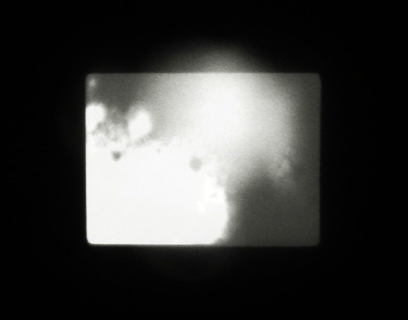
ARTIST IN FOCUS: Paul Clipson
Live soundtrack by Ignatz & Paul Labrecque 25 September 2010, 20:00. Palais des Beaux-Arts / Paleis voor Schone Kunsten, Brussels. Organized by Courtisane & Bozar Cinema.
The elegantly ravishing super 8 films of Paul Clipson (US) are lyrical explorations of light and movement. His images, mostly edited in-camera, reveal the rhythms, energy and sensuality of the everyday that we often fail to see. The influence of experimental filmmakers such as Stan Brakhage, Marie Menken, Bruce Conner and Bruce Baillie is palpable in his multi-layered studies, as well as that of the many sound artists and musicians with whom he has collaborated over the years, such as Jefre Cantu-Ledesma, Gregg Kowalsky and William Fowler Collins. For this occasion, a selection of his recent film work will be accompanied live for the first time by Bram Devens (alias Ignatz, BE) and Paul Labrecque (alias Head of Wantastiquet, Sunburned Hand of the Man, US). Both musicians draw their exorcising sound explorations from the tradition of “American Primitivism”, where the dreaded, uncompromising ghost of John Fahey dwells.
Filmmakers Statement
“My approach to making films is to bring to light subconscious preoccupations that begin to reveal themselves while filming in an improvised, stream of consciousness manner. Aspects of memory, dreams and recordings of the everyday are juxtaposed with densely layered, in-camera edited studies of figurative and abstract environments vast and small, all within a flowing formal and thematic experimental aesthetic that encourages unplanned-for results.
Maintaining a predominantly intuitive process in conceiving and creating films, where improvisation, utilizing mistakes, and “wrong” images (for example images that are overexposed or out of focus) are part of my filmmaking methodology, I’m less concerned with a preconceived end result and more with being immersed in a visual exploration of the moment. I employ a mainly handheld camera, often set at the two extremes of the focal spectrum, macro and telephoto (extreme macro close-up, extreme long shot), which maximizes the saturated textures of Super 8mm, the format I most frequently shoot in. The films are a personal recording, like a diary or essay, rendering color, light, focus and shadow in many forms, in the hope of allowing for un-thought, unexpected elements to reveal themselves.
To a large degree, the editing in the films is “in camera”, meaning that many of the shots and their order are as they were conceived at the time. Many of my films are the result of collaborations with sound artists or groups, such as Jefre Cantu-Ledesma, Gregg Kowalsky and Joshua Churchill, all of whose methods of experimenting with sound and instrumentation, incorporating improvisation, mistakes and accidents into live performances and recordings, have greatly influenced my work.
I initially create 40-60 minute films, shooting rapidly and almost daily, to collect specific thematic and formal elements as they occur to me. The films are often screened at live musical performances (in the Bay Area and at international music venues) with the largely “in-camera” edited footage in its most effective order. These performance screenings provide me with an exciting environment in which visual and sonic permutations can be studied for future films. There’s no discussion or effort made by the musicians I collaborate with to synchronize or edit the films in a way that will better suit their being experienced by the audience. Over time, shorter film pieces, such as ECHO PARK (2007) or SPHINX ON THE SEINE (2008), are carefully created from this work, utilizing the accidental, unexpected juxtapositions of sound and image that have been discovered live. Along with the influence of experimental filmmakers such as Stan Brakhage, Marie Menkin, Bruce Conner, and Bruce Baillie, many of my recent discoveries and journeys as a filmmaker are the result of my work with musicians and bands.”
“Before being a conflict of classes or parties, politics is a conflict concerning the configuration of the sensible world in which the actors and the objects of these conflicts may appear. Politics is then this exceptional practice, which makes visible that which cannot be seen, which makes audible that which cannot be heard, which counts that which cannot be counted.”
– Jacques Rancière
It is not just a matter of “making political films”, but also of “making films politically”. With this dictum Jean-Luc Godard articulated a longstanding tension between politics and cinema. What is considered as problematical here has to do with the position from which one speaks, with speaking and letting speak, and with the medium that conveys it. Most of all, it has to do with the relations – social, cultural, economical – between people, in front and behind the camera, filming and being filmed, viewing and being viewed. Making cinema in a “political” way can never be about “subjecting” or “identification”, but should rather be about “subjectivation”. Likewise it’s never simply about delivering a “message”, but always about shaping new forms of visibility. One recent, powerful film that has the notion of the political at its very heart is Sylvain George’s Qu’ils reposent en révolte (des figures de guerre).
“Art is not political owing to the messages and feelings that it conveys on the state of social and political issues. Nor is it political owing to the way it represents social structures, conflicts or identities. It is political by virtue of the very distance that it takes with respect to those functions. It is political insofar as it frames not only works or monuments, but also a specific space-time sensorium, as this sensorium defines ways of being together or being apart, of being inside or outside, in front of or in the middle of , etc. It is political as its own practices shape forms of visibility that reframe the way in which practices,manners of being and modes of feeling and saying are interwoven in a commonsense , which means a “sense of the common” embodied in a common sensorium.”
The most avid theoretical explorer of the relationship between art and politics today is undoubtedly Jacques Rancière. For him, the politics of art plays itself out in the way in which new forms of visibility enter into politics’ own field of aesthetic possibilities. Indeed, there is an aesthetics at the core of politics: a configuration of times and spaces, of the visible and the invisible, of voice and noise, that defines both the place and the arena of the political as a form of experience. Politics has in itself nothing to do with the exercise of power or the struggle for power, but rather with the framing of a specific sphere of experience, the setting of objects posed as “common” and of subjects to whom the capacity is recognized to designate and discuss these objects. Politics, then, is essentially the conflict about the very existence of that sphere of experience, the reality of those common objects and the capacity of those subjects. The conflict resides mainly in the tension between the structured social body where each part has its place – what Rancière calls the “police” aspect of the political, the rational administration and control of social processes – and ”the part with no part” which unsettles this order on account of the principle of “universality” – what Etienne Balibar has named égaliberté – the principled “equality” of all men. It is precisely where verification of equality (really the condition required for being able to think politics) clashes with the established order of identification and classification, that the political has its terrain. The essence of politics resides in acts of subjectivation that separate society from itself by challenging the natural order of bodies in the name of equality and reconfiguring what Rancière calls the “distribution of the sensible”- a system of coordinates defining modes of being, doing, making, and communicating that establishes the borders between the visible and the invisble, the audible and the inaudible, the sayable and the unsayable.
The great danger of our times, according to Rancière, is the contemporary shift in the aesthetics of politics: that what is called “consensus”. Consensus is what reduces politics to police. It does not simply mean the agreement of the political parties or the social partners about the common interests of the community. It means putting a ban on political subjectivation alltogether, by objectivizing the givens of any collective situation in such a way as they can no more lend themselves to a dispute. There is no more contestation over the givens of the situation, over the partition of the sensible, there is only debate over the technologies of management, the arrangements of policing, the configuration of those who already have a place and a stake, whose voice is already recognized as legitimate. There’s no doubt that the political is rapidly loosing ground today, giving way to a post-political, post-democratic arrangement of management and polic(y)ing, occupying the spaces of instituted democracy. Against this consensual order, which squeezes out the political bit by bit, the only way of resisting is staging dissensus. This doesn’t only imply conflicts of interests or ideas, but also that “there is a debate on the sensible givens of a situation, a debate on that which you see and feel, on how it can be told and discussed, who is able to name it and argue about it … It is about the visibilities of the places and abilities of the body in those places, about the partition of private and public spaces, about the very configuration of the visible and the relation of the visible to what can be said about it.”
“The notion of dissensus thus means the following: politics is comprised of a surplus of subjects that introduce, within the saturated order of the police, a surplus of objects. These subjects do not have the consistency of coherent social groups united by a common property or a common birth, etc. They exist entirely within the act, and their actions are manifestations of a dissensus; that is, the making contentious of the givens of a particular situation. The subjects of politics make visible that which is not perceivable, that which, under the optics of a given perceptive field, did not possess a raison d’être, that which did not have a name…. This … constitutes the ground for political action: certain subjects that do not count create a common polemical scene where they put into contention the objective status of what is ‘given’ and impose an examination and discussion of those things that were not ‘visible’, that were not accounted for previously.”
Politics is the struggle for one’s voice to be heard, always setting up dissensus and disrupting the police order by supplementing it with a ”part that has no part”. If police is concerned with the regulation of populations by assigning subjects to their proper place within the social order, seperating those who take part form those who are excluded, politics always involves the subjectivization of those who make a claim to participate in an order in which they have no part. A particular arena in this process of emancipation is taken up by the “sans-papiers”. It is precisely because the logic of police cause these people to exist as an entity – thus clashing with the logic of equality – that politics comes about. In Rancière’s terms, the entity of the sans-papiers is the part that has no part: included, but not belonging. They are the indivisible remainder of the transformation of democratic political struggle into the post-political procedure of constant negotiation and policing. Žižek writes: “Postmodern racism emerges as the ultimate consequence of the post-political suspension of the political in the reduction of the state to a mere police agent servicing the (consensually established) needs of the market forces and multiculturalist tolerant humanitarianism”. When social order is organized in this way, so that constitutive antagonisms and splits within the people are plainly denied, it’s a matter of radically cutting through this order of the visible and sayable. A political moment arises when those “who have no right to be counted as speaking beings make themselves of some account”, at the moment it is shown for all to see hat they “didn’t have the rights that they had” and “had the rights that they didn’t”.
Politics is therefore always disruptive, it emerges with the “refusal to observe the ‘place’ allocated to people and things (or at least, to particular people and things)”. This is why the political is at the heart of Sylvain George’s cinema; a body of work that stems from a refusal to stand by, a will to resist, and, most of all, a drive to turn noise into voice, to make the invisible(s) visible. If the political consists of the demand to be counted, named, and recognized, to receive a place in the order of being, then his films are giving voice to this claim – that of the “nouveaux damnés”, trapped between the rule and the exception: the stateless, the clandestine, the precarious. If politics, as Rancière maintains, is really about “the visibilities of places and abilities of the body in these places, about the partition of public and private spaces, about the very configuration of the visible and the relation of the visible to what can be said about it”, then George’s work is a much-needed intervention in the aesthetics of politics, brimming with urgency and singularity. After having seen Qu’ils reposent en révolte (des figures de guerre), his impressive first feature film portraying the situation of migrants in Calais over a period of three years, it’s hard to believe George only started making films in 2005. Still, the intention must have been there all along, in the back of his mind, all the way through his studies in philosophy and his experiences as a social worker. It’s in this intertwining of philosophical, socio-political and humanistic concerns that his cinematic endeavors are grounded. “The idea”, he says, “is to make films that take a stand and assert a political position, and at the same time not to separate content from form; to be formally demanding and to manage to define an own view and grammar as a filmmaker.”
“The dream of a suitable political work of art is in fact the dream of disrupting the relation between the visible, the sayable and the thinkable without having to use the terms of a message as a vehicle. It is the dream of an art that would transmit meanings in the form of a rupture with the very logic of meaningful situations. As a matter of fact, political art cannot work in the simple form of a meaningful spectacle that would lead to an awareness of the state of the world. Suitable political art would ensure, at one and the same time, the production of a double effect: the readability of a political signification and a sensible or perceptual shock caused, conversely, by the uncanny, by that which resists signification.“
According to Rancière, the effect of political art is always the object of a negotiation between opposites: the readability of the “message”, that threatens to tear apart the sensible form of art, and the radical uncanniness that threatens to destroy all political meaning. This exercise is always present in George’s formal language, which is full of ruptures and displacements, creating multiple games of temporality and spatiality, in his own words “space-time continuums where beings and things are fully restored to what they were, are, will be, could be or could have been”. Beyond the needs of narrative clarity, his focus is rather on an aesthetic of sensation, which tends to play on the material qualities of the medium. Changes in focus, speed, lighting and exposure, use of black & white tints, unusual angles and framing, long shots alternating with close-ups, and (in some of his films) the combination of different media (from Super-8 to DV and mobile phone): all these techniques are subtly put into the service of a certain defamiliarization and poetization, shaping the films as bodies of variating textures and intensities, loaded with intricate energies and arcane regions. While the images often ebb and flow between the figurative and the abstract, it’s the human body that is always present: rough faces, scorched hands, obscure figures. In this way, George’s work inscribes itself in a cinema with, in Nicole Brenez’ words, “a very elevated figural responsibility”; a cinema “capable of refusing physiological fatality, analysing figurative quadrates, discovering other frames and angles to view the body… a series of gestures whereby representation tears itself from itself so that, from a quantitative recording of the trace left by a body, the image becomes a speculative intervention on the body’s presence, its organic life, real needs, screaming and sometimes frenzied desires… As something that is simultaneously a trace, a reconstitution and a flickering, the figurative material appears in the state of a fetish, it is a sample, offering – or not – a hypothesis on being”. The body, after all, is an entirely political organism, craving for survival and recognition.
“Ce qui n’a jamais été vu, n’est pas reconnu”, Serge Daney once wrote. If what Rancière refers to as the police-aspect of the political – the rule governing the appearance of bodies in common space – focuses on the clear categorization of every individual, of every “visible” social unit, recognizing neither lack nor supplement, then the cinema of Sylvain George is an elementary form of resistance. By disturbing the dominant order of the visible and bear testimony to those who remain invisible and inaudible, a true anarchical act of emancipation is undertaken. Surely, we have seen images of “sans-papiers” before – in the news, in reportages that always seem to speak as authority – but never enough, hardly ever “right”. We see too many bodies without a name, too many figures who do not return the gaze we direct at them, who we are spoken about, without them given the chance to speak to us. George’s images make these silent bodies speak for themselves. Far away from any form of didacticism, what these images document is first and foremost an encounter between people, between different realities, in a indeterminant search and constant strive to make images possible that are, as Rancière has noted, “in phase with” the weight of emotions expressed, gestures uttered and words spoken. “For me”, George says, “cinema is a ‘means without an end’ – to paraphrase Agamben. The idea is to privilige the means to arrive at something that I don’t know myself. Starting for there, we are in the ‘demultiplication’ of worlds, rather than in a fixed world that tends to be folded on itself. By world, I mean that what constitutes the singularity of an individual. The objective is to shatter representations, otherwise we’re in the language of the ‘expert’, a language that reifies human beings and relations. There we’re also taking up the question of power. I claim the fact of not having an overhanging position. Yes, I provoke something in the sense that I have a camera and go meet with people, but it’s consideration I give them, in a relation of reciprocity and equality. This is what is eminently political: there we enter a world that opens up, where the borders become nomad.” Here we arrive, perhaps, at what Godard meant with “making films politically”. What is of importance here is installing relations between people other than the ones the dominating information system and police order prescribe, using modes of subjectivation that transform the aesthetic coordinates of the community, by fighting for what is the ultimate presupposition of politics: we are equal.
“Politics is gestures, cries, attitudes. This is what I think one sees in the film. We see in the film a moment in which bodies appear. There are words gushing out. There is a relation with the space which shatters itself. In general, in order to try to think about the relations between politics and aesthetics – not in the sense that it should be in the service of politics – what interests me is precisely the way in which the work of a filmmaker can be in phase with the weight of certain gerstures – be it the gesture of the revolt in the street, or the gesture of burning one’s fingers to prevent police identification. It’s something that is very important for me, the idea that the relation between politics and aesthetics is also the relation between the art form used by the individuals who struggle to change their conditions and the art form an artist applies himself, or tries to apply.”
All quotes (in grey) by Jacques Rancière. The last one is taken from a conversation with Sylvain George (translated from French). See below for video documentation. Also included are some recent interview with George (one featuring Archie Shepp, whose haunting rendition of ‘Sometimes I Feel Like a Motherless Child’ closes ‘Qu’ils reposent en révolte’), and a streaming copy of ‘Ils nous tueront tous’, a short film George has made as part of ‘Outrage et rébellion’, a collective film project born as a reaction to the “Joachim Gatti affaire”. On 8 July 2009, Gatti, a young film director, was seriously injured by the police during a peaceful demonstration in Montreuil. A flash ball bullet hit him in the face and ruptured one of his eyes. Other contributors to the project (45 in total) are Lionel Soukaz, Jean-Marie Straub, Ange Leccia, Peter Whitehead, Robert Fenz, Marcel Hanoun, Philippe Garrel and Laura Waddington, amongst others.
Sylvain George interviewed by Olivier Pierre (English translation, FID 2010)
The origin of the project?
These are the first images from a film I have been working on for the past four years, about migration policies in Europe and the social mobilizations they may set off. The idea is to try and give an account of the issues which I think are among the most crucial of our times. Indeed, issues related to immigration and the figure of the foreigner are perfect indicators to assess and question the state of our democracies, the building of public policies, the drawing up of their implementation procedures. At first, even though on paper the project already seemed substantial enough, it was supposed to be a two-part short film. Then, as I found myself facing the realities of the field, as I met people in Europe and Africa, the whole project expanded considerably. Now, there will probably be two feature-films. For instance, the film was supposed to start with the situation of migrants transiting in Calais, before showing other circumstances in Africa, Europe, … Initially, I had planned to stay in Calais for three months for that purpose. But because of the situations I discovered and the connections I developed with many people, I ended up staying for three years, through stays of various lengths, between July 2007 and January 2010. The “Calais part” gradually stood out and became independent from the rest of the film. It became a proper feature-film. It features many threads that will be drawn out, exploited and developed later on, in the second feature-film. The shooting of the latter is almost done, and the editing process is about to start.
What about the structure of the film, the editing?
The film is made of autonomous sequences, fragments that refer and correspond to each other, that intermingle, thus creating temporality and spatiality effects. Since the shooting took three years, you can feel the cycle of seasons, without it being necessarily set up in chronological order. The same applies for situations that may or may not be treated chronologically, without time or narration necessarily matching a homogeneous, linear and empty conception of time. Indeed, the correspondence, the poetic and dialectic tension set between situations, events, people or “patterns” philosophically meet the building of some history that is still very much pregnant, linear and marked by the myth of progress, and that tends to foreclose times and issues in some permanent overtaking. Politically speaking, it is about standing up, contesting these grey zones, these spaces or cracks like Calais standing somewhere between the exception and the rule, beyond the scope of law, where law is suspended, where individuals are deprived, stripped off their most fundamental rights. And that while creating, through some dialectic reversal, the “true” exceptional states. Space-time continuums where beings and things are fully restored to what they were, are, will be, could be or could have been. The question of redemption was redefined in the 20th century as a category that was’t religious, but rather political and aesthetical (Rosenzweig, Benjamin). Aesthetically speaking, I try to operate a rereading, and updating of allegory: neither baroque nor modern, but that I would call contemporary.
How was the shooting with migrants in Calais?
As a director, I follow a certain number of rules that are always evolving. First, I take the time to carefully set a frame as clearly as possible. I introduce myself, explain who I am, what I’d like to do, what kind of film it is. I spend time with people. I never film them without their knowing, nor do I steal images, etc. These rules, which are in no way dogmas, may seem simple and obvious. However, given what you see out there, they are simply revolutionary, they have to do with ethics and of course politics, Take Calais, for instance, as the film is set there. The city is a permanent film set. It is a place much exposed politically, where politics are obvious. As a result, there is always a film or still camera somewhere, a notepad… That goes from a student in journalism, to big-budget films like Welcome, or television crews, documentary directors… Generally, as regards prevailing cinematographic or journalistic practices, the end justifies the means. One should stop at nothing to get an image: befriending migrants, paying for interviews, hiding in the bushes.. My own conception of cinema and my position as an individual and a director are completely at odds with that, with such narrow-mindedness and ethnocentrism. Cinema isn’t an end in itself, it cannot just shut down on itself. It is an endless means to build a connection, a relationship to the world, to establish dialectic links with yourself and the world, and thus to assert your singularity. Cinema can introduce mobility with steadiness; break with determinism of all sorts, and set a profound movement of emancipation going. Standing by all these principles, I never had any problem with the migrants. Quite the opposite. When you build a relationship based if not on trust, at least on honesty and respect, you can really connect with people and film them, as well as facts and unexpected situations.
The film is deliberately descriptive, but it also uses some effects that give it its original form.
I think that the technique – and the camera is a technical tool – can allow to explore and develop the potentialities and virtualities within nature and mankind. Therefore you have to use all the resources your chosen medium – here, the camera – has to offer, to actualize those virtualities. They are never used for their own sake then, or as ends in themselves (an image for an image, an effect for an effect), as opposed to a countless number of films, especially those on immigration that have been really common lately, in which the filmed subject only becomes a pretext for symbolic experimentations and aesthetic experiments: an aestheticization of reality. An aestheticization of politics. But is rather according to the situations and subjects that you meet and film, to the way you perceive a context, an atmosphere, the feelings you might feel, that you find it a good idea to make use of such and such “technique”, such and such “effect”: play with the speed of frames, slow motions, accelerations, superimpositions, freeze frames etc.
Why did you choose again to shoot in black and white?
Because this allows me to work and to question the concepts of document, archive, preservation. Because doing so establishes a historical distance from displayed events that are in keeping with what’s very important, what’s indeed very red hot news. A dialectic of near/far therefore unfolds and established itself. The more you move things away, the closer they actually get. Black and white also conjures up an aesthetic and poetic dimension fully relevant to the film. The dimension is akin to elegy, although there are some nuances here awaiting further specification. However cohesive as a whole, you’ll find various types of black and white in the film, allowing to generate shifts and weave metaphors. For instance, you’ll get some overexposed sequences where whites are burnt out and black very deep. This again is consistent with numerous testimonies given by migrants; in these, they repeatedly refer to having felt like survivors, as though burnt out, scorched, consumed from within. Obviously, you also think of the “burning fingers” scene, which graphically shows that those migrants being literally “branded” like cattle by the current immigration policy beyond a mere image or metaphor.
Other choices are obvious as well, like the absence of commentary, the only voices being those of the migrants and that of the State.
Indeed, in no way I want to make a didactic film, or to treat this issue they way a journalist would, by enumerating facts and giving so many explanations. I seek to illustrate, without being comprehensive, some realities which seem crucial to me; this I do via images, sounds, words which spring out with tremendous force. In order to do so, I endeavor to be as available and attentive to what may happen as I can possibly be. I may have a few hunches before getting on the field, but these are swiftly made irrelevant during shooting and then editing. My ambition is primarily to learn and comprehend what’s taking place. So I choose to be on the lookout for persons, situations, places, and to be ready to record and welcome anything coming my way, be it testimonies, actions, objects, feelings… For the first time I have also used voice-over in the film, not so much to bring extra factual info but rather to generate distance, to play on other layers of temporalities, to open up the times and film to anything that may go through it, that may pierce it and shatter it, whether old or new. Thus, two or three times in the film, in some discreet, imperceptible way, you can hear a “voice from outside”, that of Valérice Dréville actually, who, in a murmuring voice, repeats some words actually uttered by migrants. At some other points, she speaks a poetic sentence as an echo to the second quote that concludes the film, inspired by political slogans heard during demonstrations of “sans-papiers” in the U.S. back in 2006.
Lastly, during the final credits, you’ll hear some “singing from the Outside”, in this case Archie Shepp’s voice, humming Strange Fruit. Potential links with bygone times are therefore suggested by the cover of this very eloquent, powerful song, and by the very person that sings it. The fact that this was recorded with the actual camera used for the shooting, like all the other elements present in the film, underlines the free-jazz dimension of the whole film.
Die Zeit: “Do you concern yourself with new media and technology?”
Jean-Luc Godard: “I try to keep up. But people make films on the Internet to show that they exist, not in order to see something”.
– Die Zeit, 16.12.2008
There is a great sadness in this world. A sadness that is spreading through our networks, invading our bodies, infecting our souls. It’s not like it’s taking us by surprise. Perhaps it has been there all along, as long as we care to remember. At least since the ghosts of progress made their appearance, and we suddenly found ourselves moving through a world cluttered with things. Cinema saw it coming all along. It was Charlie Chaplin who told us the story of the dehumanization of 20th century industrialism, when our bodies were taken away from us for the sake of speed and efficiency. But at least then, it seemed, we were still capable of being human. It was Michelangelo Antonioni who captured the growing sense of alienation in modern society, in his haunting images of estranged, fractured figures wandering through industrial landscapes, unfit to relate, unable to communicate. Slow burning emptiness became perfect loneliness. But then a strong, warm wind made its way and overthrew this emotional landscape. It was Chris Marker, amongst others, who documented this collective outcry for freedom and imagination; its powerful rise, and its tragic decline; from revolutionary action to cynical spectacle. It was also Marker who, during one of his many travels, witnessed the becoming of another, even more invasive, form of alienation. What he saw was a city that looked like “Planet Manga”, occupied with “pictures bigger than people, voyeurizing the voyeurs”; a giant hologram where life itself had become nothing but a simulation effect. As of then we knew our old world had started to disappear, right in front of our very eyes.
The void reigns, they say. Ever since the last decades of our previous century, when the deep effects of the neo-liberal turn were becoming evident and the promise of an all-connected world started to (im)materialize, the alienation of our times has taken a heavy stranglehold on our daily lives. As if what we experience is no longer the pulse of life, but only the cardiogram. In this post-industrial landscape, we are being overloaded with signs, unleashing endless chains of consumption, decoding, interpretation and response. With our attention constantly under siege, breathing has become difficult. We’re increasingly living in “real-time” mode, without the shadow of a past, or the light of a dream. No more maps we can trust, no more destinations to reach. The only way left to navigate this schizophrenic universe is to keep on surfing the incoming semiotic waves, wading through the chatter and fluff circulating in the infosphere. As we’re going through the motions, we’re constantly pressed to (re)act. Because the dominant pathology of our times is no longer produced by repression or suppression, but precisely by the injunction to express and confess. Saying out loud what we feel, think and see is no longer a choice, but an obligation. “Just do it”, claims Franco “Bifo” Berardi, has become the thumping mantra of the first networked generations who, deprived of any energy coming from desire or (com)passion, can do nothing but adhere to the violent logic of belonging.
“I feel like it’s an opening in an otherwise very lonely world, full of misunderstandings and regrets. So thank you to everyone for making this a community I want to be part of.” Somewhere in the deep shadows of YouTube.world a silent whisper resounds, without resolution or conclusion. In this cruel theatre of teenage blues and growing pains, broken hearts and contrite spirits, the dark side of our souls is laid bare for all to see. What we are confronted with is a cosmos of fear, anxiety, insecurity and disillusionment, expressed by bodies and voices reaching out to be understood and loved, without any hope of succeeding. Bloggers and vloggers, writes Geert Lovink, are “trapped by their own inner contradictions in the Land of No Choice”. Like the characters in Michel Houellebecq’s novels, we cope with our coded lives and branded souls by projecting our own loneliness and indifference on to the world. In this time of radical uncertainty, it turns out the Web not only functions as a mirror, but also as a projection field. And so we find ourselves in this estranged twilight zone between the public and the private, amidst a never-ending stream of micro-confessions and intimate exposures. As if we could still believe the truth would set us free. We want to believe so badly, that we fail to see that what the contemporary info-cracy facilitates is not Truth, but Nothingness.
Alone together, at last. We know we are being watched, but we don’t mind. If this is what it takes to prove we exist, to feel we belong, bring it on. We’re scared and confused, but that’s ok, because we know you are too: after all, you’re not that different anyway. Our cams are always there, almost always on. We can feel the eagerness of your gaze, but still we remain the same – “for real” – locked in our bittersweet solitude, with our bodies sealed in signs. Rather than continue to be victims of the image, we decide to become image. Because we want to be seen. Because we are visual. As if we are two-dimensional, only skin-deep. No more depth, only transparency. No matter if there’s nothing to show, nothing to say. No matter if there’s ultimately nothing left to see. We take comfort in this Nothingness. Disappearing behind our images is our way to protect ourselves from Being. No worries anymore that our images could be stolen from us, or that we should give up our precious secrets, because we no longer have any. There are no illusions or scruples left: all will be revealed for the sake of appearances; all except, perhaps, for the Truth. Take a close look. Here we are now, desperate bodies without desire, crude visuals without necessity or consequence. Here we are. Welcome to the spectacle of banality.
A reflection on ‘Because We Are Visual’, a wonderful video-essay by Olivia Rochette & Gerard-Jan Claes (2010, 47’, produced by KASKfilms). All stills taken from the video. Inspiration: Lovink, Bifo and Baudrillard, of course.
“Un cinéphile est quelqu’un qui attend trop de choses du cinéma. Qui attend que le cinéma soit le terrain sur lequel va se jouer son propre rapport à son image. Des cinéphiles, il y en a toujours eu et il y en aura encore longtemps, des gens qui demandent à l’image un peu plus que ce qu’elle peut ‘donner'”.
– Serge Daney
Gonzo Circus magazine has just published the first part of an article I recently wrote (in Dutch, available here) about film criticism and cinephilia. The article (perhaps more of a loose compendium of thoughts and musings) was written quite impulsively, partly in reaction to the débacle around the Cannes palmares (particularly Apichatpong Weerasethakul winning the Palme d’Or with Loong Boonmee raleuk chat), which showed just how fragmented contemporary film criticism really is. While magazines such as Cinemascope and Cahiers du Cinema wrote ecstatic reports about the triumph of their “golden boy” (the cover of the recent Cahiers read “Apichatpong, une palme de rêve”, Cinemascope raved about the “Apichatpalme” as the ultimate symbol of “the year we made contact”), mainstream journalists were generally unhappy and disturbed. How to communicate to their “audience” that a relatively “unknown” cineaste with a background in architecture and visual arts, and a name hardly anyone cares to pronounce (Wee-ra-se-tha-kul – but you can also just call him “Joe”) won one of the most prestigious awards in world cinema? How to explain his work, that draws as much from classical cinema (Jacques Tourneur) and avant-garde film (Bruce Baillie) as it does from Thai soap-opera’s and Boedhistic fables, resulting in a singular cinematographic world where the everyday and the mythological, reality and fantasy fuse in a complex meditation on memory, reincarnation and obsession? Most journalists didn’t even bother. In Flanders/Belgium, at least two newspapers headlined “boring Thai film wins Golden Palm”, while the self-proclaimed “quality” newspapers basically wrote the same thing, using a slightly more expansive language (hilarious quote from de Morgen’s Jan Temmerman : “…one’s dream is another man’s nightmare”).
Of course, this paradigm – delivering infotainment rather than sceptical analysis – is a problem integral to the whole print media business, as documented in Nick Davies’ book Flat Earth News. As it happens, the other day the University of Leuven published the results of a research, which state that 75% of all the articles in Flemish “quality “ newspapers partly or completely consist of pre-fabricated and/or PR-related material. “The mass-production of ignorance” that Davies finds so repulsive resonates with the proliferation of “storytelling management”, a concept that stems from the marketing industry (see Naomi Klein’s No Logo) but has over the past decennia infiltrated in diverse levels of society, in the form of branding, propaganda and post-political campaigns. These mechanisms of communication and control – cynical lowpoints are the mechanisations around the two Gulf wars – are meticulously analysed in the book Storytelling: La machine à fabriquer des histoires et à formater les esprits (2008) by Christian Salmon, who talks about the rise of a new “narrative order”. The stories we’re being told, he writes, format the imagination, instrumentalise emotions, model opinions. No doubt the dominant media play an important role in this evolution. The hollowing out of journalistic norms and values is also visible in film journalism, which is based more and more on human-interest stories and scoops. That’s why Tom Cruise’s coming-out as a Scientology fanatic in 2005 got more coverage than Spielberg’s War of the Worlds – and way more than the eruptions of violence in Darfur, that cost the life of more than 400.0000 people.
And then there’s that other aspect of the widely discussed “crisis” of journalism: the disintegration of the “professional” status and the lay-off of thousands of journalists worldwide. Sure enough, the unstable economical status and fundamental identity crisis (the Internet, dear…) of the traditional mass media are easily to blame here, although it’s also safe to say that the (film=media) industry doesn’t mind the “middle-man” being deleted from the communication process. Isn’t it easier and safer to just print an ad instead of a “critical” piece on a movie? Why bother at all? What remains are nothing more than cheap tastemakers, implicitly or explicitly sponsored by an industry which shows nothing but contempt for the cinema lover. So then, I ask, where is the beating heart of cinephilia today? What is left of the cinephile moral, the mission to counter the anesthetic effect of the cinematographic experience and the passivity of the identification process (with the characters or the cineaste) with the activity of critical thought? The ethics of the cinephile, wrote Serge Daney – “ciné-fils” par excellence – is an “impossible flirt”, informed by a firm belief in the power of cinema to show and establish a relation with the world, but at the same time by a resistance against this unique art form, which has risen out as an industry of spectacle amidst a global marketplace of interchangeable images. This evolution is what Susan Sontag had in mind when she announced the demise of cinephilia. Once, she wrote on the occasion of cinema’s 100th official birthday (but actually the birthday of the first commercial projection), cinema had its true apostles, but do they still have a place in a entertainment cloud filled with decadent en hyperindustrial movies? If cinema could arise from its ashes, it would be through the establishment of a new sort of “cine-love”. And now, 15 years after Sontag wrote her last article, about the Abu Ghraib affair – in which she pleaded for a (re)consideration of the relation between image and reality – there seems to be a new kind of burning love.
Perhaps it’s time for “Cinephilia Take Two”, thus wrote Thomas Elsaesser in his essay ‘Cinephilia or the Uses of Disenchantment’. He was not the first to make note of the possibility of new ideas and forms of cinephilia. It was notably Jonathan Rosenbaum who saw, in the 1990’s, a new transcultural generation of film lovers and critics blossoming, feeding on the proliferation of new distribution channels, media and festivals, far beyond academic and institutional walls. He recognized in programmers, critics and teachers such as Nicole Brenez, Alexander Horwath, Adrian Martin and Kent Jones a collective sensibility, free from cultural pessimism, market thinking and postmodern irony. Here was what seemed like the beginning of a movement that not only wanted to upgrade and reevaluate existing paradigms and theories, but also felt the need to develop and explore new tools and concepts, without concern for political correctness or neo-puritanism, with a sense of wonder and curiosity that extended well beyond the borders of alternative knowledge domains. Now, 13 years after Rosenbaum published the first letter of what became a whole series (published in Trafic, later compiled in the book Movie Mutations), now that the walls around the old cinema regime have crumbled down beyond recovery, this need for fresh perspectives and dynamic energy forces feels more urgent than ever.
“Goodbye Cinema, Hello Cinephelia” is the title of the new book Rosenbaum is working on. He’s right of course: cinema is no longer what it used to be. But the flirtations with the “end of cinema”, in the work of many critics and filmmakers since the 1990’s, have never implied its disappearance, rather the loss of its symbolic force. Cinema as a collective passion and memory, at the same time popular art and intellectual pleasure: that idea seems to have faded. Besides, as Chris Marker once said, quoting Godard, “cinema is that which is bigger than us – you have to lift your eyes up to it”. Now that we’re no longer watching films, but rather “databases” (dixit Geert Lovink), cinema has lost part of its essence. The digitisation and endless reproduction and distribution of the moving image means that film history is available to everyone with an internet connection and/or media player, but it also implies the loss of the classic cinema culture. At the same time, we’re all eagerly looking towards the Internet as the key to the necessary renewal of cinephilia. Looking for Robert Bresson’s obscure slapstick comedy or that infamous 12-hour long masterstroke by Jacques Rivette? What about the wonderful, insightful letters Stan Brakhage and Hollis Frampton sent to each other? Or English translations of Daney’s articles? If you dig deep enough, you’ll find it on the Web. But that’s not enough, is it? How do we go beyond mere compulsive consumption and accumulation? How can we make the paradigms of network culture – including “searchability” and “instant replay” – our own and use them to develop new forms of thinking and talking about cinema, as an antipode for the mores of the contemporary media-user, who seems to be stuck in a continuous preview-mode?
Make no mistake: there is (after)life on the Web. It does not only open (legal or illegal) pathways to an ever expanding archive of (digital copies of) cinematic works, it also functions as a safe haven for reflection and criticism. While traditional filmmagazines such as Andere Sinema (in Belgium) and Balthazar (in France) were abandoned a few years ago, and old values such as Cahiers du Cinéma or Sight & Sound have lost a major part of their relevancy and energy, on the Internet a wealth of film critical resources has appeared. There are excellent netzines like Senses of Cinema and Rouge, but perhaps even more important is the blogosphere, where you can find oldtimers like David Bordwell as well as “amateurs” like Girish Shambu (who’s actually a professional chemical engineer). The multimedia platform Mubi (formerly the Auteurs) is also an interesting case of “cinephilia 2.0”, as it profiles itself as an “online cinematheque”, with an excellent selection of films (often available before the DVD release) on offer, that tries to integrate an interactive and participatory dynamic with the help of all sorts of social networking tools. And so the Web develops itself as a space where various “gaps” can be bridged: between image and word (see Raymond Bellour’s wonderful analysis of Ritwik Ghatak’s Meghe Dhaka Tara – which I saw just recently at FID Marseille), between different cultures (take, for example, Criticine, based in the Fillipines, which maps cinema culture in South East Asia), but also between film lovers of all generations and backgrounds (read the comments on Dave Kehr’s blog). But again, is it enough? Let us remember that cinephilia consists of an ensemble of social practices. Daney put cinephilia in the tradition of griots: “If no-one speaks anymore, no-one will see, because we can’t see things very well unless we can say them…”. Cinephilia is about speaking and reaching out, about constructing a message, putting it in a bottle and throwing it into the open sea, in the hope someone will read, prolong and maybe return it. But it’s also about sharing (a sense, a view, a rhythm), friendship, love, and – let’s not forget – resistance: perhaps the only ways to bridge the chaos of the current infosphere.
The cinephile? “He who in vain keeps his eyes wide open but will tell no one that he couldn’t see a thing; he who prepares himself for a life as a professional ‘watcher,’ as a way to make up for his tardiness, as slowly as possible.” Daney again – always him – referring to the images each of us live with, the images each of us has learnt to live with, which we have once watched and are now watching us. These are the moments that constitute the primitive scène of every cinephile: the scène “in which he wasn’t present and yet it was entirely about him”. In one of his last and most touching pieces, Le Travelling de Kapo (1992), Daney wrote about his faithful compagnons-de-route: films like Alain Resnais’ Nuit et Brouillard or Alfred Hitchcock’s Psycho, who supplied the images that have haunted him his whole life. In the same piece he also traced the birth of his cinephilia to an article by one of his mentors, Jacques Rivette: a review of Gilles Pontecorvo’s Holocaust-drama Kapo. In it, Rivette described only one scène: “Search for the shot where Riva commits suicide by throwing herself on electric barbwire: the man who decides at this moment to make a forward tracking shot to reframe the dead body – carefully positioning the raised hand in the corner of the final framing – this man is worthy of the most profound contempt.” This text was Daney’s zero point, the axiom that informed his thinking and writing about cinema. In this article – about a film he has never seen – Daney found everything that would continuously feed this cinephilia: the political discourse of the Cahiers family (which would also become his), a focus on ethical and moral “justesse”, and above all a consciousness of the intimate relation between cinema and history. For him and many of his generation, the horror of WW II marked the point of no return. It was cinema that made him aware of how much this history was also his. It was also cinema that turned its back on history. The moment Daney realized his axiom had to be reevaluated was when he saw the American TV series Holocaust. The old aesthetical enemy was back, with a vengeance, in the form of sociological correct entertainment. And then, in the course of 1985, he saw an upgraded, “improved” version of his “tracking shot in Kapo”: the TV-show of USA for Africa (“we are the world, we are the children”). “These are the images”, he wrote, “I would like at least one teenager to be disgusted by and ashamed of. Not merely ashamed to be fed and affluent, but ashamed to be seen as someone who has to be aesthetically seduced where it is only a matter of conscience – good or bad – of being a human and nothing more.”
Where does our history start? Yours and mine. Which are the images that haunt and watch us? The words that teach us how to see? The gestures we despise with all our hearts? “What is Being Fought for by Today’s Cinephilia(S)?”, asked a recent edition of Framework magazine. What do we fight for – children of the blockbuster era, brought up with television, grown up on the Internet – in a world with ubiquitous images that seem to be directed to no-one. Where do we fight for, now that the memory of Nazism is fading (see Tarantino’s Inglourious Basterds or Scorsese’s Shutter Island) and the one image that haunts the collective memory – the hijacked plane that hits the second tower of the Twin Towers – has become a spectacular icon (a perfect fit for our attention culture: intense, compact and explosive). Which cinephilia do we need today? Cinephilia, writes Adrian Martin, is nothing less than a cultural war machine, more than ever embroiled in a never ending battle: the battle for cinema. The last words are for Daney, he who taught us that we have to stay true to the idea of one unique world of images, he who keeps reminding us to never give up hope. “And then I see clearly why I have adopted cinema: so it could adopt me in return. So it could teach me to tirelessly touch with my gaze the distance from me at which the other begins.”
(In December this year, Dutch translations of a selection of Daney’s texts will be (finally) published. Related to this, we’re working on a few projects that take a few issues and questions posed in this post as a starting point. More info later!)
— The title of this post (and the article) is taken from a collection of film reviews by Roger Tailleur —
In his essay ‘MyBrain.net’, Geert Lovink pointed out a “neurological turn” in recent Net criticism, referring to a slew of authors who “cleverly exploit the Anglo-American obsession with anything related to the mind, brain and consciousness”. One of the most celebrated and respected of these authors is Nicholas Carr, whose books Does IT Matter (2004) and The Big Switch (2008) have proven him to be a particularly well-informed and lucid analyst of contemporary tendencies in information technology, economy and ecology. His new book, The Shallows: What the Internet Is Doing to Our Brains grew out of his widely discussed essay ‘Is Google Making Us Stupid’ (2008) (see earlier post) and is basically an account of his research into the impact of new technologies on human cognition. Drawing on the work of Marshall Mcluhan and Joseph Weizenbaum, amongst others, Carr starts out from the idea that an honest appraisal of any new technology, or of progress in general, requires a sensitivity not only to what’s gained, but also to what’s lost. “We shouldn’t allow the glories of technology to blind our inner watchdog to the possibility that we’ve numbed an essential part of our self”. This skeptical premiss leads to an equally wide-ranging and well-written account of the interplay between technology and the mind, in which Carr freewheels between the likes of Friedrich Nietzsche, Alan Turing and Michael Merzenich, between findings in computer engineering, clinical psychology and neuroplasticity. Carr argues that the tools we use to extend or support our mental capabilities – to find and classify information, to formulate and articulate ideas, to share know-how and knowledge, to take measurements and perform calculations, to expand the capacity of our memory – have a huge influence on our mental habits. Insofar that recent discoveries in neuroplasticity indicate that these tools actually give shape to the physical structure and workings of the human mind. We become, neurologically, what we think (which brings into harmony two philosophies of the mind that have for centuries stood in conflict: empiricism and rationalism). These discoveries are all the more important now that we seem to have arrived at an important juncture in our intellectual and cultural history, a moment of transition between two very different modes of thinking: from a linear thought process to an intellectual ethic of browsing and skimming, from the world of the page to the world of the screen. “By reducing the cost of creating, storing, and sharing information, computer networks have placed far more information within our reach than we ever had access to before. And the tools for discovering, filtering, and distributing information developed by companies like Google ensure that we are forever inundated by information of immediate interest to us, and in quantities well beyond what our brains can handle. As the technologies for data processing improve, the flood of relevant information only intensifies. More of what is of interest to us becomes visible to us; Information overload has become a permanent affliction, and our attempts to cure it just make it worse”. The more we use the Web, the more we train our brains to be distracted – to process information very quickly and efficiently but without sustained attention. Every time we’re surfing the waves of the WWW, we are plunged into an “ecosystem of interruption technologies” (Cory Doctorow). Certainly, some cognitive skills are strengthened – mostly related to certain kinds of fast-paced problem solving, particularly those involving the recognition of patterns in a welter of data (see for example the much cited study of video-gaming in ‘Nature’ magazine) – but these new strengths in visual-spatial intelligence go hand in hand with a weakening of our capacities for concentration and contemplation. As we, ever restless informavores craving for our Net fix, are skimming the Web, as quickly as our eyes and fingers can move (apparently our eyes skip down pages in a pattern that resembles roughly the letter F – “F”, wrote Jakob Nielsen, for “Fast”), we revert to being mere decoders of information. As we are juggling with several mental tasks at the same time, we become “mindless consumers of data”. Loud statements indeed, but Carr is well-aware of their sour resonances: he is cautious to avoid taking the neoconservatist roads the likes of Andrew Keen are exploiting, frames the current paradigm shift in a broad historical account of intellectual ethics, and draws upon a wealth of scientific studies, indicating how scholars of the mind believe, or at least worry, that our use of digital hypermedia is having a deep influence on our ways of thinking. Carr fully acknowledges that it’s neither possible nor preferable to “rewind” or “unplug”, but aims to build up an understanding, or at last a consciousness, of the changes in our patterns of attention, cognition and memory as we’re adapting to a new information environment, and what these changes might imply on a long term, in our culture and society. We cannot deny that a new intellectual ethic is taking hold – an ethic its inventors couldn’t have foreseen – but while we are swiftly and eagerly adapting to the circumstances, we should also be aware of the price we pay to assume technology’s power. Carr quotes movie critic David Thomas, who once observed that “doubts can be rendered feeble in the face of the certainty of the medium”. Thomas was writing about cinema, but is also applies, perhaps with even greater force, to the Net.
Arguably the most satisfying pieces in The Shallows are the ones in which Carr engages with information politics and control, notably ‘the church of Google’ chapter, in which he (drawing on material that earlier appeared in the article ‘The Google Enigma‘) reveals Google’s strategy as an extension of Taylorism. “What Taylor did for the work of the hand, Google is doing for the work of the mind”. Isn’t it remarkable, Carr asks, how the intellectual ethic of Google is mirrored in Taylor’s basic concepts of scientific management, as written down by Neil Postman in his book Technopoly.
“These include the beliefs that the primary, if not the only, goal of human labor and thought is efficiency; that technical calculation is in all respects superior to human judgment; than in fact human judgement cannot be trusted, because it is plagued by laxity, ambiguity, and unnecessary complexity; that subjectivity is an obstacle to clear thinking; that what cannot be measured either does not exist or is of no value; and that the affairs of citizens are best guided and conducted by experts”
Carr describes how Google relies heavily on cognitive psychology research to further its goal of making people use their computer technologies more “efficiently”. He quotes Marissa Mayer, Google’s Vice President of Search Product and User Experience, saying that “on the Web, design has become much more of a science than an art. Because you can iterate so quickly, because you can measure so precisely, you can actually find small differences and mathematically learn which one is right (…) You have to make words less human and more a piece of the machine”. For Google, information is above all a commodity: anything that stands in the way of its collection, dissection, and transmission is a threat not only to its business but to the new utopia of cognitive efficiency it aims to construct on the Internet. But Google, as the supplier of the Web’s principal navigational tools, also shapes the relationship with the content it serves. “Google is, quite literally, in the business of distraction (…) Every click we make on the Web marks a break in our concentration – and it’s Google’s economic interest to make sure we click as often as possible.” And as fast as possible: after all, “the colonization of real-time”, as Lovink puts it, has now also become one of its main concerns. Citing Twitter’s achievements in speeding the flow of data, Larry Page (co-founder of Google) said that his company wouldn’t be satisfied until it is able “to index the Web every second to allow real-time search.” This quest is not only the driving force behind the Google Wave service (which, as one commentator has stated, “turns conversations into fast-moving streams-of-consciousness”) but also the prime reason why Google has recently revamped its search engine. The quality of a page – as determined by the links coming in – is no longer the chief criterion in ranking search results – as it turns out, it’s now only one of the 200 different “signals” that the company monitors and measures. No, the priority lays now on what it calls the “freshness” of the pages it recommends. “Google not only identifies new or revised Web pages much more quickly than it used to but for many searches it skews its results to favor newer pages over older ones. In May 2009, the company introduced a new twist to its search service, allowing users to bypass considerations of quality entirely and have results ranked according to how recently the information was posted to the Web. A few months later, it announced a “next-generation architecture” for its search engine that bore the telling code name Caffeine”. In June this year a post on the Google Blog mentioned that the system was completed. Significantly, it provides “50 percent fresher results for web searches than our last index, and it’s the largest collection of web content we’ve offered.” And so Google continues to expand its hold on Web users and their data, by diversifying its services and further colonizing all types of content. “For Google, everything that happens on the Net is a complement to its main business: selling and distributing online ads.” Most of its services (like YouTube) are actually not profitable in themselves, but they enable them to collect more information, to funnel more users towards its search engine, and to prevent would-be competitors from gaining footholds in its markets. Nearly everything the company does is aimed at reducing the costs and expanding the scope of Internet Use (that’s why they want information to be free). “Its ideals and its business interest converge in one overarching goal: to digitize ever more types of information, move the information onto the Web, feed it into its database, run it through its classification and ranking algorithms, and dispense what it calls ‘snippets’ to Web surfers, preferably with ads in tow. With each expansion of Google’s ambit, its Taylorist ethic gains a tighter hold on our intellectual lives.”
No matter if or how long Google is able to maintain its dominance over the flow of digital information, its intellectual ethic will remain the general ethic of the Internet as a medium. It’s an ethic of informality and immediacy, which might lead to a narrowing of expressiveness and a loss of eloquence (“writing will become a means for recording chatter”). It’s also an ethic, as the Google Books project (what Mayer calls its “moon shot”) makes clear, that involves fragmentation and decontextualisation. The books Google is digitizing are not being considered as self-contained literary works but as piles of data to be mined. “It’s not a library of books. It’s a library of snippets.” A result of this “slice and dice” strategy or what economists call the “unbundling” of content is, according to Carr, that “we don’t see the forest when we search the web. we don’t even see the trees. We see twigs and leaves.” “What we’re experiencing is, in a metaphorical sense, a reversal of the early trajectory of civilization: we are evolving from being cultivators of personal knowledge to being hunters and gatherers in the electronic data forest.” The Net seizes our attention only to scatter it. As attention (“a ghost inside the head” says developmental psychologist Bruce McCandliss) is really the key for memory consolidation (and long-term memory can be considered the seat of understanding) the impact is considerable. Memory now functions as an index, pointing us to places on the Web where we can locate the information we need at the moment we need it. Socrates might have actually been right all along when we warned for technologies that would “implant forgetfulness” in the mind, providing “a recipe not for memory, but for reminder”. Those who celebrate the “outsourcing” of memory to the web or the notion of “perfect remembering” (see also previous post) have been misled by the ubiquitous metaphor that portrays the brain as a computer (typically the post-internet conception of memory, in which artificial and biological memory come together). Carr explains how the old botanical metaphors for memory, with their emphasis on continual, indeterminate organic growth, are really remarkably apt: biological memory is in a perpetual state of renewal, and furthermore, the brain never reaches a point at which experiences can no longer be committed to memory. But when we’re facing many information faucets at the same time – like when we’re power-browsing – it becomes harder to retain information or transfer it to our biological memory. “Our brains become adept at forgetting, inept at remembering”, what might lead to a “self-perpetuating, self-amplifying loop”: the more difficult it gets to “process” information and weave it into conceptual schemas, the more we’re dependent on the Web’s information stores. Conclusion: more information can mean less knowledge. The tendency to automate cognitive processes and create evermore user-friendly interfaces, embedded in most contemporary software tools, reinforces this cul-de-sac. Whenever we’re externalizing problem solving and other cognitive chores, we reduce our brain’s ability “to build stable knowledge structures”. Whenever we use tools to sift information, we frame our thinking (sociologist Robert Evans has noted that the automated information-filtering tools, such as search engines, tend to serve as amplifiers of popularity, quickly establishing and then continually reinforcing a consensus about what information is important and what isn’t). Whenever we go online we are following scripts written by others, and we’re routinely and passively going through the motions. “The effects of technology do not occur at the level of opinions or concepts”, McLuhan wrote. Rather, they alter “patterns of perception steadily and without any resistance.” But perhaps there are ways of resisting, without resorting to nihilist strategies of “escaping” or “taming” the Net. Perhaps there are ways of countering the “terrors” of immediacy and informality, by designing alternative ecologies, “technologies of debate” (Bernard Stiegler), or a “contre-arsenal” (Paul Virilio). What we might need, to follow Stiegler’s reasoning, is new techniques of perception. Which reminds me of a chat I recently had with a political analyst working for a government agency, who was talking about the “thinking” software that has been installed to analyze the wealth of incoming data. “The results are basically correct, there is not one I could find that is incorrect”, he said, “but then again, they are all missing the point.”