In the Present Tense

24 FEBRUARY, 2019 – 12:00
DE BRAKKE GROND, AMSTERDAM
In the context of Sonic Acts 2019

Accounts of dispossession and resistance, transmission and resilience. (Hi)stories told, (hi)stories heard, in the present tense. The march of the victors refuted in the smallest of gestures and the noblest of speeches. The torrent of the world contained in a look, a voice, a sigh, a place, a memory. Life separating from itself in its telling, opening up to the sense of something different, and the dignity assumed in order to pursue its possibility. This film programme is curated by Stoffel Debuysere.

Umiliati: che niente di fatto o toccato da loro, di uscito dalle mani loro, risultasse esente dal diritto di qualche estraneo
Humiliated: That Nothing Produced or Touched by Them, Coming From their Hands, Proves Free from the Claim of Some Stranger
Danièle Huillet, Jean-Marie Straub, FR, GE, IT, 2003, video, colour, 34′

A continuation and the ending of Operai, contadini (Workers, Peasants), based on Elio Vittorini’s Le donne di Messina (Women of Messina, 1949 – 64), recounting the attempts of a metaphorically ​‘shipwrecked’ group of men and women to construct a new life among the rubble of post-war Italy. In Umiliati Danièle Huillet and Jean-Marie Straub isolate the chapters in which the members of the new-born community are brutally confronted with the outside’s economic and political laws and find themselves being submitted to a tribunal that has no other purpose than their humiliation.

Farpões Baldios
Barbs Wastelands
Marta Mateus, PT, 2017, video, colour, 25′

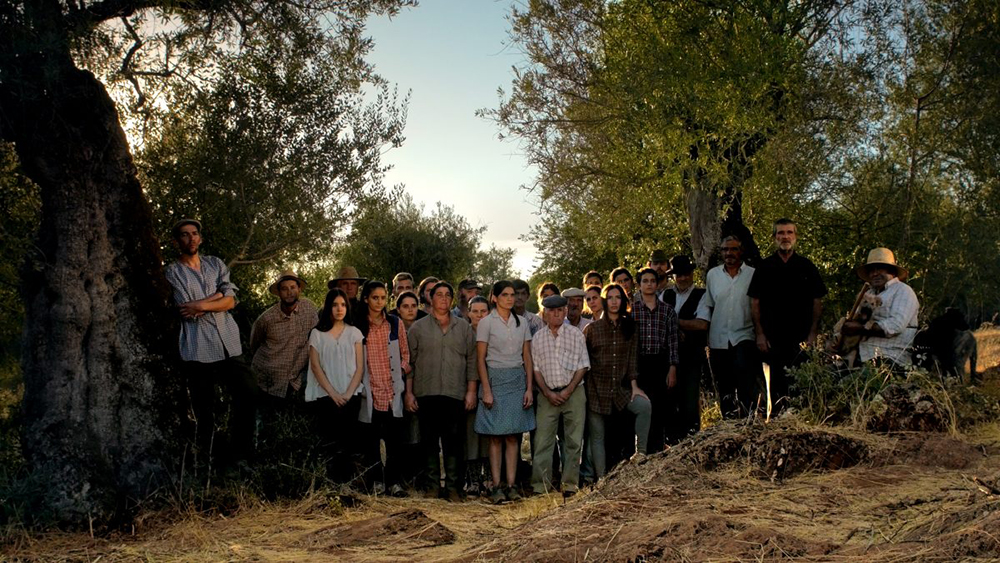
In the Portuguese Alentejo region it is said that, when something is lost, those who are looking should start to walk back to the beginning. Farpões Baldios gives an account of dispossession and occupation, of wastelands that were once part of the commons, of the people who have been living and working on these lands without ever owning them, and of their struggles for justice. Some of the people who sowed carnations and spread resistance in their own words tell their story to the youngsters of today.

Alexander Kluge: Power of Emotions

On the occasion of the screening of Die Macht der Gefühle (Alexander Kluge, 1983) at CINEMATEK, organised by Courtisane (17 – 19 DECEMBER, 2018), Sabzian published a selection of texts and excerpts from the accompanying book Die Macht der Gefühle (Frankfurt am Main: Zweitausendeins, 1984) in a new Dutch translation. Compiled and introduced by Stoffel Debuysere.

Available on Sabzian.

“Cinema is de publieke hoofdzetel van gevoelens in de twintigste eeuw,” aldus Alexander Kluge in het boek dat dient ter begeleiding van Die Macht der Gefühle (1983), een film die hij zelf beschouwt als een sleutelwerk in zijn voortdurend streven om gevoelens te herdenken in hun complexiteit en capaciteit. Met deze onderneming lijkt Kluge zich in het zog te begeven van Theodor W. Adorno en Max Horkheimer, die in hun Dialektik der Aufklärung (1944) suggereerden dat de instrumentalisering van de rede door de massacultuur een domesticatie van gevoelens met zich meebrengt. Vandaar de noodzaak, in Kluges woorden, “om gevoelens uit hun Babylonische gevangenschap te bevrijden” en ze tegelijk terug te roepen uit hun ballingschap in de louter intieme sfeer, waar ze van hun krachten zijn ontdaan. En waar elders kunnen gevoelens beter tot hun recht worden gebracht dan in cinema, deze bijzondere kunstvorm die zich in de loop van de twintigste eeuw heeft opgewerkt tot een ware “krachtcentrale van gevoelens”?

Vreemd genoeg ontdekte Kluge zijn liefde voor cinema dankzij twee denkers die een niet onbelangrijke rol hebben gespeeld in de kritische traditie die cinema tot vermoeiens toe heeft afgeschreven als een vorm van “opium voor de massa”. Het waren immers Adorno en Horkheimer die Kluge, eertijds werkzaam als juridische adviseur bij de Frankfurter Schule, introduceerden bij Fritz Lang, die hem als assistent aan boord nam bij het maken van Der Tiger von Eschnapur (1959). De kritische theoretici die de jurist wilden ontdoen van zijn affectie voor literatuur door hem naar de verdorven industriële arena van cinema te sturen, voedden onopzettelijk de singulariteit van een kunstenaar die zich van dan af voornam om “cinema te maken zoals het schrijven van boeken” en “boeken te schrijven zoals het maken van cinema”.

Ontsteld door de vernederingen die hij Fritz Lang zag ondergaan in de greep van de filmindustrie, begon Kluge socio-fictionele miniaturen te schrijven die voor het eerst verzameld zouden worden in Lebensläufe (1962). Tegelijk begon hij samen met Peter Schamoni te werken aan wat zijn eerste kortfilm zou worden, Brutalität in Stein (1961), een opgemerkt werkstuk dat een nieuwe aandacht inluidde voor de verhouding van Duitsland met zijn onfrisse verleden, in tegenspraak met de amnesie die karakteristiek was voor “Papas Kino”. Het voorbeeld van de Franse Nouvelle Vague sterkte Kluge in zijn overtuiging dat een nieuwe onafhankelijke cinema noodzakelijk was om een slagvaardige Duitse filmcultuur tot leven te brengen. In 1962 was hij een van de ondertekenaars van het “Oberhausener Manifest” en een van de stichters van het Institut für Filmgestaltung in Ulm, die allebei hebben bijgedragen tot de grondvesting van de zogenaamde “Nieuwe Duitse Cinema”.

In zijn ambitie om alternatieve vormen van filmproductie te vrijwaren en media te verlossen uit de greep van de cultuurindustrie, stichtte Kluge later ook de “Development Company for Television Program” (DCTP), die zich tot op vandaag trots situeert als een “onafhankelijke producent binnen het commerciële televisielandschap”. Sinds 1987 dient DCTP als het platform voor Kluges eigen Kulturmagazine dat bestaande televisieformats approprieert en subverteert. Eerder dan over culturele events te rapporteren met behulp van gestandaardiseerde modellen kiest hij ervoor om “vormen te ontwikkelen die kunnen overleven temidden van deze onmogelijke situatie die elke expressie vernietigt”, vormen die bovendien druk uitvoeren op de “spieren van de verbeelding”.

Kluge positioneert zich als een bondgenoot van de “onderdrukte klassen” van de menselijke zintuigen en kiest ervoor om kwaliteiten aan te spreken zoals nieuwsgierigheid, koppigheid en de honger naar het kijken, luisteren en correleren. Hij contrasteert de “dramaturgie van de onvermijdelijke tragedie”, typerend voor de 19e-eeuwse opera, met een “dramaturgie van Zusammenhang”, gebaseerd op principes van montage, simultaniteit en polyfonie. Dit zoeken naar Zusammenhang staat ook centraal in zijn literaire oeuvre, dat grotendeels werd verzameld in Chronik der Gefühle (2000, recent in het Frans vertaald als Chronique des sentiments). Aan de basis van deze “livre-océan”, zoals Georges Didi-Huberman het werk heeft gedefinieerd, ligt Alexander Kluges decennialange onderneming van “het vertellen van verhalen over hoe gevoelens niet machteloos zijn”. Een onderneming die ongetwijfeld meer aandacht verdient.

Stoffel Debuysere

Alexander Kluge: Die Macht der Gefühle

17 – 19 DECEMBER, 2018. STUK LEUVEN / CINEMATEK BRUSSELS. Curated by Stoffel Debuysere.

“The making of my film ‘Die Macht der Gefühle’ was a key experience for me. In Central Europe we have the bad habit of speaking of feelings as a sort of alchemical concoction that makes it possible to mobilise people, to capture their attention rather than serve knowledge. The mass media and advertising industry release immense quantities of ‘sentimentality’. But in reality, if feelings have any power at all, it’s not in that way. Feelings constitute a universe of precision.”

“The cinema is the public seat of feelings in the 20th century,” thus wrote Alexander Kluge in the book that accompanies Die Macht der Gefühle (1983), a film that he himself considers a key work in his continuing effort to rethink feelings in all their complexity and ambivalence. With this effort Kluge seems to take up concerns voiced earlier by Theodor W. Adorno and Max Horkheimer, who argued that the instrumentalization of reason implies a domestication of feelings. Hence the need, in Kluge’s words, “to release feelings from their Babylonian captivity,” to recall them from their banishement to the intimate sphere, where they find themselves disempowered. And where better to bring back feelings in full force than in cinema, this peculiar art form that, in the course of the twentieth century, has assumed Opera’s role as “power plant of feelings” (“Kraftwerk der Gefühle”)?

Strangely enough Kluge discovered his love for cinema due to some of those who were most influential in its dismissal as a a kind of mass opiate. It was notably Adorno and Horkheimer who introduced Kluge, then serving as a legal counsel for the Frankfurt School, to Fritz lang, for whom Kluge ended up working as an assistant on the making of Der Tiger von Eschnapur (1959). As it turned out, the critical theorists who thought they could cure an educated lawyer of his affection for literature, an art form which they considered worn out, by sending him to the depraved industrial arena of cinema, accidentally nurtured the singularity of an artist who went on to “make cinema like writing books with moving images” as well as “writing books with the means of cinema.” Appalled at the indignities Lang suffered at the hands of his producers, Kluge began writing the short stories that would later be collected in his first publication Lebensläufe (1962) and he teamed up with Peter Schamoni to direct his first film, Brutalität in Stein (1961), which inaugurated a new attention towards Germany’s relationship to its fraught past, at odds with the cinematic amnesia that characterised “Papas Kino”.

The example of the French Nouvelle Vague confirmed Kluge in his conviction that a newborn, independent kind of cinema was necessary if a vibrant film culture was to emerge in Germany. In 1962 he was one of twenty-six signatories to the Oberhausen Manifesto and co-founder of the Ulm Institut für Filmgestaltung, which both laid the foundation for the so-called “New German Cinema”. In his venture to safeguard alternative forms of production and wrest media from the exclusive control of the culture industry, Kluge founded the Development Company for Television Program (DCTP), which proudly calls itself an “independent producer in the midst of commercial-TV”. Since 1987, DCTP has served as the platform for Kluge’s own Kulturmagazine which consciously both appropriate and subvert standard television formats. Instead of reporting on cultural events in the same old standardized ways, Kluge chooses to “develop forms that can survive inside this impossible situation which destroys expression,” forms that aim to put pressure on the viewer’s “muscles of imagination.”

Kluge posits himself as an ally of the “suppressed classes” of the human senses, dramatising qualities like curiosity, memory, stubbornness, the hunger for seeing, hearing and correlation. He contrasts the “dramaturgy of inescapable tragedy”, which characterises nineteenth-century opera with a “dramaturgy of Zusammenhang”, based on principles of montage, cross-mapping, simultaneity and polyphony. This search for Zusammenhang is also central to his literary oeuvre, which has been largely collected in Chronik der Gefühle (2000), bringing together a multitude of socio-fictional miniatures that interconnect and interact with one another. At the heart of this “livre-océan”, as Georges Didi-Huberman has recently described it, is an endeavour that has been Alexander Kluge’s decades-long preoccupation: “to tell stories of how feelings are not powerless.” An endeavour which deserves all our attention.

In collaboration with CINEMATEK, STUK & Goethe-Institut. The screening in Leuven is organised by STUK and Courtisane, in collaboration with the Lieven Gevaert Centre, the Institute of Philosophy (KU Leuven) and the Research Group German Literature, Fac. of Arts (KU Leuven).

Die Macht der Gefühle
Alexander Kluge, DE, 1983, 35mm, 112′

“The film’s title (The Power of Emotion) is to be taken literally. For Kluge it is indeed about devising the genealogy of emotions (XIXe and XXe century). An operation that he conducts in a musilo-brechtian fashion, by way of collages, aphorisms and sketches, by considering emotions as objects and opera as the factory that, historically speaking, has fabricated this object on a large scale.“ (Serge Daney)

“I believe that, in the end, it is feelings that affect everything in our world, that move everything, yet these feelings have no institutional power. “They pervade us. You just can’t see them.”

When I started working on Die Macht der Gefühle, I was not in a rational state. I did not say, I have a subject and now I will make a film about it. Instead I was spellbound and observed in my direct surroundings, for example, how feelings move. I have not really dealt with the theme of my mother’s death and the fact that she was the one who taught me “how feelings move.” Nor have I dealt with how she died. That was an entire palette of feelings: “All feelings believe in a happy end,” and everyone believes tacitly that they will live forever: The entire palette is somehow optimistic, a positive attitude towards life having been put on the agenda as long as she was young, as long as her body held out, from one day to the next she collapsed. She just suddenly collapsed, like in an opera where disaster takes the stage in the fifth act. It felt as if I had observed an air raid or a disaster.

The film Die Macht der Gefühle is not about feelings, but rather their organization: how they can be organized by chance, through outside factors, murder, destiny; how they are organized, how they encounter the fortune they are seeking.

What is all this organization of feelings about? Generally feelings tend to be a dictatorship. It is a dictatorship of the moment. The strong feeling I am having right now suppresses the others. For thoughts this would not be the case. One thought attracts others like a magnet. People therefore need affirmation by other people to be sure about their own feelings (to counteract the acquisition of their feelings through outside forces). Through the interaction of many people, for example, in public, the various feelings also have a magnetic attraction to one another just like thoughts do. Feelings communicate through their manifestation in public.

The cinema is the public seat of feelings in the 20th century. The organization is set up thusly: Even sad feelings have a happy outcome in the cinema. It is about finding comfort: In the 19th century the opera house was the home to feelings. An overwhelming majority of operas had a tragic end. You observed a victim.

I am convinced that there is a more adventuresome combination: Feelings in both the opera and traditional cinema are powerless in the face of destiny’s might. In the 20th century feelings barricaded themselves behind this comfort, in the 19th century they entrenched themselves in the validity of the lethal seriousness.”

Alexander Kluge, Die Macht der Gefühle (Frankfurt am Main: Zweitausendeins, 1984)

Der Angriff der Gegenwart auf die übrige Zeit
Alexander Kluge, DE, 1985, 16mm, 106′

“Alexander Kluge’s films comprise some of the most thought-provoking, original works to come out of the New German Cinema. He is noted for his use of complex narrative structure, innovatively combining disparate elements. In Der Angriff der Gegenwart auf die übrige Zeit (The Assault of the Present Upon the Rest of Time), Kluge continues his fascination with history, culture and cinema as he examines the close of the twentieth century. Opening with a production of Verdi’s Tosca, he sets up a contrast between the treatment of moral and aesthetic issues in the nineteenth century, and their examination in the cinema. Several stories are juxtaposed, creating a filmic essay, a montage of ideas and reflections on a present which affects our perceptions of both the past and the future. At the center, serving perhaps as a metaphor both for his film and for cinema, is the story of a director who goes blind while working on his latest film. He continues working, his head full of images, trying to create what he cannot see.” (Kathy Geritz)

“We speak about the opera of the 19th century; it is considered the summit of dramatic art. In the film Die Mach der Gefühle (The Power of Emotion), opera was likened to a “power plant of emotions.” The film Carmen by Carlos Saura has shown that such older forms of dramatic art tap certain currents in spectators; this is something we did not know before. Bound up with our own century is another “power plant of emotions” – the cinema. Presumably, in the next century, beginning sixteen years from now, we will call it the cinema of the 20th century. This art form is ninety years old – a love affair of the century. The cinema consists of screening rooms, movie palaces, theaters on the front-lines, as well as many other gathering places, wherever films are shown for money. It also consists of a series of fascinating technical inventions which, though very elementary compared with the capabilities of electronics, all have to do with with the construction of a time machine. This cinema tells stories and it has produced artistic figures [Kunstfiguren] and idols. Obviously, this medium intrigues me. The present film project deals
(1) with elements of cinema;
(2) with the illusion of the city;
(3) with people acting in the city who have all kinds of things moving through their heads: personal experiences, notions about cinema, the reality of the city.

The stylistic link, and simultaneously the basis for a certain comic dimension corresponding to the seriousness of the situation, is the category of time. Cinematic time, the “condensed dramatic time of cities,” a lifetime – wrestling with time obviously occupies the course of our lives.”

Alexander Kluge, Der Angriff der Gegenwart auf die übrige Zeit (Frankfurt am Main: Syndikat Autoren und Verlagsgesellschaft, 1985)

Conversation with Lisandro Alonso

Lisandro2

In the context of a retrospective program dedicated to the work of Lisandro Alonso (8 – 16 NOVEMBER 2018, Brussels), after a screening of ‘Jauja’ (2014) on 8 November. An initiative of CINEMATEK, Cinea and Courtisane, in collaboration with the Embassy of Argentina in Brussels and Instituto Cervantes.

La Libertad: the title of Lisandro Alonso’s debut film can also be used as a fitting description for his approach to cinema, one that allows him to follow cinematic paths that aren’t paved with convention or certitude. Instead, The Argentinian filmmaker prefers to intuitively venture forward from the desolate hinterlands that he encounters on his travels to the outskirts of so-called “civilized” life: the endless barren pampas in La Libertad (2001), the swarming green jungle in Los muertos (2004), the frigid snow country of the Tierra del Fuego archipelago in Liverpool (2008), the immense, surreal desert landscapes of the Patagonia region in Jauja (2014), and even the shadowy bowels of the Teatro San Martin in Buenos Aires in Fantasma (2006). Every film’s meticulously filmed setting plays a fundamental role as the backdrop to the wanderings of a solitary, taciturn figure, whose inner life and social history remain shrouded in mystery. The reticent figures drift through frontier places where different worlds come together, where nature and civilization meet, different eras collide, memory and history, fantasy and reality coincide and become entangled, giving Alonso’s cinema a fable-like dimension that seems to shift in complexity and density.

From the circularity of La Libertad’s portrayal of the Sisyphean life of a lumberjack and the linearity of an ex-con’s downriver homeward voyage in Los muertos to the tangential shift in point of view from a sailor to a farmer in Liverpool: for every new film, Alonso finds a new freedom, driven by a searching energy that leads him time and time again towards uncharted territories. His latest film, Jauja – the result of his first collaboration with a writer and professional actors – follows the ever-widening orbit his films have been tracing even further into the register of myth. Starting with a text that refers to a place in Inca folklore, a “mythological land” which men “tried to find but got lost on the way to that earthly paradise,” the film gradually mutates into a hypnotic, trance-like odyssey during which all boundaries between the real and the unreal dissolve. With every new venture, Alonso seems to ever more radically engage with the essential pursuit of his cinematic quest: to leap into the unknown in order to rediscover freedom.

ARTIST IN FOCUS: Lisandro Alonso

8 – 16 NOVEMBER, 2018, CINEMATEK, BRUSSELS. An initiative of CINEMATEK, Cinea and Courtisane, in collaboration with the Embassy of Argentina in Brussels and Instituto Cervantes. Curated by Céline Brouwez & Stoffel Debuysere.

La Libertad: the title of Lisandro Alonso’s debut film can also be used as a fitting description for his approach to cinema, one that allows him to follow cinematic paths that aren’t paved with convention or certitude. Instead, The Argentinian filmmaker prefers to intuitively venture forward from the desolate hinterlands that he encounters on his travels to the outskirts of so-called “civilized” life: the endless barren pampas in La Libertad (2001), the swarming green jungle in Los muertos (2004), the frigid snow country of the Tierra del Fuego archipelago in Liverpool (2008), the immense, surreal desert landscapes of the Patagonia region in Jauja (2014), and even the shadowy bowels of the Teatro San Martin in Buenos Aires in Fantasma (2006). Every film’s meticulously filmed setting plays a fundamental role as the backdrop to the wanderings of a solitary, taciturn figure, whose inner life and social history remain shrouded in mystery. The reticent figures drift through frontier places where different worlds come together, where nature and civilization meet, different eras collide, memory and history, fantasy and reality coincide and become entangled, giving Alonso’s cinema a fable-like dimension that seems to shift in complexity and density.

From the circularity of La Libertad’s portrayal of the Sisyphean life of a lumberjack and the linearity of an ex-con’s downriver homeward voyage in Los muertos to the tangential shift in point of view from a sailor to a farmer in Liverpool: for every new film, Alonso finds a new freedom, driven by a searching energy that leads him time and time again towards uncharted territories. His latest film, Jauja – the result of his first collaboration with a writer and professional actors – follows the ever-widening orbit his films have been tracing even further into the register of myth. Starting with a text that refers to a place in Inca folklore, a “mythological land” which men “tried to find but got lost on the way to that earthly paradise,” the film gradually mutates into a hypnotic, trance-like odyssey during which all boundaries between the real and the unreal dissolve. With every new venture, Alonso seems to ever more radically engage with the essential pursuit of his cinematic quest: to leap into the unknown in order to rediscover freedom.

Program on www.courtisane.be