By Glauber Rocha
Originally published as ‘O último escândalo de Godard‘ in Manchete, n. 928, 31 January 1970.
This year’s talk of the town will be Vent d’est, the latest film by Jean-Luc Godard, made after Le gai savoir and before Pravda. An Italian film. Still a complete mystery. This grande fofoca is possibly of the same stature as La dolce vita. Cineriz, a big distributor associated with Rizzoli publishers, has paid an advance of one hundred thousand dollars to producer Gianni Barcelloni for a “western in colour written by Cohn-Bendit, directed by Jean-Luc Godard and featuring Gian-Maria Volonté”. Does the film meet the requirements of Cineriz? I saw the first, secret screening, in the company of the producer and a lawyer. Cineriz, suspecting that the film would have nothing in common with what they expected, are threatening to sue the producers and ask for their money back, but as yet none of them has seen the film, on which subject the craziest jokes are going around. For example, I met this young guy who asked me, “Have you heard? In Godard’s far-west, there are two horses reciting Mao!”
Gianni Barcelloni asked me for a cigarette ten minutes into the screening, and while lighting the match, I noticed he was in tears. Next to him, the lawyer kept his lips firmly sealed. At the end of the row of seats, Ettore Rosbuck, a young millionaire with long hair, was wrapped in silence. After ten minutes, the film is still in its first scene, a scene showing a couple a youngsters lying around in the grass, while on the soundtrack we can hear a political discussion, with the sound distorted – “typical Godard”, a specialized snob would say. But the joke stops there. After the first half hour, the lights come on and the lawyer, in a frenzy, says, “I agree with Godard’s words, but this is not a film! Cineriz will sue us!”
So I answered: “Listen, doctor, what technically determines the definition of a film is the length of printed pellicule, sound and image. Scientifically, the film does exist.”
The lawyer answered, “I am a practical man. It is the judge who will say that this is not a film.”
So I responded to the lawyer, “Sir, there is no legislation that says what a film is, in esthetic terms. If a judge ever ruled that this is not a film, you can appeal.”
In the middle of this conversation, the lights go out and an image appears in which Godard, in his protestant pastor’s voice, asks what a film is. The lawyer breaks out in laughter, and Godard continues with an image showing Gian-Maria Volonté on a horse, dragging along the body of an Indian.
What is a film? Every day, the bosses ask filmmakers to make films. The boss could be Brezjnev-Mosfilm, or Nixon-Paramount. The scene we are seeing now is typical of a Hollywood western: an officer of the American cavalry torturing an Indian. The scene is repeated, but this time the officer is reading a fashionable revolutionary book. In this scene we see an image and we hear the sound of a progressive film, such as those presented yearly at the festivals in Pesaro or Leipzig: a film that is the same as the reactionary films we’ve seen before, since it shows the same spectacular images, with false content.
After that, several other images are shown and numerous questions are asked about militant cinema, always in the spirit of rigorous self-critique. I tell the lawyer, “You have seen it now: the discussion will go far. If the judge behaves like an ass, call Moravia, Lévi-Strauss, Marcuse, Sartre. A Godard film can take a hit: Cineriz would prefer to loose a hundred thousand dollars than to loose face.”
The lawyer hasn’t heard me, he’s completely fascinated by the film. Barcelloni is praying. Ettore seems possessed by this bestial silence that captures one in the presence of the indecipherability of a genius.
More images follow, filled with quotes and discussions, and then the film ends. The lawyer is even more furious now and I say while getting up, “In my opinion, the only problem with the film is that at this time it will not pass the Italian censorship. Other than that, it is as good and as commercial as all the others.”
The lawyer calls me an optimist and leaves. I go out with José Antonio Ventura, the film’s sound engineer, and I tell him several things. “The sound editing is brilliant. Godard will end up making a record one day. It is not a political film as Godard usually makes them: it is rather an anarchist film in the line of Artaud and Jarry.”
From elsewhere I call Escorel (1) and I tell him all that. We ask ourselves if Paul Emilio Salles Gomes (2) would like it. Surely. A bit later, still with Ventura, “It’s a bit of a joke. With a hundred thousand dollars, we could have created a film industry in Brazil!”
When I reach Gianni, I say, “There is something in the editing of sounds and images, something that irritates me: a bourgeois anarchism, a destructive moralism, something taking itself seriously. What if, Gianni, Bach had put leftist phrases in his music, in order to make himself heard at a music festival? Or if Mondrian had painted leftist legends on his tableaux? Or even in Brazil, if Tom (3) had succumbed to the pressure, and had utilized leftist words for his music? You know, Gianni, I remember when old Nicholas Ray told me in Cannes, “Whenever I see a Godard film, I’m not always interested in the images, which are very beautiful. The big problem with Jean-Luc is that he doesn’t have the courage to speak himself!”
Gianni answers, “Jean-Luc, he worries me.”
I turn to good old Ventura, “You know, Zé, Godard’s big frustration is that he doesn’t succeed in creating a political climate; he doesn’t dispose of any violence. He always approaches reality in a theoretical way. When he shows the officer of the American military torturing a student, he doesn’t generate any terror. The shot is extremely beautiful, one of the most beautiful shots in cinema, a shot made to make cinephiles swoon.”
“That’s right,” consents Zé, “In the scene in which the officer attacks the demonstrator, he wanted to have a brutal scene, and he really asked me to raise the sound, and what remains, as you’ve seen, is this simple scene, almost lyrical.”
“But the scene has turned out brilliantly”, I respond to Zé, “because the four camera movements that he made are absolutely unprecedented in film history.”
“Yes, really beautiful!”, whispers Zé.
“Zé”, I continued, “the more I think about it, the more I’m against the film, because it’s us who are the weak part in it. This film is an instrumentalization of our misery by a French bourgeois who is doing his own thing, explaining Marxism, a subject that I don’t know very well, but I don’t think he understands it either. If a professor of political science were to help out, perhaps that would please him. Having said that, there is something, perhaps this desperate attempt to explain Marxism, that doesn’t respond very well to today’s problems. And then I don’t know… It seems to me that the film is a big joke!”
It is useless to continue to describe my reactions to Vent d’Est. In Brazil, when an intellectual doesn’t like a film from the “new cinema”, he says with the tone of a great wise man: “This is not a film!”
A film for intellectuals generally obeys the American model, which they have been seeing since childhood and which they place alongside their Oedipus complex: the least provocation, and it’s immediately taken as pretentious idiocy. One day on the beach, an intellectual from Rio told me, “I don’t like El Justicero (3) because the camera is always static, and in a comedy, the camera has to move!
And in groups, they all behave like babas. The fashionable intellectuals who already have a model of modern cinema in mind, in line with Godard’s work: Vent d’est will freak them out. And to the youngsters who have been imitating Godard for the last five years or so, I address a warning: they should move fast, because in his two next films, Jean-Luc is capable of reinventing everything and even the infernal bazar of tropicalismo won’t help them conceal their old-style soccer game, nor make the goals against the teams of their colleagues. Sadly, it seems, with Vent d’Est, the Godard fashion has come to an end, and it’s Jean-Luc who is ending it himself, horrified by his own brilliance. These are the last words I tell Ventura:
“The tragedy is that in all of Latin America, it will be wild imitation all over again, and just as the Africans should show all the white folks the door, we should prevent foreign films from coming to Brazil. Brazilian cinema can only evolve if the audience, the critics and the filmmakers only see Brazilian films. For Godard, cinema is over, and for us, cinema is only beginning. In Brazil, a cameraman like Dib Lufti makes a long shot à la main and the whole world vibrates; if Godard saw that, he would fall to the ground in tears.”
In front of this man, skinny, bald, forty years old, I feel like an affectionate aunt who is ashamed to give sweets to a sad nephew. The image is silly, but Godard provokes a great sentiment of affection. Let’s talk seriously: it’s like Bach or Michelangelo eating spaghetti swamped with cockroaches, thinking that it’s not worth painting the Sistine Chapel or composing the Actus Tragicus. Because he is like that, Godard today, more humble than Francis of Assisi, ashamed of his own genius, excusing himself to the whole world, crying like a child when Barcelloni scoffed him, complaining of feeling abandoned, of being a wreck, the glory of being the greatest filmmaker since Eisenstein weighing on his Swiss bourgeois anarcho-right-wing shoulders. Please, let’s stop that. ‘I am only a worker in cinema, so don’t talk to me about cinema: I just want to cause revolutions, help humanity’.
There he is, calling the merry May leftist club for help, using production money to pay for a nice holiday in Sicily, leaving Cohn-Bendit and his hysterical Mao-Spontec discussions behind and rushing to Paris to show some excerpts of his film on Czechoslovakia, coming back to Rome out of breath to declare that he doesn’t want to make money with the film, criticizing me of having a producer’s mentality. Then he asks me to help him destroy cinema. I tell him that what I’m into is something else: I tell him that my business is creating cinema in Brazil and the Third World. Then he asks me to play a role in the film and if I want to shoot a scene in Vent d’est and – being the old monkey that I am – I tell him to calm down, because I am only there for the adventure and I’m not clownish enough to embark in the gigolo’s collective folklore of the unforgettable French May.
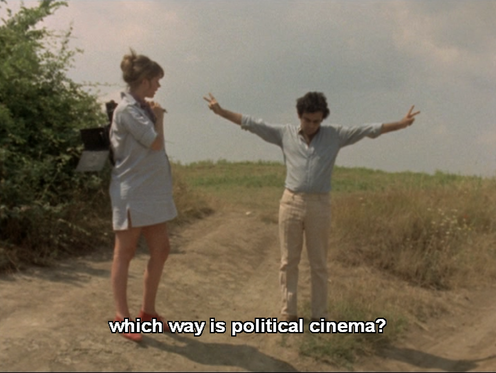
To simplify, Godard sums up all the questions of today’s European intellectuals: is art worth making? The question is an old one, Paulo Francis (5) would say: Joyce has also destroyed the novel! And that’s what is so annoying in Europe today: the issue of the usefulness of art is old, but it is in fashion and, in cinema, it’s up to Godard alone to come to grips with the crisis. Godard is what Fernando Ezequile Solanas (6) is to us in Buenos Aires. The truth, however, whether our intellectual fellow countrymen want to hear it or not, is that European and American cinema has gone up a road without hope, and it’s only in the Third World countries that there is a way left to make cinema. That’s where the crisis resides and why Godard (and co.) has a lot to do with us. In Vent d’est, he asks me what the roads of cinema are, and he himself gives the answer: “That way is the cinema of aesthetic adventure and philosophical inquiry, while this way is the Third World cinema – a dangerous cinema, divine and marvelous, where the questions are practical ones: production, distribution, training three hundred filmmakers to make six hundred films a year for Brazil alone, to supply one of the world’s biggest markets.”
I repeat: That is the difference. On the one hand, there is a general exhaustion financed by big capital, and even Godard, in his desperation and as much as he wants to escape it, makes film after film, financed by the system itself that, from its side, doesn’t care if Godard attacks it with all his strength, because cinema is also exhausted and the whole world is collapsing in attendance of the Bomb. Vent d’est is financed by Ettore Rosbuck, and this young man represents Fiat. Because it’s Fiat that has been financing the most anarchist and terrorist films in recent times, and basically Ettore doesn’t care one way or the other, because for him Vent d’est is as inoffensive as any other work of art, and the great beauty of this film is just this: it’s desperate beauty, born – imperceptibly – of the exhausted intelligence of poetry. On the other hand, tired of running, but still devoid of reflection, we are here, we, the others from the Third World, and we ask permission to film.
Godard and co. are above zero. We are below zero.
We don’t have the big capital to back us up. On the contrary, we have vicious censorship on our backs. We also have an audience that hates our films because it’s drugged out on commercial foreign and national films, and on top of that market, we also have the intellectuals who hate our films because they are drugged out on Godard films, and who hate us because we dare to make films in a country that doesn’t have stars like Gary Cooper and doesn’t speak a language that knows how to say “I love you”. The difference is simply that, and that is why it’s worthwhile, I think, to say one last thing about Godard:
The art in Brazil (or any other country in the Third World) makes sense, yes sir! The underdeveloped country that does not have a strong or madly national art is to be pitied, because, without its art, it’s all the weaker (its brain can be colonized), and it’s here that the most dangerous extension of economic colonization can be found. In the specific case of cinema, I want to let my colleagues know that they should endure the criticism, the slander and the contempt without wavering, because I am absolutely convinced that Brazilian cinema novo is currently producing images and sounds that are what we can call modern cinema.
After seeing Vent d’est, I haven’t said these last words to the lawyer, because that doesn’t interest him, but now I would like to say to everyone, interested or not interested, in the faraway homeland I love so much:
I have seen from up close the corpse of Godard, having committed suicide, up there on the screen, projected in 16mm. It was the dead image of colonization. My friends, I have seen the death of colonization! If I have been a privileged Brazilian, my apologies, but by spreading this news, I just want to let it be heard: WE HAVE TO CONTINUE TO MAKE CINEMA IN BRAZIL!
(1) Eduardo Escorel has been a major figure in Brazilian cinema since the 1960s. He edited, amongst others, Rocha’s Terra em Transe (1967) and O Dragão da Maldade contra o Santo Guerreiro (1969).
(2) Paulo Emilio Gomes (1916-1977) was was a leading Brazilian intellectual and film critic. His writings include a biography of Jean Vigo and Cinema: trajetória no subdesenvolvimento (Cinema: Trajectory in Underdevelopment).
(3) Antônio “Tom” Carlos Brasileiro de Almeida Jobim (January 25, 1927 – December 8, 1994), also known as Tom Jobim was a Brazilian songwriter, composer, arranger, singer, and pianist/guitarist. He was a primary force behind the creation of the Bossa Nova style.
(4) El Justicero by Nelson Pereira dos antos in 1967
(5) Paulo Francis (1930-1997) was a Brazilian journalist, political pundit, novelist and critic.
(6) Fernando Ezequile Solanas is an Argentine film director, screenwriter and politician. His films include La hora de los hornos (1968)
——————————————————————————————————————————————————————-
Translated by Stoffel Debuysere, with help from Mari Shields (Please contact me if you can improve the translations).
In the context of the research project “Figures of Dissent (Cinema of Politics, Politics of Cinema)”
KASK / School of Arts