Far from the Law

reis.png

By Serge Daney

On ‘Trás-os-Montes’ by António Reis and Margarida Cordeiro. Originally published as ‘Loin des Lois’ in Cahiers du Cinéma n° 276 (May 1977), as part of a report on the ‘Journées cinématographiques de Poitiers’ of February 1977, dedicated to Portugese Cinema. ‘Trás-os-Montes’ was part of the programme ‘Once was Fire‘, shown on the Courtisane Festival 2013.

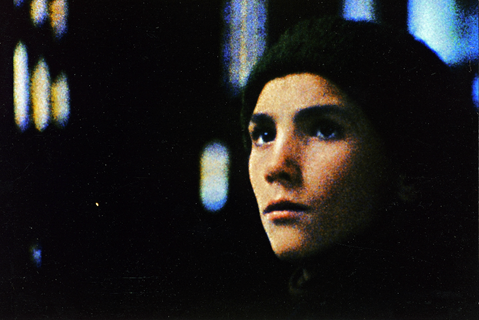
Towards the end of the film, a man teaches his son – a little boy – the basics of fishing. The boat glides over the calm water, the camera frames the shores, which are rocky, looming, equally calm. A voice (the child’s) makes itself heard. It says: “Alemanha …” A voice-over – but it does not affirm or question anything, it rather exerts itself, dreaming aloud. Then, in the same tone: “Espanha …”. What the image indicates is indeed the nearby Spain, behind the screen of mountains. But the voice that says “Espanha” does not speak louder than the other one, it does not correct it. It means that Germany is also there in the enunciation of the child. Later in the film, the rhyme will be completed in a reading of a letter sent by a father from Germany, where he emigrated to. So it is not one or the other, it is both countries at once, each reduced to one word. There is Spain as the off-image, beyond the look, and Germany as the off-sound, beneath the voice. A zone of dream and anguish separates and binds them: that which is called a “shot”.

Distanciation is the subject of the film that António Reis and Margarida Cordeiro have made in the Trás-os-Montes region (from which the film takes its title) in 1976. In the double sense of being far away (in exile) and the act itself of distancing (out of sight, and then into oblivion). Distanciation, Reis and Cordeiro tell us bit by bit, is the history of this Northeast of Portugal. It is the distant, incomprehensible and uncomprehending domination of the Capital (Lisbon) on Trás-os-Montes. To the extent that the Law enacted by the capital does not reach the farmers and they ask themselves: do they exist alone? Key scene in the film is the one in which Reis translated an extract from Kafka’s The Great Wall of China into dialect – key scene in that we’ve seen the issue put itself to rest tragically, in reality, in 1976. Distanciation de-culturising the province, cutting it off from its Celtic and pagan past, folklorizing the crumbs of popular culture in the form of postcards. Distanciation of the farmers from the cultivated fields and pastures, first to the mines in the area (beautiful scene with Armando, the abandoned child, dripping with rain), then to America (the father, never seen, suddenly returns from Argentina and leaves right away), and finally to Europe, plants and chains, França, Alemanha.

The distanciation (or its opposite: approximation) that interests the authors of Trás-os-Montes occurs in the here and now of the present. It is not the desolate dust of what is buried, the grievance of time passing by or the presentation of treasures that serve no-one (if not a necrophiliac audience, in the service of the “Knowledge of the World”). It is a much more demanding operation: to point out what in the shot (a zone of dream and anguish, I remind you) refers to elsewhere and in doing so construct, little by little, what we might call “the cinematic state of a province”. And in order to do that, Reis and Cordeiro above all do not start from the fact of the official existence of Trás-os-Montes (one of geographical maps or the bureaucracy of Lisbon), but from the opposite: from the excavation, the introcision of each “shot”, like the river already mentioned hollowing out its streamline between Spain and Germany and making its way into Portugal.

Distanciation is not only a theme (about which we can chatter, demonstrate knowledge or forge some criticism), it is also the matter of the film Trás-os-Montes. The muffled enonciation of each shot utters the same question: are there different degrees in the off? Can we be more (Alemanha) or less (Spanha) off? In other words, what is the status – the quality of being – of what comes out of the shot (of what it expresses and expels)? We guess that the answer that we give is this one (the entire enjoyment of cinema depends on it): in the off, there are no degrees. When you are far away, even if it is at the next door, in cinema, you are forever lost. This is how could be summed up, in a typically obsessive formula, the dialectics of the in and off in modern cinema. And one should add, for the indetermination to be complete: and if you come back, what can prove to me that it is still you?

The “seamless garment of reality” Bazin dreamt about is always sheared by the frame, by montage, by everything that chooses. But even patched up (repaired) by a counter-shot sewing it together, it is inhabited by a fundamental horror, a malaise: what shot A showed and what shot B has evaded may very well return in shot C, however twisted, without proof that it did not become something other. Anything that goes through the off limbo is likely to return as other. However keen on narration and representation, people like Lang or Tourneur (continued today by Jacquot or Biette) only filmed because this other, this doubt within the same, was possible, as generator of horror or comedy (see Buñuel who is the main spring). I seem to forget the film of Reis, but I’m not. As proof I’d like to point out the astonishing last scene in which a train pierces through the night, followed, one might say forcibly by the camera that not always distinguishes it from the dark and that continues to rediscover it (fort/da), either in the form of smoke (for the eye), or as a whistle (for the ear).

For him, there are no more degrees in temporal distanciation than there are in spatial distanciation. No more recent memory than long memory. Anything that is not there is, a priori, equally lost and thus, this is the important point, to be produced. Rupture with a linear, gradualist conception of loss (of sight or memory) in favor of a dynamic, heterogeneous, material conception. Because production means two things: a commodity is produced (by work) but also a presentation (when necessary). Cinema = presentation + work. Thus, despite their erudition, Reis and Cordeiro always behave as if they had to learn for themselves what they were going to communicate to a spectator who is equally ignorant. We must take Reis seriously when he speaks in the interview of “tabula rasa”. And it is not certain that this attitude is not, ultimately, better than one starting from the knowledge or supposed knowledge of the spectator, when it is not starting from a common doxa (generator, like any doxa, of satiated laziness, especially devastating in the leftist fictions). Rather, I am inclined to think that it is better – whatever side one is on from the camera – to put into practice the mizoguchien saying: wash your eyes between each shot.

——————————————————————————————————————————————————————-

Translated by Stoffel Debuysere (Please contact me if you can improve the translations).

In the context of the research project “Figures of Dissent (Cinema of Politics, Politics of Cinema)”
KASK / School of Arts
Some Notes on POV

camera-pictures.jpg

“Know that today’s struggle not only relates to the choice of subject, but also to the point of view” wrote Serge Daney in 1974. What is this notion of “point of view” which seemed to be so central to the film critical discourse of that time? And what has become of it? Daney’s statement is part of a piece in which he tried to redefine the “critical function” of the Cahiers du Cinéma, after having failed to set up a Marxist-Leninist inspired “Revolutionary Cultural Front”. It was the realization that the Cahiers of 1972-1973, this short period when radical politics was the order of the day, had not provided any effective support to the ongoing struggles, that led to a reexamination of the question: “how can we intervene?”. The answer, for Daney and his peers, was to delve deep into the relation between theory and practice, or, to use their favored concepts, between “énoncé” (the enounced statement) and “énonciation” (the enunciation). How could this relation be thought of, both for films in which the first predominated (in traditional television documentaries, for example) and those in which the latter prevailed (particularly in the so-called “films d’auteur”)? Going beyond the typical militant content-based criticism, which mainly consisted in assessing the truth or falsety of given statements, implied rethinking the esthetical dimension, not as something automatically derived from the political (as had been the case the years before), nor as something equivalent to it (as it had been for the first generation of Cahiers writers, for whom “form was never neutral”), but as something “secondary”. The question of the “point of view” then involved a concrete examination of how a political worldview could be conveyed through a chosen cinematic presentation. Against the suppositions surrounding militant cinema, all too often considered as a pretext for debate and cognizance, form once again became something to reckon with.

For quite a while the main concern for the Cahiers du Cinéma was the mise-en aspect of mise-en–scene, which was assumed to be largely obscured by the consistency of the scene. For Pascal Bonitzer, this meant that more attention had to be given to what happens “off-screen”: the blind spot where the power of the invisible lies, or to use Althusser’s expression, “the internal shadows of exclusion.” According to Bonitzer, criticism could not only be a matter of making sense of denotations (what is evident, immediate and functional in the cinematic image), the main challenge was rather to uncover the underlying (often ideological) connotations: “Criticism consists in adding meaning, in exhibiting a latent content, revealing overdeterminations [surdéterminations]: in enunciating – in order to bear judgment on it – what the object of criticism eludes, disavows or half-says.” Or as Daney has written, inspired by Barthes: “every film is a palimpsest.” This implied that one had to look beyond the self-sufficient integrity of denotations (they always loathed the idea of naturalism at Cahiers – as they would say: “the represented is not the real”, and the other way around) and take in consideration the surplus-meaning [un plus de sens] or left-over meaning [un restee de sens]. With this assertion Bonitzer explicitally took position against the legacy of the previous Cahiers generation, who had based their notion of “politique des auteurs” precisely on the rectitude of denotation. What had happened then with denotation? “It ages, fades, changes. What do we see today in the same Hollywood films? Connotations. John Wayne no longer ‘denotes”, he ‘connotes’.” Cleary, in the face of political contestations and in line with the new critical theory of the time (from Lacan to Barthes, from Bataille to Foucault via Althusser), film criticism had to take on another function: it could no longer innocently ponder the surface of cinematic worlds, it had to pierce through it, uncover its veil and reveal the workings of the real world. Always a secret beyond the door.

Not that the “politique des auteurs” was dead and buried. For Daney, by thinking of criticism solely in terms of connotation and denotation, something essential was left out: “By seeing in the iconic content of the image only what can be passed – or decanted – from the realm of connotation to the realm of denotation, one leaves aside the simple fact that in the present of the film projection something (but what?) functions as an instance that says ‘Here it is’ (Voici). Something, someone, a voice, an apparatus gives us something to see.” Here Daney draws heavily from Christian Metz’ Essais sur la signification, in which he pointed out that a shot of a gun would have to be “translated” as “voici, here is a gun”. With this indication the attention is shifted to the subject of enunciation, which is not the same as the subject of the statement. It means there is always a point of view that prevents a cinematic presentation to be reduced to a simple statement (or, in Metz’ logic, to a single word). The question of enunciation is then: who or what is this hidden instance, this voice silently saying ‘here it is’, this “little machine wound up to repeat the Lacanian phrase: ‘You want to look? Well, look at this’”? It is a question that is always connected to one of power: “as long as an image is alive, as long as it has an impact (ideologically dangerous or useful), as long as it hails an audience and gives pleasure, that means that in this image, around it, behind it, something that partakes of enonciation is at work (power + event = ‘Here it is’).” For some time this question of power – Who wants and allows this image? Who does it serve? – was lightly to be answered with “the bourgeoisie”: those who were not only supposed to have the monopoly on images of reality, but also on the pre-existing mise-en-scene of this reality. In line with the Althusserian idea of ideology as a system of representations, reality was considered as always already coded, and the challenge for any filmmaker was to look for a new mise-en scene, a new “point of view”, not to reproduce or naturalize reality but to construct one anew: “realism must always be overcome”.

After the mid 1970’s, when the dreams of many turned out to be shattered, the problematics of the “point of view” persisted, provided that it became once again a question of morality. André Bazin was back in the game, as if he had never been gone. And so was the “author”, with a vengeance: it was no longer what happend on the screen that mattered, as much as what could be recognized as the maker’s intentions. Subsequently, the old denotation-connotation scheme, which had come in handy to decipher over-coded ideological vehicles, no longer was of much use. It was no longer a matter of determining the power in or behind the image, but rather of negotiating the power inherent in the relation between those filming and those being filmed (after all, before it is given to see, an image is taken). The search for a position became one of speaking from the right place, of not speaking in the place of others. It is this problematics that Godard has pushed to its limits in Ici et Ailleurs, which is essentially a film about the act of restitution, about the impossible attempt to return images to those they have been taken of/from. This problematics is also at the heart of the films of Johan Van der Keuken, who has consciously kept on looking for the “wrong place”, for situations in which the “unequal exchange” implicit in any filmic contract, was most tangible. Van der Keuken not only tried to confront the unequal exchange between those taking images and those whose images are taken, but also between two ways of being “too much”: the structural, scandalous excess of the dispossessed, and the individual, contingent surplus of the filmmaker. In contrast to Godard, whose feeling is one of overwhelming guilt, Van der Keuken’s was rather one of shame: shame of being somewhere without a particular reason, shame to disturb those who are there without exactly knowing why. Alain Bergala once wrote that VDK’s practice had “less to do with the famous instant of decision than with a state of indecision.” Taking images, for him, was first of all an arbitrary act, determined by the contingency of his position, more than by the prominence of a subject or an instant. This indecision is balanced by continuously re-adjusting the frame, capturing the subjects in their own disadjustment. It stems from an awareness of the impossibility of capturing everything in the image of others: it always contains too much or too little for sense and presence to concincide. The image always resists, Daney said, the little of the real it contains doesn’t let itself be reduced to the cause it serves or the statements it holds. What can be done, as JVK did, is to make this inability visible: continually framing, never enclosing.

The question of inequal exhange is not about having a good or bad conscience in the face of the misery of the world, it is about showing respect in regards to pain and injustice. Between compassionate representation and estheticising indifferentism, wrote Jacques Rancière, “one has to establish the right interval, to put the right distance in the frame, one that stresses the dimensions of injustice and preserves the civility of pain. The image has to be right in the representation of this injustice that is hidden and this pain that is silent.” The immensity of injustice should not be enclosed in compassionate images, the pain of others should not be used as a mirror: one has to find a intermediary distance “where the image doesn’t promise too much beyond what it can maintain or doesn’t take too much beyond what it can return.” The ethical respect for pain and injustice becomes an esthetical search for the right distance, for a frame that is at the same time fitting and unfitting, adjusted and maladjusted to its subjects. It is always the ethics of the point of view that is at stake, or what JM Straub has referred to as einstellung: “Each image is a frame, and each frame is what the Germans call an Einstellung: which means one has to know how to situate oneself in regards to what is shown, at which distance, and at which distance of refusal and fraternity… It is a point of view on the world, touching upon moral and political opinions. One has to know how to einstell in relation to what one films and what one will show. If not one is just an irresponsable artist.” This ethics not only applies to militant or ethnographic film, as one would think; as Godard and others have persistently tried to tell us, it concerns the very act of filming itself. What else could his famous doxa “a tracking shot is a matter of morality” – later taken up by Daney in his ‘tracking Shot in Kapo’ – mean than the idea that one should never put oneself – filmmaker as well as spectator – where one doesn’t belong. The question today is if cinema can still entertain the issue of “point of view”, in a time when morality is all too often mistaken for moralizing, when faithfulness all too often serves as surrogate for respect, and the art of showing is all too often taken for an act of displaying.

A Tomb for the Eye (Straubian pedagogy)

shoenberg2.png

By Serge Daney

Originally published as ‘Un tombeau pour l’oeil (En marge de ‘L’Introduction à la musique d’accompagnement pour une scène de film d’Arnold Schoenberg’ de J.-M. Straub)’ in Cahiers du Cinéma 258-259 (July-August 1975). Republished in ‘La Rampe’.

From Nicht Versöhnt to Moses und Aron, one idea predominates, entirely contained in this title: not reconciled. Non-reconciliation: neither the union nor the divorce, neither the whole body (to preserve, to regret), nor the bias of desintegration, chaos (Nietzsche: one must desintegrate the universe, lose respect for all), but their double possibility. Straub and Huillet basically start from a simple irrefutable fact: Nazism happened. Because of Nazism, the German people of today is not reconciled with itself (Machorka-Muff, Nicht Versöhnt), but the Jews aren’t either (Moses und Aron, Einleitung). Nazism, like any power but more than any other, challenges and provokes the artists, and as a result artists no longer have the right to be irresponsible: Schoenberg is still not reconciled with Kandinsky, neither is Brecht with Schoenberg. In the Straubian system, a retro mode is simply ludicrous. Everything is in the present.

Non-reconciliation is also a way of making and producing films. It is the stubborn refusal of all the forces of homogenization. It has led Straub and Huillet to what might be called a “generalized practice of disjunction.” Disjunction, division, fission, taking seriously the famous “one divides into two.” The look and the voice, the voice and its material (the “grain”), the language and its accents are, as Chou En-lai said “different dreams in the same bed.” Films: the bed where what is disjoint, unreconciled, not reconcilable, “plays”, simulates, suspends unity. Not an (easy) art of décalage but the simultaneous head and tail of the one and the same piece, never played, always revived, inscribed on one side (the tables of the Law, Moses), stated on the other (miracles, Aaron).

What is it that imposes this homogenization against which one always has to disjoint, not reconcile, if not cultural imperialism which is in the process of submitting the industry film throughout Europe (England, Germany, Italy), to submit it to its manufacturing standards (a non-rational mess), to bring, for example, a man who, as first and against all, dared to film with direct sound and in dialect (Visconti: La Terra Trema), to no longer think of his films – for the global art market – in any other way than directly dubbed into English, without anchor point, directly mutilated?

Anchoring films, images, voices means taking seriously the cinematic heterogeneity. And this anchorage, the idea that an image is only possible there and nowhere else, is not just a matter of language and voice. There is also the body. Strangely, the Straubian cinema allows us to understand that the naked body only has such exchange value, that it constitutes for capital (porn movies) such a precious signifier, because it has no attachment to History, because it makes us loose sight of it. Therefore it is necessary to anchor the body. I’m thinking of the shirts on the torsos of (true) farmers who lay their offerings before the golden calf in Moses and Aaron. And even of the erotism in the Straub films, discrete validation, of the most neutral parts of the body, the less spectacularly consumable (see images: an ankle, a knee).

shoenberg7.png
shoenberg1.png

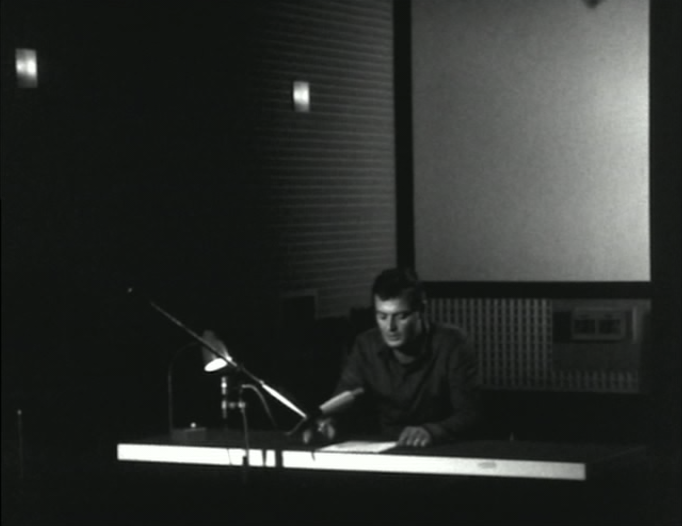
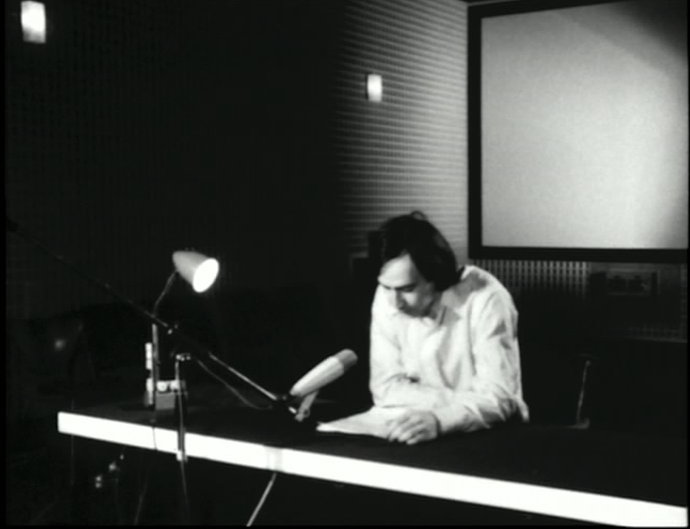
The minimum device of enunciation is the voice, the phonic device. For Straub and Huillet this is the preferred device (Othon). But there are others, other places where speech circulates and where speech is emitted. In Einleilung, rarely enough, the technical recording devices, the “sounding boards” are filmed. Look at both pictures and forget for a moment what Straschek and Nestler are saying. What do we see? Images of a a recording studio, images connoting officiality, the weight of legitimate discourse, heavy, coming from above and destined to provoke no respons. Image of “speakers”, servants of speech, therefore not having to take it.

When we see the face of Léon Zitrone appear on the TV screen, we have to think – very quickly, once past the first moment of revolt – something like: “the bourgeoisie speaks to us directly.” Does this mean that Zitrone (his voice, his face, his eyes, his intonation) is completely transparent? No, it rather means that he is not talking but is just filling his speaking time.

Speaking in the device, speaking “in position”, means being exempted from enunciation (legitimation). For many years, we have seen oppositional parties fail to master this problem. They spent a huge amount of the time allotted to them (during which time they were actually seen) saying that the rest of the time they were never seen. And then they didn’t have anymore time to say what they had come to say.

shoenberg5.png
shoenberg6.png

Being removed from power means being removed from devices. Being removed from the devices means being constrained – if only we could break out one day – to take on the dispositive of enunciation (“to distance oneself”) even before stating anything whatsoever. Obligation to note, in the device, an enunciation (the legitimacy of the event: to speak out) which the device disposseses a priori. This is why the question of enunciation is always linked to one of power (ability to speak, not to speak – Clavel – to say things otherwise), while statements are on the side of knowledge (concentrated, archived power).

Returning to the two photos, it is clear – when we have a good look – that Straschek and Nestler are not “speakers”, not even mock speakers. Just look at how they are dressed, how they read (and are installed to read, with their eyes obstinately lowered).

And what do they read? Let us quote. In the letter from Schoenberg to Kandinsky: “When I walk in the street and all men look to see if I am a Jew or a Christian, I cannot tell everyone that I am the one whom Kandinsky and some others make an exception of, while doubtless Hitler is not of this opinion.” And Brecht:” Those who are against Fascism without being against capitalism, who lament over the barbarism that comes out of barbarism, are like people who wish to eat their veal without slaughtering the calf. They are willing to eat the calf, but they dislike the sight of blood.”

What do these two speeches have in common? These are speeches of victims, of people in exile, speeches that have never participated, do not participate in any power.

The question at hand is significant: how to stage speeches, and more specifically speeches that are literary texts? Question that Straub and Huillet answer in their own way. Not so much by lodging dominant discourses in the everyday life of the dominated (the path followed by Allio in Rude journée pour la reine), rather by inscribing – fantasy? – dominated speeches, “resistance texts” in fact, in the dominating devices. Fantasy: a state radio voicing Brecht. But there is not only the enjoyment of such a revenge (mechanically, this would mean Zitrone reciting Brecht), there is also the moment when, between dominated discourse and dominating device, the incompatibility, the non-reconciliation takes off. Question to ask about Brecht, today, in the German Democratic HGH Republic.

Remember Christian Metz saying that the linguistic translation of a shot of a gun would not be the word “gun” but something like: “Here’s a gun” (observe in passing that this example is not neutral: trajectory of finger, eye and bullit, scopic drive, ballistic drive). The whole problem of enunciation in cinema: knowing what, during the time of the projection of a film, functions as the instance that expresses, the voice that silently says: “Here it is. Here are corpses, a B-52. Etc.. “, all this can probably be formulated from this remark. Sound has the privilege to assert (as it is through sound that sense is made and from which militant cinema, for example, takes comfort), but the privilege of the image, presentification, the very act of “Here it is” (Voici) hasn’t really been examined.

By only considering the image as a surface, infinitely divisible, By only seeing in its iconic content what can be passed – decanted – from the realm of connotation to that of denotation, one leaves aside the simple fact that in the present of the film projection, something (but what?) functions as the instance that says “Here it is.” Something, someone, a voice, a camera gives us something to see.

The basis of our disagreement with Marc Ferro (see ‘Le Monde diplomatique’, May 1975) can be found there. As a good historian, he thinks he can help the maximum public (competence+pedagogy) by getting accross whatever the image contains haphazardly, implicitly, involuntary, in the domain of the denotable, of information, of knowledge – knowledge after the fact, protected knowledge. However, the problem is not to reduce the image or to dream up one that would be information, purely denoted. This reduction, we begin to suspect, is impossible, it secretes, like any implementation of code, something irreducible, a “third meaning” (Barthes). The problem is rather that the image is not a flat surface to anyone, except for those who have chosen to make it flat.

As much as an image is alive, as much as it has an impact (ideologically dangerous or useful), as much as it calls out to a public, as much as it provides happiness, it means that in this image, around it, behind it, something in the domain of enunciation (power + event = “Here it is”) functions. Admirable in this regard is the latest film by Marguerite Duras (India Song) which gives us to understand (to hear) where that what images give us comes from.

In cinema, enunciation might be, hidden somewhere, a little machine wound up to repeat the Lacanian phrase: “You want to look? Well, look at this”.

The cinematic image can not only be accounted for by the competence of those who know how to keep it at a distance. It is like hollowed out by the same power that has allowed it, that wanted it. It is also this thing that people have enjoyed making and others have enjoyed seeing. And this pleasure remains: the image is a tomb for the eye. Seeing a film is coming into view of what has already been seen. Seen by others: the camera, the author, the public(s), sometimes political people (Before starting operation Fascista, wasn’t it stated that it was Mussolini himself who chose the documents?). And what has been seen has already been enjoyed.

It happens that this power is inscribed in the image, as something that marks it, guarantees, authenticates it. Hitchcock, master of suspense and of each image of suspense in which he inscribed himself as a reminder that he is the master (the enunciator). And this “politique des auteurs ” can easily be turned to politics tout court: like in this extraordinary scene in Kashima Paradise where we see the police simulate for television a Japanese attack in order to justify in advance their response (that television will film).

The question can not be simple. The silent instance of “Here it is”, the mark of the “power-to-film”, the “film-to-destruct” is never locatable. It is always on the side of that part of the cinematic device that is most heavily invested by bourgeois ideology. Either on the side of the “genre” by way of garanty (commercial cinema, Hollywood), of the author by way of deposit (nouvelle vague, etc..) or even of the the camera as evidence (Cinema verité).

shoenberg3.png
shoenberg4.png

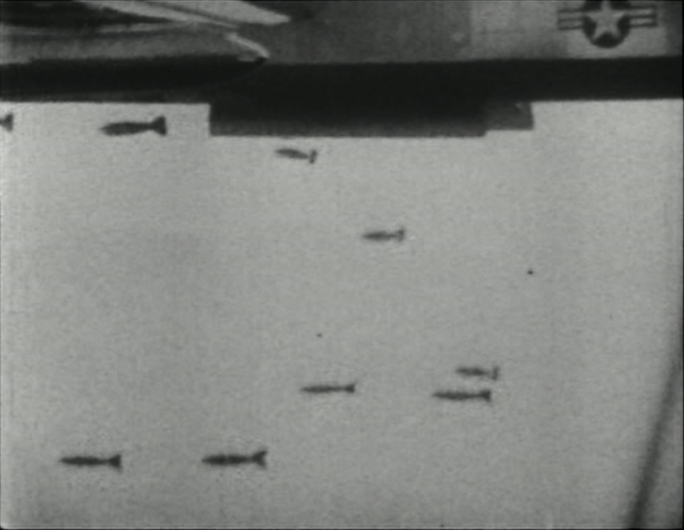
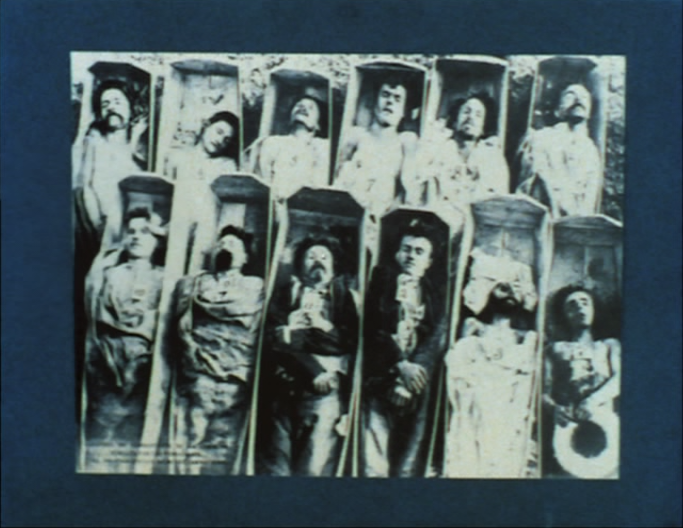
Let’s return to the two images. The Communards in their coffins, bombs from the B-52: these are of course not neutral images. They serve not only to identify such body or such bomb. They also tell us – whether they want to or not – that the camera was American, on the same side as the bomber, just as the photographer probably was on the side of M. Thiers. The non-neutrality of these images is not only that they put us in the presence of something horrible, it is that they show something for which there is no counter-shot, counter-proof, a positive image (that would be, for example, a photo taken by the Communards or the B-52 seen from the bombed field – that is to say impossible).

Same goes – a fortiori – for these images of Nazi or Nazified masses which fuel controversy and of which we do not know what to think. We have said that Nazism is a central event for Straub and Huillet. However, they never make use of images taken from the inside of Nazism. Why? Perhaps because they believe that the responsibility of artists is to create their own image – current, personal, risky – of their anti-Nazi (what made them dedicate their last film to Holger Meins), rather than reproduce images taken by Nazi cameramen in so-called “critical” montages, of which one is content just to add a hypocrite and weak commentary (silencing nothing at all) or to offer ideological neutralization through an influx of academic metalanguage (Fascita operation in Vincennes). Straub’s lesson: the derisory well-meaning assertions on the soundtrack and the “Here it is” of the Nazi image “have different dreams in the same bed.”

The two images are images of power. Not the power of enunciation of the authors (Straub-Huillet) in front of their camera, nor the power of enunciation confered by an ideological device (Straschek-Nestler), but the images produced by a bare power: that of repression and genocide, that could be signed by Thiers-Nixon. What makes Einleitung, as the authors say, “an agitation film” is perhaps its order of exposure, the time that it gives us to restore these images to what they are, images taken from U.S. power, taken from the other side. It consists of cleaning the images from every déja-vu. It consists of bringing out (to evidence but also to banish, eradicate) from these images the power that has wanted them and wanted them to not even surprise us anymore. Therefore, the horror is no longer the eternal return of the Same in the guise of the Same (retro mode), but the intolerable present (Holger Meins, 1975). Each shot is a tomb for the eye.

——————————————————————————————————————————————————————-

Translated by Stoffel Debuysere (Please contact me if you can improve the translations).

In the context of the research project “Figures of Dissent (Cinema of Politics, Politics of Cinema)”
KASK / School of Arts
Points of View

daney-odeon.jpg

By Serge Daney

Originally published as introduction to the chapter ‘L’oeil du cinéaste en plus” (cinéma militant)’ in ‘La Rampe’ (1983)

Between 1972 and 1973, Cahiers du Cinéma engaged in a “Cultural Revolutionary Front”. Belated and rather desastrous project. The texts that the magazine published back then (the famous period “without pictures”) didn’t age very well.
Needless to say, there existed a certain type of “cinema of intervention, agitation, testimony”, or as we prefered to call it: a “militant cinema”. Wellknown filmmakers became fellow travellers, unknown militants took themselves for filmmakers.
While the French film industry, once the storm had passed, reshaped itself (1970: creation of the Path-Gaumont economic interest group; 1972: sale of UGC.; 1974: film production rights granted to channel 3; 1975: Daniel Toscan du Plantier appointed CEO of Gaumont), a retro dialogue seemed to develop between militants/filmmakers and members of the old magazine.
For the Cahiers, deep down, it was not so much about verifying the social efficacy of the militant films then about searching for a certain quality in the relation between those filming and those being filmed. The shooting of a militant film reproduced “en petit” the great fantasmatic scenario of maoism in distress, with its ”people’s camp”, its “zones liberated in some way”, its “right to speak” and its “enemies of class”. It was tempting to politicize – or at least, to moralize – some of the old acquintances: frame and out of frame, commentary and voice-over, naked speech and metalanguage, naturalisme and typage.
The mana-word of this short period was “point of view”. After a reflection on the act of filming and a return to Bazin, after the infamous polemics of “technique and ideology” – which for the last time confronted leftism in art (Comolli) with exhausted experts of the communist party (Lebel)-, the Cultural Front project proceeded to a concrete examination of the way in which some tried to put forward a political point of view in their films.
Luckely, the dice were loaded: “point of view” had at least two meanings. The first was part of the standard militant language: the point of view as the application of the political line of an organization (even micro) concerning this or that issue (even “specific” – another convenient word at the time). In that sense, it necessarily existed before the film was made, and nobody cared much about knowing how, at a certain point, it became a specific problem for the filmmaker.
The second meaning was broader. It implied the situation that a filmmaker, his team and his tools de facto occupied during a shoot, their contact with the “actors” whom they didn’t know, even (and especially) if they supported them and their just causes. “Situation” in the touristic sense of the travel guide or the military sense of the survey map. The “point of view” of a militant filmmaker on a manifestation was not the same as the one of the police or state television, who filmed a crowd from up high (to count it up, and, imaginarily, to machine-gun it); the filmmaker only captured feet, banners and cries. The temptation was great to dwell on this difference and to find it, from the outset, “political”.
With time, this “debate” on militant cinema appeared as an empty ritual, for a simple reason that has remained unnoticed: the imaginary of the ’68-ers has been nourished by theatre and not by cinema. Speeches, dogmatic recitations, points of order, voicing opinions, memories of 1789, no images. We have “taken” the Odéon theatre, not the state television HQ.
However, by way of some tradition, since the great Soviet cinema (twenties) and the cinema of the Popular Front (thirties), everyone pretended to need images while no one had the means nor the taste to produce them, only enough to learn how to “read” them (hence, eventually, the academic success of the leftist semiology). Already, in 1975, Godard and Miéville’s film essay on Palestine (Ici et Ailleurs) cut short a debate which it resumed admirably.
That being said, the problematics of the “point of view” survived very well at Cahiers, on the condition of becoming once again a question of morality. Beyond the backward surge of militant activity and the withdrawal of every notion of “Front”, we rediscovered what had nourished the magazine since forever: the morality of shooting, the effacement of the notion of actor, the emergence of the author.
More and more, we’d ask “militant” filmmakers to not manipulate their images without having watched them, without having considered them both as their thing and as a thing. To lodge themselves in the gap of this dialectics. To cheat as little as possible. To make of every film a documentary on the politics of its production conditions. Always radical regressive. That is how the author of these lines, between 1972 and 1976, would go to Canossa and end up admitting that he prefers Antonioni’s Chung Kouo to Ivens and Loridan’s Yukong.
A filmmaker as witness of his times? A filmmaker as witness of images? What does it matter if the witness is present, doesn’t stand in the way of his images, and somehow inscribes his flesh and blood in them.

——————————————————————————————————————————————————————-

Translated by Stoffel Debuysere (Please contact me if you can improve the translations).

In the context of the research project “Figures of Dissent (Cinema of Politics, Politics of Cinema)”
KASK / School of Arts
Image of Change

godard-change.png

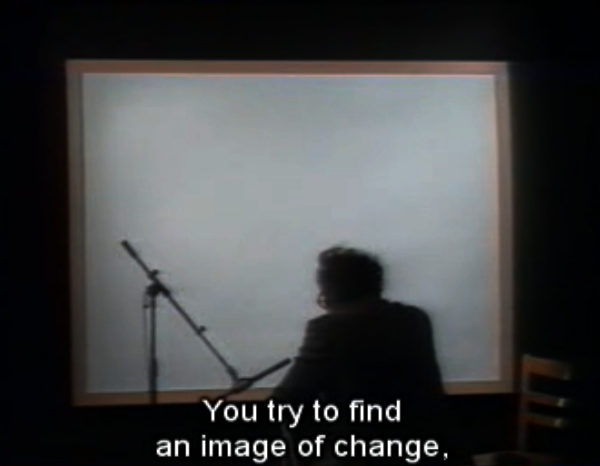
How to find an image of change? It’s a question Godard brought up three decades ago. More pressingly, how to think of an image of change when change itself cannot be imagined? It’s a question in line with the perceived impasse of our consensual times. If words such as “revolution” and “dialectics” are indeed the remnants of old ways of thinking politics, if names such as “worker” and “proletariat” have indeed lost all meaning, implying a termination of the politics bound to these names, how can we even start to consider what change might actually mean in this instance? If the word “change” itself has been emptied of all revolutionary meaning, smothered in slogans such as “Change we can believe in”, “Le changement, c’est maintenant!” (Change is now) or “Veranderen om te verbeteren” (Change to improve), how can it still be used to invent another future? If, as anyone with the slightest sympathy for Marxist beliefs or convictions would tell you, transformation of society should be our prime concern, what new worlds can be brought into being? It is precisely the absence of any horizon that has plunged the Left in an immobilizing feeling of impotence, inducing an oppressive sense of melancholy and cynicism. Views on the possible future before us have turned towards the catastrophe behind us, a pile of debris incessantly growing skyward, piling wreckage upon wreckage. Any hope of an emanipatory politics has been replaced by a defeatist Realpolitik, affirming that liberal democracy and global capitalism are here to stay, no matter what. In lieu of the grand narratives of yesteryear – or rather because of the inversion of their meaning, pointing only towards the impossibility or resisting – the only thing we can seemingly do is wait, await the safety of an improbable ontological revolution, until we finally become different from what we are.

Godard made Changer d’Images (Lettre à la bien aimée) as part of the series Le Changement a plus d’un Titre, commissioned on the occasion of the one-year anniversary of François Mitterrand’s election in 1981. Although many saw this victory, hinged on an exuberant promise of “change”, as the beginning of a socialist new dawn, it turned out to be quite the opposite. The Mitterrand era came to be known as one which was characterized by consensus-oriented politics, solely in service of the integrity of the social whole and the embrace of financial globalization. This outcome was facilitated by an intellectual climate that was overtly keen on denouncing the revolutionary tradition of the Left and repenting the wreckage it had left behind. The message was clear: the utopias of emancipatory politics, whether under the guises of Marxism or Third Worldism, could only lead to catastrophe and totalitarianism. Any hope there might have been before was violently overtaken be an overwhelming sense of guilt. Not only in France, but elsewhere as well leftist dreams had been crumbling: in Germany, Italy or Japan they exploded under the weight of the violent excesses of the radical left, in Portugal the tides generated by the carnation revolution receded as fast as they had risen, national liberation struggles worldwide were being renounced and surrendered, and in the United States and Great-Britain Thatcher and Reagan were pursuing vigorous programmes of neoliberal economic policy and regressive social agendas. The leftist decade was over, that much was clear, and the dreams of the political creation of a “new man” withered soon enough, only giving way to demands for the conservation of the age-old humanity.

The end of the 1970’s not only marked the expiration of the “red years”, but also of particular forms of militant cinema, as emblematized by the work of Godard’s and Jean-Pierre Gorin’s Dziga Vertov Group. One of their films in particular can be considered as a testimony to this ending: the one that was supposed to be titled Jusqu’à la Victoire, but in time was given another destiny and another name: Ici et Ailleurs. According to Serge Daney this was the last time a great filmmaker joined forces with a political cause: a long period of film history came to a close. But the film also made use of the critical paradigms of that time to witness how difficult it had become to intervene with images. “There are no more simple images… the whole world is too much for an image”, Godard declared, not much later echoed by Daney: an image all too often “takes the place of a link in a chain, preventing all other images from being seen”. Godard was the one who took up the task to put a halt to the circulation, suspend representation and demonstrate its falsehood. The screen was turned into a blackboard, teaching us how to see what there is (just an image) and imagine what is missing (a just image, arguably). But this art of criticism also turned out to be a labor of mourning. Looking back at this period of widespread Althusserian critique, Jacques Rancière wrote : “as if we had started wanting to read and see, started learning to read and see only when such things were entirely taken up in the system of shock and interpretation and already had no more importance.” As indicated in Daney’s last texts, the same forms of critique that claimed to disrupt the circulation of images, might have just been annexed by that circulation. In a sense, Godard’s film already came come too late: criticism was already inherent in the image, affected as it was by a overhanging sense of distance and irony. Perhaps, in all its eagerness to look behind, it forgot to look aside, ending up conforming to the established system of places.

What could an image of change be for those who grew up after the 1970’s, when the bitter end of the revolutionary era accompanied a general suspicion about the political capacity of any image? “The current skepticism”, writes Rancière, “is the result of a surfeit of faith. It was generated by the disappointed belief in a straight line between perception, affection, comprehension and action.” It now appears that mourning is not only Godard’s sensibility, it is also ours. For those of us who “came after”, a search for grounding and orientation commonly seems to result in a fascination for the dreams and energies of this past revolutionary era. It is no coincidence that numerous artists and filmmakers have recently been staging installations, performances and films as nostalgic tributes to a time when there was still something to fight for, and the image was still something to fight with. The optimistic interpretation of this renewed interest could be that there is still life left in the power of these dreams, even though there’s no way of escaping the truism that we are living in a very different world. Perhaps some of these accounts and fictions can act as potential sources of inspiration, historical poems that gives us new courage in a time of deep despair. Or else, they can give insight in the mechanisms that led to cruel failures: ever tried, ever failed, no matter, try again, fail again, fail better. But by any means, let’s try to get rid of any petrifying sense of guilt and mourning. Let’s get rid of the assumptions that images can act as instruments of change, by rendering visible that which is already recognized as possible. There can be no image of change, for the simple reason that change cannot be anticipated, nor can it be identified. However, what could be subject to change is the configuration of what is visible and invisible, thinkable and unthinkable, as a rupture with the very logic of the system of identification, keeping us in our place. And what this change could bring into being is the invention of a new landscape of the possible. Let’s be done with it: an image of change can never be fully captured. In the end, it might be just another commonplace to cancel out the art of the impossible.

Jean-Luc Godard / Changer d’image (To Alter the Image) (1982).