Transfalumination

rose.jpg

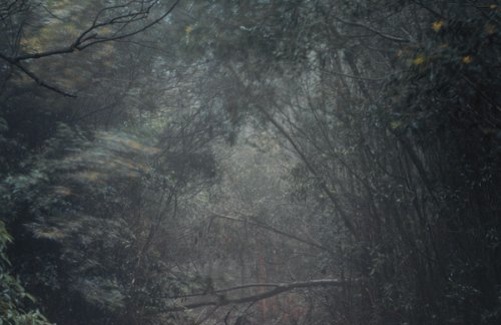
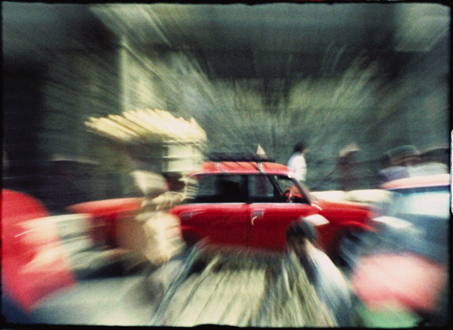
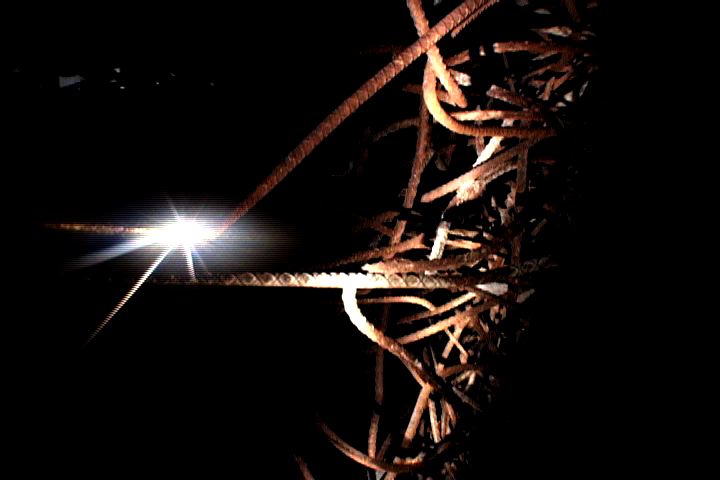
As I mentioned before I’m doing a bit of research on the representation/vizualisation of the night, and the relation with technology and perception (for a programma that might be presented as part of the next edition of the Courtisane Festival in Gent in March 2010). Some time ago I bumped into some really interesting new work by Peter Rose, of whom I only knew earlier work like ‘Analogies: studies in the movement of time’ (1977). Recently he has been experimenting with a tactic he calls “transfalumination: “I venture at night into the marginal geographies of the city and perform peculiar ceremonies with light, hoping to bring back images that appeal to some deep sense of the mysterious”.

“I’ve been interested in finding a way to somehow speak with light and to find thereby a luminal relationship with the world that is both incantatory and sensual. To this end I’ve designed an array of portable lighting instruments that project sheets of light, rather than beams of light, and I’ve been experimenting with these on a variety of scales ranging from blades of grass to fairly large landscapes. None of the images are made with any sort of animated strategy- while there is, occasionally, superimposition, and while some of the images have been slowed down, all are made in real time, in real space. I understand this all as arising from the confluence of two grand traditions in the avant-garde. There is the work that is concerned with the unadulterated, fundamental properties of light (Sharits, Kubelka, McCall, Recoder, Brakhage, the later Jacobs,et al.) And then there is a somewhat contrapuntal cabal that is more invested in ceremony, shamanic ritual, transformation, the unconscious, a performative sense of the medium that is far more narrative and lyrical; I’m thinking of Anger, Broughton, Deren, Brakhage, early Gerson, et al.)”

Here are two wonderful works from that series: Journey to Q’xtlan (2009) and Studies in Transfalumination (2008).

Journey to Q’xtlan from peter rose on Vimeo.

Studies in Transfalumination from peter rose on Vimeo.

Video Vortex V

onlinevideo3.jpg

Video Vortex, Edition V
20 – 21 November 2009. Atomium, Brussels.

In the Context of Cimatics Festival 2009.

Two years after its first edition, Video Vortex returns to Brussels, this time hosted in one of the great icons of mid 20th century modern architecture: the Atomium. During these past two years, the conference series – which focuses on the status and potential of the moving image on the Internet – has visited Amsterdam, Ankara and Split, growing out into an organised network of organisations and individuals. Time for an interim report, perhaps. We asked some participants of the first Video Vortex editions and publication, as well as new ones, to reflect on recent developments in online video culture. Over the past years the place of the moving image on the Internet has become increasingly prominent. With a wide range of technologies and web applications within anyone’s reach, the potential of video as a personal means of expression has reached a totally new dimension. How is this potential being used? How do artists and other political and social actors react to the popularity of YouTube and other ‘user-generated-content’ websites? What does YouTube tell us about the state of contemporary visual culture? And how can the participation culture of video-sharing and vlogging reach some degree of autonomy and diversity, escaping the laws of the mass media and the strong grip of media conglomerates?

Participants: Andrew Clay, Stephen Crocker, Stefaan Decostere, Aleksandra Domanovic, Constant Dullaart, Johan Grimonprez, Liesbeth Huybrechts, Rudi Knoops, Rosa Menkman, Oliver Laric, Geert Lovink, Elizabeth Losh, Keith Sanborn, Brian Willems, Simon Yuill
Moderators: Sabine Niederer, Vera Tolman, Andreas Treske, Robrecht Vanderbeeken

Full program on www.cimatics.com. On Friday Night there will be a lively event with screening (a programma of video works selected by Maria Palacios Cruz & Stoffel Debuysere, and a selection by Constant Dullaart), a performance by Tuk & Kurt D’Haeseleer, and Dj’s.

Video Vortex V is organized in cooperation with the Institute of Network Cultures (Amsterdam) and supported by KASK (Faculty of Fine Arts, University College Ghent) and CLEA (Centre Leo Apostel, VUB)

Register by sending an email to videovortex@cimatics.com. Entrance Fee: 15 / 10 € (7,50 € /day)

Andrew Clay
Andrew Clay (GB) is Principal Lecturer in Critical Technical Practices at De Montfort University, Leicester and programme leader of BSc (Hons) Media Technology in the Faculty of Computing Sciences and Engineering. He has published articles on British cinema and authors the blog Every British Feature Film 2009. He is currently researching the theory and practice of online film.

Stephen Crocker
Stephen Crocker (CA) writes about media, social theory, philosophy and the sociology of the image. He is an associate professor of sociology and assistent director of the Humanities Program at Memorial University of Newfoundland. His work has appeared in, among other places, Philosophy Today, Topia, Cultural Values, Continental Philosophy Review, Ctheory, and various anthologies. In his essay ‘The Fogo Process: Participatory Communication in a Globalizing world’, he situates the Fogo process in Newfoundland within the history of endeavors to use film/video media to promote social change.

Stefaan Decostere

The work of Stefaan Decostere (BE) follows various directions, but is always – directly or subversively – bound to a resistance to the media within which he works. For several decades, Decostere worked in public broadcasting, producing ‘television without television’ in works that used kaleidoscopic language and incorporated formal techniques from video art. In 1999 Stefaan Decostere founded CARGO, a context in which he could investigate the effect of the new technologies on the ways we develop media. He worked with Paul Virilio, Henri-Pierre Jeudy, Geert Lovink, Arthur Kroker, Rosi Braidotti and Matthew Fuller and recently presented the the installation arena WARUM 2.0 at STUK (Leuven) and V2 (Rotterdam). In a previous edition of Video Vortex he introduced the concept of ‘impactology’, a science of the technics of impact. In the meantime he has expanded this new field of knowledge, in a search to define “impact”, to analyse and chart it, and to study its political consequences.

Constant Dullaart
The work of Constant Dullaart (NL) investigates new modes of constructing and relating meaning brought about by the Internet. He uses found or borrowed material which he remixes, edits, or alters to create a fresh work which challenges our relation to the original context. He teaches at the Gerrit Rietveld academy, and curates several events in Amsterdam, such as the periodically held ‘Lost and Found’ evenings, and the recently finished the exhibition ‘Contemporary Semantics Beta’ in Arti et Amicitiae.

Johan Grimonprez
In his work, which includes the seminal DIAL H-I-S-T-O-R-Y (1997), media artist Johan Grimonprez (BE) mainly investigates the use of mass media as a political instrument and the construction of realities in an era of infotainment and media saturation. The overall focus in his earlier work is on the idea of ‘zaptitude’ – the surreal poetry of the ‘channel hopping’, which enables the TV spectator to write his/her own story. In the ambulant video library project Beware! In Playing the Phantom, you become one (1994–1998) Grimonprez also questioned the image of the spectator as a passive consumer. Recently he created Manipulators (2005-2007), along with curator Charlotte Léouzon, a “You-Tube library” variant. In his talk he will reflect on the transition from “zapping” to “skipping”.

Liesbeth Huybrechts & Rudi Knoops
Liesbeth Huybrechts (BE) is doing a Phd research in Cultural Studies on the use of new media as critical things in participatory design and art projects. She is researcher and teacher in higher art education at the Media & Design Academy in Genk. Liesbeth is active as editor of the e-culture blog of the Flemish Government. She is part of a research group Interface-Our-Space, focusing on the role of new media in an artistic and museal context. Rudi Knoops is lecturer and researcher at the Media & Design Academy in Genk, focussing on the audiovisual aspects of new media. He investigates how interactive media can make museum collections more accessible in a playful way, and he is currently exploring possible forms of interaction and ‘remediation’ between musical polyphony and audiovisual form in a research project in the arts “MULTIPLE voice/vision”. In their talk they will explore how to transform video channels into full-fledged playful objects.

Oliver Laric & Aleksandra Domanovic
Berlin based artists Oliver Laric (born in Turkey) and Aleksandra Domanovic (born in Serbia,) are, together with Christoph Priglinger and Georg Schnitzer, two of the co-founders of the platform VVORK. Their work is adept at subtle restructuring of existing popular media. With gentle emphasis they diverts images, turning them in on themselves to such a degree that they come to reflexively represent their own critique.

Elizabeth Losh
Elizabeth Losh (US) is the Writing Director of the Humanities Core Course at the University of California, Irvine, and author of Virtualpolitik: An Electronic History of Government Media-Making in a Time of War, Scandal, Disaster, Miscommunication, and Mistakes (2009), which analyzes four trends in official rhetoric: public diplomacy, social marketing, risk communication, and institutional branding. She writes about institutions as digital content-creators, the discourses of the “virtual state,” the media literacy of policy makers and authority figures, and the rhetoric surrounding regulatory attempts to limit everyday digital practices. She has published articles about videogames for the military and emergency first-responders, government websites and YouTube channels, state-funded distance learning efforts, national digital libraries, political blogging, and congressional hearings on the Internet.

Rosa Menkman
Rosa Menkman (NL) is a visualist who focuses on visual artifacts created by accidents in digital media. The visuals she makes are the result of glitches, compressions, feedback and noise. Although many people perceive these accidents as negative experiences, Rosa emphasizes their positive consequences. By combining both her practical as well as an academic background, she merges her abstract pieces within a grand theory artifacts (a glitch studies), in which she strives for new forms of conceptual synesthesia. She has shown her work at festivals like Haip (Ljubljana), Cimatics (Brussels), Video Vortex (Amsterdam) and Pasofest (Ankara) and collaborated on art projects together with Alexander Galloway, Govcom.org, Goto80 and the internet art collective Jodi.org.

Keith Sanborn
One of the major principles in the work of media artist and theoretician Keith Sanborn (US) is the investigation of public images and private perceptions. In his recent work he re-contextualizes web footage, partly as commentary on the current exploitation of user-generated content on such platforms as ‘YouTube’. Sanborn feels this “new” spectacle is less based on a collection of images, than on interhuman relations, mediated through images. Resistance requires bringing forward the background to the foreground. “Don’t pay attention to the tiny man behind the curtain” – indeed: pay attention to the curtain. “In a necessary irony, my work functions by translating the offerings of YouTube.world to other contexts, repurposing them as commentary upon that context, demonstrating, if nothing else, that there is a world beyond YouTube.world”.

Brian Willems

Brian Willems (US) teaches literature and media culture at the University of Split, Croatia. He is the author of Hopkins and Heidegger (Continuum). Essays on the intersections of literature, media and philosophy have appeared or are forthcoming in From A to < A >: Keywords in Markup, Battlestar Galactica and Philosophy, Electronic Book Review, Poiesis, Symposium, artUS and elsewhere. His creative work has appeared in The Antoich Review, Salzburg Poetry Review, Prague Literary Review, Identity Theory and elsewhere. In his talk he will argue that there are qualitative differences involved in an exegesis of YouTube video. These differences are found in the ability of YouTube and its ilk to make a de Manian blindness of reading visible. Such blindness is made manifest through the inability of YouTube to read itself, an inability which is actually made visible through tags and other metainformation.

Simon Yuill
Simon Yuill (GB) is an artist based in Glasgow, Scotland. He is developer in the Social Versioning System (SVS) and spring_alpha/SVS projects. He has helped to set up and run a number of hacklab and free media labs in Scotland including the Chateau Institute of Technology (ChIT) and Electron Club, as well as the Glasgow branch of OpenLab. He has written on aspects of Free Software and cultural praxis and has contributed to publications such as Software Studies (MIT Press, 2008), the FLOSS Manuals and Digital Artists Handbook project (GOTO10 and Folly).

IMPAKT FESTIVAL // Accelerated Living Preview

impakt_web4.jpg

Impakt Festival 2009
14 – 18 October 2009
Utrecht, Netherlands

It is now 100 years since Filippo Marinetti published his controversial “Futurist Manifesto”, in which he described the enthusiasm brought about by the arrival of modern industrial rhythms, driven by a total belief in speed and progress. In his recent “upgrade” of the Manifest, media philosopher Franco Berardi rejects unilateral interpretations of modern speed culture, making a plea for more reflection and autonomy. “The omnipresent and eternal speed”, he writes “is already behind us, in the Internet, so we can forget its syncopated rhymes and find our own singular rhythm”.

Our society is still driven by an insatiable hunger for speed, but during the past decades, the spread of globalisation and the revolution of information and communication technologies have unmistakably led to a new temporal dynamics, emphasizing the increasing importance of connectivity and flexibility. The tyranny of clock time has given way to a complex web of diverging rhythms, cycles and tempos, which stimulate the temporal imagination as never before.

Under the title “Accelerated Living”, the Impakt Festival 2009 focuses on changing notions of time and speed today. During a period of five days, a number of artists, filmmakers, musicians and thinkers will share their views on the construction and intensification of time, and its influence on our perception of reality, and by extension of ourselves. The resulting search for a new engagement with time will be explored in a range of screenings, talks, performances and an exhibition.

Curated by Maria Palacios Cruz & Stoffel Debuysere

impakt_web1.jpg

EXPO
14 – 18.10.2009
various locations

“All will be now. Dreams are too fast. You are the first. We are the last.
No sequence to follow. No fear of tomorrow. Kiss of neverness. Life of timelessness
We’ll break the speed of change. we’ll tame eternity.”
– The Pop group, ‘We Are Time’

The passing of time is something we feel intimately familiar with, and yet it continuously slips away from us. Centuries ago, St. Augustine already pointed out that tension: “What is Time? If nobody asks me, I know: but if I were desirous to explain it to one that should ask me, plainly I know not.” The invention of clock time provided a partial solution: time was rationalised, adjusted to the rhythms of growing industrialisation. This transformation – symbolically completed with the introduction of standard time and the division of the world into time zones – resonated deeply in our social and cultural lives. The experience-based understanding of time was replaced by a rigid, linear and numerical logic which has gradually become embedded in our subconscious. The arrival of ICT and globalisation has pierced this unilateral and troublesome relationship. Ironically enough, the dawning of the computer age –the main source of today’s acceleration – has allowed for new perspectives on the role and potential of time. This exhibition takes that openness as a starting point and presents a series of works which each in their own way strive for a particular time awareness. Different dimensions of time, both social and natural, objective and subjective, are unfolded, deformed and combined, in search for new forms of perception and imagination of time.

With works by Julieta Aranda, Jonas Dahlberg, Vadim Fishkin, Glenn Kaino, Guy Sherwin, Thomson & Craighead, Guido van der Werve.

thorsten.jpg

URBAN SCREENS
14 – 18.10.2009
various locations

Thorsten Fleisch : Dromosphere
A research on the representation of four dimensional space-time – described by Albert Einstein in his theory of special relativity – led to the making of this audiovisual sculpture of speed. Using a scale model of a sports cars and a dolly synchronised to the shutter of the camera, Fleisch has produced a capturing visualisation of the phenomenon of speed, which playful references to Paul Virilio and Jeremy Clarkson.

Mark Formanek & Datenstrudel : Standard Time
The recording of a performance in which 70 workers assemble and reassemble a 4 x 12 m wooden replica of a “digital” clock that displays the “real” time: a task that involves 1611 changes over a 24-hour period. This installation offers an ironic comment on the tension between labour, technology and temporality. What better way to waste time than by marking its passage?
impakt_web5.jpg

SCREENINGS
16 – 18.10.2009
Filmtheater ’t Hoogt

“Take some time, take some more, time is passing, the time of your life, the earth rotates, seasons come and go, the machine sorts zeros from ones, as another thousand tiny bursts of phosphorescent light dance to the rhythm of the wind and the tide.”
– Chris Welsby

It seems as if time is increasingly out of joint. We no longer experience time as a succession or an acceleration of events, but rather as something adrift in a fragmented world of information stimuli, out of the realm of chronology and linearity. What is the impact of this evolution on our perception patterns? How do the different internal, natural, social and technological rhythms relate to each other and influence our daily sensory perception? What is the role and potential of cinema, together with music, the art form most particularly devoted to the shaping force of time? These and other questions will be explored through a series of contemporary and historic film and video works addressing the relation between space, movement, technology and (our experience of) time.

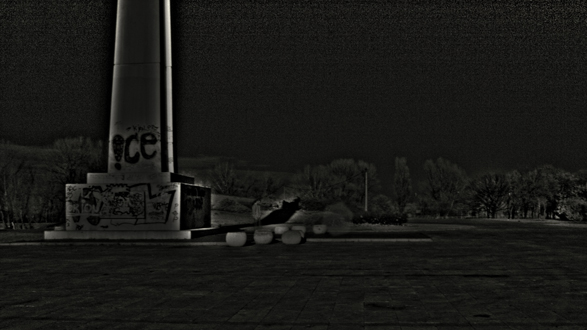
With works by Gary Beydler, Bruce Conner, Ivan Ladislav Galeta, Chris Garrat, Dryden Goodwin, Dominique Gonzalez-Foerster, Jean–François Guiton, Gerard Holthuis, Philip Hoffman, Peter Hutton, Ken Jacobs, Jim Jennings, Kurt Kren, Malcolm Le Grice, Mark Lewis, Jeanne Liotta, Rose Lowder, Gordon Matta-Clark, Pavel Medvedev, Marie Menken, Dietmar Offenhuber, Rafael Montañez Ortiz, Yo Ota, D.A. Pennebaker, Ilppo Pohjola, Michel Pavlou, Artavazd Pelechian, Norbert Pfaffenbichler, William Raban, Joost Rekveld, Nicolas Rey, Emily Richardson, Guy Sherwin, Morten Skallerud, Michael Snow, Stom Sogo, Scott Stark, Makino Takashi, Leslie Thornton, Andrei Ujica, Chris Welsby, Joyce Wieland, Fred Worden, Iván Zulueta.
impakt_web6.jpg

EVENTS

OPENING NIGHT
14.10.2009
Theater Kikker

“We will sing of the multicolored, polyphonic tides of revolution in the modern capitals; we will sing of the vibrant nightly fervor of arsenals and shipyards blazing with the violent electric moons; greedy railway stations that devour smoke-plumed serpents; factories hung on clouds by the crooked lines of their smoke.”
– F. T. Marinetti, ‘Futurist Manifest’

Thomas Köner : The Futurist Manifest

The work of media artist Thomas Köner cannot be easily categorised. For years he was active as a sound engineer, before his project Porter Ricks caused a stir in the European techno landscape of the 1990s. In filmmaker Jürgen Reble he found the perfect collaborator to pursue his interest in the symbiosis of visual and auditory experiences. All these different influences come together in Köner’s recent work, in which his fascination for tone colour has expanded to the moving image, resulting in a series of acclaimed performances and installations. Prompted by the festival theme of “Accelerated Living” and the hundredth anniversary of the Futurist Manifesto, he has composed an “opera digitale” for Impakt, which will be performed with a prepared piano, a digital ”noise orchestra” and a female singer. The sonic sediments of one hundred years of industrialisation and acceleration will be condensed in a multidimensional audiovisual space, where image and sound interact as if “time and space died yesterday”.

Carl Faia: prepared piano & live electronics
Iris Garrelfs: voice & live electronics
Thomas Koner: laptop noise orchestra, visuals

An Impakt production
impakt_web7.jpg

15.10.2009
Theater Kikker

DOPES TO INFINITY

“I have something more cosmic in mind
It’s a warpage of time and it’s bliss for everyone”
– Monster Magnet, ‘Dopes to Infinity’

Guy Sherwin
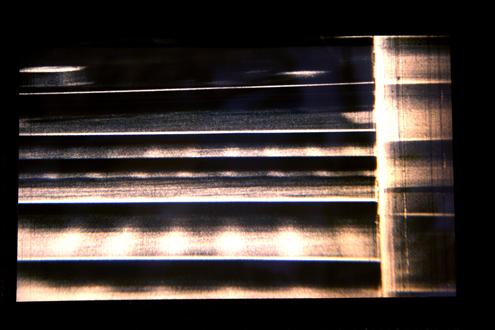
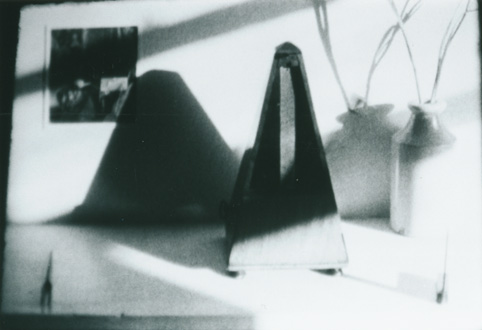
A key figure in British avant-garde cinema, Guy Sherwin pushes the limits of cinema with his films, installation works and performances, in which he explores film’s fundamental properties: light and time. Since the 1970s he has been working on a series of studies on the illusion of movement and stasis experienced during train travel. For Impakt, he will present a selection of his “train films” in the form of an expanded film performance.

Dirk de Bruyn + Joel Stern
In his work, filmmaker and media artist Dirk de Bruyn deals with the disorientating and traumatic experience of media-saturated environments. His performance ‘LanterNfanten’ for three projectors creates an absorbing space where time is disturbed and compressed as a kind of personal research on bodily trauma and cultural displacement. It will be accompanied by a live soundtrack from composer Joel Stern, merging music concrète, art brut and noise.

Core of the Coalman
Core of the Coalman is one of the alter egos of composer and visual artist Jorge Boehringer, a project in the musical no man’s land between power electronics, noise and contemporary classical music. With violin, his voice and electronics he builds sonic architectures hovering on the edge between chaos and order.

Bruce McClure
A film projector is not only a source of light but also of sound. Nobody understands this better than Bruce McClure who with his immersive performances for multiple projectors creates a pure sensory game of pulsating rhythms and shadows, well beyond the borders of cinematographic time and space. For Impakt he has prepared a unique two-hour performance, which is sure to provide a hypnotic and overwhelming experience.
kode9.jpg

16.10.2009
Tivoli de Helling

SPEED TRIBES

“It is not just a matter of music but of how to live: it is by speed and slowness that one slips in among things, that one connects with something else. One never commences; one never has a tabula rasa; one slips in, enters in the middle; one takes up or lays down rhythms.”
– Gilles Deleuze

Mount Kimbie + James Blake
British breakbeat culture is alive and kicking. The explosion of dubstep has provoked a plethora of sound experiments and cross-overs from which a fresh sound emerges from time to time. One of those surprises is London duo Mount Kimbie who inject melancholic pop sensibility and hybrid rhythmic patterns into dubstep. They are joined live by vocalist James Blake whose exciting debut reconciles jazz, soul and a taste for melodrama with the sound of the imploding metropolis.

Cooly G
This protégé of the cutting edge Hyperdub label drew the attention of the so-called « UK funky » scene last year. It’s not surprising : her spicy but contagious mixture of deep house and dubstep, seasoned with bitter sweet vocals and subtle touches of acid and hardcore is, without a doubt, a fresh wind in the the British club culture. Tribal rhythms and woozy synth chords, deep basses and aching sighs, light vibes and dark undertones : it’s precisely these contrasts that make her music so irresistible!

The Bug + Flowdan
The man behind The Bug is Kevin Martin, who has been reinterpreting industrial, dub and breakbeat since the 1990s. His fascination for intense and dark mutations of electronic rhythms and sub-harmonic frequencies was already present in earlier projects such as God, Techno Animal and Ice. The Bug is the culmination of all these influences : a highly personal exploration of bass culture, with a sound that he self-described as “warped ragga meets heavy electronic dub”. His most recent release London Zoo was praised by several media as one of the most important albums of 2008. MC Flowdan, a key figure of East London’s grime scene, will accompany The Bug as guest artist.

Kode9
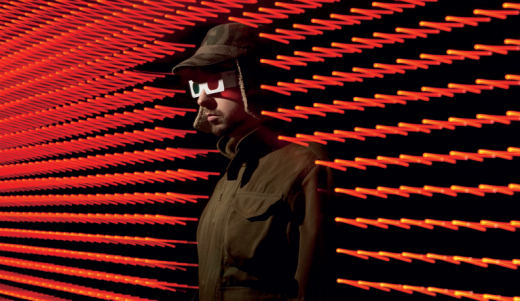
In recent years Steve Goodman aka Kode 9 has established himself as one of the most influential names in contemporary electronic music culture. A music producer, theorist and the owner of the celebrated Hyperdub label, he obstinately continues to explore the big city’s sonic fabric, its energy fields and rhythms. Movement, vibration, exaltation, emotion: Kode 9’s music acts like a hyper urban virus that mercilessly gets into our central nervous system.

+ DJ Sonido del Principe (Generation Bass)

impakt_web8.jpg

17.10.2009
Theater Kikker

ECSTATIC MUTATIONS

“Below the level of sounds and rhythms, music acts upon a primitive terrain, which is the physiological time of the listener. (…) Because of the internal organization of the musical work, the act of listening to it immobilizes passing time; it catches and enfolds it as one catches and enfolds a cloth flapping in the wind.”
– Claude Lévi-Strauss

Thomas Brinkmann
Thomas Brinkmann is one of the foremost figures of the minimal techno movement, which has influenced contemporary music production since the 1990s. His fascination for programmatic and rhythmic structures finds its roots in his background as a drummer and his training as a visual artist, and most particularly in the influence of Minimalism’s principle of reduction. The result is a vast oeuvre of mathematically refined scores made of complex grooves, overtones and doppler effects. In Utrecht he will present for the first time a completely improvised « klick » performance with 8 turntables, a series of vinyl records and a knife.

Arnold Dreyblatt Ensemble
The musical exploration of Dreyblatt, a student of the first generation of New York minimalist composers, is driven by an inclination for rhythmic complexity built on resonance and vibration. During the past decades he has developed a number of new instruments, tuning systems and performance techniques, with which he digs even deeper under the rhythmic surfaces in order to find a rich dynamics of textures and timbers. His work remained obscure for years, until it was brought to attention by musicians such as Jim O’Rourke who described one of his albums as “the first genuinely new sound in maybe 10 years”. He has recently brought together an ensemble with Jörg Hiller, Joachim Schutz and Robin Hayward, which will offer a rare not-to-be-missed concert during Impakt.

Arnold Dreyblatt: Composer, Excited Bass, Laptop
Jörg Hiller: Drums, Automated Electric Guitar
Joachim Schutz: Electric Guitar
Robin Hayward: Amplified Tuba

Oren Ambarchi + Robbie Avenaim
Oren Ambachi uses the electro-acoustic transformation of his guitar as a laboratory for tonal research. The result is an abstract and fragile sound world that continuously searches the borders of time and space. He regularly collaborates with different musicians such as Fennesz, Keith Rowe en sunn0))). This time he will be reunited with his long-time friend percussionist Robbie Avenaim, who explores the limits of the sound spectrum using modified and motorised drums. Together they create a visceral and kinetic audiovisual experience.
cello.jpg

SPECIAL EVENTS

“Time is the substance of which I am made. Time is a river which sweeps me along, but I am the river; it is a tiger which mangles me, but I am the tiger; it is a fire which consumes me, but I am the fire.”
– J.L. Borges

18.10.2009
Theater Kikker

Charles Curtis, Carol Robinson & Bruno Martinez
Eliane Radigue’s Naldjorlak I, II, III

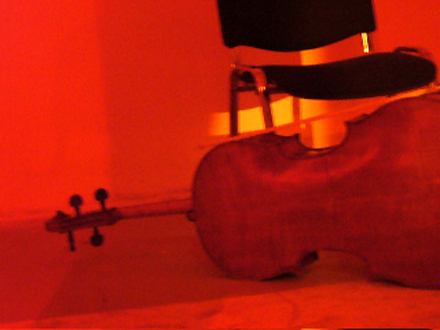
The work of French composer Eliane Radigue is first and foremost an exploration of the phenomenological reality of sound : the combination of matter, vibration and resonance which ultimately determines our experience of sound. She began to experiment with electronic feedback in the 1950s, before discovering her medium of choice, the analogue ARP synthesizer. Since 2004 she has composed exclusively for acoustic instruments. ‘Naldjorlak I’, in which the hidden, complex sonority of the cello is fathomed, was developed as a collaboration with renowned cellist Charles Curtis. For the following parts, she required the participation of basset-horn players Carole Robinson and Bruno Martinez. The result is a versatile and volatile sound world, which continuously balances on the verge of perception.

Charles Curtis: cello
Carol Robinson & Bruno Martinez: basset horns

16 – 17.10.2009
location tbc

Leif Inge : 9 Beet Stretch

There are few musical works that speak to the imagination as does Beethoven’s 9th Symphony. But although almost everyone in the Western world can easily hum its melody, this classic composition has not yet given away all its secrets. That’s what Norwegian artist Leif Inge does by digitally stretching out the piece to a length of 24 hours, unveiling its unknown and unheard dimensions. A marathon performance which is sure to provide a peculiar perception of time. In the words of a participant : “I thought I was a fly trapped in honey.”
impakt_web2.jpg

CONFERENCE

“In the sun that is young once only
Time let me play and be
Golden in the mercy of his means”
– Dylan Thomas, ‘Fern Hill’

15.10.2009
Filmtheater ‘t Hoogt

Contemporary science and technology have made possible a temporality which though still based upon clock time, has exploded into countless different time fractions and speeds beyond human comprehension. Today we seem to live in several time zones at the same time, propelled by a variety of internal and external time mechanisms and innumerable rhythms which continuously vibrate, resonate, connect, oscillate and disconnect. How to grasp the temporal complexity that surrounds and occupies us ? What sort of ecologies of time and speed have we developed under the influence of new technologies and what is their impact on our body and senses ? This conference brings together a number of international thinkers who offer new perspectives on our contemporary experience of time and speed.

A day-long programme including contributions by Mike Crang, Dirk de Bruyn, Charlie Gere, Steve Goodman, Glenn Kaino, Sybille Lammes, Carmen Leccardi, Stamatia Portanova, John Tomlinson, and others. In collaboration with the MA New Media & Digital Culture, Department of Media- and Culturestudies, Utrecht University.
deutinger_small.jpg


IMPAKT ONLINE
16.10.2009

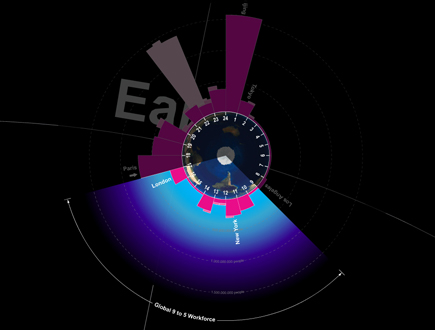
Internet is often considered as “timeless”, an endless space of connected websites and data files, a media sphere where users can wander about blindly, unaware of time. At the same time we face a growing proliferation of spam, dead links, pop-ups and search queries that lead nowhere. How to define the experience and perception of time spent online? When is information “fresh” ? How do trends develop on the Web? How fast do they wear of? These are the issues addressed by the projects curated by Sabine Niederer for Impakt Online. During the Impakt Festival, these online art projects will be presented in the presence of the artists.

With contributions by Theo Deutinger, Constant Dullaart, Richard Rogers, Daan Odijk
We are Time

lloyd-harold-clock.jpg

“All will be now / Dreams are too fast / You are the first / We are the last
No sequence to follow / No fear of tomorrow / Kiss of neverness / Life of timelessness / We’ll break the speed of change / we’ll tame eternity”

The Pop group, ‘We Are Time’

We’re still working on the “Accelerated Living” program for the upcoming Impakt Festival (14-18 October) in Utrecht, which will deal with (changing) perceptions and conceptions of time and speed. How to grasp the temporal complexity that surrounds and occupies us ? What sort of ecologies of time and speed have we developed under the influence of new technologies and the spread of neo liberal globalisation, and what is their impact on our body and senses ? How to create time awareness? These are some of the questions the project will deal with. Here’s a recent source of inspiration, Franco Berardi “Post-Futurist Manifesto” (February 2009).

1. We want to sing of the danger of love, the daily creation of a sweet energy that is never dispersed.

2. The essential elements of our poetry will be irony, tenderness and rebellion.

3. Ideology and advertising have exalted the permanent mobilisation of the productive and nervous energies of humankind towards profit and war. We want to exalt tenderness, sleep and ecstasy, the frugality of needs and the pleasure of the senses.

4. We declare that the splendor of the world has been enriched by a new beauty: the beauty of autonomy. Each to her own rhythm; nobody must be constrained to march on a uniform pace. Cars have lost their allure of rarity and above all they can no longer perform the task they were conceived for: speed has slowed down. Cars are immobile like stupid slumbering tortoises in the city traffic. Only slowness is fast.

5. We want to sing of the men and the women who caress one another to know one another and the world better.

6. The poet must expend herself with warmth and prodigality to increase the power of collective intelligence and reduce the time of wage labour.

7. Beauty exists only in autonomy. No work that fails to express the intelligence of the possible can be a masterpiece. Poetry is a bridge cast over the abyss of nothingness to allow the sharing of different imaginations and to free singularities.

8. We are on the extreme promontory of the centuries… We must look behind to remember the abyss of violence and horror that military aggressiveness and nationalist ignorance is capable of conjuring up at any moment in time. We have lived in the stagnant time of religion for too long. Omnipresent and eternal speed is already behind us, in the Internet, so we can forget its syncopated rhymes and find our singular rhythm.

9. We want to ridicule the idiots who spread the discourse of war: the fanatics of competition, the fanatics of the bearded gods who incite massacres, the fanatics terrorised by the disarming femininity blossoming in all of us.

10. We demand that art turns into a life-changing force. We seek to abolish the separation between poetry and mass communication, to reclaim the power of media from the merchants and return it to the poets and the sages.

11. We will sing of the great crowds who can finally free themselves from the slavery of wage labour and through solidarity revolt against exploitation. We will sing of the infinite web of knowledge and invention, the immaterial technology that frees us from physical hardship. We will sing of the rebellious cognitariat who is in touch with her own body. We will sing to the infinity of the present and abandon the illusion of a future.

Continuous Music

10545-kmh.jpg

This is kind of an addition to my Minimalist post, which focussed on a series of used-to-be-obscure recording of so-called “minimal” music. Thanks to New World Records – who have also reissued pearls by the likes of Julius Eastman and Peter Zummo – another “lost classic” has been given a new life: ‘KMH – Piano Music in the Continuous Mode’, Lubomyr Melnyk’s debut album from 1979. According to Wikipedia Melnyk “pioneered ‘continuous music’ which employs extremely rapid arpeggios of varying duration, repeated with the sustain pedal to generate overtones and sympathetic resonances. These overtones blend or clash according to the harmonic change in the arpeggios according to a harmony based on Melnyk’s personal geometric models and often create a sombre, stately effect. He is also the fastest pianist in the world, sustaining speeds of over 19.5 notes per second in each hand. In addition he has the record for most number of notes played in one hour with 93,650 individual notes played.” His music has been described by critics as ”the play of atoms bouncing around at supersonic speeds!”. On his personal website (tagline: “first there came Franz Lizst ….. then came LUBOMYR (-: ), it is explained that Melnyk’s Continuous Music is “based on the principle of a ‘continuous’ and unbroken line of sound from the piano — this is created by generating a constant flow of rapid (at times EXTREMELY rapid) notes, usually with the pedal sustained non-stop. The notes can be either in the form of patterns or as broken chords that are spread over the keyboard. To accomplish this requires a special technique, one that usually takes years to master — this technique is the very basis of the meditative and ‘metaphysical’ aspects within the music and the art of the piano.” Although Melnyk’s earlier music was generally classified as ”Minimalism”, Melnyk prefers to call his music ”MAXIMALism”, since the player has to generate so many, many notes to create these ”Fourth Dimensions of Sound”. On the site it also states that “people have often said that, during live performances, they heard trumpets, horns, entire string orchestras emanating from the piano … for Melnyk’s music turns the piano into a veritable orchestra of sound”. Unfortunately, according to Melnyk this sound experience is lost in the digital processing, since the overtones no longer can live freely in their high dimensions, but are, as he puts it, ”plucked out like random feathers off a chicken, leaving the once so beautifully feathered surface, splotched and scabbed with tiny sores” (see here for more explanation). But anyways, here’s some samples…

This is part 5 of ‘KHM’ (available here for try-outs)
[audio:http://chicago1.binarybooty.com/x/$vzQQnzdUunBkn6SnbBdS8tgKCg4crfSo/061dd01aa6/05 – Lubomyr Melnyk – five kmh.mp3]

Also check out this sample of his ‘Voice of Trees’ (1985), a great piece for 3 Tubas and 2 Pianos, composed for choreographer/dancer Kilina Cremona. (available here for try-outs).
[audio:http://www.lubomyr.com/musik/VcOfTrees.%20Pt2-%20B.mp3]

Melnyk is still active, by the way. Here’s an interview he did in March this year, on the occassion of a concert he gave in Halifax. Time to get this man over here…

Update: here’s another interview, conducted by Jon Mueller.