Variations on a Theme

glenngould.jpg

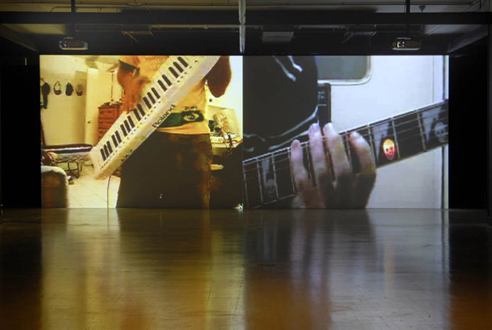
If you liked Oliver Laric’s ‘50 50‘ videos I posted some time ago, you’ll probably dig this one as well. In the installation ‘a couple thousand short films about Glenn Gould’ (2007), Cory Arcangel rescores Johann Sebastian Bach’s famous 1741 composition the ‘Goldberg Variations’, based on nearly 2000 clips of amateur musicians’ performances taken from video sharing web sites such as YouTube. Each note of the score jumps between individual clips of different musicians, with each screen carrying a separate melody line. The final effect is an almost hallucinatory montage – a flood of images which we are engulfed into. Arcangel allows anonymous guitarists, keyboard players, tuba players and other enthusiasts from around the world to unintentionally collaborate in recreating Bach’s masterpiece.

From an article in Frieze (on Paul Morley’s essay in the book ‘Cory Arcangel: a couple thousand short films about Glenn Gould‘:
“Does user-generated content make possible a new form of artistry, prefigured in both Gould’s approach to the recording studio and in Wendy Carlos’s synthesizer renditions of Bach? Or are Gould and Carlos being positioned as anticipating the dissolution of the individual artist in an anonymous digital network?

(…)

As Kirby indicates, far from leading to new forms, user-generated content has tended towards retrenchment and consolidation – for example, YouTube (for the most part) recycles old material, or else provides a space in which millions of aspirant stars ape idols whose status – established by the old systems of distribution and valuation – remains secure. Instead of being cowed by the relentless demands for viewer participation, both cultural producers and the much-derided ‘gatekeepers’ need to find new ways of asserting the primacy of production over consumption. They need to find ways of stepping outside seamless circuits in which ‘everyone’ is implicated but no-one gets what they want. In another catalogue essay for a couple thousand short films…, curator Steven Bode argues that Arcangel’s installation is ‘less an advert for networked participatory culture than an index of people’s increasing atomisation.’ If postmodern culture presents a kind of networked solipsism, perhaps what Gould can now teach us most is the value of disappearance from the screens that eagerly seek our image. Gould, who famously retired early from concert playing, showed that sometimes it is necessary to withdraw in order to find better ways to connect.”

NYT spoof

nyt_hack.jpg

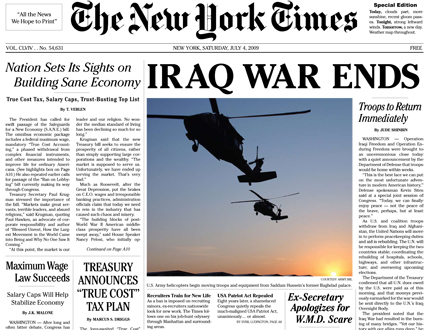
In an elaborate hoax, pranksters distributed thousands of free copies of a spoof edition of The New York Times on Wednesday morning at busy subway stations around the city of NY. The paper, an exact replica of the NYT, includes International, National, New York, and Business sections, as well as editorials, corrections, and a number of advertisements, including a recall notice for all cars that run on gasoline. There is also a timeline describing the gains brought about by eight months of progressive support and pressure, culminating in President Obama’s “Yes we REALLY can” speech. (The paper is post-dated July 4, 2009.) The hoax was accompanied by a Web site that mimics the look of The Times’s real Web site. A page of the spoof site contained links to dozens of progressive organizations, which were also listed in the print edition. Later on that day, the Yes Men issued a statement claiming credit for the prank.

According to the NYT’s City Room blog, there is a history of spoofs and parodies of The Times. Probably the best-known is one unveiled two months into the 1978 newspaper strike. A whole cast of characters took part in that parody, including the journalist Carl Bernstein, the author Christopher Cerf, the humorist Tony Hendra and the Paris Review editor George Plimpton. And for April Fool’s Day in 1999, the British business executive Richard Branson printed 100,000 copies of a parody titled “I Can’t Believe It’s Not The New York Times.” Also that year, a 27-year-old Princeton alumnus named Matthew Polly, operating a “guerrilla press” known as Hard Eight Publishing, published a 32-page spoof of the newspaper.

see video

inserted 2008-11-26T10:51:37+00:00

From Electronic Frontier Foundation:

Could the lawyers be far behind? Not surprisingly, the corporate targets of the parody were not pleased. Now, in what is becoming an all-too-familiar trend, one of those corporations has attempted to shut down the site by putting pressure on what is often the weakest link in the online speech chain: the domain name registrar. Stymied by the First Amendment and other legal impediments, those who don’t appreciate critical commentary and other “objectionable” online content have found intermediaries — providers of indispensable technical services like domain name registration and web hosting — much easier to intimidate.

This time, the complaining (and overreaching) party was the South African diamond conglomerate De Beers, the target of a critical fake ad on the web version of the New York Times spoof announcing that diamond purchases “will enable us to donate a prosthetic for an African whose hand was lost in diamond conflicts.” Miffed by the criticism, De Beers responded not by confronting the authors (whose parody is protected by the First Amendment) but instead by threatening their Swiss-based domain name registrar, Joker.com. De Beers has demanded that Joker.com disable the spoof website’s domain name or face liability for trademark infringement.

This certainly isn’t the first time that a sore target of criticism has threatened an internet intermediary in order to take down content it didn’t like. The motivation is simple: all too often, the intermediary will prove to be unwilling to stand up for the rights of its customers. For example:

* In September, 2008, the state of Kentucky initiated an ex parte proceeding aimed at seizing 141 domain names pointing to overseas websites permitting online gambling, arguing that the domain names were illegal “gambling devices” under Kentucky law. Without giving the domain name owners an adequate opportunity to defend themselves, the trial court ordered the registrars with control over the targeted domain names to transfer them to the state, a decision the court affirmed in October. Upon receipt of the court’s order, some of the registrars (such as GoDaddy) who were likely outside of the court’s jurisdiction nonetheless locked the domain names and purportedly transferred control to the Kentucky court. (EFF filed an amicus brief arguing that the orders were unconstitutional; the matter is pending appeal.)
* In January, 2008, Swiss bank Julius Baer filed suit against (among others) Dynadot, the domain name registrar with which the domain name wikileaks.org was registered. The Wikileaks website to which the domain name pointed — a self-styled “uncensorable Wikipedia for untraceable mass document leaking and analysis” — hosted (and still hosts) documents which anonymous third-party posters argue document financial wrongdoing. Instead of challenging the operators of the Wikileaks site directly, Julius Baer targeted Dynadot which quickly agreed to lock and permanently disable its customer’s domain name. (In response to briefs such as the one filed by EFF pointing out the illegality of the court’s order approving of the ill-advised agreement, the district court ultimately dissolved the permanent injunction, leading Julius Baer to dismiss its case.)
* In December, 2006, on behalf of its affiliate radio station KSFO-AM, media giant ABC sent a cease and desist letter to 1 & 1 Internet, the then-host of the blog www.spockosbrain.com, a site that criticized what its author argued was offensive and violent rhetoric broadcast by KSFO. Despite the fact that it had no risk of liability, 1 & 1 Internet promptly shut down Spocko’s site in response to receiving the threatening letter. (EFF subsequently represented Spocko, successfully moving him to Computer Tyme, a web hosting company that promised to stand up to future threats.)

Intermediaries frequently argue (incorrectly) that they have no choice but to shut down domain names or sites when they receive a legal complaint. But they do have a choice, at least in the United States. As EFF has explained to De Beers, U.S. law provides ample protection for intermediaries, in large part to ensure that online speech and commerce continues to thrive. For example, in 1996, Congress passed Section 230 of the Communications Decency Act which immunizes internet intermediaries from most kinds of liability associated with the content that their customers place on their own sites. Similarly, the Digital Millennium Copyright Act (passed in 1998) provides a safe harbor from copyright infringement liability for intermediaries who follow straightforward procedures in response to valid takedown notices. With these strong legal protections, intermediaries can and should refuse to respond to pressure from companies like De Beers.

Will the poignant work of the New York Times parodists stay up for the world to see? Will other critical online speakers be silenced by improper threats against their virtual soapboxes? The answer may ultimately depend more on the ability of targets to intimidate domain name registrars than on the legality of the underlying speech itself.

Make Believe

starship.jpg

“Cinema, Cinema, Cinema. The three things that can make us see the world like we want to see it, the way it is and the way it can be”
— Alfred Hitchcock

We didn’t include work by Bernard Gigounon in our program ‘Drawn to Life’, but we could have easily. Here is some of his lovely work along with a text I wrote some time ago for the distribution catalogue of Argos (translated from Dutch).

Cascade (2001)

Interlude (2001)

Starship (2002)

Jour de Fête (2005)

“Cinema, Cinema, Cinema. The three things that can make us see the world like we want to see it, the way it is and the way it can be”, Alfred Hitchcock once said. Precisely this perceptual ambiguity, the multiple layers of reality involved in the moving, time-based image, incited Bernard Gigounon to start using the video medium. Before that moment, after his studies at the Department of sculpture in Ensav-La Cambre (Brussels), he mostly made sculptures based on traditional materials like metal and wood. But even then his work was based on a fascination for the tiny, apparently trivial aspects of our everyday lives, from which he tries to draw magic and poetry.

It has been said that cinema is in essence a special effect. The video work of Gigounon reduces that notion to its minimal essence: cinema as an illusion, created by the manipulation of images in time. He does not create this effect with advanced, multi-dimensional digital technologies, but rather through simple, transparent magic, referring in several respects to the optic fantasies and the ‘persistence of vision’ techniques from the pre-cinematic age. But this is not about the simulation of reality through optical illusions, or the creation of immersive ‘scripted spaces’, but rather amazement itself, purposely allowing oneself to get carried away by the unreal, the surreal, the deviant. In an age when our outlook on the world is constantly mediatized and determined by all kinds of special effects, Gigounon carries us back to a proto-cinema: the experience of a train journey, the amazing effect of a cuckoo’s clock, the projection of a magic lantern. He uses video as an instrument to recreate everyday life, to tilt our perspective through a “suspension of belief” into an enchanted reality.

Fantasy worlds are always there, anywhere, just like images, the only thing we need to do as a spectator is to allow our imagination to run free. Gigounon gives us a boost to let go of trivial reality, even if just for a while. This results in tiny phantasmagorias, like ‘Jour de Fête’ (2005), in which skyscrapers seem to free themselves from their foundations, recreating the Brussels’ skyline into a setting for an elegant fairy dance accompanied by euphoric applause. Or ‘Starship’ (2002), a visual investigation of a passing ship, which turns into a weird and estranging object through the juxtaposition of its symmetrical reflection. The work of Gigounon supplies a key to our imagination, even though we have to create the opening ourselves – a reflex slowly rusting away. The simulation of reality, in television, cinema, 3D games, encloses our reality more and more tightly, it breaks through our perspective and undermines the experience of astonishment. Gigounon makes us believe again: in the stop-motion animated images in ‘Cascade’ (2001) or ‘Interlude’ (2001), in the unreal, chronology-defying stunts in ‘Héros’ (2001), in the tiny airplane, stuck to the train window in Remédie à l’ennui – shooting past, skimming over the treetops, always defying our lack of imagination.

Magic is often the result of convergence, of unexpected associations between one image and another, between a voice and a character, between image and sound. In ‘Standing Ovation’ (2001), originally part of a concert by Martha Argérich, a fragment from Jean Renoir’s Une partie de campagne is extracted and inserted into a new context, of time and sound. The backward travelling of a landscape in the rain is given new meaning on the sounds of a roaring applause. In ‘Prélude n°3’ (2003) Gigounon plays a graphical game with musical onomatopoeias, dancing and interacting within the confines of the white screen. The minimal chords and melodies of Debussy’s ‘Prélude N°3’, connected more by logic than by surreal observation, are given a visual counterpart in a pallet of coherent letters, constantly moving, shifting colour and size. Just like the composer paints an impressionist musical world with warm notes and tone colours, Gigounon creates a language of his own from sterile, achromatic graphical elements, in which the letters don’t merely derive their existence from the music, but their meaning as well. Gigounon, isn’t merely a visual artist, he is a composer as well. Like Debussy he is looking for suggestion instead of description. Like Debussy he collects tonal compositions of everyday observations, parallel visions not merely transcending reality, not even resisting it, but rather liberating and poeticising it.

Daily Seeing

save_me.jpg

“Once I avoided conventional narration and replaced it with real time I could put the images together in non sequitur impositions. This might be what you call ‘daily seeing.’ It might be similar to the visual and aural experience of ordinary daily life – collision of experiences – not necessarily chaotic.”
— Robert Breer

The film program we’re working on now, ‘Drawn to life’, is almost finished. I’m quite happy with it, especially since it gave me an opportunity to explore some realms of cinema I wasn’t very familiar with: the so-called “animation” film. What’s interesting about “animation”, for me – besides the fact that the concept itself is deeply imbedded in the roots of cinema – is that it transcends both fiction and documentary, especially in the light of new digital photographic technologies, which are more and more questioning the black box of live action. So, when we were asked to do someting about “animation” and “documentary”, we thought it could be interesting to explore how animation techniques can re-define or revitalise our daily seeing, the ways we percieve and experience the world we live in. One of the filmmakers I discovered while doing research is Stuart Hilton. He studied at the Royal College of Art, where the field of experimental animation is apparently blossoming (see also Jonathan Hodgson, amongst others). In many ways, he can be considered as a heir of Robert Breer, especially in the way he explores the border zone between the anecdotal and the abstract, between quotidian existence and more imaginative realms. Breer’s films, P. Adams Sitney once wrote, have the potential of transforming daily eyesight, making our visual world more alive. And that’s just what some of Hilton’s films do. Hilton has a way of animating his doodles and drawings and combining them with live action images, so that they connect “film projection and the glitches of hand-made work back to eyesight and to the physiology of daily seeing” (as Fred Camper once wrote about Breer’s ‘Fuji’). This effect is further enhanced by the soundtracks, which consist of musique concrète collages of found sounds and media snippets. The conjunctions of image and sound generate a kind of consciousness and emotional dynamics that remind me of Arthur Lipsett’s films. Pieces of sound and image worlds are arranged in an non-lineair way without losing the sense that there is a experiential structure holding them together which transcends the gaps between the pieces – all the more total for being fragmented.

Here’s some of Hilton’s stuff. There’s more on his YouTube page.

Argument In A Superstore (1992)

Save Me (1994)

Six Weeks In June (1998)

Animating War

waltz-with-bashir.jpg

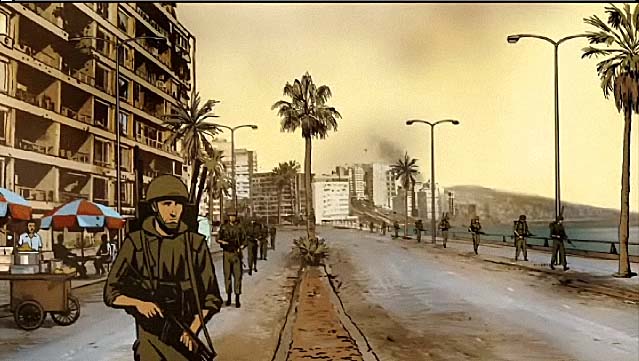
One of the movies that really struck me lately is Waltz with Bashir, Ari Folman’s animated account of his search to piece together some lost fragments from his memory, from the time that he was a soldier in Lebanon 25 years ago (leading up to the rememberance of his experience of the Sabra and Shatila Massacre). In fact, seeing this powerful film, considering its queries about the status of documents and film documentary, about the ethics of the image and the relation between media and memory, was one of guiding forces for putting together a new film program, Drawn to Life, which is partly about “animation” as “reanimation”, as a tool for revitalising history, memory and perception.

“How does one avoid overly aestheticizing violence when using animation?” asks Michael Koresky in Reverse Shot. “Despite a radical, unified look, the imagery in Waltz with Bashir ranges from the mundane to the dreamlike, and often those distinctions collapse, expand, and mutate right before our eyes. Folman isn’t gussying up a difficult chapter of history in accessible pop extravagance; rather he’s using a new form to investigate the terrible persistence, not to mention unreliability, of memory and perception, and how personal and political deceptions often go hand in hand.”

bashir.jpg

Here’s a few fragments from interviews with Folman, in which he talks about his reasons for using animation techniques (actually a specially designed combination of Flash animation, classic animation and 3D, so NO rotoscope animation. Each visual was made up of independently moving pieces) to deal with memory and trauma.

“WALTZ WITH BASHIR was always meant to be an animated documentary. For a few years, I had the basic idea for the film in my mind, but I was not happy at all to do it in real life video. How would that have looked like? A middleaged man being interviewed against a black background, telling stories that happened 25 years ago, without any archival footage to support them. Then I figured out it could be done only in animation with fantastic drawings. War is so surreal, and memory is so tricky that I thought I’d better go all along the memory journey with the help of very fine illustrators.”

“Using animation is like magic. You have freedom to go from one dimension to another pretty quickly, a freedom to move from the subconscious to the conscious, from dreams to memory and hallucinations and testimonies. (…) How do you depict a dream? You can write it down, which would be fairly accurate, but if you want to film it, you would have to have a set and actors,” he said. With animation, however, “you get rid of the ‘middle-man.’ And in some cases, you have a tool that is more truthful.”

“A journey trying to figure out a traumatic memory from the past is a commitment to long term therapy. My therapy lasted as long as the production of WALTZ WITH BASHIR: four years. There was a shift from dark depression as a result of things discovered to being in euphoria over the film finally being in production with complicated animation being done by the team at a pace better than expected. If I was the type of guy who believes in the cult of psychotherapy, I’d swear the film had done miracles to my personality. But due to previous experience, I’d say the filmmaking part was good, but the therapy aspect sucked.”

“I don’t care whether it is documentary or fiction. maybe it is the first animated documentary ever, but does it really matter? (…) The whole idea is that it was basically subjective memories, so there is no real or unreal.”

“I believe that there are thousands of Israeli ex-soldiers who keep their war memories deeply depressed. They might live the rest of their lives like that, without anything ever happening. But it could always burst out one day, causing who-knows-what to happen to them. That’s what Post-Traumatic Stress Disorder is all about.”

bashir2.jpg

Folman is now working on an adaptation of Stanislaw Lem’s novel The Futurological Congress.