In Search of a Missing People

sicilia021.jpg

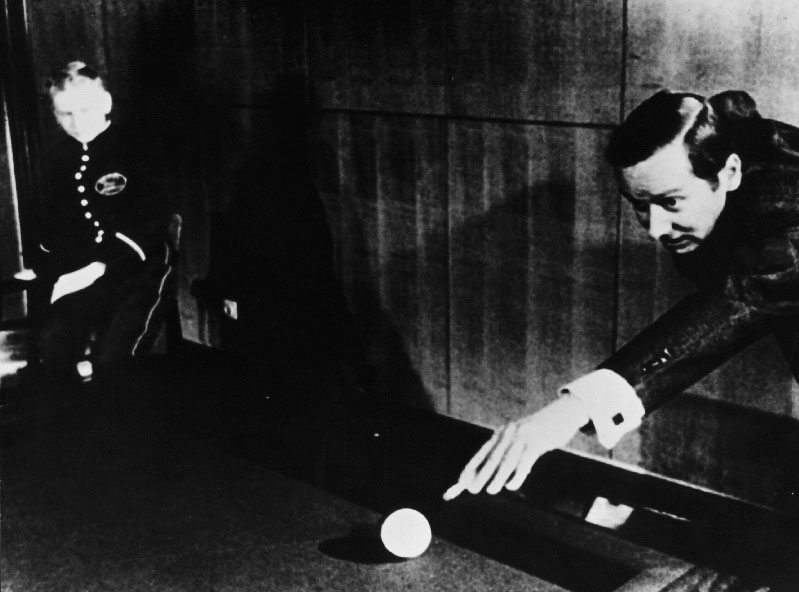
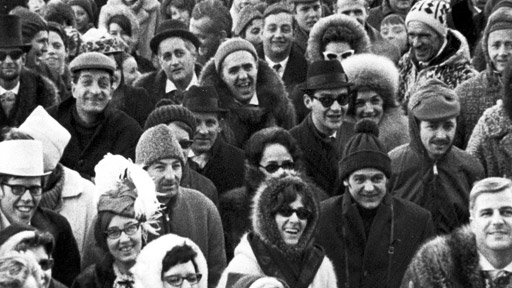
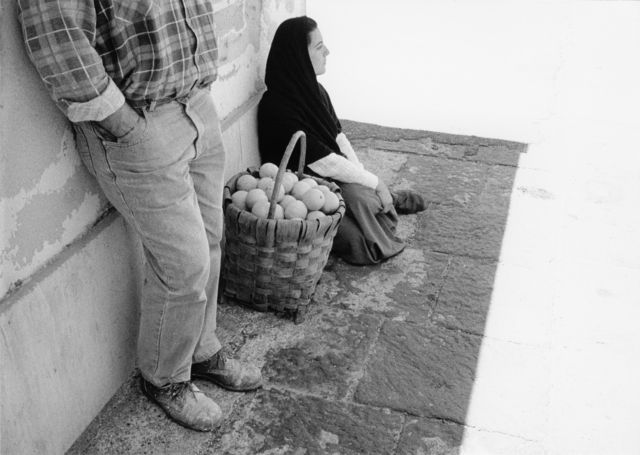
The people are missing. With these words, Gilles Deleuze, taking his cues from Paul Klee and Franz Kafka, once described the essence of what he considered to be a “modern” political cinema: the people are not there, or at least not yet. It is clear to us now, as it was for Deleuze back then, that cinema can no longer be thought of as the democratic art form par excellence, able to convert “the masses” into a genuine subject, nor is it the revolutionary medium capable of communicating the promise of a new future for all men alike. Indeed, we have drifted far away from the utopian dreams of such Soviet directors as Vertov or Eistenstein, inventors of a language meant to construct the sensible reality of communism, just as we have lost touch with the “primitive” social realism of the Lumières or Griffith, the stubborn humanism of Chaplin or Rossellini, or the heteroclite communitarianism of Ford or Mann.

Is it any wonder that their figurations of “the people” hardly work any more, in a time when forms for making socio-political conflicts visible are covered up by identity issues, when the end of the “myths” of class struggle has been loudly trumpeted, a time when yesterday’s exploited seem to have traded places with the marginalized and displaced of today, and humanity has all together shifted to the side of humanitarianism, annihilating political subjectivity by reducing it to the absolute victim, “bare life” stripped down to animality, or to its terrifying double: the inhuman perpetrator denying all humanity? How can the relationship between political truth and cinematographic appearance still be thought of today, now that the traditional borders of social divisions and the dialectic of human and citizen can apparently no longer be represented, now that people are more than ever “exposed”, yet at the same time affirmed in their impossibility to appear?

The people are not there. But have they ever been? Actually, the idea of the missing people can be traced back even further, to the days of Karl Marx, who, in The Holy Family, relentlessly dismissed Eugène Sue’s popular novel Les Mystères de Paris, as a manifestation of “petit-bourgeois morality”. In the curious, emphatic gaze of a young writer – an enthusiast of the 19th-century Parisian “physiologies” once described by Walter Benjamin as “moral dioramas” – and a philanthropist eager to mend social wounds, Marx seized the moment at a point when the dominant democratic figuration of “the people” was already established. Sue, in his own literary work, had proposed an image of society in which everyone can be immediately identified and confirmed by anyone, a society inhabited by people represented in all their familiarity, always already there.

At the end of the 1970s, Jacques Rancière defined this as a “voyeurist-unanimist” fiction, a fiction that displays the spectacle of social diversity – particularly on the fringes of society – “under the double gaze of a voyeur who feels as comfortable in high as in low places and a reformer who acknowledges social plagues and invents remedies”. It is this taxonomist logic that Rancière recognizes as characteristic of the fiction de gauche that he saw advancing in French cinema at that time: a leftist fiction in which the ambiguities of the social and the divergences in the history of the people were absorbed in this speechless “sociological majority”, which François Mitterand celebrated on the evening of his victory in 1981. Precisely in his rejection of this dominant, consensual figuration of social identification, it was Marx who made the people with unspeakable features into a name without a face. According to Rancière, “The people are what is not there yet, never in the right place, never ascribable to the place and time where anxieties and dreams await.”

“The People”. Today, even writing these words has become difficult, tainted as they are by overhanging notions of nationalism and populism. Nationalism identifies politics solely with the identity of an imagined homogeneous community (particular uses of the word Volk come to mind), while populism is used as a convenient catchphrase to discredit all possible resistance to the management of the economic and social interests of the self-defined community. The concept of “populism” – borrowed from the Leninist dictionary – perpetually presents an image of the people as an ignorant crowd, an irrational flock driven by blind rejection, targeting either those in power (allegedly stemming from a failure to understand the complexity of political mechanisms) or the “others”, those out of place (seemingly generated by an unreasonable fear of change and progress). It is a blunt return of stereotypes cultivated more than a century ago as a reaction against the rise of the workers’ movements, which were discarded as naïve and all too impressionable.

Even if “the people” as such do not exist, their images do exist, and this is one that threatens to override all others. But “the people” have always been a double figure: as Rancière and others have reminded us, the demos in ancient Athens referred to both the common people and the people as a whole, to the subject of sovereignty and a populace whose existence undermines or contradicts the attainment of sovereignty (Marx: “The proletariat does not have a homeland”). It is this constant ambiguity that captures the tension between a community and its internal divisions. According to Rancière, the people emerge as political subject only when one suspends the dominant logic of identification within the existing community, according to which everyone is assigned their proper place. This implies that the people are always different from themselves and divided within themselves. At the same time, it is bound to the homonymy of these sociological figures of the people as formless mass, miserable rabble, colourful collection of picturesque features. It is in this field of tension between the inconsistency of the people as political subject and the sociological consistency of popular embodiments that the image of the people is to be constructed.

The people do not have a body, only a mise-en-scène. In this sense, the question of the figuration of the people belongs to the aesthetics of politics, to its undertaking as a reconfiguration of given perceptual forms. After all, domination itself operates across a meaningful fabric of the visible, the sayable, the thinkable and the possible: a “distribution of the sensible”, as Rancière would have it. This question necessarily intersects with that of the politics of aesthetics. As Rancière has pointed out, the time of the great political revolutions – between the French and the Soviet Revolutions – was also that of the aesthetic revolution, dispensing with the old representative canons that defined what could be represented, and how. This was the moment when the repartition of genres, styles and characters as either noble or vile, beautiful or base, was dissolved.

These old differentiations made way for new models, two types of redistribution of equality: by displacing them within the represented people themselves or by translating their indifference into the equality of form and content. The first model constructed social narratives in which the “little people” of history – Victor Hugo’s misérables – came to occupy centre stage. The latter model showed that all subjects were worthy – “Yvetot is as good as Constantinople”, wrote Gustave Flaubert – and only the chosen form could make a difference. In any case, the representation of the people became an aesthetic problem, in line with the reorganization of the relations between narrative and descriptive, fiction and signification. As they are still used today, the problems put forward by the negotiation of the contention between the so-called Hugo and Flaubert models converge with the political problems of the negotiation between political subjectivation on the one hand and figures of social identification on the other. Still, there is no way to ascertain the “good” correlation between these two relationships: it is always a struggle. The question is how to turn the cinematic form itself into a struggle.

“Cinema is true; a story is a lie”, claimed Jean Epstein. Although cinema was born at a time when stories were highly suspect, it nonetheless inherited the basic features of narrative art: representation and identification. It is according to this logic that art assumes the properties of the featured subjects. Art is supposed to be “social” when it plunges us into the destitute margins of the global socio-economic order. It is “committed” when it deals with its terrible injustices, which one assumes in turn mobilizes our commitment. This basically goes back to Plato’s principle of mimesis, denoting the concordance between the fabric of sensory signs in which a certain art form is presented, and the fabric of perception and emotion through which it is felt and understood. But of course, as Brecht already pointed out, images of factories say nothing at all about the social relationships that manifest themselves there. There can be no straight line from looking at a spectacle to understanding the state of the world, no straight line from intellectual awareness to political action.

At the same time, cinema is also a visual art form in which recognition functions photo-mechanically, with no differentiation between worthy and unworthy, a form that is constantly jeopardized by its excess of sensible information what Godard, via Manoel de Oliveira, called “that saturation of magnificent signs bathed in the light of the absence of explanation”. So the “voyeurism” of its principle and the “unanimism” of its effects are inherent to its nature, and what we see in cinema is always evoked by immediate identification with the stereotypes of the social imaginary. Throughout the history of cinema, filmmakers have had to look for more complex representations to counter these commonplaces. Eisenstein was still able to explore the autonomous sphere of the visual in order to topple the typical heroic representations à la Hugo in the mythological, replacing traditional effects produced by identification with the story and the characters with direct identification with sensible affects. Then, with the challenge of sound synchronization and its entailing added information, one had to look for other ways to elude the limits of representation and construct new relationships between appearance and reality, the visible and the hidden, the singular and the common. From Renoir and Mizoguchi to Rocha and Pasolini, they all went out of their way to create some kind of gap between their cinematic figures and the social imaginary, in a game of displacements and differentiations in which “whatever face” could stand out from the nameless crowd: a face “in which what belongs to common nature and what is singular are absolutely indifferent” (Agamben).

In the work of these filmmakers, and many others like them, there is a mise-en-scène of transitions between individual figures, typically characters with recognizable social traits engaged in conflict scenarios, and the visual presence of a community, represented in the frame as a collectivity that does not directly identify with a human decor of figurants or extras. Because, writes Georges Didi-Huberman, “Figurants is a word for the labyrinths that every figure conceals. (…) They are to the society of spectacle what Hugo’s misérables were to the industrial society.” In other words, they are to cinema what the people are to history: without merit or consequence. The sounds they make are nothing but clamour, the gestures they produce nothing but flutter: included in the frame but not belonging to the image.

Again, it was Eisenstein who radically overturned the hierarchical relationship between “figure” and “figurant”, between small story and grand History, although others have tried in their own ways to give those “sunk into anonymity” (Mallarmé) back their faces, their words and their capacity to divide and assemble, filming them less as indistinct mass than as dissonant community. It is in this irresolvable game of composing and decomposing the popular frame that one can find an audiovisual analogy with certain forms of relationship between social imagery and political subjectivation. This consists of transforming this space of endless, undifferentiated circulation into a space for appearance. Passolini, via Roberto Longhi, called it “figurative fulguration”; Deleuze, by way of Henri Bergson, called it “fabulation”. But in both cases, it entails a mise-en-scène that relates to a process of dis-identification, an alteration of a field of experience characterized by a certain distribution of capacities, according to which each plays its part and each part has its place. For Rancière, this crossing of identities is precisely what constitutes a fundamental condition for politics: the enactment of a capacity that was not acknowledged in the name of a subject not considered as such, or “the part of those who have no part”.

How can cinema make the people appear, as political subject, in this era defined by a professed “end of politics”? Why is it that today’s so-called “minor fiction” – and fiction in general, one might add – seems so impotent in relation to the figuration of the people? “It is not we who no longer tolerate politics. It is politics which no longer tolerates the remnants of the real of fiction,” writes Rancière. As if fiction were no longer able to deal with social reality, while reality increasingly imposes its own laws on fiction. As if cinema could do nothing more than go way beyond reality, wallowing in an accumulation of effects and intensities, or align with reality, conceding with the dominant sociological imaginary and the cultivation of a depoliticized politics – a duplicitous figure, as it happens, which is also characteristic of our consensual times, in which the real can only seem to be present in the form of the infra-political (of the everyday and the anonymous) or the ultra-political (of violence and catastrophe).

The consensual order is therefore aesthetic as well as political. The arrangement of bodies in the community is a distribution of the sensible continually oscillating between sociological proximity and fantastic distance, between recognition and exception. In any case, the visible is always anticipated by its meaning. Caught in this trap, typically resulting in sterile combinations of socio-political stereotypes and hyper-dramatic clichés, most minor or social fictions seem to have lost the capacity to get out of this “consensual circle of mutual attestation of reality and signification”. The real of fiction attests to the real, and is attested by the real in return. What is at stake here is not the “end of politics”, says Rancière, but rather the end of a certain idea of political film – a certain entanglement of the real and the fictional rendered powerless. The real is no longer something to be apprehended or attested in order to make it credible: on the contrary, it has to be invented, so that it no longer recognizes itself.

Perhaps that is why we tend to look towards other cinematic propositions for relief, other dispositions for dealing with the real and the fictive, observation and construction, action and contemplation. Perhaps that is also why we tend to recall a certain childhood of cinema, when the “story” was still subsidiary to the passion of gestures and the reflection of faces, when the mimetic qualities of cinema were still compatible with its formal powers. It is not an urge of nostalgia towards the lost paradise of mute cinema or Eisenstein’s pure language of sensations, it is rather a quest for an other sort of “mutism”, one that can oppose the deafening silence of a world without possible social figuration with the sensation of the deaf speech that mute things carry with them, in harmony with the power of speech invested in bodies. Rancière refers to the “utopia of ‘kinship’ in the image”: a true exchange between the offer and the demand of the image, between the movements of the ever-yearning camera and the craving desire of the image that raises every individual beyond mere “bare life”.

This exchange also involves another “kinship”: that between those in front of, and those behind the camera. Referring to the films of Johan van der Keuken, Serge Daney once called it “unequal exchange”, indicating not only a political reality, but also the intrinsic condition of filmmaking itself. The question of the figuration of the people cannot be separated from this question of inequality and the never-ending challenge of restoring equality. In order to respond to this challenge, it is necessary to counter the system of oppositions that are as inherent to the narrative conventions of cinema, as they are to the rhetoric of populism: between high and low, inside and outside, wealth and misery, the passivity of the “wretched of the earth” and the activities of the powerful. The process of dissociation then becomes a matter of constructing a poetic of exchange that shifts the focus from the artificial construction of identifiable identities to an aesthetic construction of proximities and distances, through which everyone is acknowledged in the ability to create one’s own character. Everything that has been seized has to be returned. Everything that has been left unspoken has to be given the chance to be taken up. It is not a matter of revealing, but simply resisting. And resistance is as much part of art as it is of politics, bound together in this irresolvable promise of a future destined to remain unaccomplished. Always, in the words of Deleuze, “in view, one hopes, of the still missing people”.

Notes taken as part of the “Figures of Dissent” research project (KASK/HoGent), in association with the screening programme Once Was Fire.
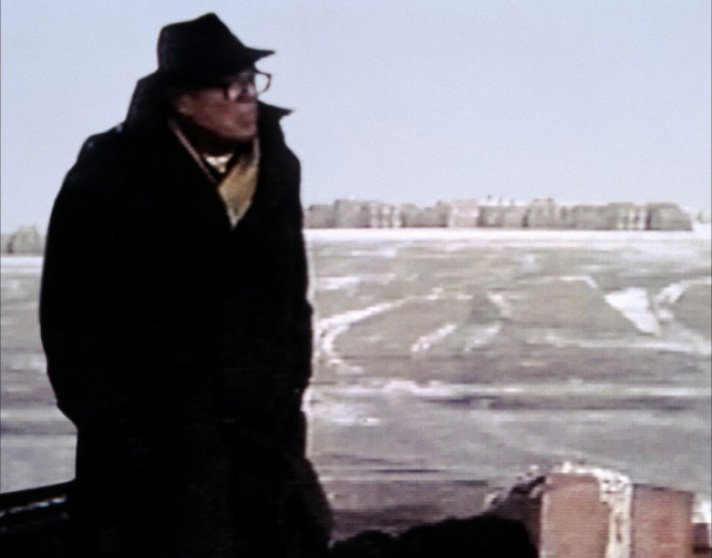
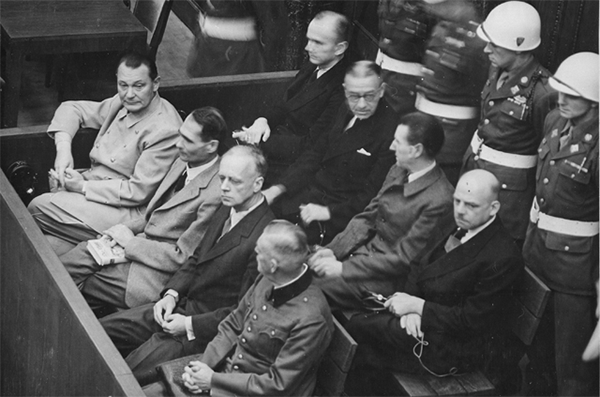
ARTIST IN FOCUS: Marcel Ophuls

veillee-d-armes-94-aff-01-g.jpg

In the context of the Courtisane festival 2013 (Gent, 17 – 21 April)

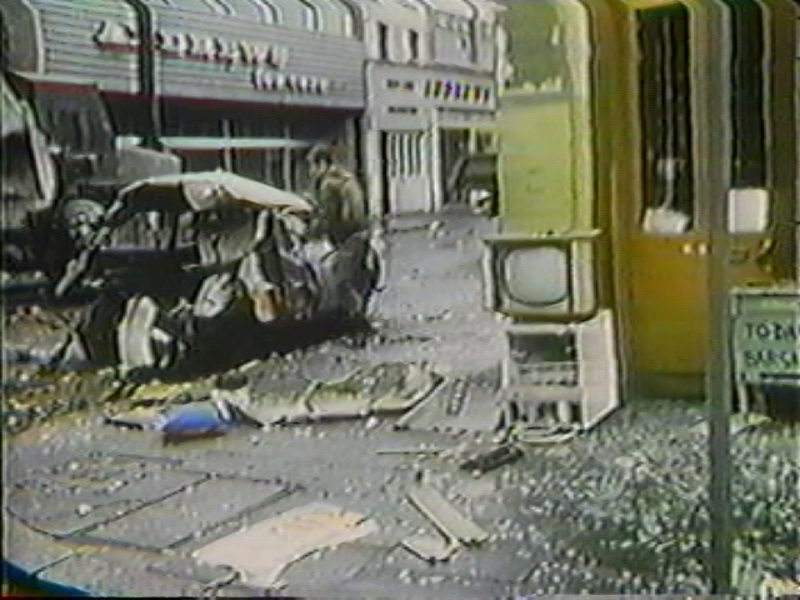
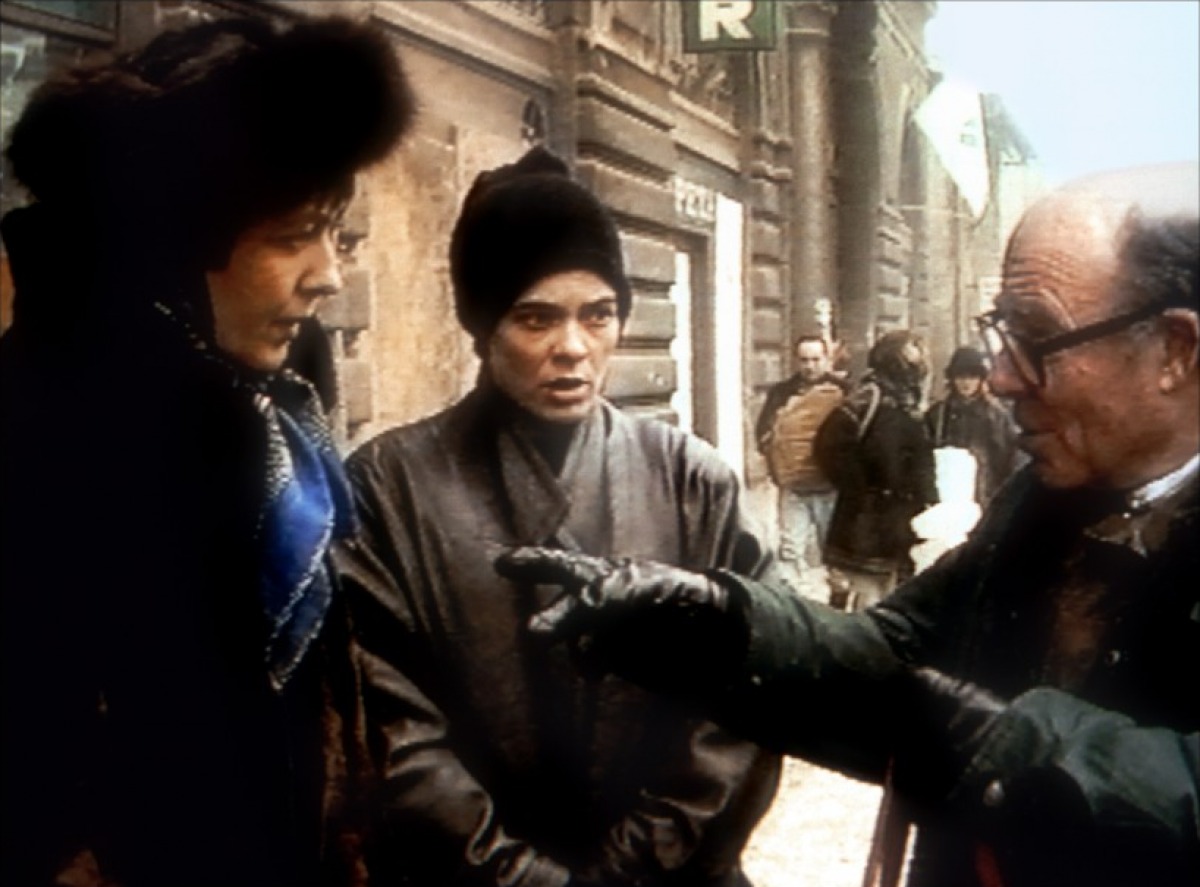
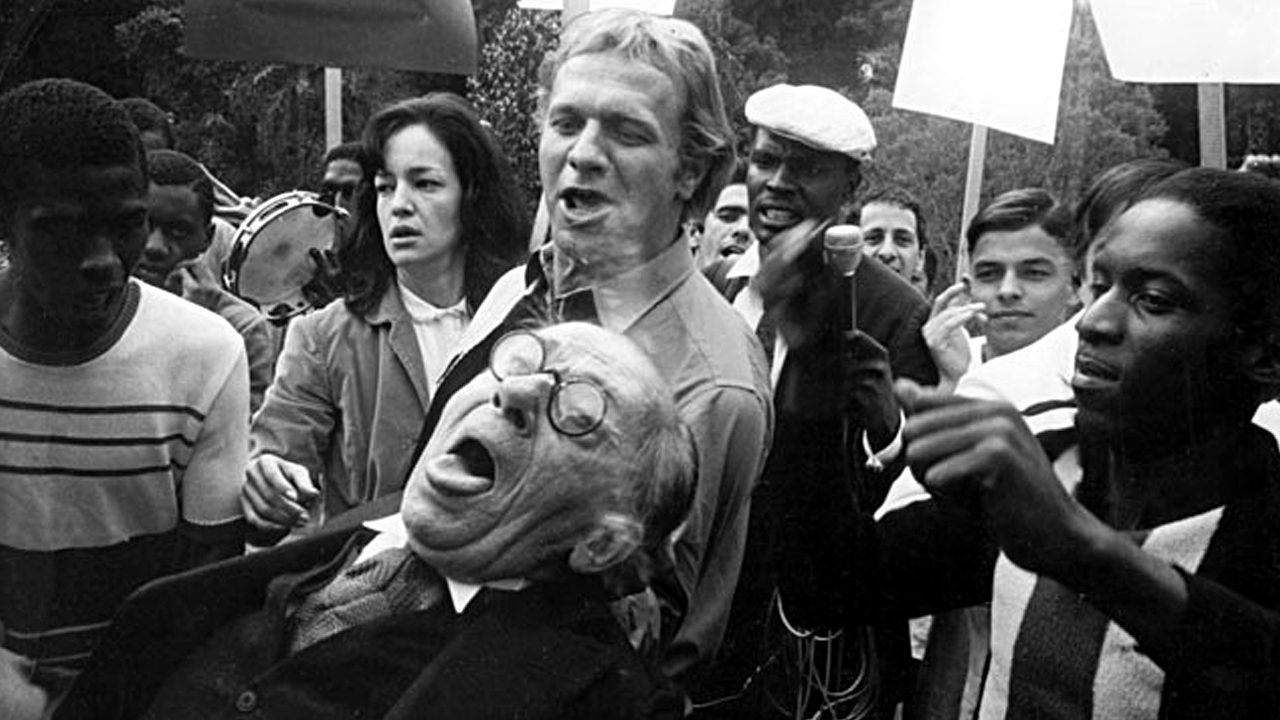
Resistance. If there is a single word that characterizes the work of Marcel Ophuls, this is it: resistance to every form of injustice and banalisation, resistance to the prevailing dogmas of documentary cinema. It is an attitude that is marked both by a whole-hearted abhorrence (for indifference) and by passionate love (for narrative film). The one is a response to his experiences during WW II, the other a legacy from his father, the famous director Max Ophuls. The result is an uncompromising cinema that for four decades has had no equal in blazing a trail through the 20th century’s shadowy realm: occupation and collaboration during the Vichy regime in Le Chagrin et la Pitié (1969), the Troubles in Northern Ireland in A Sense of Loss (1972), war crimes in Nazi-Germany and Vietnam in The Memory of Justice (1976), the siege of Sarajevo in Veillées d’armes (1994). Time and again, like a roguish Inspector Colombo, Ophuls makes his way through the heart of the conflict zone, in search of witnesses, in search of the story. Because Ophuls’s work primarily brings to mind the fact that the word “documentary” is always followed by the word “film”. This is a cinema that places structure above content, subjectivity above objectivity, discussion above pedagogy, a cinema that recognizes that documentary always equals “fiction” – a construction, a presence, a form. It is a cinema, finally, that refuses to make a distinction between “history” with or without a capital “H”, between a politics of the commonplace and the politics of the power apparatus, because that distinction, according to Ophuls, “forms the worst escape in life itself, the avoidance of every responsibility.”

——————————————————————————————————————————————————————-

memory.png

KASKcinema Thu 18 April 13:00

The Memory of Justice
1976, 35mm, color & b/w, various languages with English subtitles, 279′

The film uses Telford Taylor’s book Nuremberg and Vietnam: An American Tragedy as a point of departure in exploring wartime atrocities and individual versus collective responsibility. Divided into two parts – “Nuremberg and the Germans” and “Nuremberg and other places” – it builds into its very fabric the identity of the filmmaker. It’s not simply that we see him interviewing the subjects or feel his presence through intrusive editing; but Ophuls includes scenes with his German wife, his film students at princeton and even his grappling with cutting and arranging the overwhelming material. “I try to be autobiographical in Memory of Justice because of my wife’s childhood and my childhood – my reaction against what we feel has been misunderstood. I felt a great misunderstanding concerning The Sorrow and the Pity (the movie of my life, like Conan Doyle and Sherlock Holmes – I try to get rid of it, but it won’t go away): there is no such thing as objectivity! The Sorrow and the Pity is a biased film – in the right direction, I’d like to think – as biased as a western with good guys and bad guys. But I try to show that choosing the good guy is not quite as simple as anti-Nazi movies with Alan Ladd made in 1943.” (From an interview with Annette Insdorf, 1981)

——————————————————————————————————————————————————————-

sense.png

KASKcinema Thu 18 April 22:30

A Sense of Loss
1972, 16mm, color, English, 134′

Preceded by a talk between Marcel Ophuls & Eyal Sivan (KASK CIRQUE 20:00)

Ophuls’s self-described “film report” on the troubles in Northern Ireland. “The structure of the film was to start with the investigation of death, death in all its forms – death by the bomb, death by the bullet, the almost accidental death – and then to set out in search of who the individuals were, what their favourite record was, their favourite film, where they wanted to spend their holidays, etc.. All this to give the life of an individual some sense. It is individualistic and anti-generalizing, and in that sense almost an anti-ideological film. Consequently, what it is about is not just the structure of the completed film, but most of all a structure of research. It was indeed the case that in the chronology of filming, the ambulances were followed first, with a system of having previously established signals with the police, with the people of the IRA, with the people of the British army in order to know where a conflict was underway, where violence was taking place, where there was death, and always being on the alert, even at night in the hotel, to be able to be there in five minutes. It was only afterwards that we tried to identify the people, and the historic reasons, the ideological, sectarian aspects of this conflict. It is therefore the research structure that determines the structure of the film.” (from an interview with Lorenzo Codelli, 1973)

——————————————————————————————————————————————————————-

veillee-d-armes-1994-02-g.jpg

KASKcinema Fri 19 April 14:00

Veillées d’armes (The Troubles We’ve Seen)
1994, video, color, various languages with English subtitles, 234′

“Ethnic cleansing, that brings back memories,” Marcel Ophuls muses on the train to Sarajevo in this epic, ironic investigation of war and the journalistic impulse.. Ophuls traveled to the besieged city in 1993 to mingle with the motley crew of reporters camped out at the Holiday Inn; his interviews with French, British, American, and Bosnian journalists deliver trenchant observations on the political, ethical, and psychological factors behind the making of news. Other interview subjects include Serbian president Slobodan Milosevic, who claims his country’s freedom of the press is “unparalleled,” but says “don’t trust my explanation.” “I won’t.” Ophuls replies. Excerpting films by his father Max Ophuls, adopting the Marx Brothers as muse, the director employs a strategy of playful self-reference in the midst of horror; between feints at media and mediation, he moves in for a sucker punch of reality. As legendary reporter Martha Gellhorn, who survived both the Spanish Civil War and a marriage to Ernest Hemingway, puts it: “the brave are funny.” (Juliet Clark)

——————————————————————————————————————————————————————-

lola.png

SPHINX Fri 19 April 20:00

Max Ophuls
Lola Montès

FR/DE, 1955, 35mm, color, English with Dutch subtitles, 110’

introduced by Marcel Ophuls

Max Ophuls’ final film (and his only movie in color) is a cinematic tour-de-force masquerading as a biography, in this case a dazzling fictionalized life of the notorious 19th century dancer, actress, and courtesan. “Did his father’s reputation as a filmmaker help or hinder Marcel? “It helped me to get work. More than anything, it helped me to be modest about my achievements. I was born under the shadow of a genius, and that spared me from being vain. I don’t have an inferiority complex – I am inferior.” Ophuls worked with his father only once, as third assistant director on Lola Montès. “That means I was the coffee carrier.” It was his father’s last film, one the critics hailed for its ingenuity. In one shot, Lola arrives in a circus ring to re-enact scenes from her life while standing on a turntable that revolves in one direction, while the camera tracks round her in the opposite direction. “He was a genius, but that film killed him. I carried the coffee and saw him withering.” It was then Max had his first heart attack; two years later he died. “People say he was a romantic who dealt with private things like love and I was political,” says Ophuls. “That’s bullshit. I never make a distinction between private life and politics – that’s a petit bourgeois thing. How can you make a stand against Nazi Germany, or in Rwanda, when you live life by making that distinction? What I am saying has to do with citizenship.” (from an interview with Stuart Jeffries, 2004)

Some notes on courtisane

courtisane.jpg

www.courtisane.be

Twelve years, give or take. There comes a time when one has to ask what makes it worthwhile. Seeing, discussing, showing pieces of cinema, and all the while trying to make sense of them, and of ourselves in the process. We’re not in this to make a living, surely. But it has to do with living nevertheless.

Perhaps the time has come to try to put into words where we stand, or rather in which direction we are heading. We, that is: courtisane. We, that is: in all good faith siding with cinema. More of an open-ended itinerary than a well-devised directory really. To begin with, let us once again bring up the exhausted elegy bemoaning the terrible “end” of cinema we have been hearing as long as we remember: cast out by television, hollowed out by publicity, bought out by the dream machine, walked out on by its public. No doubt, cinema is not the dominant medium it once was. For sure, It is no longer the medium that captures the imagination of the masses (nor is television, for that matter); we know it is rather being captured by the logic of the market. In return this also means that the “audience” (a word that has more and more come to remind us of statistics) expects cinema to hold up a mirror, to function as an ideological resonance chamber. It’s for this sociologically defined “audience” that most films are scripted, fabricated, distributed, more as raids on the cultural market, than as forms of artistic production (all of the sudden the word “production” makes sense again).

Should we come to the rescue, knights in shining armor and all that? Certainly not: there are still plenty of more or less knowledgeable professionals out there supporting and cultivating cinema in its many forms, under its many umbrella terms. The only thing we can do, us amateurs, is to try to configure the cinematic landscape in a different way, to propose a counter-geography. For example: to get out of these all too easy and sterile sets of oppositions between “mainstream” and “experimental”, “system” and “margin”, “fiction and “documentary”. Why? Well, first of all because these opposites have more in common than it would appear; and then, because we think that the most interesting things are happening in their “inbetween”, there where the rug is pulled from under our feet, forcing us to look for other footing. Of course, there are oppositions that are even more sterile: the ones defining cinema by its negative, by what it is not, in order to point out its “specificity”. This game has been around for quite a while now, especially in the hallways and corridors of the academic world, studying cinema out of sight from everything that could possibly pollute it. An ancient debate all over again: the ”pure” against the “impure”. Words that frighten.

Naturally, we take sides with the latter (Bazin’s ghost continues to haunt us after all). But this doesn’t amount to embracing everything – an impulse gaining popularity these days, in service of the cultural “omnivore” – on the contrary, it’s about making concrete choices, exclaiming and defending them. It’s about mapping out different pathways through cinema’s heterogeneity, slicing it up, exploring its many contours from specific angles. This also implies probing the affiliations with other media and forms of expression. Nothing new here: cinema, as a “medium”, an experience of image and sound, has escaped its primary parameters a long time ago. We all know this. In fact, we have been battered with this idea so often in recent times that, paradoxically, we are more and more inclined to renegotiate some basic assumptions, or rather: some basic questions. It’s a trust issue really, boiling down to the question “what can cinema do for us?” What can it teach us, about ourselves and the world we’re living in? And this might seem overreaching, but it is really not. We just forgot about some things. Most of all, we forgot about the promise cinema once stood for: the promise to give us a place in the world. Not by holding up a mirror to ourselves, but by mapping out a space and time where we could meet the other.

You win some, you lose some. Gone is a certain naivety, a certain innocence in the light of the gravity of the spectacle cinema has to offer. But perhaps this innocence is something we all lost along the way. Abundance? Overexposure? Cynicism? These are some of the easy responses, characteristic of our times, but the truth is that we, as spectators, hardly ever feel addressed any more, at least not as human beings (all the more as cultural consumers). The truth is that it has become rather difficult to attribute a cinematic work to a desire (all the more to a whim or a strategy). So where does that leave us? How does one get out of this sphere of conformism, gloom and boredom all around? For us, taking on this challenge involves an attempt to regain this unattainable innocence, to reconsider cinema’s capacity to bewilder, make us experience the world anew, in the here and now. It involves searching out bodies of work that radically or gently question the consensus, either by redrawing the landscape, rearranging the places and paths we tend to call “reality”, or by displacing the angle of vision, revising what is seen and what can be thought about it. But we should never forget that “us” would be nothing without “you”. That is what this festival is all about: this fabric of sensations and impressions is here to be shared. In the end, there’s only one thing a festival should strive for: to become a community of sense. Alone together, at least for a while.

(And then it strikes us. All this seeing, discussing, showing: it’s here to remind us what it means to be human.)

Sculpted Spaces

konrad-carrara-01.jpg

KASKcinema Gent, 27 September 2012 20:30

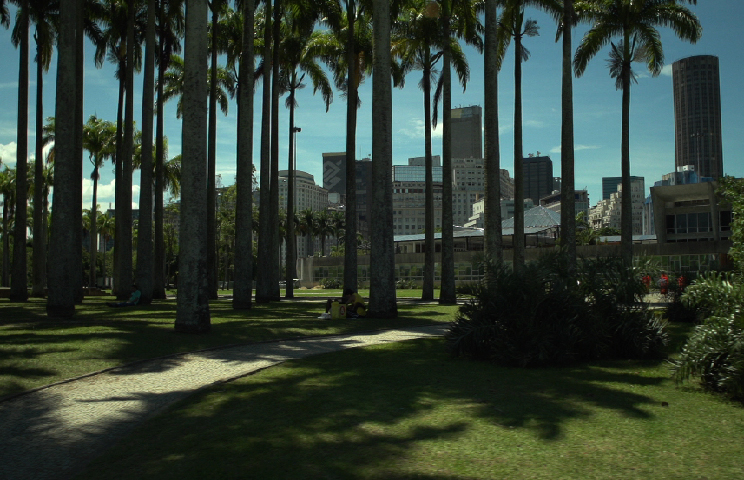
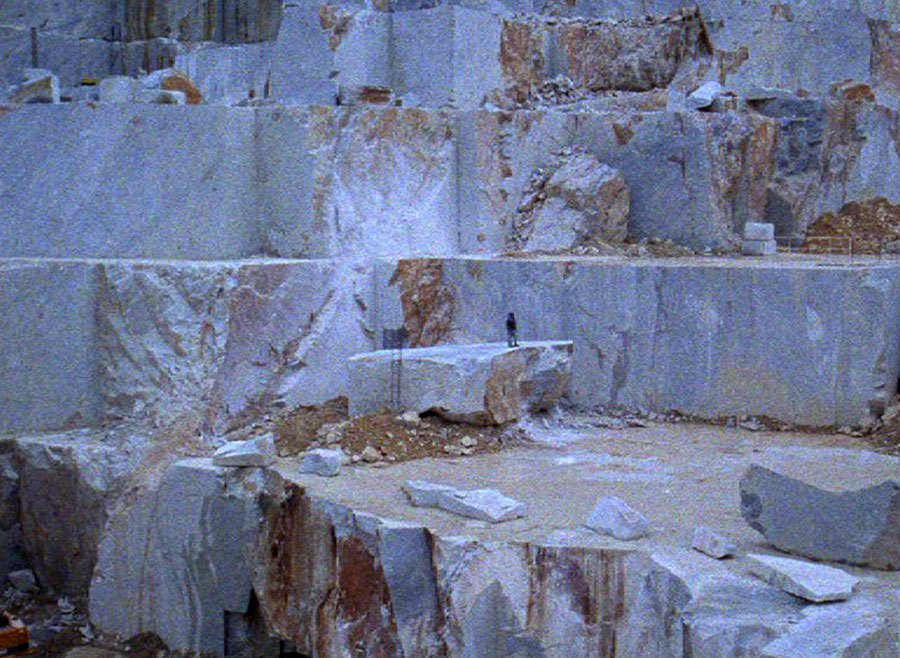
From the 19th century panoramas and Lumière’s single-shot studies to the work of Larry Gottheim, Rose Lowder or James Benning: landscapes have always taken up an important place in the (pre)cinematographic imagination. In turn the relation between cinema and landscape is part of a much longer history of fragmenting place and space, as an invitation to organized voyages inside the frame. The recent video work of Sophie Nys and Aglaia Konrad also solicit coordinated perspectives on the composition and texture of specific places: the ‘Parque do Flamengo’ in Rio de Janeiro and the Apuanian Alps in Toscany; for one the most ambitious creation of landscape architect Roberto Burle Marx, for the other the excisions of the marble out of which Michelangelo once sculpted his masterpieces. What both works make visible, under the surface of ruin and chaos, is what ultimately appears once the landscape is sculpted: architecture.

sophienys_parque_do_flamengo-1.jpg

Sophie Nys
Parque do Flamengo

2012, video, color, stereo sound, 16:9, non spoken, 45’

Drawn by her interest in history and architecture and the ambiguity which is emerging from modernist utopias, the Belgian artist Sophie Nys left in January 2011 for Rio de Janeiro to shoot the film Parque do Flamengo. From this a semi-documentary resulted whose main character is the Parque do Flamengo, a park designed by the landscape architect Roberto Burle Marx between 1954 and 1959. Simultaneously a painter, sculptor, poet and botanist, Roberto Burle Marx is known worldwide as one of the greatest landscape architects of the twentieth century. The film by Sophie Nys is a 45 minute tracking shot and represents the whole of the park as an isolated entity. The space is crossed from A to Z at a walking pace. As a stroll, the route follows the curved and sensual line of the park. The film is a physical and artistic portrait of the place, a recording of a living space between culture and nature. At Sophie Nys’s request, composer and musician Arto Lindsay composed an original sound track based on the plants that appear in the park. Faithful to her artistic practice, Sophie Nys develops a project which, behind a minimalist conceptual rigour, succeeds in revealing and eluding both the poetry and the absurdity of nature in a frame. Never objective, but always precise, the works of Sophie Nys evade historical and scientific linearity in favour of an approach based on intuitive research and free associations.

carrara_web.jpg

Aglaia Konrad
Concrete & Samples III Carrara

2010, 16mm transferred to video, color, 4:3, no sound, 19′

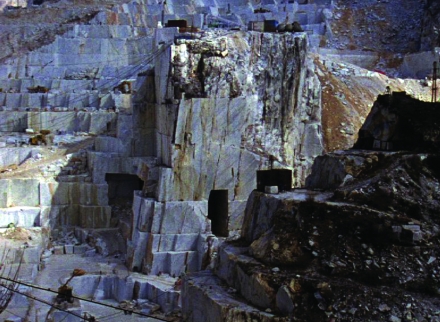
Concrete & Samples I, II, III is a series of 16mm films on sculptural architecture. What the buildings and site in all films have in common is the idea of ‘architecture as sculpture’ and a very distinct use of concrete that seem to depart from the free form of the whole in a sculptural manner. In the absence of a traditional narrative, it is the space itself, that takes the role of the protagonist, while the camera proposes a narration through its travel and observation.The film Concrete & Samples III Carrara, shows the marble quarry; within its ‘sculpted’ landscape, its temporary architecture and art-historical references form a more radical complement, to the two churches.

The people are missing

antonio.png

“What has changed?”, asked Gilles Deleuze during one of his talks on “cinema and thought” in 1985, drawing on his theory of the break between two ages based on an ontology of the cinematographic image. “Just as we’ve searched for the differences between the so-called ‘classical’ and ‘modern’ image, we could also search for the differences between the classical political cinema en the modern political cinema. It seems clear to me: there is an obvious change that makes that political cinema today, aside from The Straubs and Resnais, has left the West and North-America and has ended up in the Third World.” Deleuze elaborated on this fundamental change in regards to “political cinema” in Chapter 8 of his second Cinema book (see excerpt below), in which he argued that “if there were a modern political cinema, it would be on this basis: the people no longer exist, or not yet … the people are missing (….) Yet this recognition is no reason for a renunciation of political cinema, but on the contrary the new basis on which it is founded”, not “addressing a people which is presupposed already there”, but “contributing to the invention of a people”. The response to the question “where is the people?”, argued Deleuze, can only be undertaken by the power of “fabulation”: “It is the act of fabulation, let’s say ‘this act too big for me’, that constitutes a people, this is what I was trying to express in regards to Third World cinema: fabulation as a function of the poor or the damned” (talk of 18 June 1985).

It was only towards 1985, around the time when his two Cinema books were first published, that the issue of fabulation (sometimes translated as “story-telling”) appeared in Deleuze’s work. Taking his cue from Bergson, he and Guattari remark in What Is Philosophy? that “Bergson analyzes fabulation as a visionary faculty very different from the imagination and that consists in creating gods and giants, ‘semi- personal powers or effective presences’. It is exercised first of all in religions, but it is freely developed in art and literature.” Looking back, it’s clear that their interpretation of the notion of “fabulation” was preceded and prepared for by the concept of “minor literature”, defined in their book on Kafka (1975) as “positively charged with the role and function of collective, and even revolutionary, enunciation”, and furthermore “’if the writer is in the margins or completely outside his or her fragile community, this situation allows the writer all the more the possibility to express another possible community and to forge the means for another consciousness and another sensibility.“ It was precisely this function that Deleuze recognized in the work of the Canadian filmmaker Pierre Perrault, who became one of the protagonists in Cinema 2: Time-image. Perrault himself preferred to describe his own work as “cinéma du vécu” (living cinema) – as oppossed to “cinéma vérité” (truth cinema) – as a documentary cinema that seeks to seize the moment when one passes from one state to another in the act of what he called “legending”. In other words: “truth” isn’t something already out there to be apprehended – it has to be created. Wary of all predetermined fiction, Perrault was interested in capturing “fiction in flagrante delicto” and in doing so “contribute to the invention of his (Québecois) people.” Perrault argued that neither he nor the characters in his films were capable of producing such ‘legending’ by themselves, for they need one another as “intercessors”. In a 1985 interview Deleuze described Perrault’s function as that of a “mediator”:

“The formation of mediators in a community is well seen in the work of the Canadian filmmaker Pierre Perrault: having found mediators I can say what I have to say. Perrault thinks that if he speaks on his own, even in a fictional framework, he’s bound to come out with an intellectual’s discourse, he won’t get away from a ‘master’s or colonist’s discourse,’ an established discourse. What we have to do is catch someone else ‘legending,’ ‘caught in the act of legending.’ Then a minority discourse, with one or many speakers, takes shape. We here come upon what Bergson calls ‘fabulation’… To catch someone in the act of legending is to catch the movement of constitution of a people. A people isn’t something already there. A people, in a way, is what’s missing, as Paul Klee used to say. Was there ever a Palestinian people? Israel says no. Of course there was, but that’s not the point. The thing is, that once the Palestinians have been thrown out of their territory, then to the extent that they resist they enter the process of constituting a people. It corresponds exactly to what Perrault calls being caught in the act of legending. It’s how any people is constituted. So, to the established fictions that are always rooted in a colonist’s discourse, we oppose a minority discourse, with mediators.”

perrault_monde.jpg

Fabulation is thus proposed as the act by which a people that doesn’t yet “exist” as such (re)invents itself. Of course filmmakers can not invent a people, they can only evoke one, through forms of “free indirect discourse” (a notion Deleuze borrowed from Passolini). As Deleuze said in one of his talks, referring to Glauber Rocha’s Terra em Transe: “Rocha has put his country in trance but that’s all he could do. It was his own free indirect discourse but he couldn’t do more – it’s a great work of art but one could still say something is missing: the people is missing.” How then can cinema contribute to political acts of fabulation? What does resistance to established fictions and opposition of a minority discourse entail? Or, in his own words: “what is the relationship between the struggles of man of the work of art?”

“This is the closest and for me the most mysterious relationship of all. Exactly what Paul Klee meant when he said: ‘you know, the people are missing’. The people are missing and at the same time, they are not missing. The people are missing means that the fundamental affinity between a work of art and a people that does not yet exist is not, will never be clear. There is no work of art that does not call on a people who does not yet exist.” (talk of 17 March 1987, also published as What is the Creative Act?)

In a 1990 interview with Antonio Negri, a few years before his death, Deleuze gave some more hints to how this relationship might be thought of:

Negri: “How can minority becoming be powerful? How can resistance become an insur­rection? Reading you, I’m never sure how to answer such questions, even though I always find in your works an impetus that forces me to reformulate the questions theoretically and practically. And yet when I read what you’ve written about the imagination, or on common notions in Spinoza, or when I follow your description in The Time-Image of the rise of revolutionary cine­ma in third-world countries, and with you grasp the passage from image into fabulation, into political praxis, I almost feel I’ve found an answer… Or am I mistaken ? Is there then, some way for the resistance of the oppressed to become effective, and for what’s intolerable to be definitively removed? Is there some way for the mass of singularities and atoms that we all are to come forward as a constitutive power, or must we rather accept the juridical paradox that con­stitutive power can be defined only by constituted power?”

Deleuze: “The difference between minorities and majorities isn’t their size. A minority may be bigger than a majority. What defines the majority is a model you have to conform to: the average European adult male city-dweller, for example… A minority, on the other hand, has no model, it’s a becoming, a process. One might say the majority is nobody. Everybody’s caught, one way or another, in a minority becoming that would lead them into unknown paths if they opted to follow it through. When a minority creates models for itself, it’s because it wants to become a majority, and probably has to, to survive or prosper (to have a state, be recognized, establish its rights, for example). But its power comes from what it’s managed to create, which to some extent goes into the model, but doesn’t depend on it. A people is always a creative minority, and remains one even when it acquires a majority: it can be both at once because the two things aren’t lived out on the same plane. It’s the greatest artists (rather than populist artists) who invoke a people, and find they ‘lack a people’: Mallarme, Rimbaud, Klee, Berg. The Straubs in cinema. Artists can only invoke a people, their need for one goes to the very heart of what they’re doing, it’s not their job to create one, and they can’t. Art is resistance: it resists death, slavery, infamy, shame. But a people can’t worry about art. How is a people created, through what terrible suf­fering? When a people’s created, it’s through its own resources, but in away that links up with something in art (Garrel says there’s a mass of terrible suffering in the Louvre, too) or links up art to what it lacked. Utopia isn’t the right concept: it’s more a question of a ‘fabulation’ in which a people and art both share. We ought to take up Bergson’s notion of fabulation and give it a political meaning”.

——————————————————————————————————————————————————————-

nicht-versohnt.jpg

The text below was published in ‘Cinema 2, The Time-Image’ (Athlone Press, 1989), Paragraph 3 of Chapter 8, ‘Cinema, Body and Brain, Thought’. First published as ‘Cinema 2, L’Image-temps’ (Les Editions de Minuit, 1985). Translated by Hugh Tomlinson and Robert Caleta (translation slightly modified).

Resnais and the Straubs are probably the greatest political film-makers in the West, in modern cinema. But, oddly, this is not through the presence of the people. On the contrary, it is because they know how to show how the people are what is missing, what is not there. Thus Resnais, in La guerre est finie, in relation to a Spain that will not be seen: do the people in the old central committee stand with the young terrorists or the tired militant? And the German people in the Straubs’ Nicht Versohnt (‘Not reconciled’): has there ever been a German people, in a country which has bungled its revolutions, and was constituted under Bismarck and Hitler, to be separated again? This is the first big difference between classical and modern cinema. For in classical cinema, the people are there, even though they are oppressed, tricked, subject, even though blind or unconscious. Soviet cinema is an example: the people are already there in Eisenstein, who shows them performing a qualitative leap in Staroye i novoye (‘The General Line’ aka ‘Old and New’), or who, in Ivan Grozniy (‘Ivan the Terrible’), makes them the advanced edge held in check by the tsar; and, in Pudovkin, it is on each occasion the progression of a certain awareness which means that the people already has a virtual existence in process of being actualized; and in Vertov and Dovzhenko, in two different ways, there is a unanimity which calls the different peoples into the same melting-pot from which the future emerges. But unanimity is also the political character of American cinema before and during the war: this time, it is not the twists and turns of class struggle and the confrontation of ideologies, but the economic crises, the fight against moral prejudice, profiteers and demagogues, which mark the awareness of a people, at the lowest point of their misfortune as well as at the peak of their hope (the unanimism of King Vidor, Capra, or Ford, for the problem runs through the Western as much as through the social drama, both testifying to the existence of a people, in hardships as well as in ways of recovering and rediscovering itself).(1) In American and in Soviet cinema, the people are already there, real before being actual, ideal without being abstract. Hence the idea that the cinema, as art of the masses, could be the supreme revolutionary or democratic art, which makes the masses a true subject. But a great many factors were to compromise this belief: the rise of Hitler, which gave cinema as its object not the masses become subject but the masses subjected; Stalinism, which replaced the unanimism of peoples with the tyrannical unity of a party; the break-up of the American people, who could no longer believe themselves to be either the melting-pot of peoples past or the seed of a people to come (it was the neo-Western that first demonstrated this break-up). In short, if there were a modern political cinema, it would be on this basis: the people no longer exist, or not yet … the people are missing.

un-pays-sans-bon-sens.jpg

No doubt this truth also applied to the West, but very few authors discovered it, because it was hidden by the mechanisms of power and the systems of majority. On the other hand, it was absolutely clear in the third world, where oppressed and exploited nations remained in a state of perpetual minorities, in a collective identity crisis. Third world and minorities gave rise to authors who would be in a position, in relation to their nation and their personal situation in that nation, to say: the people are what is missing. Kafka and Klee had been the first to state this explicitly. The first said that minor literatures, “in the small nations”, ought to supplement a “national consciousness which is often inert and always in process of disintegration”, and fulfill collective tasks in the absence of a people; the second said that painting, to bring together all the parts of its “great work”, needed a “final force”, the people who were still missing.(2) This was all the more true for cinema as mass-art. Sometimes the third world film-maker finds himself before an illiterate public, swamped by American, Egyptian or Indian serials, and karate films, and he has to go through all this, it is this material that he has to work on, to extract from it the elements of a people who are still missing (Lino Brocka). Sometimes the minority film-maker finds himself in the impasse described by Kafka: the impossibility of not “writing”, the impossibility of writing in the dominant language, the impossibility of writing differently (Pierre Perrrault encounters this situation in Un pays sans bon sens, the impossibility of not speaking, the impossibility of speaking other than in English, the impossibility of speaking English, the impossibility of settling in France in order to speak French … ), and it is through this state of crisis that he has to pass, it is this that has to be resolved. This acknowledgement of a people who are missing is not a renunciation of political cinema, but on the contrary the new basis on which it is founded, in the third world and for minorities. Art, and especially cinematographic art, must take part in this task: not that of addressing a people, which is presupposed already there, but of contributing to the invention of a people. The moment the master, or the colonizer, proclaims “There have never been people here”, the missing people are a becoming, they invent themselves, in shanty towns and camps, or in ghettos, in new conditions of struggle to which a necessarily political art must contribute.

yol.jpg

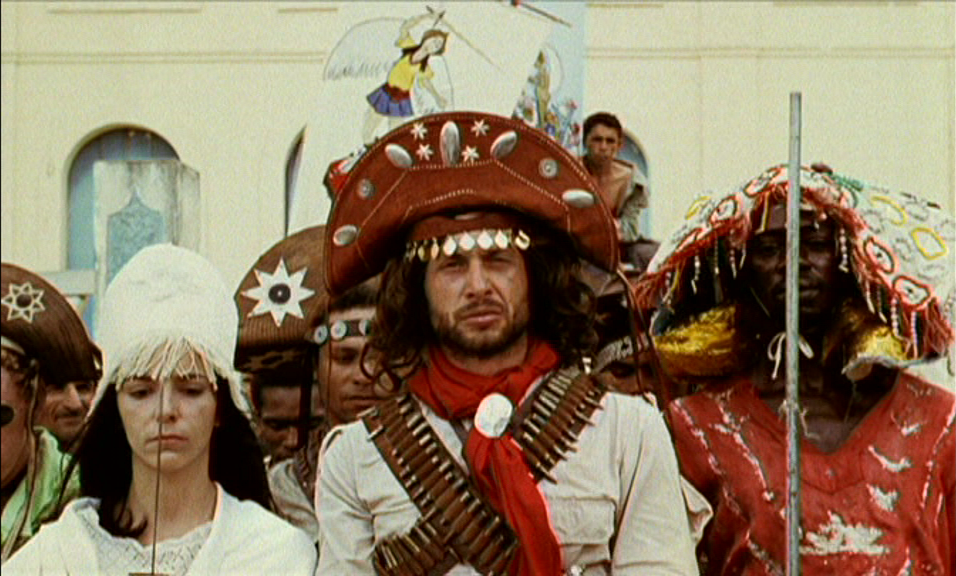
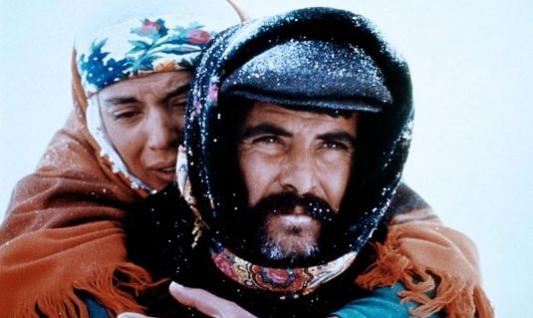
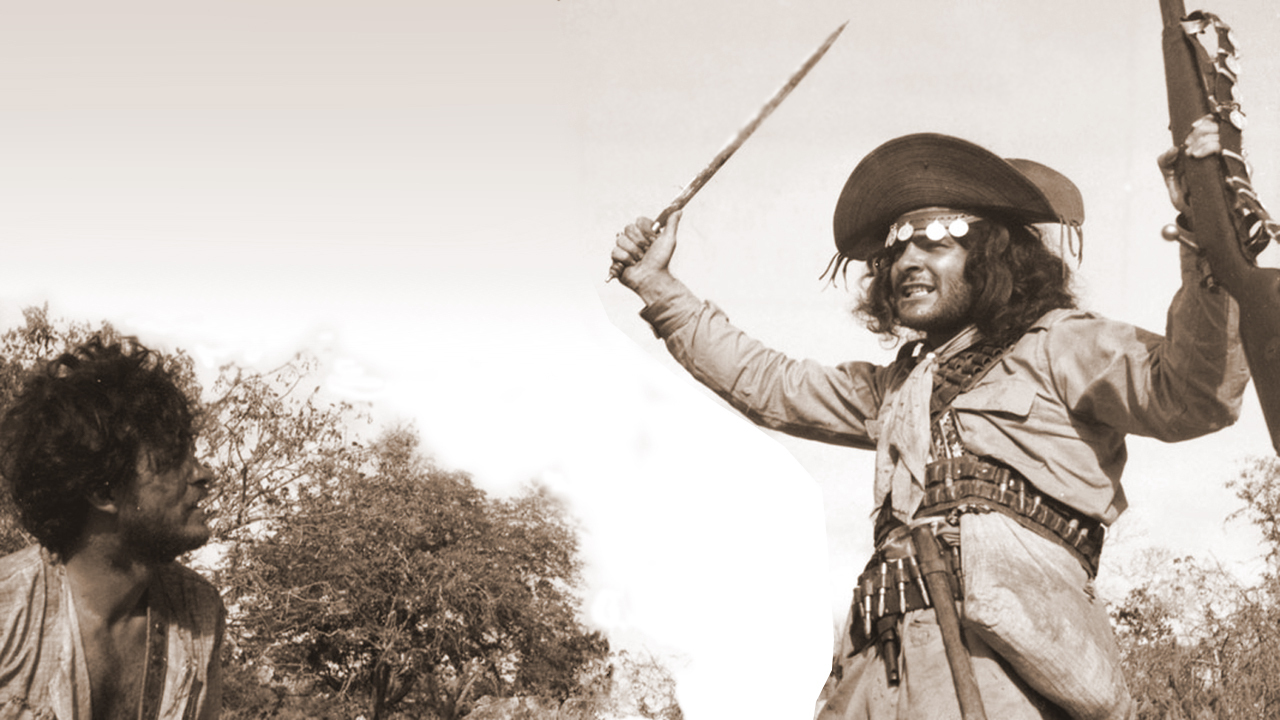
There is a second big difference between classical and modern political cinema, which concerns the relationship between the political and the private. Kafka suggested that “major” literatures always maintained a border between the political and the private, however mobile, whilst, in minor literature, the private affair was immediately political and “entailed a verdict of life or death”. And it is true that, in the large nations, the family, the couple, the individual himself go about their own business, even though this business necessarily expresses social contradictions and problems, or directly suffers their effects. The private element can thus become the place of a becoming conscious, in so far as it goes back to root causes, or reveals the “object” that it expresses. In this sense, classical cinema constantly maintained this boundary which marked the correlation of the political and the private, and which allowed, through the intermediary of an awareness, passage from one social force to another, from one political position to another: Pudovkin’s Mat (‘Mother’) discovers the son’s real object in fighting, and takes it over; in Ford’s The Grapes of Wrath, it is the mother who sees clearly up to a certain point, and who is relieved by the son when conditions change. This is no longer the case in modern political cinema, where no boundary survives to provide a minimum distance or evolution: the private affair merges with the social – or political – immediate. In Güney’s Yol, the family clans form a network of alliances, a fabric of relationships so close-knit that one character must marry the wife of his dead brother, and another go far away to look for his guilty wife, across a desert of snow, to have her punished in the proper place; and, in Süru (‘The Herd’) as in Yol, the most progressive hero is condemned to death in advance. It could be said that this is a matter of archaic pastoral families. But, in fact, what is important is that there is no longer a “general line”, that is, of evolution from the Old to the New, or of revolution which produces a leap from one to the other. There is rather, as in South American cinema, a juxtaposition or compenetration of the old and the new which “makes up an absurdity”, which assumes “the form of aberration”.(3) What replaces the correlation of the political and the private is the coexistence, to the point of absurdity, of very different social stages. It is in this way that, in Glauber Rocha’s work, the myths of the people, prophetism and banditism, are the archaic obverse of capitalist violence, as if the people were turning and increasing against themselves the violence that they suffer from somewhere else out of a need for idolization (Deus e o Diabo na Terra do Sol, ‘Black God and White Devil’). Gaining awareness is disallowed either because it takes place in the air, as with the intellectual, or because it is compressed into a hollow, as with Antonio das Mortes, capable only of grasping the juxtaposition of two violences and the continuation of one by the other.

blackgodwhitedevil2.jpg

What, then, is left? The greatest ‘agitprop’ cinema that has ever been made: the agitprop is no longer a result of a becoming conscious, but consists of putting everything into a trance, the people and its masters, and the camera itself, pushing everything into a state of aberration, in order to communicate violences as well as to make private business pass into the political, and political affairs into the private (Terra em Transe, ‘Earth Entranced’). Hence the very specific aspect assumed by the critique of myth in Rocha: it is not a matter of analysing myth in order to discover its archaic meaning or structure, but of connecting archaic myth to the state of the drives in an absolutely contemporary society, hunger, thirst, sexuality, power, death, worship. In Asia, in Brocka’s work, we can also find the immediacy of the raw drive and social violence underneath the myth, for the former is no more “natural” than the latter is “cultural”.(4) A lived actual which at the same time indicates the impossibility of living can be extracted from myth in other ways, but continues to constitute the new object of political cinema: putting into a trance, putting into a crisis. In Pierre Perrault, it is a matter of a state of crisis and not of trance. It is a matter of stubborn quests rather than of violent drives. However, the aberrant quest for French ancestors (Le regne du jour, Un pays sans bon sens, C’etait un Quebecois en Bretagne) testifies in its own way, beneath the myth of origins, to the absence of boundary between the private and the political, but also to the impossibility of living in these conditions, for the colonized person who comes up against an impasse in every direction.(5) It is as if modern political cinema were no longer constituted on the basis of a possibility of evolution and revolution, like the classical cinema, but on impossibilities, in the style of Kafka: the intolerable. Western authors cannot save themselves from this impasse, unless they settle for a cardboard people and paper revolutionaries: it is a condition which makes Comolli a true political film-maker when he takes as his object a double impossibility, that of forming a group and that of not forming a group, “the impossibility of escaping from the group and the impossibility of being satisfied with it” (L’ombre rouge).(6)

egyptianstory.jpg

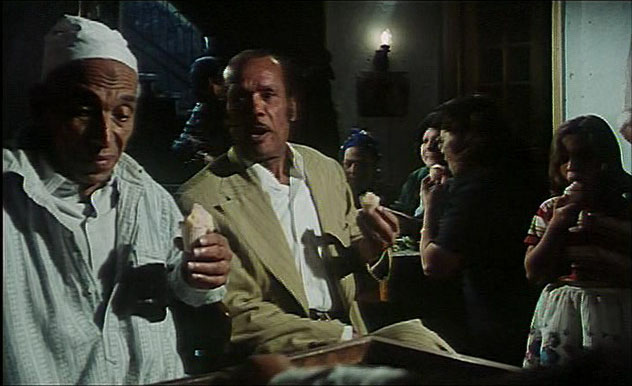
If the people are missing, if there is no longer consciousness, evolution or revolution, it is the scheme of reversal which itself becomes impossible. There will no longer be conquest of power by a proletariat, or by a united or unified people. The best third world film-makers could believe in this for a time: Rocha’s Guevarism, Chahine’s Nasserism, black American cinema’s blackpowerism. But this was the perspective from which these authors were still taking part in the classical conception, so slow, imperceptible and difficult to site clearly. The death-knell for becoming conscious was precisely the consciousness that there were no people, but always several peoples, an infinity of peoples, who remained to be united, or should not be united, in order for the problem to change. It is in this way that third world cinema is a cinema of minorities, because the people exist only in the condition of minority, which is why they are missing. It is in minorities that private business is immediately political. Acknowledging the failure of fusions or unifications which did not re-create a tyrannical unity, and did not turn back against the people, modern political cinema has been created on this fragmentation, this break-up. This is its third difference. After the 1970s, black American cinema makes a return to the ghettos, returns to this side of a consciousness, and, instead of replacing a negative image of the black with a positive one, multiplies types and ‘characters’, and each time creates or re-creates only a small part of the image which no longer corresponds to a linkage of actions, but to shattered states of emotions or drives, expressible in pure images and sounds: the specificity of black cinema is now defined by a new form, “the struggle that must bear on the medium itself” (Charles Burnett, Robert Gardner, Haile Gerima, Charles Lane).(7) In another style, this is the compositional mode of Chahine in Arab cinema: Iskanderija… lih? (‘Why Alexandria?’) reveals a plurality of intertwined lines, primed from the beginning, one of these lines being the principal one (the story of the boy), the others having to be pushed until they cut across the principal one; and Hadduta misrija (‘An Egyptian Story’ aka al-Dhakira, ‘Memory’) leaves no place for the principal line, and pursues the multiple threads which end in the author’s heart attack, conceived as internal trial and verdict, in a kind of Why Me?, but where the arteries of the inside are in immediate contact with the lines of the outside. In Chahine’s work, the question “why” takes on a properly cinematographic value, just as much as the question “how” in Godard. “Why?” is the question of the inside, the question of the I: for, if the people are missing, if they are breaking up into minorities, it is I who am first of all a people, the people of my atoms as Carmelo Bene said, the people of my arteries as Chahine said (for his part, Gerima says that, if there is a plurality of black “movements”, each film-maker is a movement in himself). “But why?” is also the question from the outside, the question of the world, the question of the people who, missing, invent themselves, who have a chance to invent themselves by asking the I the question that it asked them: Alexandria-I, I-Alexandria. Many third world films invoke memory, implicitly or even in their title, Perrault’s Pour la suite du monde, Chahine’s al-Dhakira, Khleifi’s Al Dhakira al Khasba (‘Fertile Memory’). This is not a psychological memory as faculty for summoning recollections, or even a collective memory as that of an existing people. It is, as we have seen, the strange faculty which puts into immediate contact the outside and the inside, the people’s business and private business, the people who are missing and the I who is absent, a membrane, a double becoming. Kafka spoke of this power taken on by memory in small nations: “The memory of a small nation is no shorter than that of a large one, hence it works on the existing material at a deeper level.” It gains in depth and distance what it lacks in extent. It is no longer psychological nor collective, because each person “in a little country” inherits only the portion due to him, and has no goal other than this portion, even if he neither recognizes nor maintains it. Communication of the world and the I in a fragmented world and in a fragmented I which are constantly being exchanged. It is as if the whole memory of the world is set down on each oppressed people, and the whole memory of the I comes into play in an organic crisis. The arteries of the people to which I belong, or the people of my arteries …

terratransa.jpg

But is this I not the I of the third world intellectual, whose portrait Rocha and Chahine among others have often sketched, and who has to break with the condition of the colonized, but can do so only by going over to the colonizer’s side, even if only aesthetically, through artistic influences? Kafka pointed to another path, a narrow path between the two dangers: precisely because “great talents” or superior individualities are rare in minor literatures, the author is not in a condition to produce individual utterances which would be like invented stories; but also, because the people are missing, the author is in a situation of producing utterances which are already collective, which are like the seeds of the people to come, and whose political impact is immediate and inescapable. The author can be marginalized or separate from his more or less illiterate community as much as you like; this condition puts him all the more in a position to express potential forces and, in his very solitude, to be a true collective agent, a collective leaven, a catalyst. What Kafka suggests for literature is even more valid for cinema, in as much as it brings collective conditions together through itself. And this is in fact the last characteristic of a modern political cinema. The cinema author finds himself before a people which, from the point of view of culture, is doubly colonized: colonized by stories that have come from elsewhere, but also by their own myths become impersonal entities at the service of the colonizer. The author must not, then, make himself into the ethnologist of his people, nor himself invent a fiction which would be one more private story: for every personal fiction, like every impersonal myth, is on the side of the “masters”. It is in this way that we see Rocha destroying myths from the inside, and Perrault repudiating every fiction that an author could create. There remains the possibility of the author providing himself with “intercessors”, that is, of taking real and not fictional characters, but putting these very characters in the condition of “making up fiction”, of “making legends”, of “fabulation”. The author takes a step towards his characters, but the characters take a step towards the author: double becoming. Fabulation is not an impersonal myth, but neither is it a personal fiction: it is a word in act, a speech-act through which the character continually crosses the boundary which would separate his private business from politics, and which itself produces collective utterances.

ceddo3.jpg

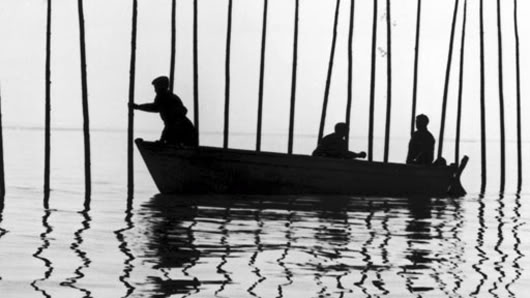
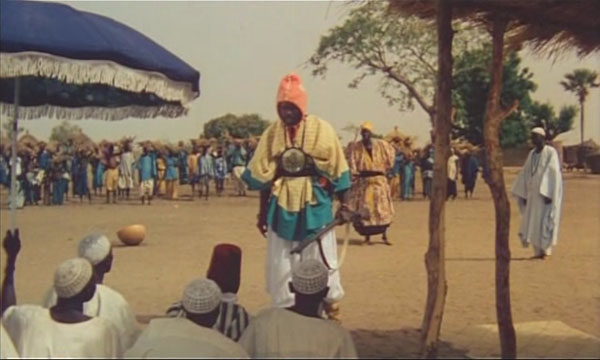
Daney observed that African cinema (but this applies to the whole third world) is not, as the West would like, a cinema which dances, but a cinema which talks; a cinema of the speech-act. It is in this way that it avoids fiction and ethnology. In Ceddo, Ousmane Sembene extracts the fabulation which is the basis of living speech, which ensures its freedom and circulation, which gives it the value of collective utterance, thus contrasting it with the myths of the Islamic colonist.(8) Was this not already Rocha’s way of operating on the myths of Brazil? His internal critique would first isolate a lived present beneath the myth, which could be intolerable, the unbelievable, the impossibility of living now in “this” society (Deus e o Diabo na Terra do Sol, Terra em Transe); then he had to seize from the unliving a speech-act which could not be forced into silence, an act of fabulation which would not be a return to myth but a production of collective utterances capable of raising misery to a strange positivity, the invention of a people (O Dragão da Maldade Contra o Santo Guerreiro (‘Antonio das Mortes’), Der Leone have sept cabeças (‘The Lion Has Seven Heads’), Cabeças Cortadas (‘Severed Heads’)).(9) The trance, the putting into trances, are a transition, a passage, or a becoming; it is the trance which makes the speech-act possible, through the ideology of the colonizer, the myths of the colonized and the discourse of the intellectual. The author puts the parties in trances in order to contribute to the invention of his people who, alone, can constitute the whole [ensemble]. The parties are again not exactly real in Rocha, but reconstructed (and in Sembene they are reconstituted in a story which goes back to the seventeenth century). It is Perrault, at the other end of America, who addresses real characters, his “intercessors”, in order to prevent any fiction, but also to carry out the critique of myth. Operating by putting into crisis, Perrault will isolate the fabulation speech-act, sometimes as the generator of action (the reinvention of porpoise-fishing in Pour la suite du monde), sometimes taking itself as object (the search for ancestors in Le regne du jour), sometimes bringing about a creative simulation (the elk-hunt in La bete lumineuse), but always in such a way that fabulation is itself memory, and memory is invention of a people. Everything perhaps culminates in Le pays de la terre sans arbres, which brings all the ways together, or, by contrast, in Un pays sans bon sens, which minimizes them (for, here, the real character has the most solitude, and does not even belong to Quebec, but to a tiny French minority in an English country, and leaps from Winnipeg to Paris the better to invent his belonging to Quebec, and to produce a collective utterance for it).(10) Not the myth of a past people, but the fabulation of the people to come. The speech-act must create itself as a foreign language in a dominant language, precisely in order to express an impossibility of living under domination. It is the real character who leaves his private condition, at the same time as the author his abstract condition, to form, between the two, between several, the utterances of Quebec, about Quebec, about America, about Britanny and Paris (free indirect discourse). In Jean Rouch, in Africa, the trance of the maîtres fous is extended in a double becoming, through which the real characters become another by fabulation, but the author, too, himself becomes another, by providing himself with real characters. It may be objected that Jean Rouch can only with difficulty be considered a third world author, but no one has done so much to put the West to flight, to flee himself, to break with a cinema of ethnology and say Moi un Noir, at a time when blacks play roles in American series or those of hip Parisians. The speech-act has several heads, and, little by little, plants the elements of a people to come as the free indirect discourse of Africa about itself, about America or about Paris. As a general rule, third world cinema has this aim: through trance or crisis, to constitute an assemblage which brings real parties together, in order to make them produce collective utterances as the prefiguration of the people who are missing (and, as Klee says, “we can do no more”).

——————————————————————————————————————————————————————-

Notes
(1) For example on democracy, the community and the necessity of a “leader” in King Vidor’s work, cf. Positif, no. 163, novembre 1974 (articles by Michel Ciment and Michael Henry).
(2) cf. Kafka, Journal, 25 December 1911 (and letter to Brod, June 1921); Klee, On Modern Art, trans. Paul Findlay, London: Faber, 1966, p. 55. (“We have found parts, but not the whole. We still lack the ultimate power, for: the people are not with us. But we seek a people. We began over there in the Bauhaus. We began there with a community to which each of us gave what he had. More we cannot do.”) Carmelo Bene has also said: “I make popular theatre. Ethnic. But it is the people who are missing” (Dramaturgie, p. 113).
(3) Roberto Schwarz and his definition of ‘tropicalism’, Les Temps modernes, no. 288, juillet 1970.
(4) On Lino Brocka, his use of myth and his cinema of drives, cf. Cinématographe, no. 77, avril 1982 (especially the article by Jacques Fieschi, ‘Violences’).
(5) On the critique of myth in Perrault, cf. Guy Gauthier, ‘Une ecriture du reel’, and Suzanne Trudel, ‘La quete du royaume, trois hommes, trois paroles, un langage’, in Ecritures de Pierre Perrault, Edilig. Suzanne Trudel distinguishes three kinds of impasse, genealogical, ethnic and political (p. 63).
(6) Jean-Louis Comolli, interview, Cahiers du cinéma, no. 333, mars 1982.
(7) Yann Lardeau, ‘Cinema des racines, histoires du ghetto’, in Cahiers du cinéma, no. 340, octobre 1982.
(8) cf. Serge Daney, La rampe, Cahiers du cinéma / Gallimard, pp. 118- 23 (especially the character of the story-teller).
(9) On Rocha’s critique of myth and the evolution of his work, cf. Barthelemy Amengual, Le cinema novo brésilien, Etudes cinématographiques, II (p. 57: “the counter-myth, as one says counter-fire”).
(10) Ecritures de Pierre Perrault: on real characters, and the speech-act as fabulation function, “flagrant offence of making legend”, cf. the interview with René Allio (on La bête lumineuse, Perrault would say: “I recently came across an unsuspected country … Everything in this apparently quiet country is made into legend as soon as one dares to talk about it.”).