Staring Back

chris-marker-demo18paris2006.jpeg

“The heart of the aporia seems to me to lie precisely in the necessity we face, and the impossibility we struggle against, of collectively inventing a new image of a people, a new image of the relation between membership in historical communities (ethnos) and the continued creation of citizenship (demos) through collective action and the acquisition of fundamental rights to existence, work, and expression, as well as civic equality and the equal dignity of languages, classes, and sexes.”
— Etienne Balibar, ‘We, The People of Europe? Reflections on Transnational Citizenship.‘

In a recent edition of the Oxford Art Journal I found an interesting thinking piece about Chris Marker’s Staring Back, titled ‘Towards a New Image of Politics‘, written by Vered Maimon. As in the recently published Communities of Sense – a book Maimon co-edited – the article attempts to plug into critical discourse about politics and aesthetics, put forward by Jacques Rancière (see earlier post) and Etienne Balibar, amongst others. As it happens, Rancière himself mentioned Marker’s remarkable project, consisting of a series of still black and white photographic portraits documenting his long standing engagement with political resistance and the human face, in an insightful interview with Fulvia Carnevale and John Kelsey (published in Art Forum, March 2007):

“If there is a circulation that should be stopped at this point, it’s this circulation of stereotypes that critique stereotypes, giant stuffed animals that denounce our infantilization, media images that denounce the media, spectacular installations that denounce the spectacle, etc. There is a whole series of forms of critical or activist art that are caught up in this police logic of the equivalence of the power of the market and the power of its denunciation. The work of dissensus is to always reexamine the boundaries between what is supposed to be normal and what is supposed to be subversive, between what is supposed to be active, and therefore political, and what is supposed to be passive or distant, and therefore apolitical.”

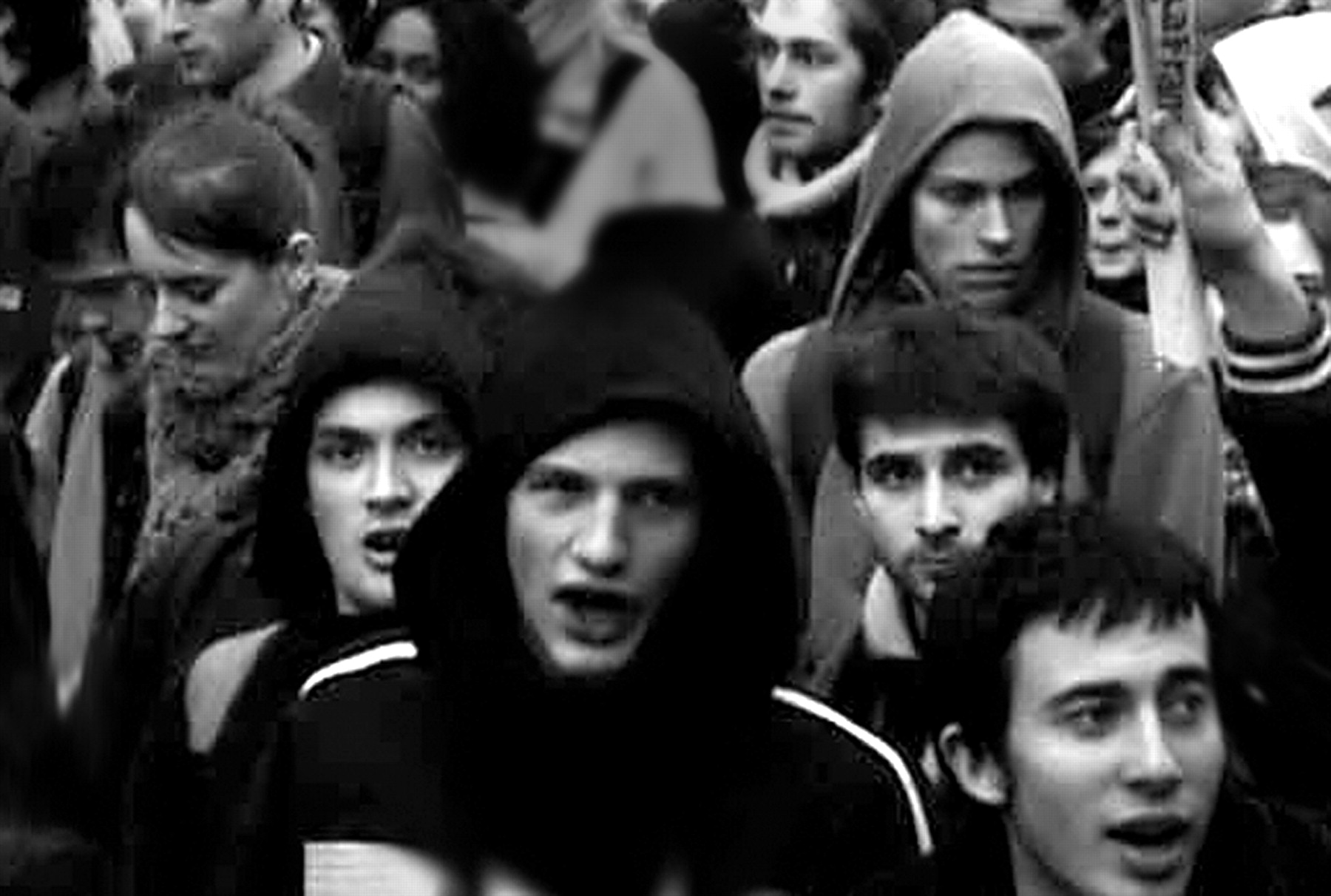
“(…) I was also thinking of the portfolio of images by Chris Marker published recently in these pages [‘The Revenge of the Eye,’ Artforum, Summer 2006]–pictures of French students in the spring of 2006 protesting against a law that would have made working conditions for young people less secure. By proceeding in two modes, through filming and through manipulated screen captures from the video footage, Marker created a sort of fabulous population out of groups of real protesters. I’m thinking in particular of an image of a group of young people in hooded sweatshirts. During the riots in the Parisian banlieue in the fall of 2005, these hoods, covering the heads of Arab and black youth, became a stigma: They were compared both to terrorists’ masks and to Muslim girls’ veils. The hoods became the symbol of a population locked up inside its own idiocy. Now, in ‘The Revenge of the Eye,’ they transform the young people into medieval monks, bringing to mind Saint Francis’s companions in Rossellini’s film. The protestors become a “fabulous” population in Deleuze’s sense. It’s as if the capacity of art brought to bear on the figures were actually a property of the figures themselves. That’s an example of a reversal of perspective. And I think what art can do is always a matter of the reversal of perspectives. Police consists in saying: Here is the definition of subversive art. Politics, on the other hand, says: No, there is no subversive form of art in and of itself; there is a sort of permanent guerrilla war being waged to define the potentialities of forms of art and the political potentialities of anyone at all.”

chris-marker-demo17.jpeg

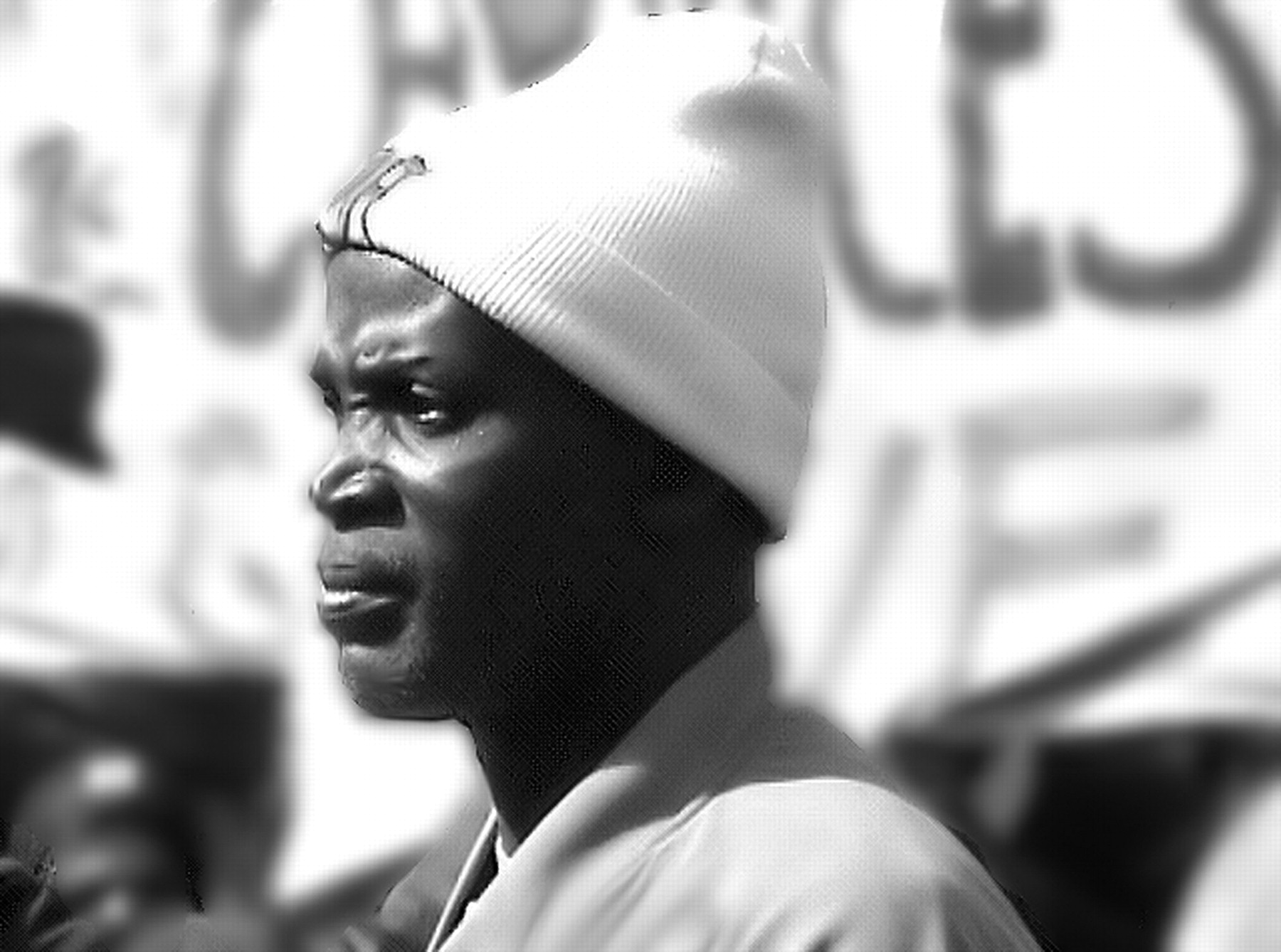
The ‘Revenge of the Eye’ portfolio that Rancière refers to consisted of some of the most recent images in Marker’s Staring Back book and exhibition project (of which I saw a version in Antwerp in 2008). The images were taken during the tumultuous 2006 anti-CPE (‘contract première embauche’) demonstrations protesting against the French government’s employment policies. Marker wrote: “The fight isn’t any longer against a largely imaginary fascism, neither is it about changing the world. Today’s mottoes deal with unemployment, income, fears of uncertain retirement (at 20… and yet in the long run they’re right). As my lens slips inside the crowd like an inquisitive snake, what it frames is, despite the apparent cohesiveness of the groups, the everlasting face of solitude.” Staring Back also features images of other political demonstrations – most of them extracted from his films – beginning with the notorious Charonne affaire in 1962 (some rendered from his film Le Joli Mai) to the actions against the Pentagon in 1977 (La sixième face du Pentagone), to May 1968 in Paris (Le Fond de L’air est Rouge), to various demonstrations in Paris in the period 2002-2004 (Chats Perchés). But in many ways it’s really the 2006 images that are the most striking. These images are not “bona fide photographs,” as he puts it, but frame captures from his video footage, studied in slow-motion playback to stem the otherwise “inordinate flow of video and television.” Working in this “superliminal” mode (Marker: ““If subliminal refers to the object the eye doesn’t catch but the brain does, Superliminal is the REVENGE OF THE EYE . . . that on slow-motion catches one image among many others apparently identical as being THE image . . .”), Marker searches for the “one frame lost in the stream of almost identical frames … the real photogram, something nobody has perceived–not even the guy who shot it (me, in most cases).” Bill Horrigan, curator of Staring Back, notes: “the subsequent digital manipulation he has imposed, and the startlingly flattened depth of some of the compositions, results in images unlike any others he has ever exhibited; it’s as though the faces of 2006 had become the faces of 1936 and 1236, the persistence of the Popular Front no less than the medieval among us”. It’s through this encounter with these faces, writes Vered Maimo, “that one is offered the recognition that in the current age politics can only exist beyond the realm of identities, precisely in the possibility (as Balibar argues) of creating transnational forms of citizenship. It is thus through the epistemological and political move beyond identity that Staring Back proposes a new image of politics and of the people and inseparably from it a new ‘politics’ of the image”.
chris-marker-demo15paris2006.jpeg

Maimo builds on for any political struggle and any prospect of future transformation.” Elsewhere he writes: “for Marker representational forms have lost their innocence. The beau masque, the theatricality that performs the revolution without enacting it, is itself a consequence of reality’s intensified colonisation by the image. For Marker hereafter the essential question thus becomes how as a filmmaker he can render the disingenuous transparency of the image, not so much opaque, but material”. Related to this, Maimo points out Rancière’s emphasis on the fictional and imaginary aspects of political subjectivities. In Dis-agreement (La Mésentente) he argues that politics is a matter of fictions and staged appearances and that “appearance is not an illusion that subsumes the real; It is the introduction of a visible into the field of experience, which then modifies the regime of the visible. It is not opposed to reality. It splits reality and reconfigures as its double”. For him, appearance and the logic of the double it enacts are necessary for politics because they expose the inconsistencies and tensions in any form of political and social identifications. This recognition of the power of the ‘fictions of the real’, writes Maimo, sheds a light on the images he presented in Staring Back.

“It is as if it is only by extracting these stills from the video footage that something new is introduced into the realm of the visible, such that their subject appears not as a personal ‘I’ or a unified and collective ‘We’, but as a subject in the process of ‘becoming-other’, a subject that has been ‘individuated’ from the flow and mass of people but like a shadow or an echo still remains inextricably bound to them. In short, a subject that displays the double impossibility of every form of political identification: that of forming a group and of not forming a group. Thus what we ultimately encounter in these images are doubles, ghosts not because these are manipulated digital images whose supposedly ‘truth’ status has been compromised or because they present people who are real before being actual, that is, an ideal and abstract collective as in classical cinema. Rather, these are, precisely, people who are actual before being real, people who are caught within a double and ceaseless movement between what always already is, and what has yet to be realised.”
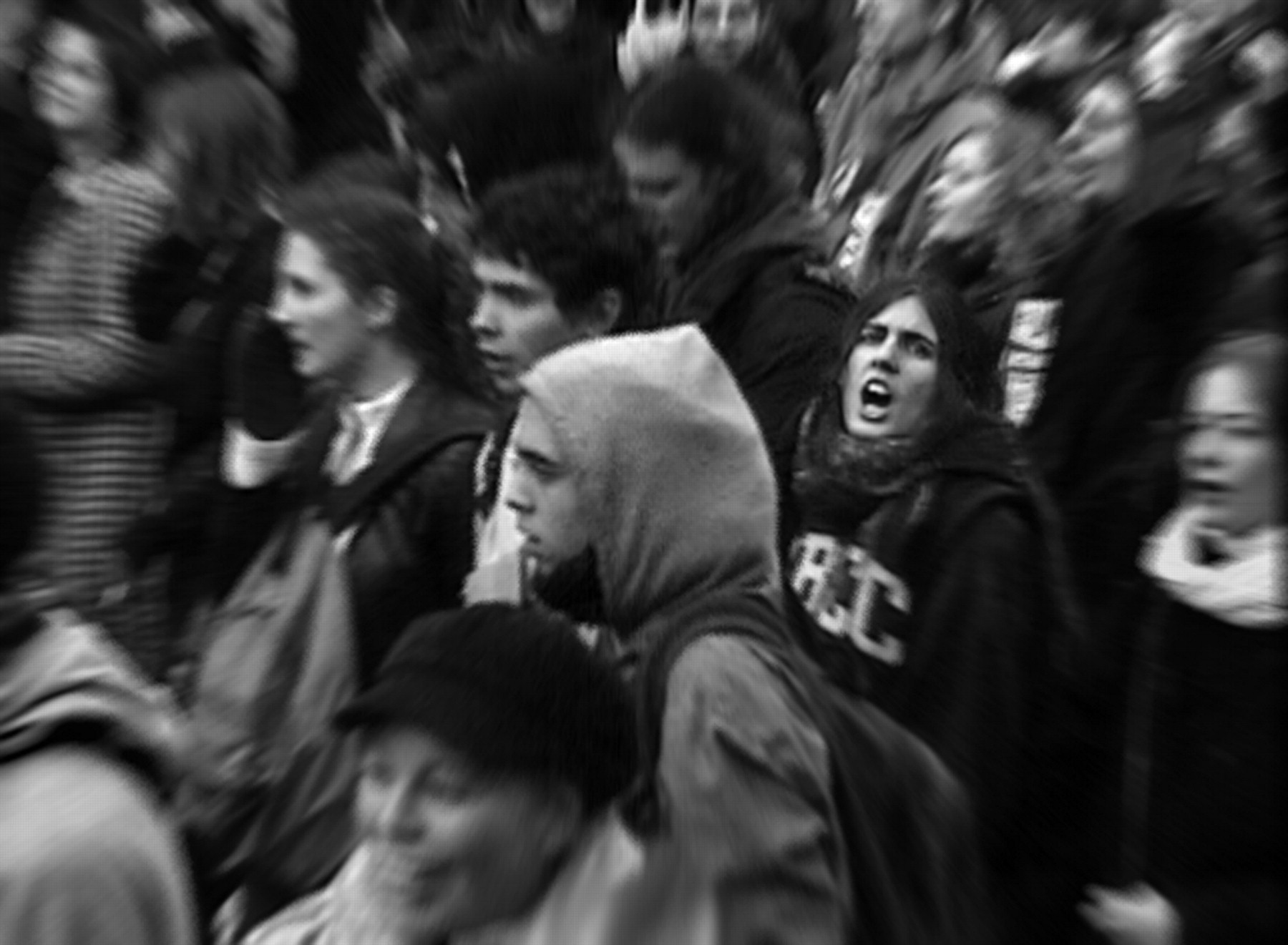
chris-marker-demo8paris2006.jpeg

Maimo’s ideas are informed by Deleuze’s argument in his Cinema studies that one of the main differences between classical and modern cinema is that whereas in classical cinema, the people are already there (“real before being actual, ideal without being abstract”), in modern cinema “the people no longer exist or not yet . . . the people are missing”. It is no longer possible to “represent” the people as unified because “they were no people, but always several people, an infinity of people, who remained to be united, or should not be united . . . because the people exist only in the condition of minority, which is why they are missing”. What Deleuze terms “minor cinema” is not a cinema of becoming-conscious as in classical cinema, but of becoming-other – not “a cinema of demographic minorities that are given an identity as ‘Others’, but one which struggles to articulate collective utterances that address a people who do not yet exist or whose existence is precisely what is at stake” (for Rancière, the fact that the people are internally divided is the primary condition of the exercise of politics). Modern political cinema, Deleuze argues, consists in “putting everything into a trance . . . pushing everything into a state of aberration, in order to communicate violence”. Since modern cinema can no longer constitutes itself on the basis of the possibility of a revolution, it constitutes itself on a double impossibility, “that of forming a group and that of not forming a group, the impossibility of escaping from the group and the impossibility of being satisfied with it”’. This is not only the dilemma underlining Le Fond de L’air est Rouge, argues Maimo, but also a crucial element in understanding the images in Staring Back.

“They offer an adequate response for Balibar’s call for ‘a new image of a people’ because they reveal that the condition of possibility for this kind of image lies precisely in the ability to think about political and active forms of citizenship beyond the ‘myths of identity’ and the ‘illusions about the necessary course of history’. This makes Marker’s images ‘minor images’, not because of their modesty, but because of the way they mark the horizon of the virtual beyond its immediate actualisations.”

chris-marker-demoantilepenparis2004.jpeg

“Virtuality” (another Deleuzian term) thus consists in the ability to create images which present the people as missing – as a split subject that does not have a pre-given identity and is not simply just “already there”. Yet, in Staring Back, the virtual also manifests itself in the individual portraits that are part of the project. Maimo uses Deleuze’s analysis of the close up and his notion of ‘faciality’ to point out the connection between the images of demonstrations and the portraits, as a way to “show the epistemological and political move beyond identity functions as a necessary condition for a new kind of relations between politics and visual images.” “It is precisely by ‘individuating’ the flow of images”, notes Maimo, “that Marker creates an ‘affection image’ or cinematic close up in which an image of a face does not identify a person as a separate self-sufficient subject, but by presenting him/her as both present and absent opens the transformative possibility of ‘becoming-other’ and the problem of ‘belonging’ to a group. It is in this sense that Staring Back suggests to us a new image of politics and the people, and inextricably a new politics of the image.”

“Once the people are presented as divided and political agency as inseparable from the ‘fictions of the real’, the image itself as an affection image is no longer a mark of identity, ‘truth’, or resemblance, but precisely what expresses the possible beyond its delimitation in fixed identities, ‘friend’ versus ‘enemy’, and the division into binary objective or subjective forms of enunciations. That is, once politics is configured as inseparable from the realm of phantoms and doubles, images are no longer addressed as exclusively documentary or fictional, analogical, or digital, while viruality itself is not associated with a specific technology. Rather it is associated with the conceptual and aesthetic capacity to configure heterogeneous forms of subjectivity and conflicted forms of collective association by imagining something like active, rather than merely ‘representational’, transnational forms of citizenship that emerge as something new in the current political context.”

chris-marker-untitledtehran1950s.jpeg

Images:
1. Demo 18 (Paris, 2006)
2. Demo 17 (Paris, 2006)
3. Demo 15 (Paris, 2006)
4. Demo 8 (Paris, 2006)
5. Demo anti Le Pen 3 (Paris, 2004)
6. Untitled (Tehran, 1950s)

Courtisane Festival documentation

abbott.jpg

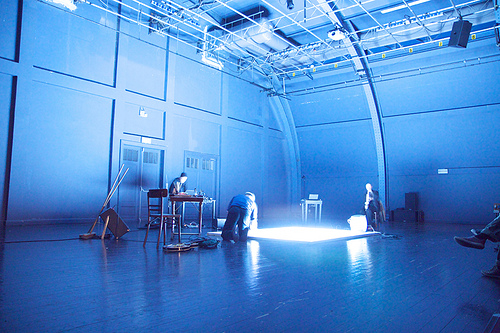
Here’s some video documentation of the events that happened in the context of the Courtisane Festival 2010 (March 17 – 21 2010 – Ghent, BE).

An introduction I wrote for the catalogue:

“What we see is inseparable from how we see”. This is a quote from a recent article by Brad Butler, one of the guests of this edition of the Courtisane festival. For Butler, our dependence on narrative coherence and transparency is not as innocent and neutral as we seem to think. On the contrary, the flood of easily digestible commodities and self-contained narratives that we process on a daily basis – in cinema, on television, in education, in the news – implies nothing more and nothing less than a form of systematic violence, an evolution towards a fully “fictionalised” world.

How can we challenge today those conditions and conventions, so deeply embedded in our social and cultural tissue that we are almost no longer aware of them? Can we, in this strange moment of excess and acceleration, bring ourselves to contemplate what (and thus also how) we see, hear and read? To interrogate? To formulate alternatives? The work of Brad Butler and his partner Karen Mirza is one of the many examples in this year’s festival programme that proves how possible, but also necessary, it is.

Audiovisual essays, radical formal experiments, impulsive “films bruts”, hybrid performances and installations: the search for alternative cinematographic models takes many forms. Courtisane proposes a kaleidoscopic mosaic of styles, media, gestures, languages and emotions; a patchwork of recent and historical works that share an insatiable hunger for adventure; a personal signature; and above all, an implicit – or sometimes outspoken – feeling of resistance.

Other than the yearly selection of recent Belgian and international films and videos, the programme comprises two thematic evenings filled with performances, installations and screenings. Three “Artists in Focus” – David O’Reilly, Morgan Fisher and David Gatten – will present a combination of their own work and their personal sources of inspiration. The central theme of this year’s edition is explored in both the exhibition Digest Sound and the programme Vital Signs, which search for the limits of the creation and communication of meaning. For the little ones, we have prepared a new Baby Matinee. “Avant-garde for kids”: there is no age to learn to see.

(more info on my events page)

Courtisane festival 2010 – Paul Clipson & William Fowler Collins from Courtisane Festival on Vimeo.

Courtisane festival 2010 – Disinformation, The Origin of Painting from Courtisane Festival on Vimeo.

Courtisane festival 2010 – Phantom Limb & Earth’s Hypnagogia from Courtisane Festival on Vimeo.

Courtisane festival 2010 – Karen Mirza, Brad Butler & David Cunningham from Courtisane Festival on Vimeo.

Courtisane festival 2010 – Lis Rhodes, Light Music from Courtisane Festival on Vimeo.

Courtisane festival 2010 – Paul Abbott, Seymour Wright & Ross Lambert from Courtisane Festival on Vimeo.

Courtisane festival 2010, opening Digest Sound – No Fun Acid from Courtisane Festival on Vimeo.

Courtisane festival 2010, opening Digest Sound – Oneohtrix Point Never from Courtisane Festival on Vimeo.

Courtisane festival 2010 – Peter Jacquemyn, Mauro Pawlowski & Eric Thielemans Trio from Courtisane Festival on Vimeo.

More videos can be found on our Vimeo page.
Also check out some great stuff from the 2009 edition.

Courtisane festival 2009 – Guy Sherwin, Paper Landscape from Courtisane Festival on Vimeo.

Courtisane festival 2009 – Luke Fowler & Lee Patterson from Courtisane Festival on Vimeo.

Image on top: Paul Abbott, Seymour Wright & Ross Lambert. More images on Flickr.

Cold Intimacies

eyes-wide-shut.jpg

“The fundamental right has become the right, as Homi Bhabha puts it, to narrate; the right to tell your story; to formulate the specific narrative of your suffering”
— Slavoj Zizek, in converstation with Glyn Daly

While doing some research for the Here We Are Now program, I came across a captivating book by Eva Illouz, entitled Cold intimacies: the making of Emotional Capitalism, which provides some insights into the rise of contemporary tendencies of self exposure and selfploitation (see also previous posts). Illouz’ thesis is that capitalism has fostered an intensely specialized emotional culture. Looking through the prism of emotions, she uncovers that the conventional division between the public (traditionally seen as a-emotional) and the private doesn’t hold up. She describes how throughout the twentieth century a new culture of emotionality has been established, mainly informed by the language of therapy. After WWI, the overall success and institutionalization of psychoanalysis and psychology, and the accompanying narratives of selfhood, led to a pre-occupation with emotional life and the development of a variety of techniques to apprehend and manage these emotions. The therapeutic culture was not only foregrounded in the context of “the family”, but also made its way to the workplace, as the psychological discourse – focusing on personal emotions and motivations – was able to make sense of the large-scale transformations that haunted corporate culture, on the threshold of the so-called post-industrial society. All behavioral theories converged around one leading cultural model: that of “communication” (or rather communicative competence). The concept and practice of communication was presented as both a set of techniques and an ideal definition of self, but it has also increasingly been applied to corporate selfhood. Today, communication is considered as an emotional skill which enables to successfully navigate the contemporary workplace, with its specific hierarchies, tensions and contradictions. “The economic sphere”, Illouz writes, “far from being devoid of emotions, has been on the contrary saturated with affect, a kind of affect committed to and commanded by the imperative of cooperation and a mode of settling conflicts based on ‘recognition’.” Illouz calls this intertwining of economical and emotional spheres ‘emotional capitalism’.

“a culture in which emotional and economic discourses and practices mutually shape each other, thus producing what I view as a broad, sweeping movement in which affect is made an essential aspect of economic behavior and in which emotional life – especially that of middle classes – follows the logic of economic relations and exchange. … Market-based cultural repertoires shape and inform interpersonal and emotional relationships, while interpersonal relationships are at the epicenter of economic relationships. More exactly, market repertoires become intertwined with the language of psychology and, combined together, offer new techniques and meanings to forge new forms of sociability.”

If in corporate culture, psychological discourse made productivity an emotional affair, in the realm of intimacy the therapeutic narrative (highly influenced by liberal feminism) predicated pleasure and sexuality on the implementation of ideas of “emotional health” and “healthy relationships”. However, argues Illouz, the intertwining of therapy and feminism, and the resulting norms of equality and freedom, have also produced a process of rationalization. Emotions and intimate relationships have increasingly become things to be evaluated, measured, quantified and categorized (“emotional intelligence”, for example, is an instrument of classification), which has given rise to an “emotional ontology” – the idea that emotions can be detached from the subject, to be inspected and bargained. As in the corporation, communication – characterized by neutral modes of expression and negotiation – is here the model at once describing and prescribing relations.

“The cultural persuasions of therapy, economic productivity, and feminism intertwined and enmeshed with one another and provided the rationale, the methods, and the moral impetus to extract emotions from the realm of inner life and put them at the center of selfhood and sociability in the form that has become widely pervasive, namely the model of communication… Through the cultural medium of psychology , the private and public spheres have become intertwined with each other, each mirroring the other, absorbing each other’s mode of action and justification, and ensuring that instrumental reason be used in and applied to the realm of emotions, and , conversely, making self-realization and the claim to a full emotional life become the compass of instrumental reason.”

“Recognition” is key here. Illouz argues that the model of communication which has pervaded our emotional lives and social relationships contains and performs the “new demand that one be recognized by others and recognize others.” It’s this narrative of recognition, which combines the aspiration to self-realization with the claim to emotional suffering (We live, in the words of Robert Hughes, in “an increasingly confessional culture, one in which the democracy of pain reigns supreme”. Identity is defined by its psychic lacks and deficiencies, which is incorporated back into the market through injunctions of self-help), that has made emotions into micro public spheres, “domains of action submitted to a public gaze”. This process of publicly exposing the private self finds its most potent expression on the internet, “a technology which presupposes and enacts a public emotional self and in fact even makes the public emotional self precede private interactions and constitute them.” Illouz considers the internet as a supremely psychological technology, in the sense that it presumes a psychological understanding of the self, and encourages a psychological model of sociability. It’s through the permeation of the cultural imaginary of psychology that the practices of self exposure on the Internet have to be understood.

“…the psychological persuasion has made the emotional self into a public text and performance in a variety of social sites such as the family, the corporation, support groups, television talk shows, and the Internet. The transformation of the public sphere into an arena for the exposition of private life, emotions, and intimacies which has characterized it for the last twenty years cannot be understood without acknowledging the role of psychology in converting private experiences into public discussion. The Internet is the latest development in this process, as it presupposes a psychological self which can apprehend itself through texts, classify and quantify itself, and present and perform itself publicly, its problem being precisely how to convert that psychological performance back into a private emotional relationship.”

If in industrial and even advanced capitalism we could easily shift back and forth between the “strategic” and the purely “emotional”, the main cultural problem in contemporary culture, according to Illouz, is that it becomes more and more difficult to shift from the strategic (or the economic) back to the emotional. We are increasingly stuck in a condition of “hyperrationality” which has commodified and rationalized the self. The standardization and scripting of intimacy and the ways we talk about it (using a vocabulary more and more dictated by the market), weakens our capacity for nearness, for passionate and intuitive thinking and, perhaps most of all, for fantasy. True enough: fantasies have never been as abundant and multiple in a culture which incessantly engineers them, yet they may have become entirely self-generated and sterile, as we are drifting afloat in a hyperrational world of endless choice and market logic, dominated by an overwhelming sense of tiredness and cynicism (sure, we are aware of the distance between mask and reality, but nonetheless still insist upon the mask). The deeper we descend into the fantasmatic netherworld, the more fatuous and empty it appears. As Zizek, ruminating on Kubrick’s Eyes Wide Shut, wrote: ”It’s not that fantasy is a potent abyss of seduction that threatens to swallow you but quite the opposite: that fantasy is ultimately sterile”. And still we continue to fantasize about fantasy, only to avoid confronting the inevitable disappointment.

Still taken from Stanley Kubrick’s ‘Eyes Wide Shut’

In Search for Autonomy

ubermorgen2.jpg

“We require just a little order to protect us from chaos. Nothing is more distressing than a thought that escapes itself, than ideas that fly off, that disappear hardly formed, already eroded by forgetfulness or precipitated into others that we no longer master. These are infinite variabilities, the appearing and disappearing of which coincide. They are infinite speeds that blend into the immobility of the colorless and silent nothingness they traverse, without nature or thought.”
– Gilles Deleuze & Félix Guattari, What is Philosophy?

1977. That year the hijacking of Lufthansa Flight 181 by four members of the Popular Front for the Liberation of Palestine, demanding the the release of ten Rote Armee Fraktion prisoners, set in motion a gruesome set of events. Shortly after Operation Feuerzauber put an end to the violent calamity, three RAF members were found dead in Stammheim prison; cause of death unclear. The day after, the lifeless body of Hanns-Martin Schleyer, who had been kidnapped by the RAF five weeks prior to the hijacking, was discovered in the boot of a car. 1977 was also the year Apple introduced the first mass-marketed personal computer and the word ‘telematics’ was brought forward in Alain Minc and Simon Nora’s L’Informatisation de la Société. Around the same time Yuri Andropov, General Secretary of the Communist Party of the Soviet Union, wrote a passionate letter to Brezhnev, arguing that the gap with the US in the domain of informatics was urgently to be bridged, if their socialist state was to survive. 1977 saw the death of Charlie Chaplin, the man who had recounted the dehumanization of the industrialization in a heartbreaking plea for warmth and tenderness, but it also saw the immense success of Saturday Night Fever, in which a new working class seemed perfectly happy to be exploited, in exchange for some jivin ‘n’ shakin. In 1977, Jean-François Lyotard wrote the first draft of La Condition Postmoderne, the Sex Pistols gave voice to the “No Future” generation and approximately eight hundred Japanese youngsters commited suicide. 1977, according to Franco “Bifo” Berardi, was the year the twentieth century came to an end. The year of premonition.

1977 also marks a pivotal moment in Bifo’s own history as radical political thinker and activist, and member of the Italian Autonomia movement. In September of that year, following a powerful wave of social conflicts and uprisings, no less than one hundred thousand people convened in Bologna in search for a new future, only to get carried away in a cycle of despair and violence. This faillure, coinciding with the closing off of infinite horizons of possibility, is still haunting Bifo: for him, the way Utopian rebellion collapsed into desperate dystopia signaled the tragic passing of modernity, as well as the dis-empowerment of democracy, taken over by a series of irreversible automatisms. Now, over thirty years later, it is evident that political participation has become an empty ritual, devoid of the ability to provide true alternatives and true choices. Politics can simply not escape the pervasive system of techno-economic automatisms that capitalism has become since its mutation in semio-capitalism. It seems like there is no desire or vitality left outside the economic enterprise, outside productive labor and business activity. What interests Bifo is the question if and how it is possible to wake up from this bad dream. How to reconstruct autonomy within our current conditions of semio-capitalism, characterized by the fusion of media and capital? Look at the state we’re in: ruthless economic competition and digital intensification of informatic stimuli have induced a state of crisis, not only economic but also psychopathic. We’re experiencing a permanent electrocution that flows in the widespread pathology, manifesting itself in panic and attention disorders. The main source of this collapse, writes Bifo, can be found in the organization of time in the digital sphere, in the relation between what he calls “cyberspace” and “cybertime”. For Bifo this distinction is the key for contemporary arrangements of struggle. Of course, the colonization of time has always been a fundamental objective in the development of capitalism in the modern era, but with the spread of digital technologies, time has become the primary battlefield, as it is the space of the mind, of the soul. Cyberspace indicates the sphere of connection between mind and machine, which is unlimited expandable. Cybertime, on the contrary, is limited: we can increase the time of exposure to information, but experience cannot be intensified beyond certain limits. The problem is that, under the influence of the current attention economy, cyberspace is constantly widening, inducing us to exceed these limits, which leads to an impoverishment of experience and a reduction of the capacity for empathy (see also Nicholas Carr and others). The gap between electronic cyberspace and organic cybertime leads to “a loss of intensity which concerns the aesthetic sphere, that of sensibility, and importantly also the the sphere of ethics. The experience of the other is rendered banal; the other becomes part of an uninterrupted and frenetic stimulus, and loses its singularity and intensity – it loses its beauty.”

The effects of the accelerations and intensifications produced by network technologies are amplified by the precariousness of cognitive labor. In the net economy, capital no longer recruits people, but buys packets of time. Work time is fractalized, reduced to fragments that can be endlessly reassembled and recombined. This systemic depersonalization of the cognitariat, as a virtual unorganizable class of mental labor, has led to a new economic system, centered on what Bill Gates once described as “business at the speeds of thought.” Networked digital labor functions as an artificial nervous system, in which, in the words of Gates, “information is our vital fluid.” As the fragmented mosaic of cognitive labor turns into a fluid process within our networks, capital becomes the semiotic flux that runs through the veins of the global economy. But the progressive incorporation of the digital in the organic nervous system inevitably leads to a breakdown. The intense and prolonged investment of mental energies, and the total dependence of emotion and thought on the flow of information, have created the conditions for a psychic collapse, which is now manifesting itself in the form of economic recession, military aggression and suicidal tendencies. For Bifo all of this is connected to the pathological turn of the pyscho-sphere, which is the most important feature of the current anthropological mutation which encompasses social change, politics and violence. If we want to understand something about what is happening in the society of the new millennium, we need to reflect on the transformations of activity and labor, the subsumption of the time of the mind under the competitive realm of productivity, and most of all, we need to understand this mutation of the cognitive and psycho-social system. “It is within the psychospere that the effects of twenty years of info-invasion, nervous overload, mass psychopharmacology, sedatives, stimulants and euphoric substances, of fractalization of working and existential time, of social insecurity which translates in fear, solitude and terror manifest themselves. Time-based psychobombs are exploding in the interconnected global mind. The effect is unpredictable.”

elephant-van-sant.jpg

Bifo uses Elephant, Gus van Sant’s captivating account of the Columbine tragedy, to illustrate the spreading psychopathology of the first post-alpha(betic) generations, the ones who “have learned more words from a machine than from their mother” (as the anthropologist Rose Golden wrote in 1975). He writes: “it is with glacial tenderness that Van Sant shows us the neurotic mumbling, the anorexic hystericisms and the relational incompetence of the Columbine generation (…) Bodies that have lost contact with their soul and hence no longer know anything about their corporeality”. In Elephant Bifo sees the cognitive mutation that is unfolding in the context of a communicative transformation: the passage from “conjunction” to “connection” as the predominant mode of interaction. While conjunction is a singular process of “becoming other”, connection is a functional and repeatable interaction between discrete, formatted segments. Connection requires that these segments are compatible and interoperable – which is something digital network technologies dwell on, as they expand by reducing more and more elements to format, standard and code. There’s no room for margins of ambiguity or gradations of nuance here. Central to this shift is the insertion of the electronic into the organic, which has provoked a palpable change in the relation between consciousness and sensibility. As the info-sphere is becoming thick and dense, putting our attention constantly under siege, we are less and less able to react consciously to emotional impulses. There’s just not enough time for empathy, time to experience, to caress, to feel the other as a sensorial body. “Affective attention suffers a kind of contraction, and it is forced to find ways of adaptation: the organism adopts tools for simplification, and it tends to smooth out the living psychic response, to repackage affective behaviour in a frozen and fastened framework.” Reducers of complexity such as money, media clichés, stereotypes or interfaces have simplified the relationship with the other, and when the other appears in flesh and blood, we are unable to deal with its presence, because it hurts our (in)sensibility. It is as if we cannot longer understand or convey that which cannot be verbalized, that which cannot be reduced to simple codified signs.

The dominant pathologies of our times cannot be understood from the standpoint of the Freudian paradigm of repression. In Freudianism, at the basis of pathology lies concealment: something is hidden or removed; we are prevented from something. The basis of pathology today however is no longer concealment but hypervision, an excess of visibility, the explosion of the info-sphere and an overload of info-neural stimuli. What plays itself out it is no longer repression, but an eruption of expression: “just do it”. As Anselm Franke pointed out in a recent essay, subjectivity’s dual organizing principle forbidden/allowed has changed into possible/impossible (related to this, the slogan of another sportswear producer – “Impossible is nothing” – can be read as the neoliberal counterpart to disciplinary threats: “make it real” or you will be cast into nothingness). While the Freudian imperative required a renunciation of instincts, the new social imperative thrusts us towards enjoyment and expression. While Freud identified the dominant social psychopathology with neurosis, today, this is psychosis (which reminds me of Ubermorgen’s Psych|OS project, from which the image on top is taken). Leaving the Freudian framework behind, Bifo instead turns to Baudrillard, who foresaw the expressive excess and indeterminacy swamping the infocratic regime of semio-capitalism. “Overproduction is an immanent character of capitalist production, since the production of goods never corresponds to the logic of human beings’ concrete needs, but to the abstract logic of the production of value. In he domain of semio-capitalism the specific overproduction that occurs is a semiotic one: an infinite excess of signs circulating in the infosphere. Individual and collective attention is saturated.“ In the semiotic regime we all seem to exist in a state of schizophrenia: as the world is moving too fast and too many signs are calling for our attention, we try to grasp meaning through a process of “overinclusion” – the main characteristics of schizophrenic interpretation (as described by Gregory Bateson). “The system of collective cognition loses its critical competence; this amounted to the ability to discern truth value in the statements that were submitted in sequences to relatively alert attention. Amidst the proliferation of fast media, interpretation no longer unfolds along sequential lines; instead, it follows associative spirals and a-signifying connections.”

Is there any remedy to the wave of psychopathologies that seems to have submerged our lives, Bifo asks. Is there a way out of this factory of unhappiness? Drawing from Alain Ehrenberg’s La Fatigue d’être Soi (recently translated as The Weariness of the Self), Bifo points to the infernal spiral of depression, reinforced by the dominant neoliberal ideology, sucking all our energies in the trap of self-enterprise, regulating our libindinal investments according to economic rules, capturing our attention in the precariousess of virtual networks. In the neoliberal phase of capitalism, Bifo writes (Taking cue from Roberto Saviano’s terrifying Gomorra), “all rules of coexistence are abolished, the rules of violence imposed. The regulations that set limits to the invasiveness of the principles of competition are removed, hard-and-fast automatisms are introduced in material relations between people”. But at the same time, there is truth in depression. We shouldn’t consider depression as a mere pathology, but as a form of knowledge. Inspired by the work of Deleuze and Guattari, Bifo argues that the challenge when dealing with a depression is not to bring one back to normality or to reintegrate behavior in the standards of normal social language, but “to change the focus of his/her depressive attention, to re-focalize, to deterritorialize the mind and the expressive flow. Depression is based on the hardening of one’s existential refrain, on its obsessive repetition (…) Overcoming depression implies some simple steps: the deterritorialization of the obsessive refrain, the re-focalization and change of the landscape of desire, but also the creation of a new constellation of shared beliefs, the common perception of a new psychological environment and the constuction of a new model of relationship.” The only way to overcome our depression, according to Bifo, is to apply Deleuze and Guattari’s schizoanalytic model as political therapy, to give the possibility of seeing other landscapes, to change focus, to slow down, to open new paths of imagination. “In the days to come, politics and therapy will be one and the same. Our task will be the creation of social zones of resistance, zones of therapeutic contagion. Capitalism will not disappear from the global landscape, but it will lose its pervasive role in our semiotization, it will become one of possible forms of social organization.“

The missed opportunity of 1977 clearly still lingers in Bifo’s mind. The memory of that year has not been erased, because it’s inconceivable to cancel hope for a life autonomous from competition, possession and accumulation, a life in which we can anew share a sense, a view, a rhythm, a common refrain (or ritournelle, in Guattari’s words). That’s why 1977 will always be around the corner: it’s the coming revolution. Any day now. Any day.

“I don’t believe that the world can be governed by reason. The utopia of Enlightenment has failed. But I think that the dissemination of self-organised knowledge can create a social framework containing infinite autonomous and self-reliant worlds. The process of creating the network is so complex that it cannot be governed by human reason. The global mind is too complex to be known and mastered by subsegmented localized minds. We cannot know, we cannot control, we cannot govern the entire force of the global mind. But we can master the singular process of producing a singular world of sociality. This is autonomy today”.

The Soul at Work: From Alienation to Autonomy (Semiotext(e) / Foreign Agents, 2009)
Precarious Rhapsody. Semio-capitalism and the Pathologies of the Post-Alpha Generation (Autonomedia, 2009)

Whatever, Life

paik_fingerprints.jpg

“WhateverLife.com is simply put as an ‘inside joke’. It then developed into something else- as ‘For whatever life you lead’- meaning there would be information and fun things for anyone and everyone! (Which is why I’m always expanding in content…er, as much as I can!) [[[Or, for the long story…a night at Bre’s back in 2004 (playing Mario Party 2 or 3…)- we both lost to computer characters (I think DK was on EASY)- So I throw the controller down and walk off. On my way, I say ‘Whatever, Life’- as sarcastically as possible. Then I started thinking about how neat of a website name it would be. Here it is. 🙂 ♥ ]]]”
— Ashley Qualls, founder of Whateverlife.com, a hugely succesful MySpace layouts website.

The quote above was taken from ‘Blog Theory: Feedback and Capture in the Circuits of Drive’, the new book by Jodi Dean, arguably one of the most striking voices working today at the crossroads between contemporary radical political thinking and new media technologies. In a breathlessly compelling fashion she expands her earlier explorations of what she calls “communicate capitalism”, a notion indicating the role of networked communication technologies in the advancing convergence of democracy and capitalism. By focussing on blogging and related practices of online disclosure, discussion and surveillance, she tries to access and unravel the current conjuncture of media, subjectivity and politics. The anecdote of whateverlife.com is used to illustrate what she considers as one of the key features of communicative capitalism: the emergence of so-called “whatever beings”. The term, introduced by Giorgio Agamben and further developed by Dominic Pettman in his fascinating book ‘Love and Other Technologies: Retrofitting Eros for the Information Age’, points at contemporary modes of belonging unbound by inscriptions of disciplinary identity. In Agamben’s words: “a being whose community is mediated not by any condition of belonging (being red, being Italian, being Communist) …but by belonging itself”. What matters is belonging, not that to which one belongs. Pending in limbo. At the same time, blogs and other personalized “participatory” media say: whatever happens to me matters – if only just for a second. Mattering matters, but only in and of itself. Convenience surpasses commitment – just leave your mark. This is what the popular blank word “whatever” (not coincidentally also the English title of one of Michel Houellebecq’s books) suggests: communication without communicability. In the networks of communicative capitalism, everything can be said, but all that is said merely serves as a contribution to its infinite flows of information and entertainment. What or who is irrelevant, as long as something is said (which is precisely what Pentagon’s “Message force multipliers” rely on). The only thing relevant is circulation itself.

“What could motivate whatever beings? What might move them? As Agamben conceives them, they seek nothing, they lack nothing. They co-belong without struggle or antagonism. It would seem, then, that they are not political beings at all; their being is a-political, beyond politics. They neither attack nor resist; they are neither inside nor outside. Perhaps it makes better sense to think of the politics of whatever beings in terms of their setting. They are moved and propelled; they circuit through contemporary networks”.

Caught in a Trap

The contemporary setting of electronically mediated subjectivity is one of infinite doubt and ultimate reflexivization. Our networks are reflexive, because we create, feed and sustain them. “We are producing the environment we inhabit, the connections that configure us. We provide the feedback that amplifies or ignores. We are configuring the world we inhabit, yet there are ever less what we desire but haven’t reached and ever more what we cannot escape yet still enjoy.“ Networked, participatory media let us stage and perform our own entrapment. Dean links this compulsive complicity to the psychoanalytic concept of “drive”, drawing heavily on the work of Lacan and Žižek. The latter writes, “drive is something in which the subject is caught, a kind of acephalous force which persists in its repetitive movement”. Drive circulates endlessly, round and round, producing satisfaction in the repetitive process of not reaching it. We enjoy our faillure, even if we think we don’t. What we enjoy is the circulation of affect that presents itself as communication – which is exactly what accrues from reflexive communication, from communication for its own sake. As the system draws us in, we become captured in our endless circulation, lost in our repetitive loop. Click. Click. Post. Post. Tweet. Tweet. Drive takes its force and pulsion from loss, the loss of “symbolic efficiency” (aka the collapse of the big Other), the term that Žižek (inspired by Lévi-Strauss) uses to designate the fundamental uncertainty accompanying the impossibility of anchoring and pinning down meaning. “We cannot know certainly; we cannot know adequately. But we can mobilize this loss, googling, checking Wikipedia, mistrusting it immediately, losing track of what we doing, going somewhere else. We are captured because we enjoy”. Now that the gaps of signification and desire are increasingly being filled in and closed off, we find ourselves complying with suffocating injunctions to enjoy, express, be real. And as we try to make sense of it all, go out looking for ourselves, in the brittle hope to pull together our fragmented identity and dispersed consciousness, we only get stuck in the holes around which we circulate. Drawn to these uncertainties, we inscribe ourselves in the images we see, the stories and theories we read. Dean relates this condition to the idea of the gaze – the gaze, however, not as the big Other of the “ego ideal” (the point from which one sees one’s actions as making sense) but precisely as the object of the drive. In this reading, the gaze refers to the subject’s entrapment in the field of the visible: “I see only from one point, but in my existence I am looked at from all sides” (Lacan). What one sees is always incomplete, in need of replenishment. We are aware that all of our actions and disclosures are being watched, followed, remembered – in ways that often exceed our ability to manage or control – but that’s precisely what moves us to keep on posting, confessing and expressing. At the same time the notion of the gaze also reminds us that “what one looks at is what cannot be seen”. In communicative capitalism, the gaze to which we make ourselves visible is a point hidden in an opaque and heterogeneous network (what Lacan calls “objet petit a”), rendering ourselves vulnerable to various forms of exploitation. This gaze refers “not to a specific person whom one imagines being seen by but rather to a more unsettling feeling of an excess disturbing one’s seeing, both in terms of what one sees and in one’s being seen… Lacking answers, ever more uncertain, we become mesmerized by our own looking, entranced by the reversal of looking for an object to looking at ourselves as objects, to becoming objects ourselves”.

“Because one is never sure how one is seen, one is never certain of one’s place in the symbolic order. How, exactly, are we being looked at? One never really knows who one is—despite all the cameras, files, media, and databases. Who one is in the sociosymbolic order is uncertain—and ever changing. The order is never fixed; it is in constant flux. The term for this flux and uncertainty is the decline in symbolic efficiency.”

Driven in circles

Social networks actually provide an effective response to the decline of symbolic efficiency. “Anxious before the gaze, before the disturbing inquiries and intrusions of unknow others, unsure about what to expect, about whether one is succeeding or failing, whether others are friends or foes, we build more reliable, apparently intimate networks”. And so we, the users, the whatever beings, are sucked deeper and deeper into the circuits of drive. Without stable points of symbolic identification, we incessantly oscillate between the imaginary and the Real, “crafting our ever-adaptable, morphing, identities even as they remain threatened and vulnerable to the success, presence, and enjoyment of others. Communicative capitalism commands us to enjoy, at the same time that it reminds us that we aren’t enjoying enough, as much, or as good as others are.” We move from one imaginary identity to another, never sure of how we appear because we don’t really know before whom we appear. Rather than following norms, we cycle through trends. Caught in the reflexive network, we lose the capacity for reflection – our networks are reflexive so that we don’t have to be. “The movement from link to link, the forwarding and storing and commenting, the contributing without expectation of response but still hoping of further movement (why else count page views?) comes down to nothing but circulation for its own sake.” The more we contribute, the more we surrender. As we share our thoughts and upload our videos, there are more opinions to read and images to watch, more responses to write and elements to mix ’n’ blend. So we get lost in our own exuberance: the continuous search for the information we need renders it perpetually out of reach. At the same time the reflexivity of complex networks leads to power law distributions and installs previously unseen dimensions of inequality. But still we believe that our actions can make a difference, infused by fantasies of abundance, inclusion, discussion, and participation (Žižek describes this kind of false activity with the term “interpassivity”). According to Dean, then, this circulation of infostreams is in essence depoliticizing, not because people don’t care or don’t want to be involved, but because we do. The possibilities of access, distribution, sharing and participation that networked communications imply, far from enhancing democratic governance or resistance, result in precisely the opposite: the post-political formation of communicative capitalism. Here Dean’s account differs from the one offered by the likes of Michael Hardt and Antonio Negri, who also consider communication as capitalist production, but do see potential for political change. With Agamben she argues that communication has “detached itself from political ideals of belonging and connection to function today as a primarily economic form. Differently put, communicative exchanges, rather than fundamental to democratic politics, are the basic elements of capitalist production”.

“As multiple-recombinant ideas and images circulate, stimulate, they distract us from the antagonisms constitutive of contemporary society, inviting us to think that each opinion is equally valid, each option is equally liked, and each click is a significant political intervention. The deluge of images and announcements, enjoining us to react, to feel, to forward them to our friends, erodes critical-theoretical capacities – aren’t they really just opinions anyways, Feelings dressed up in jargon? Drowning in plurality, we lose the capacity to grasp anything like a system. React and forward, but don’t by any means think”.

Running on Empty

The loops and repetitions of the circuit of drive characterize the dynamics of the networks of communicative capitalism, the ways its flows capture subjects, energies and aspirations. Accompanying each repetition, each loop or reversal, is a little nugget of enjoyment, a smidgen of attention that attaches to it, making it stand-out from the larger flow before it blends back in. Enjoyment (or jouissance in Lacanian terms) is key here. We keep on contributing to the networks because we enjoy it (in fact, the open architecture of the internet enables and requires the capture of enjoyment insofar as it is premised on users’ contributions). Not that we like to admit to it: at the same time as we’re posting, browsing, skimming, we’re always imagining that we surely have something better to do: read a good book, clean the house, participate in a political rally. While fantasizing out loud, the necessary confrontation with drive is constantly suspended. “Confident in what we would prefer to do, if only we could, we overlook what we are actually doing. The fantasy of enjoyment covers over the fact that we are already enjoying, that we get off, just a little bit, in and through our multiple, repetitive, mediated interactions”. Moreover, the overall multiplicity of these interactions obscures their embeddedness in the communicative capitalism that makes them possible in the first place. That’s how blogs and social network platforms, situated in a logic of drive, function as “displaced mediators”, accessing and amplyfying the key features of communicative capitalism: the intensification of mediality in reflexive networks (communicating about communicating), the emergence and failed subjectivation of whatever beings (beings who belong but not to anything in particular), the circulation of affect (as networks generate and amplify spectacular effects). The very media practices we enjoy, that connect us to others appropriate and reassemble our longings (not for something we want but rather lack) into new forms of exploitation and control. What is too often idealized as the very form of freedom – reflexivity – is unveiled as a mechanism for the generation of inequality and capture, smoothing the paths of neoliberal capitalism. Even as globally networked communications provide tools and terrains of struggle, they make political change more difficult—and at the same time more necessary—than ever before. According to Dean, the blind faith in the transformative power of our networks, the believe that they are capable of changing politics just as they changed our economics, can only be explained if one thinks there is no politics other than the market. “This Lack or absence of the political is the hole around which networked communications circulate. Or, more precisely, this loss of a capacity to think the political circulates as drive.“ The open question Dean leaves us with is if we can develop media politics beyond communicative capitalism. How to break with and through the fantasies attaching us to communicative capitalism? Where to look for strategies that redirect and disrupt the loop of drive?

“Communicative capitalism is a formation that relies on imbalance, on the repeated suspension of narratives, patterns, identities, norms, etc. Under conditions of the decline of symbolic efficiency, drive is not an act; it does not break out of a set of given expectations because such sets no longer persist as coherent enchainments of meaning. On the contrary, the circulation of drive is functional for the prevention of such enchainments, enchainments that might well enable radical political opposition. The contemporary challenge, then, is producing the conditions of possibility for breaking out of or redirecting the loop of drive”.

Image: still taken from ‘Nam June Paik’s Fingerprints’ (Taly & Russ Johnson, 2006)