Figures of Dissent: Glauber Rocha

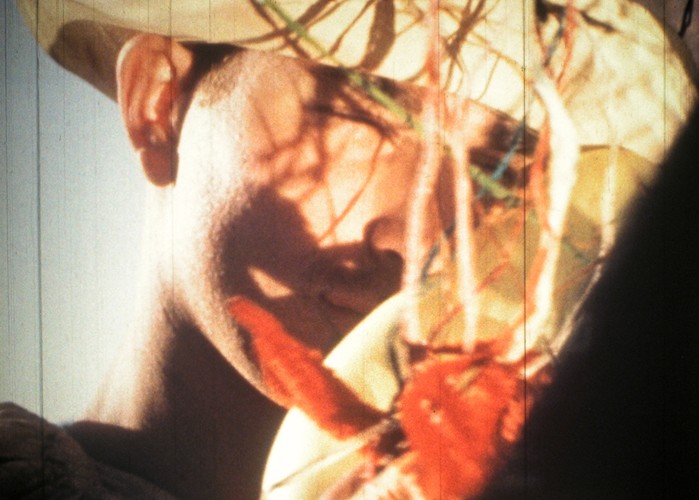
a-idade-da-terra-4.jpg

25 October 2012 20:30, KASKcinema, Gent. A Courtisane event.
introduced by Stoffel Debuysere

“Revolution is magic because it is the unforeseeable within dominating reason. It must be dominating reason’s impossibility to comprehend such that that same dominating reason denies itself and devours itself in the face of its impossibility to comprehend. (…) Revolutionary art must be magic capable of bewitching man to such a degree that he can no longer stand to live in this absurd reality. Overcoming this reality, Borges wrote the most liberating irrealities of our times. His aesthetic is a dream’s.”
“Political cinema means nothing if it’s the product of moralism, anarchy, opportunism. Only a wretched like me could say that art has meaning for the wretched, and that’s why I’m not ashamed to say that my films are the product of grief, of hate, of a frustrated impossible love, of the incoherence of underdevelopment.”

– Glauber Rocha

A Idade da Terra
1980, 35mm, color, sound, Portugese spoken, English subtitled, 140′

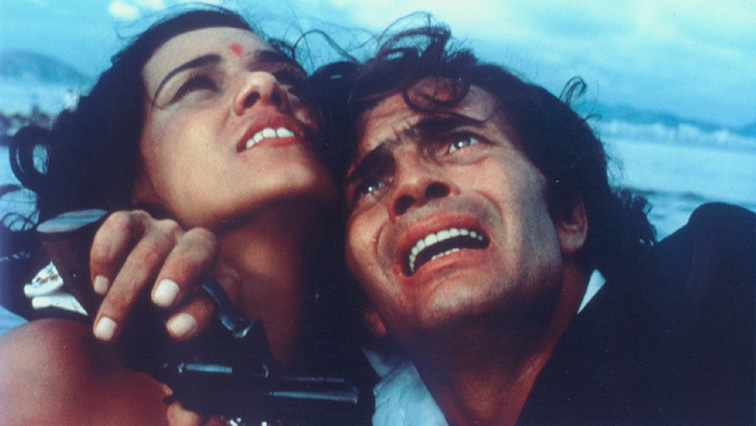
“Like nothing known to man. A torrential, hallucinatory film. A filmic UFO, no more, no less…” Serge Daney’s description of Glauber Rocha’s very last film is right on the nose: A Idada Da Terra is, just as the whole of Rocha’s oeuvre, made in the image of his much loved Brazil, that extravagant nation with its “verbose, loquacious, energetic, sterile and hysterical people”. The result is a boundless cinema-opera as radical alternative to the domineering American operetta, a dissonant anti-symphony as final convulsion of the tricontinental dream. At the same time the film can be considered as Rocha’s response to the Mexican adventures of Eisenstein, his shining example, whose well-intended attempts to translate the “Third World” in esthetic terms was for him essentially the same “as taking the word of God (and the interests of the conquistadors) to the Indians”. Or still: as a rectification of the evangelic interpretations of Pasolini, his discordant brother in arms, whose Oedipal Christ is here displaced with a more militant one, “a new, primitive phenomenum, in a very new civilization”. Catholic rituals and Afro-Indian gods, rural mysticism and revolutionary politics, Brahms and Villa-Lobos: the work of Glauber Rocha, angel-demon of the Brazilian “Cinema Novo”, defies every attempt at unequivocal classification or definition. In the light of overbearing repression, hypocrisy and consensus there is no place for evasive proposals: “the worst enemy of revolutionary art is its mediocrity”.

In the context of the research project “Figures of Dissent (Cinema of Politics, Politics of Cinema)”
KASK / School of Arts

See also “The death of Glauber Rocha” by Serge Daney.

Glorious Catastrophes

littlestabsathappiness-ken_jacobs_1.jpg

31 October 2012, Beursschouwburg, Brussels., in the context of the ‘I Fail Good’ project. In collaboration with Courtisane.

“A seriousness that fails”: this is how Susan Sontag described the essence of “camp”, this transient mixture of excess, fantasy, passion and naivety that has taken up a distinctive place in the cultural firmament since the 1960’s. Andy Warhol, who emphatically responded to this trend with his film Camp (1965), saw it differently: he was rather interested in the idea of failure itself, a failure that has to be taken seriously. After all the majority of Warhol’s films consists of observations of people in and as image, who in all their fallibility reveal a genuine authenticity and startling vulnerability. Two characters who play lead roles in Camp also take up a central place in this film programme: Paul Swan and Jack Smith. Warhol’s self-titled portrait of Swan, a dancer and actor who was once lauded as the “most beautiful man in the world” is an as ruthless as affectionate observation of a man who alternately falls in and out of the role of his lifetime. The area of tension between playing and being, playful fantasy and harsh reality, is also the arena of Jack Smith, the “enfant terrible” of the post war American underground scene. The early films Smith made in collaboration with his then confidant Ken Jacobs manifest a brutal beauty and audacious hedonism, unleashing a bewildering vitality not despite but because of their deliberate “trash” esthetics. Between innocence and nonsense, order and disorder, catastrophe and utopia: what the films in this programme have in common, are forms of expression that thrive in relation to their own failing.

With film works by Andy Warhol, Ken Jacobs, Jack Smith
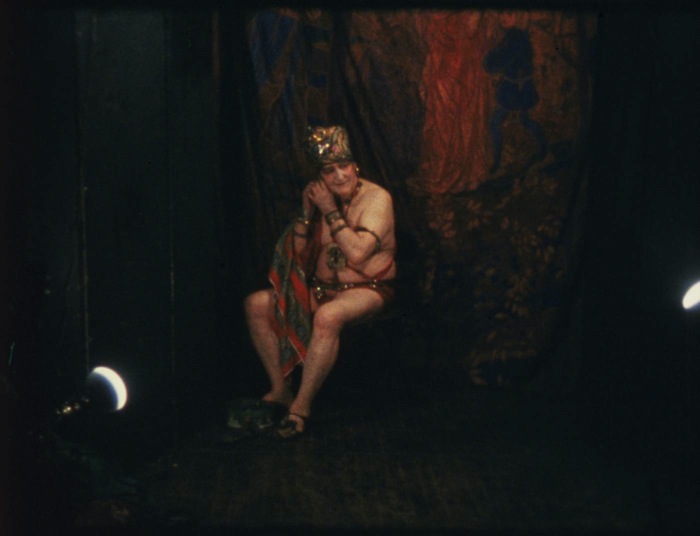
paulswan.jpg

Andy Warhol
Paul Swan

1965, 16mm, color, sound, 66’

“Paul Swan is Andy Warhol’s two-reel portrait of the dancer once billed as “the most beautiful man in the world.” In 1965, when Warhol filmed him, Swan was eighty-two years old and still performing his aesthetic dance routines in weekly salons attended by the likes of Marcel Duchamp and Alexander Calder. In Warhol’s film, Swan dances such numbers as “Two Hero’s Slain,” his elegy for World War I soldiers, “The Elements: Earth, Water, Fire, and Air—the Movements Seen and Unseen in Nature,” and “Three Oriental Numbers” in skimpy costumes that he spends a great deal of the time getting into and out of. Paul Swan is one of the few films Warhol shot it color in 1965, and though the camera is stationary in the first reel, trained throughout on the tapestry backdrop Swan uses for a set, in the second reel Warhol zooms right in on Swan’s aging flesh and shoe-polish eye make-up. For much of that reel, though, Swan remains off-stage (and off-screen) looking for a particular pair of black slippers that he insists must be worn with his French peasant costume. Swan’s pianist helps him look for the slippers while the crew behind the camera becomes increasingly impatient to get Swan back in front of the camera. Not surprisingly, Warhol is content to let the action take its own course. Callie Angell wrote that “Warhol’s interest in Paul Swan seems to have been based on the observation that, in his unswerving dedication to his increasingly anachronistic art form, Swan had become the living embodiment of camp.” And in fact Swan had appeared in Warhol’s film of that title around the same time that Paul Swan was made. Angell also noted that Swan’s performance in Warhol’s film recalls “the equally disorganized, equally uncompromising performances of Jack Smith,” with whom he appears in Camp.” (Douglas Crimp)
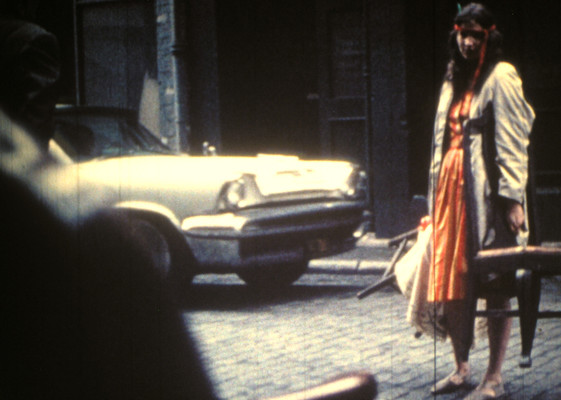
stabs.jpg

Ken Jacobs (featuring Jack Smith)
Little Stabs At Happiness

1958-1963, 16 mm, color, sound, 15’

“’Down’ and person to person, cinema officially gets grabbed back from the professionals here. Material was cut in as it came out of the camera, embarrassing moments intact. 100′ rolls were used, the timings fitted well with music on old 78’s. I was interested in immediacy, a sense of ease, and an art where suffering was acknowledged but not trivialised with dramatics. Whimsy was our achievement. And breaking out of step.” (KJ)

“Nasty overstuffed clogged and airless American fifties. The few good Hollywood films after the Left-dumping, ‘The 5.000 Fingers of Dr. T.’, ‘The Sweet Smell of Success’, etc., are skyscrapers on the Mojave. Overwhelmed, hopeless, it was a good time for irreverence. In particular, for art film in the vernacular, like an amusing letter, me to you. Sketchy, airy, anti-precious, without a lot of geniusing at the audience. Slices of imaginative life, not choosing to hide a N.Y. specific economic reality but I can dream, can’t I? Not anti-art, which my superiors, the critics of the period, assumed. To my bafflement. I had decided, with the examples of jazz improvisation and of action painting which would buil don one impulsive stroke, and let things hang out – indications of wrong turns towards the emerging clarity, not to edit and doll up the 100-foot camera rolls. Bot to let the film materials show, the Kodak perforations and start and end roll light flares; to feature the clicks and scratchings of the 78 r.p.m. records I pirated for accompaniment (“The Happy Bird” and south-of-the-border barnyard music I’d become attached to in Alaska in the Coast guard). Camera sequence as determined impulse opon impulse by the cinematographer seemed sensible to me, and to be respected. The off-moments, vagaries, ‘tis-human-to-errs, such beatings about the bush also delineated the bush; there was the example of Cezanne’s outlines, groping for the contour. Follow the impulses, I thought, and let appearances fall as they may. That’d be perfect enough.” (KJ)
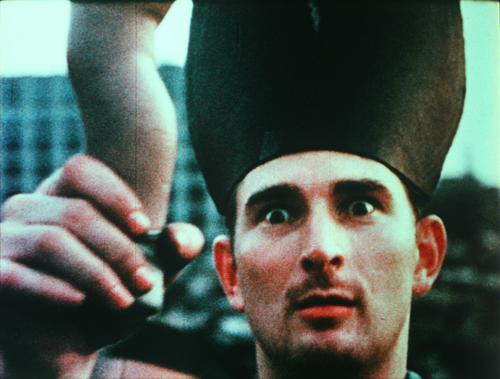
cobra3.png

Ken Jacobs (Camera: Bob Fleischner, featuring Jack Smith)
Blonde Cobra

1963, 16mm, color and b&w, sound, 33’

“BLONDE COBRA is an erratic narrative -no, not really a narrative, it’s only stretched out in time for convenience of delivery. It’s a look in on an exploding life, on a man of imagination suffering pre-fashionable Lower East Side deprivation and consumed with American 1950′s, 40′s, 30′s disgust. Silly, self-pitying, guilt-strictured and yet triumphing -on one level- over the situation with style, because he’s unapologetically gifted, has a genius for courage, knows that a state of indignity can serve to show his character in sharpest relief. He carries on, states his presence for what it is. Does all he can to draw out our condemnation, testing our love for limits, enticing us into an absurd moral posture the better to dismiss us with a regal “screw-off”.” (KJ)

“Jack says I made the film too heavy. It was his and Bob’s intention to create light monster-movie comedy. Two comedies, actually, two separate stories that were being shot simultaneously until they had a falling-out over who should pay for the raw stock destroyed in a fire started when Jack’s cat knocked over a candle (Jack was behind in his electricity bill). Jack claimed it was an act of God and wouldn’t (couldn’t) pay for the burnt film. In the winter of `59, Bob showed me the footage. Having no idea of the original story plans I was able to view the material not as the fragments of a failure, of two failures, but as the makings of a new entity. Bob gave over the footage to me with the freedom to develop it as I saw fit. I think it was in late 1960 that Jack and I ignored our personal animosities long enough to record his words and songs for the sound track. The phrases he repeated for me into the tape recorder were mostly ones I’d at some time heard him say; most were pet phrases he loved to recite, over and over, his lessons, and a very few I made up in his style. This was the procedure for recording his monologues and songs: I played him selections from my 78 collection, music from the `20′s and `30′s, often only the beginning of a record and if he liked it we would restart the record and immediately record. I don’t think there was a second take of anything, the Cult Of Spontaneity was in the air. Any lack of clarity is due to the very second-rate equipment, third-rate, fourth-rate, we were using. I play a piano harp for the Madame Nescience monologue, Jack supplied the Arabic music from his small but choice collection. There’s also some SAFARI IN HIFI; a Villa-Lobos string quartet speeded up; a haunting section of a children’s 45… Baby Wants To Sleep. A small amount of my own previous shooting was cut into the film, the “drowning in nescience” color sequence near the beginning.” (KJ)
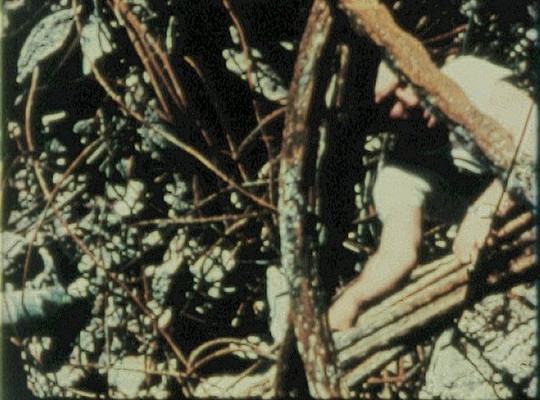
scotch.jpg

Jack Smith (featuring Ken Jacobs)
Scotch Tape

1959-1962, 16 mm, b/w & colour, sound, 3’

“A Master sense of spiritual nothingness…the most recent explosion of a major creative force in cinema has in this film filled a New Jersey junkyard with life and movement and spiritual
weightlessness.” (Jonas Mekas)

“Jack Smith’s first released movie is an apparently edited-in-camera 100-foot roll of Kodachrome II shot in 1959, using Ken Jacob’s 16mm Bell & Howell at one of Jacob’s Star Spangled to Death locations – the rubble-strewn site of the future Lincoln Center on Manhattan’s west side. Despite its brevity, Scotch Tape anticipates the epic quality of Smith’s subsequent films and theater pieces. The alternation of long shots and close-ups suggests considerable elapsed time between each set-up. Jacobs, who appears in the film, frantically dancing and mugging along with another Star Spangled to Death performer Jerry Sims, proposed that Smith call his film “Reveling in the Dumps” and even drew titles. Instead, Smith chose to name his movie after the dirty piece of stickum that had wedged out in the upper right corner of the frame. For a three-minute film, Scotch Tape carries considerable conceptual weight. The title anticipates Andy Warhol’s go-with-the-flow acceptance of cinematic “mistakes”, even as it draws the viewer’s attention to the perceptual tension between the film’s actual surface and its represented depth. Scotch Tape’s audio accompaniment was created, some three years rhumba, “Carinhoso,” to match the footage. The resultant sync event, Conrad recalled, had a decisive effect on his own life, inspiring him to become a filmmaker. Flaming Creatures aside, Scotch Tape would be Smith’s only completed film.” (J. Hoberman)
Occupation: Handsworth Songs

handsworth2.jpg

11 May 2012, Khiasma, Paris.
In the context of ‘Occupation. Festival of Living Literatures and Words’ and the exhibition ‘Les Nouveaux Mondes et les Anciens: Un envoutement de l’histoire’.

Black Audio Film Collective / John Akomfrah
Handsworth Songs


GB, 1986, 16mm, color & b/w, English spoken, French subtitles, 60′

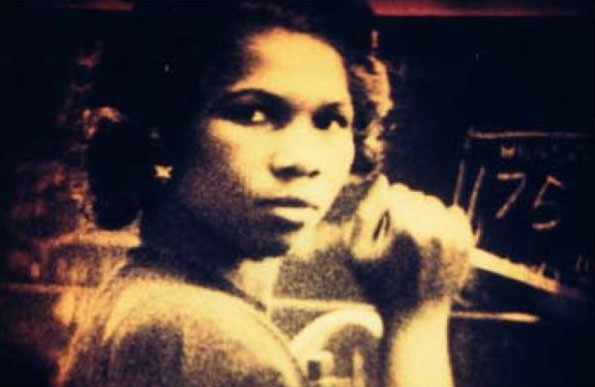
BAFC was a British collective of filmmakers active in the 1980’s and 1990’s who expressed their radical views on the post-colonial decline of the imperialistic world order, the disastrous socio-economic effects of Thatcher’s doctrine and the meaning of the diasporic condition in an evenly radical way. Handsworth Songs explores the origins of the riots in the Birmingham district of Handsworth, where the local black community rose against a political policy that they considered as a return to colonialism. In contrast with the didactic panoptic impulse of the documentary film tradition, filmmaker John Akomfrah chose an open, polytonic structure where eye-witness accounts, mediated voice-overs and a mosaic of sound, intersperse with a poetic montage of archive footage. The inherent historical discourses are dismantled, and in result the impressions of the past gain a new place in the constellation of the present, as a promise to the future. “There are no stories in the riots, only the ghosts of other stories”.

“The collective’s key work, Handsworth Songs (1986), is a succinct articulation of the dialectic of crisis and difference, and a critical primer – in artistic terms – of transnational post-colonialism. Though Handsworth Songs is an analytical essay on the cultural conditions under which young black men and women in Britain lived, and the racist policing tactics directed against them, the film, produced for Channel Four, did not merely reflect upon the structural violence of Thatcherism. In the aftermath of the protests in Handsworth, the film inhabits a different order of things: it is as much about elsewhere as about Britain. That elsewhere is the broader post-colonial world. This feeling of disjuncture is reflected not only in the jump cuts of the film’s narrative discontinuity – moving between archival photographs, newsreel fragments, media reportage, and on-site interviews – it is also deeply anchored by the sombre aural pulse, the disjunctive syncopation of the snare drum beat, the mournful reverb of the dub score that sustains a quiet rage. Though ostensibly addressing the issues of policing, Handsworth Songs reflects more profoundly the agency of the oppressed; it narrates their stories, not purely from the point of view of the event from which it derives its name, but equally through an archaeology of the visual archive of minoritarian dwelling in Britain. As is often the case in BAFC’s work, the ghosts of those stories inform the notion of a historically inflected dub cinema whose spatial, temporal and psychic dynamics relays the scattered trajectories of immigrant communities…” (Okwui Enwezor)

In the context of the research project “Figures of Dissent (Cinema of Politics, Politics of Cinema)”
KASK / School of Arts

Texts about Handsworth Songs by Salman Rushdie, Stuart Hall, Darcus Howe, Isaac Julien & Kobena Mercer can be found here.

Stardust and Shadows

wednesday-morning-two-am-copy1-462x299.jpg

Stardust and Shadows
Recent Re-animations by Janie Geiser and Lewis Klahr

21 May 2012, Vecteur Charlerloi. A Courtisane programme.

“I’m not so interested in being completely autobiographical and confessional because I don’t think my story is that important. I’m more interested in using things that are motivating to me and looking at them in a bigger picture way, but through a very small world.”
— Janie Geiser

“My films engage in a kind of archaeological detection that requires empathetic projection into other eras to explore the pastness of the present.”
— Lewis Klahr

Memory is always a work of fiction, a construction of a relationship between different spaces and times, between seeing and meaning, perception and recollection. What better way to explore and mime the processes of memory than re-animating the discards of contemporary life – images, illustrations, objects, words and sounds – into narratives that feel like vivid dreams of forgotten realms, reflecting pools of evaporating time? Janie Geiser and Lewis Klahr are, each in their own way, masters in assembling collages of forsaken remnants of the past, weaving together enigmatic constellations of modern hieroglyphics that require to be deciphered with a mode of seeing that relies on touch and feel, rather than a purely optical reading. Their films can be considered as what Tom Gunning once called “submerged narratives”, in which “plots stir just beneath the threshold of perceptibility.” Hovering between dream vision and memory feedback, past and present, these subliminal stories shape experiences that are both deeply personal and broadly collective, all of our desires, obsessions, aspirations and failures inextricably tied to the images and objects drifting in the wastelands of our consumer culture. This program offers several recent works from Lewis Klahr’s series of “Couplets”, organized “around the pairing of various pop songs and the theme of romantic love”, as well as Janie Geiser’s series of “Nervous” films, as allusive as elusive explorations of “the nervous energy and the world we live in now”.

wed500.jpg
Lewis Klahr, Wednesday Morning Two A.M., 2009, 10′
“This is the first completed paula creamer pokies film of a new series entitled “Couplets”. These will generally, but not exclusively, organize themselves around the pairing of various pop songs and just as in these songs lyrics, the theme of love”. (LK)

sugar500.jpg
Lewis Klahr, Sugar Slim Says, 2010, 7′
“Same address, different buildings. “Put the rope in the can.” Mark Anthony Thompson (aka Chocolate Genius) and I became friends because our sons were classmates. He played me his new album and I showed him some of my recent films and we got excited about collaborating. This is the result.” (LK)

april500.jpg
Lewis Klahr, April Snow, 2010, 10′
“Another ‘couplet’ from my ongoing Prolix Satori series. I thought up the juxtapostion of these two pop songs while creating a mix-tape back in 1988 but never thought I’d work with them as a film soundtrack. Back then the taboo in experimental film circles about using music was so strong it seemed permanent.” (LK)

ghost500.jpg
Janie Geiser, Ghost Algebra, 2009, 7’30”
“Under erratic skies, a solitary figure navigates a landscape of constructed nature and broken bones.  She peers through a decaying aperture, waiting and watching: the fragility of the body is exposed for what it is: ephemeral, liquid, a battlefield of nervous dreams. Using found and natural objects, rephotographed video, medical illustrations, and other collage elements, Ghost Algebra suggests one of the original meanings of the word “algebra”: the science of restoring what is missing, the reunion of broken parts.” (JG)

floor500.jpg
Janie Geiser, The floor of the World, 2010, 9′
“In a shifting landscape of dirt and sky, excavation and construction merge. Figures move back and forth between life and death, and possibly somewhere else. The ephemerality of existence is a mundane question in this world, where numbers mark the way. The floor of the world turns out to be easily pierced, liquid, permeable.” (JG)

ricky500.jpg
Janie Geiser, Ricky, 2011, 11′
“The realms of childhood, war, and loss echo through Ricky. A found sound recording forms the spine of the film…a scratched audio letter from father to son.” (JG)

Figures of Dissent: Johan Van der Keuken

waysouth.png

3 May 2012 20:30, KASKcinema, Gent. A Courtisane event.
introduced by Stoffel Debuysere

“There is a debate on the relevance of the use of cinematic writing methods in the service of political ends. Some filmmakers working in the heat of a struggle claim they have no interest in developing language forms. I rather think you have to attack language itself in order to cancel out the predetermined language.“
– Johan Van der Keuken

De Weg Naar Het Zuiden (The Way South)
NL, 1981, 16mm, color, various languages, English subtitles, 145’

According to the late Serge Daney the idea of “Unequal exhange” is what defines the work of Johan Van der Keuken (1938-2001), form as well as content: the ever unequal exhange between filming and being filmed, between one image and another, but also between here and there, between those who belong and those who are left out. The “gliding Dutchman”, as Daney used to call Van der Keuken, always had an eye for the economical and ecological aberrations of the capitalist world order, not in the least regarding the relation between “North” and “South”. In the so-called North-South triptych (Diary, The White Castle and The New Ice-age, 1973-1974) he showed how the current global system of inequality and exploitation holds different worlds, which are still inseparably linked. This idea is also central to The Way South, which is in more than one way his most direct film. It is the account of a journey from North to South, from Amsterdam, his hometown, to Caïro, where he literally and figuratively looses the North; but is also a chronicle of migration, of people who see their own lives reflected in that of others, always elsewhere. Van der Keuken records his impressions and encounters with an eye as a scalpel: sharp and precise, but also fragile and pure, always conscious of the tension between a look and the world, between those filming and those being filmed. It is this consciousness, and rendering it visible, that forms the true political stake of Van der Keuken’s work: every exchange is unequal.

In the context of the research project “Figures of Dissent (Cinema of Politics, Politics of Cinema)”
KASK / School of Arts

See also ‘The Way South and ‘The cruel radiance of what is‘ by Serge Daney.