ARTISTS IN FOCUS: Sandra Gibson & Luis Recoder

gibson_recoder_small.jpg

ARTISTS IN FOCUS: Sandra Gibson & Luis Recoder
In the context of the Courtisane Festival 2012 (Gent, March 21 – 25).

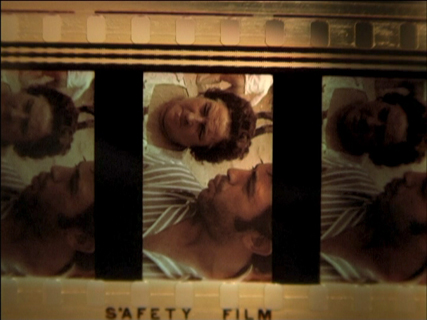
Even though the often announced death of cinema may well be an overstatement, film seems irrevocably doomed. Nevertheless, or because of that reason precisely, a number of artists and filmmakers continue to stubbornly hang on to the film medium, as an inexhaustible source for magic and wonder. With their groundbreaking excursions into the realm of so-called “expanded cinema” Sandra Gibson (US, 1968) and Luis Recoder (US, 1971) have emerged as two of the most inspired and inventive film acolytes of their generation. Since their first meeting in 2000 they have been producing numerous installations and performances that make full use of the optical and mechanical qualities of film projection. Using 16mm and 35mm projectors, celluloid strips, deviating lenses and manual interventions they create elusive and hypnotic light sculptures, which transform the projection room into a sensual three dimensional experience. During the Courtisane Festival they will present their new performance as well as some installation works and a film programme that pays homage to the work of one of their principal “teachers”, Paul Sharits.

——————————————————————————————————————————————————————-

gibson_recoder_perf.jpg

Performance
WED 21.03, 20:30 VOORUIT (DOMZAAL)

Aberration of Light: Dark Chamber Disclosure
Projector Performance by Sandra Gibson, Olivia Block & Luis Recoder

For the opening of the festival, Courtisane presents the new film performance by Sandra Gibson and Luis Recoder. Their research on light as an optical phenom- enon revolves this time around the light play of two 35mm projectors, fractured and dispersed by a series of lenses. The performance makes the most of the in- trinsic properties of the “changeover” system which in film theaters is used to project two film reels the one right after the other. The result is a stimulating and enigmatic game of filmic illusion and desillusion. This is the second projects that Gibson and Recoder have created in collaboration with Olivia Block (US), whose sound work seeks to examine and redefine the limits of the cinematographic experience. Block began her jour- ney into music as a pop musician, until she turned to field recordings in the 1990s. Since then she has devel- oped a unique musical language, in which she brings to- gether refined textures of environmental material with raw noise and an elegant instrumental sound architec- ture, in which wind instruments are predominant. Com- positional ordering and digital processing enter into an absorbing dialogue with the natural world.

——————————————————————————————————————————————————————-

sharits_colour.jpg

Carte Blanche to Sandra Gibson & Luis Recoder
FRI 23.03, 20:00 SPHINX

REPROJECTION: Paul Sharits and the analytical film

“I’m intrigued with parthenogenesis, which has some relation to the new film, and toyed with the thought of titling the film REPROJECTION; before then I had decided that since the film was being structured in a way which might be thought of as non-algebraically tautologic, I would title it PROJECTIONPROJECTION; now it seems better to return to my first title: either PRINT PROJECTION or simply PROJECTION.”
Paul Sharits (‘Correspondence with Stan Brakhage’)

Analytical Studies II: Unframed Lines
US, 1971-1976, silent, 25′

“Most of my films set up an experiential field wherein the film is not constantly imposing itself on you yet has enough consistency that you can “move through” yourself rather than just follow the development of the film. All the films have a little bit to do with meditation. These locational works become the ultimate field for that kind of contemplative reflection. It becomes like watching fireflies or water flowing over a dam – something that’s moving. A fire or a candle flame – it’s shifting – but it doesn’t change its form dramatically”. – Paul Sharits (‘An Interview with Paul Sharits’ by Linda Cathcart)

Color Sound Frames
US, 1974, sound, 26′

“Other works of the past few years are composed by rephotographing strips of “flicker” footage in a home-made system, wherein the projector element has no shutter blade Pokies or gripper arm and thereby allows the “subjects” – the “flicker” film strips – to be observed as continuous strips of film, with their sprocket holes visible; not only is there a natural horizontal and vertical division of the frame but there is also possible a layering of color planes (when the strips are projected at a rapid speed and rephotographed, their differently colored frames begin to blur into each other, forming whole ranges of shimmering color bars and planes, several appearing at a time within the frame, some assuming dominance – like fundamental tones – while others pulse around/behind the dominants, as if they were their overtones). The works which are made this way [i.e., Color Sound Frames] are certainly more complex than I have described them: because their images “move” at varieties of speeds, contain superimpositions, have sound elements (sync-soundtracks of the sprocket hole images’ rates of passage), etc., these factors also contribute to the films’ total “chordal fabrics.” – Paul Sharits (‘Hearing: Seeing’)

Razor Blades
US, 1965-1968, optical sound, 25’

“Projection Instructions: two 1000’ reels to be projected side by side onto one very large screen or two normal size screens / projectors should be identical, same focal length lenses, same intensity bulbs, detachable speakers / each reel has its own soundtrack and both should be played full volume and full treble / detachable speakers must be placed one on each side of the room, half way between screen and projectors, for stereo effect / synch ‘left’ and ‘right’ reels by aligning title / credits which appear at beginning of each reel / proper reels for ‘right’ and ‘left’ projectors indicated on head leaders.”

Declarative Mode
US, 1976-1977, silent, 38’

“Projection Instructions: 1. place 2 projectors close, side by side; do not load film yet. 2. turn on bulbs and find less intense bulb – use that faint bulb for the inner image (it is important that the inner image be dimmer; if necessary put a neutral filter of about 1 stop in front of lens). 3. you MUST HAVE AT LEAST ONE ZOOM LENS, so that one image can be put inside the other (the precise proportion is shown in a drawing accompanying the prints); another way of doing this is to move one projector forward until the right size is reached – but this cannot be done in a projection booth because there is not enough space. 4. make sure that inner rectangle is precisely placed so that the top and bottom borders and the sides are exactly equal – there should be absolutely no keystoning – this is of IMPORTANCE. 5. thread film and go to the punch mark on each reel. 6.ADVANCE THE FOOTAGE FOR THE INNER SCREEN 24 frames AHEAD OF THE REEL FOR THE EXTERIOR IMAGE – THIS SLIGHT OUT-OF-SYNC IS CRUCIAL TO THE EFFECT OF THE FILM. 7. start both projectors at the exact same instant. 8. FOCUS BOTH PROJECTIONS ON THEIR EDGES – the sharpness of the edges is also crucial.”

——————————————————————————————————————————————————————-

gibson_recoder_install.jpg

Film Installation
THU 22.03 – SUN 25.03, 14:00-20:00 FREE VOORUIT (BRUGZAAL)

Open Screening

“In our installation work, we use projected light to ar- ticulate space and time. Film projectors and celluloid are the material base of our constructions in light and shadow, the elemental properties of cinema. These things are deeply imbued with a history of viewership in the dark of the theater. To remove it from darkness is to flood this history and cast a certain illumination upon it. A certain exposure. Light spills in the shifting of film from its native darkness in enclosed chambers (camera obscura) to the uncanny openness and defamiliarized illumination of installation. We are exploring the shift, elaborating the displacement, recasting the light mechanics of a peculiar estrangement of the medium. The art of cinema, yes. But more timely: the becoming cinema of art. That is the coming attraction for us.” (Gibson/Recoder)

——————————————————————————————————————————————————————-

Masterclass
FRI 23.03, 13:30 KUNSTTOREN Gent

ARTISTS IN FOCUS: Ben Rivers & Ben Russell

riversrussell.jpg

ARTISTS IN FOCUS: Ben Rivers & Ben Russell
In the context of the Courtisane Festival 2012 (Gent, March 21 – 25).

Ben Rivers (UK, 1972) and Ben Russell (US, 1976) are not unkown to the Courtisane public: their individual work has been shown on many occasions at the festival. Longtime friends, they are currently working together on the film A Spell To Ward Off the Darkness, which has provided them with the perfect alibi for a series of side projects, including the installation and someday, somehow, before the end which will premiere at Courtisane. In a spirit heir to the postwar avant-garde cinema, they both use 16mm film as their medium of choice, sharing many other common interests and concerns, from counter-culture and anthropology to a fascination with the mystical and the utopian. This fertile combination is at the centre of their film work, a selfproclaimed “participatory etnography” which examines the possibility of a spiritual existence in response to a world that increasingly seems to draw closer to the secular. During the festival these themes and questions will serve as guidelines for a diverse range of public events, including an exhibition, an evening of performances and two screening programmes which Ben and Ben have set up in dialogue with each other’s work.

——————————————————————————————————————————————————————-

lichens_600.jpg

Event Night
THU 22.03, 20:30 KUNSTTOREN

Ben & Ben: Beard Beat Triangle Worship

Ben & Ben’s idea of a night out, in the company of an assembly of kindred souls that propose a wide palette of kaleidoscopic sound excursions: from hypnotic drone mantras to neo-cosmic proto-acid and back. Robert aiki aubrey Lowe (US) aka Lichens is not only the leading actor in Ben and Ben’s new film, he also makes music that totally rhymes with the spiritual and mystical tonalities of their work. Using voice, guitar and modular synthesizers he layers sprawling sound patterns to epic drones, in which both the spirit of John Fahey as that of Demetrio Stratos habitate. Jake Williams (UK) is the protagonist of Ben Rivers’s feature film Two Years at Sea. He will bring his electric mandolin and promises a set of Scottish folk songs, bittersweet ditties and maybe even a cover of Lily Allen. Finally, the shadowy hours of the night are heralded by Antwerp-based Stellar OM Source (NL) aka Christelle Gualdi, who uses analogue synths and electronics to bridge the gap between the kosmische musik à la Klaus Schulze and the Detroit techno school.

——————————————————————————————————————————————————————-

install-lake1.jpg

Installation
FRI 23.03-SUN 25.03, 14:00-20:00 FREE, KUNSTTOREN
VERNISSAGE THU 22.03, 19:00

And someday, somehow, before the end
2012, 3-channel looped installation, 6’30

A rehearsal for death(1) as a rehearsal for transformation(2) is a rehearsal for infinity(3).

1) “Call no man happy till he is dead.” Aeschylus

2) “It’s been a prevalent notion. Fallen sparks. Fragments of vessels broken at the Creation. And someday, somehow, before the end, a gathering back to home. A messenger from the Kingdom, arriving at the last moment. But I tell you there is no such message, no such home – only the millions of last moments… nothing more. Our history is an aggregate of last moments.” Thomas Pynchon, Gravity’s Rainbow

3) “Effective magic is transcendent nature.” George Eliot (Mary Anne Evans), Middlemarch

——————————————————————————————————————————————————————-

sackbarrow.jpg

SUN 25.03, 15:30 SPHINX

Ben On Ben: Sack Barrow, or Don’t Let’s Forget About The Factory

“In which Ben Russell gathers together a short-list of seven films and videos that reflect the conceptual and material elements at play in the fabrication of Ben Rivers’ 2011 film Sack Barrow. Having observed his dear friend and occasional collaborator at work on the cinema production line for years and years, Russell seeks to offer a spot of invaluable insight (however speculative) into Rivers’ particular manufacturing process. The result, a metal-coated and smoke-filled twenty-one minute 16mm bit of wonderment, all toxic gas and British pin-up model and verité worker sympathy, will be projected for your eyes and ears at the end of the line. What precedes Sack Barrow is the fabrication of influence – a proposition for the alchemical combination of seven works, some of which Rivers has never seen, through which the emotion, spirit, and history of his practice can be seen to resonate. Thematic sub-topics include, but are not limited to: Industrial Flames, Animal Blood, Worker Paranoia, Empty Factories, Labor as Dance, Employee Theft, and Flatulence.”

riverrites.jpg

SUN 25.03, 17:30 SPHINX

Ben On Ben: River Rites, or If You’re Going To Do It This Might Be The Best Way

“In which Ben Rivers (that’s me writing about myself in the third person) tries to compile a programme of films based around what he thinks might be going on in his friend Ben Russell’s film River Rites. We have talked for years now about what it means to film people, how to not be on the outside but on the inside, though sometimes you have to stay on the outside in order to see clearly. What happens when you bring a camera into a place, and you knowingly place it facing in one direction instead of another, and you record images on film for ten minutes at a time, unbroken stretches of film that become trance. About lives lived alongside others, at work and play on the same piece of land or in the same stretch of river. About movie-magic – transformation tricks we play in order to find some other truth to the material, a world that exists in cinema and nowhere else. This programme points to some possible answers as to how we can make films with and about people.”

——————————————————————————————————————————————————————-

twoyears.jpg

FRI 23.03, 22:45 SPHINX

Ben Rivers
Two Years At Sea

UK, 2011, 16mm blown up to 35mm, b&w, sound, 86’

“A man called Jake lives in the middle of the forest. He goes for walks in whatever the weather, and takes naps in the misty fields and woods. He builds a raft to spend time sitting in a loch. He sleeps in a caravan that floats up a tree. He is seen in all seasons, surviving frugally, passing the time with strange projects, living the radical dream he had as a younger man, a dream he spent two years working at sea to realise. I made a short film about Jake five years ago, and as time has passed and other films have been made, I have had a continual feeling that I should go back—to make another film where I, and then the audience, can spend more time hanging around Jake’s place in the forest. I want the film to embrace the different perception of time that Jake and his environment have, which is much more patient and relaxed than my own urban living. The film will have at its core the relationship between a person and the place they have chosen to live out their life, and the deep connection there is between them.” (BR)

——————————————————————————————————————————————————————-

Masterclass
DO/THU 22.03, 11:00 KUNSTTOREN Gent
ARTIST IN FOCUS: Philippe Grandrieux

grandrieux1.png

ARTIST IN FOCUS: Philippe Grandrieux
In the context of the Courtisane Festival 2012 (Gent, March 21 – 25).
Additional screenings at INSAS on March 26.

Cinema as a sensual experience: this understanding is the basis of the extraordinary work of Philippe Grandrieux (FR, 1954). The French filmmaker, who studied at INSAS in Brussels, has made quite an impression during the past decade with feature films such as Sombre (1998) and La Vie Nouvelle (2002), but his idiosyncratic oeuvre also includes documentaries and video art works, many of which have never been shown in Belgium before. His cinematic vision is clearly inspired by the modernist ideas of artists such as Antonin Artaud and Jean Epstein, who saw in cinema the potential to grasp the essential power and brutal beauty of reality. As very few have, Grandrieux succeeds in inscribing the most archaic and primitive sensations in the materiality of the medium. This is a cinema that vibrates and shimmers: cinematic space is transformed into a plastic mass of light, sound, colour and movement, in which form and content, figure and ground, body and matter, the abstract and the figurative fuse. At the occasion of the festival, an extensive selection of his work will be shown in Ghent and Brussels, including the first part of the film series “Il se peut que la beaute ait renforce notre resolution”, which celebrates filmmakers who in the course of the last century dedicated their work and life to resistance and emancipation.

——————————————————————————————————————————————————————-

adachi.png
SAT 24.03 15:30, SPHINX

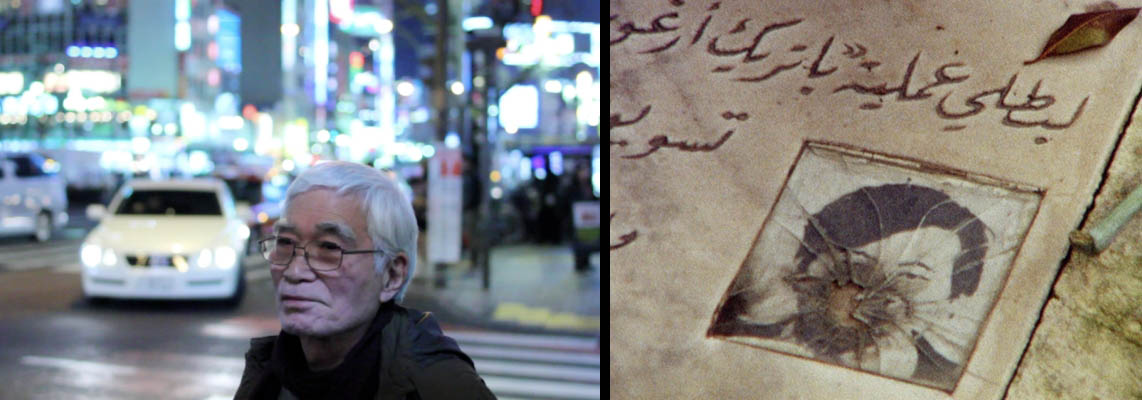
Il se peut que la beauté ait renforcé notre résolution – Masao Adachi
FR, 2011, video, colour, stereo, Japanese and French spoken, English subtitles, 75’

“A to and fro between politics and cinema, between Trotskym and Surrealism, between armed struggle and screenplays, between Palestine, Lebanon and Japan, between the day-before-yesterday and today, between beauty and resolve, between the art of eating and that of being a father, such is the risky and precise life of Masao Adachi, the monsieur with the white hair glimpsed in his delusions. And this is just how Philippe Grandrieux, faithful to his way of doing things, decided to suggest his portrait, with no a priori, without interrupting speech, filming him and listening to his words without at first understanding them, framing him in a tight close-up that is sometimes underexposed, other times overexposed, to better abandon him later for: cherry trees in blossom, the streets of Tokyo swarming with cars and passersby, familiar objects and lactescent celling light. And from time to time, Grandrieux lets speak a few shots from his earlier films, from where suddenly crops up the phrase, Genet-like, given in the title: a paradoxical program that hesitates to connect one shore to the other”. (Jean-Pierre Rehm)

sombre.jpg
SAT 24.03, 22:30 SPHINX

Sombre
FR, 1998, 35mm, colour, French spoken, English subtitles, 117’

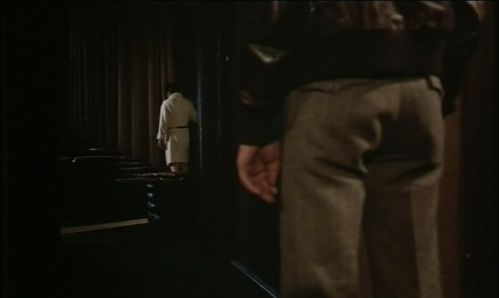
“There is something profoundly new about Grandrieux’s plastic exploration of violence, but also something very contemporary. His approach is not based on such editing and framing effects one finds and admires in Hitchcock and Ray, nor in an exploration of excess as in Tarantino. He works on the inside of an image, on the special relation between the luminous content and the vibrant and fragmentary figuration. Grandrieux may ‘tell’ the story of a serial killer in Sombre, but the violence is both removed from the story and heightened: it descends with its hero into the dark, in scenes of a carved-up female body, captured with a hand-held 35mm camera. As Raymond Bellour observes in his eulogy and lively defence of the film, ‘Pour Sombre’: [the camera places us] among the bodies, into situations of unmitigated suffering, in order to confront us, despite the brutality of the acts, with ambiguous content, in a constantly disrupted fusion”. (Christa Blümlinger)

lac.jpg
SUN 25.03, 13:30 SPHINX

Un lac
FR, 2009, 35mm, colour, French spoken, English subtitles, 85’

“Instead of the heavy 35mm camera painfully held on the shoulder for Sombre, it’s with a small DV camera (and all that it involves) that Grandrieux has shot Un Lac, with a freedom of mastered improvisation which is felt throughout the entire film (…). And thus the camera’s most directly sensitive recording capacity accompanies a will of great abstraction in the way that Grandrieux treats each of the components of the film, in the editing and the sound design, which is entirely constructed, as well as in the decision of lowering the level of light sensitivity, carefully respected from the shooting to the digital colourgrading and the blowup to 35mm. All of this seems to suggest that we are in front of a new way of negotiating the relation between the ‘two biggest trends in cinema, the design-tendency and the recording-tendency’. Serge Daney added ‘two ways of engaging the inhuman in the human’, explaining that it would be ‘in the middle, the ‘scene-tendency’ (…) that the inhuman is kept at a distance’.” (Raymond Bellour)

——————————————————————————————————————————————————————-

MON 26.03, 18:00 INSAS, Brussels

sarajevo.jpg

Retour à Sarajevo
FR, 1996, video, colour, Bosnian spoken, French subtitles, 70’

“Initially, this film was commissioned by Arte. The idea was to return to Sarajevo with Sada, a Bosnian woman who had spent the war in exile in Paris. As the work progressed, I realized that it was not that simple. That war had escaped me a bit, I was interested in how it could be done from Paris. It was a week after the Dayton Accords and the situation was definitely not stabilized, Sarajevo was still surrounded by the Serbs. At the same time, I’m not predisposed to be a war reporter, it’s not my story, this kind of fear does not excite me. We took one of the first busses that went back to Sarajevo and the trip was incredible. We crossed completely devastated landscapes: 300 kms of ruins between Split to and Sarajevo; a trip of countless hours through a piece of history that was absolutely shattered. We were arrested and controlled all the time, without any idea by whom. I’d never been physically in a war landscape. The film was an incredibly strong experience because it faced me with a certain responsibility, a commitment. If I had not been affronted with all these questions, with my own story and my relationship to history, perhaps I would have never embarked on a feature film. In that respect, this film seemed decisive. “(PG)

vienouvelle.jpg

La vie nouvelle
FR, 2002, 35mm, colour, English and French spoken, French subtitles, 102’

“There was an extremely simple, basic narrative premise: a young man meets a young woman and wants her for himself, in an Orphic way. Little by little the film was constructed in terms of intensity – relations of intensity between characters who could inhabit or haunt the film. There’s the impression that everything is moving all the time, like a kind of vibrant, disturbed materiology. That’s what we were looking for: a disquieting film, very disquieting, very fragile and vibrant. Not a film like a tree, with a trunk and branches, but like a field of sunflowers, a field of grass growing everywhere. Here’s the biggest rupture: in the way the film was conceived. It was conceived and developed on questions of intensity rather than psychological relations. My dream is to
create a completely ‘Spinoza-ist’ film, built upon ethical categories: rage, joy, pride … and essentially each of these categories would be a pure block of sensations, passing from one to the other with enormous suddenness. So the film would be a constant vibration of emotions and affects, and all that would reunite us, reinscribe us into the material in which we’re formed: the perceptual material of our first years, our first moments, our childhood. Before speech. That’s the impulse – the desire – which led to the film.” (PG)

——————————————————————————————————————————————————————-

Carte Blanche to Philippe Grandrieux
SAT 24.03, 17:30 SPHINX

bernhard.png

Edmond Bernhard
Dimanche

BE, 1962, 35mm, b&w, 20’

Too often forgotten and ignored, this is the master piece of Belgian filmmaker Edmond Bernhard, one of Grandrieux’s teachers during his studies at INSAS.
“Dimanche was supposed to be a didactic film, intended to evoke the problem of leisure. Bernhard diverts the order and outwits the trap of the ‘thematic’ film. Without resorting to any form of commentary, making use of extraordinary images sublimating common spaces (the boredom of Sundays, the changing of the guard, children playing, a runner in the woods, a football match, …), he constructs with a nifty montage an exceptional work dealing with the sense of void and the fossilisation of the world.” (Boris Lehman)

dwoskin.jpg

Stephen Dwoskin
The Sun and the Moon

UK , 2007, video, colour, 60’

One of the most personal and intimate films by Stephen Dwoskin. A radical portrait of lust, pain and melancholia, at the same time lurid fairytale and autobiographical essay. “The Sun and the Moon, a film fairy tale, is about two women’s terrifying encounter with ‘Otherness’ in the form of a man, abject and monstrous, and for them to either to witness, accept or partake in his annihilation. All are caught in their own isolation and are fearful of the menace that has to be met. The film, as a personal interpretation of Beauty and the Beast, enciphers concerns, beliefs and desires in seductive images that are themselves a form of camouflage, making it possible to utter harsh truths.” (SD)

fassbinder1.png

Rainer Werner Fassbinder
Deutschland im Herbst (episode)

DE, 1977/78, 35mm, colour and b&w, 26’

Fassbinder’s contribution to the omnibusfilm Deutschland im Herbst, which attempted to portray the political climate in Germany in 1977 after the kidnapping and assassination of Hanns-Martin Schleyer by the Red Army Faction, and the subsequent “suicides” in Stammheim prison of three members of the Baader-Meinhof group. Exposing himself with frankness and brutality, Fassbinder conveys, in the words of Wilhelm Roth, “the feeling of powerlessness experienced by a left wing intellectual. It is not the political discussions that give this half hour its importance, but the brutality and honesty with which Fassbinder deals with himself as a man and a director.”

——————————————————————————————————————————————————————-

Masterclass
MON 26.03 13:00 Sint-Lukas Brussel

——————————————————————————————————————————————————————-
Avec le soutien de l’Ambassade de France en Belgique

Reverberances

rev_frame.jpg

Part of Courtisane Festival 2012, March 21 – 25, Gent.

A series of revisitations and reverberations: dialogues between then and now, between different generations and traditions, exploring ways of seeing and thinking cinema, politics, documentary and ethnography.

With works by Robert Gardner, Robert Fenz, Thomas Harlan, José Filipe Costa, Eric Baudelaire, Philippe Grandrieux

In the context of the research project “Figures of Dissent” (School of Arts/HoGent). Curated by Stoffel Debuysere.

——————————————————————————————————————————————————————-

REVERBERANCE 1

Robert Gardner
Forest of Bliss

US/IN, 1986, 35mm, col, stereo sound, 90’

Robert Fenz
Correspondence

US/DE, 2011, 16mm, b&w, silent, 30’

rev_gardner.jpg

“Robert Gardner’s camera scans with precision and feels with sympathy – the objectivity of an anthropologist, the fraternity of a poet.”
– Octavio Paz

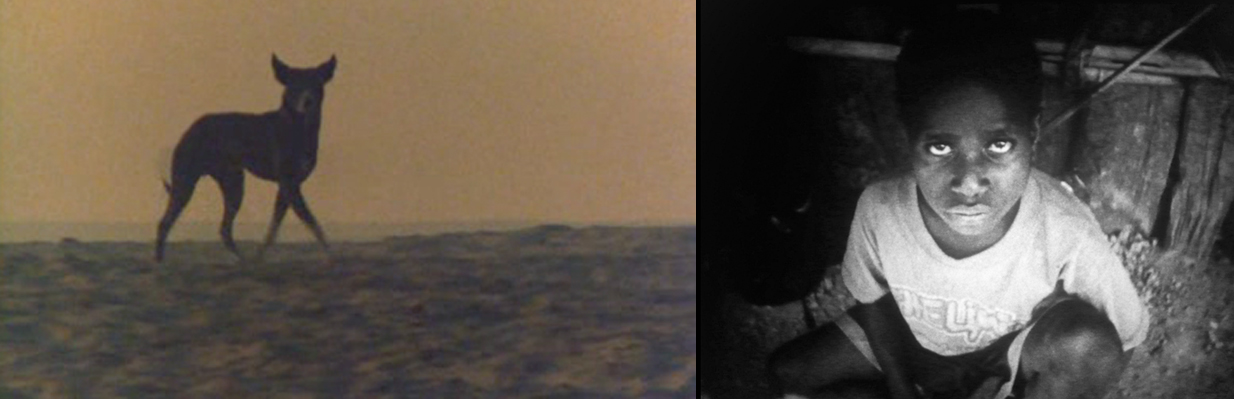
“It is apparent that only a certain kind of person will want to make ethnographic films”, is how Robert Gardner (1925) situated his own practice. “It will, above all, be those who sense the profound affinity that exists between the film medium and a desire to understand people.” As often scorned by scholars as applauded by the avant-garde, the work of Robert Gardner is of undeniable influence in the field of visual anthropology. As legendary fimmaker Stan Brakhage, a fervent defender, once put it, the question of whether Gardner is “An Artist, an Anthropologist, or WHAT?” is “SUCH a boring question once one has fully experienced his films.” It was while studying anthropology in the 1950s that Gardner started making films, some in collaboration with American painter Mark Tobey. His international breakthrough would come with Dead Birds (1963), a multi-awarded but controversial portrait of the Dani people in New Guinea. His lyrical and cinematographically exquisite portrayal of non Western cultures would produce many more master pieces in the following decades such as Rivers of Sand (1974), about the Hamar in Southwest Ethiopia, and Forest of Bliss (1986), filmed in the Indian city of Benares. The three abovementioned films are the starting point of Correspondence, Robert Fenz’s tribute to Gardner. Fenz literally followed Gardner’s footsteps in search for the shooting locations of the three films. The result is a poetic dialogue which at the same time pays homage to a way of filmmaking that has become obsolescent.

——————————————————————————————————————————————————————-

REVERBERANCE 2

Thomas Harlan
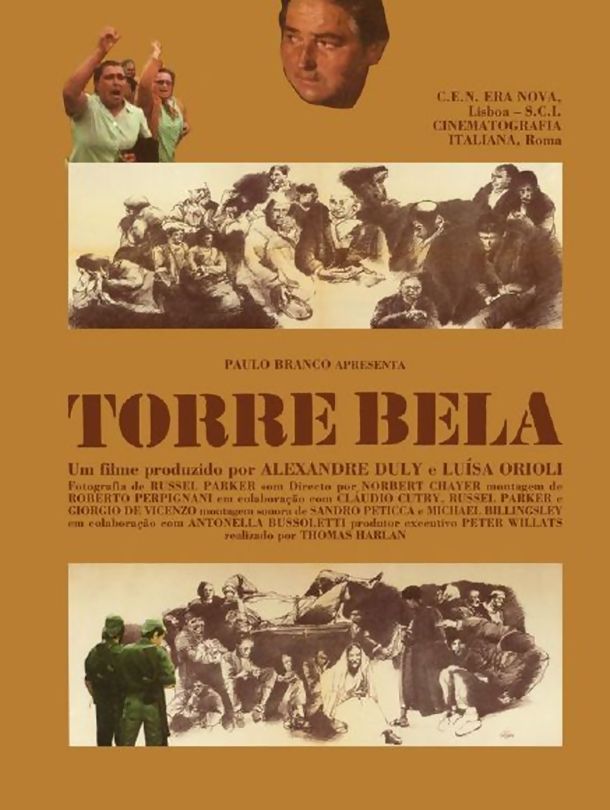
Torre Bela

PT, 1975, 16mm, color, stereo sound, Portugese spoken, 106’

José Filipe Costa
Linha Vermelha

PT, 2011, video, color, stereo sound, Portugese & French spoken, English subtitles, 80′


rev_harlan.jpg

“My works don’t tell political stories. They rather document a political alertness, a clairaudience for certain constellations. My films, each for themselves, are generally useless for the purpose of a position or theory.”
– Thomas Harlan

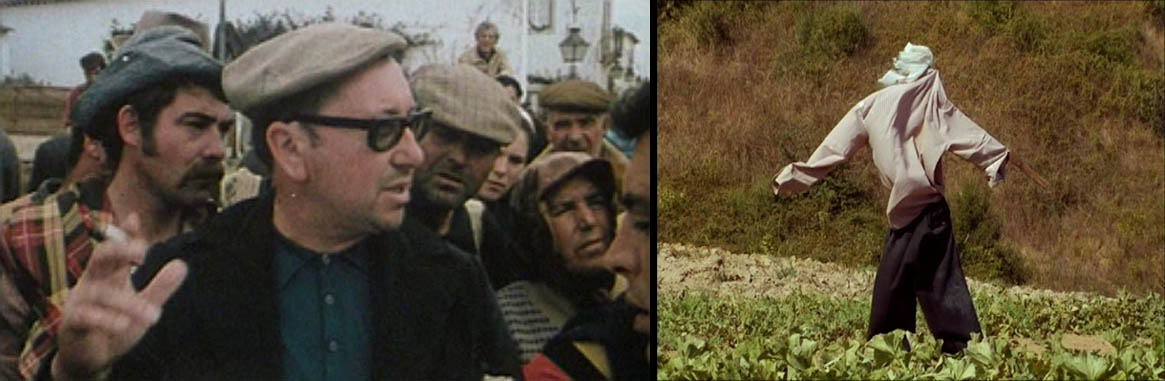
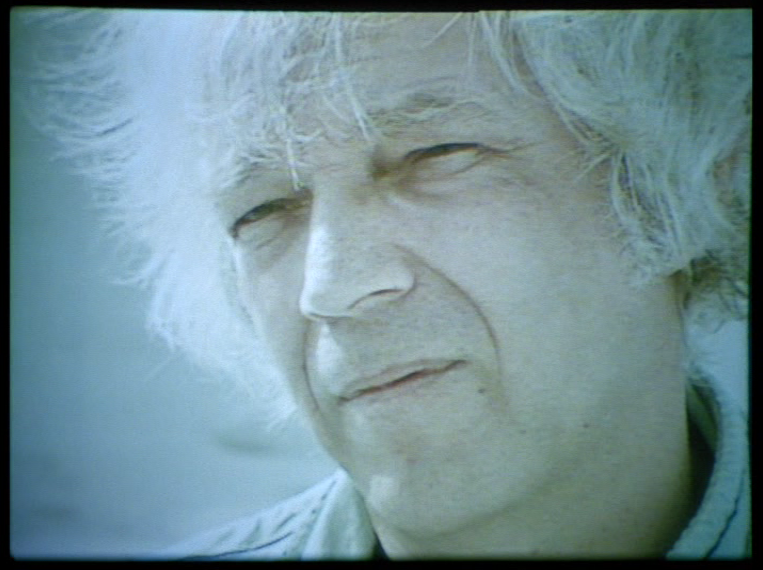
“I am the son of my parents. That is a disaster. It has determined me”, declares author, dramaturge and filmmaker Thomas Harlan (1929-2010) in the interview book ‘Hitler war meine Mitgift’. Harlan, who grew up in Nazi-Germany, once shared a table with Adolf Hitler, accompanied by both of his parents, actress Hilde Körber and filmmaker Veit Harlan, the director of the infamous anti-Semitic propaganda film Jud Süß. It is a heritage that he could never get rid of and the appalled son would take upon himself the sins of his repent-less father. His whole life Harlan would strive for truth as the only possible justice: he spent years in the Polish archives, looking for proofs of German war crimes; in Rome he joined the radical leftist group “La Lotta Continue” and travelled to wherever the spirit of revolt and revolution emerged. In 1975 Harlan was in Portugal where, in the aftermath of the Carnation Revolution, various movements of resistance and initiatives of land occupation were developing. That is where he shot his first film, a documentary about the occupation of the Torre Bela estate, which according to critic Serge Daney represents a condensation of “all the key ideas – materialised, embodied – of political and theoretical leftism from the past decade”. More than 35 years later another filmmaker, José Filipe Costa, revisits in Linha Vermelha the production process of the much discussed film, which Harlan himself once described as in “complete opposition to what documentary should be”: a seemingly pure “observational” cinematographic document that has become over time a controversial historical object.

(See also ‘The militant ethnography of Thomas Harlan‘ By Serge Daney)
——————————————————————————————————————————————————————-

REVERBERANCE 3

Eric Baudelaire
The Anabasis of May and Fusako Shigenobu, Masao Adachi, and 27 years without Images

FR, 2011, Super8 to video, colour and b&w, English, japanese, french spoken with English subtitles, 66‘

Philippe Grandrieux
Il se peut que la beauté ait renforcé notre résolution – Masao Adachi

FR, 2011, video, color, stereo sound, Japanese and French spoken with English subtitles, 75′

rev_adachi.jpg

“Shooting a gun or shooting with a camera, it doesn’t make a difference to me”
— Masao Adachi

“The revolution has been continuously my main subject” says Masao Adachi (1939). “People Said: Revolutionary Cinema. I said: No. It’s Cinema for Revolution.” Of all the filmmakers that would be inspired by the spirit of resistance and utopia of the 1960s and 1970s, Adachi is without a doubt the most radically and perseveringly militant. Armed with a camera or with a gun: it made no difference to him. To him, both weapons served as possible intervention tools in the fight against political and social oppression. With his surrealistically tinted and politically provoking experiments he inscribed himself rapidly as part of the so called “new wave” currents that shook Japanese culture of the time. In 1971, after visiting the Cannes Film Festival, Kôji Wakamatsu and Adachi travelled to Lebanon to make a propaganda film in support of the Arab fight against Isreali occupation. In 1974 Adachi returned to Palestine, with the idea of making a second film. He would end up staying 26 years, at the service of the Palestinian cause. In 1997, under the pressure of the Japanese authorities, he was incarcerated in Beirut. He was extradited to his country three years later, where he remained in prison for two more years. Two French filmmakers have recently made, independently from one another, cinematographic portraits of the Japanese filmmaker. One from a distance, the other on the skin. Eric Baudelaire confronts landscape images from Beirut and Tokyo with the recollections of Adachi and Maya Shigenoby (daughter of Fusakao, one the leaders of the Red Army). Philippe Grandrieux translates a brief meeting into an intuitive and sensory combustion of image, sound, light and colour.

Figures of Dissent: Thomas Harlan

nazi4.png

Figures of Dissent: Thomas Harlan

Programme 1: 16 February 2012 19:00, KASKcinema, Gent.
Programme 2: Courtisane Festival (21 – 25 March 2012)

introduced by Stoffel Debuysere

“My works don’t tell political stories. They rather document a political alertness, a clairaudience for certain constellations. My films, each for themselves, are generally useless for the purpose of a position or theory.”
– Thomas Harlan

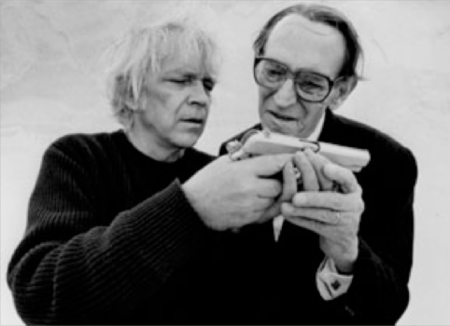
“I am the son of my parents. That is a disaster. It has determined me”, declares writer, playwright and filmmaker Thomas Harlan (1929-2010) in the interview book ‘Hitler war meine Mitgift’. Harlan, who grew up in Nazi-Germany, once shared a table with Adolf Hitler, accompanied by both of his parents, actress Hilde Körber and filmmaker Veit Harlan, the director of the infamous anti-Semitic propaganda film Jud Süß. It is a heritage that he could never get rid of: the appalled son would take upon himself the sins of his repentless father. His whole life Harlan would strive for truth as the only possible justice: he spent years in the Polish archives, looking for proofs of German war crimes; in Rome he joined the radical leftist group “La Lotta Continue” and travelled to wherever the spirit of revolt and revolution emerged. In 1975 Harlan was in Portugal where, in the aftermath of the Carnation Revolution, various movements of resistance and initiatives of land occupation were developing. That is where he shot his first film, a documentary about the occupation of the Torre Bela estate, which according to critic Serge Daney represents a condensation of “all the key ideas – materialised, embodied – of political and theoretical leftism from the past decade”. His following film project started as a reaction to the “German Autumn” of 1977. Wundkanal explores the relation between the events in the Stammheim prison, where several members of the RAF died in suspicious circumstances, and the logic of Nazi terror. The shooting of the film, in which war criminal Alfred Filbert played a hardly fictionalized version of himself, appears in Robert Kramer’s documentary Notre Nazi, revealing a staggering portrait of a filmmaker who, in an attempt to come to terms with his past, takes on the methods of the enemy and in doing so becomes his own worst enemy; and thus an old sin is replaced by a new one.

——————————————————————————————————————————————————————-
PROGRAMME 1
16 February 2012 19:00, KASKcinema, Gent. A Courtisane programme.

nazi2.jpg

Thomas Harlan
Wundkanal

1984 – RFA/France –107’

Robert Kramer
Notre Nazi

1984 – RFA/France – 116’

“My film is perhaps another fiction: the story of a certain T., son of the greatest Nazi filmmaker, and himself a film director. All his life he has tried to undo his past. Today he is shooting a fiction film, he has given the main role to a Nazi war criminal who is more or less the same age. By this act T. releases a whole torrent of unforeseeable energy which sweeps the set and even more than the set.”
– Robert Kramer

“For the first time in the history of cinema, said Louis Marcolles in le Monde (30 August 1984), two films were shot against each other; the first being fiction, the second unmasking this fiction; the first mystifying its subject (crime), the second outrageously unveiling its methods of manipulation.
Yet, both films were produced by the same producer, both in the outskirts of Paris and with two directors who are complementary to each other: Thomas Harlan, The German and Robert Kramer, the American.
Wundkanal by Thomas Harlan is a fiction film about a killer. Notre Nazi by Robert Kramer kills the fiction.
But the Killer is a real-life killer, and never before in the history of cinema did an audience get so intimate with a murderer like doctor Alfred Filbert, did an audience get so close to his face and to his skin.
Indeed, Alfred Filbert – the archetypal gentel German grandpa – belonged to the inner circle of nine men who in Hitler’s terror state planned the Holocaust; so in the film he appears as an actor and as himself, playing his own part in history.
In Wundkanal – a quiet oratorio of long sequence shots – four terrorists interrogate a war (and peace) criminal they kidknapped in Alsatia, trying to drive him to commit suicide.
In Notre Nazi the actor playing a part in a fiction film becomes a real human being again, of flesh and blood. The members of the film crew discover their sorrow and their pity as they live through unimaginable moments of violence and despair.
Two inseperable films – lashing out against each other as ruthlessly as a couple divoring publicly – “the scandal”, as Il Messagero put it, “of the 1984 Venice Film festival.” (Editions Filmmuseum)

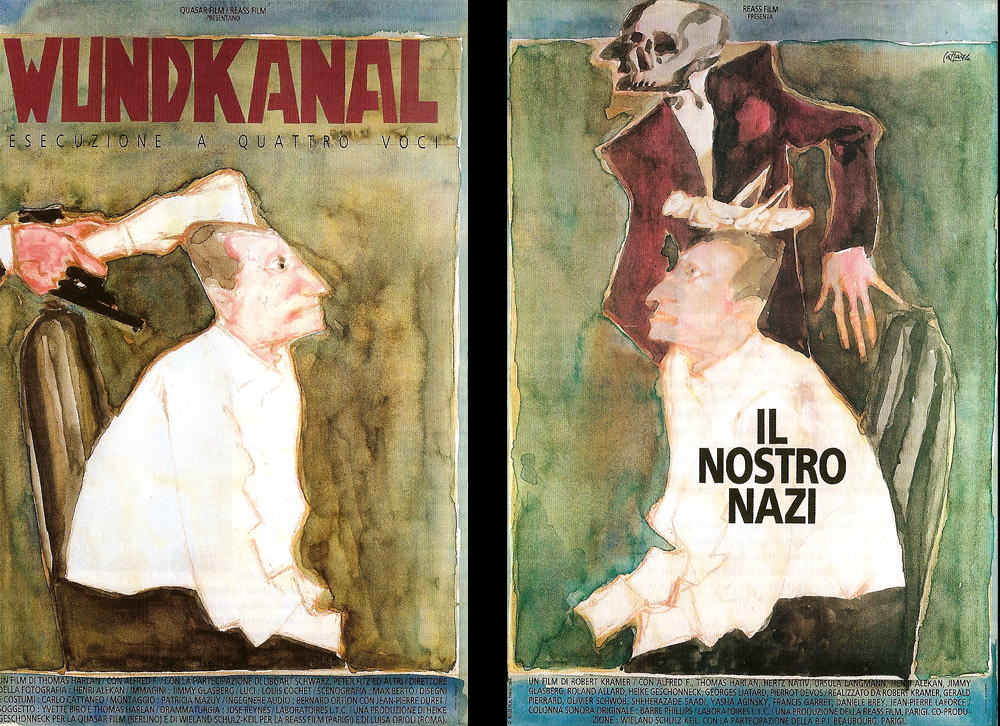
harlan-poster-small.jpg

Note: There is actually a third film in this series: Dorenavant tout sera comme d’habitude by Roland Allard, a documentary report on the making of Wundkanal and Notre Nazi. Unfortunately I haven’t been able to track down a copy.
——————————————————————————————————————————————————————-
PROGRAMME 2
Part of the Courtisane Festival (21 – 25 March 2012)

linha_vermelha_1-500x375.jpg

Thomas Harlan
Torre Bela

1977 – Portugal – 106’

José Filipe Costa
Linha Vermelha

2011 – Portugal – 80′

“Torre Bela is the complete opposite of what a documentary should be. The film is a film that we, in fact, did not conceive as a film, but as reality. The reality was provoked, intentionally created.”
– Thomas Harlan

“In the revolutionary Portugal of 1975, a group of peasants occupied the vast manor and estate of Torre Bela owned by the Duke of Lafões and founded a cooperative there. The events were recorded in the film Torre Bela (1977) by the German director Thomas Harlan, son of the director Veit Harlan.

When I first started filming Red Line I asked a woman in a village near Torre Bela if she had been involved in any way in the 1975 occupation. She immediately replied that she had not and that I should ask that question to another villager who was on the other side of the street. When I asked him, the latter was extremely surprised by his neighbour’s denial: since it was even possible to see her in the film, amongst a crowd shouting slogans! After this episode I became increasingly aware of how an observational documentary had become a controversial historical object: for some it was even proof of a “crime” committed during the revolutionary period of 1975. In one of the most controversial sequences of Harlan’s film it is possible to see the squatters breaking into the palace on the estate, opening drawers and trying on the Duke’s jackets, as they play joyfully with these symbols of power. Red Line questions how the film Torre Bela played a role in how these events are viewed and examines how Thomas Harlan intervened in the flow of the events, himself becoming a squatter. Drawing on testimonies, recently discovered sound rushes and other documents, Red Line explores the complexities and ambiguities of a filmed revolution, in which the camera helps people to play new roles: “Are we actors or occupiers? If we are actors, we’re actors…” says one occupant while waiting for the camera to start filming before the group broke through the door of the palace in 1975.” (José Filipe Costa)

torre.jpg

In the context of the research project “Figures of Dissent (Cinema of Politics, Politics of Cinema)”
KASK / School of Arts

See also ‘The militant ethnography of Thomas Harlan‘ By Serge Daney