Accelerated Living // Conference

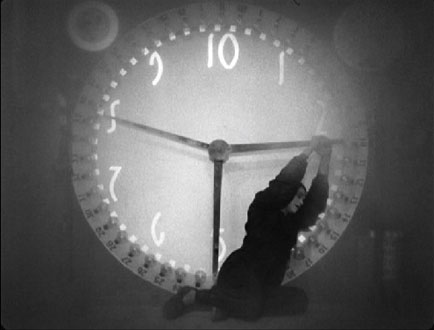
metropolis_fritz-lang1.jpg

ACCELERATED LIVING

CONFERENCE

In the context of the programme “Accelerated Living”, part of IMPAKT FESTIVAL 2009, 14-18 October 2009, Utrecht, NL. Preview here.

Thursday 15 October 2009 / Filmtheater ‘t Hoogt / 10:00 – 18:30.
Free entrance. Prior registration recommended via rsvp@impakt.nl (please indicate your full name and contact details).

The Italian media philosopher Franco Berardi aka Bifo recently wrote in his ‘Post-Futurist Manifest’ (2009) that «the omnipresent and eternal speed is already behind us, in the Internet, so we can forget its syncopated rhymes and find our own singular rhythm». During the past decade the spread of neo liberal globalisation and the revolution of information and communication technologies have led to a new temporal dynamics, both in terms of our personal lives and for society as a whole. The rise of communication networks, stretched accross time and space, has brought us to realize that clock time – the long-time regulator of our social lives – is not an absolute backdrop against which to communicate and synchronize time, but a human construction which has little to do with our experience of and in time. Contemporary science and technology have made possible a temporality which though still based upon clock time, has exploded into countless different time fractions and speeds beyond human comprehension. Today we seem to live in several time zones at the same time, propelled by a variety of internal and external time mechanisms and innumerable rhythms which continuously vibrate, resonate, connect, oscillate and disconnect. How to grasp the temporal complexity that surrounds and occupies us? What sort of ecologies of time and speed have we developed under the influence of new technologies and what is their impact on our body and senses? This conference brings together a number of international thinkers who offer new perspectives on our contemporary experience of time and speed.

In collaboration with the MA New Media & Digital Culture, Department of Media and Culture Studies, Utrecht University. Introduction: Ann-Sophie Lehmann (Utrecht University). Moderation: Klaas Kuitenbrouwer (Virtueel Platform, Amsterdam) & Mirko Tobias Schaefer (Utrecht University).

Participants: Mike Crang, Dirk de Bruyn, Charlie Gere, Steve Goodman, Glenn Kaino, Sybille Lammes, Carmen Leccardi, Stamatia Portanova, Jon Thomson & Alison Craighead, John Tomlinson.

10:00
Introduction Ann-Sophie Lehmann

10:15
John Tomlinson (GB) is Professor of Cultural Sociology and Director of the Institute for Cultural Analysis, Nottingham (ICAn). He has published a number of books on the themes of globalisation, cosmopolitanism and cultural modernity, including Cultural Imperialism (1991) and Globalization and Culture (1999). His recent book The Culture of Speed: The Coming of Immediacy (2007) examines how speed emerged as a cultural issue during modernity. “The rise of capitalist society and the shift to urban settings was rapid and tumultuous and was defined by the belief in ‘progress’. The attempt to regulate the acceleration of life created a new set of problems, namely the way in which speed escapes regulation and rebels against controls. This pattern of acceleration and control subsequently defined debates about the cultural effects of acceleration. However, in the 21st century ‘immediacy’, the combination of fast capitalism and the saturation of the everyday by media technologies, has emerged as the core feature of control. This coming of immediacy will inexorably change how we think about and experience media culture, consumption practices, and the core of our cultural and moral values”.

11:00
Mike Crang
(GB) is Lecturer in cultural geography at Durham University. He has worked extensively on the relationship of social memory and identity. He is also interested in more abstract issues regarding time-space, action and temporality and co-edited the journal Time & Society from 1997 to 2006. The other strand to his work is the analysis of transformations of space and time through electronic technologies. In his paper ‘Acceleration, fragmentation and combination’, he looks at the way multiple scales of action and paces of life now intersect in our daily lives. “Burgeoning numbers of technologies enhance our spatial reach, and promise also to allow ever more to be packed into the same amount of time. Temporal intensification and spatial extension run hand in hand. And yet the pattern is not simply one of further and faster. These technologies take up and build upon the sedimented legacies of past forms of life – social and technological. The promised acceleration brings not only liberation but new constraints, as it depends upon new ways of organising time and space. The new technologies bring mutual interdependencies that produce rigidities, and new dependencies in turn as what at first brought freedom becomes necessity. Old spatial and temporal orders are sometimes disrupted but also sometimes reanimated. Meanwhile the acceleration of some can result in and even depend upon the fixity and sometimes slowing of others. The pattern is neither uniform nor unidirectional”.

11:45
Carmen Leccardi
(IT) is Professor of Cultural Sociology at the University of Milan-Bicocca. She has researched extensively in the fields of time, youth cultures and gender. She was a former co-editor (1999-2008) of the journal Time & Society. Recent publications include Sociologie del tempo. Soggetti e tempo nella ’società dell’accelerazione’ (Sociologies of Time. Subjects and time in the ‘acceleration society’) (2009). According to Leccardi, “there are good reasons to believe that social acceleration has now assumed such disrupting features as to have become an authentic mark of globalization. In this temporal scenario, the present becomes ‘all there is’, an ‘absolute present’ (Heller). It cedes the way to a simultaneous and, de facto, de-temporalized dimension. Thus, a loss of the present (not only of the future) as a space of choice and of reflexive action can occur. A possible area of resistance to these processes of dissolving temporality (and historicity) is the specific vision of time and space proposed by anti-globalization movements. Besides that, as recent research would indicate, a number of young people appear to be actively involved in the construction of form of mediation between the need for subjective control over time and the destructuration of the temporal experience linked to the expansion of speed”.

12:30
Lunch

13:30
Steve Goodman
(GB) teaches music culture at the School of Humanities & Social Sciences, University of East London. He runs the master “Sonic Culture” and is now working on Sonic Warfare, a theoretical research on the intersection between war and sound culture. A member of Ccru (Cybernetic Culture Research Unit), under the name of Kode9 he is a main figure in contemporary breakbeat culture. In his essay ‘Speed Tribes: netwar, affective hacking and the audio-social’, Goodman formulates the unifying relay for music cultures through speed, perception and sensation. According to him “speed tribes” are micro-cultures attached to a specific sound and speed. The distinguishing instance that defines a speed tribe expresses itself through the motion and rest of bodies. A music culture develops as an assemblages of embodied perceptions which produce and re produce multiple singularities. In this continuous flux of movement bass nature forms itself not as closed entity but appears as a collective through ‘”rhythmic consistency and affective potential”.

14:15
Stamatia Portanova
(IT) received her PhD in Digital Cultures from the East London University, and is now a Honorary Fellow in English Language and Literature at the University of Naples “L’Orientale”. She is a member of The Sense Lab (Concordia University, Montreal) and of the editorial board of Inflexions, the online journal of the Sense Lab. She is working at the preparation of a monograph on the relationship between choreography, science and philosophy. In her talk, she will propose a redefinition of the digital age as a “neo-Baroque” age: digital technologies make us ‘almost’ aware of our infinite micro-perceptions, and are therefore paradoxically able to intensively influence our enjoyment, even of the most ‘static’ arts. “The critique to notions of rhythm and speed intended as ‘pure velocity’, and the political consideration of how our everyday lives are (not always positively) affected by technological fastness, constitute the main shift from a Futurist to what Franco Berardi (BIFO) has defined as a Post-Futurist era. My intervention would like to replace to this definition Gilles Deleuze’s own concept of the ‘Neo-Baroque’. How is ‘digital speed’ to be considered as ‘Baroque’? Digital technology is all about short temporalities and small scale entities (second, half-seconds, nanoseconds). Like a sort of ‘temporal microscope’, this invention shows an enormous capacity to affect perception and thought. An almost ‘hallucinatory’ time thus unfolds itself, constituting a visionary experiential field where art and philosophy share a particular ‘molecular’ taste (a ‘way of treating things’) with science. It does not really matter that the dissection (or digitalization) cannot go ad infinitum, insofar as it shows a way, or a tendency, towards the infinite. Gottfried Leibniz, a ‘Baroque philosopher’ and the inventor of differential calculus, is one of the precursors of this idea: for him, an infinity of ‘inconspicuous perceptions’ or microscopic folds of thought compose the consciousness of every single moment, but without individually standing out enough for us to be aware of them.“

15:00
Dirk de Bruyn
(NL/AU) Senior Lecturer in Animation and Digital Culture at Deakin University, Melbourne, Australia. The past decades he has produced a number of films, videos and performances, mainly dealing with the feeling of trauma and disorientation. His talk is titled ‘The After-Image as Traumatic Affect’. “The digital nEw has had its traumatic impact to become the digital nOw. (From E to O : E > O – i.e. Pinocchio’s donkey-scream)”, he writes. “And just as the speed of train travel imposed its compact sampled staccato reading of the panoramic landscape through its window-screen, nOw the sensory cluster-of-being in global technologised space has been morphed, skewered most emphatically into the visual to succumb to the omni-presence of the technical image. The ‘new’ critical looking that is now mandated for the body finds its traces in the 70s theoretical ruminations around Materialist film and the 20s cut-up avant-garde response to the shell-shock of WW1. Like the suicided Rock or Movie star, film itself flashes-back with a new aura after its own death to stand in that spot reserved for Banquo’s ghost; to gesticulate both wildly and quietly the ‘essential’ laws and limits that this new critical body-situated perception expects”.

15:45
Coffee break

16:00
Sybille Lammes
(NL) is Assistant Professor at the Department of Media and Culture Studies, Faculty of Humanities, Utrecht University. In recent years, her research has focused on the function of computer games as cultural spaces and the impact of digital maps on the meanings of media and cartography. In her talk, titled ‘“I’ll be there in a Stretch”: Digital Ludic Cartographies and the Location of Time’ she will address the curious treatment of time related to mapping practices in so-called historical strategy games. “What is striking about maps that figure in such games is that they are at the same time highly contemporary and highly historical. Their contemporary dimension lies in their transformative qualities that make them changeable and malleable at a speed that we haven’t known before. This is a feature they share with other recent digital cartographical practices such as navigation devices and Google Earth. Their historical dimension is actually also related to this transformability: players are not just reading maps, but constantly influence the shape and look of the map itself. This is reminiscent of maps and cartographers before the Renaissance when maps were used and made in much more personal, and probably slower, ways”.

16:45
Charlie Gere
(GB) teaches New Media Research at the Institute for Cultural Research, Lancaster University and is Chair of the group ‘Computers and the History of Art’ (CHArt). He’s interested in the cultural effects and meanings of technology and media, in relation to art and philosophy. His book Art, Time and Technology (2006) explores artistic responses to the increasing speed of technological development. In his talk he will look at some apocalyptic and messianic understandings of time, especially in relation to ecology. “I start with John Ruskin’s apocalyptic vision of the ‘stormcloud of the nineteenth century’ and show how it relates to the eschatological messianism of Walter Benjamin, Jacques Derrida and then, via Jacob Taubes, St Paul and Giorgio Agamben. I will discuss Agamben’s concept of ‘messianic time’ in relation to Benjamin’s concept of ‘dialectics at a standstill’. I attempt to think this in relation to our current ecological catastrophe. Finally I relate this to a work exhibited in the 2009 Venice Biennale, entitled ‘The Ethics of Dust’, by Jorge Otero-Pailos.”

17:30
Jon Thomson
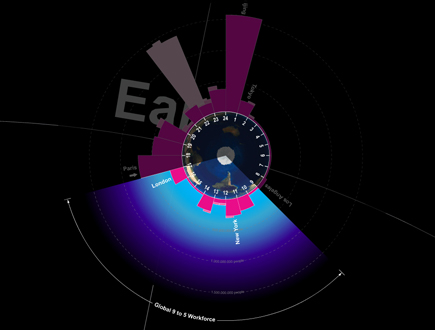
and Alison Craighead (GB) have been working together since the beginning of the 1990s on an idiosyncratic oeuvre, situated in the twilight zone between visual art and online media. Based in London, they have exhibited widely both nationally and internationally, having earned an excellent reputation as leading UK practitioners in the field of artists using technology. Most of their work deals with the influence of new technologies on our experience of time and perception of the world around us. “As time has gone by it seems more and more like we are making artworks that look at whether live information (live data) can be considered to be a material at all in artistic terms, and whether it can be used to make artworks, much like charcoal or video might be. More recently, we’ve been exploring how globally networked communications systems interact with global time zones and the physical space of the world.” Thomson teaches at the Slade School of Fine Art in London, and Craighead lectures at the University of Westminster and Goldsmiths, University of London.

18:00
Glenn Kaino
(US) is not easy to pin down. A former creative director for Napster, mastermind of ueber.com, co-founder of the Deep River Gallery in Los Angeles, visual artist… Much like Andy Warhol, he effortlessly crosses the borders between art and entertainment, using a variety of media and cultural references. His installation series ‘Time Machines’ is the result of a pronounced fascination with the complexity of time. “I’m trying to extend, or shorten perhaps, the life of my projects by adding temporal subjectivity, the idea that the factor of time is critical to the consumption of the work. In my work, time is a sculptural component with which I am trying to further existing explorations. It all started with my investigations into simultaneity, which were first exhibited publicly in ‘Time Machines #2”, an experiment in the use of sculptural installation to affect a temporary perceptual circumstance. On Kowara is a major influence on my thinking about this. His gesture is incredibly precise and clear while simultaneously abstract and poetic – to paint with time. The new work is an attempt to continue these investigations.”
IMPAKT FESTIVAL // Accelerated Living Preview

impakt_web4.jpg

Impakt Festival 2009
14 – 18 October 2009
Utrecht, Netherlands

It is now 100 years since Filippo Marinetti published his controversial “Futurist Manifesto”, in which he described the enthusiasm brought about by the arrival of modern industrial rhythms, driven by a total belief in speed and progress. In his recent “upgrade” of the Manifest, media philosopher Franco Berardi rejects unilateral interpretations of modern speed culture, making a plea for more reflection and autonomy. “The omnipresent and eternal speed”, he writes “is already behind us, in the Internet, so we can forget its syncopated rhymes and find our own singular rhythm”.

Our society is still driven by an insatiable hunger for speed, but during the past decades, the spread of globalisation and the revolution of information and communication technologies have unmistakably led to a new temporal dynamics, emphasizing the increasing importance of connectivity and flexibility. The tyranny of clock time has given way to a complex web of diverging rhythms, cycles and tempos, which stimulate the temporal imagination as never before.

Under the title “Accelerated Living”, the Impakt Festival 2009 focuses on changing notions of time and speed today. During a period of five days, a number of artists, filmmakers, musicians and thinkers will share their views on the construction and intensification of time, and its influence on our perception of reality, and by extension of ourselves. The resulting search for a new engagement with time will be explored in a range of screenings, talks, performances and an exhibition.

Curated by Maria Palacios Cruz & Stoffel Debuysere

impakt_web1.jpg

EXPO
14 – 18.10.2009
various locations

“All will be now. Dreams are too fast. You are the first. We are the last.
No sequence to follow. No fear of tomorrow. Kiss of neverness. Life of timelessness
We’ll break the speed of change. we’ll tame eternity.”
– The Pop group, ‘We Are Time’

The passing of time is something we feel intimately familiar with, and yet it continuously slips away from us. Centuries ago, St. Augustine already pointed out that tension: “What is Time? If nobody asks me, I know: but if I were desirous to explain it to one that should ask me, plainly I know not.” The invention of clock time provided a partial solution: time was rationalised, adjusted to the rhythms of growing industrialisation. This transformation – symbolically completed with the introduction of standard time and the division of the world into time zones – resonated deeply in our social and cultural lives. The experience-based understanding of time was replaced by a rigid, linear and numerical logic which has gradually become embedded in our subconscious. The arrival of ICT and globalisation has pierced this unilateral and troublesome relationship. Ironically enough, the dawning of the computer age –the main source of today’s acceleration – has allowed for new perspectives on the role and potential of time. This exhibition takes that openness as a starting point and presents a series of works which each in their own way strive for a particular time awareness. Different dimensions of time, both social and natural, objective and subjective, are unfolded, deformed and combined, in search for new forms of perception and imagination of time.

With works by Julieta Aranda, Jonas Dahlberg, Vadim Fishkin, Glenn Kaino, Guy Sherwin, Thomson & Craighead, Guido van der Werve.

thorsten.jpg

URBAN SCREENS
14 – 18.10.2009
various locations

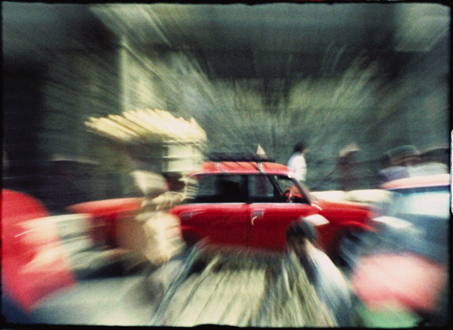
Thorsten Fleisch : Dromosphere
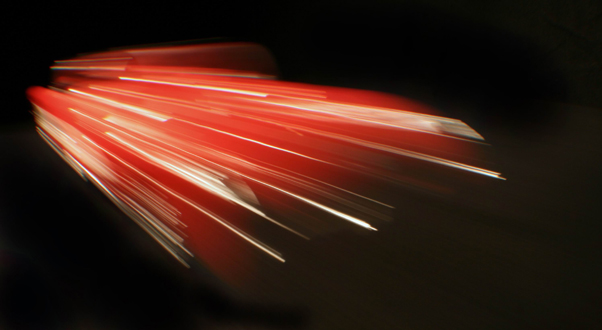
A research on the representation of four dimensional space-time – described by Albert Einstein in his theory of special relativity – led to the making of this audiovisual sculpture of speed. Using a scale model of a sports cars and a dolly synchronised to the shutter of the camera, Fleisch has produced a capturing visualisation of the phenomenon of speed, which playful references to Paul Virilio and Jeremy Clarkson.

Mark Formanek & Datenstrudel : Standard Time
The recording of a performance in which 70 workers assemble and reassemble a 4 x 12 m wooden replica of a “digital” clock that displays the “real” time: a task that involves 1611 changes over a 24-hour period. This installation offers an ironic comment on the tension between labour, technology and temporality. What better way to waste time than by marking its passage?

impakt_web5.jpg

SCREENINGS
16 – 18.10.2009
Filmtheater ’t Hoogt

“Take some time, take some more, time is passing, the time of your life, the earth rotates, seasons come and go, the machine sorts zeros from ones, as another thousand tiny bursts of phosphorescent light dance to the rhythm of the wind and the tide.”
– Chris Welsby

It seems as if time is increasingly out of joint. We no longer experience time as a succession or an acceleration of events, but rather as something adrift in a fragmented world of information stimuli, out of the realm of chronology and linearity. What is the impact of this evolution on our perception patterns? How do the different internal, natural, social and technological rhythms relate to each other and influence our daily sensory perception? What is the role and potential of cinema, together with music, the art form most particularly devoted to the shaping force of time? These and other questions will be explored through a series of contemporary and historic film and video works addressing the relation between space, movement, technology and (our experience of) time.

With works by Gary Beydler, Bruce Conner, Ivan Ladislav Galeta, Chris Garrat, Dryden Goodwin, Dominique Gonzalez-Foerster, Jean–François Guiton, Gerard Holthuis, Philip Hoffman, Peter Hutton, Ken Jacobs, Jim Jennings, Kurt Kren, Malcolm Le Grice, Mark Lewis, Jeanne Liotta, Rose Lowder, Gordon Matta-Clark, Pavel Medvedev, Marie Menken, Dietmar Offenhuber, Rafael Montañez Ortiz, Yo Ota, D.A. Pennebaker, Ilppo Pohjola, Michel Pavlou, Artavazd Pelechian, Norbert Pfaffenbichler, William Raban, Joost Rekveld, Nicolas Rey, Emily Richardson, Guy Sherwin, Morten Skallerud, Michael Snow, Stom Sogo, Scott Stark, Makino Takashi, Leslie Thornton, Andrei Ujica, Chris Welsby, Joyce Wieland, Fred Worden, Iván Zulueta.

impakt_web6.jpg

EVENTS

OPENING NIGHT
14.10.2009
Theater Kikker

“We will sing of the multicolored, polyphonic tides of revolution in the modern capitals; we will sing of the vibrant nightly fervor of arsenals and shipyards blazing with the violent electric moons; greedy railway stations that devour smoke-plumed serpents; factories hung on clouds by the crooked lines of their smoke.”
– F. T. Marinetti, ‘Futurist Manifest’

Thomas Köner : The Futurist Manifest

The work of media artist Thomas Köner cannot be easily categorised. For years he was active as a sound engineer, before his project Porter Ricks caused a stir in the European techno landscape of the 1990s. In filmmaker Jürgen Reble he found the perfect collaborator to pursue his interest in the symbiosis of visual and auditory experiences. All these different influences come together in Köner’s recent work, in which his fascination for tone colour has expanded to the moving image, resulting in a series of acclaimed performances and installations. Prompted by the festival theme of “Accelerated Living” and the hundredth anniversary of the Futurist Manifesto, he has composed an “opera digitale” for Impakt, which will be performed with a prepared piano, a digital ”noise orchestra” and a female singer. The sonic sediments of one hundred years of industrialisation and acceleration will be condensed in a multidimensional audiovisual space, where image and sound interact as if “time and space died yesterday”.

Carl Faia: prepared piano & live electronics
Iris Garrelfs: voice & live electronics
Thomas Koner: laptop noise orchestra, visuals

An Impakt production

impakt_web7.jpg

15.10.2009
Theater Kikker

DOPES TO INFINITY

“I have something more cosmic in mind
It’s a warpage of time and it’s bliss for everyone”
– Monster Magnet, ‘Dopes to Infinity’

Guy Sherwin
A key figure in British avant-garde cinema, Guy Sherwin pushes the limits of cinema with his films, installation works and performances, in which he explores film’s fundamental properties: light and time. Since the 1970s he has been working on a series of studies on the illusion of movement and stasis experienced during train travel. For Impakt, he will present a selection of his “train films” in the form of an expanded film performance.

Dirk de Bruyn + Joel Stern
In his work, filmmaker and media artist Dirk de Bruyn deals with the disorientating and traumatic experience of media-saturated environments. His performance ‘LanterNfanten’ for three projectors creates an absorbing space where time is disturbed and compressed as a kind of personal research on bodily trauma and cultural displacement. It will be accompanied by a live soundtrack from composer Joel Stern, merging music concrète, art brut and noise.

Core of the Coalman
Core of the Coalman is one of the alter egos of composer and visual artist Jorge Boehringer, a project in the musical no man’s land between power electronics, noise and contemporary classical music. With violin, his voice and electronics he builds sonic architectures hovering on the edge between chaos and order.

Bruce McClure
A film projector is not only a source of light but also of sound. Nobody understands this better than Bruce McClure who with his immersive performances for multiple projectors creates a pure sensory game of pulsating rhythms and shadows, well beyond the borders of cinematographic time and space. For Impakt he has prepared a unique two-hour performance, which is sure to provide a hypnotic and overwhelming experience.

kode9.jpg

16.10.2009
Tivoli de Helling

SPEED TRIBES

“It is not just a matter of music but of how to live: it is by speed and slowness that one slips in among things, that one connects with something else. One never commences; one never has a tabula rasa; one slips in, enters in the middle; one takes up or lays down rhythms.”
– Gilles Deleuze

Mount Kimbie + James Blake
British breakbeat culture is alive and kicking. The explosion of dubstep has provoked a plethora of sound experiments and cross-overs from which a fresh sound emerges from time to time. One of those surprises is London duo Mount Kimbie who inject melancholic pop sensibility and hybrid rhythmic patterns into dubstep. They are joined live by vocalist James Blake whose exciting debut reconciles jazz, soul and a taste for melodrama with the sound of the imploding metropolis.

Cooly G
This protégé of the cutting edge Hyperdub label drew the attention of the so-called « UK funky » scene last year. It’s not surprising : her spicy but contagious mixture of deep house and dubstep, seasoned with bitter sweet vocals and subtle touches of acid and hardcore is, without a doubt, a fresh wind in the the British club culture. Tribal rhythms and woozy synth chords, deep basses and aching sighs, light vibes and dark undertones : it’s precisely these contrasts that make her music so irresistible!

The Bug + Flowdan
The man behind The Bug is Kevin Martin, who has been reinterpreting industrial, dub and breakbeat since the 1990s. His fascination for intense and dark mutations of electronic rhythms and sub-harmonic frequencies was already present in earlier projects such as God, Techno Animal and Ice. The Bug is the culmination of all these influences : a highly personal exploration of bass culture, with a sound that he self-described as “warped ragga meets heavy electronic dub”. His most recent release London Zoo was praised by several media as one of the most important albums of 2008. MC Flowdan, a key figure of East London’s grime scene, will accompany The Bug as guest artist.

Kode9
In recent years Steve Goodman aka Kode 9 has established himself as one of the most influential names in contemporary electronic music culture. A music producer, theorist and the owner of the celebrated Hyperdub label, he obstinately continues to explore the big city’s sonic fabric, its energy fields and rhythms. Movement, vibration, exaltation, emotion: Kode 9’s music acts like a hyper urban virus that mercilessly gets into our central nervous system.

+ DJ Sonido del Principe (Generation Bass)

impakt_web8.jpg

17.10.2009
Theater Kikker

ECSTATIC MUTATIONS

“Below the level of sounds and rhythms, music acts upon a primitive terrain, which is the physiological time of the listener. (…) Because of the internal organization of the musical work, the act of listening to it immobilizes passing time; it catches and enfolds it as one catches and enfolds a cloth flapping in the wind.”
– Claude Lévi-Strauss

Thomas Brinkmann
Thomas Brinkmann is one of the foremost figures of the minimal techno movement, which has influenced contemporary music production since the 1990s. His fascination for programmatic and rhythmic structures finds its roots in his background as a drummer and his training as a visual artist, and most particularly in the influence of Minimalism’s principle of reduction. The result is a vast oeuvre of mathematically refined scores made of complex grooves, overtones and doppler effects. In Utrecht he will present for the first time a completely improvised « klick » performance with 8 turntables, a series of vinyl records and a knife.

Arnold Dreyblatt Ensemble
The musical exploration of Dreyblatt, a student of the first generation of New York minimalist composers, is driven by an inclination for rhythmic complexity built on resonance and vibration. During the past decades he has developed a number of new instruments, tuning systems and performance techniques, with which he digs even deeper under the rhythmic surfaces in order to find a rich dynamics of textures and timbers. His work remained obscure for years, until it was brought to attention by musicians such as Jim O’Rourke who described one of his albums as “the first genuinely new sound in maybe 10 years”. He has recently brought together an ensemble with Jörg Hiller, Joachim Schutz and Robin Hayward, which will offer a rare not-to-be-missed concert during Impakt.

Arnold Dreyblatt: Composer, Excited Bass, Laptop
Jörg Hiller: Drums, Automated Electric Guitar
Joachim Schutz: Electric Guitar
Robin Hayward: Amplified Tuba

Oren Ambarchi + Robbie Avenaim
Oren Ambachi uses the electro-acoustic transformation of his guitar as a laboratory for tonal research. The result is an abstract and fragile sound world that continuously searches the borders of time and space. He regularly collaborates with different musicians such as Fennesz, Keith Rowe en sunn0))). This time he will be reunited with his long-time friend percussionist Robbie Avenaim, who explores the limits of the sound spectrum using modified and motorised drums. Together they create a visceral and kinetic audiovisual experience.

cello.jpg

SPECIAL EVENTS

“Time is the substance of which I am made. Time is a river which sweeps me along, but I am the river; it is a tiger which mangles me, but I am the tiger; it is a fire which consumes me, but I am the fire.”
– J.L. Borges

18.10.2009
Theater Kikker

Charles Curtis, Carol Robinson & Bruno Martinez
Eliane Radigue’s Naldjorlak I, II, III

The work of French composer Eliane Radigue is first and foremost an exploration of the phenomenological reality of sound : the combination of matter, vibration and resonance which ultimately determines our experience of sound. She began to experiment with electronic feedback in the 1950s, before discovering her medium of choice, the analogue ARP synthesizer. Since 2004 she has composed exclusively for acoustic instruments. ‘Naldjorlak I’, in which the hidden, complex sonority of the cello is fathomed, was developed as a collaboration with renowned cellist Charles Curtis. For the following parts, she required the participation of basset-horn players Carole Robinson and Bruno Martinez. The result is a versatile and volatile sound world, which continuously balances on the verge of perception.

Charles Curtis: cello
Carol Robinson & Bruno Martinez: basset horns

16 – 17.10.2009
location tbc

Leif Inge : 9 Beet Stretch

There are few musical works that speak to the imagination as does Beethoven’s 9th Symphony. But although almost everyone in the Western world can easily hum its melody, this classic composition has not yet given away all its secrets. That’s what Norwegian artist Leif Inge does by digitally stretching out the piece to a length of 24 hours, unveiling its unknown and unheard dimensions. A marathon performance which is sure to provide a peculiar perception of time. In the words of a participant : “I thought I was a fly trapped in honey.”

impakt_web2.jpg

CONFERENCE

“In the sun that is young once only
Time let me play and be
Golden in the mercy of his means”
– Dylan Thomas, ‘Fern Hill’

15.10.2009
Filmtheater ‘t Hoogt

Contemporary science and technology have made possible a temporality which though still based upon clock time, has exploded into countless different time fractions and speeds beyond human comprehension. Today we seem to live in several time zones at the same time, propelled by a variety of internal and external time mechanisms and innumerable rhythms which continuously vibrate, resonate, connect, oscillate and disconnect. How to grasp the temporal complexity that surrounds and occupies us ? What sort of ecologies of time and speed have we developed under the influence of new technologies and what is their impact on our body and senses ? This conference brings together a number of international thinkers who offer new perspectives on our contemporary experience of time and speed.

A day-long programme including contributions by Mike Crang, Dirk de Bruyn, Charlie Gere, Steve Goodman, Glenn Kaino, Sybille Lammes, Carmen Leccardi, Stamatia Portanova, John Tomlinson, and others. In collaboration with the MA New Media & Digital Culture, Department of Media- and Culturestudies, Utrecht University.

deutinger_small.jpg


IMPAKT ONLINE
16.10.2009

Internet is often considered as “timeless”, an endless space of connected websites and data files, a media sphere where users can wander about blindly, unaware of time. At the same time we face a growing proliferation of spam, dead links, pop-ups and search queries that lead nowhere. How to define the experience and perception of time spent online? When is information “fresh” ? How do trends develop on the Web? How fast do they wear of? These are the issues addressed by the projects curated by Sabine Niederer for Impakt Online. During the Impakt Festival, these online art projects will be presented in the presence of the artists.

With contributions by Theo Deutinger, Constant Dullaart, Richard Rogers, Daan Odijk

Imagine

allthroughthenight-large.jpg

IMAGINE

CASZUIDAS Urban Screen Festival
4 & 5 September 2009, Zuidas, Amsterdam

Compiled by Courtisane for the first edition of CASZUIDAS Urban Screen Festival, Imagine is a selection of works and artists previously shown by Courtisane. Digital reveries and riddles, the video works in this programme seek to actively engage the « mental » participation of urban spectators, to throw them back upon themselves, opening up the limits of their sight to the freedom of their imagination. They imagine a new sensory language in which meaning is played with, but never denied. Between abstraction and playful transformation, distilling, reinterpreting popular media culture, these works leave way for the countless images generated by each spectator. Parallel worlds for the imagination of the spectator to wander around.

curated by Stoffel Debuysere and Maria Palacios Cruz, in cooperation with Courtisane.

Stephen Gray, Beep prepared, 2002, 5’ (UK)

gray2.jpg

“What is Road Runner without Willie E. Coyote, what is a cartoon without protagonists? What remains of the longest running and most existential series of sketches, once the actors have left the stage? Part one of a deconstructivist trilogy.”

Stephen Gray is a British visual artist. His body of work highlights the growing gulf between the direct and decisive nature of our media conventions and our traumatic, ridiculous and unruly everyday existence. He lives and works in Bristol.

Joseph Ernst, Hip-Hop Movie, 2008, 4’ (UK)

ernst.jpg

Transforming visual imagery into words, this video is a word for word translation of a stereotypical hip hop video. ‘Bling bling’ from a different point of view.

Joseph Ernst (UK, 1974) studied Architecture at the University of Edinburgh, Sci Arc in Los Angeles, and The Bartlett in London. Since 2000 he has worked as an art director at various advertising agencies in Amsterdam, Shanghai, and London producing work for clients such as Nike, Levis, Electronic Arts, Audi, and Coca Cola. Joseph has been directing since 2007. He currently lives and works in London.

Max Hattler, Collision, 2005, 02’30” (DE/UK)

hattler.jpg

Islamic patterns and American quilts, and the colours and geometry of flags as an abstract field of reflection.

Max Hattler (DE, 1976) graduated from the Royal College of Art with an MA in Animation in 2005 and went on to teach at Goldsmiths College, London and Volda University College, Norway. His films have been broadcast on television and screened at over one hundred film festivals around the world. Max also directs music videos. He lives and works in London and Berlin. Award for Best Experimental Film, Halloween Short Film Festival, London, 2006 Honourable Mention, Darklight Festival, Dublin, 2006 Special Mention, San Gio Festival, Italy, 2006.

David O’Reilly, RGB XYZ, 2005-2008, 13′ (IE)

oreilly.jpg

Discovered in late 2007 when a gardener accidentally dug up a hard drive buried somewhere in central Europe, RGB XYZ found its way to David O’Reilly, who compiled its five incomprehensible episodes into what became perhaps the most enigmatic piece of animation ever to leave a computer.

David O’Reilly (IE, 1985) is an animation artist based in Berlin. His unorthodox approach to animation is essentially straight-forward in intention: “I want every idea to justify existing in animation–to be ideas that would be useless in any other medium,” he explains. “Essentially I want to capture elements of life which could never be recorded by camera. If film is ideal for capturing a sense of reality, then animation offers the chance to embrace ideas of perception, which is an entirely different proposition.”

Simon Faithfull, 13, 2004, 5’25” (UK)

faithfull2.jpg

A melancholy journey through a strangely dissolving and pixelated landscape. Created from PalmPilot drawings made while walking along the A13 trunk road, the film presents the journey in the mind of a dog as it sniffs its way back to Barking. A road movie in a parallel universe, populated by ghost lorries in the night and suffused with the pathos of dying light. Sound by Joe Wilson of the Sneaker Pimps.

Simon Faithfull (UK, 1966) is lecturer at the Slade School of Art and lives in Berlin and London. His drawings, videos and installations have been in numerous national and international solo and group exhibitions.

Dave Griffiths, Rogue State, 2003, 02’20” (UK)

griffiths2.jpg

Vetoed UN resolutions hand-inscribed onto DV tape using a magnetic quill. Reinterpreted by the digital apparatus, these marks reveal abstract, lawless sonic and visual explosions – a fluid display of synthetic aerial terror. The action alludes to the shared nature of entertainment and military technology in seeking perfect spectacle whilst shunning error or uncertainty. Compressed light and sound are unleashed in volatile glitches to commemorate the abandonment of conventions in both the digital medium and international law.

Dave Griffiths is a British artist working with film, video, animation and sound. His film works dwell on the physical and fictive borders of media spaces and forms. He combines a rigorous attention to barely perceptible matter in moving images with an aesthetic study of their dramatic potential. Along with political and historical asides, the work is filtered through the languages and strategies of cinema and media art to attempt an ironic critique of our social bond with visual technologies.

Michael Robinson, All Through the Night, 2007, 6’ (US)

robinson.jpg

All Through the Night is described by Michael Robinson as a “charred visitation with an icy language of control; there is no room for love”. In this 4 minute digital video sequence, Robinson recontextualizes appropriated animation footage. In doing so, he successfully merges video effects into textures and glacial landscapes and creates his own kind of melancholic magic.

Since the year 2000, Michael Robinson has created a body of film, video and photography work exploring the poetics of loss and the dangers of mediated experience. His work has screened in both solo and group shows at a variety of festivals, cinematheques and galleries including the International Film Festival Rotterdam, The New York Film Festival, The Times BFI London Film Festival, Media City, Anthology Film Archives, Viennale, Cinematexas, The Wexner Center for the Arts, ICA London, Impakt, The Yerba Buena Center for the Arts, Chicago Filmmakers, PDX, and the San Francisco, Oberhausen, and Hong Kong International Film Festivals. Michael currently teaches filmmaking at Binghamton University.

Mary Helena Clark, And the Sun Flowers, 2008, 5′ (US)

clark.jpg

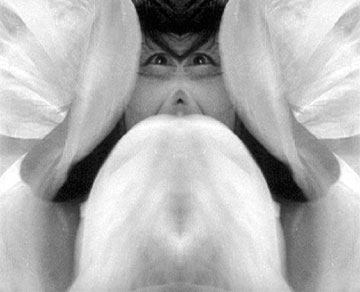
‘Henry James had his figure in the carpet, Da Vinci found faces on the wall. Within this Baltimore wallpaper: a floral forest of hidden depth and concealment, the hues and fragrance of another era. Surface decoration holds permeable planes, inner passages. There emerges a hypnotic empyrean flower, a solar fossil a speaking anemone, of paper, of human muscle, of unknown origin, delivering an unreasonable message of rare tranquillity.’ (Mark McElhatten)

Mary Helena Clark is a Baltimore-based filmmaker. Her short films have been shown at numerous international festivals including Rotterdam and Views of the Avant-Garde (New York).

Rebecca Baron & Doug Goodwin, Lossless #5, 2008, 3′ (US)

baron_goodwin2.jpg

Lossless is a series of works that looks at the dematerialization of film into bits, exposing the residual effects of the process that makes file sharing possible. Baron and Goodwin used several methods to alter these works, either interrupting the data streaming by removing basic information holding together the digital format or comparing 35 mm to DVD and examining the difference between each frame. The project considers the impact of the digital age on filmmaking and film watching, the materiality and demateriality of film as an artistic medium, as well as the social aspects of how the online community functions and the audience for such obscure films.

The films of Rebecca Baron (US, 1972) have screened widely in international film festivals and media venues including Documenta 12, Rotterdam, Viennale, Oberhausen, Cinémathèque Française, Anthology Film Archive and the Whitney Museum of American Art’s 2000 Biennial. Baron teaches documentary and experimental film at the California Institute of the Arts.
Douglas Goodwin is an artist and writer. His work investigates the mechanisms by which language and technology mediate the area between perception and reality. His work has shown in Los Angeles, Frankfurt, Boston, Seattle, San Francisco, and Denver.

Martijn Hendriks, The Birds without the birds (excerpt), 2007-ongoing, 3’ (NL)

hendriks2.jpg

Martijn Hendriks is fascinated by the potential of negation and the conditions under which a non-productive gestures becomes productive. By drawing the attention to what remains after the objects of our attention have been erased, sabotaged of shown to contradict themselves, he questions our relation to images and the expectations of visibility and availability. In recent video work such as This is where we’ll do it, a series of manipulated You Tube clips, or The Birds without the birds, in which he uses fragments from Hitchcock’s The Birds, the absence of essential elements from well known images brings unexpected notions to the foreground.

Martijn Hendriks’s (NL, 1973) videos, sculptures and installations are often the results of seemingly unproductive acts like displacements, theft, jokes, withholding things, disruptions, obstructions, overdoing things, and attempts at clearly impossible tasks. The work he shows rarely documents those actions directly. Rather, it is what is left over from them or produced by those acts. His work has been exhibited internationally in galleries, centres for contemporary art and museums of modern art, and in 2008 he received the international Kraft Prize for New Media for his ongoing work The Birds without the birds. He lives and works in Amsterdam.

Nicolas Provost, Papillon D’Amour, 2003, 03’30” (BE)

provost2.jpg

By subjecting fragments from the Akira Kurosawa’s film Rashomon to a mirror effect, Provost creates a hallucinatory scene of a woman’s reverse chrysalis into an imploding butterfly. This physical audiovisual experience produces skewed reflections upon Love, its lyrical monstrosities, and a wounded act of disappearance.

The work of Nicolas Provost (BE, 1969) is a reflection on the grammar of cinema and the relation between visual art and the cinematic experience. His short films have been awarded at prestigious festivals worldwide and he’s now busy with his first long feature film. He lives and works in Brussels.

Stewart Smith, Jed’s Other Poem, 2005, 3’ (US)

smith.jpg

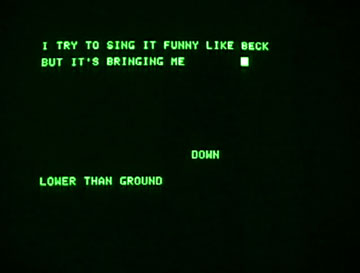
Stewart Smith programmed JED’S OTHER POEM, a music video for a Grandaddy song, in Applesoft II on a 1979 Apple ][+ with 48K of RAM. Seriously. Jeddy-3, a humanoid robot built from spare parts, is a recurring character in Grandaddy’s 2000 album “The Sophtware Slump”. According to Grandaddy, before Jed’s system crashed he wrote poems. Poems for no one.

Stewart Smith is an artist-programmer in New York City. He earned his MFA from Yale University in 2008 and operates Stewdio, a consultancy that approaches art and software through the lens of graphic design. Stewart has also taught introductory Web design at Yale and occasionally advises organizations exploring new interactive technologies and visualization techniques.

We are Time

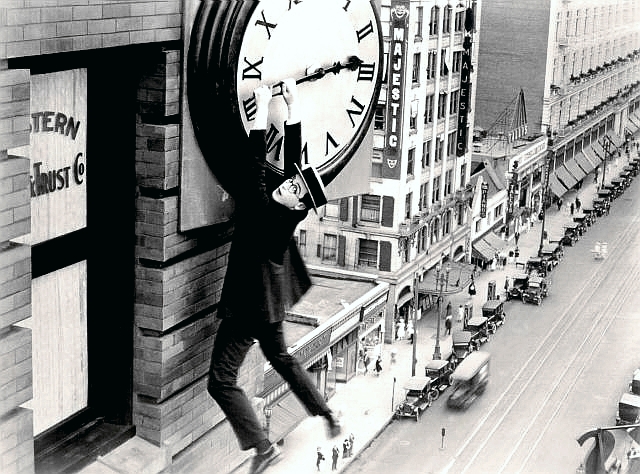
lloyd-harold-clock.jpg

“All will be now / Dreams are too fast / You are the first / We are the last
No sequence to follow / No fear of tomorrow / Kiss of neverness / Life of timelessness / We’ll break the speed of change / we’ll tame eternity”

The Pop group, ‘We Are Time’

We’re still working on the “Accelerated Living” program for the upcoming Impakt Festival (14-18 October) in Utrecht, which will deal with (changing) perceptions and conceptions of time and speed. How to grasp the temporal complexity that surrounds and occupies us ? What sort of ecologies of time and speed have we developed under the influence of new technologies and the spread of neo liberal globalisation, and what is their impact on our body and senses ? How to create time awareness? These are some of the questions the project will deal with. Here’s a recent source of inspiration, Franco Berardi “Post-Futurist Manifesto” (February 2009).

1. We want to sing of the danger of love, the daily creation of a sweet energy that is never dispersed.

2. The essential elements of our poetry will be irony, tenderness and rebellion.

3. Ideology and advertising have exalted the permanent mobilisation of the productive and nervous energies of humankind towards profit and war. We want to exalt tenderness, sleep and ecstasy, the frugality of needs and the pleasure of the senses.

4. We declare that the splendor of the world has been enriched by a new beauty: the beauty of autonomy. Each to her own rhythm; nobody must be constrained to march on a uniform pace. Cars have lost their allure of rarity and above all they can no longer perform the task they were conceived for: speed has slowed down. Cars are immobile like stupid slumbering tortoises in the city traffic. Only slowness is fast.

5. We want to sing of the men and the women who caress one another to know one another and the world better.

6. The poet must expend herself with warmth and prodigality to increase the power of collective intelligence and reduce the time of wage labour.

7. Beauty exists only in autonomy. No work that fails to express the intelligence of the possible can be a masterpiece. Poetry is a bridge cast over the abyss of nothingness to allow the sharing of different imaginations and to free singularities.

8. We are on the extreme promontory of the centuries… We must look behind to remember the abyss of violence and horror that military aggressiveness and nationalist ignorance is capable of conjuring up at any moment in time. We have lived in the stagnant time of religion for too long. Omnipresent and eternal speed is already behind us, in the Internet, so we can forget its syncopated rhymes and find our singular rhythm.

9. We want to ridicule the idiots who spread the discourse of war: the fanatics of competition, the fanatics of the bearded gods who incite massacres, the fanatics terrorised by the disarming femininity blossoming in all of us.

10. We demand that art turns into a life-changing force. We seek to abolish the separation between poetry and mass communication, to reclaim the power of media from the merchants and return it to the poets and the sages.

11. We will sing of the great crowds who can finally free themselves from the slavery of wage labour and through solidarity revolt against exploitation. We will sing of the infinite web of knowledge and invention, the immaterial technology that frees us from physical hardship. We will sing of the rebellious cognitariat who is in touch with her own body. We will sing to the infinity of the present and abandon the illusion of a future.

Continuous Music

10545-kmh.jpg

This is kind of an addition to my Minimalist post, which focussed on a series of used-to-be-obscure recording of so-called “minimal” music. Thanks to New World Records – who have also reissued pearls by the likes of Julius Eastman and Peter Zummo – another “lost classic” has been given a new life: ‘KMH – Piano Music in the Continuous Mode’, Lubomyr Melnyk’s debut album from 1979. According to Wikipedia Melnyk “pioneered ‘continuous music’ which employs extremely rapid arpeggios of varying duration, repeated with the sustain pedal to generate overtones and sympathetic resonances. These overtones blend or clash according to the harmonic change in the arpeggios according to a harmony based on Melnyk’s personal geometric models and often create a sombre, stately effect. He is also the fastest pianist in the world, sustaining speeds of over 19.5 notes per second in each hand. In addition he has the record for most number of notes played in one hour with 93,650 individual notes played.” His music has been described by critics as ”the play of atoms bouncing around at supersonic speeds!”. On his personal website (tagline: “first there came Franz Lizst ….. then came LUBOMYR (-: ), it is explained that Melnyk’s Continuous Music is “based on the principle of a ‘continuous’ and unbroken line of sound from the piano — this is created by generating a constant flow of rapid (at times EXTREMELY rapid) notes, usually with the pedal sustained non-stop. The notes can be either in the form of patterns or as broken chords that are spread over the keyboard. To accomplish this requires a special technique, one that usually takes years to master — this technique is the very basis of the meditative and ‘metaphysical’ aspects within the music and the art of the piano.” Although Melnyk’s earlier music was generally classified as ”Minimalism”, Melnyk prefers to call his music ”MAXIMALism”, since the player has to generate so many, many notes to create these ”Fourth Dimensions of Sound”. On the site it also states that “people have often said that, during live performances, they heard trumpets, horns, entire string orchestras emanating from the piano … for Melnyk’s music turns the piano into a veritable orchestra of sound”. Unfortunately, according to Melnyk this sound experience is lost in the digital processing, since the overtones no longer can live freely in their high dimensions, but are, as he puts it, ”plucked out like random feathers off a chicken, leaving the once so beautifully feathered surface, splotched and scabbed with tiny sores” (see here for more explanation). But anyways, here’s some samples…

This is part 5 of ‘KHM’ (available here for try-outs)
[audio:http://chicago1.binarybooty.com/x/$vzQQnzdUunBkn6SnbBdS8tgKCg4crfSo/061dd01aa6/05 – Lubomyr Melnyk – five kmh.mp3]

Also check out this sample of his ‘Voice of Trees’ (1985), a great piece for 3 Tubas and 2 Pianos, composed for choreographer/dancer Kilina Cremona. (available here for try-outs).
[audio:http://www.lubomyr.com/musik/VcOfTrees.%20Pt2-%20B.mp3]

Melnyk is still active, by the way. Here’s an interview he did in March this year, on the occassion of a concert he gave in Halifax. Time to get this man over here…

Update: here’s another interview, conducted by Jon Mueller.