Shadows of the Unseen 1 – 4

Smith

In these Corona stricken times I have been enjoying compiling some mixtapes based on sound and music originally made for, related to, or part of cinematic works. I have particularly, but hardly exclusively, been delving into the work of – in desperate lack of a better word – “leftfield” composers and sound artists related to cinema, a beloved area of interest that I was happy to revisit and expand on this occasion. Amongst the pieces assembled here you will find some fragments of soundtracks that, unfortunately, have not yet been given a proper release, notably work by Basil Kirchen (although a lot of his music has been released or reissued lately, this is not yet the case for his excellent soundtrack for Jack Cardiff’s The Freakmaker), Jack Nitzsche (for Greaser’s Palace and by extension all the work he did with Robert Downey Sr.), Mario Nascimbene (especially for Shadi Abdel Salam‘s Al Mummia and Roberto Rosselini’s Socrates – although some parts were released on the compilation LP Psycorama), Brian Eno (most of his early soundtrack work can be found on his Music for Films LP’s, but not for Kostas Karagiannis’ Land of the Minotaur – or Malcolm Le Grice’s Berlin Horse, for that matter), Philippe Arthuys (in particular the thrilling organ score for JL Godard’s Les Carabiniers, but also the pieces he made for Rosselini or Rivette, amongst others), Jôji Yuasa (notably for Toshio Matsumoto’s Funeral Parade of Roses), Barney Wilen (score for Caroline de Bendern’s A l’intention de Mlle Issoufou à Bilma – a kind of twin project to his great Moshi LP – but also his collaboration with Sunny Murray for Serge Bard’s Fun and Games for Everyone), Horace Tapscott & The Pan-Afrikan Peoples Arkestra (for Larry Clark’s films), Trevor Mathison (his wonderful work with the Black Audio Film Collective), Phil Kline (for Sara Driver’s films), Meredith Monk (especially for her Ellis Island), Steve Reich (for Lutz Mommartz’s 3 Gläser but also some of Robert Nelson’s films), Beatriz Ferreyra (for Fiorella Mariani’s under-appreciated Homo Sapiens), Krishan Mueller and José Maceda for Kidlat Tahimik’s Perfumed Nightmare, and much more. Some of these soundtracks were released in limited edition and have been long out of print, for example Toshi Ichiyanagi’s music for Yoshishige Yoshida’s Eros + Massacre, Günter Schickert’s compositions for a film by Sabine Franck-Koch, or Richard Landry’s pieces for Lawrence Weiner’s A First Quarter (and what on earth happened to the soundtrack for Weiner’s A Bit of Matter and a Little Bit More, scored by the all too forgotten Marzette Watts?)… Others have only very recently seen the light of day, such as Sam Waymon and Carman Moore’s compositions for Bill Gunn’s films Ganja & Hess and Personal Problems (thanks to Strange Disc records and Reading Group), Delia Derbyshire and Elsa Stansfield’s work for Circle of Light (Trunk records) or Henning Christiansen’s pieces for film (Penultimate Press), just to name a few.

In any case, the pleasure of discovery has all but subsided and a Belgian edition is in the works, so stay tuned!

Thanks to Sabzian for publishing!

Tracklist
1. Mario Nascimbene – Socrate [Socrates] (Roberto Rossellini, 1971)
2. Toru Takemitsu – Moetsukita chizu [The Man Without a Map or The Ruined Map] (Hiroshi Teshigahara, 1968)
3. Phil Kline – Your Are Not I (Sara Driver, 1981)
4. Henning Christiansen – Eftersøgningen [The Search] (ABCinema, 1969)
5. Alan R. Splet, David Lynch, Peter Ivers – Eraserhead (David Lynch, 1977)
6. Frans Zwartjes – Living (Frans Zwartjes, 1971)
7. Otomo Yoshihide – Yûheisha – terorisuto [Prisoner – Terrorist] (Masao Adachi, 2007)
8. Trevor Mathison – Expeditions (Black Audio Film Collective, 1983-1984)
9. Cabaret Voltaire – Chance Versus Causality (Babeth Mondini, 1979)
10. Sally Smmit (Timms), Pete Shelley – Hangahar (unknown, 1979)
11. Psychic TV – Pirate Tape (Derek Jarman, 1987)
12. Mika Vainio – Mannerlaatta [Tectonic Plate] (Mika Taanila, Mannerlaatta, 2016)
13. Vittorio Gelmetti, Giovanni Fusco – Il deserto rosso [Red Desert] (Michelangelo Antonioni, 1964)
14. Meredith Monk – 16 Millimeter Earrings (Robert Withers, 1966)
15. Pierre Henry – Maléfices [Where the truth lies] (Henri Decoin, 1962)
16. Jean Prodromides – Et mourir de plaisir [Blood and Roses] (Roger Vadim, 1960)
17. Pierre Barouh, Francis Lai – Un homme et une femme [A Man and a Woman] (Claude Lelouch, 1966)
18. Victor Young – Johnny Guitar (Nicholas Ray, 1954)
19. Walter Schumann – The Night of the Hunter (Charles Laughton, 1955)
20. François de Roubaix – Les lèvres rouges [Daughters of Darkness] (Harry Kümel, 1971)
21. Can – Tote Taube in der Beethovenstraße [Dead Pigeon on Beethoven Street] (Samuel Fuller, 1973)
22. Haruomi Hosono – Paradaisu byû [Paradise View] (Go Takamine, 1985)
23. John Carpenter – Assault on Precinct 13 (John Carpenter, 1976)
24. Klaus Schulze – Next of Kin (Tony Williams, 1982)
25. Jack Smith, John Cale, Tony Conrad – Silent Shadows on Cinemaroc Island (1964)
26. Mike Ratledge – Riddles of the Sphinx (Laura Mulvey & Peter Wollen, 1977)
27. Terry Riley – Lifespan (Alexander Whitelaw, 1976)
28. Neil Young – Dead Man (Jim Jarmusch, 1996)
29. Nouvelle Vague (Jean-Luc Godard, 1990)
30. Bruce Langhorne – The Hired Hand (Peter Fonda, 1971)
31. Star Spangled to Death (Ken Jacobs, 2004)
32. Albert Marcœur – Deux lions au soleil (Claude Faraldo, 1980)
33. Idea Fire Company & BRRR – The Terrible Comet Salt (Timothy Shortell, 2000)
34. Star Spangled to Death (Ken Jacobs, 2004)

Tracklist
1. Putney Swope (Robert Downey Sr., 1969)
2. Fiorucci Made Me Hardcore (Mark Leckey, 1999)
3. Coil, Simon Fisher Turner – Blue (Derek Jarman, 1993)
4. Jim O’Rourke – Kaien Hoteru burû [Kaien Hotel Blue] (Kôji Wakamatsu, 2012)
5. Alessandro Alessandroni (1972, from library music collection)
6. George Auric, Isla Cameron and The Raymonde Singers – The Innocents (Jack Clayton, 1961)
7. Brian Gascoigne, David Briscoe, David Vorhaus – Phase IV (Saul Bass, 1974)
8. Goblin – Tenebre [Tenebrae] (Dario Argento, 1982)
9. Coil – Blue (Derek Jarman, 1993)
10. Conrad Schnitzler (1975, from ‘Filmmusik’ collection)
11. Bernard Parmegiani – Rock (Michel Treguer, 1982)
12. Edvard Graham Lewis – All Under (Gunilla Leander, 2003)
13. Steve Reich – 3 Gläser (Lutz Mommartz, 1967)
14. Jim O’Rourke – Not Yet (Jim O’Rourke, 2003)
15. Jim O’Rourke – Kaien Hoteru burû [Kaien Hotel Blue] (Kôji Wakamatsu, 2012)
16. Ennio Morricone – Un uomo da rispettare [The Master Touch] (Michele Lupo, 1972)
17. Toshi Ichiyanagi – Eros + Massacre (Yoshishige Yoshida, 1969)
18. Little Murders (Alan Arkin, 1971)
19. Claudio Gizzi – Blood for Dracula or Andy Warhol’s Dracula (Paul Morrissey, 1974)
20. Vladimir Ussachevsky (1960, from educational audiovisual ‘Music Appreciation Series’)
21. Jack Nitzsche – Cutter’s Way (Ivan Passer, 1981)
22. Nino Rota – Il Casanova di Federico Fellini [Fellini’s Casanova] (Frederico Fellini, 1976)
23. Nico, Ari Boulogne – La cicatrice intérieure (Philippe Garrel, 1972)
24. Beatriz Ferreyra – Homo Sapiens (Fiorella Mariani, 1971-1974)
25. Sun Ra and his Solar Arkestra – The Magic Sun (Phill Niblock, 1966)
26. Bernard Parmegiani – Je, tu, elles (Peter Foldes, 1969)
27. Frans Zwartjes (unknown, from archival collection)
28. Charley Cuva – Putney Swope (Robert Downey Sr., 1969)
29. Jack Smith – Star Spangled to Death (Ken Jacobs, 2004)
30. The Velvet Underground – Walden: Diaries, Notes, and Sketches (Jonas Mekas, 1964)
31. Angus Maclise – The Invasion of Thunderbolt Pagoda (Ira Cohen, 1968)
32. Popul Vuh – Nosferatu: Phantom der Nacht (Werner Herzog, 1979)
33. Terry Riley – Lifespan (Sandy Whitelaw, 1975)
34. Franco Falsini – Naso Freddo [Cold Nose] (Filippo Milani, 1975)
35. If There Be Thorns (Michael Robinson, 2009)
36. Krishan Mueller, José Maceda – Mababangong Bangungot [Perfumed Nightmare] (Kidlat Tahimik, 1977)

Tracklist
1. Basil Kirchen – The Freakmaker or The Mutations (Jack Cardiff, 1974)
2. Alice in Wonderland (Jonathan Miller, 1981)
3. Delia Derbyshire, Elsa Stansfield – Circle of Light (Anthony Roland & Pamela Bone, 1972)
4. John Cage – Dreams That Money Can Buy (Marcel Duchamp segment) (Hans Richter, 1947)
5. Meredith Monk – Ellis Island (Bob Rosen & Meredith Monk, 1981)
6. Meredith Monk, David Byrne – True Stories (David Byrne, 1986)
7. Joe Hisaishi – Sonatine (Takeshi Kitano, 1993)
8. Tangerine Dream – Risky Business (Paul Brickman, 1983)
9. Kurt Stenzel – Dune (Alejandro Jodorowsky, 1974, film never realized)
10. Günter Schickert – In den Zeichen (Sabine Franck-Koch, 1981)
11. Ash Ra Tempel – Le berceau de cristal (Philippe Garrel, 1976)
12. Eugeniusz Rudnik – Szychta (Jerzy Kalina, 1988)
13. Bruce Gilbert – Swamp (Charles Atlas, 1986), based on Do You Me? I Did (choreography by Michael Clark, 1984)
14. Why Do Things Get in a Muddle? (Come on Petunia) (Gary Hill,1984)
15. Luc Ferrari – Chronopolis (Piotr Kamler, 1983)
16. Don Cherry, Karl Berger, Anthony Braxton – Don Cherry (Jean-Noël Delamare, Nathalie Perrey & Philippe Gras, 1967-1969)
17. Ornette Coleman, Marianne Faithfull – Who’s Crazy? (Thomas White & Allan Zion, 1966)
18. Keith Waithe, Martin Carter – The Terror and The Time (Victor Jara Collective, 1977)
19. Ornette Coleman – Who’s Crazy? (Thomas White, Allan Zion, 1966)
20. Howard Shore, Ornette Coleman, The London Philharmonic Orchestra – Naked Lunch (David Cronenberg, 1991)
21. La rabbia [The Anger] (Pier Paolo Pasolini, 1963)
22. Trevor Duncan – La jetée (Chris Marker, 1962)
23. Minnie and Moskowitz (John Cassavetes, 1971)
24. Sandro Brugnolini (1972, from library music collection)
25. Masahiko Sato – Kanashimi no Belladonna [Belladonna Of Sadness] (Eiichi Yamamoto, 1973)
26. François de Roubaix – Dernier domicile connu [Last Known Address] (José Giovanni, 1970)
27. Jack Nitzsche – Greaser’s Palace (Robert Downey Sr., 1972)
28. Jack Nitzsche – Moment to Moment or Two Tons of Turquoise to Taos Tonight (Robert Downey Sr., 1975)
29. David Shire – The Conversation (Francis Ford Coppola, 1974)
30. Mario Nascimbene – Al Mummia [The Night of Counting the Years] (Shadi Abdel Salam, 1969)
31. Brian Eno – Land of the Minotaur or The Devil’s Men (Kostas Karagiannis, 1976)
32. Sam Waymon – Ganja & Hess (Bill Gunn, 1973)
33. Kevin Drumm – In Order Not To Be Here (Deborah Stratman, 2002)
34. Stephen O’Malley, Randall Dunn, Jóhann Jóhannsson – Mandy (Panos Cosmatos, 2018)
35. Basil Kirchen – The Freakmaker or The Mutations (Jack Cardiff, 1974)
36. Delia Derbyshire, Elsa Stansfield – Circle of Light (Anthony Roland & Pamela Bone, 1972)
37. Ravi Shankar – Alice in Wonderland (Jonathan Miller, 1981)

Tracklist
1. Jimmy Giuffre – This Island (Leo Hurwitz & Peggy Lawson, 1970)
2. Teresa Luciani (from library music collection, 1972)
3. Suzanne Ciani – Untitled (Ronald Mallory, 1973)
4. Iannis Xenakis – Orient-Occident (Enrico Fulchignoni, 1960)
5. Harry Partch – Windsong (Madeline Tourtelot, 1958)
6. Roy Budd – The Internecine Project (Ken Hughes, 1974)
7. Basil Kirchin, John Coleman, Jack Nathan, Lindsey Moore – I Start Counting (David Greene, 1970)
8. Jôji Yuasa – Bara no Sōretsu [Funeral Parade of Roses] (Toshio Matsumoto, 1969)
9. Touch of Evil (Orson Welles, 1958)
10. Philippe Besombes – Libra (Groupe Pattern, 1975)
11. Philippe Arthuys – Les carabiniers (Jean-Luc Godard, 1963)
12. Henning Christiansen – Skarpretteren [The Executioner] (Ursula Reuter Christiansen, 1971)
13. Jon Appleton – Scene Unobserved (Jon Appleton, Wayne Wadhams, Pierre Payne & John Mellquist, 1969)
14. Vladimir Ussachevsky – No Exit (Tad Danielewski & Orson Welles, 1962)
15. Lejaren Hiller – Pogányok ideje [Time of the Heathen] (Peter Kass, 1962)
16. Mesias Maiguashca – Dort wo wir Leben [The World We Live In] (unknown, 1967)
17. Bernard Herrmann – The Day the Earth Stood Still (Robert Wise, 1951)
18. Lalo Schifrin – THX 1138 (George Lucas, 1971)
19. Edward Artemiev – Soylaris [Solaris] (Andrei Tarkovsky, 1972)
20. Aminadav Aloni – Once (Morton Leonard Heilig, 1973)
21. Charles Wain – The Last Wave (Peter Weir, 1977)
22. Body and Soul (Robert Rossen, 1947)
23. Giorgio Moroder – Scarface (Brian De Palma, 1983 – own wrecked version)
24. None Shall Escape (André De Toth, 1944)
25. Rino de Filippi (from library music collection, 1978)
26. Teresa Luciani (from library music collection, 1972)
27. Dick Raaijmakers – Bekaert: het andere woord voor staaldraad (industrial film, 1966)
28. Tom Dissevelt – Glas (Bert Haanstra, 1958)
29. Jean Guérin – Bof… Anatomie d’un livreur (Claude Faraldo, 1971)
30. Barney Wilen – A l’intention de Mlle Issoufou à Bilma (Caroline de Bendern, 1971)
31. Art Ensemble of Chicago – Les stances à Sophie (Moshé Mizrahi, 1970)
32. Jean-Charles Capon, Baroque Jazz Trio – Midi Minuit (Pierre Philippe, 1970)
33. Horace Tapscott & The Pan-Afrikan Peoples Arkestra – As Above, So Below (Larry Clark, 1973)
34. Bush Mama (Haile Gerima, 1975)
35. Sam Waymon, Carman Moore – Personal Problems (Ishmael Reed, Bill Gunn, 1980)
36. Adele Bertei, The Red Krayola (Susan Carena Whitby, Georgina Mary Birch, Epic Soundtracks, Mayo Thompson) – Born in Flames (Lizzie Borden, 1983)
37. Tell Them Willie Boy is Here (Abraham Polonsky, 1969)
38. Richard Landry – A First Quarter (Lawrence Weiner, 1975)
39. Cyclobe (Stephen Thrower & Ossian Brown) – Death Bed: The Bed That Eats (George Barry, 1977)
40. John Duncan – Move Forward (John Duncan, 1984)

ARTIST IN FOCUS: Kevin Jerome Everson

Curated by Stoffel Debuysere for the Courtisane Festival 2020 and CINEMATEK, but cancelled due to COVID.

“My work must project and reveal the materials, procedure and process. I believe that this approach is not necessarily important to be noticeable to the viewer; it merely explains how I continue to approach the craft of art making. I firmly believe that the materials of the work must be noticeable. Procedure is the formal quality I am exploring with the work. The process is the execution of the formal quality. Once I have a grasp of procedure, the process becomes a discipline.”

Material, procedure and process: for the artist-filmmaker Kevin Jerome Everson, these three words define the core of his artistic approach. It is with this approach, grounded in an early preference for minimalism and a background in sculpture and street photography, that he knows like no other how to evoke the poetics of the lives and experiences of working-class African-American communities. Rather than pursuing conventional realism, he elects to abstract everyday expressions into theatrical gestures and to choreograph prosaic situations as artificial compositions. Rather than seeking a classical narrative form, he tends, more and more, towards pure abstraction.

Living and teaching in Virginia but born and raised in Mansfield, Ohio, as the child of parents who came from Mississippi during the Great Migration, Everson makes films that are inextricably linked to the socio-economic conditions and histories of the Midwest and South of the United States. The place-specific conditions of work, migration, language and culture form the primary material from which he derives his subjects, whereby he pays a great deal of attention to the concrete gestures and customs that are brought about by those conditions. From Taylorian labour rituals to Spartan sports exercises, from the agility of rodeo riders to the dexterity of street magicians, Everson focuses pre-eminently on the performative qualities expressed by gestures, expressions and interactions that all too often go unnoticed and undervalued. The films not only suggest the unrelenting cycle of everyday life but also the beauty, dignity and skill that lie within it. “The people on screen are always smarter than the viewer,” he notes, “so the viewer has to catch up.”

Everson’s esteem for work and craftsmanship can also be seen in his own artistic practice and work ethic. In over twenty years, he has produced a continuously growing body of work of more than 170 short films and a dozen full-length films, which time and again stand out for their exceptional care for the specificities of place, movement, speech and form. A look at the life of black communities near Lake Erie is organized as a structural composition (Erie), a portrait of polling stations in Charlottesville, Virginia, can be experienced as a “flicker film” (Tonsler Park), a demonstration of consumer products manufactured in Mansfield, Ohio, takes on the allure of a Kerry James Marshall painting (Westinghouse). Constantly juggling between reality and artificiality, materiality and narrativity, Everson displays an ever-increasing skill in the art that was once aptly described by another craftsman as “sculpting in time”.

——

PROGRAM 1

Eason
Kevin Jerome Everson, US, 2016, HD, 15′

Part of the one-hundred anniversary of the great Black migration in Philadelphia, Pennsylvania, Eason is loosely based on the life of James Walker Hood Eason (1886-1923) a long time member of the UNIA of Philadelphia.

The Reverend E. Randall T. Osborn, First Cousin
Kevin Jerome Everson, US, 2007, HD, 4′

One of Everson’s signature archival films that reveal the construction of performance and portrayal in a minimally edited interview with Martin Luther King’s first cousin about police brutality during race riots in Cleveland Ohio.

According to …
Kevin Jerome Everson, US, 2007, HD, 9′

With a rich source of found and original footage, this short film presents several versions of tragic events in the rural South.

Second and Lee
Kevin Jerome Everson, US, 2008, HD, 3′

A cautionary tale about when not to run. It uses archival reportage and voiceover recollection to trace through repetitive corridors of presumption, justice and judgment.

Ears, Nose & Throat
Kevin Jerome Everson, US, 2016, HD, 10′

In Kevin Jerome Everson’s deeply affecting Ears, Nose and Throat, a woman’s testimonial faculties are confirmed through medical examinations before she recites a tragic story, whose horrors we don’t see, hear, or smell, but can imagine far too easily.

IFO
Kevin Jerome Everson, US, 2017, HD, 10′

In Mansfield, Ohio, multiple UFO sightings yield both passionate firsthand accounts and detailed reflections; meanwhile, suburban youths raise their arms toward the heavens in becalmed surrender.

Recovery
Kevin Jerome Everson, US, 2020, HD, 10′

About an Airman training to be a pilot at Columbus Air Force Base 14th Flying Training Wing in Columbus, Mississippi.

——

PROGRAM 2 – Black Fire UVA

Over the last half-dozen years, Kevin Jerome Everson and Claudrena N. Harold have collaborated with their students on a series of films that examine the history of African American students and faculty at Charlottesville’s University of Virginia (UVA).

Sugarcoated Arsenic
Kevin Jerome Everson, Claudrena N. Harold, US, 2013, HD, 20′

A cinematic exploration of African American intellectual, social, and political life at the University of Virginia during the 1970s. The film tells the story of African American women and men who through their public and private gestures sought to create a beloved community that thrived on intellectual exchange, self-critique, and human warmth.

We Demand
Kevin Jerome Everson, Claudrena N. Harold, US, 2016, HD, 10′

The story of the anti-Vietnam War Movement from the perspective of James R. Roebuck, a northern- born African American who studied at the University of Virginia dur- ing the late 1960s and early 1970s. Over a ten-day period of unprecedented student upheaval at the University, Roebuck, the first African American president of UVA’s Student Council, confronted a series of political challenges and existential dilemmas.

Fastest Man in the State
Kevin Jerome Everson, Claudrena N. Harold, US, 2017, HD, 10′

Kent Merritt waxing poetically about being one of the first four Black scholarship athletes at the University of Virginia.

How Can I Ever Be Late
Kevin Jerome Everson, Claudrena N. Harold, US, 2017, HD, 10′

African American students at the University of Virginia greet the band Sly and the Family Stone at the Charlottesville airport in 1973.

Black Bus Stop
Kevin Jerome Everson, Claudrena N. Harold, US, 2019, HD, 9′

Students reclaim a popular gathering spot on the campus of the University of Virginia.

Hampton
Kevin Jerome Everson, Claudrena N. Harold, US, 2019, HD, 7′

Finds the University of Virginia gospel choir, Black Voices, returning from a triumphant concert in Hampton Roads.

——

PROGRAM 3

Workers Leaving the Job-Site
Kevin Jerome Everson, US, 2013, HD, 7′

Another take, another era, another factory, shot in Mississippi in summer 2012, this is a riff on the Lumière Brothers classic 1895 film.

Fe26
Kevin Jerome Everson, US, 2014, HD, 7′

Shot on 16mm in the summer of 2013, Fe26 follows two gentlemen around the East Side of Cleveland, Ohio, and examines the tensions between illegal work — in this case, the stealing of manhole covers and copper piping — and the basic survival tactics that exist in areas of high unemployment. The film features two local residents, Issac “I-Pleeza” Chester and Jonathan “Streets” Lee, previously seen in Rita Larson’s Boy/The Tombigbee Chronicles No. 2. As in Sound That, the buried suggests the relationship between what’s seen above ground and the elements taken for granted beneath the surface, in this instance, criminal deeds and activities. (KJE)

Sound That
Kevin Jerome Everson, US, 2014, HD, 12′

Sound That follows employees of the Cleveland Water Department on the hunt for what lies beneath, as they investigate for leaks in the infrastructure in Cuyahoga County, Ohio. As in Fe26, the buried suggests the relationship between what’s seen above ground and the elements taken for granted beneath the surface, in this instance, basic city services. The sound invites the viewer/listener into the hollow sounds lurking under Cleveland’s surfaces. (KJE)

R-15
Kevin Jerome Everson, US, 2017, HD, 5′

An insulator doles out R-15, a material that keeps homes warm in the winter months and cool in the summer.

Westinghouse Four
Kevin Jerome Everson, US, 2020, HD, 3′

About an old consumer product produced at the Westinghouse factory in Mansfield, Ohio in the 1960s.

Ten Five in the Grass
Kevin Jerome Everson, US, 2012, HD, 32′

A film about Black cowgirls and cowboys in preparation for the specific rodeo event of calf roping. Filmed in Lafayette, Louisiana and Natchez, Mississippi in late spring/summer 2011, the title Ten Five in the Grass refers to the type of rope used to capture fast calves.

Union
Kevin Jerome Everson, US, 2019, HD, 3′

Illustrates the Virginia Union University football team working together.

——

PROGRAM 4

Emergency Needs
Kevin Jerome Everson, US, 2007, HD, 7′

Emergency Needs is a 16mm film about the mayor of Cleveland, Ohio Carl Stokes, dealing with the July 1968 uprising.

Rhinoceros
Kevin Jerome Everson, US, 2013, HD, 6′

A staging of the last speech of Alessandro de’ Medici (1510- 1537), the first Duke of Florence. Because of his mixed African Italian heritage, Alessandro, sometimes referred to as Il Moro (the Moor), has been called the first black European head of state. Rhinoceros suggests that Alessandro de’ Medici’s final political performance was captured on tape for television broadcast and now exists as found object and historical document.

Rita Larson’s Boy
Kevin Jerome Everson, US, 2012, HD, 11′

Everson hoped to find a lost audition tape of the actor Nathaniel Taylor, raised in Columbus, MS, who portrayed the character ‘Rollo Larson’ — Rita Larson’s Boy — in the 70s sitcom Sanford and Son. With no luck, he set out to make his own version of the tape. Ten young actors, in Cleveland Ohio, portray ten actors auditioning for the role of Rollo Larson.

Round Seven
Kevin Jerome Everson, US, 2018, HD, 19′

Centers on the famous 1978 boxing match in Dayton, Ohio between Sugar Ray Leonard and prizefighter Art McKnight of Mansfield, Ohio. One of a series of films focusing on people and phenomenon related to the filmmaker’s hometown.

Undefeated
Kevin Jerome Everson, US, 2008, HD, 2′

About mobility and immobility, or just trying to stay warm. Featuring DeCarrio Couley shadowboxing to the rhythm of a hand-cranked Bolex.

Charlie’s Proof
Kevin Jerome Everson, US, 2013, HD, 13′

Charlie’s Proof is about legendary Charlie Smith of Columbus, Mississippi disagreeing with the filmmaker.

Music from the Edge of the Allegheny Plateau
Kevin Jerome Everson, US, 2019, HD, 7′

Rappers and gospel singers, on the streets and in their homes. Everson was inspired by William Klein’s The Little Richard Story (1980), a film that tells the story of the rock- and-roll icon’s life through the eyes and experiences of friends, family, and impersonators.

——

PROGRAM 5

BZV
Kevin Jerome Everson, US, 2010, HD, 28′

A film about the result of labor. It has a couple using their hard earned wages in search of furniture, citizens’ leisurely water skiing and fishing. BZV was shot in and around Brazzaville, The Republic of Congo. With a naturalistic approach, the film also interweaves various elements concerning the social and physical landscape. The title is the three-letter airport code for Brazzaville.

The Island of St.Matthews
Kevin Jerome Everson, US, 2013, HD, 70′

The Island of St. Matthews happened because I was looking for a lot of old photographs for artist’s books years ago. When I was down in Mississippi, I was asking my aunt on my mom’s side, “Where are the old pictures and stuff like that?” And she kept saying, “We lost them in the flood.” So I always wanted to make a film about the 1973 flood of the Tombigbee River back home. (KJE)

——

PROGRAM 6

Regal
Kevin Jerome Everson, US, 2015, HD, colour, 3′

Regal is three Pontiacs and a Buick Regal becoming something entirely different.

Company Line
Kevin Jerome Everson, US, 2009, 30′

Company Line is a film about one of the first predominately Black neighborhoods in Mansfield Ohio. The title refers to the name historically used by residents to describe their neighborhood, located on the north side of town close to the old steel mill. The Company Line began during the post-war migration of Blacks from the south to the north in the late forties. The neighborhood was purchased in the early seventies and its residents were scattered throughout Mansfield. City employees and former residents of the Company Line narrate the film.

Lead
Kevin Jerome Everson, US, 2009, b&w, 3′

Lead is a story of an early 20th Century Robin Hood.

Lost Nothing
Kevin Jerome Everson, US, 2016, colour, 3′

Lost Nothing is the subject Willie James Crittenden waxes poetically about.

Traveling Shoes
Kevin Jerome Everson, US, 2019, colour, 7′


Traveling Shoes
is based on the hit record by the Ohio based gospel group, The Brown Singers.

Improvement Association
Kevin Jerome Everson, US, 2016, colour, 11′

Improvement Association has Malik Hudgins, an UNIA life-long member of Philadelphia Pennsylvania, waxing poetically about life.

Oscar at 8903 Empire
Kevin Jerome Everson, 2016, colour, 2′

Oscar at 8903 Empire is the address of proud home owner Oscar Dickerson.

Ninety-Three
Kevin Jerome Everson, US, 2008, b&w, 3′

Ninety-Three is a wonderful age to celebrate.

——

PROGRAM 7

Condor
Kevin Jerome Everson, US, 2019, HD, b&w, 7′

The July 2, 2019 solar eclipse, filmed in 100% totality, over the Chilean coast, in 16mm black and white. Condor is the national bird of Chile.

Erie
Kevin Jerome Everson, US, 2010, HD, b&w, 81′

Erie consist of a series of single take shots in and around communities near Lake Erie. The scenes relate to a Black migration in the USA, contemporary conditions, folks concentrating on the task at hand, theater and famous art objects.

——

PROGRAM 8

The Mayberry Practice Calf
Kevin Jerome Everson, US, 2012, 4′

The Mayberry Practice Calf is about Natchez, Mississippi’s Fred Mayberry’s wonderful design.

Second Place
Kevin Jerome Everson, US, 2012, colour, 3′

Second Place is about the skillful effort that goes into a rodeo’s finest events.

The Wooden Calf
Kevin Jerome Everson, US, 2012, colour, 2′

The Wooden Calf is about keeping sharp before the rodeo.

Cinnamon
Kevin Jerome Everson, US, 2006, colour, 70′

Cinnamon presents a glimpse into the world of African American drag racing. It is an experimental feature film about the consistent routine of a bank teller and a mechanic as they prepare for the sport of drag racing. Once the routine is disrupted, the result of the race comes into doubt. The bank teller is a driver who tries to stay focused before races. The mechanic’s routine is to constantly examine the driver’s behavior. He has to adjust the racecar to the driver’s skill and ability. Also the mechanic adjusts the racecar for the weather conditions. The film portrays their relationship as similar to that of a composer and a musician, in which the mechanic is the composer and the driver interprets the music. Cinnamon hosts several different formal styles as well as different materials. The techniques and styles employed will alternate between the conventionally scripted scenes and documentary footage. The scripted scenes have a naturalistic feel.

——

PROGRAM 9

Tonsler Park
Kevin Jerome Everson, US, 2017, 16mm, 80′

This portrait of Afro-American staff members of the polling station at Tonsler Park in Charlottesville, Virginia, was filmed during the US Presidential Election Day on 8 November 2016, the day when the battle between Donald Trump and Hillary Clinton was decided. Kevin Jerome Everson records the staff taking oaths, rows of voters passing as they hand out voting slips, while no one seems aware of the camera that is standing there, motionless. Conversations change to hubbub, backs block the camera’s view. This is democracy in practice and every vote counts. The film slowly opens a space for those who so often remain invisible, and the location is itself not without significance: Tonsler Park is named after Benjamin Tonsler, a local Afro-American school director who defied the rules to continue to teach older Afro-Americans in the era of segregation. With a sense of place and historical research, Kevin Jerome Everson’s films combine scripted and documentary elements with rich elements of formalism. The subject matter is the gestures or tasks generated by certain conditions in the lives of working-class African Americans and others of African descent.

——

Oh, Weary Rivers
Curated by Terri Francis

Kevin Everson’s films echo the blues, as much a revolt within weariness as a catalog of creative resilience in the everyday.

As a secular musical expression, the blues have specific formal qualities and social contexts that speak to the dislocations, meteorological threats, economic precarity, inequity and overcoming in the epic story of Black lives in the United States.

Neither European nor African, the blues, say scholars like James Sellman are distinguished by the “blue note,” which is “sung or played slightly flat, or lower than their ‘correct’ scalor pitches.”[1] The blues means, as Langston Hughes put it, “the bellowing voice of Bessie Smith” and the “incongruous humor” of lamenting life’s disappointments and struggles, whether personal as in a lover gone away or political as in a collective sense of resilience and pride in the face of economic deprivation and voter disenfranchisement. The blues involves mythologies of deals with the devil and histories of Black Migration from Mississippi to points north such as Chicago and Detroit. The lyrics can be funny, even raunchy, as well as plaintive and poetic.[2]

The blues conjures that certain shift in the weather, felt in the bones, that portends a stranger’s arrival, a secret revealed — something calamitous — or else, the blues convey the relief in the air once the storm has passed; it’s an exhaling of grief, loss, longing. The blues always feels old, and somehow even older than nineteenth-century cinema, despite taking shape in the first decades of the twentieth century.

This program presents a chamber of resonances and dissonances with documentary tradition, labor movements, and collectivity. Madeleine Anderson’s coverage of civil rights demonstrations speak to the past with newsreel-like immediacy. Harris’s film is marked by the absence of visible people where almost any Everson film is defined by the presence of people, his neighbors, family members, students, and co-creators in Northern Ohio and Mississippi. Both Anderson and Harris’s films feature the human voice through essayistic montage and Black music traditions, still resonating with the formal rigor of Everson’s work. (Terri Francis)

[1] “The Negro Artist and the Racial Mountain (1926).” Oxford African American Studies Center. 31 May. 2010; Accessed 5 Feb. 2020. https://oxfordaasc-com. proxyiub.uits.iu.edu/view/10.1093/acref/9780195301731.001.0001/acref- 9780195301731-e-78675.
[2] “The Negro Artist and the Racial Mountain (1926).” Oxford African American Studies Center. 31 May. 2010; Accessed 5 Feb. 2020. https://oxfordaasc-com. proxyiub.uits.iu.edu/view/10.1093/acref/9780195301731.001.0001/acref- 9780195301731-e-78675.

Integration Report 1
Madeline Anderson, US, 1960, DCP, 20′

Preserved by the Smithsonian’s National Museum of African American History and Culture, Integration Report 1 examines the late 1950s struggle for Black equality in Alabama, Brooklyn and Washington, D.C., through speeches and the musical tradition of protest singing, here performed by Maya Angelou. Filmed in part by pioneering television producer and editor Madeleine Anderson, it speaks of both one person’s testimony and collective history.

still/here
Christopher Harris, US, 2000, 16mm, 60′

Harris’s dirge-like remembrance of a bygone neighborhood is too a direct critique of real estate and banking policies in the neighborhood. Its blues influences are heard in the melancholic score performed by Chicago bassist Tatu Aoki.

Mississippi Blues
Robert Parrish, Bertrand Tavernier, US, FR, 1984, colour, 96′

Described by New York Times film critic Janet Maslin as “both serious and quaint,” the documentary situates the blues within a quilt of humor, gospel, blues, Faulkner, and the African American church. Blue notes are heard in both storytelling, both spoken and sung. (Terri Francis)

The Southerner
Jean Renoir, US, 1945, b&w, 85′

Evoking the Franco-American writings of Michel-Guillaume-Saint-Jean de Crèvecoeur, Renoir turns his gaze on the American South. Nominated for a Best Director Oscar, the film portrays a white family’s struggle with their cotton farm in Texas. Is this film one of erasure that pictures the South devoid of Black Americans except in the background of its fleeting early sequences? (Terri Francis)

Zouzou
Marc Allégret, FR, 1934, b&w, 91′

As the star of Zouzou, Josephine Baker was the first Black woman to star in a major motion picture. Jazz and the blues defined American “blackness” in Europe during the 1920s and 1930s. Not only does the film resonate with the theme of mutual curiosity between the French and African Americans but it features themes of displacement, disappointment, and longing, characteristic of the blues. (Terri Francis)

Film criticism: before and after

by Serge Daney

Published in Cinémarabe nr. 7/8, 1978. The articles assembled in this special edition around the theme of “film criticism” were supposed to be discussed in the presence of their writers in Hammamet (Tunesia) and Marrakech (Marocco). Unfortunately, due to a number of reasons this colloquium never took place.

Precaution. There is little to gain from the gargarizing of words. Those used in the introductory text of this edition – words like aesthetics, criticism, culture, struggle, national, forms, popular, dynamics, etc. – have a different meaning depending on me placing myself here (France, or rather Paris) or there (for example the Arab world, the Maghreb, or the little that I know about it). I’m even not quite sure if we know very well what they encompass here, in Paris. For example the expression “film criticism”. Also, before asking oneself how an Arab criticism should demarcate itself from French criticism (Parisian in fact), I would like to describe how I see this criticism function (badly).

Before (television). Film criticism in France is undoubtedly constituted on the model – established in the XIXth century – of pictorial or theatrical criticism. The critic is not a professional spectator. In the best case (s)he lives off writing by contributing to newspapers (freelance or in charge of a column). (S)he has to have culture and a minimum of taste for writing.

(S)he sees the same films as the average spectator. Simply because (s)he sees almost all of the films, (s)he is the instance who distinguishes (or should distinguish) the good from the bad, the well-done from the failed, the fake from the authentic, the new from the old. (S)he takes on the role of conductor and regulator. (S)he gives to readers advice for “enlightened consumption”. It’s a time (before the “crisis” hit) when the whole world sees a lot of films, but when films are created according to a limited number of narrative and representational codes, tied to serial production in the Studios of Hollywood, Misr or Mohan. Characteristic of this time was that there was an ideological consensus, guaranteed by the natural adhesion to codes. Divergences can only bear on their application (more or less talented, rigorous, artisanal). The role of the critic is not make cinema loved (which is spontaneously adopted and loved by the people), but to make it accepted by those who regulate the Bourgeois Culture. This situation lasts until the 1950s. At this time the appearance of television, a medium that has an even more pronounced mass (and massifying) vocation, will gradually topple cinema into culture (via the movement of ciné-clubs). The generation of critics-filmmakers of Cahiers du Cinéma, for example, is contemporary to this mutation.

In the old-fashioned cinephilia, there was, in the connivance and the anonymity of obscure cinema spaces, a provisory coincidence between the mass audience and petit-bourgeois cinema lovers who preferred the anonymous, established, a bit prostitutional space of cinema (the prostituted image: the star) to the stilted space of theatre, place of social representation and bourgeois prestige.

After (television). This situation will change bit by bit. This will result in the “crisis” of cinema (magic word that doesn’t explain anything), which is traditionally attributed to television. We observe two things.
1. Cinema ceases to be the dominant audiovisual medium
2. Film criticism ceases to be the only discourse about cinema. Let’s expand on this.

What is in crisis in cinema, since 20 years, is not talent or the avant-garde, it’s the grand (serial and industrial) cinema, which leads to cinematic “yogurts” like Taxi Mauve (Yves Boisset, 1977). Why? Because cinema is no longer a privileged means of ideological impregnation and control of the masses. It’s no longer with films that the French bourgeoisie stages its consensus (except, by way of the US, with Walt Disney or catastrophe films, as means to reaffirm the consensus in extremis). Inversely, it’s in cinema that the crisis of consensus reverberates the most.

Cinema becomes a sensitive plate for all the debates of opinion which are already delineated by the press. Thus, decrease of popular consumption of films and increase of (intellectual and non-intellectual) petit-bourgeois consumption, in search of general (and vague) ideas. The codes that bore on the ideological consensus run out of steam, which allows for a certain room for maneuver and which makes for formal innovations (Bresson, Tati, Rosselini, Antonioni, Godard) finding their way into industrial cinema and producing small ones. This desegregation of codes, the disqualification of work in the framework of a distraught industry, are still essential phenomena today, that need analyzing.

A grave rupture is produced between the remnants of mass – or “popular” – cinema and an “art & essai” kinda cinema (“cinéma d’auteurs”). The new cinema audience accepts (which is new) being in default of a film (disappointed, shocked, bored – up until a certain point). It also accepts that a film no longer suffices to itself and requires a debate (hence a very sharp loss of acuity and spontaneity in the reaction of “enlightened” spectators). Cinema encultures itself by increasingly playing a role comparable to that of theater yesteryear. In the face of this, the remnants of “popular” audiences are heteroclites and never meet one another: remainders of family (Disney, French comedians, catastrophes, animals), gangs (karate), atomized, migrated individuals (porno).

What happens to criticism and the profession of critics?
1. There is no effect whatsoever on this popular audience which doesn’t read and which is already staged by publicity
2. There is a – limited – influence on the average cinephilized layers (young and urban audience mostly)

What influence? Paradoxically: at a time when criticism has less and less effective action (as it is replaced, both up- and downstream, by distributors, managers, publicists, etc.), the circle of cinema – films to see, to think about, to make known, to criticize – is considerably widened. Especially in Paris (privileged city). The films arrive on new media (broadcast, video, super8) and moreover, they arrive from the whole world (every political regime understands, even if out of suspicion, that one has to take the audiovisual into account – see cases à la Moustapha Akkad or Mohammed Lakhdar Hamina). A critic can no longer be the common measure of everything (s)he sees. The critical activity enters into crisis as well.

Before judging one has to inform, before informing one has to inform oneself. There are no longer communal codes linking the producer to the critic and to the consumer. A film is seen. Who has made it? Where does it come from? What with, against what does it exist? Very rare are the critics who try to see from up close by themselves.

More prevalent are the critics who find everything prepared for them in pressbooks, which hey copy while adding their own signature or writing effect. The critic comes dangerously close to the “masquerade of culture”, as described by Straub. Finally, critics are transmuted into dealers of their discoveries and become press agents.

Which is fair. But there is a risk that the critic confounds the work of pre-chewed information-publicity with the work of criticism. (S)he runs the risk of becoming a sociologist specialized in cinema (in committed or African cinema perhaps) who unceasingly refers the product back to context and the context back to the product. And who, not at all knowing what the artistic work consists off, ends up despising it.

There is no evidence that activity of criticism is viable, interesting, evident today, here in France. No evidence that it is the lever which, in the Arab world, would allow for the advancement of those who love cinema and who do something with it. One has to start from something else: criticism has largely become a simulacrum, it is only a discourse on cinema amongst others. There are others. For those who continue to be mobilized by it, there is one sole weapon: the independence of thought.

(Translated by Stoffel Debuysere)

Conversation with Eyal Sivan

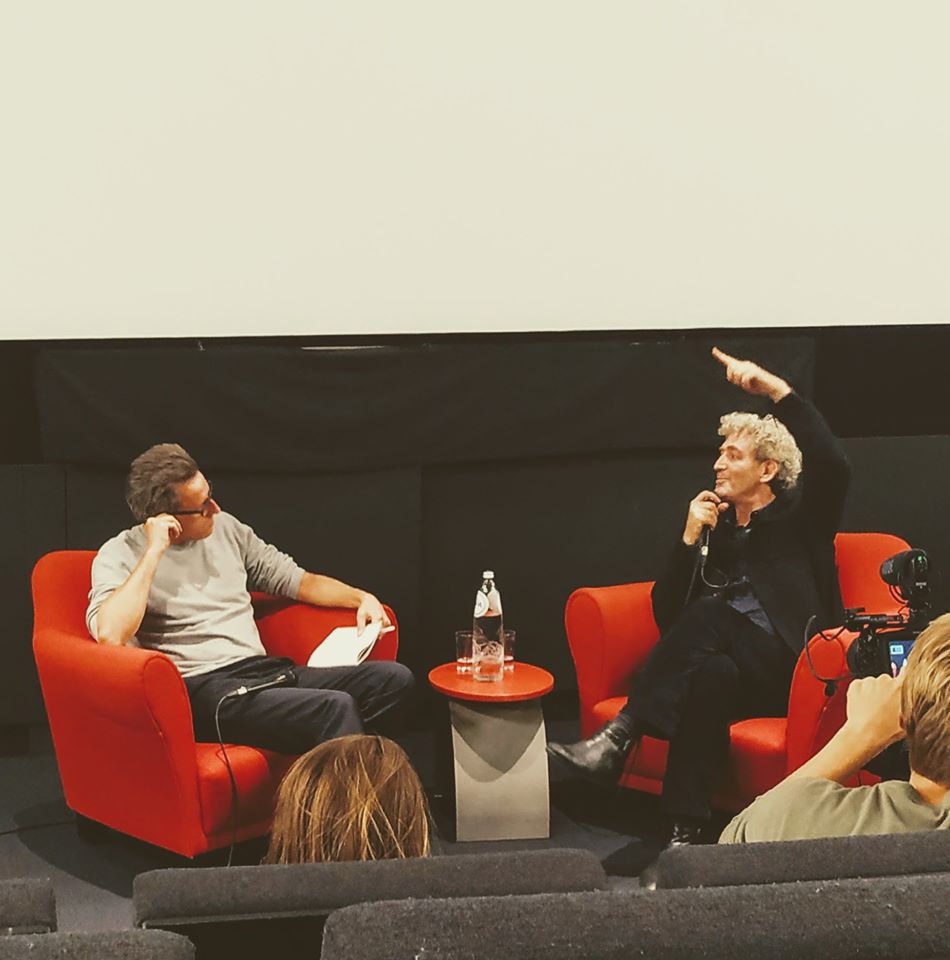
Sivan

Conversation after a screening of Aus Liebe zum Volk (Eyal Sivan, Audrey Maurion, 2004) in the context of ‘1989: stories about Die Wende’, a program of screenings on the occasion of the fall of the Berlin wall 30 years ago, presented by CINEMATEK and Goethe-Institut Brussel.

Mr B has worked for twenty years as a public servant “in service of the people”. Out of love. An unconditional and absolute love for “his people”. A blind and destructive love. When the times change and the regime he adheres to is defeated, he becomes a social reject and life as he has always known it falls apart. Fired from his job, his “House”, Mr B. is left with nothing, no perspective, no future. He sits alone in this office which is no longer his. Once he walks out that door, he will never come back.

In February 1990, a few weeks after the fall of the Berlin Wall, the Ministry for State Security of the GDR is dismantled. This marks the end of the “Stasi”, the East German secret police. Major B. was a Stasi officer. Relieved of his duties, he delivers a detailed account of twenty years of his life and work within this institution.

Aus Liebe zum Volk is based on this extraordinary personal testimony, supported by never seen before archive footage. This is a film about surveillance and blindness, about faith and disillusion.

Conversation with Fronza Woods

Fronza

In the context of the program ‘Breaking Sacred Ground’, part of Courtisane Festival 2019 (3 – 7 APRIL 2019). Curated by Stoffel Debuysere.

“I like films about real people. I am inspired by almost everything but especially by struggle. I am interested in people who take on a challenge, no matter how great or small, and come to terms with it. What inspires me are people who don’t sit on life’s rump but have the courage, energy, and audacity not only to grab it by the horns, but to steer it as well.”

Fronza Woods was born, raised and educated in Detroit. She began her professional life as a junior copywriter at a small Detroit advertising agency. In 1967, she moved to New York, where she continued to work in advertising. Then, at a time when television was opening up to people of colour, she went to work for ABC news, before learning to craft her own films at the Women’s Interart Center under the aegis of Ellen Hovde and Muffie Meyer. Killing Time, an offbeat, wryly humorous look at the dilemma of a suicidal woman unable to find the right outfit to die in, examines the personal habits, socialization, and complexities of life that keep us going. When the film recently screened, Richard Brody wrote in The New Yorker: “very simply, one of the best short films that I’ve ever seen,” comparing it favorably to Chantal Akerman’s first film Saute Ma Ville. In Fannie’s Film, a 65­-year­-old cleaning woman for a professional dancers’ exercise studio performs her job while telling us in voiceover about her life, hopes, goals, and feelings. The first in an unaccomplished series of portraits dedicated to “invisible women”, Fannie’s Film offers “a brutal, brilliant allegory for women and film” (Manohla Dargis, The New York Times). In addition to making her own films, Woods has worked as camerawoman on numerous independent films, was assistant sound engineer on John Sayles’ The Brother from Another Planet (1984) and a cast member in Yvonne Rainer’s The Man Who Envied Women (1985), and taught basic filmmaking at the University of Wisconsin, Milwaukee, where she also created and curated an outreach film programme for the city’s black community. She now resides in the southwest of France.

(portrait (c) Michiel Devijver)

Courtisane 2019: Fronza Woods from Courtisane Festival on Vimeo.