Another artist whose work we’d like to show in the context of the ‘Night Vision’ program is Anri Sala. A majority of his (earlier) video work is shot at night, like ‘Time After Time’ (2003), a ghostly vision of a horse standing alone in the dark, surrounded by busy traffic and restless dogs, or ‘Ghostgames’ (2002), set on a North Carolina beach in total darkness, in which two youngsters hunt so-called ghost crabs using flashlights to “capture” them. For the exhibition ‘When the Night Calls it a Day’ (Le Musée d’Art Moderne de la Ville de Paris, 2004), Sala’s idea was to plunge his work in permanent half-darkness, to play with the lighting in such a way as to create the particular luminosity of twilight that is sometimes refered to as “entre chien et loup” in French – the moment at sunset when night, and the indistinctness that comes with it, takes over and half-light reigns.
Some excerpts from his notes:
“Instead of building a dark projection room and allowing the video to dictate the atmosphere of day or night according to the projected image, I want to create two specific experiences. Because most of the videos that will be presented have been shot at night – I want to situate them in a place which is entre chien et loup, where the image projects the night, but the surrounding museum space remains in twilight. And so, the projected image will be darker than the space of projection itself. This wish to freeze and expand this moment of twilight very directly echoes the cinematographic experience of shooting outside at dusk when it’s almost impossible to control the ight and the temperature of the image because they’re constantly changing. The idea is to extend this moment of time that normally lasts fifteen minutes to the whole time of the exhibition, hour after hour, day after day.”
“What I also like about the expression entre chien et loup is the reading of a situation where you are no longer sure of what you see and you assume the possibility of being wrong and also of being taken for someone else. In English, it’s called ‘twilight’, but interestingly, in French, it is not directly related to the light but to its effect on our vision: one cannot tell the difference between a dog and a wolf.”
You can watch ‘Time After Time’ on the website of Lumen Eclipse.
Image on top: part of the ‘Light-Pushing’ photo series (image also appears in ‘Ghostgames’ )
“Today, some people think that the light of the atom bomb will change the concept of painting once and for all. The eyes that actually saw the light melted out of sheer ecstasy. For one instant, everybody was the same color. It made angels out of everybody.”
Willem de Kooning on the radical visuality unleashed by the atomic bomb (1951)
Paul Virilio. War and Cinema: The Logistics of Perception (1989)
“The development of ‘secret’ weapons, such as the ‘flying bomb’ and stratospheric rockets, laid the basis for cruise and intercontinental missiles, as well as for those invisible weapons which, by using various rays, made visible not only what lay over the horizon, or was hidden by night , but what did not or did not yet exist. Here we can see the strategic fiction of the need for armaments relying on atomic radiation – a fiction which, at the end of the war, led to the ‘ultimate weapon’.
(..) Many epilogues have been written about the nuclear explosions of 6 and 9 August 1945, but few have pointed out that the bombs dropped on Hiroshima and Nagasaki were light-weapons that prefigured the enhanced-radiation neutron bomb, the directed-beam laser weapons, and the charged-particle guns currently under development. Moreover, a number of Hiroshima survivors have reported that, shortly after it was detonated, they thought it was a magnesium bomb of unimagined power.
The first bomb, set to go off at a height of some five hundred metres, produced a nuclear flash which lasted one fifteen-millionth of a second, and whose brightness penetrated every building down to the cellars. It left its imprint on stone walls, changing their apparent colour through the fusion of certain minerals, although protected surfaces remained curiously unaltered. The same was the case with clothing and bodies, where kimono patterns were tattooed on the victims’ flesh. If photography, according to its inventor Nicephore Niepce, was simply a method of engraving with light, where bodies inscribed their traces by virtue of their own luminosity, nuclear weapons inherited both the darkroom of Niepce and Daguerre and the military search light. What appears in the heart of darkrooms is no longer a luminous out line but a shadow, one which sometimes , as in Hiroshima, is carried to the depths of cellars and vaults. The Japanese shadows are inscribed not, as in former times , on the screens of a shadow puppet theatre but on a new screen, the walls of the city.”
Akira Mizuta Lippit. Atomic Light (Shadow Optics) (2005)
“What was intimated in the radioactive culture of the late nineteenth and early twentieth centuries erupted at full force in Hiroshima and Nagasaki: if the atomic blasts and blackened skies can be thought of as massive cameras, then the victims of this dark atomic room can be seen as photographic effects. Seared organic and nonorganic matter left dark stains, opaque artefacts of once vital bodies, on the pavements and other surfaces of this grotesque theater. The “shadows”, as they were called, are actually photograms, images formed by the direct exposure of objects on photographic surfaces. Photographic sculptures. True photographs, more photographic than photographic images.
(…) There can be no authentic photography of atomic war because the bombings were themselves a form of total photography that exceeded the economies of representation, testing the very visibility of the visual. Only a negative photography is possible in the atomic arena, a skiagraphy, a shadow photography. the shadow of photography. By positing the spectator within the frames of an annihilating image, an image of annihilation, but also the annihilation of images, no one survives, nothing remains: “it made angels out of everybody.”
(…) The catastrophic flashes followed by a dense darkness transformed Hiroshima and Nagasaki into photographic laboratories, leaving countless traces of photographic and skiagraphic imprints on the landscape, on organic and nonorganic bodies alike. The world a camera, everything in it photographed. Total visibility for an instant and in an instant everything rendered photographic, ecstatic, to use Willem de Kooning’s expression, inside out.The grotesque shadows and stains – graphic effects of the lacerating heat and penetrating light – the only remnants of virtual annihilation.
(…) In the remainder, a dark writing was born. A secret writing, written in the dark, with darkness itself. In the atomic night and on the human surface, a dark, corporeal surface appeared.”
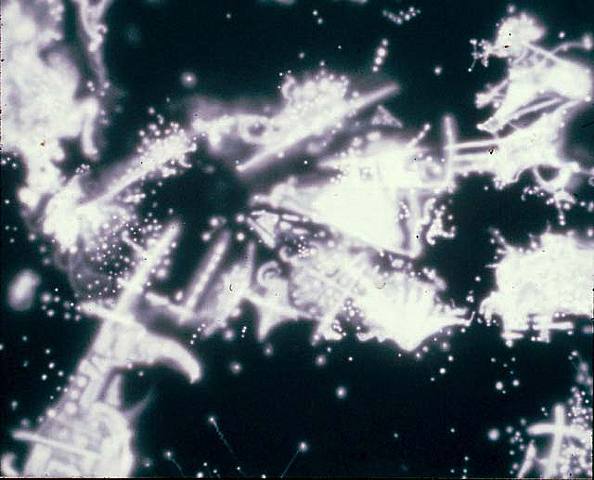
Below: documentation of ‘The Origin of Painting’ by Disinformation (Joe Banks) – luminous graffiti, live electromagnetic sound and shadow photography, autodestructive portraiture and experimental painting installation – a piece we’d like to show on the ‘night vision’ event (Courtisane Festival, March 18-21)
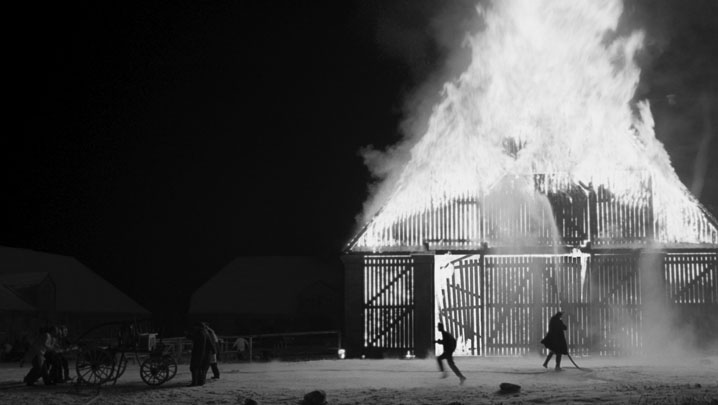
Yesterday I saw Michael Hanneke’s extraordinary Das Weisse Band (“the White Ribbon”). One of the things that makes the film stand out is its visual style: it was shot on color film, with a minimum of lighting, and then, in post-production, digitally retouched and translated to black-and-white. The night scenes in particular are lavishing, and sharper than anything I’ve seen before. Here’s an excerpt from an interview that was published in Sight & Sound (December 2009 issue), in which he talks about how the style of the film came about, the influence of German photographer August Sander and the impact of digital technology.
“It was Sander, really; most of the photos of that era are not very sharp, but his are often extraordinary in that respect. But he shot all his photos by daylight, whereas we had to shoot some scenes at night, and that’s difficult if you have people moving around and using petrol lamps or torches. If you look at those kinds of night scenes in films, even the best look completely theatrical. Even Dreyer – look at Ordet again. Very beautiful, but not at all realistic.
But I wanted lighting that looked wholly credible, and that’s very difficult to achieve. We had to shoot in colour because today’s black-and-white film isn’t sufficiently sensitive to low light, and even then, though there were no faults – the cameraman shot it impeccably – we spend two weeks working on it digitally. Even five years ago we wouldn’t have been able to get what we wanted. Look even at fairly recent Hollywood films with night scenes lit that way – a really beautiful film like Unforgiven – and you see the colours, especially red, bleeding. Thanks heaven for digital; I had to do the same on Time of the Wolf, which was in colour. Black and white shows up those problems far more than colour, so this new film involves lots of work. But it’s worth it.”
“The daytime to me is about total disappearance, because there is an even light that floods everything out, but at nighttime one can light and spot light. So I see the nighttime as being where I can kind of come into my own, and the daytime is about my absence.”
Jack Goldstein in ‘Wir Männer die Technik so Lieben’ (Stefaan Decostere, 1985)
Jean Fisher about Goldstein:
– To see is that sense of loss, of an appearing disappearance, that is always behind –
“If Goldstein’s spectacle holds us in a thrall that seems both disturbing and imperative, it is because the work’s function is to lay bare the image of the image with all the tyranny that it exerts upon us. Like the prisoners in Plato’s allegory of the cave, we are reluctant to tear our eyes away from our illusions, to break the spell of desire that captures us in its play of nocturnal shadows. Through all the manifestations of the spectacle – the masquerade, the carnivalesque, the cinematic – the immobilized, fascinated subject becomes, in the dark, other than himself. There our fear of the body’s temporality and physicality recedes into forgetfulness, and we can spin our dreams of immortality. To go into the light is to risk the blindness of the absolute insight of the gods.
Such is the paradox of the sublime sensibility alluded to in Goldstein’s painted spectacles: an ecstatic vision of a transcendental self, and an abject self that contemplates the terror of its own effacement by powers beyond its comprehension. In 19thC American art, the sublime was expressed through a landscape of light and space, evoking immensity, silence, and the potentially catastrophic with a tragic theatricality that we find recurring in post-Modernism. For the late 20thC this ambivalence is expressed through the mediated, cinematic spectacle of technology, in the face of which the subject is both remote and anonymous, denied ‘spontaneity’. To image this Heideggerean dread, to use technology’s own devices is, for Goldstein, to exert a measure of ‘control’ over its effect. We may now begin to see the Promethean rather than literal dimension of the artist’s images of impending disasters, warplanes and ‘burning cities’, and their relationship to the cosmic energies described in the more recent paintings of lightning, volcanoes and eclipses.”
Here’s a fragment from ‘Wir Männer die Technik so Lieben’ with parts of interviews with Goldstein and Paul Virilio (see also here). If you’re interested in seeing or showing this (great) video, please contact Stefaan Decostere.
image: Jack Goldstein, Untitled, 1981 (Oil on masonite, 49 x 61 inches)
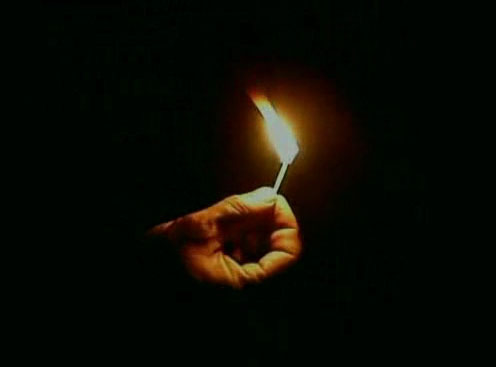
Here’s a wonderful scene from Abbas Kiarostami’s ‘ABC Africa’ (2001) – the first work he shot with DV, documenting Ugandan children orphaned by the successive disasters of civil war and AIDS – in which the image is wrapped in complete darkness. It is night, and the power has been turned off in the Ugandan city of Masaka, leaving the director and members of his small crew, who had been filming a cloud of mosquitoes, with no illumination. And for about five long minutes, we are also in the dark, listening to idle conversation (in Farsi) as the portable, battery-powered digital video camera keeps rolling. The dark spell ends with a few flashes of lightning briefly illuminating a tree waving in the wind outside the window. The scene doesn’t only call attention to the medium’s limitations (and its power) and to the artifice involved in even its simplest use, but also to the terror of the pitch black (African) night, filled with the unknown. Jonathan Rosenbaum wrote about this scene: “(Kiarostami’s) impressions come to the fore during a lengthy conversation with his assistant in the dark, and this scene evokes a sense of reality in Africa that otherwise would have been impossible to capture. … Creativity – his own joined with ours – winds up playing a role; the lighting of matches and the bursts of lightning and thunder that ultimately lead us out of the darkness are the essence of his art, flashes of illumination in the midst of total uncertainty.”
It’s worth pointing out that Alain Bergala believes this scene was staged, pointing out similar ideas in previous films. In ‘A Taste of Cherry’ (1997), there’s a moment towards the end when the main character lies in his grave at night, sporadically illuminated by ominous bursts of lightning. Adrian Martin wrote: “with its flashes of lightning in the blackout of night, with its sensurround rumbling of thunder, with its unbearably poignant mystery of whether this man will live or die, the scene takes us close to an absolute (and absolutely cinematic) experience of existential negation, more powerfully than any horror movie.”
Apparently, Kiarostami wanted to extend the intermittent darkness that he abandoned the audience in to seven minutes of unbroken black screen in ‘The Wind Will Carry Us’ (1999) but could not sustain it. What remains of this plan is the cow milking scene (the one in which the poem (by Forough Farrokhzad) is quoted that gave the film its title) in which the main character pays a visit to a young woman with the goal of buying some milk. He finds the woman in complete darkness, out of which she emerges with a gas lamp, which she holds down by her side to light the way.
In ‘ABC Africa’, Kiarostami did finally achieve his exercise in darkness.