Sound Mirrors

soundmirror.jpg

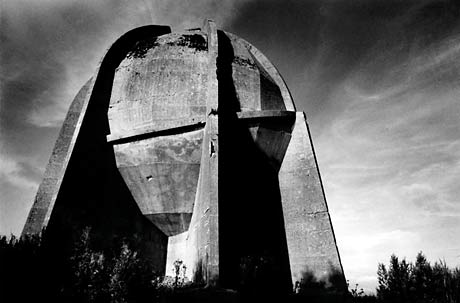
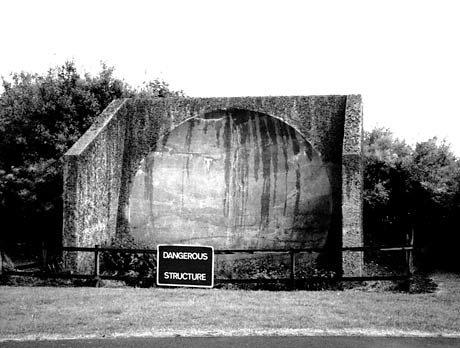
One of the works that will be shown in the Courtisane 2010 exhibition – titled “Digest Sound’ – is Barry Hale’s ‘Blackout (The Antiphony Video Supplement)’ (1997), a video which was produced as part of a project by Disinformation (Joe Banks) and conceived as supplementary to images taken by photographer Julian Hills which appear on the sleeve of the Disinformation ‘Antiphony’ CD (Ash International, 1997). The video (later more or less copied by several other artists, notably Tacita Dean. See Brian Dillon’s article ‘Listening for the Enemy‘) is an audiovisual survey of the so-called “sound mirrors”, acoustic detection early-warning devices designed to pick up sounds from approaching enemy aircraft. The structures were devised by the British air force in the 1920’s, as part of a plan to install a chain of “concrete ears” along the coast that would peer out over the English Channel. The plan was never completed, but some of these decaying structures can still be seen alongside the UK coast, at Abbots Cliff between Dover and Folkestone, West Hythe, and on the Dungeness shingle at Denge. Reportedly there were three types of sound mirrors: “with the circular, concave 20- and 30-foot-diamater concrete bowls, movable, cone-shaped metal sound collectors were used, connected by tubing to stethoscopes worn by the operators. The other type were strip mirrors, curved in elevation and plan of 26 by 200 feet. With these structures, microphones were placed on a concrete forecourt in front of the mirrors and wired to a nearby control room. All the sound mirrors were located in positions that attempted silence. A 1924 report suggested that the sound mirrors were ten times more sensitive than the human ear, and they were tested by blind listeners in 1925.” (Steve Goodman,’ Sonic Warfare’, 2010)

This is what Joe Banks wrote about Sound Mirrors in Sound Projector, Issue 5 (1999)
“Following promising experiments in the grounds of Binbury Manor, near Maidstone, Kent in 1916 – in which a Professor (probably FC) Mather sculpted a parabolic sound mirror into the face of a chalk cliff – Dr W S Tucker of the RAF Air Defence Experimental Establishment experimented extensively with sound mirrors as passive acoustic early-warning detectors, designed to provide directional fixes on the sounds of incoming enemy Zeppelins, planes and ships. Mirrors were installed at several sites on the Kent and Yorkshire coasts – the awesome monofiths documented in the ‘Disinformation Antiphony Video Supplement’ by Barry Hale – and at Baharic-Cahaq in Malta and plans were drawn up to extend the UK coastal network and build similar chains for colonial defence in Hong Kong Singapore, Gibraltar and Aden. Tests were conducted using aircraft, ships, and also concrete tubes projecting low frequency drones at frequencies below 50Hz to simulate aircraft noise. Dr Tucker also designed an active sound mirror to project an acoustic beam – guiding aircraft to safe landings on fog-bound runways; these experiments were abandoned after a number of serious accidents at Biggin Hill aerodrome. lt is tempting to speculate that, should this prove to have been the first experiment with blind-landing Dr Tucker may have been in effect the unsung father of controlled airspace and contemporary air traffic control.
ln his booklet ‘Mirrors by the Sea‘ Richard Scarth reports that the decision to abandon the sound mirror early-warning system was made by the Royal Engineers in May 1939 – they had been rendered obsolete by the increasing speeds of hostile aircraft and, more importantly, by the invention of radar. Nonetheless in January 1940 Dr Tucker conducted ‘experiments to investigate the nature of the disturbance produced by explosions in large, concave, concrete reflectors’ at the Greatstone site near Dungeness.”
mirror2.jpg

Banks also explored these ideas, suggested by the imagery of his ‘Antiphony’ CD and the ‘Antiphony Video Supplement’ (later retitled “Blackout”) video, in an article that was featured in issue 6 of Sound Projector, under the title ‘Antiphony Architectural Supplement‘. An excerpt:
“During the WW2 nocturnal Blackout procedures were tantamount to a policy of compulsory mass hyperacusis. Venturing outdoors at night, particularly the urban population, already hypersensitized by fear, found their hearing heightened still further by immersion in levels of darkness which were unprecedented since the introduction of street-lighting.
The basic hypothesis here is that the experience of defensively listening, consciously and unconsciously, for the dull-thud of explosions, the whistle of rockets and bombs and the roar of planes is the mechanism by which such autonomic states encode, at a fundamental neurological level, as conditioned, reflexive responses to ambient low frequency sounds. These high states of arousal are necessarily those in which individuals are most receptive to sense-data. These responses are also culturally transmissible – primarily through the medium of cinema. It is worth noting that extreme sensitivity to sound (of the exact sort idealised by the composer John Cage) is not only a state of heightened aesthetic awareness, but also a recognised medical condition, often associated with debilitating phonophobia and the onset of conditioned tinnitus – and during the war advertisements in Picture Post magazine suggest there was a roaring trade in sedatives, not only for people but also for household pets.
In the light of this hypothesis it seems natural that sound should be an ideal medium for abstract representations of war – so it is not surprising that some of its greatest sculptural representations rely heavily on the effects of sound. My interest in these sculptures originally stemmed from recognising the cultural primacy of visual images over intellectual concepts (“people eat with their eyes”, “a picture speaks 1,000 words”) and therefore the commercial necessity and challenge of finding visual analogues which could encapsulate and advertise the Disinformation brand-name noise repertoire.
The solution was provided by an article by W. Harms in Shortwave Magazine, which described a series of massive concrete monoliths which still stand, slowly crumbling into waste-land at a site near Dungeness in Kent…”

The Sound Mirrors are also mentioned in Steve Goodman’s (aka Kode 9) recently published book ‘Sonic Warfare, Sound, Affect, and the Ecology of Fear‘, an excellent read about the use and impact of sonic tactics and acoustic forces. Like Banks, he also draws heavily on some ideas Paul Virilio offered in ‘War and Cinema’ (see earlier posts). Some excerpts:
“Just as Virilio found the logistics of military perception within the history of cinema, especially the emergence of cybernetics in the postwar period, we can locate, updating an ancient history of acoustic warfare, an undercurrent of research into sonic tactics guiding a symbiosis of noise, bodies, and machines. Across the continuum of war, from sonar to nonlethal acoustic weaponry, this logistics of perception in its vibratory, resonant, affective, and virtual sonic dimensions is now assuming new permutations in cultures mutated by the impact of global terrorism and assymmetric warfare.
This logistics of (im)perception does not merely seek to intervene in the “normal” functioning of psychophysiological circuitry, but, in McLuhanist terms, also involves perceptual prosthetics: an extension or an amputation. Conceived differently, for philosopher Baruch Spinoza, the focus shifts from what a body is, even in its technologically extended sense, to its powers – what it can do. The body of sonic warfare is therefore always a speculative question, which does not return home to a pregiven human, corporeal demarcation. The episodic history of sonic warfare’s perceptual assemblages can therefore equally be found in electronic and electromagnetic cartography, the distributed nervous system of technical sensors that feed it, and the flood of information these systems produce.
In the cybernetic phase of martial evolution, which emerged out of the detritus of World War II, turning this data flood into workable knowledge became as important as the efficiency and accuracy of weapon systems. The logistics of perception has been confronted by the ravenous information hunger of military systems, generating a chain reaction of problems in the gathering, transfer, and processing of data. The more sophisticated the military’s distributed nervous system, the more overpowering the sheer weight of information to be dealt with. And as an unavoidable corollary, the more exposed the battlefield becomes, the more appearance gives in to an array of camouflage, decoys, jamming, smokescreens, and electronic countermeasures. To be percieved is to be “taken out”. So investment in forces co-evolves with the investment in their concealment. Stealth, secrecy, and the logistics of perception signal, for Virilio, that the war of images has in fact superseded the war of weaponry. Whether we agree with Virilio’s historical argument or not, his insight is to draw attention to how the evolution of weapons and armor is paralleled by the co-evolution of visibility and invisibility and, by implication, of audibility and inaudibility.”

Follow Goodman’s research on his blog.

Images: Julian Hills
Fauxtography

mouse.jpg

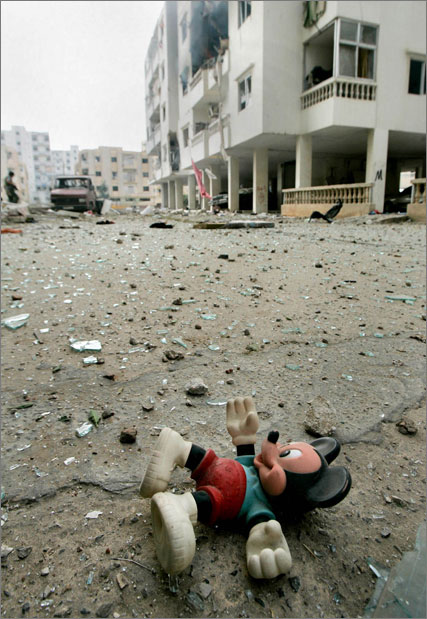
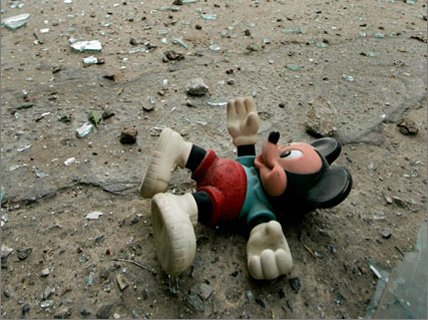
Interesting read in the online NY times this week: an article by filmmaker Errol Morris, titled ‘It Was All Started by a Mouse’ (part 1 and 2), on war and photography, prompted by the sheer number of images of child’s toys amid the ruins of war.

“Why are there so many similar photographs? How did all these toys come to be photographed? What is the viewer supposed to infer from such a scene? Is it simply that the idea of children and their toys ratchets up the drama of a war photograph? The juxtaposition of innocence and destruction in one image? Is it just anti-war? Or is something more sinister involved? Is it disguised propaganda with a definite bias towards one side or another?”

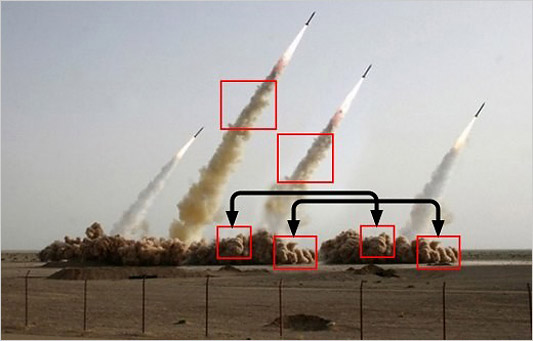
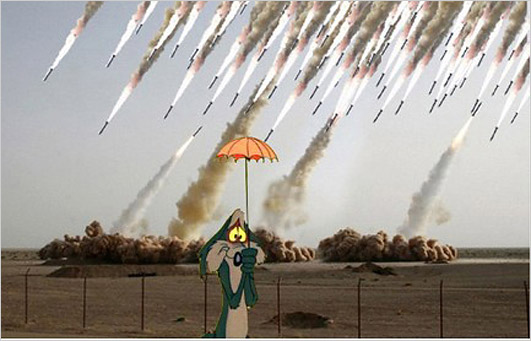
The article is, in some ways, a follow-up to his essay ‘Photography as a Weapon‘ (NY times, August 11, 2008 – the title of the piece is inspired by John Heartfield, by the way), in which he explored the manipulation of photography, in particular the photo of four Iranian missiles streaking heavenward, first published on July 10 2008 (on a sidenote, see also Oliver Laric’s video ‘Versions’) .

“For me it raised a series of questions about images. Do they provide illustration of a text or an idea of evidence of some underlying reality or both? And if they are evidence, don’t we have to know that the evidence is reliable, that it can be trusted? (…) The problem is not that the photograph has been manipulated, but that we have been manipulated by the photograph. Photoshop is not the culprit. It is the intention to deceive. (…) We should remember that the power of photographs comes not only from their ability to copy reality, but also to alter reality. Photographs can be used — to borrow Heartfield’s phrase — as weapons. They can be used to warn us about the dangers of impending war. They can also be used to ratchet up the blind forces of rage and unreason that drag us into conflict.”

missile-shot-with-red-boxes.jpg
coyote.jpg

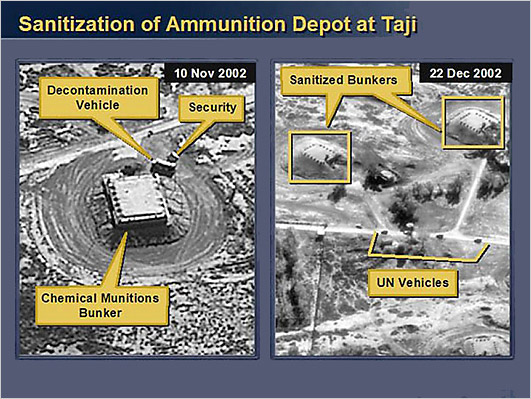
In the article, Morris also wrote: “You don’t need Photoshop. You don’t need sophisticated digital photo-manipulation. You don’t need a computer. All you need to do is change the caption“, referencing the photographs presented by Colin Powell at the United Nations in 2003. “Photographs that were used to justify a war. And yet, the actual photographs are low-res, muddy aerial surveillance photographs of buildings and vehicles on the ground in Iraq. I’m not an aerial intelligence expert. I could be looking at anything. It is the labels, the captions, and the surrounding text that turn the images from one thing into another.”

powellslide1.jpg

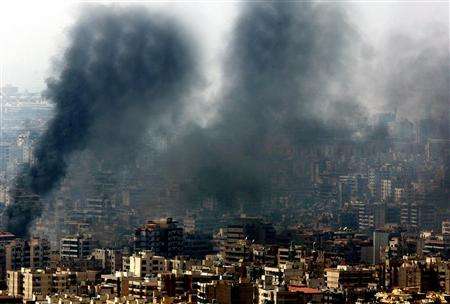
These issues are also addresses in ‘It Was All Started by a Mouse’, in an interview with Ben Curtis, Chief Photographer/Photo editor, Middle East, of the Associated Press, who has been criticised for a series of photos which appeared to be staged (see the article ‘The Reuters Photo Scandal. A Taxonomy of Fraud‘). Talking about the need for veracity and objectivity in photojournalism, Curtis refers to the “the Reuters incident” -the distribution of a doctered photo showing the aftermath of an Israeli airstrike on Beirut – which was uncovered by Charles Johnson on the Little Green Footballs blog (Johnson also coined the term “fauxtography”).

beirutphotoshop04.jpg

“I read the Reuters website after (the incident), and there was a lot of handwringing and reevaluation of their procedures. After the war, I read that Reuters was working with Adobe on some software component for Photoshop that would keep a record of all the changes that had been made in Photoshop, so that editors could see exactly what had been done to an image. It would aid in preventing manipulation of photographs. I found that quite interesting from a technical perspective, and I could see how such thing could be useful in the work flow of maintaining accuracy of images. This was one of the things that was in my head when I was writing the “in defense of captions” post — while that’s useful or could be useful, a technical solution alone is never going to solve the problem of accuracy in the media. You could take a photographer’s image straight from the camera, not even processed with Photoshop, put it on the wire, and it’s the caption that provides the accuracy for that picture. The caption is the place where it’s easy to mislead the reader.”

mouse2.jpg

Here are some more excerpts taken from their discussion on the ethical issues surrounding the Mickey Mouse photograph (not posed or manipulated in any way, but, according to Morris “nonetheless a photograph that telegraphs a message”). Its caption read “A child’s toy lies amidst broken glass from the shattered windows of an apartment block near those that were demolished by Israeli air strikes in Tyre, Southern Lebanon, Monday, August 7th, 2006.”

Morris: “…Are we saying that there’s no damage done to these apartment buildings? That no children were killed? Even in the clearly Photoshopped image of the smoke over Beirut? Are we saying that Beirut was never hit by a bomb? That there were no apartment buildings leveled by Israeli drones? Is the crime posing? Or is the crime creating an image — even if it was produced ethically — that leads the viewer to a controversial conclusion. A photographer makes the decision to take a picture with a Mickey Mouse toy in the foreground. Is that a crime? Is it a crime if he found the toy and didn’t place it? Is it unacceptable because it suggests that children were killed?”

Curtis: “Yes. I’m looking at the Mickey Mouse picture again. A reader might infer from that, that a child had been killed in the attack and that this toy belonged to some child who is dead somewhere. Okay, you’re a reader, you can infer that if you want. But we’re not saying that. I’m not saying that. I’m saying it’s a child’s toy lying in the middle of a street after an air strike. That’s all I’m saying. If you want to infer from that what you want, that’s your prerogative, but you can’t then criticize us for that, you know? If I knew who that toy belonged to, if I knew his name and where he was now and what happened to him, that would be great. I’d include it in the caption. But I’m running around and I’ve got 10 minutes to get in, shoot pictures and get out of there, before maybe they’ll launch another air strike.”

…
Morris: “It’s narrative compression.”

Curtis: “It’s very compressed. You’re really trying to compress a huge amount of things. An air strike. Destruction. Some humanity. You’re trying to convey all of that in a single image. And, frankly, it’s pretty hard, especially when there’s not many people around.”

Morris: “Yes. Your stories are endlessly interesting, because you’re telling us about the exigencies of photography, that photography requires us to do certain kinds of things. The way in which stories are told by newspapers, by photographic convention, all influence how photographs are made, how they’re distributed, how they’re printed and published and disseminated, etcetera, etcetera. I’m not telling you anything you don’t know, but it’s interesting to take a step back and to talk to a photographer, particularly when we’re dealing with a controversial photograph, a supposedly posed photograph, and attempt to contextualize it thoroughly for the first time”.

Morris concludes:
“Photographs can give us a glimpse of the specific, of the particulars in a cauldron of seething politics. And yet, the meaning of what we’re looking at remains unclear. The Mickey Mouse photograph can function as pro-Arab or as pro-Israeli propaganda depending on the text it accompanies. Not just the text, but the mind-set, the mental captions, that inform how we see it. Mickey Mouse after all is “so human, that’s the secret of his popularity.” Images are plastic, malleable, and lend themselves to any and every argument.

Errol Morris on Twitter

Entre Chien et Loup

sala_crab2.jpg

Another artist whose work we’d like to show in the context of the ‘Night Vision’ program is Anri Sala. A majority of his (earlier) video work is shot at night, like ‘Time After Time’ (2003), a ghostly vision of a horse standing alone in the dark, surrounded by busy traffic and restless dogs, or ‘Ghostgames’ (2002), set on a North Carolina beach in total darkness, in which two youngsters hunt so-called ghost crabs using flashlights to “capture” them. For the exhibition ‘When the Night Calls it a Day’ (Le Musée d’Art Moderne de la Ville de Paris, 2004), Sala’s idea was to plunge his work in permanent half-darkness, to play with the lighting in such a way as to create the particular luminosity of twilight that is sometimes refered to as “entre chien et loup” in French – the moment at sunset when night, and the indistinctness that comes with it, takes over and half-light reigns.

Some excerpts from his notes:
“Instead of building a dark projection room and allowing the video to dictate the atmosphere of day or night according to the projected image, I want to create two specific experiences. Because most of the videos that will be presented have been shot at night – I want to situate them in a place which is entre chien et loup, where the image projects the night, but the surrounding museum space remains in twilight. And so, the projected image will be darker than the space of projection itself. This wish to freeze and expand this moment of twilight very directly echoes the cinematographic experience of shooting outside at dusk when it’s almost impossible to control the ight and the temperature of the image because they’re constantly changing. The idea is to extend this moment of time that normally lasts fifteen minutes to the whole time of the exhibition, hour after hour, day after day.”

“What I also like about the expression entre chien et loup is the reading of a situation where you are no longer sure of what you see and you assume the possibility of being wrong and also of being taken for someone else. In English, it’s called ‘twilight’, but interestingly, in French, it is not directly related to the light but to its effect on our vision: one cannot tell the difference between a dog and a wolf.”

sala_5.jpg

You can watch ‘Time After Time’ on the website of Lumen Eclipse.
Image on top: part of the ‘Light-Pushing’ photo series (image also appears in ‘Ghostgames’ )

Atomic Shadows

largevalvehandleshadow.jpg

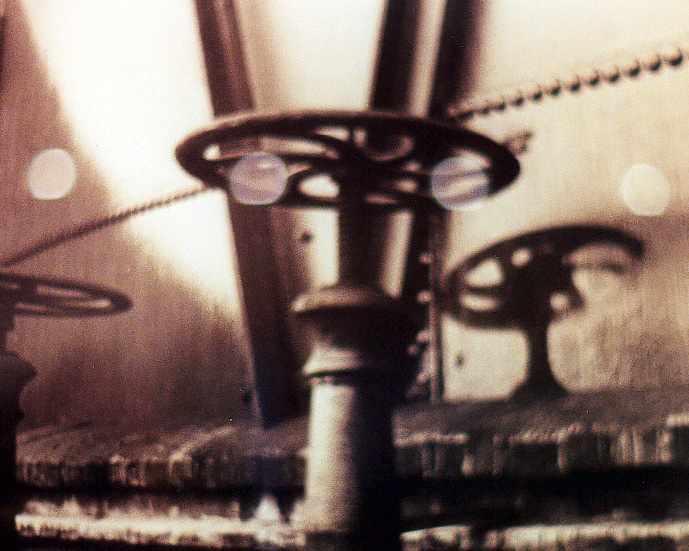
“Today, some people think that the light of the atom bomb will change the concept of painting once and for all. The eyes that actually saw the light melted out of sheer ecstasy. For one instant, everybody was the same color. It made angels out of everybody.”
Willem de Kooning on the radical visuality unleashed by the atomic bomb (1951)

Paul Virilio. War and Cinema: The Logistics of Perception (1989)
“The development of ‘secret’ weapons, such as the ‘flying bomb’ and stratospheric rockets, laid the basis for cruise and intercontinental missiles, as well as for those invisible weapons which, by using various rays, made visible not only what lay over the horizon, or was hidden by night , but what did not or did not yet exist. Here we can see the strategic fiction of the need for armaments relying on atomic radiation – a fiction which, at the end of the war, led to the ‘ultimate weapon’.

(..) Many epilogues have been written about the nuclear explosions of 6 and 9 August 1945, but few have pointed out that the bombs dropped on Hiroshima and Nagasaki were light-weapons that prefigured the enhanced-radiation neutron bomb, the directed-beam laser weapons, and the charged-particle guns currently under development. Moreover, a number of Hiroshima survivors have reported that, shortly after it was detonated, they thought it was a magnesium bomb of unimagined power.

The first bomb, set to go off at a height of some five hundred metres, produced a nuclear flash which lasted one fifteen-millionth of a second, and whose brightness penetrated every building down to the cellars. It left its imprint on stone walls, changing their apparent colour through the fusion of certain minerals, although protected surfaces remained curiously unaltered. The same was the case with clothing and bodies, where kimono patterns were tattooed on the victims’ flesh. If photography, according to its inventor Nicephore Niepce, was simply a method of engraving with light, where bodies inscribed their traces by virtue of their own luminosity, nuclear weapons inherited both the darkroom of Niepce and Daguerre and the military search light. What appears in the heart of darkrooms is no longer a luminous out line but a shadow, one which sometimes , as in Hiroshima, is carried to the depths of cellars and vaults. The Japanese shadows are inscribed not, as in former times , on the screens of a shadow puppet theatre but on a new screen, the walls of the city.”

Akira Mizuta Lippit. Atomic Light (Shadow Optics) (2005)
“What was intimated in the radioactive culture of the late nineteenth and early twentieth centuries erupted at full force in Hiroshima and Nagasaki: if the atomic blasts and blackened skies can be thought of as massive cameras, then the victims of this dark atomic room can be seen as photographic effects. Seared organic and nonorganic matter left dark stains, opaque artefacts of once vital bodies, on the pavements and other surfaces of this grotesque theater. The “shadows”, as they were called, are actually photograms, images formed by the direct exposure of objects on photographic surfaces. Photographic sculptures. True photographs, more photographic than photographic images.

(…) There can be no authentic photography of atomic war because the bombings were themselves a form of total photography that exceeded the economies of representation, testing the very visibility of the visual. Only a negative photography is possible in the atomic arena, a skiagraphy, a shadow photography. the shadow of photography. By positing the spectator within the frames of an annihilating image, an image of annihilation, but also the annihilation of images, no one survives, nothing remains: “it made angels out of everybody.”

(…) The catastrophic flashes followed by a dense darkness transformed Hiroshima and Nagasaki into photographic laboratories, leaving countless traces of photographic and skiagraphic imprints on the landscape, on organic and nonorganic bodies alike. The world a camera, everything in it photographed. Total visibility for an instant and in an instant everything rendered photographic, ecstatic, to use Willem de Kooning’s expression, inside out.The grotesque shadows and stains – graphic effects of the lacerating heat and penetrating light – the only remnants of virtual annihilation.

(…) In the remainder, a dark writing was born. A secret writing, written in the dark, with darkness itself. In the atomic night and on the human surface, a dark, corporeal surface appeared.”

Below: documentation of ‘The Origin of Painting’ by Disinformation (Joe Banks) – luminous graffiti, live electromagnetic sound and shadow photography, autodestructive portraiture and experimental painting installation – a piece we’d like to show on the ‘night vision’ event (Courtisane Festival, March 18-21)

Low Light

nyffwhtribbon718.jpg

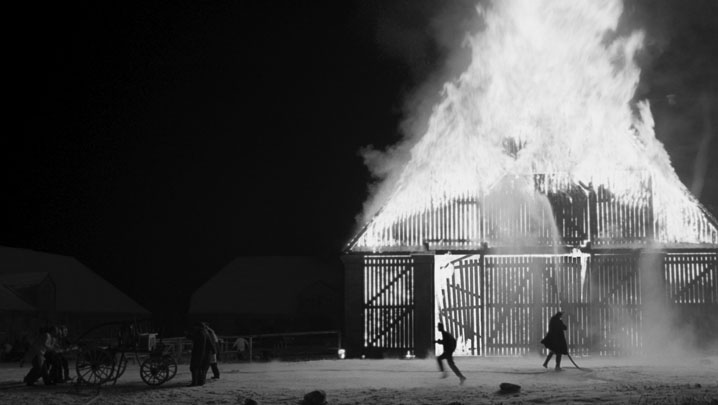
Yesterday I saw Michael Hanneke’s extraordinary Das Weisse Band (“the White Ribbon”). One of the things that makes the film stand out is its visual style: it was shot on color film, with a minimum of lighting, and then, in post-production, digitally retouched and translated to black-and-white. The night scenes in particular are lavishing, and sharper than anything I’ve seen before. Here’s an excerpt from an interview that was published in Sight & Sound (December 2009 issue), in which he talks about how the style of the film came about, the influence of German photographer August Sander and the impact of digital technology.

“It was Sander, really; most of the photos of that era are not very sharp, but his are often extraordinary in that respect. But he shot all his photos by daylight, whereas we had to shoot some scenes at night, and that’s difficult if you have people moving around and using petrol lamps or torches. If you look at those kinds of night scenes in films, even the best look completely theatrical. Even Dreyer – look at Ordet again. Very beautiful, but not at all realistic.
But I wanted lighting that looked wholly credible, and that’s very difficult to achieve. We had to shoot in colour because today’s black-and-white film isn’t sufficiently sensitive to low light, and even then, though there were no faults – the cameraman shot it impeccably – we spend two weeks working on it digitally. Even five years ago we wouldn’t have been able to get what we wanted. Look even at fairly recent Hollywood films with night scenes lit that way – a really beautiful film like Unforgiven – and you see the colours, especially red, bleeding. Thanks heaven for digital; I had to do the same on Time of the Wolf, which was in colour. Black and white shows up those problems far more than colour, so this new film involves lots of work. But it’s worth it.”