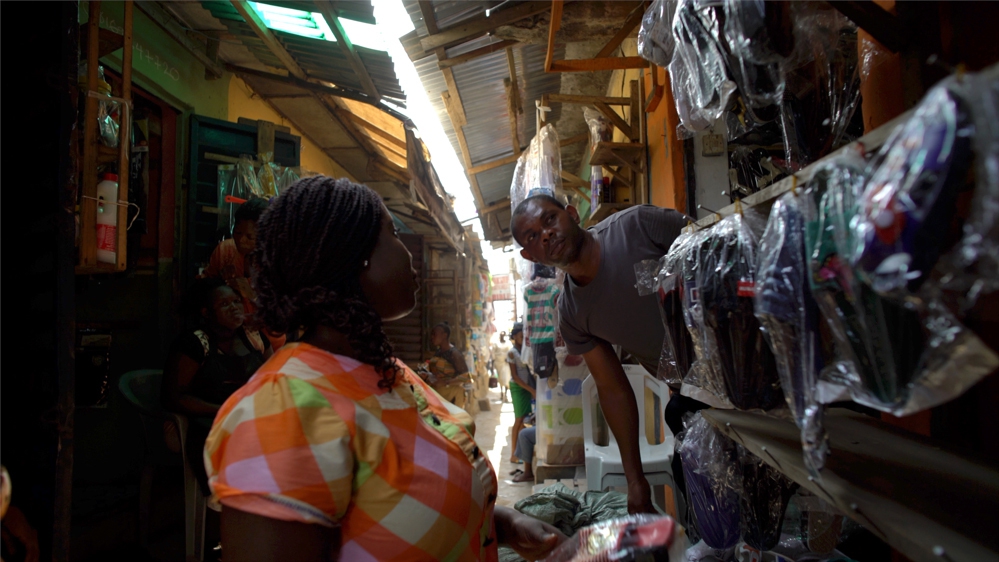
Voyage into Limbo

A small text I wrote (originally in Dutch) for Kunstenfestivaldesarts 2020 to accompany Wang Bing’s work Scenes: Glimpses From a Lockdown.

“You shouldn’t be here, Sir.” These are the words that can be heard spoken in a foreign language at the start of Scenes, Wang Bing’s new installation. The admonishment seems to be addressed off-camera to the film-maker as he points his camera at a huge throng of oil lorries that seem to be furloughed in the green suburb of an as yet unknown city. Is it a coincidence that Wang Bing has given this scene – in which attention is exceptionally drawn to himself – such an important place? After all, Scenes is the result of his first cinematographic foray outside his homeland of China: this is Lagos, the most populous city in Nigeria and, by extension, on the African continent.

But this is not the first time that the film-maker has been in places where according to the rules he “shouldn’t be”. Two decades ago as a recent graduate in photography and art, he travelled to the heart of the condemned industrial district of Tiexi, in north-east China. Without official permission, he spent two years here filming the maze of factory buildings and the living spaces that went with them. Using a rented DV camera, he managed to distinctively record the precarious lives of the remaining workers who were facing the slow deterioration of their living environment and job security. Using more than three hundred hours of footage, he created the monumental Tie Xi Qu/West of the Tracks (2002), a nine-hour documentary on China’s transition from an industry-based controlled economy to a consumption-based market economy, and on the ensuing erosion of the collective working class that has inexorably given way to the rise in cheap and temporary labour.

Ever since, Wang Bing has tirelessly focused on unjust and commonplace experiences in everyday life that is stifled all too often by the success of China’s “miracle of growth”. In a small mountain village in the province of Yunnan, he produced a portrait of three young sisters (San Zimei/Three Sisters, 2012) who had to look after themselves when their parents left to work in far-off cities – unfortunately something that is happening to tens of millions of children in China. In Ku Qian/Bitter Money (2016), he followed three young people leaving their village to look for work in the city of Huzhou in the east of the country, known for its huge temporary workforce. In this film and others, Wang Bing patiently takes stock of the impoverished material and social circumstances of migrant workers who are principally rural and cannot claim urban citizenship. This means that over a tenth of Chinese nationals are considered undocumented foreigners in their own country. From urban workshops where these “second-zone citizens” slave away for hours for a tiny wage and are painfully aware of what is commonly called “bitter money” to a remote psychiatric institution where mentally ill patients and political renegades are left to their fate (Feng ai / ‘Til Madness Do Us Part, 2013) or refugee camps where members of the Ta’ang, a Burmese ethnic minority, are trapped between violent civil war and the Chinese border (Ta’ang, 2016): in the internal geography of Wang Bing’s work, the uncertain lives of those who on the margins of society, in the middle of vast and rapidly changing landscapes in 21st-century China, are central.

Is it really such a great leap to Africa? Under the banner of the historical friendship forged between China and Africa since the post-colonial peak of the Non-Aligned Movement, exchanges between the two regions have actually developed a great deal in the last two decades, an evolution watched with attention on the world’s economic and geopolitical stage. While China likes to boast investments and large-scale infrastructure projects that in its view will result in a “win-win” situation, accusations of neo-colonialism are increasingly being made. As Lamido Sanusi, the former governor of the Central Bank of Nigeria, wrote: “China takes our primary goods and sells us manufactured ones. This was also the essence of colonialism.” Yet the discussion about whether China is positioning itself as a colonising power or as a capitalist benefactor transcends a social and intercultural reality that is undergoing a complete transformation and poses huge challenges to both sides. The policy of China’s presence in Africa not only involves capital and goods, but the labour force as well, as reflected in the growing number of construction workers, road builders and shopkeepers in the socioeconomic fabric. Meanwhile, since the economic liberalisation of the 1990s, numerous African students and entrepreneurs have been trying their luck in major Chinese cities. This is especially the case in Guangzhou, a megacity in the south of the Pearl River Delta and one of the most populous regions in the world, which has become a retail industry hub between the economic superpower and several African states.

One of these shopkeepers is the central character in Scenes. Wang Bing met Kingsley in Guangzhou where he has a hairdressing business and buys merchandise for the shop he and his wife run in the Ikotun district of Lagos. This fortuitous encounter – something that continually drives his work – ultimately took Wang Bing to Africa in autumn 2019, a journey he had been waiting for for a number of years. The filming he did in Lagos provided the source material for a first version of the installation, which was part of the “China ⇋ Africa” exhibition at the Pompidou Centre in Paris. It shows fragments of Wang Bing’s first impressions of the African metropolis, from the agriculture and accumulation of rubbish on the outskirts to the retail outlets and carpool services in the centres. The Chinese presence is implicit in references to two of the main Chinese economic activities in Nigeria: oil extraction and mining. This happens to chime with Wang Bing’s previous investigations into the Chinese energy industry, Caiyou riji/Crude Oil (2008) and Tong dao/Coal Money (2009). However, it is also manifested in the thousands of motorcycle couriers whose bright green kit contrasts with the mostly drab urban landscape, not that different from similar services in Chinese cities. The courier service is also one of the visible traces of China’s recent entry on the African e-commerce and fintech landscape because the company in question aspires to be a multifunctional digital platform. Or how the flow of Chinese capital is gradually opening up a route into African online lives.

As China soaks up Africa’s natural resources, African states are importing huge quantities of cheap consumer goods bearing the label “Made in China”. It is goods like these that Kingsley and his wife stock in their shop, which seems to have been built in haste and where everything feels provisional. Wang Bing follows the couple and their young son as they roam through the packed network of streets and alleys in Ikotun, amid the multi-level tangle of modest stalls and narrow passageways of which their shop is part. He knows how to move his handheld camera in confined spaces like no one else, constantly adapting to the environment, always maintaining the right distance from people. He takes the time to observe their daily activity at length, a temporality that confers on them an existence on screen that transcends short-sighted clichés. It is in this constant scanning that Wang Bing manages to lose the negative connotations so often associated with filming in places where people say “you shouldn’t be”. That his work shows no hint of bleak voyeurism is down to his intense focus on what is in front of the lens, without claiming to know or understand in advance what should be seen. He does not take the position of someone who knows, but of someone who chooses to look, constantly lying in wait for something unexpected, for what cannot be captured in all-knowing frames. It is an approach that respects the visible dimensions of injustice and at the same time is radically opposed to the basic injustice that condemns “wretched of the earth” to invisibility or stigmatisation. Rather than trapping them in a context that is supposed to match their life, Wang Bing endeavours to achieve visibility that is open to glimmers of what might be possible.

Wang Bing’s installation in progress promises to become a diptych, with one part of it recorded in Lagos and the other part in Guangzhou. Meanwhile, the pandemic has not only postponed Kingsley’s planned trip back to China, but has also exacerbated the discrimination migrants face, whether they originally come from rural China or Africa. The draconian campaign to prevent the spread of the virus has hugely stigmatised them as high-risk populations, with the consequence that many have lost their homes and are deprived of any form of service. While inequalities in housing, healthcare, education, employment and security of residence continue to grow, migrant workers risk even greater precariousness. Wang Bing, who returned to Guangzhou in late April to continue filming, will doubtless not have missed these terrible developments. The tireless chronicler of the underside of the Chinese economic myth persists in focusing on the precarious lives that are generally condemned to obscurity. A task that authoritarian voices who stipulate where “you should or shouldn’t be” are too swift to ignore.

Michel Khleifi : Fertile Memory / Mémoire Fertile

untitled

Publication compiled on the occasion of a retrospective film programme dedicated to Michel Khleifi, organized by CINEMATEK and Courtisane (Brussels, 26 September – 05 November 2019).

“What we see on the screen, or in any picture representing the solidity of Palestinians in the interior, is only that, a utopian image making possible a connection between Palestinian individuals and Palestinian land.”

It’s been almost four decades since Edward Said wrote this passage on Michel Khleifi’s first film, Sadh-dhakira al khisba (Fertile Memory, 1980), but it has lost none of its expressive force. For Said, the film managed, with astonishing precision and beauty, to call up the memory of his own mother and all those who have had their land seized by the Israeli state. In seeing the moment when one of the women portrayed sets foot on her own land that has been “repossessed” by Israelis, but that she stubbornly refuses to sell, Said was reminded of how separated he was from the experience of an interior that he could himself not inhabit. “At once inside and outside our world” was how he described the experience of exile, one that Michel Khleifi himself is not unfamiliar with. In September 1970, the month that would become infamous as “Black September”, Khleifi left the city of Nazareth in Galilee and found refuge in Brussels, where he devoted himself to the art of cinema. It was only a decade later that he returned to the place of his birth to shoot Fertile Memory, the first full-length film ever to be shot by a Palestinian filmmaker within the disputed West Bank “Green Line”.

Fertile Memory portrays the lives of two women bearing the weight of a double occupation: both the burden of Israeli domination and the restrictions of a patriarchal society. By showing the lived contra- dictions of life under occupation, Khleifi’s film marked an important shift in the history of Palestinian cinema, one that he would explore further in his subsequent work. In Urs al-Jalil (Wedding in Galilee, 1987), which was awarded the International Critics Prize at Cannes, the guests at a wedding are contorted between the modern military power of the Israeli occupant and the archaic patriarchal authority of the local government. In Nashidu alhajar (Canticle of the Stones, 1990), the love that is refound by a couple, since their forced separation during the war of 1967, is contrasted with the violence raging on the streets of Jerusalem during the first Intifada. In these and subsequent films, Khleifi, time and again, shifted the dividing lines between reality and fiction, between document and narration, in order to give form to the complexity of a world that is all too often reduced to commonplaces and newspeak.

The films by Michel Khleifi inevitably bear the traces of the turbulent times that Palestine-Israel has gone through in the past decades. Fertile Memory was finished just before the Lebanon war broke out; Wedding in Galilee was released shortly before the beginning of the First Intifada; Route 181 (2003), in which Khleifi and Eyal Sivan trace the demarcation line put forward by the UN in 1948, was made right after the outbreak of the Second Intifada, which led to the blockade of the Gaza Strip. Today, violence is once again on the rise and a solution seems to be further away than ever. As the continuity of land increasingly disappears from the lives of Palestinians, and narratives claiming the inevitability and irreversibility of the Israeli-Palestinian conflict gain ever more traction, could Michel Khleifi’s “utopian images” still have something to say?

Stoffel Debuysere

Publication available via Courtisane bookshop

Of Sea and Soil: The Cinema of Tsuchimoto Noriaki and Ogawa Shinsuke

Tsuchogawa

Publication compiled and published on the occasion of the film programmes dedicated to Ogawa Shinsuke and Ogawa Pro (CINEMATEK Brussels, 1 April – 5 May 2019) and Tsuchimoto Noriaki (Courtisane Festival Ghent, 3 – 7 April 2019). Both programmes, initiated by Courtisane, would not have been possible without the dedication of Ricardo Matos Cabo.

Ogawa Shinsuke (1935-1992) and Tsuchimoto Noriaki (1928-2008) are considered as the two towering pillars of Japanese documentary film. Both filmmakers forged parallel trajectories through the tumultuous landscape of postwar Japan, during which they developed extraordinary forms of committed cinema which remain unequalled in their dedication and perseverance.

Ogawa and Tsuchimoto were among a number of crucial postwar Japanese filmmakers who emerged from Iwanami Productions, a studio run by the Iwanami publishing house that mostly produced educational and PR films. Heated discussions on cinema and politics amongst these filmmakers led to the creation of an informal group they called the “Ao no kai”, or “Blue Group”. When the group dissolved, Ogawa and Tsuchimoto each went on their own way to make their first important independent films, which took sides with the student protest movement in Japan in the mid to late 1960s.

In the years that followed, their filmmaking approach underwent a profound transformation, which can be described as a movement from “outside” to “inside”. This inward shift, which evolved towards a full implication in the struggles of the people they filmed, reached its most refined and profound development in the Minamata and Sanrizuka Series. While Tsuchimoto committed himself to document the disastrous consequences of the mercury poisoning incident in Minamata, Ogawa recorded with great diligence the struggle by farmers and student protesters to prevent the construction of the Narita International Airport in Sanrizuka.

After the waning of the Sanrizuka protests, Ogawa and his colleagues of Ogawa Productions devoted themselves to an equally ambitious project, relocating to Yamagata Prefecture and beginning a series of films focusing on the rural village of Magino. Living and working with the farmers they filmed, the collective created a unique portrait of a culture and a way of life that are rarely depicted. From his side, Tsuchimoto – and his crew – continued to painstakingly document the effects of the Minamata tragedy on the life of the local fishing communities, while also redirecting their focus towards the dangers of nuclear power and the “theft of the sea” perpetrated by giant business conglomerates.

With the benefit of hindsight, the films of Ogawa and Tsuchimoto reveal themselves as monumental works in progress which remain open to incessant processes of debate and development. They made films that convey a material understanding of the world they document, films not on a subject, but with the subject. The astonishing commitment and persistence invested in their work continues to raise timely and pertinent questions about the responsibility, politics and ethics of documentary
filmmaking in the face of injustice and adversity. In that way, their films still accomplish what they were meant to do in the first place: to cultivate shared spaces of collective thought and struggle.

This publication aims to trace the trajectories of Ogawa Shinsuke and Tsuchimoto Noriaki, who film critic Hasumi Shigehiko respectively called “the filmmaker of the soil” and “the filmmaker of the sea”. The publication has taken the form of a scrapbook which assembles a patchwork of writings, quotes and interviews that we were able to track down and translate, with the help of numerous other “amateurs” who admire and cherish the work of these two filmmakers.

In all its modesty, we dearly hope that this body of texts, most of which are available here for the very first time in English, can serve as a stepping stone to a wider recognition and appreciation of these unique and singular practices of filmmaking which never cease to inspire and actuate.

Stoffel Debuysere, Courtisane
Elias Grootaers, Sabzian

Publication available via Courtisane bookshop

Alexander Kluge: Power of Emotions

On the occasion of the screening of Die Macht der Gefühle (Alexander Kluge, 1983) at CINEMATEK, organised by Courtisane (17 – 19 DECEMBER, 2018), Sabzian published a selection of texts and excerpts from the accompanying book Die Macht der Gefühle (Frankfurt am Main: Zweitausendeins, 1984) in a new Dutch translation. Compiled and introduced by Stoffel Debuysere.

Available on Sabzian.

“Cinema is de publieke hoofdzetel van gevoelens in de twintigste eeuw,” aldus Alexander Kluge in het boek dat dient ter begeleiding van Die Macht der Gefühle (1983), een film die hij zelf beschouwt als een sleutelwerk in zijn voortdurend streven om gevoelens te herdenken in hun complexiteit en capaciteit. Met deze onderneming lijkt Kluge zich in het zog te begeven van Theodor W. Adorno en Max Horkheimer, die in hun Dialektik der Aufklärung (1944) suggereerden dat de instrumentalisering van de rede door de massacultuur een domesticatie van gevoelens met zich meebrengt. Vandaar de noodzaak, in Kluges woorden, “om gevoelens uit hun Babylonische gevangenschap te bevrijden” en ze tegelijk terug te roepen uit hun ballingschap in de louter intieme sfeer, waar ze van hun krachten zijn ontdaan. En waar elders kunnen gevoelens beter tot hun recht worden gebracht dan in cinema, deze bijzondere kunstvorm die zich in de loop van de twintigste eeuw heeft opgewerkt tot een ware “krachtcentrale van gevoelens”?

Vreemd genoeg ontdekte Kluge zijn liefde voor cinema dankzij twee denkers die een niet onbelangrijke rol hebben gespeeld in de kritische traditie die cinema tot vermoeiens toe heeft afgeschreven als een vorm van “opium voor de massa”. Het waren immers Adorno en Horkheimer die Kluge, eertijds werkzaam als juridische adviseur bij de Frankfurter Schule, introduceerden bij Fritz Lang, die hem als assistent aan boord nam bij het maken van Der Tiger von Eschnapur (1959). De kritische theoretici die de jurist wilden ontdoen van zijn affectie voor literatuur door hem naar de verdorven industriële arena van cinema te sturen, voedden onopzettelijk de singulariteit van een kunstenaar die zich van dan af voornam om “cinema te maken zoals het schrijven van boeken” en “boeken te schrijven zoals het maken van cinema”.

Ontsteld door de vernederingen die hij Fritz Lang zag ondergaan in de greep van de filmindustrie, begon Kluge socio-fictionele miniaturen te schrijven die voor het eerst verzameld zouden worden in Lebensläufe (1962). Tegelijk begon hij samen met Peter Schamoni te werken aan wat zijn eerste kortfilm zou worden, Brutalität in Stein (1961), een opgemerkt werkstuk dat een nieuwe aandacht inluidde voor de verhouding van Duitsland met zijn onfrisse verleden, in tegenspraak met de amnesie die karakteristiek was voor “Papas Kino”. Het voorbeeld van de Franse Nouvelle Vague sterkte Kluge in zijn overtuiging dat een nieuwe onafhankelijke cinema noodzakelijk was om een slagvaardige Duitse filmcultuur tot leven te brengen. In 1962 was hij een van de ondertekenaars van het “Oberhausener Manifest” en een van de stichters van het Institut für Filmgestaltung in Ulm, die allebei hebben bijgedragen tot de grondvesting van de zogenaamde “Nieuwe Duitse Cinema”.

In zijn ambitie om alternatieve vormen van filmproductie te vrijwaren en media te verlossen uit de greep van de cultuurindustrie, stichtte Kluge later ook de “Development Company for Television Program” (DCTP), die zich tot op vandaag trots situeert als een “onafhankelijke producent binnen het commerciële televisielandschap”. Sinds 1987 dient DCTP als het platform voor Kluges eigen Kulturmagazine dat bestaande televisieformats approprieert en subverteert. Eerder dan over culturele events te rapporteren met behulp van gestandaardiseerde modellen kiest hij ervoor om “vormen te ontwikkelen die kunnen overleven temidden van deze onmogelijke situatie die elke expressie vernietigt”, vormen die bovendien druk uitvoeren op de “spieren van de verbeelding”.

Kluge positioneert zich als een bondgenoot van de “onderdrukte klassen” van de menselijke zintuigen en kiest ervoor om kwaliteiten aan te spreken zoals nieuwsgierigheid, koppigheid en de honger naar het kijken, luisteren en correleren. Hij contrasteert de “dramaturgie van de onvermijdelijke tragedie”, typerend voor de 19e-eeuwse opera, met een “dramaturgie van Zusammenhang”, gebaseerd op principes van montage, simultaniteit en polyfonie. Dit zoeken naar Zusammenhang staat ook centraal in zijn literaire oeuvre, dat grotendeels werd verzameld in Chronik der Gefühle (2000, recent in het Frans vertaald als Chronique des sentiments). Aan de basis van deze “livre-océan”, zoals Georges Didi-Huberman het werk heeft gedefinieerd, ligt Alexander Kluges decennialange onderneming van “het vertellen van verhalen over hoe gevoelens niet machteloos zijn”. Een onderneming die ongetwijfeld meer aandacht verdient.

Stoffel Debuysere

Pas de deux, The Cinema of Anne-Marie Miéville – Publication

”The love experience will be reshaped into a relationship that is meant to be between one human being and another, no longer one that flows from man to woman.”

This quote from Rainer Maria Rilke, which adorns the end of Lou n’a pas dit non (1994), encapsulates the essence of Anne-Marie Miéville’s quest, which is driven by a universal, imperishable question: how to live together? The same film illustrates par excellence how her singular trajectory finds its way through art history in all its forms, from the sculpture of the mythical couple of Mars and Venus, which occupies a central place in the film, to an extensive pas de deux from Jean-Claude Gallotta’s Docteur Labus that expresses a broad palette of friction and tension between a man and a woman. Again and again, the possible relationship with another is examined as a constant field of tension between stasis and movement, between silence and speech.

Miéville’s delicate study of the challenges of communication and the trials of love is already central in her first short film, How Can I Love (a Man When I Know He Don’t Want Me) (1983), whose title is extracted from Otto Preminger’s Carmen Jones (1954). The theme of Carmen doesn’t accidentally recall Prénom Carmen (1983), a film for which Miéville herself provided the screenplay to Jean-Luc Godard, her companion in life and work since they collaborated on the film that would become Ici et ailleurs (1973-‘76). But whilst Prénom Carmen revolves around the unrequited love of a man for a woman, the roles in How Can I Love are reversed. A reversal, as Alain Bergala has remarked, that changes everything, not in the least as seen in the mise-en-scène that reflects the desire for togetherness as a permanent arena in which men more often than not shield themselves, incapable or unwilling to open up to a possible dialogue.

The figure of the man who has lost his confidence in the potential of discourse returns in Le Livre de Marie (1984-‘85), in which a marital separation is portrayed with remarkable elegance and precision from the perspective of the young daughter, who expresses her resistance to the parental drama with the help of language, music and dance. In Miéville’s first feature length film, Mon cher sujet (1988), the power of word and song is employed by three women of as many generations — grandmother, mother and daughter — to acquire a place in a world where women are expected to share everything while men tend to flee from every commitment to share. Also in her following film, Lou n’a pas dit non, it’s the woman who, by exploring various forms of expression and creation, paves the way for a possible exchange, in a perpetual movement of approach, confrontation and reconciliation.

How to give shape to commonality in difference? In Nous sommes tous encore ici (1996), originally devised for theatre, this question is approached using extracts from the work of Plato and Hannah Arendt that resonate in the life of a couple played by Jean-Luc Godard and Aurore Clément, who unmistakably evokes the presence of Miéville. In Après la réconciliation (2000), Godard and Miéville themselves act as two of the four characters involved in philosophical reflections on the powers and limits of language and the challenge to learn to live together with someone else who will always remain a stranger. Sometimes brutal and confrontational, then tender and comforting, Anne-Marie Miéville’s work continues to trust in “the love we are struggling and toiling to prepare the way for, the love that consists in two solitudes protecting, defining and welcoming one another”. (Rilke)

Compiled on the occasion of a retrospective film programme organized by CINEMATEK and Courtisane (Brussels, 4 – 30 October 2018), this publication aims to provide a summary of the trajectory of Anne-Marie Miéville on the basis of a series of texts and interviews that were produced between 1984 and 2018. The French and English versions of these texts are brought together here for the first time.

Stoffel Debuysere, Courtisane & Gerard-Jan Claes, Sabzian

Publication (EN/FR) available via Courtisane bookshop