Snap Shots

kramer.gif

By Robert Kramer

Written in July 1997. French version was published in ‘Trajets : à travers le cinéma de Robert Kramer’, edited by Vincent Vatrican & Cédric Venail (Institut de l’image, 2001). Kramer’s “Vietnam Trilogy”, consisting of ‘People’s war’ (1969), ‘Point de départ’ (1993), and ‘SayKomSa’ (1998) will be shown at KASKcinema on February 21, as part of the “Figures of Dissent” series.

“After the events of the previous days, he already felt that in the new landscape around them humanitarian considerations were becoming irrelevant.
‘Doctor?’
‘Mr. Jordan, I daren’t be honest with myself. Most known motives are so suspect these days that I doubt whether the hidden ones are any better. All the same, I’ll try to get you to the beach.”
(The Drought, J. G. Ballard)

I know that it is about me and my movies, and I gave the editors, Vincent and Cedric, a list of friends and others who might eventually participate, but as I write here I haven’t read what’s in this book. What I hope is that there is material that describes the interchange between someone, one other person, one mind/body, and one of the movies. Something that happens in a specific time and place, to someone, and in front of a screen. An event that is singular, that, like a conversation, does happen in both directions, and whose existence is confirmed by the traces it leaves after. I dream of this relationship. I try as best I can to make it happen: that the movie slips into someone, as secretive and unexpected as the arrival of love or desire, or sometimes like a knife. That the movie infiltrates around the obstacles and expectations that increasingly dominate our internal landscape, that diffusing outward the movie escapes the given compartments that organize our experience, and squeeze that event into old and familiar (and therefore harmless) grooves. A movie, entertainment, a documentary, art, culture, militant: the names weight the thing down so that it can’t fly anymore. This is how we die.

Or so I was led to believe. I was led to believe that it was less interesting to tell someone something, than to create a space where the experience of it could be shared. Share our confusions and our curiosity, for example, make certain discoveries together. At any rate, I didn’t feel like I knew too many answers (the things you know for sure are so known you doubt they could have much value to anyone), so turning the questions around and around, watching their contures change with the light and time and distance, with the changing moods of looking, or the history around them, I was forced to accept that, having no message as such, I only had something to keep trying to live out. And that this was both a process and a method. I mean, there was an intention to try to live a certain way, and to let that lived life define the directions of the adventure. In a sense, I was just the cartographer of the expedition, I was only there to map the geography of the lands we crossed and tell the tale of the trip. I think of the lost chronicler of Hesse’s “Journey To The East,” or as Bichet, the painter-cameraman from Pontarlier in the Doubs said the other day, “you’re a tramp, boy, just a tramp!”

Which, when we pull back again to movies, means that they were always at least two things simultaneously, these movies. They are a way to go out there into that new geography each time, they are a means to leave, to break off, to escape, to change the air as surely as Ishmael knows to do it when he feels himself going stale and the violence rising in him, and he goes down to the sea, and the whaling ship that will take him off to Moby Dick. Movies are the means by which one packs one’s bag and walks away from everything that the room and habit and society and family represent. And then the movies are also like signposts, markers, milestones. They indicate that a life passed by there, that this is the sense that could be made of the experience, that the movie is a measure of the profitability of the experience, its intrinsic usefulness, and that in principle there is something here that is worth sharing together. From this point of view the movies are always two-things-in-one, and surely more.

I’m going to be 58.

I never thought I’d get to this age.

It’s true that at that time (I’m talking about the USA in the 50’s, but it could have been any time in our national history because that is our story and our contribution) there was an atmosphere of dying young, of “no way out” and “born to lose,” and many friends or heros I had did die young, trying to find a way out, pushing themselves too far, trying to change the world. But what I felt was not only about a menacing world and the real consequences of living dangerously. It was also a reflection of how few examples I had of anyone who had grown older well. I couldn’t visualize myself in a future because the world, and my elders, were so much what I did not want for myself. If that was what was going to happen to you, why do it? And oddly enough, that’s what the elders seemed to be saying all the time. They said, there is no way to resist the pressure and control of the design. This is life. There is no way to avoid being like us. Whatever way you jerk your life around you’re going to get worn down. You can’t avoid growing up, but beside being able to drink in the bars and drive a car, there’s nothing much to say for it. It’s a question of compromsing and making your peace with the deals. They seemed to say that, and much more that was too dark and soiled and disappointed to say. It was in their expressions and their gestures, in the unexcited way they were with eachother, in the very distance they took from the roles they were playing, or how old they seemed when they were not really so old. Death was in the air. Partly because it was a doctor’s house, yes, of course, but the talk of sickness and death and dying was more like a dirge for what happens to a life, and in the young boy who was always and dutifully listening, it surely raised a doubt as to whether there were not some things that were worse than death.

I’m talking about memories of 45 years ago.

I’ve tried, but they always come out the same.

I think of coins minted invariably from the same mold, legal tender, money of the realm: that’s how I paid my way and purchased my distance. Younder stands your orphan with his gun, crying like a fire in the sun….

We were standing there: high on a slope of industrial rubble, a slag heap of smoking metal, of bombed out ruins and rusting debris. It’s the 1950’s creeping into the 60’s, it’s the wasteland moving into the war zone, and behind us, right on our heels, there’s a curtain. Curtains of artifice and lies! Eisenhower theatre curtain, iron curtain, or their new media curtain with its unprecedented cool blue technological glow: it is their curtains thrown over the obscene mess they have made of the 20th century! And what is there of value behind that curtain? What can we make use of in all that history and culture? What can we scavage for ourselves there, or learn about finding a way out of here? Some people continue to look back, searching for scraps and bones and pieces of gristle, while the more radical ones say “there is nothing behind us anymore, there is no one to listen to and nothing to live up to. It’s up to us to figure out how to live.” The past doesn’t go away, it isn’t even past, but you could feel that used and misused experience coagulating, accumulating into a black hole of fabulous density: an invisible gravity that now sucks at our energy and drags us back into their known and predicted defeats.

The actual physical sensation that came from this experience of the weight of the past was a weariness unto death. It was not so much boredom as a frightening absence of energy. Something (perhaps history itself) had been used up, squandered, and the slang that says it best is wasted. Tired stoned or dead, you’re wasted. Wasted opportunities, like garbage. There were times when I did not think I could lift my hand off the surface of the desk. Those were my symptoms anyway, while others experienced the widest range of psychological disorders, including syndroms of doubt and disgust, self-hate, self-defeat, self-mutilation, suicide, etc., and a constant scrambling for the reasons why.

It is difficult to distinguish between the way one is formed by the life around one, and the form one gives to things just by thinking about them with the specific means one has at ones disposal. It is a vicious circle and surely no one escapes from their subjectivity. In the practise of a life, that subjectivity is what one has to work with. That is to say, what I saw is that I lived in a society that told itself alot of lies and lived by quite a few fictions. Like most young people this young nation was haunted by the imminence of death, obsessed by a sense of vulnerability, of fragility and transcience. Our power and position were precarious: everybody out there wanted to take away our new toys! The insecurity of the situation had each of us still trying to puff ourselves up to go out alone into that wildness of untamed land that we were forever claiming and conquering with our guns, as if the ritual of our national founding could never be allowed to end. This young nation, this USA, was a paper-thin veneer of history, a transparent membrane stretched over this vast continent of land stolen so recently from those who had lived there alone for tens of thousands of years. That’s how it looked.

The Beat poets had started laying down that other view of America, the underside and secret history, that I am describing here another way and from another class, and Dylan (who has sung most of what I ever wanted to say) was coming soon. And jazz. We were listening to jazz like you listen to a clandestine Radio Rebellion, and blues, and now rhythm’n blues. The music was, but even more pervasive and troubling was the very existence of black people in this closed and stuffy and thoroughly white banquet hall of the 50’s. They were kept segregated. They were kept apart, other. They were hasselled and harrassed, but stayed unknowable, cool in the face of a white power that had only adapted the habits of slave holding to the wage system. Because black people were kept apart from this USA, because they couldn’t buy in, perhaps they had been less poisoned. That was the instinctive flash. Perhaps they had remained more human. No one knew what the limits of their energy was, or where it might lead us, but the Black Belt South was there, and the ghettos were there in all the cities and towns of our wanderings, like immense and unmapped territories.

Sure, there were illusions here. But it was the instinctive start of building another view of things. And for this schoolboy who went down through the ghetto streets every day on the way to his white private school, who fought with black kids just because the lines got drawn first around race, and only later around class or religion: for that kid, the ghettos said what needed to be learned about the meaning of white skin, and the senseless privileges it bestowed upon me and all the other settlers, recently arrived on these shores or not.

Like all settler nations the States was obsessed by its identity because this identity is so illusive, intangible, and finally illegitimate. It was insecure about its place in the world, shakey and unconvincing as a world leader, and absolutely magnificent in its role as the shimmering, muscular summary of where Western Civilization had gotten us to. You could sing that to jazz.

“Did you believe this stuff?”

I did. I do. But it is not a question of belief,of argument, of opinion, that’s not what I’m interested in here. I am trying to describe an atmosphere and context. I am thinking about how you come to feel or see things, by what stages and in what order, and how absolutely one is enclosed in a capsule whose construction one hardly notices. I saw things this way: it is a matter of seeing, and of finding that no matter where you start or how you turn you are led back to variations on these same themes. Study only confirms the seeing and helps give name and body to things. A good psychoanalysis only deepens the texture and detail of the vision, and helps to eliminate the extraneous. This kind of seeing comes before politics, for example, before there is any practise of revolution. In fact, later, when revolutionary politics do arrive, they appear as a confirmation of what has been clearly seen for a very long time.

“You were just alienated.”

I was. I am. What interests me is what are the ingredients of that alienation? Why did it appear so widely then and with such interesting results? What kind of a motor is alienation? What kind of protection does it offer? What is the difference between alienation and immigration? What kind of a guide is it? What is it telling us about the holes in our lives? How useful is it, and how much does it only amputate your possibilities and keep you in the back of the bus?

And how much choice does one really have?

There is a kind of sadness. It has to do with subdued light, thick, expensive textured fabrics in shades of browns and beige, drapes for the windows and rugs covering out to the walls. Everything turned inward, away from the harsh world outside, a secret space. And yet the secret seemed to be that they were killing eachother, or so it seemed to me, or that at best, each was holding the other back from something that the other vaguely imagined was possible. The image of relationships that I received from my mother and father is very close to Eugene O’Neill. I have thought about it for years, but I don’t really know more now than I did then. There was something suffocating, something unsaid, something almost murderous, and there was comforting, there was this…couple. I had noticed that my father had no male friends, none, no one to talk to that way, and that he had been in this state of no-male-friends-of-his-own since the late 1930’s, I suppose since he met my mother. And though I mistrust myself in this area, I think she wanted it that way, she needed him alone, and her dissatisfaction with herself and insecurity was such that anyone else was a threat. Why else would she have become so obsessed by the idea that he was having an affair with the nurse who assisted him in his office? By affair she usually meant that they were fucking, and in this sense he always swore to her that there was no affair. In fact the fucking part is a technicality, it’s rather unlikely, but my mother was certainly picking up on something, and the real difficulty for her would be to have to name it. I always felt that Milton had found some relief with his nurse. Muriel was an Irish workingclass woman, plain and sensible and popular, unlike my mother in every respect, and my father could talk with her, he was at ease with her and not always trying to live up to something. His power and dignity were not only intact but enhanced. When I went to the office it was easy and comfortable between them. They had this life together, which was the office and lunch and the totality of his work, which was the only thing my father really had anyway. Perhaps because of the violence of my mother’s obsession with this relationship, the nurse married and moved away. But the question of this infidelity dominated their last years together. It drove me as far away from them as I could get. I thought they had created a living hell, she was accusing and he was defending, neither one could get inside the other, not for a minute, and when my father died suddenly I was not surprised.

My father sat there in the browns and beiges and the television was one of his few pleasures. My father was so used up, tired, sad. He had become all gray, he was already gone, and he was only 58. He had so much self-control! In a way they all did, these immigrants and children of immigrants, they had to walk a straight and narrow way, and the exterminations in Europe must have destabilized them all over again with its reminder of how precarious things really are. He hardly spoke to me now. He thought he had lost me to my mother’s way, but perhaps all he had to do was say something about himself. He might have said anything that was not thought of as advice, as instruction, but as something we might share together. Perhaps if we had talked about his sadness. Or his childhood (about which I know nothing) or his worries and fears, jewishness (he was supposed to be rabbi?), the army years, Muriel…I know nothing.

Instead, I have another memory:

“You said I lied!” Milton said. He was white with rage.

“Lied?” I said, “we were having an argument. I said I disagreed with you. That you were wrong.”

“So I’m lying? You said in front of other people that I’m lying! You say it again right here!”

I would like to have another memory.

I would like to make myself more responsible for the impasse, because I was, I was rather hard and ruthless and also very slippery, I knew how to cut off my emotions and make someone pay dearly for any sign of feeling, and if I met me today I would know how to act to cut down a package like that. But even if I too was responsible for our never arriving at anything, the memories I have are of a man who did what he had to because that was what a man was supposed to do, and that was where dignity and self-respect were, that is who a doctor is, and that is what life is. You are right. And even if I say now that I respect that in him, and out of a sort of ancient obedience insist that this was all his generation knew and that I accept his necessity, the truth is that I hate it and I think it is full of shit, and it wasted really alot of our time together, which could have been interesting instead of dutiful, and might have helped both of us, and surely me, with this problem of my elders, and the feeling that I was all alone and nobody was talking about what they had really lived through.

Because I guess what I was thinking even then was that, while we may not be able to escape the necessity of who we are and what this makes us do, we can learn how to see ourselves, we can get some distance from that necessity, describe it, share it, deflect it away from blindness toward something useful. If our genes or our upraising push us, so something else inside us, yes, something higher, can push back!

It had to do with consciousness and self-consciousness. I was too angry and disgusted to see it, but at that time the project was already beginning to go in that direction: locked inside the self, yes, but by moving the camera, by changing the angle, you could still see that self from the outside, like simultaneously being inside and outside the egg.

In 1967 Newsreel was getting started, and we went looking for filmmakers who had been active in the movements of the 30’s. We didn’t want them to do anything. We wanted to talk about their experience. There were variations and nuances of course, but collectively what they said was: in the 30’s we did everything you are trying to do now, and we did it better. We did it better because our work was rooted in the working class, in the real interests of America, there was a real movement and not this rag-tag-bobtail thing that’s happening out there with no control, and as cultural workers we were not alientated marginals and outcasts and hippies, we belonged to an industry, etc. We were in touch with the real people, you are just playing around. Furthermore, even though we did what you want to do but better, we have learned that it is not worth doing. Change won’t come about that way nor will good movies, although we did make great movies. Many of us have gotten really fucked over. We were manipulated. We’ve been there, and we have earned the right to tell you, forget about it! And that was about as far as those meetings went: a moreorless total put-down. (It reminded me of Israel. I had just come back. I had visited Jerusalem under protection of the guns of the new occupiers. I had my doubts. As soon as you start to question policy, someone sticks out their arm with the tattoo of numbers. The arm trembles there in the white desert light, time stands still, the numbers mark a final authority of suffering. Better drink your tea and split.)

I don’t think we were very interested in their judgements. We weren’t looking for experts, or professionals or heros or teachers. I know that we didn’t think too much of their movies or their Communist Party-dominated organizations. Most of us weren’t there out of respect or admiration for their past or what they had become. But we did want to meet them as people who made movies and who had tried to live out something through and around movies. We wanted to go deep into the detail of an experience in which each of them had given alot. We wanted to know how they had reconcilled individual and collective work, what about ambitions and careers, how had they planned out their movies, what had the role of the Party been, did their marriages survive, what about their children? No, there were really alot of things to talk about. Blindly, I’m sure, we were swimming toward the source of material that really makes a difference, material that is behind and before either judgements or positions. Material that is about how you live a life.

What I am interested in here is the relation of one generation to another, and the question of what to do with our different weights of experience. I am thinking about transmission.

It is not that they behaved badly, these old-lefty filmmakers, or that they should have spoken to us differently. Let’s just say that given everything, our style made the whole operation doubtful. But…but what is striking is that they did not think it was important to try to find the connections between what they had believed then and who they had become now. They did not use our presence to do their own work. They did not try to understand who we were, and how close we might be to one another, or at least to who they had once been. They were more threatened than they were curious. They had, with time, camped on their experience, compressed it into a servicable shape, and given it a specific meaning in which they had invested considerable self-interest. Beyond that they seemed to want to sweep that experience under the carpet and move on to other things.

And why not?

This is all very human and natural and understandable. This is how it is.

The 30’s were long past. The road between then and now is strewn with the wrecks and road-kill of all the sacrifices and dreams you can name. The Cold War ideology had done its work, the Rosenbergs were dead as a warning, McCarthy had come and gone. There were no lack of scars. Bitterness, disillusionment, internercine feuds, no, these guys had paid their dues, so why should they lose any sleep because a few young, thuggish rebels, with no sense of history, came knocking on their doors with a lot of questions? Why should they bother…and yet….

I imagine that we were difficult, to say the least, and I’m sure we weren’t polite or very diplomatic, but we were burning bright, we were smart, and there were already hundreds of thousands of people marching in opposition to the war in Vietnam, there had been assasinations and black rebellions, and it was clear that something was happening out there, and a sort of Ice Age that these guys had lived through was melting away. We were full of life, we were asking questions about everything, nothing was sacred: and the lessons that I drew from those encounters, and that I’ve tried very hard to hold on to over the years, is that the way they talked to us is no way to go about encouraging others (and specifically our children) to do their invaluable job of exploring.

And that if there was anything left of the sensibility that in their pasts had led them to find a home in radical movements, or comfort in humane ideas like equality, solidarity, generosity, cooperation, it was precisely with us that you would have thought to see it put into practise. In a way, to be the people that I think they did want to be, they had to find a way to talk openly with us. We were the living presence of their past. We were their implications. We were their opportunity to look at that again from another point of view. They could say “what a drag.” Most people would agree with them, “what’s done is done.” Or you could feel that you were being given a big gift: “those not busy being born are busy dying.”

The idea is, my idea, for myself is, that the independence of mind and the rebelliousness of our children is very precious. Precious, that is, if you are still interested in, or believe in the possibility of new paths and fresh ideas. And in that case, you want to keep a hand in that dialogue as much as possible, even though it is often very uncomfortable and painful. You want to try to do this at least as much for yourself and your own not losing contact, as for them. And then, you are a film-maker, you are working “in culture,” which is a sort of endless reflection on our collective experience, and you have this radical past, and all that must mean something about your will to openness and your curiosity, no? Well, no. It didn’t happen. Let’s just say it was the USA, where historical continuity and flexibility are not survival values, where identities are fragile, egos vulnerable. And anyway, we were too threatening: we didn’t have the right style. Crash and burn.

I had no children then, but more than anything else I thought about not being that way with any children I might have, or with anybody for that matter. I never forgot the tone of the voices telling us you couldn’t change the world, they’d tried, they knew. It was New York City, there was a whole life that went with those voices, rambling apartments on the upper-West Side, Time-Life Corporation, publishing, teaching, writing, some film-making still, getting into TV work, smoked salmon, bagels, sunday brunch and the New York Times, it was another of the alternate grownup worlds, intellectual, civilized. It was this worldly-wise tone, the cynical upholstering, but it was also the absolute disparity of the points of view. It’s not even a question of whether they were right or not. There was no way we could hear them. There was nothing they said that made us want to listen: on the contrary, at that time, it mainly made you want to kill. Kill who? Them, yourself, bring definitive pain and fear inside the tissue of abstractions. Push everything further along! Obliterate the space between the words and the things. Talk about your drunk wife and junkie kids! Bring the black ghettos in here! Bring the war in Vietnam home and into these peaceful livingrooms!

Maybe that way they’ll know what we’re talking about.

Maybe that way they’ll remember in their bodies how they saw it, how they felt it, how they fought back!

But this way, they’re just getting in the way.

Get out of the way. The times are changing.

I should say more about this violence, which is, as H. Rap Brown said, “as American as cherry pie.” It was also, surely at the time we were meeting with these men who chose to act old, beginning to be one of the real themes of daily life in America, and in our part of America it was always linked with the question of how much violence was necessary to bring about the changes that needed to be made. Talk of armed struggle was in the air. How could it not be? The world around us was in flames. Vietnam was winning. Hands held a machinegun to the blazing sun….

But this is before.

This is before Newsreel, this is in the beginning.

I was a community organizer in the black ghetto in Newark. One night we were in our apartment there. No one could get to sleep because of the way J.C. was hassling the girls. I said something like, “I thought we wanted to live in a world where nobody is treated like a slave.” I was thinking about the way he was all over the girls, about power-over, and he was very big, on the scale of Muhammad Ali, and beautiful like that. Nothing happened that night, but the next day I heard that J.C. said I’d called him a nigger and a slave and he was going to kill me for it. Other street organizers told me to stay away until he cooled off. By accident I ran into him. I was as frightened as I have ever been. 200 years of rage. It wasn’t even a question of my explaining or talking, there was just a face-off in which his anger was so total and absolute that the fact that he did not kill me is still surprising to me. In fact he didn’t touch me. I don’t know why. Probably it was still and again a priviledge of my white skin. I kept my hands in my pockets because I wanted to be clear I wasn’t going to be the one to start anything. He told someone later I had my hands in my pockets because I had a gun.

He didn’t have to touch me, I was dead. I was invisible, I was not even me but a texture, a color, a smell. I had never been raped by such total and impersonal hatred. The immense undertow of black-white in America mixed with my native paranoia, it flowed through my middle-class fragility, it played with my sense of impotency in the face of power, in the face of brute force, in the face of animal and mineral and memories of the blood. There was beauty and guilt here, there was indeed something about real love, about the rightness of disappearing there that way, of my death (how was this possible!) because of ancient crimes of slavery. There was something about the inevitability of this humiliation….

I don’t describe it well. All I want to describe really is a knot, a dark knot that I could not undo. In this anodine experience there was everything. There was me and my package, and there were black people, and there was all of American history, and there were things no one can name because of the ways they have been coded into our being.

I didn’t work it out with J.C. We’d cross paths and there would be these stand-offs, but by then it was clear nothing more was going to happen. Still, for a long time, I was like an invalid, I was frightened of my own shadow, and I felt that this amorphous fear was going to get the better of me. The experience with J.C.’s rage felt more important than the community organizing we were doing. It felt absolutely essential and central. Violence had pushed me back into unorganized levels of myself. Violence had joined me with the world around me. Violence had made me see this ghetto differently, and all the small signs of the rebellion that was literally going to burn to the ground the neighborhood I was then living in. Violence had made me feel America, feel it differently, and how the fault lines were all spreading apart. And it made me feel something in myself that had been hiding beneath the veneer of Manhattan and Europe-in-New York, and Jews, and timidity and fear, and educated distance, and good manners and obedient listening. I had the impression that I was part of a long line of those being reborn through a necessary violence, and the places that this violence can take you.

I started to train at a karate dojo in Chinatown. The master was a former Marine who had studied in Japan. Many of the students were New York City cops. In those days they still left their pistols in the holsters hanging in the dressing room with their clothes. These were moreorless the same guns that were killing black kids in Harlem or Newark. These were moreorless the same cops who were trying to block our demonstrations against the war. And this ex-Marine karate master used to interupt his classes to read letters from former students of our dojo who were now fighting in Vietnam: letters that told in great detail about the savage hand-to-hand combats in the first main-unit battles of the war.

I thought that if they knew what was in my mind (another Dylan song) they’d put my head in a guillotine. Perhaps. But this situation, this sense of being a spy, of being an infiltrator, secret, a clandestine pair of eyes looking out at this alien world, I liked this, I liked the complexity of it, the balancing act that is the same one you live in a foreign culture and with a language that is not your own, I like this looking for the right distance, and it was also very familiar. I had the impression that behind my eyes I had always lived this way.

That I liked these acrobatics, these adjustments of distance, and trying to find the right way to see it, the right distance, the right angle, was very helpful, for in the next period we were going to be dragged out of familiar waters and taken to places were there were no charts to navigate with. You were going to have to find your own way.

I don’t have to recall all that history for you, you’re familiar with it. What mattered was clearing the air and the feeling of possibility that it bestowed. The main movement was the continued coming apart of the European empire system, and the USA’s difficulty in assuming its role as successor. The indecisive outcome of the Korean war was just the prelude and soon we are riding a wild and unexpected wave. The Vietnamese defeat the French at DienBienPhu and open the way for the independence of Algeria. The first black nations appear in Africa. Egypt takes the Suez. Everywhere the words are different but the ideas are the same: self-determination, independence, liberty, and a highly plausible desire to find more humane solutions to old and painful problems. The success of the Cuban revolution brings the news to the new world. In fact, it is very important to us that with our beards and long hair we really do look like the companeros who ride into Havana! Now there are guerilla movements everywhere in Latin America. Desegregation in the USA opens the door and the civil rights movement pushes black people to the very center of things. The war in Vietnam escalates continuously. Body bags return the corpses to all the neigborhoods without exception, white, black, brown. Malcolm X goes down, Kennedy, Martin Luther King, all the great cities are beseiged by the fiercest wave of racial violence in the history of the nation. And suddenly we are not so alone. All the alienated white kids from before, the jazz listeners and intellectuals, the escapees of the 50’s, are suddenly dispersed inside a mass of youth who just came unplugged from the control of their elders, and started laughing at the social obligations and discipline required by the system’s various machines of profit. Rock ‘n roll, drugs, a different sexuality and sense of community: we are fish who now have a sea to swim in! The war keeps escalating because the Vietnamese are willing to pay the staggering price it will eventually cost them to win. The Black Panther Party throws out the image of citizens armed to take revolutionary power in their communities. Actions to end the war grow in size and violence and people start to fight back. People are killed fighting back. The police are an occupying army, and sometimes one President or another needs to use the regular army to keep us down. War at home, war abroad. The war is everywhere, in your dreams, in your bed, in gestures you meant to be gentle, in the idea you make of the meaning or non-meaning of a life, it is there in every act and on every screen in every home. Image comes to mean war. And this part, the war, is like the ritual drum of trance: it drives everything along, it sets the groove, the mood, it spreads its twilight smokey desperate careless tone of young men bodies ripped apart by metal shreds, of fire blooming in the tree tops, of blood soaking into fabric, mixing in water and mud and on sidewalks, or splattered across a wall, of blood dripping from plastic I.V. bags, of sacrificing everything you have for nothing that makes any sense to any reasonable person, or only doing it because it is a friend and friendship is the feeling you have to save. The images of that war, and their impact, have never been equaled, nor will they be, because of the work of hardening and defending and distancing from image that has gone on inside us in the years since.

This history I am describing created a vast new territory of the imagination, and it remapped the geography of the planet. Vietnam and Cuba were closer than France. Venezuela showed parallels with Newark, New Jersey, while Guinea-Bissau or Mozambique were not far from Watts. Rebelling students in Mexico City spoke to kids at Columbia University and Pachucos in L.A. Some regions were the front lines and in flames while others worked in relative peace to extend our sense of more interesting ways to live. And we, we were privileged to be behind the lines–in the USA–“in the belly of the beast,” as the saying went–a 5th column, a resistance movement capable of doing some damage and impeding the function of the imperial machine, but always obliged to wait for help from our allies abroad.

And life in this new territory confirmed the sense that the bonds that hold have more to do with shared experience, with shared ideas and desires and ways of working, than with Blood or Nation. If you lived in this new territory you lived different friendships and intimacies, you lived languages and adventures that had nothing to do with what we had known before, and it was out of this that a different sense of family and community grew up. Living differently, the colors of the world changed. I had the impression that a blindfold was taken off. I was beginning to see, learning all over again. There were dangers, extreme highs and lows of feeling, and a breadth of daily experience that seemed to point toward another way of living on a global scale.

I began talking about violence before because of how crucial the question of violence was in all this. There was a war going on. And then, right there down the street for example, wherever people tried to alter the conditions of their lives, there was violence. Wars, armies, CIA/FBI, police, prisons, gangs, guns, bombs, knives, karate. You pushed and they pushed back ten times harder. And so: how much violence is necessary to the process of changing things? Changing things in the world? changing things inside oneself? How much armed violence needs to be organized? How much of the daily violence of pushing things to their extremes, of forcing the issue and making oneself vulnerable and going over the edge? In personal relationships for example, in love and in work and in the play between men and women, and in bringing up our children?

The real substance of those years was this illusive idea of change. What is real and significant change? In the organization of work and leadership in a society, for example, and in the distribution of its wealth? What kind of change do we need? what’s possible in the relations between men and women, or in our whole conception of sexuality?

What’s the best way to live together?

What do I need?

What do you want?

What part is “human nature” and what part is our free choice?

How much can I give up before I lose I?

How can we go there?

Historically, the ground we were working was called utopian. But we didn’t feel utopian, we felt gritty and realistic, and grounded in a point of view that argued that new levels of technological capacity have made utopian ideas plausible and practical, and absolutely essential for our collective survival on the planet. To get there, however, means over-turning everything.

The days went by. The years went by. What was difficult and painful in them was largely overcome by the very density of experience. I mean, there was a sense of being at ground zero, at the heart of the matter. It was clear that changing things, in oneself or in the world, is not an event, a specific moment or act, but a process that never actually ends. It is a life, or a way of living, a way of carrying a point of view through a life, and events indicated that not many people are down for a life like that. It is a difficult life without much certainty or security, in those times and in these times a very minority life, and its real sense is a playfulness, contradictory as this may seem, that goes against all the ways we have been indoctrinated and trained to try to control everything, and to assure our own survival. So the question of change led us back to how complicated the idea of change really is. About how deep the need for stability, predictability and assurance are, about how ridgid our structures of survival are and how they make us suspicious and inflexible, and about how deep the structures of control are, both inside us and encircling us, and penetrating into the very privacy of our body feeling mind. Their terror was real enough, but we are complicitous in the repression, and habit numbs even pain. Change led us back toward a collision with stasis. It obliged us to ask (once again!) whether our openness wasn’t just another aspect of our priviledges: that we were for the most part the same relatively protected minority we had always been, as dissident or alienated as we had always been, and therefore ready for any adventure that might lead us up out of this dead place and into more promising and fruitful ground. But with very few real stakes in any of the dominant activities of our society, living on the edge and in an odd shadowland of other ideas and a self-elaborated culture, we were strange spokespeople for a new way of life. And change led us back to the question of violence: of what its real role in change was, of the minority nature of our violence, and of how difficult it is to imagine that violence and coercion can do anything but replicate their massive violence and coercion.

Erika and I were in love in a way I cannot describe adequately, and that has only been possible to try to live with and try to live out. Our love was very new then, it had only started a few months before. We were sleeping in a small cabin not far from the main house where the rest of our collective lived. Winter, dawn, there was a hard steady knocking on the door. This little cabin had once been a chicken coop. It had no windows, but small openings between the rafters, and through these slits I could see that we were surrounded: the shack was surrounded by state police in high black boots, and FBI agents in their usual street clothes and with automatic weapons aiming at this place that measures maybe 3 meters by 4 meters.

At that time I slept with a handgun under my pillow. We could discuss the wide range of reasons for this, but let’s just say that it was in the nature of that period of our history. What’s true is that when it came to members of the Black Panther Party and other companeros of color, the pigs didn’t knock, they just came in shooting. Helicopters in Vietnam never knock, and white phosphorous burns indifferently to the bone and then through the bone. Under the pillow my fingers wrap around the .38 special. Erika and I are looking at eachother, into eachother. The phrase is “Live like them!” Try to live like all the freedom fighters everywhere, from the Sierra Maestra to CuChi, from Chicago to Quebec or Mexico City or Berlin or Luanda, “live like them!” was a very tangible imperpetive. We had built a great deal around it and we had tried not to cheat. “Come out with your hands up!” The stock of the shotgun beats against the door. “Live like them now!” At this moment it means, “show the same level of resistance as other freedom fighters. Make the enemy pay a price for its repression. Act out the collective determination. Don’t hide behind your white skin. Be an example.” We are still looking into eachother Erika and me, and we have always loved, so much, from the start, which was then. “Come out! Live like them!”

I think I thought I might use the gun that was in my hand, but my body knew I would not come out of that cabin shooting. The part of Erika in this is imponderable. I got up. I went to the door nude, in these situations it is better to be nude. I opened the door and stepped out into the bare field. With my hands in the air. Big florid nervous men, those men, men-men, they close around. Erika comes out. Probably they laughed. We stand in the snow while these movie-typical men search the cabin. They are looking for some fugitives. Friends of ours, we know they’re far away. The police don’t bother to look under the pillow. All they want is our indentification.

Some years later, in Europe, I worked with a photograph of 3 Polish, jewish locksmiths, nude except for their shorts in the Auschwitz winter, in a light drifting hazy snow or mist. They are gravediggers for corpses coming from the gas chambers. When their job is done they will be killed. I keep filming this old rare fading photograph in different ways. Strangely attracted to it. Feeling the cold on their bare backs and the needles of snow. Feeling in my body the way their bodies are bent over, both a natural posture and a contortion.

Like so many experiences I know nothing about it and something about it.

The pounding on the door, what flooded between me and Erika, or the triangle that was formed by the points of our two bodies pressed together still half-asleep and humid, and my hand on the butt of the pistol: that one experience, like so much that we lived during those years, was inconclusive. Taken by itself, alone, separated from the whole tissue, it’s incomplete. Incomplete without the shadow of all the friends who were also being woken at gunpoint in the big house 50 meters away. Or the black tops of the bare maples against the sky. Or Doodles the wolf dog barking from the barn. Or without knowing that many of us had been to Hanoi or Havana wanting more than anything to conspire and increase our common force and make as much trouble as possible for our government. There was alot of activity to put to our accounts, but it still felt the way it always had felt, the way it felt from the beginning, tangible and intangible, real and unreal, an odd piece of work where stark elements, like various documents, were indistinguishable from the fictions we use to try to make an order out of all this experience that is streaming by.

Somewhere Chris. Marker asks, “Where does history get made?” A question like that, and the pain that I think lies just behind it, is the product of a certain line of life and endevor. How does this history happen? Or, “This life I am living, is it real?” Or “Today is a good day to die.” Those are some of the voices you hear in this territory.

I lived inside this territory for 15 years. The world it accurately represented no longer exists. Yet I am not so sure I ever left that place. Or rather, it never left me. I carry the territory around with me, and to a certain extent it replaces the idea of nation, of national culture and even home, and gives another different, virtual soil for roots to grow down in. I am still there with that same material going around and around inside my head. My cocaine. The compost of that history is very rich and mysterious, and this was also because of the principle of putting things into practise, because of pushing yourself to step off the edge, because of action, immediacy, risk.

I’m 58 years old now, the age my father was when he died. Erika and I have been living in Europe since 1979. If I had to write about these last years, I would have to write very differently. I wouldn’t be able to put aside talking about films and filmmaking, about the intricacies of immigration or earning a living, or the fierce vortex of family. It is true, for example, that before we came to Paris, Erika, Robert and Keja (then 5 years old) had never lived together alone as a family, the 3 of us, an apartment, a telephone, gas-electric-taxes-evening dinner together, etc., just us 3, alone. There was always a group, a community, each one of us had other people to go to. It is also true that while I had worked driving a truck or teaching or reviewing books, I had never received a salary as a filmmaker. I had made five features and quite a few short films, yet I had absolutely no connection with any part of the movie industry, and only very fragile ones with the independent film community in the States or abroad. This is certainly not a complaint, I chose it, if anyone is responsible I am. It’s an observation, a part of the story, and the reasons why I helped to make it happen this way in the beginning, why I continued to make it happen all along, would have to be looked for and eventually fitted with the whole scheme of things.

No, if I were to try to write about the period since 1979 I would have to write very differently. Different experience requires different camera movements. To get the movements in a right relation with what’s there you have to really know what you’re seeing. I would have to start sorting it all out again, and that makes me tired to think about. Too tired to even try. Besides, I’m still right in the middle of it. Since I’ve come to Europe, mostly everything has been about making movies, or the result of having made a certain movie. And while this movie making was yet another way of creating temporary communities to live inside of, the shelters and campsites that I need so much, it is not the same project as the one that went before.

***
Sensible speech

ouvriers_paysans1.jpg

By Jacques Rancière

Originally published as ‘La parole sensible’ in Cinéma, n°5, 2003. This text is a transcription of a lecture given on November 2001 in Nantes, at the invitation of ‘La vie est à nous’.

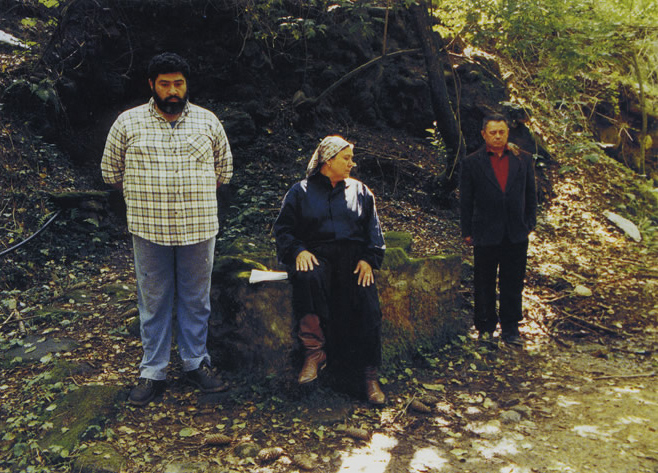
Operai, Contadini engages with a certain idea of sensibility and the sensible essence of art. In order to try to define it, let us begin with the beginning: in front of us we have immobile characters, who will all stay that way except for one of them, who we will see leaving the field of vision. On one occasion, another character promptly lifts his arm in the air to accentuate a word. Otherwise, their hands are generally occupied holding a notebook, their eyes often lowered towards this books, of which we wonder if they are actually reading it. In any case the book is there to call to mind the centrality of the text. Furthermore, the characters hardly ever look at each other, even when responding. They keep their eyes on the book. And when they do raise them, their gaze, turned to us and not to their companions, is generally directed slightly above the normale line of gaze projection.

So the sensorial dispositif of the film essentially consists of things being said, voices saying them, a distribution of bodies in space, and finally what we could call the frame: the place – the clearing of a forest – the games of light and shadow, the sounds of leaves or the singing of birds.

The things being said generally speak about sensorial elements. The history – if there is one – of this community of workers and farmers is recounted by the characters through small stories of frost, milk or light – of the stars or electricity – or blows and fights. The community is called by its chief, Faccia Cattiva, “the good thing”, and this good thing is constantly presented as an entirely physical thing.

To this idea corresponds a certain poetics, an aesthetic poetics, which is to say anti-representative: it’s about transforming a story in a presentation of significant or privileged moments. From Vittorini’s book Le donne di Messina, containing 82 chapters, the Straubs have only extracted four chapters composing these accounts. In the fictional economy of the book, the narrator is absent during wintertime and the famers tell him how it went after his return. But in these chapters, Vittorini himself has been conducted by something else than the only fictional logic. He didn’t really need to make this connection, but he has used it to inject the heart of the narrative with a sort of poem in prose. The Straubs have radicalized this displacement by substituting the narrative sequence with this selection of privileged moments which speak for themselves, or which have to show directly the sensible force of what is being said. They have clearly opposed a poetics of fiction with a poetics of embodiment.

We can see why there is this rejection of fiction. Fiction, in the traditional sense of the word, with its beginning, middle and end, is condemned to always having to end, nolens volens, but in any case to finish, to reject all of which is spoken about in the past, in the “having-been”. Compare this film to another one based on a similar story about a community: Jean-Louis Comolli’s La Cecilia, in which we witness the birth, the life and death of an utopian community in Brasil. In the Straub’s work, nothing begins, nothing ends. The blocs of embodiment are there for ever. This position in regards to fiction is also a political choice. Operai, Contadini speaks about one of the communities we tend to call utopian. However, an utopia is by definition what is destines to give way to the real and end up badly. And in Vittorini’s book things end just like in Comolli’s film: the community explodes as soon as it comes in contact with the external world, the real world, with politics and history. At the end of the book, the hunters arrive and recount what happens in the Italy of 1945: there is the Republic, the elections, and the people will find that it is possibly more interesting than their stories of milk and cheese… Yet the Straubs refuse this politico-poetic scenario. Their community has no history, it only has moments, and any of these moments holds the global force of the community. We can say that this film is a communist film, presenting communist moments in which its real is never confronted with another real that would be its exterior referent. Which means that these moments are for ever.

This poetic and political choice of presenting sensible blocs instead of a narrative rests on a paradox: these sensible moments themselves only exist as reports in the form of narratives. But perhaps the word “narrative” (récit) has to be put into question in the context of this film. Because the talking bodies it presents are not informers, who have to connect the unknown with the known. Even when they speak about having-been, the film does not at all take the form of an inquiry in which a puzzle has to be put together. They are not narratives of the community but communist voices, bodies giving voice to the community while giving voice to these things being said. Everything has to pass through the force of what is being said: the snow and the frost, the ray of light produced by the work of the community, the blows given to the deserter Spine, or the preparation of ricotta. Everhing has to pass directly via speech, which has to equal the force of these moments of community.

But this direct passage via speech can not come about in the classical way: by an appriopriate choice of expression producing the impact of sentiment or sensation. We could imagine the phrases being spoken in a tone of tenderness or anger, horror or nostalgia. But this is eschewed here. The passage of the sensible of the community to the sensible of speech doesn’t occur in the unity of an expression or a system of signs, instead it operates by dividing the speech in two. The speech does not express the sentiment of what is being said, it rather accounts for its sensible force. And it does so by dividing.

ouvriers__paysans_01.jpg

In this film, essentially a film of speech reminding us that cinema is also an art of speech, this is actually twofold: there is lyrical speech and dramatic speech. Lyrical speech attests to what we could call the fundamental tone of the community – an expression which has a heideggerian resonance, but this resonance is also in the film. Dramatic or dialectical speech attests to an agnostic mode, the essential nature of the community, which is to say its divided nature. Speech, in the poetic economy of the Straubs, is communist because it at the same time unites and opposes these two poetic registers: a lyrical register, which is the expression of the common as common, and a dramatic or dialectical register which is the expression of the common as divided or marked by division.

At first sight it is the second aspect that seems to impose itself here: in this film we have the impression that we are seeing a well-known political scenario (at least for the generation of the Straubs and myself): the contradiction at the heart of the people. Here it takes on three figures: firstly, workers and farmers, meaning the worker’s activities of construction, concrete and electricity against the earthly obedience to the laws of nature; secondly, masses and avant-garde: the masses responding to the everyday of suffering and insufficiency, the avant-gardes dealing with the future of the community; thirdly, men and women: the women claiming their intellectual and sexual autonomy opposite or alongside the men who make them either into objects of desire, or mirrors to admire their own image in.

A lot of the progressist fictions function by drawing episodes and affects from the game of these three contradictions, to which often is added a fourth one, opposing the proletariat to the lumpen-proletariat or the marginal. But what happens here? On one side, the Straubs radicalize the thing. There is a distribution of voices, of groups, of postures that we recognize materially and on the terrain the contradictions and their terms: we first see the group of famers and the one of the workers responding (without looking at eachother), then a group of managers responding to the masses, from a separated space, itself divided into two groups, each one marked by the division men/women. But in this visual dramatization of things, there is at the same time a gap in regards to the progressist fiction that plays on the affect of contradiction and in which division is often presented as a misfortune of history, an fatal absence of synchronism. There is division because the farmers are not advanced enough – technologically as well as ideologically – to be able to follow the worker’s dynamics or, inversely, the workers are not advanced enough politically to recognize what is positive in the farmer’s prudence. The division is the misfortune, due to the fact that the whole world doesn’t march at the same rhythm. It is a sort of essential delay.

Here, in return, the division is principal: it is logical, axiomatic. The division in the heart of the people is not an accidental phenomenon, or a sign of immaturity, a fatality of history. But the subject-people is as if defined by division, evinced by it. There are artists and filmmakers of the people that are missing, according to Deleuze’s formula. This is exemplary the case for Godard. In Straubs’ films, the people are present, but present as what divides them, what evinces them by upholding themselves in the affirmation of their division, by contending this division. Of course, there is still something of the old dialectical formula according to which “one divides in two”, but here it also means, and more an more vigorously, that the one is evinced by the two. This communist people, going through communist moments, evinces itself by its division. Operai, Contadini, the title of the film, is also the beginning of the last verse of the Internationale: Workers, farmers, we are / The great party of the workers. In this film, this comma between workers and farmers becomes a co-presence on the mode of conflict, or a conflict on the model of co-presence. Which is to say that division is a matter of logic affirmation: here there are no bodies living the contradiction, suffering from it, as in la Cecilia, but rather bodies contending it. They occur in a dialectical, materialised dispositif, which has a double effect. Each group contends its quarrel with the other, or contends it in a internal way (in the case of the last two), but each one attests at the same time to the reality of the gathering mentionned by Faccia Cattiva, the reality of the communist people. It attests to it in front of a third party, suggested by Jean-Marie Straub and Danièle Huillet as the vis-à-vis of their gazes, when raised. In their text, this third party has four names, all followed by an interrogation mark: the judge? Investigator? Spectator? God? We could even add a fifth: history as instance of spectator-judge-investigator-God pronouncing the fact that it has been, which is to say it is dead, and who judges that what is dead deserved to die.

The line of gaze, always slightly raised, is adressed to the spectator-judge of history. This is how poetics is reconciled with politics. Refusing the traditional fiction also means refusing this judgement of history, while at the same time setting up a counter-process. The disputants contend together against this “witness” who pronounces in the name of history the judgement on what has been. This imaginary instance who says what is dead and that if it’s dead, it means it had to die, is here defied by the affirmation of a “this has been, we maintain that it has been, so it is.” Hence the central importance of the character of Carmela, who counts, over-articulating, those who come and go, her eyes always fixed on her text or absent-minded. This voice keeping count acts as a sort of stubborn bass of the film: a film keeping count itself, correcting the count.

This is how the one is evinced by the two: the game of affirmation continues, which reminds us of this verse of Mallermé’s Prose pour des Esseintes: “Nous fûmes deux, je le maintiens.” Even if in the film the logic is very different, there is still something that says: “we were divided, so we maintain”. Significantly, the character of the worker saying “no, there is no dissension” is the one who we see leaving the field of vision altogether.

But the quarrel tends to change meaning itself. Originally, the dispositif of the dialectical discussion had a Brechtian tonality in the Straubs’ work: in History Lessons, just as in the other films inspired by Brechtian pedagogy, the display of arguments took on the value of an exercise. The dialectical exercise had a recognisable imaginary destination: the young revolutionary in need of exercising his aptitude to apprehend the contradictions of speech in order to apprehend the political and social contradictions. Such is the case in films like Fortini – Cani or Dalla Nube alla Resistenza. However in Operai, Contadini, as in Sicilia!, the addressed spectator is not an imaginary militant who needs to be schooled by dialectics. It is rather the sceptic, the judge, who has pronounced on all this the verdict “utopia”, the point of view of history. In regards to this spectator, this judge, the contradiction evinces existence, more than an exercise schooling a dialectical mind.

This evidence, this communist affirmation proposed by the film passes, as I’ve said, through a relation between two forces of language; lyrical speech and dramatic speech: there are bodies contending division, on the basis of a common affirmation, of a common force of speech.

ouvriers_paysans2.jpg

It is clear that the common speech of the farmers is not the voice of the farmers. This was already the case in Vittorini’s book, which doesn’t bear any trace of accentuation of a way of speaking which is characteristic of a specific group. But here the choral distribution of quarrels and the voicing (mise en voix) of the text reinforce this affirmation of a common property of language. Bodies never express any trait of expression particular to workers, women, etc. In their eyes or in their gestures, they never mime what the texts recount or their inherent sentiments. They are bodies bearing voices; they attest to what the text says and the common force of its writing. The mouth takes on an remarkable importance. What we see is first of all the work of the mouth articulating every syllable, every wording of the quarrel. It’s the way in which the farmers over-articulate and make the sobriquets and reproaches of the opposing clan resonate. But this articulation had to render the syllables as sensorial as the blocs of ice, the ricotta or the aroma of burning laurel leaves of which they are talking. The traditional expressive mimetic is opposed with a sort of equivalence or equality of intensity. This is particularly perceptible in the case of the widow Biliotti or Carmela: each time the mouth has to make an effort to keep the speech at the level of the experience, at the communist level of language. This is, I think, the meaning of these eyes so often lowered to the book which they don’t really seem to read.

This supposes a unique intervention in the text, not consisting of adding or removing words, but of correcting them in setting up a lyrical disposition. Danièle Huillet has translated Vittorini’s continuous description in prose into a poem in verses, which have to resonate a bit like a translation of Sophocles by Hölderlin or of Aeschylus by Claudel. Thus the voice has to adapt to the exigencies of the poem: exigency of the perpetual upswing of the voice, of adhesion to every word, of equality between intensity of experience being said and verbal intensity. The disposition in verse creates numerous breaks in the phrases, or breaks in the middle of the verse itself. These breaks can be very spectacular, like when the widow Biliotti conveys the worker’s accusations to the farmers (e Fischio venne urlando / che noi contadini / avevamo in testa / di fare la strage degli innocenti) or when Elvira, for the workers “deserters”, evokes these white kitchens they have never known (di cucine bianche / in cui mai siamo entrate). To this is often added the force of indirect discourse, where every part of the phrase becomes an autonomous affirmation: there is an autonomisation of each intensity, a constant relation between dramatic speech and lyrical speech, debative speech and speech that is intensive, equal, common.

It is interesting to confront this use of speech with two other ones. It is first of all opposed to the classical representative tradition according to which languages are assigned according to the dignity of the characters: grand language for the eminent character , shallow language to the minor one. But it also opposed to the counter-tradition, which counters this hierarchy with a cultural model (popular culture versus elevated language), or opposes the arts of making or living, designated as popular, to the arts of language designated as those of the dominant. Here such an opposition is untenable. The quarrel of the dominated is asserted in an equal language. And the savoir-faire of the people is not asserted in a popular idiom but in the language of poetry. Virgilius is already called upon by Vittorini and the Straubs do so even more. Their method disrupts the opposition between the arts of supposedly noble language and the supposedly popular arts of savoir-faire and savoir-vivre. Here there is a short circuit that puts the arts of popular living in direct relation with the grand art of speech. That is how the voice most in line with “classical tragedy” is given to the widow Biliotti, the character designated the most (woman/farmer) as belonging to a world of the dominated.

Following this tension of speech, the curve of the film, starting from situations of quarrel, goes more and more towards affirmations of sensible and shared fulfillment, culminating in the evocation of the preparation of ricotta, of the community of pleasure that it supposes – which is also the pleasure of the community to which it gives rise (behold the intensity of narratives speaking about fire, laurels, sharing). This implies the passage from a dramatic tonality to a lyrical one, from Brechtian quarrel to Virgilian idyll around ricotta and laurel leaves. This passage principally comes about through the relation of equivalence that is constructed between apparent contradictions; the famers savoir-faire of the fabrication of cheese and the capacity of life spoken in noble language. Between the ricotta, its sharing, and the eloquent speech, the film establishes the same relation as between the cantate of Bach opening and closing the film, between the presto chords, the striking assonances and the force of words: Es schallet kräftig fort und fort / Ein h¨chst erwünscht Verheissungswort / Wer glaubt, soll selig werden.

Between the intensity of speech and the intensity of the communist experience it recounts, the film searches for a identical accord to the one that links the force of Bach’s music to the force of the promise the cantate expresses. The equal aptitude to the fabrication of ricotta and the grand poetic speech renews an experience that was already present in the mother-son episode in Sicilia! Against the son-investigator-inquisitor, the speech of the mother affirmed an equivalence between a savoir-faire (the prepartion of a grilled fish), an affirmation of sexual liberty, and a dignity of speech: there was also an intensity and amplitude which became more and more powerful in the speech of the mother at the moment when she told the son how she had been unfaithful to his father. A equivalence was constructed between the grandness of speech, a pride of possession of her body and the glorification of the socialist grandfather leading the cavalcade of Saint Joseph: equivalence beween a popular art of the body and the most elevated resources of language.

sicilia3.jpg

In the same way, Operai, Contadini passes from dialectical game to direct affirmation, a direct lyrical force of communism: affirmation of a popular pride, a proud speech in which the political audacity of subverting the order of the world and history is on equal par with the savoir-faire of elementary things. Even though the assembly of the two takes on an almost sacramental dimension. This affair of preparation, of sharing and degustation of ricotta takes on the quality of a celebration of the people.

One has to talk about the mythological dimension of the film. Here once more, this is first of all a sensorial affair. It starts with the decor: this forest with the ravine in which farmers and workers are confronted, the fringe where the group of “managers” tears itself apart; the sun, exposing the last trio, continuously shifting place in the ravine, shining on a shoulder, a character, making its radiance coincide with a voice’s, before gliding to the side to shine its light on wild grass, dead leaves, rocks or foam. Our attention is split between things spoken from the lips of the speakers and the light events dancing in their necks or on dead leaves. There are all these sounds continuously meddling with words or punctuating silences; bird songs, insects drones, the screams of a rooster in the distance etc. This is what is always so striking in a Straubs film: it starts a bit like a lot of films, with little birds and water sounds. But in ordinary films, it only serves to create an ambiance of euphoria that has to preside over the film’s viewing: in short, a sensible captatio benevolentiae. In the Straubs work, on the contrary, it continues, it never comes to a halt. Nature is something other than a repertoire of uplifting effects. It is a phystical, metaphysical and mythological force. Here, in particular, it is three things at the same time; it is the ante of debate (up until what point can we interfere with it in our attempts to institute a better human order?), at the same time it is its arbiter, invoked by the parties; and it is also, for those who see the light shifting and the bird singing without caring much for the speakers and their expressive needs, the mute force, indifferent to the debate.

The text of the cantate speaks about an “inconceivable light”. It is the light of God and grace. But the film proposes a more literal translation; the inconceivable light is that which does not depend on a concept, carrying out its work without caring about what is being thought and spoken, and continuing to shine here and there, just like the water continues to stream and the birds continue to sing. Nature is what does not stop, but also what does not stop erasing traces. On one side, it is the non-human force that scoffs at what is being said and done. And this is translated in the film by the ambiguity of its manifestation: when we hear the distant shriek of a rooster, at the moment when someone evokes the deserters, we can think that it serves as a symbol of derision and betrayal. But in fact, this shriek belongs to a continuity of nature that doesn’t care for what is being said and whatever can be symbolized by a rooster’s scream.

On one side, an indifferent nature, but also a nature-ante: this is what is at stake in the debate between workers and farmers: what audacity we can take towards it. There is the audacity of the sons of fire, de mechanic constructors and the electricians who would prefer, very much like nature, to never stop. Opposite, there is the cautiousness of the men of the earth, the farmers, who would like community life to follow the rhythm of peace and quiet and the earth’s activity. The conflict at the heart of the people becomes a conflict of elements, a mythological quarrel of fire and earth. Behind Vittorini’s text, we find a dramaturgy of pride of men, who’ve wanted to seize nature’s secrets and energies, force it to be completely active, completely at their disposal. We hear other texts the Straubs have used earlier: Dialogues with Leuco, in which the communist Pavese charged history from the rear while recovering the weight of mythe and the inhuman; Hölderlin’s drama’s of Empedocles with Oedipus challenging the sun god or Antigone dealing with the underground gods. In evoking Hölderlin, we could also evoke his favored reader, Heidegger. I don’t know what kind of relation the Straubs have with him, but I am struck by the way in which their dramaturgy tends to recode the Marxist dialectical schema in a game of oppositions of a Heideggerian sort: that is what the disposition of places conveys: clearing of the “Open”, where the chiefs set up their camp, withdrawing from the ravine where the masses are. As in Heidegger, the reality of conflicts can be translated in a metaphysical war of elements, leading up to a position of defense of the earth.

Story of salvation, in any case. The difference is that for Heidigger only a God can save us. In the Straubs work a more complex game is set up around the cantate and the speech of promise. To the devine promise they continue to oppose a human promise and a promise that has already been achieved. One shouldn’t say, like in the cantate, that the one who believes will be saved. One should say: the one who believes is saved. He is saved in the eternity of a here and now of maintained experience, having become the speech of life. This way the movement of the film leads us from the process to a new celebration, to the affirmation of a salvation that is already there and of which the force is affirmed, in the final crescendo, in passing from the evocation of a fire of laurel leaves to this grand ascending panorama that leaves us in the overture of reconciled elements and a communism elevated to a dimension of eternity.

——————————————————————————————————————————————————————-

Translated by Stoffel Debuysere (Please contact me if you can improve the translations).

In the context of the research project “Figures of Dissent (Cinema of Politics, Politics of Cinema)”
KASK / School of Arts

The strange tribunal

le_retour_du_fils_prodigue_2003_portrait_w858.jpg

By Jacques Rancière

Originally published as ‘L’étrange tribunal’ in Le Monde diplomatique, april 2004.

Unlike anything else. The films of Danièle Huillet and Jean-Marie Straub are in many ways unique. Somehow, cinema is reinvented. Not only in form, admirably cut, composed of a singular play of actors and an incredible work of voices, but also and above all in substance. Because what Straub and Huillet propose, since almost thirty years, is a criticism “en règle” of capitalism. The most radical imaginable. And that encompasses, of course, the usual criticism of cinematic representation. It is thus not surprising that their films are often boycotted by the big festivals and the main distributors. This is also why it is indispensable to see them…

Jean-Marie Straub and Danièle Huillet’s diptych Le Retour du fils prodigue and Humiliés / Umiliati is based on Elio Vittorini’s novel Le donne di Messina, story of a short-lived community founded at the end of the second world war in Italy by people stemming from different regions. The intrigue of a book is never really of interest for Straub and Huillet. Their work is always about extracting its tensions – in the double sense of the word: confrontations of ways of thinking and differences in sensible intensity. From Le donne di Messina they’ve only kept two short extracts: in an earlier film based on the same novel, Operai, Contadini (2001), they used four chapters comprising of intertwined monologues in which the community of workers and farmers reveals itself in the argumentation of its quarrels and the affirmation of its sensible force.

While Le Retour du fils prodigue returns to this presentation of the community, Humiliés isolates the chapters in which it is brutally confronted with the outside’s economic and political laws; the finished war, the Republic and the persevering economic miracle.

The continuity seems to be unproblematic. It is nothing of the sort. The right-wing logic which sympathises with the utopias before sacrificing them to the dialectics of history is not shared by Straub-Huillet. What attracts them to Vittorini’s book, is the recognition of the same tension animating their cinema and their marxism – a tension that can be summed up with two names, Bertold Brecht and Friedrich Hölderlin: the artist who wanted to make theater using marxist dialectics in the most rigorous way; and the poet who was among the first to conceive this revolution of forms of the sensible world, of which marxist materialism resumed the idea in its own way.

le-retour-du-fils-prodigue3.jpg

Brecht and Hölderlin: on one side, the dialectic game of embodied thinking dismantling the mechanisms of domination and their impact on the dominated; on the other, the affirmation of the new sensible community and the risks for those venturing in its unknown. The art of Danièle Huillet and Jean-Marie Straub has always operated between these two poles, while at the same time demonstrating their secret relatedness.

At the time of History lessons (1972), they put the emphasis on the cynicism of Roman senators, construing either the “affairs of mister Julius Caesar” in the comfort of their garden, or the law of profit, triumphant in a time of war exploits and palace revolutions. It is still a lesson on political economy which, in Umiliati, is thrown in the face of the artisans of the community by the delegates of the new Italy. But the meaning of the history lesson as dispositif of voices enouncing it and bodies receiving it has changed.

Operai, contadini even seemed to rule out all lessons. The community was discarded from the logic which provides every story with its end and beautiful dreams with a sad ending. The numerous quarrels instructed by the protagonists – workers / farmers, bosses / masses, men / women, deserters and loyals – coalesced in the same fundamental tone, in the lyricism of a speech which stated, in the grandest language, the force of the constructors of the new world, materialized in the taste and the smell of a heather fire, the cooking of ricotta or an excursion in search for laurel leaves. The community didn’t have an end, only sensible moments, for ever present. Oftentimes leaning over to read the notebooks containing their lines, the protagonists regularly raised themselves to affront an imaginary spectator, designated in the text with an ironic interrogative: “the investigator, the judge, God?”.

Not an end of a journey, not a tribunal or history’s devices. In the face of the absent judge, the figure of the woman of the people, embodied by Angela Nugara – the same actrice who played in Sicilia! (1998) – affirmed with the diction of tragediennes the collective capacity or the possession of “a life of one’s own”. However, of the twelve protagonists in Operai, contadini, only she does not appear in Umiliati: she is replaced by an old farmer who only intervenes with the gesture of a hand demanding speech which is not granted. This disappearance is symbolic, just as a music of the apocalypse, borrowed from Varèse, comes to substitute a chant of hope, a Bach cantate.

retour-du-fils-prodigue.jpg

The perspective has brutally changed. Here, the present of the community has an ending. The tribunal of history takes place, not so much to pass judgement than to humiliate the men and women of the community. Standing on a hillock, in the light, in their soiled clothes, their eyes often lowered, their hands sometimes behind their back, they find themselves submitted to the crossfire of the judges, situated beneath them in the freshness of the ravine and the certainty of their reasoning.

No more notebooks. The prosecutor and the three judges know their lesson – of economy and history – in its two versions: bourgeois (laws of property called to mind by a non identified character) and proletarian (laws of history made explicit by three partisans in red scarfs). Opposite – if we can say so, because no shot puts the two parties together: on the contrary, the absence of common space is accentuated – the words and gestures of the members of the community seem to be reduced to ruptions of anger and gestures of impotence.

Nevertheless, it is a peculiar tribunal. “Who are you?”, the “prosecutor” is asked. Question without answer. In Vittorini’s book, this “Charles the Bald”, armed with a surveyor’s yardstick, appeared as a enigmatic manipulator. Here he is only a voice animating a body: an almost ventriloquist voice in accordance with a frenzied look. What is passed through this voice, at the same time assured and laborious, as if astounded by what it says, is the law without age of property: terrains and houses, land and water, seas and volcanos, all that, it says, makes up a seamless framework where everything is appropriated: what doesn’t belong to Caïo belongs to Tizio, and what doesn’t belong to either of them belongs to the public administration.

le_retour_du_fils_prodigue_2003_portrait_w858-1.jpg

There is no place on the land registry where communities like this one can settle. But the monologue resonates more like a chant of mourning than as an indictment. As the strange prosecutor’s speech brings about these rivers and craters all belonging to a master, his voice seems to radiate. It is as if the impersonal voice devides itself in two, as if the discourse of Vittorini’s sly manipulator has been secretly tainted with the voice of a poet, that of a Hölderlin maladroitly woken up from his sleep and assessing what has become of his world and his dream.

The voice of the partisans (“hunters” in Vittorini’s book) lacks the state of mind to explain the people of the village what their community is: a cooperative like all others if it wasn’t for the restrictions of its operations, the obsoleteness of its material and its ridiculous productivity. The scansions strongly articulated in the text, organized in rhythmic sequences by Danièle Huillet, at the same time playing with these Hölderlinian “antirhytmical suspensions” offered by the upward motion of accents in the Italian language, take another function here. In the frenzied monologue of the “prosecutor”, they contribute to the abstraction of a world. In the assured rhetorics of the red scarfs, they open up the wound with the knife of irony. If Charles the Bald states the law without age of space, they are the mouthpieces of time, the youth of the world. They can gleefully return the bullet of the dialectical game without having to look at those they are talking to, and who are like those behind their backs, those who have to chase the “train of history” on foot. They know the Republic, the law of the market and the boogie-woogie. In short, they are good Brechtians.

This Brechtianism is definitely not that of the filmmakers. The hunters will leave with the train of history, without having found the man they were looking for, but having reached another goal: disrupting the community. The Straubs, they stay behind, on foot, observing that the train has passed and refusing to comply. The stretched hand of the old farmer does not yield. In the last shot, Siracusa, the companion of the chief who has “nothing left to say” to the deserters, rests on the doorstep of the closed house, her head in her arms, in the pose of Boticelli’s Derelitta. But with a last cry, an “Ah, yes!” passing from resignation to ultimate affirmation, her arms loosens, while the camera slides down in a last movement which frames, up until the height of her naked feet, the dangling arm which the fist remains firmly closed.

——————————————————————————————————————————————————————-

Translated by Stoffel Debuysere (Please contact me if you can improve the translations).

In the context of the research project “Figures of Dissent (Cinema of Politics, Politics of Cinema)”
KASK / School of Arts

Letter to Elias Sanbar

bergen-belsen.jpg

By Jean-Luc Godard

Originally published in Cahiers du Cinéma n° 300 (May 1979), which was completely put together by JLG.

Elie Sanbar,
somewhere in
Palestine

19th July 1977.

We are really sad that we were unable to see you, but the shooting with Camille took more time than expected. Talking with children was much harder than with Ludovic. (1)

I would have liked to have your opinion about a text and a picture that I’€™m considering to put in the third programme, which is about bringing things to light. (2)

We are wondering how, at a given moment, the Germans have become such great executioners and the Jews such great victims.

The Jewish people are a very original people, and their history is a very interesting one. It still remains to be told.

It—s a history of you and me, that is: of oneself and the other.

At a certain point in time, the Germans and one German in particular, supported by the other Germans, wanted to become other without forsaking anything of themselves, that is: to simply expand until infinity, multiply themselves until death, a bit like cancer, or like those who give lessons, those who produce texts.

And amongst the other people hindering them in their desire to spread their truth everywhere, which of course meant all the other people in general, except for the Japanese who were doing similar things at the same time, but it was above all the people who stood out as other from the outset, for whom being themselves first of all meant being an other, who started out from difference rather than alikeness, and who considered themselves like that and not otherwise, since the night of time: the Jewish people.

Therefore the Germans not only had to exterminate them but wipe them from the face of the earth, and in a spectacular fashion at that.

And that’€™s how the original image of the Jewish people finally found a legitimate place.

But Israel never acknowledges it: that they needed a second and terrible image, that of the German madness, in order to gain this right to have a place of their own, to be fully legitimized, and that it’€™s a burdensome inheritance.

Yet this is visible in any image of the German camps, but not if we look thoughtlessly because it’€™s too horrible to look at, too horrible especially to exist only because of the hate for the other.

Nobody knows where things will end up in the Middle-East, but we can somewhat know where and when it has really started.

It was here, in Europe (it is thus also our war, and if it wasn’€™t ours we would not understand why the people here get so exited about Libanon rather than South-Africa or Cambodia).

In Europe and with one of these images, not just any at that, and with it’s true legend.

The current war in the Middle-East is born in a concentration camp on the day when a great Jewish outcast, on the verge of dying, was called “musulman”€ by some SS. (3)

One really had to be the essence of evil to be able to inoculate the memory of six millions of Jewish dead with the memory of the hate for the other, but for the other Jew this time, because in thirty years time the Jewish people would meet its alike, an other Jewish people, and on a very specific territory, not in the night and fog, but in a place somewhat in the sun, and who told them: I am the same as you, I am a Palestinian.

We have often spoken about this: that an image is useless if it is not accompanied by its alike in a different situation.

But perhaps that’€™s why images are frightening. Even alone, if well taken, it calls for an other, and first of all it’s rightful legend, like justice establishing balance.

godard_cahiers300.jpg

Under this picture of a Palestinian woman who is grabbed by the hair by one of Begin’s soldiers, the English text says: “West bank say no”€. (4)

In a magazine for professional photographers, its legend would be: Nikon case, 58mm lens, I/60 to f: 4, Ektachrome X.

It’€™s not that they are false, these legends, but rather incomplete, and deliberately so. That’€™s where it doesn’€™t move, in the most simple sense: it prevents to move, further, not as far, no matter, it’s about putting a stop to circulation.

Perhaps a cinema magazine made with other people, people who would need to establish relations with other people, living under different skies, perhaps this would salvage a bit of the circulation in our impotent capability to imagine.
—————————————————————————

Translated by Stoffel Debuysere (Please contact me if you can improve the translations).

In the context of the research project “Figures of Dissent (Cinema of Politics, Politics of Cinema)”
KASK / School of Arts

translator’s notes

(1) References to Camille Virolleaud in France/tour/détour/deux/enfants and Ludovic in Six Fois Deux, Part 6B: Jacqueline et Ludovic, both made with Anne-Marie Miéville.

(2) Reference to France / tour / détour / deux / enfants, Deuxième mouvement (Lumière/Physique).

(3) In regards to the use of the word “Musulman”, Andy Rector sent me these lines taken from This Way For the Gas, Ladies and Gentleman (1959) by Auschwitz survivor Tadeusz Borowski:

page 32:
“Just as we finish our snack, there is a sudden commotion at the door. the Muslims* scurry in fright to the safety of their bunks, a messenger runs into the Block Elder’s shack. The Elder, his face solemn, steps out at once.
‘Canada! Antrten! But fast! There’s a transport coming!'”

(…)

*’Muslim’ was the camp name for a prisoner who had been destroyed physically and spiritually, and who had neither the strength nor the will to go on living — a man ripe for the gas chamber.

Borowski, quoted in the introduction, page 22:
“The first duty of Auschwitzers is to make clear just what a camp is…But let them not forget that the reader will unfailingly ask: But how did it happen that you survived?…Tell, then, how you bought places in the hospital, easy posts, how you shoved the ‘Moslems’ into the oven, how you bought women, men, what you did in the barracks, unloading the transports, at the gypsy camp; tell about the daily life of the camp, about the hierarchy of fear, about the lonliness of every man. But write that you, you were the ones who did this. That a portion of the sad fame of Auschwitz belongs to you as well.”

(4) Menachem Begin was the founder of Likud and the sixth Prime Minister of the State of Israel.

Montage Interdit

notremusique.png

Some rough translations of extracts taken from various texts written by and interviews with Godard, all related to the question of ‘Montage Interdit’ – the main issue of the next DISSENT ! session with Eyal Sivan (12 December).

——————————————————————————————————————————————————————-

Talk with Antoine de Baecque about an interview that Godard attempted with Yasser Arafat, as published in Godard: biographie, Grasset, 2010.

“I asked him if the origins of the Palestinians’ difficulties had something to do with the concentration camps. [Arafat] said to me, ‘No, that’s their story, the Germans and the Jews.’ And I said, ‘Not exactly, you know that in the camps, when a Jewish prisoner was very weak, close to death, they called him Muslim [musulman].’ And he responded, ‘So?’ I said, ‘You know, they could have called them black or an entirely different name, but no, they said Muslim, and that shows that there is a relationship, a direct relationship between the Palestinians’ difficulties and the concentration camps.’”

——————————————————————————————————————————————————————-

Letter to Christa Maerker, March 1995.
“… Understand that I pay attention, if even possible, to what images say as well as to what they withhold; for example, to those millions of Jews, gypsies, all those who struggled, those we “celebrate” these days, forgetting that in the ultimate stage the German language decorated them with the name “musulman”, which leads us to Sarajevo, doesn’t it. “Montage Interdit” – forbidden montage, as Bazin would say.”
——————————————————————————————————————————————————————-

Interview with Youssef Ishaghpour, published in Archéologie Du Cinema Et Mémoire Du Siecle, 2000.
“… It’s a juxtaposition and it’s an image, like many of the ones in Histoire(s). No one but me has said that at one point in the extermination camps the Germans had decided to declare a Jew to be a Musulman. Although they all knew it, the survivors, it’s in all the books, but no one made the juxtaposition, not even when the war broke out in the Middle East… But that’s an image, one day it struck me as an image, that there should be two words juxtaposed, it’s two images…”

——————————————————————————————————————————————————————-

Interview with Serge Kaganski, published in Les Inrocktibles, May 2004.

Notre Musique deals with genocide. What can cinema do in the face of genocide?
I don’t know. I wanted the film to bears the marks of the Israeli–Palestinian conflict, a conflict we feel close to since a long time. Me and Anne-Marie Miéville, we met at the Palestinian library in Paris. As dropouts, driven from our cinematographic domain by what we can call American cinema, I feel close to the Vietnamese, the Palestinians… As creators, we have become outcasts. For a long time I have been saying that I was working in the fringes, but that it’s because of the fringes that the pages come together. Today I have fallen from the fringes, it feels as if I am inbetween the pages.

In you most recent film, the poet Mahmoud Darwish says: “we have the misfortune and good fortune of having Israel as our enemy. You’ve brought us defeat and renown.” Can you comment on that reflection?
It’s true. But we can’t resolve it with phrases, like that. We have to take the time to examine the facts and out of that, perhaps, like in scientific experiments, can come a necessity or utility for a phrase we can use as a precept, to heat up water or send a rocket into space. Before that there is nothing. We can only say: “look”.

The Israeli–Palestinian conflict is very present in the film…
No, not really. I wanted there to be a representative of poetry in the film, and that it’d be Mahmoud Darwish, rather than an Irish poet, for example. I also wanted there to be a conversation, stemming from an old project of dialogues with my intellectual opponents, such as Claude Lanzmann, Bernard-Henri Lévy, Alain Finkielkraut… But Lanzmann didn’t want to be filmed. (1)

You have signed a petition against the cancellation of a screening of Eyal Sivan and Michel Khleifi’s film Route 181 at Centre Pompidou. The film includes a sort of détournement of the barber scene in Shoah…(2)
If you say so. I don’t see why it would be a détournement of Shoah. There are barbers in Palestine, aren’t there? On the ordnance road, there would have only been tanks. Route 181 is a good television film. It’s true that, as you say, it advances meaning, intent. It’s a militant film. There are good ones and lesser ones. In the great barber scene in Shoah, there is no more intent, and then you attain something else.

Do you define the films you’ve made between 1968 and 1972 as militant films?
Some, not all of them. I tried to escape that, I tried to be more militant in cinema, and from there on reach militants in Vietnam, or elsewhere… But I never considered the camera as a gun. Nor did I believe that one had to make cinema with the camera on the shoulder, in the heart of the struggle. Today there are other forms of cinema of intent. For example, I don’t like Chantal Akerman’s films very much, suh as Sud or De L’Autre Côté. The intent is visible. It consists of, let’s say, filming the poor. Before it were the rich people who were noble, today it’s the poor (laughs). And on this noble subject, she applies a so-called formal rigor. She uses travellings, beautiful frames. We can call that a dispositive. Or an installation, like Boltanski, who puts pyjamas in the nave of a church and calls it “deportation” or I don’t know what. Always the name and the intent, the legend and not even the picture.

Do you watch television?
Yes. From time to time, television transmits something. It is supposed to be made for that, so sometimes we see a face, a voice, a document we don’t know and it makes us happy. But it’s mixed in with all the rest. It’s like they say: haven’t there also been some decent people in Soviet Russia? Or in Nazi Germany? Or in today’s United States of America?

Do you mean to say that there are some “decent programmes’ in an otherwise globally bad televisual landscape?
I sometimes watch debate programmes by way of practice, to see if I still have a taste for argument, if I could still end a discussion with three responses. As I don’t speak to people a lot, I watch those instead. But the image I am looking for are the people in the back, what is called the audience, or the citizens. On television, you can see cleary what democracy means: there are citizens, speechless, there are noblemen, or Parliamentarians, or the governement, around the table; and then there is an animator. That is democracy. It’s an image.

The other day, I was watching my friend (Elias) Sanbar (3), who was talking with the Israelian ambassador on LCI (French television news channel). In the corner of the image, you could see a picture of the map of the Gaza strip. The Israeli said they had to leave this strip because there were 1 million of Palestinians and 7000 Israelis. The strip was marked in red, with a part in blue for the Israelis. One should have seen that the 7000 people had 35% of what the 1 million had. So let’s look at that, and then, let’s find out what to say. But the relation with the image was not made. We are afraid of the image. We prefer a flood of words.

Perhaps this relation between the demographic figures and the image of the Gaza territory hasn’t been established during this programme, but it has been mentioned many times in other media. Perhaps the news channel wasn’t as afraid of the image than of repeating a fact that has been largely divulgated.
It was mentioned in words, not in images.

No, Le Monde or Libération have published many pictures and maps of Gaza.
But accompanied with words, while words are not needed. You make an animation with maps of Palestine from 1948 till today, and then you look. You can even do it from 1900 on, with the first Jewish colonies. Then you look.

You speak of Jewish “colonies” in 1900, although there wasn’t an Israeli nor a Palestinian state back then, and Jews had been living on that land for six thousand years.
Absolutely. It so happens that they were called “colonies”. When a word is used, one can’t be surprised that people pick it up again.

(…)
A shot and counter-shot can be two words, two images, it can be an image and a word, but it’s not two times the same thing in the guise of an other. What is called the other is the same, as in the case of the Hutus and the Tutsis, and that’s why they are fighting each other. They are the same and they hate each other. Three-quarters of the people, you and me, hate each other’s guts. If we don’t analyze, we don’t know that what we don’t like in the other, is ourselves. In regards to that, Lacan sometimes set up shots and countershots. We was quite the filmmaker.

An example of a “real” shot / counter-shot in Notre Musique?
There are some that can perhaps be criticized like Sivan has been. When I show a photograph of a deported Jew on which I write “Jew”, and two images after that, I show a photograph of a corpse against a fence and I write “Musulman”. People have told me “But that’s awful, because the history of the Palistinians is not the Holocaust of the Jews.” But when I write “Musulman’, it’s because in Auschwitz Jews were called “Musulman”. And then Hollywood was called the Mekka of cinema.

godard_juif_mus.jpg
——————————————————————————————————————————————————————-
Interview with Jacques Mandelbaum and Thomas Sotinel, published in Le Monde, May 2004.

Three Jewish characters is a lot in one movie (Notre Musique).
I’m the fourth. I’m a Jew of the cinema.

You seem to be placing more and more emphasis on the fate of the Jews. Where does that
come from?

It’s been a gradual process, because I’ve had to educate myself on the subject. At my
grandfather’s house – he was a collaborationist – we would listen to speeches by Philippe
Henriot every evening. During the war, my parents were part of the Swiss Red Cross, visiting
refugee camps. But no one ever explained to me what had happened.
Afterwards, bit by bit, I did some reading here and there and finally made some connections. But
basically, I’ve never succeeded in knowing what it really means to be Jewish. The only way for
me to understand it is to tell myself that I’m the same: I want to be with others, and at the same
time not with others. This is a feeling I have myself.

Exactly what do you mean by the parallel you make between Jews and Muslims in the film,
based on the two photos of Nazi death-camp prisoners? Where did you get the photos you
used for that?

The first photo is well known, it’s a picture of a prisoner with bulging eyeballs, which I believe
was taken when the camps were liberated. The other photo, also of a deported person, gives you the
feeling that the end is near. They’re the ones who were so exhausted physically they were nearly
dead, who were called “Musulman” in the camps. I’ve always wondered how it happened that the
Germans called Jews “Musulman.” And then I realized that this was where the Middle East
conflict started. You’re in an apartment, and someone arrives and says, “I have been appointed
by God; I will now occupy this apartment.” I wanted to make a movie about that with Marcel
Ophuls, where we would show the two of them in that apartment. We talked, we tried to solve
the question between ourselves, as if we had the power to do so, but it didn’t work out. (4)

Isn’t it dangerous to suggest, as you do, a parallel between the extermination of the Jews
and the Palestinian exile due to the Middle East conflict?

Of course, I thought about that for a long time. When you put the two things side by side, they
say it’s disgusting. But how is it that no one – neither the Jews nor the Palestinians – has drawn
that parallel? And when I do that, I’m not thinking about it, I do it like a scientist bringing
elements together. People would rather talk about something than really look at it. What I’m
saying is, let’s look at the images. I would rather look [first], then talk about it afterwards.

In the dialogue between the Israeli journalist and the Palestinian poet Mahmoud Darwish,
they don’t speak the same language, but they seem to understand each other.

He understood her, because Darwish speaks Arabic and understands Hebrew, but she didn’t
understand him, because she doesn’t speak Arabic, but she’s a good actress.

The poet says, “We are fortunate that our enemy is Israel, because the Jews are the centre of
the world.” What is your understanding of this idea that the Jewish people, the pariah of
the nations for 20 centuries, is the centre of the world?

What does that mean, “the centre of the world”? Here’s how I understand it. There is something
very original about the Israelis, but they’ve introduced the idea of origin into their originality.
Origin means that someone came first. They have theorized about all that, and so it’s completely
normal that what happened to them did happen to them, and they’ve been able to theorize about
it because it happened to them.

——————————————————————————————————————————————————————-

godard-fict-docu.jpg
Conversation with Elias Sanbar, in Le Havre, November 2004.

Godard: This distinction between documentary and fiction is a cliché that has been there since a long time. On the contrary, in the Cahiers the Cinéma days, I remember a critic writing about Jean Rouch’s Moi un Noir that “it’s a great documentary because it’s a great fiction film.” In Notre Musique, I hesitated between “The Israelis become the stuff of doumentary” and “the Israelis become the stuff of fiction”. It seemed to me that, considering the history of zionism, the second sentence was more appropriate: after all, they are on the land of their fiction. And this also corresponds to something Elias said to me and that I’ve put in the film: “When a Israeli dreams at night, he doesn’t dream about Israel but about Palestine. Whereas, when a Palestinian dreams at night, he dreams about Palestine, and not at all about Israel.”

Sanbar: This sentence is actually a fragment from a non-polemical conversation a had with an Israeli friend. I tried to explain to him that the power relation was perhaps not as he imagined, because there is something that completely escapes the Israelis. I told him: “When you sleep, we are the ones who occupy your skulls. You occupy the land during the day. We occupy your head at night.” This was not a wisecrack. I think this is the essence of the Israeli’s vexing fear. The more atomic weapons, armored cars and airplanes they have, the more they are in a state of weakness.
In relation to that, I would also like to specify something that Mahmoud Darwish says in the film about the defeated. He doesn’t glorify defeat, but loss. It’s not at all the same thing. Since twenty years, this has been a central theme is his poems. He has been developing the idea that during the war in Troy, ultimately it wasn’t Achilles, Hector or Ulysses who were the most interesting, but rather the Trojans. In some way we are, amongst the Arabs, like the Trojans. This is not at all about valorizing defeat, but a way of saying that in loosing there is endlessly more humanity than in the accumulation of victories. That is perhaps the plight that has been given to us. But one has to understand that we don’t like being victims. We leave victimhood to those who want to endorse it.

(…)
Godard: the word “demon” reminds me of Maxwell’s equations, at the end of the XIX century, that were later resolved by the theory of quantum physics, in showing that a particle can be in two places at the same time and that when the speed of this particle – possibly a photon – is observed from a third place, we cannot know where it is situated. This is what I call the real shot/counter-shot, which is a known figure in cinema which hasn’t been used as such. We have used another shot we call counter-shot, but in reality it isn’t that. Maxwell wondered how to get from one place to another, but he didn’t find the theoretical solution. So he called this transfer the “demon”. In science this is still referred to as “Maxwell’s demon” (5). It’s strange that he decided to call it the demon and not the angel’s leap, for example.
In regards to the counter-shot, I’ve read this anecdote about the physician Niels Bohr, who liked cinema a lot and who said, while watching a western with Tom Mix, that “the rogue’s elopement with the young girl was logical. This is how it always happens. That the bridge collapsed under their carriage is improbable, but I readily accept it. The heroine hanging over an abyss between the skies and the earth is even less probable, but I accept even that. I even accept as true that at this very moment her savior rides past on his horse. But it is beyond me that at the same time somebody with a camera happens to be on the spot and films all this idiocy”. (6) This anecdote might give you an idea of what quantum physics is. And the presence of this cameraman gives the impression of a real counter-shot.

godard-sanbar.jpg

——————————————————————————————————————————————————————-

Translated by Stoffel Debuysere, except for the Le Monde interview, which was found online (Please contact me if you can improve the translations).

In the context of the research project “Figures of Dissent (Cinema of Politics, Politics of Cinema)”
KASK / School of Arts

translator’s notes

(1) Two letters Godard wrote to Claude Lanzmann and Bernard-Henri Lévy in 1999, can be found here. In the letters Godard discusses the Pas un dîner de Gala [Not A Gala Dinner] project, which would have consisted of a three-way conversation. The proposition was a reaction to Gérard Wajcman‘s article in Le Monde of December 3rd, 1998, “Saint-Paul Godard contre Moïse Lanzmann?” [Saint Paul Godard vs Moses Lanzmann?], which was itself a reaction to Serge Kagansky’s interview with Godard in Les Inrockuptibles, where Godard declared, notably, “I have no proof of what I am venturing to say, but I think that if I put my mind to it, with a good investigative journalist, I could find images of the gas chambers after twenty years; one would see the deportees enter and one would see in what state they left. It’s not a question of pronouncing a ban, as Lanzmann or Adorno, who take things a bit too far, because we always find ourselves discussing ad infinitum different ways of saying ‘it’s unfilmable’, do. People should not be prevented from filming; we mustn’t burn the books, if we do, we can no longer criticize them.”
(2) Route 181 was censored by the French Ministry of Culture and subsequently pulled out of Le Festival du Cinema du Reel, held at the Centre Pompidou in Paris. In a statement released by the Ministry of Culture and the Centre Pompidou, organisers behind the decision to pull the film said: “The film’s broadcast on ARTE … had already provoked intense emotion, particularly among those who are alarmed by the rise of anti-Semitic and anti-Jewish statements and acts in France, and who consider that the film’s underlying hostility to the existence of Israel may be of a nature to encourage these acts.” Later, in 2004, Sivan filed a libel suit in Paris courts against philosopher Alain Finkelkraut (Sivan vs Finkelkraut) for the latter’s claim that Route 181 was a “call to murder Jews” and that Sivan himself was representative of a “particularly painful, particularly frightening reality – Jewish anti-Semitism”. Finkelkraut also claimed that Sivan’s film was a constant plagiarism of Claude Lanzmann’s Shoah. The presiding judge at the trial rejected Finkielkraut’s conflation of criticism of Israel with anti-Semitism, and dismissed Sivan’s petition based on the argument that Finkielkraut’s attack was part of a legitimate political disagreement. Following the trial, Sivan lost his teaching position at CLEMI (the French Ministry of Education’s centre for information media) and the French television network, ARTE, decided to cease commissioning his films. (source: aljazeera. The trial is documented by Cabinet magazine)
(2) Godard and Elias Sanbar have know eachother since 1969, when they worked together on Jusqu’à la Victoire. A letter written by Godard to Sanbar was published as ‘Lettre à Elie Sanbar’ in Cahiers du Cinéma n° 300, 1979. Sanbar’s account of their meeting in Jordan was published as ‘Vingt et un ans après’ in Trafic n° 1, 1991.
(3) Two public discussions between Godard and Marcel Ophüls that took place in 2002 and 2009, were collected in Jean-Luc Godard & Marcel Ophuls. ‘Dialogues sur le cinéma’, Le bord de l’eau éditions, 2011. Godard about the abandoned film project: “It was a little bit “Of What is ‘Jew’ the Name,” to parody the title of a little book by Alain Badiou, the philosopher. Something I’ve been wondering about for myself. He [Ophüls], being Jewish, not necessarily Israeli, his father too, having lived through that era. I wanted to make a film that would be called simply “Being Jewish…” It seems to me that being Jewish is very different from being German, or being a writer, and that’s why, these days, I’m very reticent about using the verb “to be.””
(4) Maxwell’s demon is a thought experiment to “show that the Second Law of Thermodynamics has only a statistical certainty”. It demonstrates Maxwell’s point by hypothetically describing how to violate the Second Law: a container is divided into two parts by an insulated wall, with a door that can be opened and closed by what came to be called “Maxwell’s demon”. The demon opens the door to allow only the “hot” molecules of gas to flow through to a favoured side of the chamber, causing that side to gradually heat up while the other side cools down, thus decreasing entropy.
(5) Godard is probably referring to an article by Leonid Kozlov published in Cinéma 04, 2002, éditions Léo Scheer. A version of the text can be found here.