What is cinema for us?

hondo2.jpg

by Med Hondo (Abid Mohamed Medoun Hondo)

Originally published in ‘Framework’, Autumn 1979, as found on Jump Cut. Translation by Greg Kahn. Med Hondo’s ‘West Indies’ (1979) was shown as part of the ‘Across the Margins, Beyond the Pale’ program.

Throughout the world when people use the term cinema, they all refer more or less consciously to a single cinema, which for more than half a century has been created, produced, industrialized, programmed and then shown on the world’s screens: Euro-American cinema.

This cinema has gradually imposed itself on a set of dominated peoples. With no means of protecting their own cultures, these peoples have been systematically invaded by diverse, cleverly articulated, cinematographic products. The ideologies of these products never “represent” their personality, their collective or private way of life, their cultural codes, and never reflect even minimally on their specific “art,” way of thinking, or communicating — in a word, their own history and civilization. The images this cinema offers systematically exclude the African and the Arab.

It would be dangerous (and impossible) for us to reject this cinema simply as alien — the damage is done. We must get to know it, the better to analyze it. We’ll see that this cinema has never really concerned African and Arab peoples. This seems paradoxical, since it fills all the theaters and dominates the screens of all African and Arab cities and towns.

But do the masses have any other choice? “Consuming” at least a reflection of one’s own people’s life and history — past, present and future? LAWRENCE OF-ARABIA disseminates an image of Lawrence, not the Arabs. GENTLEMAN OF COCODY has a European as the gentleman hero, and not an Ivory Coast African. Do we have a single image of the experiences of our forefathers and the heroes of African and Arab history? Do we see a single film showing the new reality of cooperation, communication, support, and solidarity among Africans and Arabs?

This may seem exaggerated. Some critics will say that at least one African country, Egypt, produces some relatively important films each year and that since independence a number of cineastes have made a future for themselves in African countries. Yet, in the whole continent of Africa, Egypt is only one country, one cultural source, one sector of the market. Few African countries buy Egyptian films and they themselves produce too few films. Furthermore, the market within Egypt itself is still dominated by foreign films.

African and Arab filmmakers have decided to produce their own films. But despite the films’ undoubted quality, they have no chance of being distributed normally, at home or in the dominant countries, except in marginalized circuits — the dead-end art cinemas.

Even a few dozen more filmmakers would only achieve a ratio of one to ten thousand films. An everyday creative dynamic is necessary. We need to make a radical change in the relation between the dominant Euro-American production and distribution networks and African and Arab production and distribution, which we must control. Only in a spirit of creative and stimulating competition among African and Arab filmmakers, can we make artistic progress and become “competitive” on the world market. We must first control our own markets, satisfy our own people’s desires to liberate their screens, and then establish respectful relations with other peoples, and balanced exchange.

WE MUST CHANGE THE HUMILIATING RELATION BETWEEN DOMINATING AND DOMINATED, BETWEEN MASTERS AND SLAVES.

Some critics flee this catastrophic state of affairs, thinking cinema is restricted for Western, Christian and capitalist elites or they throw a cloak of fraternal paternalism over our filmmakers, ignoring and discrediting our works, blaming us, in the short term forcing us to a formal and ethical “mimesis” — to imitate precisely those cinemas we denounce — in order to become known and be admitted into international cinema; in the end, forcing us into submission, renouncing our own lives, creativity and militancy.

Since our independence many of our filmmakers have proved their abilities as auteurs. They encounter increasing difficulties in surviving and continuing to work, because their films are seldom distributed and no aid is available. Due to the total lack of a global cultural policy, African and Arab cinema becomes relegated to an exotic and episodic sub-product, limited to aesthetic reviews at festivals, which, although not negligible, are insufficient.

Multinational film companies earn 50% of their profits from Third World screens. Each year millions of dollars are “harvested” from our continents, taken back to the original countries, and then used to produce new films which again come to our screens.

Thus, each of our countries unknowingly contributes a lot of money to the production of films in Paris, New York, London, Rome or Hong Kong. We have no control over them and reap no financial or moral benefit, being involved in neither production nor distribution. In reality, however, we are coerced into being “co-producers” while our resources are plundered. The United States allows less than 13% foreign films to enter its market — and most of these are produced by European subsidiaries controlled by the U.S. majors, which exercise an absolute protectionism.

Film plays a major role in building peoples’ consciousness. Cinema is the mechanism par excellence for penetrating the minds of our peoples, influencing their everyday social behavior, directing them, and diverting them from their historic national responsibilities. It imposes alien and insidious models and references, and without apparent constraint encourages our people to adopt modes of behavior and communication based on the dominant ideologies. This damages our own cultural development and blocks true communication between Africans and Arabs, brothers and friends who have been historically united for thousands of years.

This alienation disseminated through the image becomes all the more dangerous for being insidious, uncontroversial, “accepted,” and seemingly inoffensive and neutral. It needs no armed forces and no permanent educational program from those who seek to maintain the division between African and Arab peoples — our weakness, submission, servitude, and ignorance of each other and of our own history. We forget our positive heritage, united through our foremothers with all humanity. Above all we have no say in the progress of world history.

Dominant imperialism seeks to prevent portraying African and Arab values to other nations. Were they to appreciate our values and behavior they might respond positively to us. They believe themselves “superior” to us, to our peoples’ roles in world history. We are not proposing isolation, closing our frontiers to all Western film, nor any protectionism separating us from the rest of the world. We wish to survive, develop, and participate as sovereign peoples in our own specific cultural fields and to fulfill our responsibilities in a world from which we are now excluded.

The night of colonialism caused many quarrels among us. We have yet to assess the full consequences. It poisoned our potential communications with other peoples since we have been forced into relations of colonial domination. We often have preconceived and false ideas of each other imprinted by racism. Having been colonized and then subjected to even more pernicious imperialist domination, we are not entirely responsible for this state of affairs. Yet some intellectuals, writers, filmmakers, thinkers, and our cultural leaders and policy-makers are also responsible for perpetuating this insatiable domination. It has never been enough simply to denounce our domination, for the imperialists dictate the rules of the game to their own advantage.

Some African and Arab filmmakers realize that the cinema alone cannot change our disadvantaged position, but they know that it is the best means of education and information and thus of solidarity. We must organize our forces, reassert our different creative potentialities, and fill the void in our national, regional and continental cinemas. We must establish cultural relations of communication and cooperation between our peoples in a spirit of equality, dignity and justice. We have the will, means and talent to undertake this great enterprise.

Without organizing our resources, we cannot flourish at home. Dozens of African and Arab intellectuals, filmmakers, technicians, writers, journalists and leaders have had to leave our own countries, often despite ourselves and end up contributing to the development and overdevelopment of countries that don’t need us, and that use their excesses to dominate us.

This will continue until we grasp the crucial importance of cultural and economic strategy and create our own networks of film production and distribution, liberating ourselves from all foreign monopolies.

Politique des auteurs, what is left of it

rio-bravo-6.jpg

By Jacques Rancière

Originally published as ‘La politique des auteurs, ce qu’il en reste’, in Cahiers du cinéma, n° 559, July-August 2001.

A final word, young man. Face to face, fine, but in society, in public, don’t ever talk about cinema. Never ever. It shows a lack of taste, a terrible lack of taste. And yet, Louis Skorecki talks about it every day in the Libération. It’s just that he’s not a young man anymore and that he speaks to the youngsters about something they have not known: the time of cinema, the time of the innocence of an art that wasn’t an art – small budget films and great thrillers, sublime melodramas, works by obscure authors that were shown in cinemas in obscure neighborhoods. It reminds us of the testimentary position of Godard or Daney’s last texts, or even of Lourcelles’ dictionary, evoking the happy times of artisans and studios, John M. Stahl or Christian-Jaque, all killed by the Nouvelle vague and the auteurism of Antonioni, Bergman, Godard or Bresson. In Skorecki’ book, they are called Lynch, Kiarostami, Wong Kar-Wai or Tarentino.

The expeditious style of his reviews, assembled under the title Les violons ont toujours raison (The violins are always right), is not the same as that of his old compagnons Serge Daney (La Maison cinéma et le Monde) and Jean-Claude Biette (Qu’est-ce qu’un cinéaste?). But in all three books it’s the same generation that draws up the balance of the ‘politique des auteurs’. Skorecki’s dazzling notes and Biette’s meticulous analyses extend the assessment of the 1970’s when Daney analyzed the Pyrrhic victory of this politics. We know the conclusions he has drawn from that. La Maison Cinéma et le Monde, a collection of articles from the period between 1962 and 1981, allows us to take some distance from the dichotomies he would fall into sometime later, showing us the road leading from the promotion of the author to his denunciation. Yet there is nothing straightforward or evident about this. In a way, it’s always the same thing that has to be figured out in the praise and revocation of the author: the intimate and paradoxal relation between the autonomous force of the cinematic art and the consideration of an essential heteronomy. Which is in itself a double heteronomy. It is the dependence of the art of the ‘metteur-en-scène’ on what puts him to work: screenplay, assignment, industry. But it is also the presence within this art of something not-mastered that is more fundamental: the capacity of matching the decision of putting a camera in place with what it decides for itself, what it inscribes in the film without the knowledge of the artist: power relations, obscure tradition of art, childhood secret.

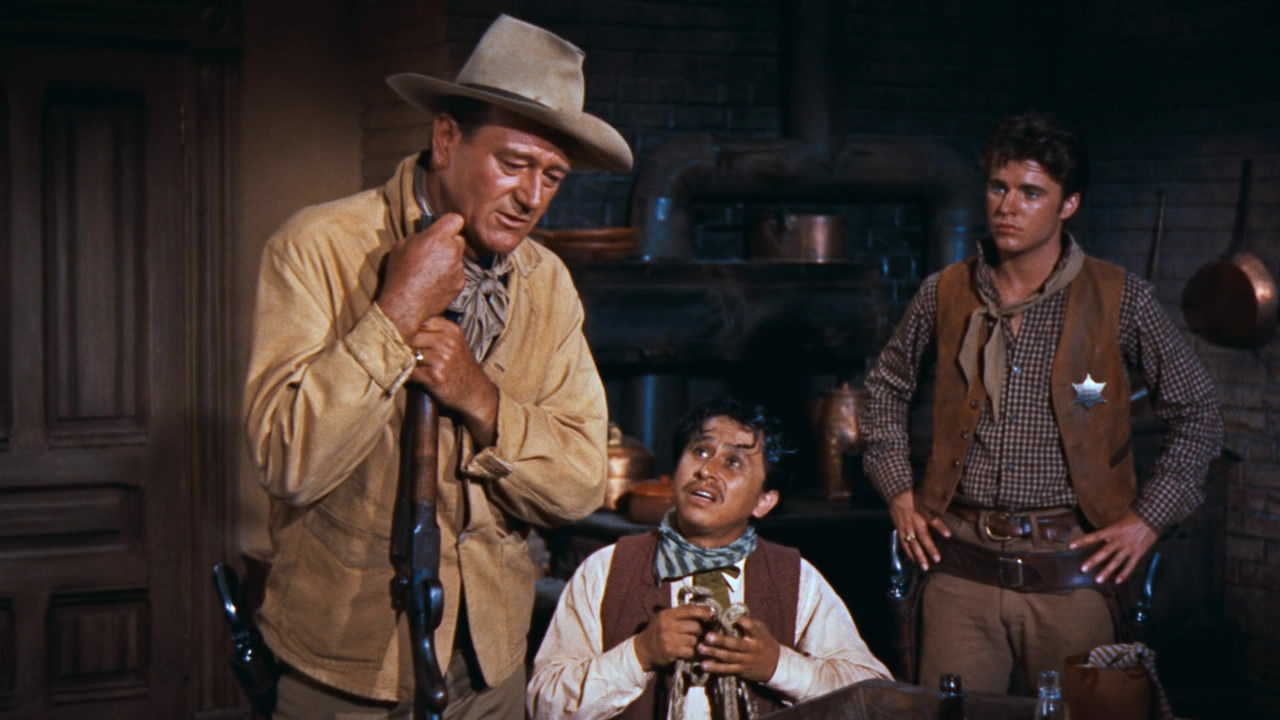
The ‘politique des auteurs’ was a way of settling the first relation, showing that these artisans who put their know-how in the service of stories of thwarted romance, troops to conduct or banks to rob, were full-grown artists. It would be an error, said the young Serge Daney, to see in the ”humble western” Rio Bravo only “an ensemble of beautiful fights between extras”. Every shot, just like every melody in The Art of Fugue, only exists in relation to others, in a system that is closed on itself. But it’s also a view on the world, a moralist point of view that is asserted in the trajectory that connects the transformation of Chance (John Wayne) with the rehabilitation of Dude (Dean Martin). Under the name of “mise-en-scène” was then proposed an equivalence between the autonomization of form, by which the artisan overturned his dependance of the industry, and the ethical declaration of a point of view on the world.

anatomy-of-a-murder.jpg

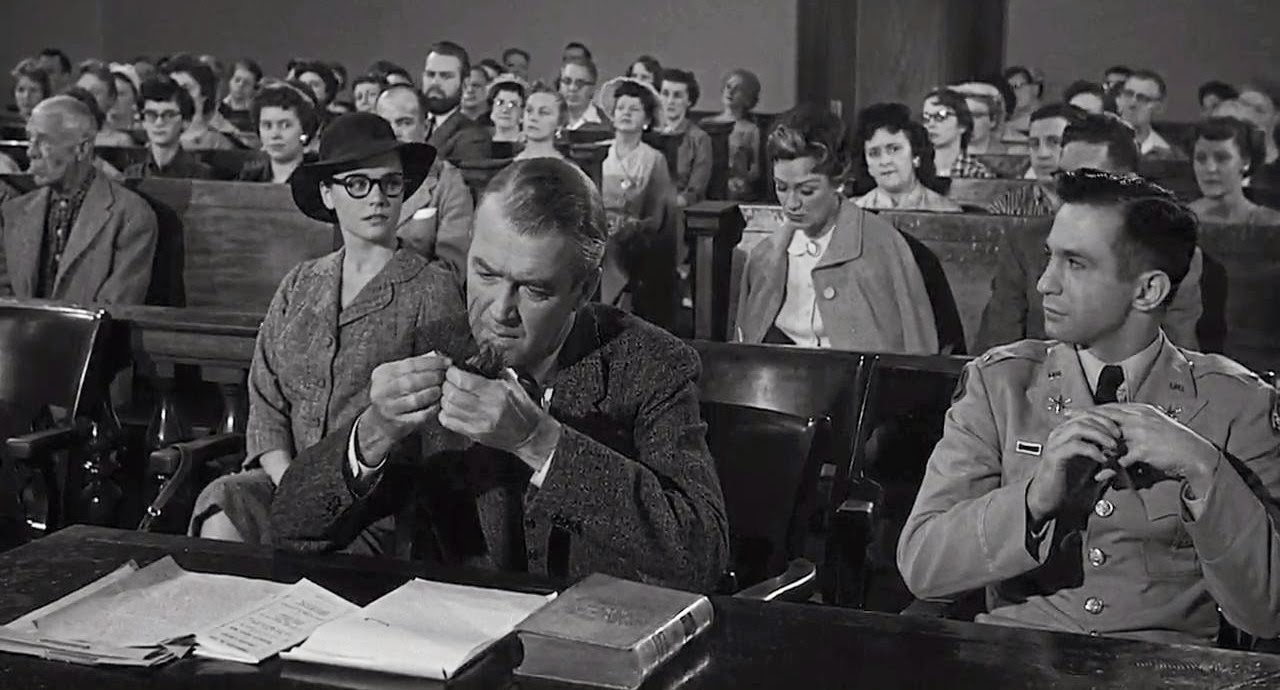
Undoubtably this reversal was precarious. The lucid filmmaker Otto Preminger was in the same position as his character, the lawyer Paul Biegler (Anatomy of a Murder). He declared his mastery by treating the case that happened to fall in his lap (a dubious murder, a successful novel). But he also found himself, after having demonstrated “for a few seconds” the power of his art, in the position of an unpaid lawyer. But above all the ‘politique des auteurs’ stumbled against the indetermination of concepts – look, point of view, morality – that asserted the common force tied to the exercise of the author’s formal power. This much-touted “point of view”, as easily assimilated by the Mac-mahonien “humanism” as by the Brechtian distanciation, was condemned to fall back on a formal singularity and to recover classical synonyms: the style of the writer or the hand of the artist, this pure signature of which Hegel had already shown that it in the end brings back the act of the artist to where he is – or believes to be – the only master of his matter and the means of making it into a form.

Between the critic, the author and the audience, a singular dialectics was put in place. Around 1968 the critic, formerly devoted to showing the hand of the artist in the realization of the ordinary assignment, changed roles: he became attached to revealing what the position of the author concealed: the place of his camera, the political and social places to which it assimilated itself, the function assigned or denied to the ‘hors-champ’. But he also broke with the “contract of innocence” (Biette) in which the work of the mise-en-scène on the realized and transformed assignment was put into concordance with the erratic tradition of cinema and the ambiguous expectations of the spectators. He then started to participate in the movement that, in the reality of production and consumption, liquidated the floating negotiation between industry, pleasure and art that was till then practiced in the singularity of films. He replaced it with a complicity of knowledge asserted on the back of the film and its characters: knowledge jointly drawn by the author and the spectator from the fresh flesh of naive characters – such as Doillon’s children, who are for Daney the typical illustration. Eventually the function of the critic vanished in the dual relation according to which the educated spectator no longer goes to see films, but productions of this or that author, master of his effects and exempted from proving the always anticipated force of his art.

chaplin-limelight-silent-movies-13775504-1837-1447.jpg

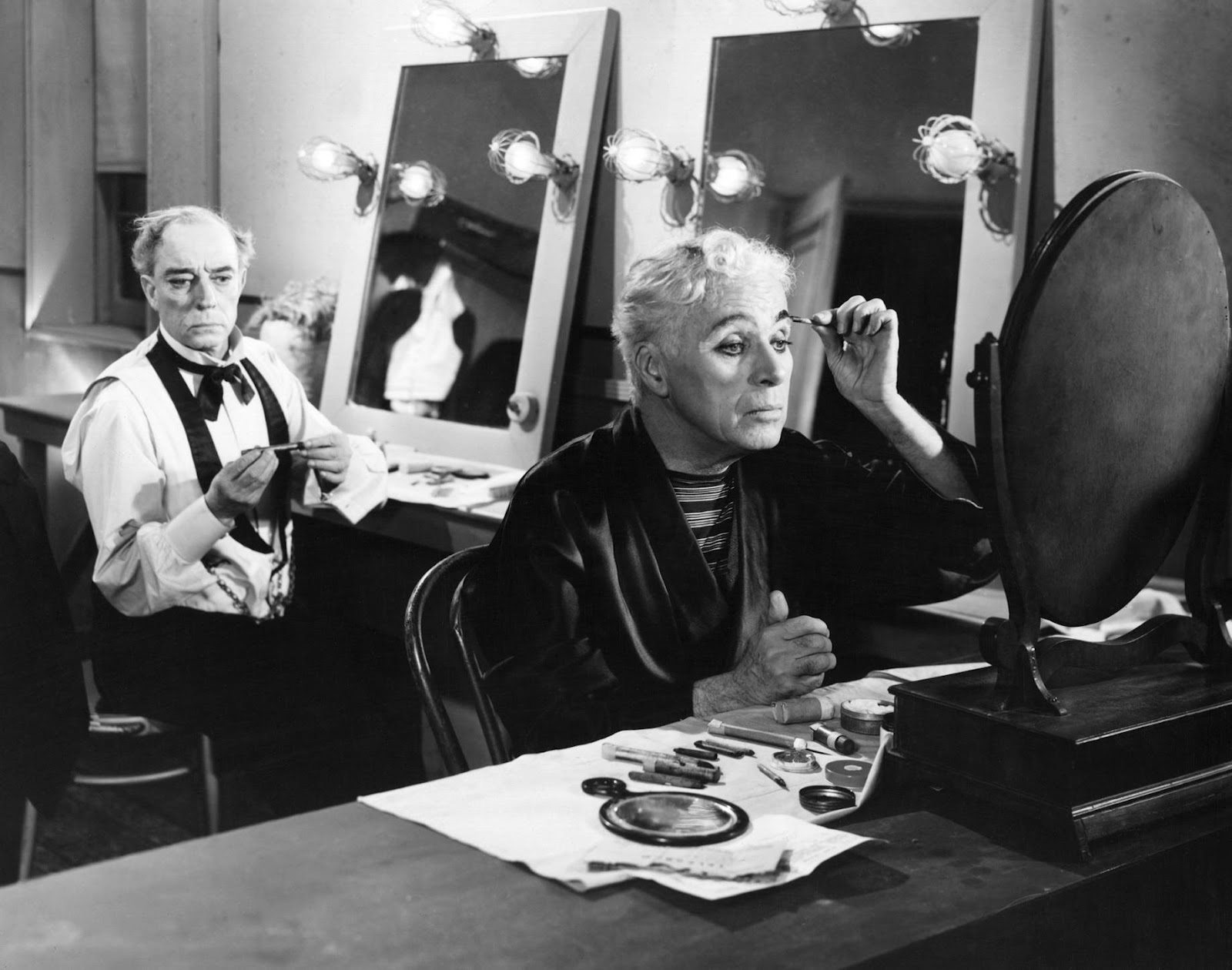
The critic then once again changes position. After having emphasized, in the cinephile manner, the positivity of the author, before revealing, in the semiotico-marxist manner, what it omitted, he then became attached to manifesting, in the lacanian way, the positivity of the omitting itself, the failure by which the force of a film is accomplished. After having denounced the unanimist naturalism of the leftist fiction (“fiction du gauche”) or the indulgence of the retro style towards the “twilight zone” of mankind, he celebrates the documentary (Torre bela) which – after the fact – gives the leftist idea this sensible flesh of which the leaders and propagandists, at the “right” time, had dreamed in vain. After having celebrated the enclosing on itself of Rio Bravo, and having denounced the indifference of Hawks towards the ‘hors-champ’ of his images, he finds in Limelight the perfect metaphorization of the force of cinema and its fundamental condition: the asymmetry of places and the non-contemporaneity of times. The comedian Calvero and the artist Charlie Chaplin are then rejoined by the militant filmmaker Thomas Harlan in the same untimely discourse addressed to the amateur of incarnated truths and the marks of the author: “here is the flesh of the ideas you thought you had… the proof that what you talked about (without having seen it) has indeed existed… although I’m saying this you, I am talking from where I will never be and there where you are not yet”

So the untimeliness of cinema tends to be confounded with the being-past of art, and the critic tends to take up the voice from beyond the grave. Serge Daney concluded that the time had come to go from the film magazine to the newspaper and from the analyses of film to that of the great vision machines. Louis Skorecki, from his side, lodges himself in the gap between two times, presenting to today’s tele-spectators the films of another time that are shown on television. Opportunity to refine from day to day the legend of a lost cinema that wasn’t an art but a fairground attraction (a declaration maliciously proclaimed about a film d’auteur par excellence, Rancho Notorious). This cinema did not consist of works to watch but “mortal” films, “idiot” films to see and forget: cinema of masters, great (Tourneur or Minelli) or small ones (Don Siegel or Edward Ludwig): cinema of phasic obsessions, visceral fears and colorful nightmares, condemned to death by the mid 50’s by the rise of television, and anticipating this death by suicide in the antique way, in the “overdose of perfection” of Johnny Guitar or the “suicide of meaning” of Voyage in Italy. The funeral undertaker Alfred Hitchcock could then, for his own gain, cut the body of the condemned in two: one part converted in tv series, the other put to ice as “storyboarded and highlighted” post-cinema, entrusted to “frigid” actresses such as Kim Novak, Eva-Marie Saint or Tippi Heddren. From there on: the long history, the long agony of post-cinema, devoted to the mannerism of the effect by which the art signals itself as art, a glacial era only sometimes breached by the screening of some fabulous animals like the small Rosetta, as opposed to the Godardian Virgin Mary. Doesn’t this retrospective history forget that retrospection, since about two centuries, has itself become the law of art? The nostalgia for the time when “it worked because we didn’t know how it worked” has begun in the 1720’s, when Vico outlined the figure of a “true” Homer – storyteller because he thought of himself as historian, poet because he was witness of a time that didn’t yet know how to think in concepts and talk in prose. It has been systematized at the end of the same century in the Schillerian concept of naive poetry: an antique poetry, taken from the tissue of the life of a people, of its savoir-faire and its celebrations, its believes and its fears, opposed to this “sentimental” poetry that viewed itself henceforth as an activity separated from a world of prosaic activities. It’s always in the past that art has been rooted in life, witness in the present of a world. It’s always the poetry that comes after (since two centuries it is called “criticism”) that invents this poetry of before in which the child is united with the old man, and the savvy and is united with the man of the people. The lost innocence of before the ‘politique des auteurs’: it is the ‘politique des auteurs’ itself that has positively made it up.

les-dames-du-bois-de-boulogne.jpg

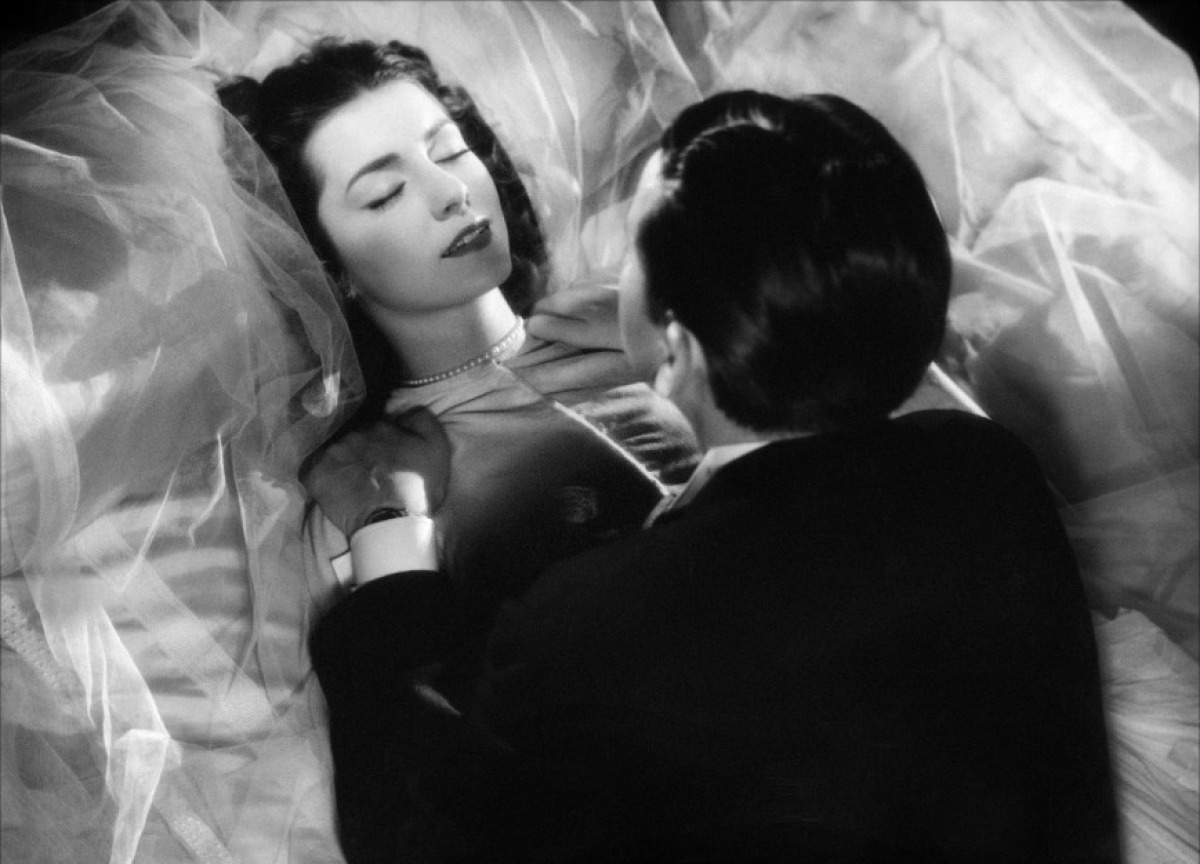
Perhaps this awareness animates the less bewildering, more sinuous studies that Jean-Claude Biette consecrates to the notion of the filmmaker. Undoubtedly he agrees with Daney and Skorecki on a lot of things: the constatation of the commercialization of the author, the revendication of an impure cinema that drags along the slags of the world and mixes up all the arts, starting with the once despised theatre. It’s him who denounces the “filmed cinema”, in echo with the Bressonian denunciation of the “filmed theatre”. He does not disown Bresson. But, like Daney or Skorecki, he considers him in a roundabout way, recommending Les Dames du bois de Boulogne or Le Journal d’un curé de campagne – the “theatrical” films – rather than Mouchette or Un Femme Douce, pursuing the moment when the “model” gives way to the “character”.

In cinema, as in all the arts of the aesthetical era, it’s always about matching what we want to do with what we don’t want, with what no one has ever wanted. Related to that Biette constructs an elegant tableau with four positions: there is the director who does whatever he is told to do, the ‘metteur en scène’ who manages to do what he wants while doing what is asked of him, the author who decides on everything – the screenplay and the ways to make it into a work – and the filmmaker who, while doing what he wants, also does what he does not want. Not what is asked of him, but what no-one has asked him to do and what was not proposed either: to mark the place of the other – the ‘contrechamp’, the unconscious or only the empty time.

The opposition of the time of innocence and the time of commercials is then replaced with a dialectics of which the Hegelian fundament (the contradiction of form and content) is tinged by athussero-maoist reminiscences (the principal and secondary contradictions and their displacements). “The reign of films” appears as an unstable conflict between three terms: story, dramaturgy and formal project. The dramaturgy is the place where the “good” heteronomy can appear, the one that disjoins by itself the work of the mise-en-scene and the declaration of the author. And it’s around the character that the dramaturgy operates, around the corporeal opacity that it opposes to the formal project, like the slowing down that it imposes on the conduct of the story.

“To slow down” the story, to put the film to sleep, and us with it, this dramaturgy of lost time is at the heart of the analyses and appreciations that Biette proposes. Echoing Daney’s watchword (there is no fire) and the proustian demonstration (it’s time lost to not take up art that makes the difference of art) but alsof the adornian paradox: it’s the most ”wanted” work, the work most inclined towards a separation with the ordinariness of the aestheticised marketeers world, that is the most capable of accepting the return of the repressed, the task of the unconscious by which art remains loyal to the fears of the child and the promises of the fairies, to the memory of alienation and the proposition of liberty.

It is this internal thwarting, played film after film, that the “optimists” oppose to the Cassandra of the end of the image. And yet it poses some problems. The “point of view” that tends to return, is it more capable than forty years ago to make the difference by which the filmmaker distinguished himself? What does it mean to mark this place of the unconscious that – in all hypothesis – will never fail? The pages – sharp-edged or even-tempered – of our authors attest to a similar gap between a global vision of cinema and criteria of judgment suitable for persuading that it is on that sole film that they apply. This gap is not accidental. The “disjunction” between the will of the author and what it does is also the disjunction between the criticism that makes cinema the art that is not an art and that which is supposed to tell us why beautiful films are beautiful. Attempting to get to grips with it would not necessarily indicate a lack of taste.

——————————————————————————————————————————————————————-

Translated by Stoffel Debuysere (Please contact me if you can improve the translations).

In the context of the research project “Figures of Dissent (Cinema of Politics, Politics of Cinema)”
KASK / School of Arts
The testament that Godard has never written

vlcsnap-2010-05-17-22h33m06s84.jpg

By Masao Adachi

Written in 2002. French version published in ‘Le Bus de la révolution passera bientôt près de chez toi’, edited by Nicole Brenez and Go Hirasawa (Editions Rouge Profond, 2012)

1. About the black screen, once more

To be honest, until I watched Ici et Ailleurs (Here and Elsewhere), my memory of Godard’s cinema was merged in my head with all the other films of the Nouvelle Vague. They were mixed up in a blurry silhouette that seemed to erupt from a magic lantern. But then again, for those who know Godard’s films, this blur of memories isn’t all that surprising.

And yet. While watching Ici et Ailleurs, my vague memories were going in all directions, and every image, every sound was mutating into a tidal wave, sweeping me away from all sides. Was I really watching Ici et Ailleurs, or was it my memory, in which I had buried all those memories and those intimacies, which was forced to open itself like an old book of magic spells with stuck-together pages? I was in the grip of a great confusion.

Suddenly, in the middle of this wave of sounds and images, I could not help noticing once more that my memories of Godard and his group were above all tied to their force as militants, their capacity to evoke the agonies of their contemporaries. Ici et Ailleurs manifests a spirit that we shared with comrades all over the world, mobilized as we were by the march towards the creation of a new world. The film recounts the shadows of the historical time and space as we lived it back then. It is an account that demonstrates the painful road travelled by those who marched without halt in the middle of those shadows, towards a confiscated goal.

It is often said that Godard continued on this road with several other films, but it is above all in Ici et Ailleurs that he tried, through his own desperation, to narrate the problems of a whole era. In his inability to let himself whither away because of this desperation, he has left us this ultimate letter, addressed to all those who will survive him, a sort of “testament”. Twenty-seven years after being made, not a single word has aged. On the contrary, I think that these are words that resonate in the most lively way possible in today’s world, in 2002. They reflect the effervescence of agitators who were very much alive in the spirit of the time. In addition, the sorrow and the irritation of a Godard who was constantly in search of a new life force for cinema has reminded me of this era, and the zeal that emerged from it.

I have also made a decisive discovery in Ici et Ailleurs.

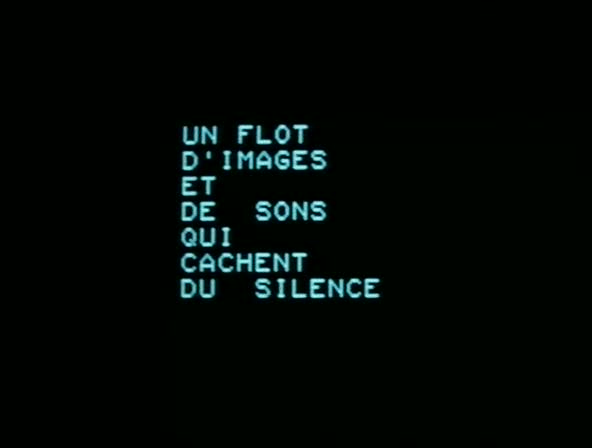
Godard’s group, in the late 1960s and early 1970s, used the method of the tableau noir, or “black screen”, in a perfect example of this cinematographic language that he and others developed, and which as he said, proposed to “make possible the realization of our images and sounds, our cinema”. In other words, they wanted to express a message by way of silence. At that time, I criticized that method, wondering if it wasn’t simply some sort of flight towards aphasia. But this time, while watching this black screen, I told myself that Godard was giving us an alarm call, warning us of danger, a trap: “We are being seen so we don’t see anything.” I was unable to sense this other message at the time, this despair of an era during which Godard, with such dedication, explored ways to make himself understood by all.

I might be reproached for repeating the same things over and over again, but I really want to write Godard about this profound and new emotion that I felt while watching Ici et Ailleurs.

2. The possibilities of the struggle for the liberation of Palestine

There are several points that link Godard and myself. The most obvious concerns our common commitment to the struggle for the liberation of Palestine. Let us think, from our point of view, about what Godard and his friends were able to consider as possibilities to explore, and what has, in contrast, disappointed them, and then compare their positions with the actions and analyses that my comrades and myself conducted at the time. In other words, it is about asking, in the light of this commitment to the liberation of Palestine, of what this “despair of an era” contained in the black screen wants to tell us. We have to clarify the message that Godard tries to communicate, and the reasons that have pushed him to change the title from Jusqu’à la Victoire (Until Victory) to Ici et Ailleurs.

We can already discern an answer in the process of self-transformation undertaken by Godard and his comrades. They indeed clearly adapted themselves to the characteristics of the process of development of the struggle for the liberation of Palestine.

After 1968, the Palestine Liberation Organization (PLO) assumed the role of leadership of an ethnic movement. It passed from a political and peaceful activity to armed struggle. The PLO defined this “strategic defensive war” as the last stage of the resistance, and reinforced offensive armies against the Israeli occupier. When Godard travelled to Palestine in 1970, the organization was at the height of its activities and the Palestinians finally began to acquire an identity on an international level. The PLO imposed itself as the principal representative of the Palestinians. It is important to point out that the 1,500,000 refugees, who had been rejected by the bordering Arab countries, who lived in misery and suffering and were asking for the liberation of their homeland, had become the principal actors in the struggle, and that it was because of them that the “Palestinian government in exile” was formed. Since then, the forces of the Palestinian liberation have led numerous military operations across the occupied territories.

It was in this context that Godard, in collaboration with the PLO, decided to realize a documentary film about the reality of the struggle. Godard declared his position at the beginning of Ici et Ailleurs: “From February till July 1970, ‘we’ – ‘I’, ‘you’, ‘she’, ‘he’, go to the Middle-East, to the Palestinians, to make a film. And we have filmed things in this order and we have organised the film that way… saying: here is what was new in the Middle East. Five images and five sounds that had not been heard or seen on Arab soil. The people’s will + the armed struggle = the people’s war + the political work = the people’s education + the people’s logic = the popular war extended, until the victory of the Palestinian people.”

To summarize, Godard here evokes the road of a war of the people. He declares his support for the armed struggle of the PLO, acknowledging that the liberation of Palestine had not been possible in a peaceful manner and that the Palestinians had no other choice than to engage in a long popular war against Israel, with an army in which equality between man and woman was considered necessary. Those were the principal themes, and they were as important for Godard as for the PLO. In substance, the method taken up by Godard can be summarized as follows: to use sound and image to paint a frontal portrait of the people in revolution.

When Godard was getting ready to finish the film, Black September happened, the month in which there was a real massacre of Palestinian fighters. At that time, Israel was not the only one fearing the victory of the Palestinians. Various Arab countries also thought there was a risk that too great an influence of the Palestinian conscience in their respective countries could take down their own regimes. Then the government of Jordan found itself confronted with such nationalist slogans as “Let us transform Amman into Hanoi!”, launched by the Palestinians. Fearing a coup d’état, it in turn started to engage in its own oppression of the Palestinian forces.

The violence of the coup inflicted on Palestine during this event certainly gave Godard’s group food for thought. Numerous collaborators were killed and the production of the film found itself in crisis. And that is not all. The extremely abrupt change of the conditions in which the Palestinian forces found themselves must have led Godard to completely rethink the form of the coproduction. The filmmaker was obliged to look for new possibilities to continue to work with the PLO.

We cannot exclude the idea that in order to revive the production of Jusqu’à la victoire, the group was considering taking up the events of Black September in the film. The importance of this drama demanded a reworking of the strategy for the liberation of the Palestinians. Meanwhile, the PLO evidently did not want to increase its hostility towards the Jordanian government or worsen the antagonisms at the heart of the Arab population, already brought to light during Black September. The PLO could not go along with Godard’s proposition, as it advocated a reinforcement of the nationalist movement and the popular war to resolve the internal conflicts within the whole of the Arab countries.

This information was given to us soon after we arrived in Palestine ourselves, where we were confronted with the same problem. So it seems to have been political issues that prevented the production of Jusqu’à la victoire from being finished.

3. Significant differences despite commonalities

In 1971, we started the production of a documentary film depicting the conditions of struggle for the liberation of Palestine, somewhat similar to what Godard’s team were doing. Then we had to face yet a new tragedy for the Palestinian camp: the battle of Jarash. (1) The royal Jordanian army, together with the Israeli army, launched a menacing attack, wiping out a whole Palestinian battalion on the mountains of Jordan, which was an outpost for the offensive against the territories occupied by Israel. In the middle of shooting the film, we witnessed the determination of the Palestinian forces who, far from willing to retreat, either militarily or politically, persisted on the road of armed struggle. Our film, Sekigun-PFLP: Sekai Senso Sengen (The Red Army / PFLP: Declaration of World War), reflects this situation. Realized in collaboration with the FPLP, it is a document that we later showed in Japan, as well as in certain Palestinian camps and in Europe.

Our engagement with Palestine consisted above all in experimenting with militant cinema in the context of the struggle for the liberation of Palestine, while at the same time supporting the struggle in Japan, in order to create a global solidarity in favour of armed struggle.

Fundamentally, Godard’s engagement had the same starting point as our own. We had in common a position and a will to change the old system that dominated the era in which we were living. That is what led us to voice our support for the transformation of the struggle in popular war, by and for the people. But the shift in the politics of the PLO created a gap between our points of view, and it eventually imposed a change of method in our respective cinematic approaches. Godard and I have each drawn our own conclusions, and these have led to different responses.

At the start, we shared with Godard a desire to experiment with the new possibilities of cinema. The events, however, led us to reconsider the fundamental question of our way of working on the resolution of the problems linked with the development of a cinematic activism, starting from zero. This question was crucial. We had to include in the global vision a common experience of the research of possibilities of the worldwide revolution, symbolized by the struggle for the liberation of Palestine.

This is why the differences that separate us have given birth to films underlining those differences, despite the proximity of our commitments. It is also about questioning to what extent our films, or rather the similarities and the differences between our approaches to cinematic activism, could be linked to the worldwide revolutionary movement. Our differences are not determined by our vision of the revolution, but rather concern our respective conceptions of the strategy that the movement of worldwide solidarity had to adopt.

This being said, the particularities and the contradictions that distinguish us are well and truly discernable in Ici et Ailleurs and Sekigun-PFLP. At the point when we were working on the production and distribution of our film and when I joined the international forces for Palestine, Godard and his group abandoned their film. After five years of tormented reflection, they decided to rework Jusqu’à la Victoire into Ici et Ailleurs.

It is perhaps not pertinent to compare the results, but as we finished our film and engaged with an activist movement, we couldn’t help wondering why Jusqu’à la Victoire was not completed in collaboration with the PLO and why a hiatus of five years separated this first draft from Ici et Ailleurs. Could Godard and his group have refused to finish the film for uniquely political reasons, because of a difference of opinion with the PLO? Or perhaps the independent financial resources dried up, making the continuation of the shooting impossible? Until I finally watched Ici et Ailleurs, I thought all these reasons were possible.

Today, I don’t think I was completely wrong, but I have to admit that I wasn’t completely right either. Actually, during the period when the production drew to a halt, Godard and his comrades did not question the spatial and temporal void that separated Palestine and France. They had instead given priority to a reflexion on the transformation of existence at the heart of our societies. Later, they reformulated their reflection in regards to their commitment to Palestine, which was failing. They acknowledged the weakness of their subjectivity and integrated this in a new structure that constitutes the principal message of Ici et Ailleurs.

Godard said it himself: “And then we came back home. I came back, you came back. In fact we haven’t recovered yet. We finally came back. She, he, you, I. I came back to France. It wasn’t working out. And then days passed, months passed. It’s not going well anywhere. Nowhere. I can’t do anything. In France, you soon don’t know what to do with the film. Very quickly, as they say, the contradictions explode and you with them.” He rather openly confesses being torn between France and Palestine, suffering after having stopped the production of the film.

This means that the disputes concerning the content of the film and the lack of funding were not the only reasons. What then were the other motives? I think that the filmmakers were asking themselves how to build a bridge to the new stage of the struggle: going beyond their belonging to society, even though they were socially and politically divided.

If this is the case, one has to ask in which way the team and Godard himself proceeded to sublimate their desire, so far away from Palestine. Did they maybe take some distance, during some time, from their involvement with Palestine? In truth, this was not at all the case. In fact, Ici et Ailleurs reveals itself as an experimentation with new methods susceptible of responding to and coping with a new context for the struggle. These are valid not only in regards to the commitment to Palestine. Ici et Ailleurs also constitutes a tipping point, after which Godard began a change in his cinematographic methods.

4. The desire to pass the border again

What stimulated Godard to take up the project again? At what point, while being so far removed from Palestine, did he pick up the abandoned Jusqu’à la Victoire film, to deconstruct it and recompose it in the form of Ici et Ailleurs?

From the remaining material, Godard chose five images and five sounds: “The people’s will + the armed struggle = the people’s war + the political work = the people’s education + the people’s logic = the popular war extended.” He has not been able to alter them. In Ici et Ailleurs, the authors become attached to “elsewhere” (Lebanon, Syria, Jordan). The words of this language, in spite of the events that have struck Palestine, do not change. “Here”, that is to say in France, such words are considered non-existent.

Godard says it himself in the film: “Probably, in attempting to add hope to dreams, we have made adding errors,” “It’s true that we never listened to silence in silence. We wanted to crow victory right away. And what’s more, in their place. If we wanted to make the revolution in their place, it’s maybe because at that time, we didn’t really want to make it where we were, and preferred to make it where we weren’t.”

Godard continually poses the question of knowing what is keeping them at a distance from this “elsewhere”, these scenes of struggle in the Arab and Palestinian liberation, in which he and his team had invested in the past. The films from the US and the Soviet Union were what plundered the images and sounds. It is capitalism that seizes the time of life and relations between humans. It is Godard and his friends themselves who are alienated and buried “here”, under the numerous “zeros”, the coefficient of capitalism in France.

Godard and his friends wanted, once again, to go beyond the “zeros” and once more face the battlefield of Palestine and other places, from “here” to “elsewhere”, from “elsewhere” to “here”. But what pushed them to take this turn? This is only my hypothesis, but I am certain it has to do with what happened during the Olympic Games in Munich in September, 1972. After the massacre of Palestinians during Black September, after the “massacre of Mount Jerash” inflicted on the Palestinian guerrillas, it was during the Olympic Games in Munich, just after the battle of Lydda in May 1972, that members of the Palestinian guerillas broke into the athletes’ village. They occupied the village, taking Israelis hostage in order to demand the release of Palestinian prisoners of war. Television stations interrupted their broadcasts of the games and relentlessly filmed the village where the guerillas barricaded themselves in with the hostages. It was a moment of tension that Godard described as follows: “In Munich, the force of imperialism was exerted through television. Two billion spectators wanted a program.”

While watching these broadcasts, Godard undoubtedly thought of a way to counter the powerful imperialist message of television. If I am able to formulate such a supposition, it is because we had exactly the same experience. In February 1972, when we were in Japan, working on Sekigun-PFLP, the Japanese Red Army had taken hostages and entrenched themselves in a chalet in Asama.(2) This event was baptized the “Battle of Asama”. Television unceasingly turned its cameras on the event. The authorities distilled a message that impelled spectators to expect “the great scene of the arrest of the guerrillas and the liberation of the hostages”. The whole of Japan was nailed to their seats. This message was more powerful than any sound or word.

We can assume that what had awakened Godard and the others, torn between here, Europe, and there, Palestine, and what led them to take up the challenge to make Ici et Ailleurs, may have been the continuous broadcast of “the scene of pitched battle between the Palestinian guerrillas and the special forces” that unfolded in Munich. This hypothesis seems acceptable to me. Godard’s comment in Ici et Ailleurs is extremely radical: “Take advantage of the fact the world is watching to say: ‘show this image from time to time’. If they refuse, take advantage of a worldwide TV audience to say: ‘You refuse to show this image’. At each final, for example. Ok, we’ll kill the hostages and be killed afterwards. And for them as for us, it’s silly to die for an image. And we’re a little scared”

These words, full of bitterness, are spoken as a counterpoint to the moment when we see the group searching for a way to show Jusqu’à la Victoire on television, with the authors carrying out a critical analysis of their own counter-information film: “Looking back, the things that are described in these images are not all that different than those we can see in whatever American or Soviet films.”

What takes place is a singular process of sublimation that allows for a reversal of the field of possibilities. Let us reconsider Godard’s words: : “If we wanted to make the revolution in their place, it’s maybe because at that time, we didn’t really want to make it where we were, and preferred to make it where we weren’t.” Godard thus reconsiders his counter-information film in order to definitively conclude the impossibility of its succeeding.

We can guess the meaning of the other message brought about by the black screen. The black screen of the Godard cinema, combined with another crucial term, the “memory” of the filmmaker, suggests a smothered howl stemming from the author’s soul. The “memory” that transcends time is both a past and a future. It accompanies us towards a conscience of the present. It is most probably in this way that Godard wanted to cross the border between here and elsewhere. It is not about going “forwards” or “backwards”. It is not about being “here” or “elsewhere”. The border depends on the positioning of “forwards=backwards” and “here=elsewhere”. Do Godard and his comrades mean to imply that the equal sign (=) allows for the infinite accumulation of “zeros” that links Soviet and American films?

What is really happening? I try once again to take time for an inner reflection in front of this black screen. I don’t know how much time I will be able to concentrate. I have to say that while hearing the news about Palestine and seeing Ariel Sharon urging the butchers to continue their indiscriminate murder of Palestinians, the interior of my mind already colours whiter and whiter with anger.

Thinking about it, the ultimate, heartbreaking message that Godard has sent us in Ici et Ailleurs does not reside in the black screen, but in a screen made of the purest white.

(1) Referred to as Gaza Camp, Jerash is home to Palestinian refugees who fled the Gaza Strip after the 1967 Arab-Israeli war.
(2) During nine days, the Japanese population could follow live television broadcasts of the spectacular progress of this hostage-taking, which turned popular opinion against the leftist movements.

——————————————————————————————————————————————————————-

Translated by Stoffel Debuysere, with help from Mari Shields (Please contact me if you can improve the translations).

In the context of the research project “Figures of Dissent (Cinema of Politics, Politics of Cinema)”
KASK / School of Arts
Re-mise en scène

antonioni-cina.jpg

By Serge Daney

Originally published as ‘La remise en scène’ in Cahiers du cinéma 268 (July 1976).

Deceitful intent and despicable procedure

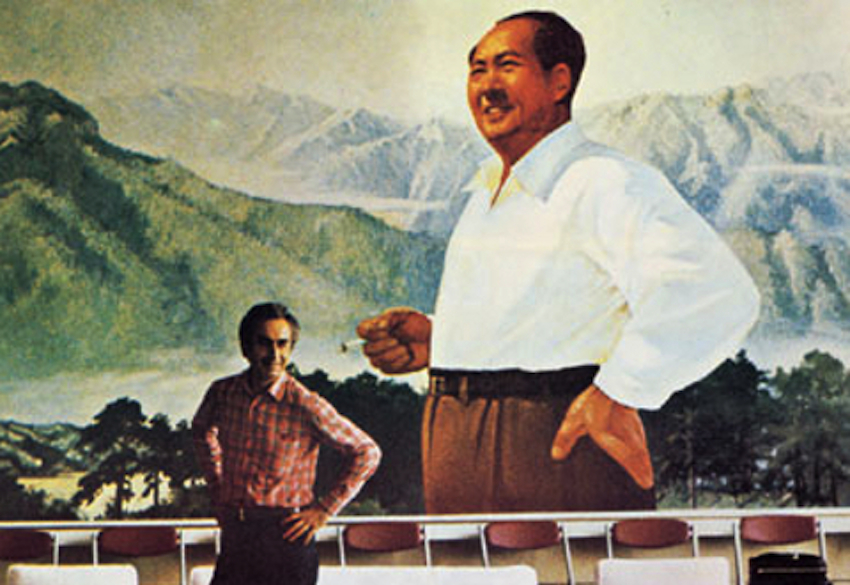
It’s under this title that the Renmin Ribao (“The People’s Daily”) trashed Antonioni’s Chung Kuo. The argumentation was rather strange. Judge by yourselves (it’s about the Tiananmen Square).“The film doesn’t provide any general view of this place and removes all majesty from the Tiananmen gate, which the Chinese people hold so dearly. Conversely the author doesn’t save any pellicule to film small groups of people on the square, sometimes from a distance, at other times up close; sometimes up front, other times from the back; here a swarm of faces, there an mesh of feet. He deliberately turns the Tiananmen square into a messy fair. Doesn’t he have the intent to insult our great homeland?” (To this false question, the answer is evidently: yes)

Two reproaches then: 1. By way of an exaggerated multiplication of shots and angles, Antonioni cuts as he pleases (without respect, denigrating, insulting). 2. He doesn’t reproduce the official image, which is supposed to be emblematic of the place “which the Chinese people hold so dearly”, its “brand image”. He does the same when he films the Nankin bridge: “While filming the great Nankin bridge on the Yangtsé, this magnificent modern bridge, he has deliberately chosen very bad angles, giving the impression that it’s crooked and unstable.” In other words: every image that deviates from the brand image is supposedly slanderous. Or: not filmed= denied, denied= contended.

There are cut up images that are supposed to be whole, and there are images that are supposed to be there but are missing. Third reproach: “In regards to the choices he made while filming and editing, he has hardly filmed the good, new and progressist images, and if he has filmed them it was rather for show and to cut them out afterwards.” In other words: the “good, new and progressist images” are not to be constructed but are already there, already given and only to be reproduced. Isn’t the Renmin Ribao contributor assigning a mission to cinema: re-mettre en scène?

Typage and natural, natural and typage

So far for the Renmin Ribao’s argumentation (definitely strange). Let’s get back to Europe. For those interested in Chinese politics (and not only in China as dream or utopia, model or challenge), Chung Kuo wasn’t a very satisfactory film. We couldn’t get rid of the impression that we were assisting in the mute tribulations of Chinese extras in China, under the eye of a great skeptical but nevertheless attentive esthetician who concludes from all this, a bit brisk, the impossibility of understanding anything at all of the mysteries that were shown to him. He refused to affix his signature to the already constituted images (the “good images”) that were expected to be reproduced (Chinese naivety? Pro-Chinese naivety?). Worse: he got even more attached to the images that were advised against or forbidden: an official building, a military boat, a free market in open country. The Chinese didn’t seem to be aware that the only image that marks or “brands” here in the West, is that which is won out on something.

For us (at Cahiers), there was something else at stake in the criticism on Chung Kuo. It provided us with a particularly convenient occasion to restate our mistrust of naturalism. To all those who were bewildered by this slice of life, it sufficed to say: in cinema, there is not only encounter, naturalness, “as if”. There is no image that slyly (naturalism) or explicitly (publicity) wants to become a brand image, that is to say of the congealed, blocked, repressed. And we added: the sly typage welling up from Chun Kuo is not without ulterior motives or malicious intent. We don’t have great merit in being right: Antonioni himself doesn’t hide that he avoids what he does not understand or consider: Chinese politics.

But confronted with the arguments made by the author (anonymous of course) of “Deceitful intent and despicable procedure”, we were also divested. How can one reproach Antonioni of not having filmed the Tiananmen square from an official angle? And why infer that these shots would insult the Chinese people, while in France it’s exactly those shots that do not hold any denigration or slander? It’s almost the opposite: for a progressist audience (those to whom the film is aimed, evidently not the Franco-Chinese friends), a human, close, non majestic image, not resembling a postcard of Tiananmen, was something positive. Where do paradoxes like this one come from (from the Renmin Ribao): “But Antonioni shows the Chinese people as an ignorant and stupid crowd, cut off from the world, with sad and worried faces, without energy or hygiene, loving to drink and eat, in short a grotesque horde. “ And in Libération we could read, written by Philippe Sollers, at text on the calmness, the nonchalance, the lack of hysteria of the Chinese crowd.

We also wanted to tell the Chinese exactly the contrary of what was being said to the readers of Libération and Cahiers: there is not only typage, the exemplary, a film is not only an encoding, a shot is not completely determined by the cause it serves, the image resists. The little of the real it encloses doesn’t let itself be reduced like that. There is always something that remains.

Funny debate which was already about the here and the elsewhere. Here (Paris, end of 1973): release of an Antonioni film on China. Question: what does an image hide? What is its out-of-frame? Elsewhere (China, beginning of ’74): violent debate on western art and “musique sans titre”. Question: what does an image show? What is there in the frame? Here: repression of the “prise de vues”, of the political dimension of the shooting, in favor of of the fetichism of the image taken, won (of the scoop), according to the double criterium of rarity (China) and truth (the eye of the master: Antonioni). Elsewhere: repression of the image in favor of a normalization of the “good image” which is nothing but a “re-prise” of the déja-vu. Here: tracking down the mise-en-scene under the natural. Elsewhere: tracking down the natural under the re-mise-en-scène. Cross-over or short-circuit?

Ambivalence or Amphibology

There’s a scene which the Renmin Ribao contributor didn’t mention: the opening scene showing a childbirth (Caesarian, under acupuncture). Suppose that Antonioni wasn’t the anti-Chinese monster in lack of defamatory images. In that case a question comes up: which images to take back from China that can satisfy the Chinese authorities (those who invited him) and can show the western audience (the only ones who will see the film) something of China, something impressive, something that they don’t know or don’t know well. The cesarian is one response.

In fact, it plays out on two levels. For the Chinese, it illustrates the success of popular medicine: success of acupuncture, success of the ideology “in service of the people” in medicine. Of this image (a birth “with eyes open”), the Chinese have reason to be proud. It’s evidence in their favor.

For us as well this image plays out favorably, yet for different reasons: it shows – better than all discourse – that the relationship the Chinese have with the body is at the very least very different than the one that exists in a society such as ours. The fear of disembowelment, of in- and outside, of shame and fault, is missing here. It’s about something else. About what? We don’t know, but it’s enough that the question is asked. This image, for us, is revelatory. It touches upon our truth.

So here’s a series of shots that is twofold positive, but in two different areas. For them and for us. It satisfies two audiences who will never meet, except by virtue of this film. It forbids the western spectators to put themselves where they are not (in pro-China for example), it does not permit the Chinese to put themselves where they are not (in the throes of the Christian body). It keeps its distance and in doing that, it makes visible.

We see that a militant discourse would object to this double scene. What is important, it would say, is not that these shots play out positively in two areas that don’t know about each other, it’s the fact that because of this mediation these two areas, the Chinese and the French one, have started communicating with one another.

We should know by now that it’s not people who communicate but rather objects (statements, images) that communicate by themselves. In putting too much trust in communication, we risk being disappointed, like we were three years after Chung Kuo when noticing that Joris Ivens, despite his talent, only provoked smiles with Yukong. At least Antonioni is a smuggler, not “here”, not “elsewhere”, but between brackets, protected by them, without anchor, exposed. Exposed to the utopia, to the non-place. Moreover, that’s what worries and delights him since forever: cinema as affirmation of distance, however small. In this scene in The Passenger in which the old African chieftain grabs the camera and films Jack Nicholson, one can see quite clearly what is at issue: the sudden possibility of a reversibility, of the camera passing without a word from hand to hand to the great confusion of the scene and the actors. This, in China, was simply impossible.

The pose (keep smiling)

Someone is being filmed? There are several approaches:
1. The filming happens within the framework of the industry of cinema. It is then symbolically covered by the type of contract (wage, one-off fee, benefits participation, unpaid) agreed between the production and the actors. In the name of this contract, the filmmaker will be able to demand a certain acting or performance.
2. The filming happens within the loose framework of a documentary, of a socio or ethno-logical essay, or of an investigation. Most often, actors do not have the capacity, total or relative, of controlling, technically or intellectually, the operations to which they lend their bodies and voices. We then enter the domain of morals and risk: to film those for whom there exists no reversibility, no chance of becoming themselves “filmeurs”, no possibility of anticipating the image which will be made of them, no hold on the image. Mad people, children, primitives, the excluded, filmed without hope (for them) of a reply, filmed “for their own good” or for the sake of science or scandal: exoticism, philanthropy, horror.
3. There is a third type of situation (the one that interests us here): when the filming is done by a filmmaker or a crew who have decided to put their camera and their know-how at the service of. Of a people, of a cause, of a fight. In these conditions, the non-reversibility has other causes (under-development, lack of equipment, need for foreign help) , but generates new kinds of problems.

We know that a people in struggle is led to make an image of this struggle, a “good” image. Every extended struggle makes itself a brand image, a flag, a symbol regarding its identity, so regarding itself (because it always starts with the negation of this identity). Every image is always proof, a constatation, a piece of evidence. And to obtain this image one has to pose, and make pose. The Renmin Ribao reproached Antonioni to have cut, not having filmed a “general shot”, to have destroyed the pose. We are in the heart of the problem: how to respect this pose? And also: how not to respect it?

It’s an old question. Just like Joris Ivens’ response: “In every place we had to struggle to conquer our liberty. The natural tendency of people is to show only the positive aspect of things, to beautify reality. Is is a problem, I think, that I’ve encountered everywhere in the world. When receiving a guest, we clean the table and do the dishes. All the more so when the guest arrives with a camera.”

The common part

The same question is asked to the collective that has made L’Olivier. Danièle Dubroux: “In the children’s camps, what interested us was to show the relations between them, how they handled themselves, autonomously, their life, while doing the dishes, taking care of the plantations and the sheep… But they didn’t understand at all why we were interested in all that and the leader made them put everything in order especially for us.” It’s what Serge Le Peron formulated under the guise of a question-program “What is the common part of two systems of questions?” The film is taken up in a real four corners game. On one hand the one being filmed and their personal issues. On the other the ones filming and their personal dealings. But, behind the ones filming, there is also the question of knowing what effect these images will have on their audience and behind the ones being filmed, of what they imagine and what they hope from this effect that they don’t know. Example: “the Fedayeen were completely dumbstruck when we told them that this image they were showing of themselves, that of people taking up arms, is an image that, here, shows them like madmen, like people who only think about death and suicide, crazy, insane people.. While there, they were completely disarmed, if we could say so, in front of this possible becoming of their images, of these images of them in arms.”

Because, supposing that there are images that actually gratify this four corners game, it doesn’t mean that they would be the most clarifying or even the most useful. It is doubtful that the search for average images, formation-images of compromise defined by the sole fact that they don’t upset anyone, produces anything other than in-decidability, all obscurity and softness. An image can exist in various areas but it can only bear one point of view.

And yet, Ivens and Loridan: “These images, it’s a mixture of our presence and their reality. There is a dialectics between the two.” Strange dialectics according to which the terms of contradiction cannot be assigned. Mixture muddles while dialectics unites contradictorily, unites to divide, combines to disconnect.

“Our presence and their reality”. Making cinema directly based on a coded reality, is what characterizes ethnological cinema. In the case of China, the code has a name: politics. As its name indicates, socialism aims for socialization of relations between people. It makes them enter (mostly by force) the apparatus where individuals think and live the exercise of power collectively and “unconsciously”. By them and on them. Who doesn’t notice that we are already talking about cinema? The “cinema” that makes up a society, the postures that it takes in order to save face?

A camera and a microphone that are naively connected to the Chinese reality necessarily encounter this social pre-mise en scène. Either it renews it (to make it look spontaneous) or it makes it forget it for a while (but then, one has to cut it up). Naturalism is a technique that renews something that pre-exists it: the society as it is is already a mise-en-scène. To work on this given, break this pre-mise en scène, make it visible as it is, is always an courageous, difficult and unpopular undertaking. Realism is always to be won.

The duettists in question

In How Yukong Moved the Mountains, the most interesting episode, according to me, is the one taking place in the generator factory in Shanghai. Why? Because at the moment when Ivens and Loridan are in this factory, something happens that obliges them to leave their first idea behind and adopt another. The film becomes a report on an event that shakes up the factory: dissatisfaction of the workers, campaign of dazibaos, leaders being criticized, meetings etc. Suddenly there is a necessity for the filmmakers to stick to this fiction, to not cheat with it, to respect time and space. Necessity to do what they don’t do anywhere else in their film-flow: to make the masters of discourse come back to the screen at a time when these discourses have touched the fire of the real. In cinema, as in life, we can only take seriously what happens at least twice: for example the two criticized leaders (the duettists) of the generator factory.

What strikes us is that, from the beginning to the end of the film (before and after being criticized), they hold on to the same discourse, which all of the sudden sounds more and more hollow. Discourse without surprise: it is said that one shouldn’t go against the masses, accept their criticism, that it enriches, makes one better etc. If nothing had happened in this factory, this discourse would have played a accompanying role to an “open door” operation. But because we have had the time to witness them sound hollow, it makes us to see what other films seem to want to hide: that in China, more than elsewhere, discourse is above all not to be taken for what it says but for what it constitutes as a political practice that is more diffuse, more crafty, more complex, through which, in low as as in high places, power plays out.

The problem is not so much to know if the people are sincere or not than to encircle the articulation between this or that individual (a body and a singular voice, even if the discourse is stereotypical) and the collective discourse, the rhetorics for all purposes. What does it mean? What does he want when he talks? Or when he shuts up? Where is the accent of truth in what he says? Or, as they say in china, in “waving the red flag to attack the red flag”?

Roland Barthes, in a short text (‘Alors, La Chine?’) has seen this fundamental aspect of the relation between the Chinese and their discourse: circulation of power in the fact of power circulating speech and thus getting rid of it: “In fact, every discourse seems to progress by means of commonplaces (“topoi” and clichés), analogous to the sub-programs known in cybernetics as “bricks”. What, no liberty? Yes, under the theoretical crust, the text fuses (desire, intelligence, work, struggle, all that divides, bursts, exceeds). First of all, these clichés, everyone combines them differently, not only according to an esthetical project of originality, but under the more or less vivacious pressure of his political conscience (using the same code, what difference is there between the solidified discourse of this responsable of a popular commune and the vivacious, precise, topical analysis, of this shipyard worker in Shanghai).”

The important phrase here is “using the same code.” We know (it’s enough to read Pékin-Information) that the most bitter, violent ideological and political struggles speak the same language, they speak from the inside of a limited body of statements that function like so many cards (statement-trumps, statement-masters) in games that are always renewed. Hence the difficulty in recognizing the adversary. That is why Ivens can naively say “no-one says openly: I am a reactionary”.

Hence also the completely particular use that the Chinese make of brackets. Inside a discourse, the brackets never attest to the presence of another (system of quotes). Brackets in China are essentially defamatory. They constitute a double operation
1. To translate. Translate plainly (in the common code) what the other has never said but is supposed to have thought. Example: someone is supposed to have defended the thesis (evidently unsayable) that “the bourgeoise does some good.”
2. To put on the side. Brackets mark an isolation of bad discourse, designating it as defamation.

It’s because Ivens and Loridan have been the first to base their film on the words of the Chinese, that we are entitled to make remarks and reservations about their film. They relate to a decisive point that we can approach in different ways: discourse/power, statement/enunciation.

How to understand something of power, Chinese or otherwise?

How to film brackets?

——————————————————————————————————————————————————————-

Translated by Stoffel Debuysere (Please contact me if you can improve the translations).

In the context of the research project “Figures of Dissent (Cinema of Politics, Politics of Cinema)”
KASK / School of Arts
Godard’s latest scandal

glauber_godard.jpg

By Glauber Rocha

Originally published as ‘O último escândalo de Godard‘ in Manchete, n. 928, 31 January 1970.

This year’s talk of the town will be Vent d’est, the latest film by Jean-Luc Godard, made after Le gai savoir and before Pravda. An Italian film. Still a complete mystery. This grande fofoca is possibly of the same stature as La dolce vita. Cineriz, a big distributor associated with Rizzoli publishers, has paid an advance of one hundred thousand dollars to producer Gianni Barcelloni for a “western in colour written by Cohn-Bendit, directed by Jean-Luc Godard and featuring Gian-Maria Volonté”. Does the film meet the requirements of Cineriz? I saw the first, secret screening, in the company of the producer and a lawyer. Cineriz, suspecting that the film would have nothing in common with what they expected, are threatening to sue the producers and ask for their money back, but as yet none of them has seen the film, on which subject the craziest jokes are going around. For example, I met this young guy who asked me, “Have you heard? In Godard’s far-west, there are two horses reciting Mao!”

Gianni Barcelloni asked me for a cigarette ten minutes into the screening, and while lighting the match, I noticed he was in tears. Next to him, the lawyer kept his lips firmly sealed. At the end of the row of seats, Ettore Rosbuck, a young millionaire with long hair, was wrapped in silence. After ten minutes, the film is still in its first scene, a scene showing a couple a youngsters lying around in the grass, while on the soundtrack we can hear a political discussion, with the sound distorted – “typical Godard”, a specialized snob would say. But the joke stops there. After the first half hour, the lights come on and the lawyer, in a frenzy, says, “I agree with Godard’s words, but this is not a film! Cineriz will sue us!”

So I answered: “Listen, doctor, what technically determines the definition of a film is the length of printed pellicule, sound and image. Scientifically, the film does exist.”

The lawyer answered, “I am a practical man. It is the judge who will say that this is not a film.”

So I responded to the lawyer, “Sir, there is no legislation that says what a film is, in esthetic terms. If a judge ever ruled that this is not a film, you can appeal.”

In the middle of this conversation, the lights go out and an image appears in which Godard, in his protestant pastor’s voice, asks what a film is. The lawyer breaks out in laughter, and Godard continues with an image showing Gian-Maria Volonté on a horse, dragging along the body of an Indian.

What is a film? Every day, the bosses ask filmmakers to make films. The boss could be Brezjnev-Mosfilm, or Nixon-Paramount. The scene we are seeing now is typical of a Hollywood western: an officer of the American cavalry torturing an Indian. The scene is repeated, but this time the officer is reading a fashionable revolutionary book. In this scene we see an image and we hear the sound of a progressive film, such as those presented yearly at the festivals in Pesaro or Leipzig: a film that is the same as the reactionary films we’ve seen before, since it shows the same spectacular images, with false content.

After that, several other images are shown and numerous questions are asked about militant cinema, always in the spirit of rigorous self-critique. I tell the lawyer, “You have seen it now: the discussion will go far. If the judge behaves like an ass, call Moravia, Lévi-Strauss, Marcuse, Sartre. A Godard film can take a hit: Cineriz would prefer to loose a hundred thousand dollars than to loose face.”

The lawyer hasn’t heard me, he’s completely fascinated by the film. Barcelloni is praying. Ettore seems possessed by this bestial silence that captures one in the presence of the indecipherability of a genius.

More images follow, filled with quotes and discussions, and then the film ends. The lawyer is even more furious now and I say while getting up, “In my opinion, the only problem with the film is that at this time it will not pass the Italian censorship. Other than that, it is as good and as commercial as all the others.”

The lawyer calls me an optimist and leaves. I go out with José Antonio Ventura, the film’s sound engineer, and I tell him several things. “The sound editing is brilliant. Godard will end up making a record one day. It is not a political film as Godard usually makes them: it is rather an anarchist film in the line of Artaud and Jarry.”

From elsewhere I call Escorel (1) and I tell him all that. We ask ourselves if Paul Emilio Salles Gomes (2) would like it. Surely. A bit later, still with Ventura, “It’s a bit of a joke. With a hundred thousand dollars, we could have created a film industry in Brazil!”

When I reach Gianni, I say, “There is something in the editing of sounds and images, something that irritates me: a bourgeois anarchism, a destructive moralism, something taking itself seriously. What if, Gianni, Bach had put leftist phrases in his music, in order to make himself heard at a music festival? Or if Mondrian had painted leftist legends on his tableaux? Or even in Brazil, if Tom (3) had succumbed to the pressure, and had utilized leftist words for his music? You know, Gianni, I remember when old Nicholas Ray told me in Cannes, “Whenever I see a Godard film, I’m not always interested in the images, which are very beautiful. The big problem with Jean-Luc is that he doesn’t have the courage to speak himself!”

Gianni answers, “Jean-Luc, he worries me.”

I turn to good old Ventura, “You know, Zé, Godard’s big frustration is that he doesn’t succeed in creating a political climate; he doesn’t dispose of any violence. He always approaches reality in a theoretical way. When he shows the officer of the American military torturing a student, he doesn’t generate any terror. The shot is extremely beautiful, one of the most beautiful shots in cinema, a shot made to make cinephiles swoon.”

“That’s right,” consents Zé, “In the scene in which the officer attacks the demonstrator, he wanted to have a brutal scene, and he really asked me to raise the sound, and what remains, as you’ve seen, is this simple scene, almost lyrical.”

“But the scene has turned out brilliantly”, I respond to Zé, “because the four camera movements that he made are absolutely unprecedented in film history.”

“Yes, really beautiful!”, whispers Zé.

“Zé”, I continued, “the more I think about it, the more I’m against the film, because it’s us who are the weak part in it. This film is an instrumentalization of our misery by a French bourgeois who is doing his own thing, explaining Marxism, a subject that I don’t know very well, but I don’t think he understands it either. If a professor of political science were to help out, perhaps that would please him. Having said that, there is something, perhaps this desperate attempt to explain Marxism, that doesn’t respond very well to today’s problems. And then I don’t know… It seems to me that the film is a big joke!”

It is useless to continue to describe my reactions to Vent d’Est. In Brazil, when an intellectual doesn’t like a film from the “new cinema”, he says with the tone of a great wise man: “This is not a film!”

A film for intellectuals generally obeys the American model, which they have been seeing since childhood and which they place alongside their Oedipus complex: the least provocation, and it’s immediately taken as pretentious idiocy. One day on the beach, an intellectual from Rio told me, “I don’t like El Justicero (3) because the camera is always static, and in a comedy, the camera has to move!

And in groups, they all behave like babas. The fashionable intellectuals who already have a model of modern cinema in mind, in line with Godard’s work: Vent d’est will freak them out. And to the youngsters who have been imitating Godard for the last five years or so, I address a warning: they should move fast, because in his two next films, Jean-Luc is capable of reinventing everything and even the infernal bazar of tropicalismo won’t help them conceal their old-style soccer game, nor make the goals against the teams of their colleagues. Sadly, it seems, with Vent d’Est, the Godard fashion has come to an end, and it’s Jean-Luc who is ending it himself, horrified by his own brilliance. These are the last words I tell Ventura:
“The tragedy is that in all of Latin America, it will be wild imitation all over again, and just as the Africans should show all the white folks the door, we should prevent foreign films from coming to Brazil. Brazilian cinema can only evolve if the audience, the critics and the filmmakers only see Brazilian films. For Godard, cinema is over, and for us, cinema is only beginning. In Brazil, a cameraman like Dib Lufti makes a long shot à la main and the whole world vibrates; if Godard saw that, he would fall to the ground in tears.”

In front of this man, skinny, bald, forty years old, I feel like an affectionate aunt who is ashamed to give sweets to a sad nephew. The image is silly, but Godard provokes a great sentiment of affection. Let’s talk seriously: it’s like Bach or Michelangelo eating spaghetti swamped with cockroaches, thinking that it’s not worth painting the Sistine Chapel or composing the Actus Tragicus. Because he is like that, Godard today, more humble than Francis of Assisi, ashamed of his own genius, excusing himself to the whole world, crying like a child when Barcelloni scoffed him, complaining of feeling abandoned, of being a wreck, the glory of being the greatest filmmaker since Eisenstein weighing on his Swiss bourgeois anarcho-right-wing shoulders. Please, let’s stop that. ‘I am only a worker in cinema, so don’t talk to me about cinema: I just want to cause revolutions, help humanity’.

There he is, calling the merry May leftist club for help, using production money to pay for a nice holiday in Sicily, leaving Cohn-Bendit and his hysterical Mao-Spontec discussions behind and rushing to Paris to show some excerpts of his film on Czechoslovakia, coming back to Rome out of breath to declare that he doesn’t want to make money with the film, criticizing me of having a producer’s mentality. Then he asks me to help him destroy cinema. I tell him that what I’m into is something else: I tell him that my business is creating cinema in Brazil and the Third World. Then he asks me to play a role in the film and if I want to shoot a scene in Vent d’est and – being the old monkey that I am – I tell him to calm down, because I am only there for the adventure and I’m not clownish enough to embark in the gigolo’s collective folklore of the unforgettable French May.

To simplify, Godard sums up all the questions of today’s European intellectuals: is art worth making? The question is an old one, Paulo Francis (5) would say: Joyce has also destroyed the novel! And that’s what is so annoying in Europe today: the issue of the usefulness of art is old, but it is in fashion and, in cinema, it’s up to Godard alone to come to grips with the crisis. Godard is what Fernando Ezequile Solanas (6) is to us in Buenos Aires. The truth, however, whether our intellectual fellow countrymen want to hear it or not, is that European and American cinema has gone up a road without hope, and it’s only in the Third World countries that there is a way left to make cinema. That’s where the crisis resides and why Godard (and co.) has a lot to do with us. In Vent d’est, he asks me what the roads of cinema are, and he himself gives the answer: “That way is the cinema of aesthetic adventure and philosophical inquiry, while this way is the Third World cinema – a dangerous cinema, divine and marvelous, where the questions are practical ones: production, distribution, training three hundred filmmakers to make six hundred films a year for Brazil alone, to supply one of the world’s biggest markets.”

I repeat: That is the difference. On the one hand, there is a general exhaustion financed by big capital, and even Godard, in his desperation and as much as he wants to escape it, makes film after film, financed by the system itself that, from its side, doesn’t care if Godard attacks it with all his strength, because cinema is also exhausted and the whole world is collapsing in attendance of the Bomb. Vent d’est is financed by Ettore Rosbuck, and this young man represents Fiat. Because it’s Fiat that has been financing the most anarchist and terrorist films in recent times, and basically Ettore doesn’t care one way or the other, because for him Vent d’est is as inoffensive as any other work of art, and the great beauty of this film is just this: it’s desperate beauty, born – imperceptibly – of the exhausted intelligence of poetry. On the other hand, tired of running, but still devoid of reflection, we are here, we, the others from the Third World, and we ask permission to film.

Godard and co. are above zero. We are below zero.

We don’t have the big capital to back us up. On the contrary, we have vicious censorship on our backs. We also have an audience that hates our films because it’s drugged out on commercial foreign and national films, and on top of that market, we also have the intellectuals who hate our films because they are drugged out on Godard films, and who hate us because we dare to make films in a country that doesn’t have stars like Gary Cooper and doesn’t speak a language that knows how to say “I love you”. The difference is simply that, and that is why it’s worthwhile, I think, to say one last thing about Godard:

The art in Brazil (or any other country in the Third World) makes sense, yes sir! The underdeveloped country that does not have a strong or madly national art is to be pitied, because, without its art, it’s all the weaker (its brain can be colonized), and it’s here that the most dangerous extension of economic colonization can be found. In the specific case of cinema, I want to let my colleagues know that they should endure the criticism, the slander and the contempt without wavering, because I am absolutely convinced that Brazilian cinema novo is currently producing images and sounds that are what we can call modern cinema.

After seeing Vent d’est, I haven’t said these last words to the lawyer, because that doesn’t interest him, but now I would like to say to everyone, interested or not interested, in the faraway homeland I love so much:

I have seen from up close the corpse of Godard, having committed suicide, up there on the screen, projected in 16mm. It was the dead image of colonization. My friends, I have seen the death of colonization! If I have been a privileged Brazilian, my apologies, but by spreading this news, I just want to let it be heard: WE HAVE TO CONTINUE TO MAKE CINEMA IN BRAZIL!

(1) Eduardo Escorel has been a major figure in Brazilian cinema since the 1960s. He edited, amongst others, Rocha’s Terra em Transe (1967) and O Dragão da Maldade contra o Santo Guerreiro (1969).
(2) Paulo Emilio Gomes (1916-1977) was was a leading Brazilian intellectual and film critic. His writings include a biography of Jean Vigo and Cinema: trajetória no subdesenvolvimento (Cinema: Trajectory in Underdevelopment).
(3) Antônio “Tom” Carlos Brasileiro de Almeida Jobim (January 25, 1927 – December 8, 1994), also known as Tom Jobim was a Brazilian songwriter, composer, arranger, singer, and pianist/guitarist. He was a primary force behind the creation of the Bossa Nova style.
(4) El Justicero by Nelson Pereira dos antos in 1967
(5) Paulo Francis (1930-1997) was a Brazilian journalist, political pundit, novelist and critic.
(6) Fernando Ezequile Solanas is an Argentine film director, screenwriter and politician. His films include La hora de los hornos (1968)
——————————————————————————————————————————————————————-

Translated by Stoffel Debuysere, with help from Mari Shields (Please contact me if you can improve the translations).

In the context of the research project “Figures of Dissent (Cinema of Politics, Politics of Cinema)”
KASK / School of Arts