Re-mise en scène

antonioni-cina.jpg

By Serge Daney

Originally published as ‘La remise en scène’ in Cahiers du cinéma 268 (July 1976).

Deceitful intent and despicable procedure

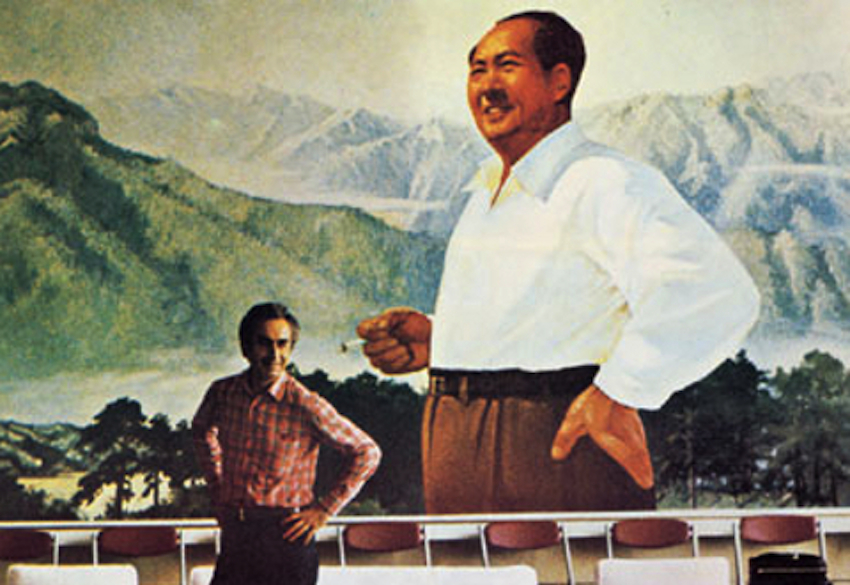
It’s under this title that the Renmin Ribao (“The People’s Daily”) trashed Antonioni’s Chung Kuo. The argumentation was rather strange. Judge by yourselves (it’s about the Tiananmen Square).“The film doesn’t provide any general view of this place and removes all majesty from the Tiananmen gate, which the Chinese people hold so dearly. Conversely the author doesn’t save any pellicule to film small groups of people on the square, sometimes from a distance, at other times up close; sometimes up front, other times from the back; here a swarm of faces, there an mesh of feet. He deliberately turns the Tiananmen square into a messy fair. Doesn’t he have the intent to insult our great homeland?” (To this false question, the answer is evidently: yes)

Two reproaches then: 1. By way of an exaggerated multiplication of shots and angles, Antonioni cuts as he pleases (without respect, denigrating, insulting). 2. He doesn’t reproduce the official image, which is supposed to be emblematic of the place “which the Chinese people hold so dearly”, its “brand image”. He does the same when he films the Nankin bridge: “While filming the great Nankin bridge on the Yangtsé, this magnificent modern bridge, he has deliberately chosen very bad angles, giving the impression that it’s crooked and unstable.” In other words: every image that deviates from the brand image is supposedly slanderous. Or: not filmed= denied, denied= contended.

There are cut up images that are supposed to be whole, and there are images that are supposed to be there but are missing. Third reproach: “In regards to the choices he made while filming and editing, he has hardly filmed the good, new and progressist images, and if he has filmed them it was rather for show and to cut them out afterwards.” In other words: the “good, new and progressist images” are not to be constructed but are already there, already given and only to be reproduced. Isn’t the Renmin Ribao contributor assigning a mission to cinema: re-mettre en scène?

Typage and natural, natural and typage

So far for the Renmin Ribao’s argumentation (definitely strange). Let’s get back to Europe. For those interested in Chinese politics (and not only in China as dream or utopia, model or challenge), Chung Kuo wasn’t a very satisfactory film. We couldn’t get rid of the impression that we were assisting in the mute tribulations of Chinese extras in China, under the eye of a great skeptical but nevertheless attentive esthetician who concludes from all this, a bit brisk, the impossibility of understanding anything at all of the mysteries that were shown to him. He refused to affix his signature to the already constituted images (the “good images”) that were expected to be reproduced (Chinese naivety? Pro-Chinese naivety?). Worse: he got even more attached to the images that were advised against or forbidden: an official building, a military boat, a free market in open country. The Chinese didn’t seem to be aware that the only image that marks or “brands” here in the West, is that which is won out on something.

For us (at Cahiers), there was something else at stake in the criticism on Chung Kuo. It provided us with a particularly convenient occasion to restate our mistrust of naturalism. To all those who were bewildered by this slice of life, it sufficed to say: in cinema, there is not only encounter, naturalness, “as if”. There is no image that slyly (naturalism) or explicitly (publicity) wants to become a brand image, that is to say of the congealed, blocked, repressed. And we added: the sly typage welling up from Chun Kuo is not without ulterior motives or malicious intent. We don’t have great merit in being right: Antonioni himself doesn’t hide that he avoids what he does not understand or consider: Chinese politics.

But confronted with the arguments made by the author (anonymous of course) of “Deceitful intent and despicable procedure”, we were also divested. How can one reproach Antonioni of not having filmed the Tiananmen square from an official angle? And why infer that these shots would insult the Chinese people, while in France it’s exactly those shots that do not hold any denigration or slander? It’s almost the opposite: for a progressist audience (those to whom the film is aimed, evidently not the Franco-Chinese friends), a human, close, non majestic image, not resembling a postcard of Tiananmen, was something positive. Where do paradoxes like this one come from (from the Renmin Ribao): “But Antonioni shows the Chinese people as an ignorant and stupid crowd, cut off from the world, with sad and worried faces, without energy or hygiene, loving to drink and eat, in short a grotesque horde. “ And in Libération we could read, written by Philippe Sollers, at text on the calmness, the nonchalance, the lack of hysteria of the Chinese crowd.

We also wanted to tell the Chinese exactly the contrary of what was being said to the readers of Libération and Cahiers: there is not only typage, the exemplary, a film is not only an encoding, a shot is not completely determined by the cause it serves, the image resists. The little of the real it encloses doesn’t let itself be reduced like that. There is always something that remains.

Funny debate which was already about the here and the elsewhere. Here (Paris, end of 1973): release of an Antonioni film on China. Question: what does an image hide? What is its out-of-frame? Elsewhere (China, beginning of ’74): violent debate on western art and “musique sans titre”. Question: what does an image show? What is there in the frame? Here: repression of the “prise de vues”, of the political dimension of the shooting, in favor of of the fetichism of the image taken, won (of the scoop), according to the double criterium of rarity (China) and truth (the eye of the master: Antonioni). Elsewhere: repression of the image in favor of a normalization of the “good image” which is nothing but a “re-prise” of the déja-vu. Here: tracking down the mise-en-scene under the natural. Elsewhere: tracking down the natural under the re-mise-en-scène. Cross-over or short-circuit?

Ambivalence or Amphibology

There’s a scene which the Renmin Ribao contributor didn’t mention: the opening scene showing a childbirth (Caesarian, under acupuncture). Suppose that Antonioni wasn’t the anti-Chinese monster in lack of defamatory images. In that case a question comes up: which images to take back from China that can satisfy the Chinese authorities (those who invited him) and can show the western audience (the only ones who will see the film) something of China, something impressive, something that they don’t know or don’t know well. The cesarian is one response.

In fact, it plays out on two levels. For the Chinese, it illustrates the success of popular medicine: success of acupuncture, success of the ideology “in service of the people” in medicine. Of this image (a birth “with eyes open”), the Chinese have reason to be proud. It’s evidence in their favor.

For us as well this image plays out favorably, yet for different reasons: it shows – better than all discourse – that the relationship the Chinese have with the body is at the very least very different than the one that exists in a society such as ours. The fear of disembowelment, of in- and outside, of shame and fault, is missing here. It’s about something else. About what? We don’t know, but it’s enough that the question is asked. This image, for us, is revelatory. It touches upon our truth.

So here’s a series of shots that is twofold positive, but in two different areas. For them and for us. It satisfies two audiences who will never meet, except by virtue of this film. It forbids the western spectators to put themselves where they are not (in pro-China for example), it does not permit the Chinese to put themselves where they are not (in the throes of the Christian body). It keeps its distance and in doing that, it makes visible.

We see that a militant discourse would object to this double scene. What is important, it would say, is not that these shots play out positively in two areas that don’t know about each other, it’s the fact that because of this mediation these two areas, the Chinese and the French one, have started communicating with one another.

We should know by now that it’s not people who communicate but rather objects (statements, images) that communicate by themselves. In putting too much trust in communication, we risk being disappointed, like we were three years after Chung Kuo when noticing that Joris Ivens, despite his talent, only provoked smiles with Yukong. At least Antonioni is a smuggler, not “here”, not “elsewhere”, but between brackets, protected by them, without anchor, exposed. Exposed to the utopia, to the non-place. Moreover, that’s what worries and delights him since forever: cinema as affirmation of distance, however small. In this scene in The Passenger in which the old African chieftain grabs the camera and films Jack Nicholson, one can see quite clearly what is at issue: the sudden possibility of a reversibility, of the camera passing without a word from hand to hand to the great confusion of the scene and the actors. This, in China, was simply impossible.

The pose (keep smiling)

Someone is being filmed? There are several approaches:
1. The filming happens within the framework of the industry of cinema. It is then symbolically covered by the type of contract (wage, one-off fee, benefits participation, unpaid) agreed between the production and the actors. In the name of this contract, the filmmaker will be able to demand a certain acting or performance.
2. The filming happens within the loose framework of a documentary, of a socio or ethno-logical essay, or of an investigation. Most often, actors do not have the capacity, total or relative, of controlling, technically or intellectually, the operations to which they lend their bodies and voices. We then enter the domain of morals and risk: to film those for whom there exists no reversibility, no chance of becoming themselves “filmeurs”, no possibility of anticipating the image which will be made of them, no hold on the image. Mad people, children, primitives, the excluded, filmed without hope (for them) of a reply, filmed “for their own good” or for the sake of science or scandal: exoticism, philanthropy, horror.
3. There is a third type of situation (the one that interests us here): when the filming is done by a filmmaker or a crew who have decided to put their camera and their know-how at the service of. Of a people, of a cause, of a fight. In these conditions, the non-reversibility has other causes (under-development, lack of equipment, need for foreign help) , but generates new kinds of problems.

We know that a people in struggle is led to make an image of this struggle, a “good” image. Every extended struggle makes itself a brand image, a flag, a symbol regarding its identity, so regarding itself (because it always starts with the negation of this identity). Every image is always proof, a constatation, a piece of evidence. And to obtain this image one has to pose, and make pose. The Renmin Ribao reproached Antonioni to have cut, not having filmed a “general shot”, to have destroyed the pose. We are in the heart of the problem: how to respect this pose? And also: how not to respect it?

It’s an old question. Just like Joris Ivens’ response: “In every place we had to struggle to conquer our liberty. The natural tendency of people is to show only the positive aspect of things, to beautify reality. Is is a problem, I think, that I’ve encountered everywhere in the world. When receiving a guest, we clean the table and do the dishes. All the more so when the guest arrives with a camera.”

The common part

The same question is asked to the collective that has made L’Olivier. Danièle Dubroux: “In the children’s camps, what interested us was to show the relations between them, how they handled themselves, autonomously, their life, while doing the dishes, taking care of the plantations and the sheep… But they didn’t understand at all why we were interested in all that and the leader made them put everything in order especially for us.” It’s what Serge Le Peron formulated under the guise of a question-program “What is the common part of two systems of questions?” The film is taken up in a real four corners game. On one hand the one being filmed and their personal issues. On the other the ones filming and their personal dealings. But, behind the ones filming, there is also the question of knowing what effect these images will have on their audience and behind the ones being filmed, of what they imagine and what they hope from this effect that they don’t know. Example: “the Fedayeen were completely dumbstruck when we told them that this image they were showing of themselves, that of people taking up arms, is an image that, here, shows them like madmen, like people who only think about death and suicide, crazy, insane people.. While there, they were completely disarmed, if we could say so, in front of this possible becoming of their images, of these images of them in arms.”

Because, supposing that there are images that actually gratify this four corners game, it doesn’t mean that they would be the most clarifying or even the most useful. It is doubtful that the search for average images, formation-images of compromise defined by the sole fact that they don’t upset anyone, produces anything other than in-decidability, all obscurity and softness. An image can exist in various areas but it can only bear one point of view.

And yet, Ivens and Loridan: “These images, it’s a mixture of our presence and their reality. There is a dialectics between the two.” Strange dialectics according to which the terms of contradiction cannot be assigned. Mixture muddles while dialectics unites contradictorily, unites to divide, combines to disconnect.

“Our presence and their reality”. Making cinema directly based on a coded reality, is what characterizes ethnological cinema. In the case of China, the code has a name: politics. As its name indicates, socialism aims for socialization of relations between people. It makes them enter (mostly by force) the apparatus where individuals think and live the exercise of power collectively and “unconsciously”. By them and on them. Who doesn’t notice that we are already talking about cinema? The “cinema” that makes up a society, the postures that it takes in order to save face?

A camera and a microphone that are naively connected to the Chinese reality necessarily encounter this social pre-mise en scène. Either it renews it (to make it look spontaneous) or it makes it forget it for a while (but then, one has to cut it up). Naturalism is a technique that renews something that pre-exists it: the society as it is is already a mise-en-scène. To work on this given, break this pre-mise en scène, make it visible as it is, is always an courageous, difficult and unpopular undertaking. Realism is always to be won.

The duettists in question

In How Yukong Moved the Mountains, the most interesting episode, according to me, is the one taking place in the generator factory in Shanghai. Why? Because at the moment when Ivens and Loridan are in this factory, something happens that obliges them to leave their first idea behind and adopt another. The film becomes a report on an event that shakes up the factory: dissatisfaction of the workers, campaign of dazibaos, leaders being criticized, meetings etc. Suddenly there is a necessity for the filmmakers to stick to this fiction, to not cheat with it, to respect time and space. Necessity to do what they don’t do anywhere else in their film-flow: to make the masters of discourse come back to the screen at a time when these discourses have touched the fire of the real. In cinema, as in life, we can only take seriously what happens at least twice: for example the two criticized leaders (the duettists) of the generator factory.

What strikes us is that, from the beginning to the end of the film (before and after being criticized), they hold on to the same discourse, which all of the sudden sounds more and more hollow. Discourse without surprise: it is said that one shouldn’t go against the masses, accept their criticism, that it enriches, makes one better etc. If nothing had happened in this factory, this discourse would have played a accompanying role to an “open door” operation. But because we have had the time to witness them sound hollow, it makes us to see what other films seem to want to hide: that in China, more than elsewhere, discourse is above all not to be taken for what it says but for what it constitutes as a political practice that is more diffuse, more crafty, more complex, through which, in low as as in high places, power plays out.

The problem is not so much to know if the people are sincere or not than to encircle the articulation between this or that individual (a body and a singular voice, even if the discourse is stereotypical) and the collective discourse, the rhetorics for all purposes. What does it mean? What does he want when he talks? Or when he shuts up? Where is the accent of truth in what he says? Or, as they say in china, in “waving the red flag to attack the red flag”?

Roland Barthes, in a short text (‘Alors, La Chine?’) has seen this fundamental aspect of the relation between the Chinese and their discourse: circulation of power in the fact of power circulating speech and thus getting rid of it: “In fact, every discourse seems to progress by means of commonplaces (“topoi” and clichés), analogous to the sub-programs known in cybernetics as “bricks”. What, no liberty? Yes, under the theoretical crust, the text fuses (desire, intelligence, work, struggle, all that divides, bursts, exceeds). First of all, these clichés, everyone combines them differently, not only according to an esthetical project of originality, but under the more or less vivacious pressure of his political conscience (using the same code, what difference is there between the solidified discourse of this responsable of a popular commune and the vivacious, precise, topical analysis, of this shipyard worker in Shanghai).”

The important phrase here is “using the same code.” We know (it’s enough to read Pékin-Information) that the most bitter, violent ideological and political struggles speak the same language, they speak from the inside of a limited body of statements that function like so many cards (statement-trumps, statement-masters) in games that are always renewed. Hence the difficulty in recognizing the adversary. That is why Ivens can naively say “no-one says openly: I am a reactionary”.

Hence also the completely particular use that the Chinese make of brackets. Inside a discourse, the brackets never attest to the presence of another (system of quotes). Brackets in China are essentially defamatory. They constitute a double operation
1. To translate. Translate plainly (in the common code) what the other has never said but is supposed to have thought. Example: someone is supposed to have defended the thesis (evidently unsayable) that “the bourgeoise does some good.”
2. To put on the side. Brackets mark an isolation of bad discourse, designating it as defamation.

It’s because Ivens and Loridan have been the first to base their film on the words of the Chinese, that we are entitled to make remarks and reservations about their film. They relate to a decisive point that we can approach in different ways: discourse/power, statement/enunciation.

How to understand something of power, Chinese or otherwise?

How to film brackets?

——————————————————————————————————————————————————————-

Translated by Stoffel Debuysere (Please contact me if you can improve the translations).

In the context of the research project “Figures of Dissent (Cinema of Politics, Politics of Cinema)”
KASK / School of Arts
Godard’s latest scandal

glauber_godard.jpg

By Glauber Rocha

Originally published as ‘O último escândalo de Godard‘ in Manchete, n. 928, 31 January 1970.

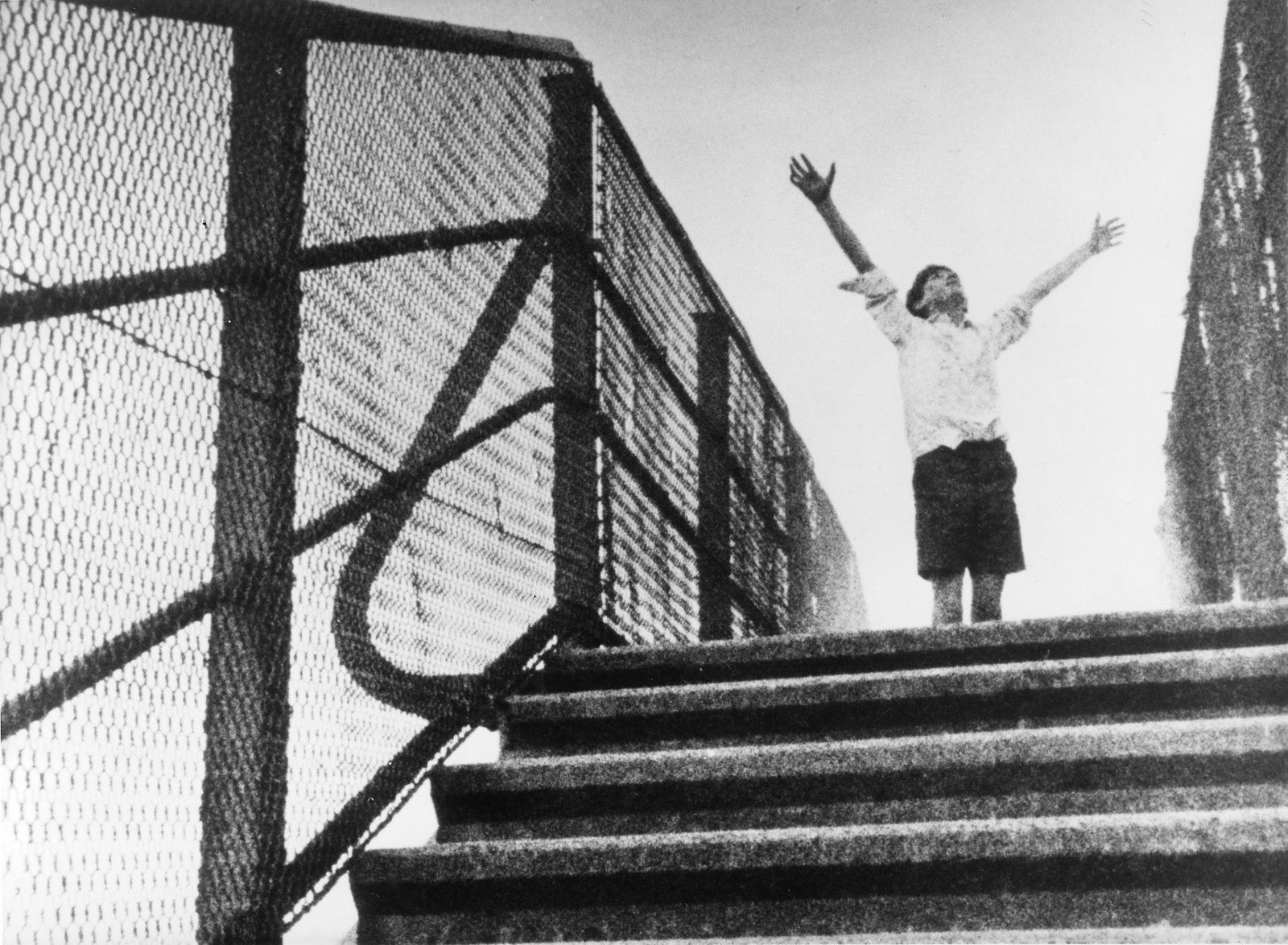
This year’s talk of the town will be Vent d’est, the latest film by Jean-Luc Godard, made after Le gai savoir and before Pravda. An Italian film. Still a complete mystery. This grande fofoca is possibly of the same stature as La dolce vita. Cineriz, a big distributor associated with Rizzoli publishers, has paid an advance of one hundred thousand dollars to producer Gianni Barcelloni for a “western in colour written by Cohn-Bendit, directed by Jean-Luc Godard and featuring Gian-Maria Volonté”. Does the film meet the requirements of Cineriz? I saw the first, secret screening, in the company of the producer and a lawyer. Cineriz, suspecting that the film would have nothing in common with what they expected, are threatening to sue the producers and ask for their money back, but as yet none of them has seen the film, on which subject the craziest jokes are going around. For example, I met this young guy who asked me, “Have you heard? In Godard’s far-west, there are two horses reciting Mao!”

Gianni Barcelloni asked me for a cigarette ten minutes into the screening, and while lighting the match, I noticed he was in tears. Next to him, the lawyer kept his lips firmly sealed. At the end of the row of seats, Ettore Rosbuck, a young millionaire with long hair, was wrapped in silence. After ten minutes, the film is still in its first scene, a scene showing a couple a youngsters lying around in the grass, while on the soundtrack we can hear a political discussion, with the sound distorted – “typical Godard”, a specialized snob would say. But the joke stops there. After the first half hour, the lights come on and the lawyer, in a frenzy, says, “I agree with Godard’s words, but this is not a film! Cineriz will sue us!”

So I answered: “Listen, doctor, what technically determines the definition of a film is the length of printed pellicule, sound and image. Scientifically, the film does exist.”

The lawyer answered, “I am a practical man. It is the judge who will say that this is not a film.”

So I responded to the lawyer, “Sir, there is no legislation that says what a film is, in esthetic terms. If a judge ever ruled that this is not a film, you can appeal.”

In the middle of this conversation, the lights go out and an image appears in which Godard, in his protestant pastor’s voice, asks what a film is. The lawyer breaks out in laughter, and Godard continues with an image showing Gian-Maria Volonté on a horse, dragging along the body of an Indian.

What is a film? Every day, the bosses ask filmmakers to make films. The boss could be Brezjnev-Mosfilm, or Nixon-Paramount. The scene we are seeing now is typical of a Hollywood western: an officer of the American cavalry torturing an Indian. The scene is repeated, but this time the officer is reading a fashionable revolutionary book. In this scene we see an image and we hear the sound of a progressive film, such as those presented yearly at the festivals in Pesaro or Leipzig: a film that is the same as the reactionary films we’ve seen before, since it shows the same spectacular images, with false content.

After that, several other images are shown and numerous questions are asked about militant cinema, always in the spirit of rigorous self-critique. I tell the lawyer, “You have seen it now: the discussion will go far. If the judge behaves like an ass, call Moravia, Lévi-Strauss, Marcuse, Sartre. A Godard film can take a hit: Cineriz would prefer to loose a hundred thousand dollars than to loose face.”

The lawyer hasn’t heard me, he’s completely fascinated by the film. Barcelloni is praying. Ettore seems possessed by this bestial silence that captures one in the presence of the indecipherability of a genius.

More images follow, filled with quotes and discussions, and then the film ends. The lawyer is even more furious now and I say while getting up, “In my opinion, the only problem with the film is that at this time it will not pass the Italian censorship. Other than that, it is as good and as commercial as all the others.”

The lawyer calls me an optimist and leaves. I go out with José Antonio Ventura, the film’s sound engineer, and I tell him several things. “The sound editing is brilliant. Godard will end up making a record one day. It is not a political film as Godard usually makes them: it is rather an anarchist film in the line of Artaud and Jarry.”

From elsewhere I call Escorel (1) and I tell him all that. We ask ourselves if Paul Emilio Salles Gomes (2) would like it. Surely. A bit later, still with Ventura, “It’s a bit of a joke. With a hundred thousand dollars, we could have created a film industry in Brazil!”

When I reach Gianni, I say, “There is something in the editing of sounds and images, something that irritates me: a bourgeois anarchism, a destructive moralism, something taking itself seriously. What if, Gianni, Bach had put leftist phrases in his music, in order to make himself heard at a music festival? Or if Mondrian had painted leftist legends on his tableaux? Or even in Brazil, if Tom (3) had succumbed to the pressure, and had utilized leftist words for his music? You know, Gianni, I remember when old Nicholas Ray told me in Cannes, “Whenever I see a Godard film, I’m not always interested in the images, which are very beautiful. The big problem with Jean-Luc is that he doesn’t have the courage to speak himself!”

Gianni answers, “Jean-Luc, he worries me.”

I turn to good old Ventura, “You know, Zé, Godard’s big frustration is that he doesn’t succeed in creating a political climate; he doesn’t dispose of any violence. He always approaches reality in a theoretical way. When he shows the officer of the American military torturing a student, he doesn’t generate any terror. The shot is extremely beautiful, one of the most beautiful shots in cinema, a shot made to make cinephiles swoon.”

“That’s right,” consents Zé, “In the scene in which the officer attacks the demonstrator, he wanted to have a brutal scene, and he really asked me to raise the sound, and what remains, as you’ve seen, is this simple scene, almost lyrical.”

“But the scene has turned out brilliantly”, I respond to Zé, “because the four camera movements that he made are absolutely unprecedented in film history.”

“Yes, really beautiful!”, whispers Zé.

“Zé”, I continued, “the more I think about it, the more I’m against the film, because it’s us who are the weak part in it. This film is an instrumentalization of our misery by a French bourgeois who is doing his own thing, explaining Marxism, a subject that I don’t know very well, but I don’t think he understands it either. If a professor of political science were to help out, perhaps that would please him. Having said that, there is something, perhaps this desperate attempt to explain Marxism, that doesn’t respond very well to today’s problems. And then I don’t know… It seems to me that the film is a big joke!”

It is useless to continue to describe my reactions to Vent d’Est. In Brazil, when an intellectual doesn’t like a film from the “new cinema”, he says with the tone of a great wise man: “This is not a film!”

A film for intellectuals generally obeys the American model, which they have been seeing since childhood and which they place alongside their Oedipus complex: the least provocation, and it’s immediately taken as pretentious idiocy. One day on the beach, an intellectual from Rio told me, “I don’t like El Justicero (3) because the camera is always static, and in a comedy, the camera has to move!

And in groups, they all behave like babas. The fashionable intellectuals who already have a model of modern cinema in mind, in line with Godard’s work: Vent d’est will freak them out. And to the youngsters who have been imitating Godard for the last five years or so, I address a warning: they should move fast, because in his two next films, Jean-Luc is capable of reinventing everything and even the infernal bazar of tropicalismo won’t help them conceal their old-style soccer game, nor make the goals against the teams of their colleagues. Sadly, it seems, with Vent d’Est, the Godard fashion has come to an end, and it’s Jean-Luc who is ending it himself, horrified by his own brilliance. These are the last words I tell Ventura:
“The tragedy is that in all of Latin America, it will be wild imitation all over again, and just as the Africans should show all the white folks the door, we should prevent foreign films from coming to Brazil. Brazilian cinema can only evolve if the audience, the critics and the filmmakers only see Brazilian films. For Godard, cinema is over, and for us, cinema is only beginning. In Brazil, a cameraman like Dib Lufti makes a long shot à la main and the whole world vibrates; if Godard saw that, he would fall to the ground in tears.”

In front of this man, skinny, bald, forty years old, I feel like an affectionate aunt who is ashamed to give sweets to a sad nephew. The image is silly, but Godard provokes a great sentiment of affection. Let’s talk seriously: it’s like Bach or Michelangelo eating spaghetti swamped with cockroaches, thinking that it’s not worth painting the Sistine Chapel or composing the Actus Tragicus. Because he is like that, Godard today, more humble than Francis of Assisi, ashamed of his own genius, excusing himself to the whole world, crying like a child when Barcelloni scoffed him, complaining of feeling abandoned, of being a wreck, the glory of being the greatest filmmaker since Eisenstein weighing on his Swiss bourgeois anarcho-right-wing shoulders. Please, let’s stop that. ‘I am only a worker in cinema, so don’t talk to me about cinema: I just want to cause revolutions, help humanity’.

There he is, calling the merry May leftist club for help, using production money to pay for a nice holiday in Sicily, leaving Cohn-Bendit and his hysterical Mao-Spontec discussions behind and rushing to Paris to show some excerpts of his film on Czechoslovakia, coming back to Rome out of breath to declare that he doesn’t want to make money with the film, criticizing me of having a producer’s mentality. Then he asks me to help him destroy cinema. I tell him that what I’m into is something else: I tell him that my business is creating cinema in Brazil and the Third World. Then he asks me to play a role in the film and if I want to shoot a scene in Vent d’est and – being the old monkey that I am – I tell him to calm down, because I am only there for the adventure and I’m not clownish enough to embark in the gigolo’s collective folklore of the unforgettable French May.

To simplify, Godard sums up all the questions of today’s European intellectuals: is art worth making? The question is an old one, Paulo Francis (5) would say: Joyce has also destroyed the novel! And that’s what is so annoying in Europe today: the issue of the usefulness of art is old, but it is in fashion and, in cinema, it’s up to Godard alone to come to grips with the crisis. Godard is what Fernando Ezequile Solanas (6) is to us in Buenos Aires. The truth, however, whether our intellectual fellow countrymen want to hear it or not, is that European and American cinema has gone up a road without hope, and it’s only in the Third World countries that there is a way left to make cinema. That’s where the crisis resides and why Godard (and co.) has a lot to do with us. In Vent d’est, he asks me what the roads of cinema are, and he himself gives the answer: “That way is the cinema of aesthetic adventure and philosophical inquiry, while this way is the Third World cinema – a dangerous cinema, divine and marvelous, where the questions are practical ones: production, distribution, training three hundred filmmakers to make six hundred films a year for Brazil alone, to supply one of the world’s biggest markets.”

I repeat: That is the difference. On the one hand, there is a general exhaustion financed by big capital, and even Godard, in his desperation and as much as he wants to escape it, makes film after film, financed by the system itself that, from its side, doesn’t care if Godard attacks it with all his strength, because cinema is also exhausted and the whole world is collapsing in attendance of the Bomb. Vent d’est is financed by Ettore Rosbuck, and this young man represents Fiat. Because it’s Fiat that has been financing the most anarchist and terrorist films in recent times, and basically Ettore doesn’t care one way or the other, because for him Vent d’est is as inoffensive as any other work of art, and the great beauty of this film is just this: it’s desperate beauty, born – imperceptibly – of the exhausted intelligence of poetry. On the other hand, tired of running, but still devoid of reflection, we are here, we, the others from the Third World, and we ask permission to film.

Godard and co. are above zero. We are below zero.

We don’t have the big capital to back us up. On the contrary, we have vicious censorship on our backs. We also have an audience that hates our films because it’s drugged out on commercial foreign and national films, and on top of that market, we also have the intellectuals who hate our films because they are drugged out on Godard films, and who hate us because we dare to make films in a country that doesn’t have stars like Gary Cooper and doesn’t speak a language that knows how to say “I love you”. The difference is simply that, and that is why it’s worthwhile, I think, to say one last thing about Godard:

The art in Brazil (or any other country in the Third World) makes sense, yes sir! The underdeveloped country that does not have a strong or madly national art is to be pitied, because, without its art, it’s all the weaker (its brain can be colonized), and it’s here that the most dangerous extension of economic colonization can be found. In the specific case of cinema, I want to let my colleagues know that they should endure the criticism, the slander and the contempt without wavering, because I am absolutely convinced that Brazilian cinema novo is currently producing images and sounds that are what we can call modern cinema.

After seeing Vent d’est, I haven’t said these last words to the lawyer, because that doesn’t interest him, but now I would like to say to everyone, interested or not interested, in the faraway homeland I love so much:

I have seen from up close the corpse of Godard, having committed suicide, up there on the screen, projected in 16mm. It was the dead image of colonization. My friends, I have seen the death of colonization! If I have been a privileged Brazilian, my apologies, but by spreading this news, I just want to let it be heard: WE HAVE TO CONTINUE TO MAKE CINEMA IN BRAZIL!

(1) Eduardo Escorel has been a major figure in Brazilian cinema since the 1960s. He edited, amongst others, Rocha’s Terra em Transe (1967) and O Dragão da Maldade contra o Santo Guerreiro (1969).
(2) Paulo Emilio Gomes (1916-1977) was was a leading Brazilian intellectual and film critic. His writings include a biography of Jean Vigo and Cinema: trajetória no subdesenvolvimento (Cinema: Trajectory in Underdevelopment).
(3) Antônio “Tom” Carlos Brasileiro de Almeida Jobim (January 25, 1927 – December 8, 1994), also known as Tom Jobim was a Brazilian songwriter, composer, arranger, singer, and pianist/guitarist. He was a primary force behind the creation of the Bossa Nova style.
(4) El Justicero by Nelson Pereira dos antos in 1967
(5) Paulo Francis (1930-1997) was a Brazilian journalist, political pundit, novelist and critic.
(6) Fernando Ezequile Solanas is an Argentine film director, screenwriter and politician. His films include La hora de los hornos (1968)
——————————————————————————————————————————————————————-

Translated by Stoffel Debuysere, with help from Mari Shields (Please contact me if you can improve the translations).

In the context of the research project “Figures of Dissent (Cinema of Politics, Politics of Cinema)”
KASK / School of Arts
Figures of Dissent: Bill Douglas

my-childhood_bill-douglas.jpg

6 February 2014 20:30, KASKcinema, Gent. In collaboration with Courtisane.

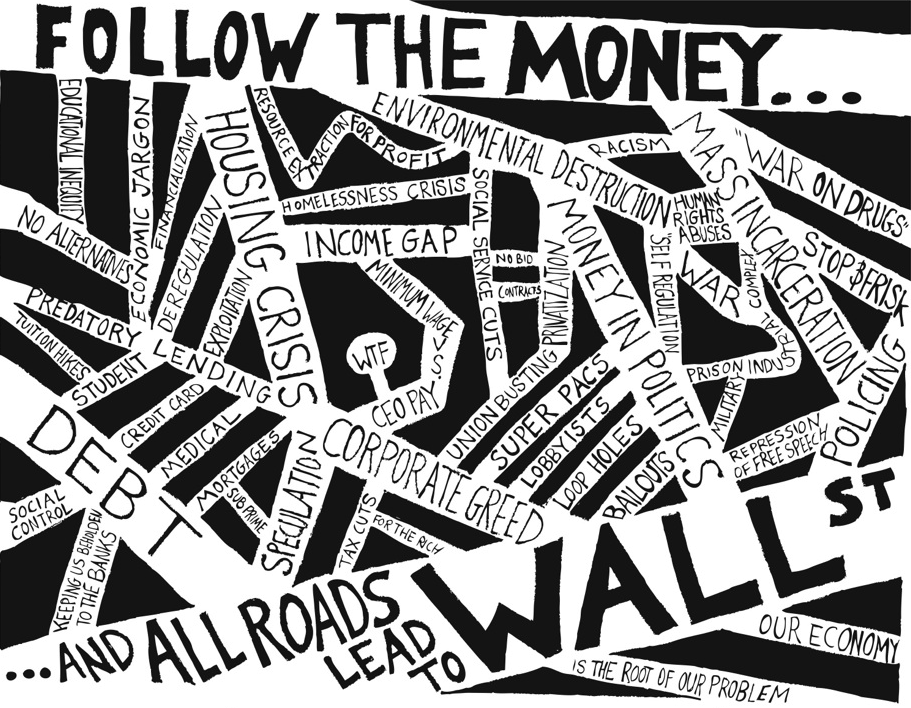
My Childhood (1972, b&w, English spoken, 46’)
My Ain Folk (1973, b&w, English spoken, 55’)
My Way Home (1978, b&w, English spoken, 71’)

“Strangely enough, my trilogy is not about a dream world, but about the real landscape I had wanted so badly to escape from. But the making of these films could not be a cathartic exercise. There had to be a distance. I had to be objective so that the characters could come to life, so that the work could have shape.”
– Bill Douglas

He wouldn’t have liked his work being associated with the notion of the political. Certainly, although this trilogy portrays the life of a boy growing up in a poverty-stricken mining village in post-war Scotland, it does not shed any light on the circumstances of the economic and industrial devastation that would lead up to the widespread misery of the Thatcher years. And although the largely autobiographical films are clearly rooted in a deepfelt empathy for the hardship and loss endured by many, cries of suffering and injustice remain shrouded in silence, while signs of struggle and revolt seem stifled in bleak monochrome shades. But perhaps this mutism is exactly what defines the poetics of Bill Douglas’ work, which is also a politics. In contrast to many works of militant fiction – including those categorised as “social realism” – his films do not consist of denouncing false promises and hidden agendas for the sake of constructing another future, one that is always already laid out. There is no predetermined scheme of cause and effect here, no fixed scenario that can show us a way out. There are only situations, composed of inter-weavings of glances and gestures, times and spaces. The “realism” Douglas was looking for means precisely this: to take distance from the narrative schemes that supposedly make up reality, and delve deep into the interior of the situations themselves, there where the events of the world become affects, enclosed in mute faces, mobilized in silent actions, finding expression in spare words. In this world of affects and intensities lingers the sense of another life and the dignity needed to pursue the dream of this other life, always unpredictable, far away from this “reality” where everyone, as the boy is told time and time again, is bound to a sole place and destiny.

In the context of the research project “Figures of Dissent (Cinema of Politics, Politics of Cinema)”
KASK / School of Arts
DISSENT ! Alberto Toscano

allroadsleadtowallstshoort.gif

18 February 2014 20:30, Argos Brussels.

“The dangers of didacticism, or the seemingly unbridgeable rift between cinematic drama and economic affectlessness, would seem to factor against attempting to film the crises of capitalism. Yet the works of past filmmakers and theorists struggling with the experience of economic collapse remain alive with lessons for the present, and the ongoing financial crisis has been the object of noteworthy, if rare, attempts to give narrative and visual form to its underlying causes and effects.”
– Jeff Kinkle & Alberto Toscano

“Representations of crisis need not be crises of representation“, wrote Alberto Toscano in ‘Filming the Crisis’, a piece he jointly wrote with Jeff Kinkle on various cinematic responses to the ongoing economic turmoil, from Oliver Stone’s Wall Street sequel to Michael Moore’s Capitalism: A Love Story and Hito Steyerl’s In Free Fall. The article rehearses some of the approaches that both authors have been exploring in view of their forthcoming book Cartographies of the Absolute, which aims to provide a critical survey and a series of reflections on the proliferation of works in the visual arts, cinema and literature which seek to tackle the representation of contemporary capitalism. The focus is on those works which in one way or another try to provide models or narratives that might allow us to orient ourselves around the global economic system, taking in account the associated dimensions that pose obdurate problems for plot and image: invisibility and connectivity, the immaterial and the systemic. The book promises to extend the already broad scope of Toscano’s work, which includes acclaimed books such as Fanaticism: On the Uses of an Idea and The Theatre of Production: Philosophy and Individuality between Kant and Deleuze, as well as numerous translations of Alain Badiou and contributions to several journals of art and cultural criticism. He has also occasionally written on the entanglement of politics, aesthetics and political economy in cinema, notably in regards to the films of Jean-Luc Godard, Masao Adachi and Koji Wakamatsu, amongst others. Recently his translation of Franco Fortini’s The Dogs of the Sinai was published alongside a new release of Straub-Huillet’s Fortini/Cani. In this DISSENT ! session we will mainly discuss his Cartographies project, in trying to get to grips with some of the common drives and shared impasses that seem to characterize the current wave of film and art works dealing with the logics of capitalism and its failures.

DISSENT ! is an initiative of Argos, Auguste Orts and Courtisane, in the framework of the research project “Figures of Dissent” (KASK/Hogent), with support of VG & VGC.

——————————————————————————————————————————————————————-
About DISSENT!

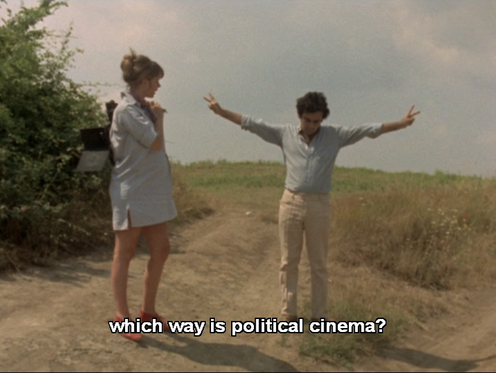
How can the relation between cinema and politics be thought today? Between a cinema of politics and a politics of cinema, between politics as subject and as practice, between form and content? From Vertov’s cinematographic communism to the Dardenne brothers’ social realism, from Straub-Huillet’s Brechtian dialectics to the aesthetic-emancipatory figures of Pedro Costa, from Guy Debord’s radical anti-cinema to the mainstream pamphlets of Oliver Stone, the quest for cinematographic representations of political resistance has taken many different forms and strategies over the course of a century. The multiple choices and pathways that have gradually been adopted, constantly clash with the relationship between theory and practice, representation and action, awareness and mobilization, experience and change. Is cinema today regaining some of its old forces and promises? Are we once again confronted with the questions that Serge Daney asked a few decades ago? As the French film critic wrote: “How can political statements be presented cinematographically? And how can they be made positive?”. These issues are central in a series of conversations in which contemporary perspectives on the relationship between cinema and politics are explored.

Afterlives of the militant image

vent-dest.png

I am currently working on an event that aims to deal with some of the contemporary resonances of militant film culture. The premise of the event, entitled “The Fire Next Time (Afterlives of the militant image)” is at least twofold, in that it wants to engage with the attraction that this particular notion of militancy currently has – not in the least in the contemporary art world – and wants to re-evaluate the discursive practices that have informed this notion, without resorting to nostalgia or romanticism. The main challenge is then one of setting up a “dialogue” with the period in question, as well as the associated thinking about politics on one hand and cinema on the other, in search for reverberations that can help us to think their relation today. Here’s an introductory text:

“There was a time when cinema was believed to make a difference, to be able to act as a weapon in struggle, to operate as a realm of discord. The so-called “militant cinema” was not only considered as a tool to bear witness but also to intervene in the various political upheavals and liberation movements that shook the world in the 1960s and ‘70s. What remains of this unassailable alliance between cinema and politics? After the flames had died down, all that seemed to be left was a wreckage of broken promises and shattered horizons. Today it feels like we have been living through a long period of disappointment and disorientation, while the sense of something lacking or failing is spreading steadily. An overwhelming melancholy seems to have taken hold of our lives, as if we can only experience our time as the “end times”, when the confidence in politics is as brittle as our trust in images. Perhaps that is why, for those who came after, there is a growing tendency to look back at an era when there was still something to fight for, and images were still something to fight with. Can a re-imagining of old utopian futures shed a new light on our perceived dead-end present, in view of unexpected horizons? Can an understanding of past dreams and illusions lead to reinvigorated notions of responsibility, commitment and resistance? Can a dialogue with the period in question help us to find the very principles and narratives capable of remedying its impasses? And how can this questioning help us to think about how cinema, unsure of its own politics, can be “political” today? In light of a potential rebirth of politics, would it still be possible for the art of cinema to appeal to the art of the impossible?”

The Fire Next Time is a two-day program of interventions and screenings (3-4 April 2014), organized in conjunction with an exhibition of work by Eric Baudelaire and Mathieu Kleyebe Abonnenc. This event will take place during the forthcoming Courtisane Festival, in the framework of the research project ‘Figures of Dissent’ (KASK/HoGent) and the EU project ‘The Uses of Art’ (confederation L’Internationale).

For those interested: we’ve set up a Tumblr as a kind of repository of images, fragments, articles and quotes. Check out fire-next-time.tumblr.com.