In the context of Courtisane Festival 2019 (Gent, 3 – 7 April 2019). Curated by Stoffel Debuysere
AFRICAN-AMERICAN INDEPENDENT FILMMAKING ON THE US EAST COAST, 1967-1989
“Film is, in this culture — especially for Black people — the last solid white bastion of the society. It’s the one area where we have an inferiority complex. The whole myth of Hollywood, the way film functions in this culture, has succeeded, artistically, in brainwashing all of us… Film is the largest, most powerful, most potent myth. And we have not thought about how that myth applies to us. We don’t believe it applies to us. So, we can’t believe ourselves as filmmakers when we talk about John Ford, Huston, Betty Davis, John Wayne, and so forth. Hollywood is the one mythical world that America created! The Gods and Goddesses of America are film stars! They’re the Greek mythology of America, and we don’t know who we are in that mythology. How can we talk about picking up a camera when there is a sacred imaginary mythology around film, around Hollywood, around movies, and we would be breaking sacred ground!” — Kathleen Collins, 1980
“There are times when the white critic must sit down and listen. If he cannot listen and learn, then he must not concern himself with black creativity… I want to say that it is a terrible thing to be a black artist in this country — for reasons too private to expose to the arrogance of white criticism.” — Bill Gunn, letter to The New York Times, 1973
In a tribute to the singular actor, playwright, screenwriter, novelist, and filmmaker Bill Gunn, Ishmael Reed wrote: “Gunn used the stage and the page to rail against the Movie Industry forces, not in the manner of the diatribe, but in the style of the samba and the bossa nova. With subtlety and with wit. He was too deft for the obvious. Too complicated. Too odd.” When he passed away in 1989, Gunn had directed only three films, all with problematic histories. Stop (1970), one of the first studio films to be directed by an African-American filmmaker, was shelved and remains locked in Hollywood’s vaults. Ganja & Hess (1973), which Reed called “what might be the country’s most intellectual and sophisticated horror film,” was heavily recut, retitled, and reissued without Gunn’s approval. Personal Problems (1980) was an experimental, shot-on-video soap opera that had limited showings on public television and at scattered venues before disappearing for nearly forty years.
Why is it that the work of so many African-American filmmakers seems to remain hidden from history? “Isn’t the canon debate really about identity politics?” filmmaker and critic Peter Wollen was asked over two decades ago. To which he replied: “All I want to claim is that when we set out to revise the canon, we should be able to argue our position on aesthetic grounds,” giving the work of Bill Gunn as a prime example of films “we should look at again.” This programme is a modest invitation to “look again” at a selection of African-American independent films that have sadly gone overlooked or underappreciated for too long.
Following the programme dedicated to the work of the so-called “LA Rebellion” movement at Courtisane Festival 2015, this selection will focus on manifestations of independent filmmaking emerging from the East Coast of the US, particularly from New York. Most, if not all, of these works have been largely invisible for decades. This was notably the case for William Greaves’s endlessly revelatory meta-documentary Symbiopsychotaxiplasm: Take One, filmed in 1968 and completed in 1971, but only shown publicly two decades later. At that time it became a new entry in the annals of film history, but perhaps it wasn’t the rewriting of them that it should have been. The same can be said about the films of Kathleen Collins, a playwright, writer, director, and educator who worked with Greaves on Symbiopsychotaxiplasm and the groundbreaking television show Black Journal, before embarking on her own cinematic ventures. She completed two films, most notably Losing Ground (1982), which was one of the first feature-length films produced by an African-American woman. At a time when the film industry predominantly identified “black experience” with tales of poverty and crime, this thoughtful, understated film about the interior passions and affections of a woman in a troubled marriage received little notice in the US, until it finally had its first theatrical release in 2015.
Some of these films were initially responded to with curiosity and acclaim, at least in Europe. Ganja & Hess premiered during the Critics’ Week at the 1973 Cannes Film Festival, where it received a standing ovation and the critics’ choice prize, but was largely dismissed by most American critics and quickly lumped into the category of blaxploitation films. Personal Problems had its world premiere at the Centre Pompidou in 1980 and was reportedly described by a critic as a soap opera as Godard would have done it; but due to industrial obstructions, the self-described ‘Black soap opera’ was never able to reach a wide audience. Sidewalk Stories (1989), Charles Lane’s tender homage to Chaplin’s The Kid, won the Prix du Publique in Cannes, where its 12-minute ovation set a new record, but receded from view after a limited run. Luckily these three works, too, have been given a new life thanks to recent restorations.
Other films, however, are still awaiting the consideration and appreciation they deserve. In 1989, a piece in Cahiers du cinéma read: “Twenty years after Bill Gunn’s Ganja & Hess, the intellectual Black American cinema returns with the remarkable Chameleon Street”. But despite garnering the Grand Jury Prize at Sundance and having its remake rights purchased by a major studio, Wendell B. Harris Jr.’s witty and sardonic critique of race and class relations vanished as fast as it appeared. Two years later, the same Sundance prize was won by Camille Billops and James Hatch, whose emotionally raw and uncompromising autobiographical documentaries about domestic life remain all too unseen to this day.
So let us look again at some of the films that have attempted to break the “sacred imaginary mythology” that Kathleen Collins spoke about. Let us look closely at Fronza Woods’s sensitive portrayals of everyday struggle and resolve, and Edward Owens’s poetic portrait studies of his mother and her circle, both of whose filmmaking careers were regrettably short-lived. Let us look again at the work of all those who might have been considered too deft, too complicated, too odd. For, perhaps more than ever, we need to cherish and hold on to that very notion that critic Serge Daney once reserved for the films of Bill Gunn: “unclassifiable”.
Thanks to Jacob Perlin, Louise Archambault Greaves, Brian Belovarac (Janus Films), Jonathan Hertzberg (Kino Lorber), Amy Heller & Dennis Doros (Milestone Films), Nora Wyvekens (Carlotta Films), Ed Halter, MM Serra (The Film-Makers’ Cooperative), Edda Manriquez (Academy of Motion Picture Arts), Amy Aquilino (Women Make Movies), Eugene Lee & Roselly Torres (Third World Newsreel), Céline Brouwez (Cinematek), George Clark, Wendell B. Harris Jr.
——

Symbiopsychotaxiplasm: Take One
William Greaves, US, 1971, HD, colour, 75′
When Symbiopsychotaxiplasm: Take One surfaced in 1991, it was a double surprise. It surprised those who assumed they were familiar with the major independent and experimental films of the sixties, and it surprised those who believed they understood the career of William Greaves (1926 – 2014); firstly, as a stage and film actor and a drama teacher and, subsequently, as a director and producer of documentary films. Neither of these careers seemed to account for this singular metacinematic experiment. And yet, as fully as any film he has made, his self-described “study of the creative process in action” combines his interest in acting and in actors with his need to document and interpret real events. Symbiopsychotaxiplasm, conceived as ‘take one’ of a series of ‘takes’, documents the shooting of a strange film in Central Park. “Various couples repeatedly rehearse a screen test in the afternoon sun under the indulgent eye of the director. The script is acrimonious yet somewhat clichéd, the actors tense and awkward. The crew is unnerved and wrong-footed by the filmmaker, played by William Greaves himself, whose directing style is infuriating, inconclusive, vague and deliberately contradictory. At their wits’ end, they borrow a camera and film themselves debating the shoot in urgent, rambling, evening discussions. The frame splits in two. Greaves encourages his crew in their Palace Revolution; obstreperous tramps wander onto the non-set to hijack the nonmovie, sound levels repeatedly stutter and glitch; through it all glides the soundtrack of Miles Davis’ In a Silent Way: serene, serious, enigmatic.” (The Otolith Group)
“Symbiopsychotaxiplasm is neither a documentary nor a traditional feature. At least I don’t feel that it is. It is more of a happening. Instead of being a form of conventional art it is a piece of abstract art. Abstract in the sense that it does not obey the language of convention. It obeys the mind, the heart, the intuition, the subconscious. These are the determinants, rather than the Aristotelian approach to drama — the traditional dramatic form of Sophocles or Ibsen or whomever. You’re going for — let’s call it divine action, another level of insight into the human condition, using cinema.” — William Greaves
“What if they made a revolution and nobody saw it? That’s what happened in 1968, when William Greaves filmed one of the most daring and original movies of the time… It’s one of the greatest movies about filmmaking ever made, and one that would have spoken to young independent filmmakers of the time. It’s a vision of filmmaking that didn’t get seen when it could have made a decisive difference for a new generation… The movie is no mere self-exploration or self-reflection but a vision of the times, a crucial work of late-sixties politics in action.” — Richard Brody, The New Yorker
English spoken, no subtitles
——

Ganja & Hess
Bill Gunn, US, 1973, DCP, colour, 113′
Celebrated at the Cannes Film Festival, then exorcised by timid distributors and inappropriately marketed as grindhouse blaxploitation before being revisited by Spike Lee forty years later, this eerie, sui generis work by director Bill Gunn (1929-1989) has now been resurrected in a new restoration, which has prompted its recognition as a landmark feature of African-American cinema. In Cannes, Gunn introduced the film by saying, “We’re not yet allowed to make personal films — so I was offered a vampire movie to do instead. When they came back, this is what they found.” Gunn was hired to make a bloodsaturated exploitation movie; instead he delivered a languid, baroque, and phantasmagoric exploration of addiction, assimilation and identity — ”an Africanized vision quest filtered through a ramshackle collection of psychedelic and genre elements” (Howard Hampton, Film Comment). A groundbreaking film for the period, Ganja & Hess not only became renowned for its all black cast, but also for the remarkable work of cinematographer James E. Hinton, who changed the look of African-American filmmaking by insisting that the skin tones of the black actors and actresses in the film not be lightened photographically, a technique which was standard at the time. The film features Duane Jones and Marlene Clark as the title characters, as well as Sam Waymon (Nina Simone’s brother), who also composed the film’s haunting score.
“Ganja & Hess is quiet, literate, thoughtful and sombre — as far from Blaxploitation as it is possible to get. Its luminous cinematography and fascinating modulation from refined Europhilia to sophisticated Afrophilia constitute an African-American art-house movie that remains unparalleled to this day.” — The Otolith Group
“Almost before the credits have finished their cryptic roll in Ganja & Hess, you know you are watching an extraordinary film. Something about the ‘voice’ of the film — its editing, camerawork and point of view — tells you this experience will be unique. The film has a vitality that seems to broadcast itself. It comes alive as only masterworks do… Like the greatest films of the horror genre, Ganja & Hess taps hidden reservoirs in our collective unconscious for its power. But unlike most of those films, it doesn’t think to emphasize the metaphor. Its terror is considerably closer to home than to Hollywood’s Transylvania.” — James Monaco
Introduced by John Gianvito.
English spoken, no subtitles. Restored in its original version by The Museum of Modern Art with support from The Film Foundation and re-released in 2018.
——

Personal Problems
Bill Gunn, US, 1980, DCP, colour, 165′
In 1979, Bill Gunn teamed up with writer Ishmael Reed and producer Steve Cannon to create what Reed has called “an experimental soap opera,” an exceptional, roughedged ensemble piece exploring black working class lives in New York City with candor and emotional intensity, featuring powerful performances by artists such as Vertamae Smart Grosvenor, Jim Wright, Walter Cotton, and Sam Waymon, with music by Carman Moore, and cinematography by Robert Polidori. Remarkable for its raw early video aesthetics — which often take on a beautiful life of their own — and unpredictable narrative digressions and leaps, this two-episode diptych has been celebrated as “nothing less than an explosion of the television form” (Chuck Bowen, Slant) and “a startling, totally idiosyncratic work of art” (Nick Pinkerton, Art Forum). Originally intended to air on public television in 1980, it went unseen for many years; the original U-Matic tapes have been carefully restored and the film is now available in its full-length version for the first time in decades!
“So what happens when a group of unbankable individuals tell their stories? Actors who have final say over their speaking parts? A director, who was found ‘too difficult’ for Hollywood? A composer, who would not submit to the formulaic mediocre soundtracks required by the industry? A Black male lead, who was not black enough? A Black actress lead who was not light enough? An actor who had been retired because he belonged to another era? He was a star during the ‘Race Films’ era. A cinematographer who chose art over expediency? An unmarketable male, a roguish charming home wrecker who didn’t look like Clark Gable? Three producers who, having no experience in producing movies, organized a production with the amount of money that Hollywood spends on catering? Maybe less. Some consider the result to be a classic.” — Ishmael Reed
“Gunn, Reed, and Cannon used new technology to walk back a classical genre stricture, and the result is something for which the white film industry never coined a category… Only hindsight allows us to see Personal Problems as it is: another path not taken, a miniature epic of radically compassionate filmmaking.” — Steve Macfarlane, Cinema Scope
English spoken, no subtitles. Restored in its original version by Kino Lorber and re-released in 2018.
——

Losing Ground
Kathleen Collins, US, 1982, DCP, colour, 86′
Characterized by Kathleen Collins (1942-1988) as a comic drama about a young woman who takes herself too seriously, Losing Ground was one of the first feature films by an independent African-American woman filmmaker. Her protagonist (played by longtime collaborator Seret Scott in a role based on Collins’s own experiences) is a professor of philosophy who tries to examine “ecstasy” from a purely rational perspective, while her artist-husband (Bill Gunn) finds it more interesting to pursue ecstasy. A rare breed, Sara is immersed in the philosophy of Western civilization, but ironically the limitations of her life are illuminated by her involvement in black folk culture. She “becomes” Frankie in a student film (within the film) based on the folk song ‘Frankie and Johnny’. Highly influenced by the work of Eric Rohmer, whom she described as “the only person who’s ever influenced me cinematically”, Losing Ground is a witty, perceptive study of the emotional awakening of a woman in a troubled marriage. At its release, the film was met with cold indifference from producers, distributors and critics, as it didn’t feature poverty, gangs, or as cinematographer Ronald K. Gray put it, “poor suffering black folk.” Rediscovered, restored, and finally released to much acclaim in 2015, Losing Ground now “feels like news, like a bulletin from a vital and as-yet-unexplored dimension of reality” (A. O. Scott, The New York Times).
“Essentially it’s that change is a rather volatile process in the human psyche; and, that real change usually requires some release of fantasy energy. This is why it has an element of violence… This is less a feminist statement than it is a statement that any kind of real change or disruption involves some kind of change in the psyche; some kind of fantasy or imagine release before one can actually initiate the change.” — Kathleen Collins
“Sometimes creative and artistic individuals provide the world with artifacts that may exceed the limited cultural and political aims of a particular moment. But if she and her art are really good, though we are not quite ready, they will wait for us to catch up and discover their beauty, truth, and meaning: Even if it means doing so from the afterlife. Such is the case with Kathleen Collins and the films she left us with.” — LaMonda Horton-Stallings
Restored by Milestone Films and re-released in 2015.
——

Sidewalk Stories
Charles Lane, US, 1989, DCP, b&w, 97′
The lowbudget, New York-in-the-’80s movie that proves that silence is not all that golden, Charles Lane’s magnetic feature debut — a retake of his 1977 student film A Place in Time — is long overdue for rediscovery. With an overlap to a more recent attempt to update silent film for a modern movie audience, Lane plays The Artist, a Chaplin-esque street portraitist whose hapless efforts at fitting into the odd world of sidewalk performance are made all the more troublesome when he finds himself caring for an abandoned toddler, played by Lane’s adorable daughter Nicole Alaysia. The Artist’s efforts to find the girl’s mother are quickly and continually confounded by the many oddball characters he meets. Shot and released in the same year as Spike Lee’s Do the Right Thing, Sidewalk Stories is a similarly vivid encapsulation of the race and class divisions that inform life on New York City’s streets. Lane’s version centers on the homeless perspective, made all the more visceral for being shot in black-and-white and silent apart from Marc Marder’s wideranging score and a brief moment spent listening to panhandlers. The result is an ingenious, spellbinding effort by a black artist to give a voice to those who have none. (Arthur Ryel-Lindsey)
“Charles Lane is a man with a vision. What has to be developed in filmmakers is a sense of who you are, what you want to say, and how you want to say it — a worldview or a perspective that you can express in your own terms.” — Charles Burnett
“In the annals of filmmaking by, about or incidentally peopled with blacks, there does not seem to exist a hero quite like Lane’s. With all the terrible mythology around black people as true bunglers and fools, Lane has created a black hero with true pathos — avoiding all the pathetic traps into which the Steppin Fetchits of the world have fallen. It is an act of great jubilation that Lane has replaced the bulging eye-balls of the frightened negro with the soft humane consciousness of a being whose adventure is life itself. The quest for the meaning of life is as much the black man’s inner quest, foolish, bungling and wise, as it is that of any other human soul.” — Kathleen Collins
English spoken, no subtitles. Restored by Cineteca di Bologna at L’Immagine Ritrovata and re-released in 2014.
——

Chameleon Street
Wendell B. Harris Jr., US, 1990, DCP, colour, 93′
This highly original existential black comedy charts the real-life exploits of William Douglas Street Jr. (played with a great deal of charisma and wit by writer-director Wendell B. Harris Jr.), a compulsive imposter whose improbable successes are spurred along by the fact that he’s black. From the late 70s to the mid80s Street carried off a number of impersonations, presenting himself as a Time magazine reporter, a surgery intern (he performed 23 successful operations), a Caribbean exchange student at Yale, and a civil rights attorney; various other scams landed him in prison. Without wasting any time on facile psychologizing, Harris uses his subject as a means to explore the paradoxes of acting (some of Street’s real-life victims play themselves) and the invisibility of blacks in the US; Street is also the source of some very funny comedy. In all, this disturbing yet compelling rogue’s progress calls to mind an 18th-century picaresque novel…. Wendell B. Harris Jr. demonstrates probably the darkest sense of being black since Ralph Ellison’s Invisible Man! (Jonathan Rosenbaum)
“As it is, Chameleon Street exists as a gloriously strange one-off that deserves to be appreciated by a new generation sure to delight in its rich palette of cinematic reference, humour and formal invention. A lost masterpiece of black American cinema, Chameleon Street is, as I discovered, a cinematic road well worth walking.” — Ashley Clark, Sight & Sound
“Like its character, the film keeps on freewheeling without a horizon in sight, aggregating sketches, voice-over comments, language changes (Street is keen on French) and more or less extravagant disguises (beautiful scene in which he puts on a costume from Jean Cocteau’s Beauty and the Beast), all the while retaining a tone of acid mockery reinforced by the sickly arrogance of the black chameleon.” — Camille Bui, Cahiers du Cinéma
English spoken, no subtitles
——

Remembrance: A Portrait Study
Edward Owens, US, 1967, HD, colour, 6′

Private Imaginings and Narrative Facts
Edward Owens, US, 1970, 16mm, 12′
In the mid 1960s, Edward Owens (1949-2009) was an African-American teenager attending the Art Institute of Chicago when Gregory Markopoulos arrived to found the school’s film program. Owens, who was then studying painting and sculpture, had already been making 8mm movies for a few years; impressed by the maturity of his work, Markopoulos encouraged him to move to New York. Over the next four years, Owens created a cluster of films that display an increasing mastery of form, inspired by Markopoulos’s style but transformed into something purely his own. Remembrance: A Portrait Study and Private Imaginings and Narrative Facts were both shot in Chicago, and bring his formidable repertoire of techniques to bear upon nonfictional subject matter: his own family and their circle. Remembrance pictures his mother, Mildered Owens, and her friends Irene Collins and Nettie Thomas. The women are shown drinking, smoking, and hanging out, their faces lit like 17th-century paintings, set to a soundtrack of pop songs. Originally titled Mildered Owens: Toward Fiction, the achingly silent Private Imaginings and Narrative Facts focuses more directly on his mother, setting her regal depiction amidst delicate pulses of editing and oblique superimpositions, evoking the gap between the homebound realities of life and desires for far-off luxury and refinement. In spite of praise by the likes of Parker Tyler and Jonas Mekas, Owens’s filmmaking career tragically ended when he was only twenty years old. (Ed Halter)
“Edward Owens may well be one of the few for whom ‘amateur’ and ‘professional’ need have no significance whatsoever: true to his own native talents, with grim determination uncanny, whether the mind in the arts is for or against beauty or its opposite twin, chaos. So that with each subsequent struggle to complete a film he will leave us breathless with anticipation for his next work.” — Gregory Markopoulos
New digital preservations by The Film-Makers’ Cooperative.
——

Killing Time
Fronza Woods, US, 1979, 16mm, b&w, 10′

Fannie’s Film
Fronza Woods, US, 1979, 16mm, b&w, 15′
Fronza Woods was born, raised and educated in Detroit. She began her professional life as a junior copywriter at a small Detroit advertising agency. In 1967, she moved to New York, where she continued to work in advertising. Then, at a time when television was opening up to people of colour, she went to work for ABC news, before learning to craft her own films at the Women’s Interart Center under the aegis of Ellen Hovde and Muffie Meyer. Killing Time, an offbeat, wryly humorous look at the dilemma of a suicidal woman unable to find the right outfit to die in, examines the personal habits, socialization, and complexities of life that keep us going. When the film recently screened, Richard Brody wrote in The New Yorker: “very simply, one of the best short films that I’ve ever seen,” comparing it favorably to Chantal Akerman’s first film Saute Ma Ville. In Fannie’s Film, a 65-year-old cleaning woman for a professional dancers’ exercise studio performs her job while telling us in voiceover about her life, hopes, goals, and feelings. The first in an unaccomplished series of portraits dedicated to “invisible women”, Fannie’s Film offers “a brutal, brilliant allegory for women and film” (Manohla Dargis, The New York Times). In addition to making her own films, Woods has worked as camerawoman on numerous independent films, was assistant sound engineer on John Sayles’ The Brother from Another Planet (1984) and a cast member in Yvonne Rainer’s The Man Who Envied Women (1985), and taught basic filmmaking at the University of Wisconsin, Milwaukee, where she also created and curated an outreach film programme for the city’s black community. She now resides in the southwest of France.
“I like films about real people. I am inspired by almost everything but especially by struggle. I am interested in people who take on a challenge, no matter how great or small, and come to terms with it. What inspires me are people who don’t sit on life’s rump but have the courage, energy, and audacity not only to grab it by the horns, but to steer it as well.” — Fronza Woods
English spoken, no subtitles. Prints courtesy of the Academy Film Archive and Women Make Films.
——
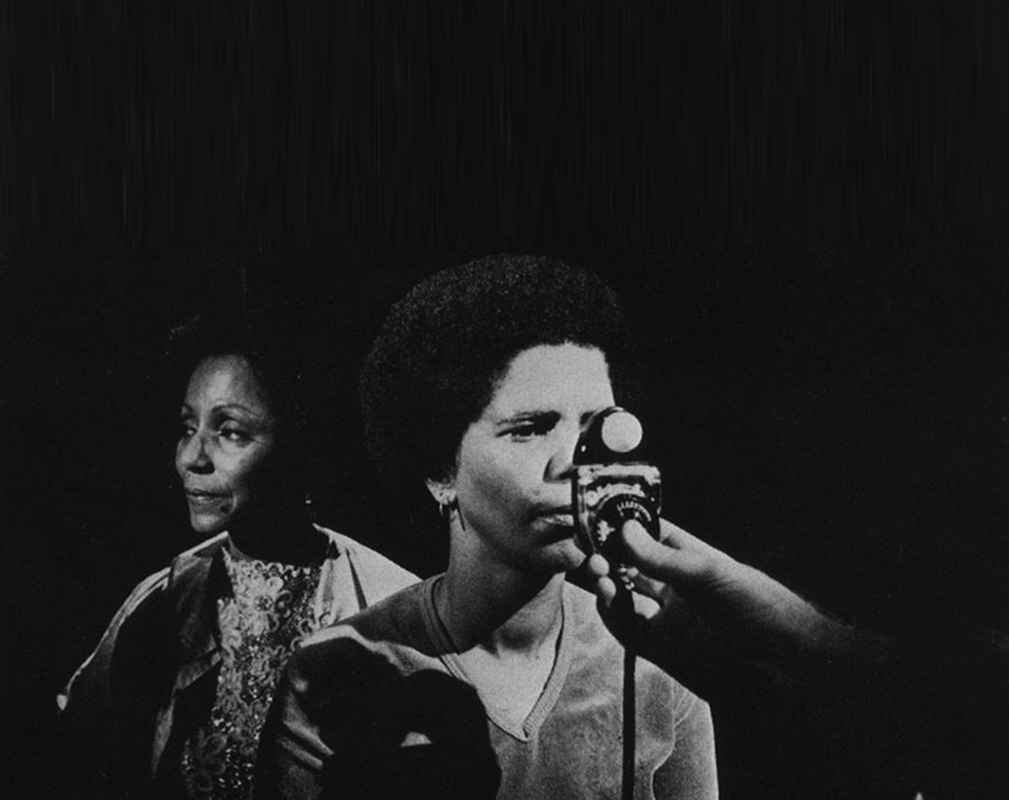
Suzanne, Suzanne
Camille Billops & James Hatch, US, 1982, 16mm, b&w, 30′
After studying sculpture on the west coast, Camille Billops moved to New York, where she earned a master’s of fine arts degree from the City College in 1973. Together with her husband James Hatch, she subsequently founded the Hatch-Billops Collection, an extensive archive of African American cultural history. They began their career in filmmaking in the early 1980s with Suzanne, Suzanne, the first in a series of films dealing with Billops’s family. The film profiles her niece, Suzanne Browning, as she struggles to come to terms with the legacy of her abusive, now-deceased father, and her escape into heroin addiction as a respite. Suzanne is compelled to understand her father’s violence and her mother’s passive complicity, who suffered at her husband’s hands as well, as the keys to her own selfdestruction. After years of silence, Suzanne and her mother are finally able to share their painful experiences with each other in an intensely moving moment of truth. Emotionally raw and wrenching, Camille Billops autobiographical approach has been described as “a means to a new black documentary style” (B. Ruby Rich, Sight & Sound).
“I’ve always liked Camille Billops’s films. Suzanne Suzanne is one of my favourite films, because more than any other films by independent black filmmakers, she really compels people to think about the contradictions and complexities that beset people. We’re not used to women artists of any race exerting that kind of relationship to art.” — Bell Hooks
English spoken, no subtitles. Copy courtesy of The New York Public Library and Third World Newsreel.