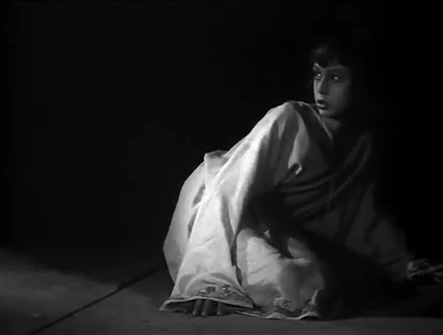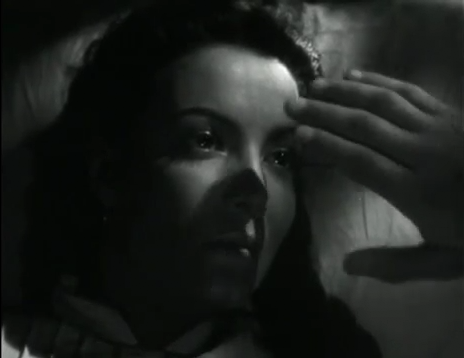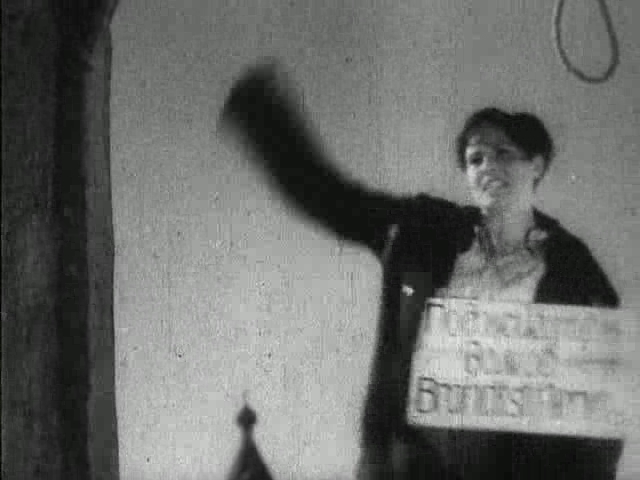
The Red of La Chinoise

chinoise2.jpg

By Jacques Rancière

Originally published as ‘Le rouge de la Chinoise’, Trafic n° 18, spring 1996. English version appeared in ‘Film Fables’ (Berg Publishers, 2006). Translated by Emiliano Battista.

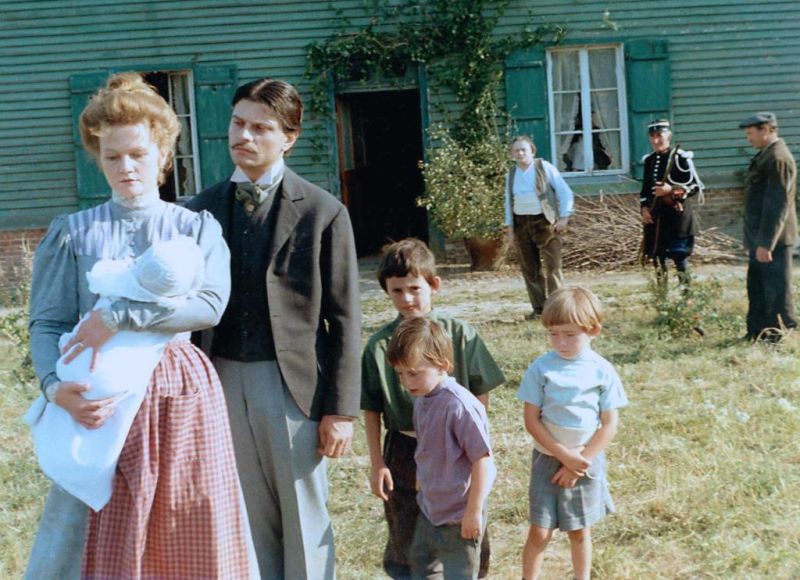
How should we understand the politics Godard puts into play with his cinematographic practice in La Chinoise? The opinions on the matter have more or less followed the fluxes and refluxes of the left. Accused when first released of being just a caricature, and not a serious representation, of real militant Maoists, the film was later praised as a brilliant anticipation of the events of May 1968, and as a lucid look both at the passing infatuation with Maoism by bourgeois youngsters and at the outcomes of that infatuation: the return to order and terrorism. The question of whether or not the film or its characters are actually good Marxists is not only not interesting, but also misguided, since we’re bound to get nowhere with such relationships of subordination: it is the coordination that we must look at instead. Godard doesn’t film “Marxists” or things whose meaning would be Marxism. He makes cinema with Marxism. “A film in the making,” he says, and we must understand this in many ways. La Chinoise invites us onto the set, it makes us feel like were watching the shooting of the film. And it also makes us feel like we’re watching Marxism, a certain Marxism anyway, in the process of making itself into cinema, of play-acting. As we watch this play-acting in La Chinoise, we see also what mise-en-scéne means in the cinema. It is the intertwining of these two that we must look at more closely.

We might start with the following formulation: Godard puts “cinema” between two Marxisms — Marxism as the matter of representation, and Marxism as the principle of representation. The Marxism represented is a certain Marxism, Chinese Maoism as it figured in the Western imaginary at the time, which the film represents from the angle that renders the stereotypes of its rhetoric and gestures complicit with Godard’s method of the object lesson and classroom exercises.(1) Maoism here is a catalogue of images, a panoply of objects, a repertoire of phrases, a program of actions: courses, recitals, slogans, gym exercises. The montage of all these elements brings into play another complicity. The method of the “object lesson” happens to align perfectly with the specific Marxism that serves as the principle of representation, namely Althusserian Marxism, which, in 1967, was essentially a doctrine that held that Marxism for the most part still had to be invented, and that inventing it was like relearning the sense of the most elementary actions. Godard, as is his wont, treats Althusser in bits and pieces that he takes, for the most part, from prefaces and conclusions. He composes with these bits and pieces the speech of the militant Omar and the peroration of the actor Guillaume. And he is likely to have read this sentence, which could well sum up his whole method as a filmmaker in the preface to Reading Capital: “I venture to suggest that our age threatens one day to appear in the history of human culture as marked by the most dramatic and difficult trial of all, the discovery and training in the meaning of the ‘simplest’ acts of existence: seeing, listening, speaking, reading — the acts which relate men to their works, and to those works thrown in their faces, the ‘absences of work.'”(2)

Althusser’s project of knowing what “seeing, listening, speaking, reading” mean is exactly what Godard puts into play in La Chinoise. At the center of the film there are two red objects, the Little Red Book and the Cahiers marxists-leninists: linked by their color, these two objects stand in a relationship of solidarity and contradiction. The Little Red Book compiles the detached maxims that all those who took part in the Cultural Revolution either learned by heart or simply brandished as rallying calls. The Cahiers marxistes-leninistes is the Marxist journal of the students of the Ecole Normale Supérieure, the sophisticated militant journal that lends to the chosen bits and pieces learned by the Red Godard their theoretical foundation as well as their practical acceptability. This journal transforms the Althusserian project of relearning to see, speak, and read into Maoist rhetoric and gestures. Godard’s method is to split up the terms of this operation, to break up the evidence, by making Althusserian pedagogy the principle for the mise-en-scène of Maoist rhetoric and gestures. The film, then, is about learning to see, hear, speak, or read these phrases from the Little Red Book or from the Pékin Information. But it is also about learning to read with them, as if these phrases were just another example, and in essence no different from the stories and examples that illustrate the workbooks pupils use when learning to read and write in elementary school. La Chinoise is an exercise on Marxism with Marxism as much as it is an exercise on film with film.

“To give vague ideas a clear image.” To understand the formula that is like an epigraph for the film, we have to feel that the tension weighing down on the relationship between word and image is strictly parallel to the tension that fueled — in the China of the time and in the Western Maoist imaginary — the fight between two conceptions of the dialectic. “One is split in two,” the formula reclaimed by Maoists; “two are joined in one,” the formula stigmatized as “revisionist.” The strength of the film is that it brings together cinema and Marxism by treating those two formulas as two different conceptions of art in general, and hence also of Marxist cinema.

What does a Marxist film, a film that proposes Marxism as the meaning of the fiction it puts on the screen, ordinarily do? How do the waves of progressive fictions that nourished on the heels of La Chinoise work? Basically through a mixture of beautiful images and painful speeches, of fictional affects and realist references, that when combined compose a symphony on which Marxism imposes itself as the theme or melody necessarily being sought by the mass orchestration. As such, these films remain tied to the everyday functioning of communication. They join two in one in the image of the everyday chassé croisé of words and images. Words make images. They make us see. A sentence quasi-visible that never attains the clarity of the image. Images, in their turn, constitute a discourse. We hear in them a quasi-language not subject to the rules of speech. The problem, however, is that when we “see” a word, we no longer hear it. And likewise with the image: when we hear it, we no longer see it. This is the dialectic of the “two in one” instituted by the principle of reality.(3) It is identical in every way to the rhetorical-poetical principle of the metaphor. The metaphor, more than a means of making an abstract idea concrete by linking it to an image, is this chassé croisé of words that hide by becoming visible and of images made invisible by becoming audible. One quasi entails the other. One refers to the other, lasts only as long as is needed to do the others work and to link its powers of disappearance to that of the other. The result is this melodic line that is like the music of the world.

We might call this, after one of the episodes of the film, the bowl-and-toast principle. Look at Henri drink his café au lait and butter his toast in front of his water heater as he itemizes all his reasons for going back to the Communist Party. The realistic weight of his words is entirely dependent upon these accessories. Had he delivered it with a blackboard behind him and a professor’s desk before him in the apartment of his old comrades, the same speech would lose 80 per cent of the force and conviction it receives from the “popular” gestus of this “popular” kitchen, which changes even the connotation of his student cap: here it is the cap of the son of the prole and not the cap of the student who plays at being a prole. The interview of the maid Yvonne is another demonstration of the same genre. The speech in which this daughter of the people evokes the hardships of growing up in the country immediately generates an image. No need, then, to show us the countryside, we see it in her words. It would be clumsy to show it, even perverse. And Godard’s perversity is to insert at this point not the quintessential countryside Yvonne’s words make visible, but a silly countryside that he sums up in two images: chickens in front of the wall of a farmhouse, and cows in a field of apple trees. The common work of art and politics is to interrupt this parading, this incessant substitution of words that make us see and of images that speak which imposes belief as the music of the world. The point is to split in two the One of representative magma: to separate words and images, to get words to be heard in their strangeness and images to be seen in their silliness.

There are two possible ways of achieving this dissociation. Jean-Pierre Léaud announces the first one in the film: would that we were blind, he says, then we would really listen to each other, really understand each other. This dream of seizing the radical experience of hearing or seeing at its origins invariably takes us back to the experiences that made these two senses so dear to the eighteenth century. Diderot’s Letter on the Blind and Letter on the Deaf and Dumb are never very far from Godard, nor is Rousseau’s Discourse on the Origin of Language, At its limits, the method of the “object lesson” always tends towards two renowned Utopias, the tabula rasa and fictional Robinsonades. Godard leaves it to Henri, the “revisionist,” to wax ironic about these fictive experiences by recalling the story of Psammetichos, King of Egypt, who tried to discover the original language of humankind by raising two of his children in complete isolation. When he heard them speak, they spoke in the only “language” they were able to learn, that of the sheep whose pen adjoined their retreat. The Robinsonade is how the characters express the experimental situation Godard puts them in. But the principle of the mise-en-scène is different. If Godard really wants us to hear the words — and Marxism, like any theory, is first and foremost an assemblage of words — and see the reality they describe and project — and reality is, first and foremost, an assemblage of images — he cannot treat them separately. He must reorganize their liaison, which doesn’t mean separating the words of Marxism from every image in order to make us hear them, but the reverse: Godard must really make us see them, he must replace their obscure image-making with a brute image of what they say. He has to put these words in bodies that treat them as the most basic utterances, bodies that try to speak them in various ways as well as to turn them into gestures.

Godard then sets about elaborating an apparatus of separation that makes words audible by making them visible. Here is where Godard gives cinematographic meaning to this representation, at first attacked and then praised for its lucidity, of “petit bourgeois youngsters cut off from the masses and talking non-stop in the isolation of their bourgeois apartment.” Godard is fond of the method of enclosing his characters within the four white walls of an apartment where they struggle to put meat on the bones of a few great ideas. The “Althusserianism” of La Chinoise is its actualization of Althusser’s Diderot-inspired practices. The difference is that in the film the “political” principle of isolation is the condition for the artistic understanding of what a political discourse says. The task of art is to separate, to transform the continuum of image-meaning into a series of fragments, postcards, lessons. The bourgeois apartment is the frame of representation wherein Godard arranges the necessary and sufficient elements for the mise-en-scène of the question: what does Marxism, this Marxism, say? How does it speak? How does it turn itself into film? In the pictorial and theatrical frame, words and images can be rearranged in order to undo the metaphorical play that makes sense of reality by transforming images into quasi-words and words into quasi-images.

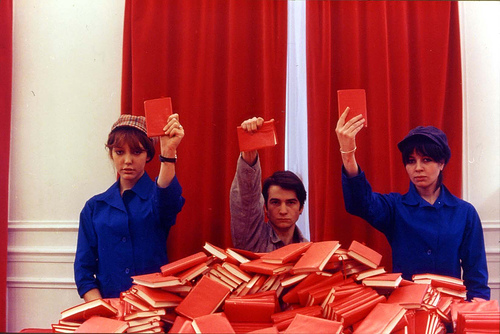
There are two major forms of representation that work against the metaphor. The first is surrealism, which essentially literalizes the metaphor. Logicians have been pointing out since antiquity that when we utter the word “chariot,” no such vehicle issues from our mouths. As a general rule, though, these same logicians have paid less attention to the fact that though the chariot doesn’t issue from our mouths, it doesn’t for all that fail to dance confusedly before the eyes of our interlocutors. Surrealists then represent the chariot issuing from the mouth. Magritte’s paintings are the best illustration of this pictorial method, which, in literature, is at the root of Lewis Carroll’s nonsense, though it had already served other masters before him, such as Rabelais and Sterne. Godard rarely does without it. He makes his use of it explicit in the scene of Jean-Pierre Léaud throwing rubber-tipped darts at images of the representatives of bourgeois culture as an illustration of the idea that Marxism is the arrow trained on the target of the class enemy. And he uses it directly, as in the scene where Juliet Berto illustrates the idea that the Little Red Book is the rampart of the masses against imperialism by standing in front of a wall of red books, or when she visualizes the principle that Mao’s thought is the weapon of these same masses by turning the radio that broadcasts Mao’s thought through the voice of Radio-Peking into a submachine gun.

The surrealist method is itself subordinate to the dialectical method, which replaces the figure of the metaphor with the figure of comparison. Comparison dissociates what the metaphor joins. Instead of telling us, as the slogans of the period did, that Mao’s thought is our red sun, comparison makes us see and hear this thought next to the sun. Comparison foils the metaphor’s power to join together: it gets us to hear words and see images in their dissociation, though not via some sort of Utopian separation, but by keeping them together in their problematic relationship in one and the same frame. It then becomes a matter of showing this: the revolutionary struggle might resemble such an image; a group “armed with the thought of Mao Tse Tung” might resemble the arrangement of such a sequence of discourses and gestures. To interpret Maoist discourse — to understand what it tells us — we must try to perform [interpréter] it — to represent it — this way.(4) We have to help ourselves to the bodies of actors, to a set, and to all the elements of representation in order to figure out how to perform/interpret these words, how to make them audible by making them visible.

Godard structures all of this with his remarkable use of color in the film. He distributes on the white background of a canvas or projection screen three pure colors that he never allows to intermix: red, blue, and yellow. These three colors are first of all emblematic of the objects represented: the red of Mao’s flag and thought, the blue uniforms of Chinese workers, the yellow of the race. And they are also the three primary colors, the three straightforward colors that oppose the gradation, nuances, and confusion of “reality,” that is to say, of the metaphor. They function as the table of categories that Deleuze claims Godard is always creating. The “simple things” to be relearned are determined and reflected in the categorical grid formed by these pure colors. This use of color, even though a constant in Godard, is at its most powerful when the issue at hand is one of color, like the red-white-blue Godard had already used to structure the political fable Made in USA. La Chinoise, a film about red as the color of a line of thought, is entirely structured by this chromatic apparatus, which structures not only what goes on between the white walls of the apartment, but also the relationship between inside and outside. The outside is the real, the referent of their discourses. It is the green countryside inserted into Juliet Berto’s speech. It is the vacant suburban lots and the University of Nanterre barely visible beyond them that Godard uses, once he has them rendered equivalent with a panoramic shot, to illustrate Juliet Berto’s speech, to show what her speech about the three inequalities and about the worker-student link looks like. Finally, the real is the alternating scenery of countryside landscape and suburban houses that flies by behind the window of the train where Anne Wiazemsky talks to Francis Jeanson, and that strengthens with its discreet evidence Jeanson’s words by showing this rural France, grassy and punctuated by homes, so utterly foreign to the discourse of the aspiring terrorist.

Godard was accused of giving the upper hand to the “realist” discourse of Francis Jeanson, the once upon a time assistant to the FLN,(5) over the discourse of the student extremist who fidgets nervously with the handle on the train window. But Godard doesn’t take sides. All he does is place the tension of the two discourses in the tension of the visual sets. He puts in question the evidence provided by the rural France that speaks through Jeanson’s mouth by accentuating in him, to the point of caricature, the habitus of the professor who’s having a little fun at the student’s expense: “Yes, but”, “And then?”, “So?”, “What do you conclude from that?,” “Ah, I see,” “And you’re the one who’ll do all that?” But mainly, it is the pure colors and forms of the closed off apartment that filter the play of reality and keep it from appearing in a good light. Time and time again, these pure colors and forms refer reality to its mixed character, this mixture of mutually dissembling colors and metaphors that ignites, on the other side of the train window, the reality that proves itself in the perennial referral of its mixed tones—a testament to the infinite complexity of the real —to their dominant tonality: green, the color of life in its essential originality, color of the countryside and authenticity. Green is the mixed color that passes itself off for a primary color. It is also, by convention, the anti-red: green for go, red for stop, the color of the market and not the color of communism. “Green prices, since the Reds have seen their day,” ran an ad in the 1990s where debunked Red heroes urged everyone not to miss the bargain prices at FNAC.(6) La Chinoise is certainly a film from the red epoch, the epoch of straightforward colors and simple ideas. Not simplistic ideas, but the idea of trying to see what simple ideas look like. The green epoch is the epoch of the mixed colors of reality — supposedly recalcitrant to ideas — that ultimately lead to the green monochrome of life, which is, we’re told, simple and to be savored in its simplicity.

Inside the frame structured by the three primary colors, Godard organizes the mise-en-scène of the different modes of discourse within which the Maoist text can be spoken. There are three such modes: the interview, the lecture, and the theater. Godard’s task is to examine and modify the value of truth and illusion normally accorded to each of these three modes. As a general rule, the lecture is thought to portray the situation of authority commanded by big words divorced from reality. The apparatus of the lecture — table, blackboard, and lecturer standing in front of an audience seated on the floor and answering their questions — seems to accentuate the image of the authority wielded by big words. The interview, on the other hand, is generally thought to sound the voice of the real with the small and slightly awkward words that anyone at all — preferably a woman — uses to describe the personal experiences that have led her to entrust her life to these big words. The image can occasionally lend a supplementary authenticity to all of this. The big eyes and pursed lips of Yvonne, the daughter of the people who seems startled by what she dares to say; the bowl-and-toast of Henri, the realist who knows what he’s talking about; the vacant lots that authenticate Véroniqu’ s discourse. The authenticity increases when the voice of the interviewer is muted or annulled in order to transform the solicited response i into a gush of spontaneity. The mise-en-scène calls this truth hierarchy into question. The insertion of a stupid shot, the voice of the interviewer that we hear without being able to make out the words, the performances of the naive and the canny, these are all ways in which the mist-en-scene invites us to see — and hence to hear — that the regime of “authentic” speech is, just like the lecture, the regime of an already-said, of a recited text. It is how the mise-en-scène invites us to ask ourselves, instead, if the situation of authenticity isn’t actually just like that of the blackboard on which one ventures to write down sentences to be able to look at them and see what they’re saying, or like the position of authority held by the amateur professor, who ventures to let these sentences escape his mouth and to hear their echo.

Beyond the professor and the interviewee is a third character, the actor, who takes their two performances back to their common origin, the art of acting. In the confrontation with the student Véronique, it isn’t the professor and politician Francis who has the last word, but Guillaume, the actor thus named as a tribute to his ancestor, Goethe’s Wilhelm Meister. If Jean-Pierre Léaud’s words evoke the Letter on the Blind, it is certainly a new version of the Paradox of the Actor that he illustrates in the famous demonstration he mimes: a Chinese student covered in bandages has come to show the wounds inflicted upon him by “revisionist” policemen, but what he shows us, as he removes the last bandage, is a face free of any wounds. The political militant and the actor are alike: their work is to show us not visible horrors, but what cannot be seen. The actor becomes, in the same gesture, the elementary school teacher who returns the speeches and gestures of the nave interviewee and of the learned professor to their first elements.

The actor teaches the militant that it is possible to understand a text by lending one s voice and body to it, just as he teaches all of them how to spell out words and to vocalize and visualize ideas. That’s what Jean-Pierre Léaud’s work illustrates when he shouts, as a warrant officer would, the “Why?” that is always falsely inquisitive in the professor, or when he mimes the meaning of what he says by changing tones, “we need sincerity … AND VIOLENCE.” Spelling out the sentences of the Little Red Book and scanning them with physical exercises, this is to study stereotypes with stereotypy. It doesn’t make a chariot issue from the mouth, but at least it makes it weigh on the tongue.

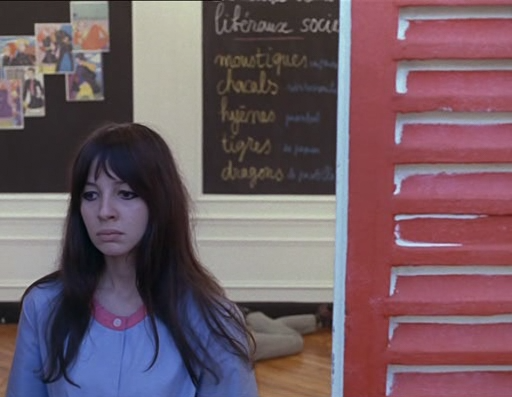
When the nave country girl asks the amateur professor “What is an analysis?,” it is the actor who answers, who shows her in the strictest sense what an analysis is. He decomposes the assembly of gestures and images and returns them to their basic elements. The universality of his art is that it establishes the most basic elements, and assemblies thereof, that make a discourse and a practice intelligible by making them comparable to other discourses and practices, by, for instance, making a political discourse and union comparable to a declaration of love and a love affair. This is what we see in the opening shots of the film, which show the fragmented speeches and intertwining hands of Jean-Pierre Léaud, who still seems to be acting in Masculine Feminine, and Anne Wiazemsky, who’s still speaking the Bresson of Au hasard Balthazar. It is what Wiazemsky teaches Léaud when she makes the utterances “Do you love me?” and “No, I don’t love you anymore” as problematic as political utterances. If we prefer a visual over a dialectical demonstration, there is one in that superb shot of Yvonne, her posture straight out of a maid in Manet, looking out the window in the scene when Henri is being expelled: the image renders her scansion of the word “re-vi-sio-nist” identical to the scansion of “I-don’t-love-you-anymore.”
yvonne.png

Godard shows us what the words and gestures of politics looks like by translating them into the attitudes of being in and out of love. His translation isolates the simple elements of a political speech that resurface not only in the lover’s discourse, but also in the glib tongue of the street vendor peddling his wares and in the smooth talking of the market vendor. The final episodes of the film are not an illustration of moral relativism, of the equivalence of all things: the militant’s speech as he lays out his copies of the Little Red Book the same as the street vendor selling his heads of lettuce. We would do better to recall the Brecht who conceived the episodes of Jungle of Cities as the rounds of a boxing match. Like Brecht’s variations, the film brings to light all those elements in the job of the actor that are also present in every meaningful action and effective speech. Godard inverts the logic of Wilhelm Meister, a book he is always reading and rereading Goethe’s hero starts in love with the theater and ends by finding certainty in collective knowledge. Godard’s hero moves in the opposite direction and leads collective knowledge back to the elements of the art of the theater. Politics resembles art in one essential point. Like art, politics also cuts into that great metaphor where words and images are continuously sliding in and put of each other to produce the sensory evidence of a world in order. And, like art, it constructs novel combinations of words and actions, it shows words borne by bodies in movement to make them audible, to produce another articulation of the visible and the sayable.
theatre-annee-zero.png

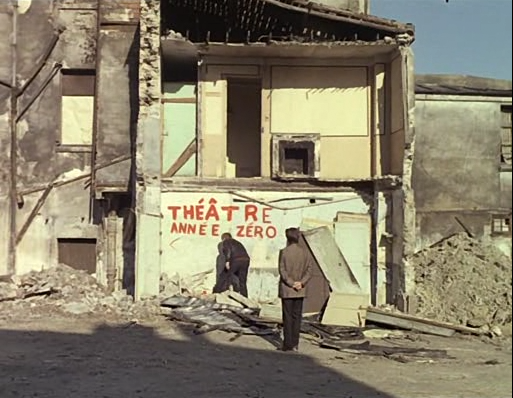
Theater Year Zero is the title Godard gives to the theatrical adventures of Guillaume Meister, and his allusion to Rossellini’s Germany Year Zero is nominal as well as visual. Jean-Pierre Léaud roams the same ruined landscape and ventures into underground spaces similar to those visited by the young Edmund, though not to experience there the law of a world in ruins, but to relearn the meaning of the three blows of the theater. Rossellini wanted his title to evoke a world that had been wiped out and to serve as an epitaph to a child victimized by a murderous ideology. Godard’s subtitle, in turn, speaks about what Rossellini’s film shows: a kid playing hopscotch against the backdrop of a world in ruins. Ultimately, the moral of the film emerges from the opposition between the actor Guillaume and the terrorist Véronique: there is no zero situation, no world in ruins or to be ruined. There is only a curtain that rises and a child, an actor who plays with so much lightness the role of a child whose shoulders have to bear the double weight of a devastated world and of a world about to be born. Anyone determined to think the separation between the games of the child actor and the wanderings that end with the death of the child in the fiction, or between theatrical work and revolutionary work, must also think their community. That is what we see in this cinema between two Marxisms that concludes as a meditation on the theater.

——————————————————————————————————————————————————————-

translator’s notes
(1) “Leçons des choses” and “travaux practiques” are indissociable pedagogical methods that started being used in French schools towards the end of the nineteenth century. The basic idea is to organize exercises where the students learn, literally, from things. I render the first term by “object lesson” and the second by “classroom exercises or simply by “exercises.”
(2) Louis Althusser and Etienne Balibar, Reading Capital, trans. Ben Brewster (London: NLB, 1970) 15-6.
(3) Not Freud’s reality principle! The principle of reality is the principle of the metaphor, as Rancière indicates in the next sentence.
(4) Rancière is playing on the word “interpréter,” which means to interpret, and also to act out, perform (“interprète” being one of the words for actor in French).
(5) The Front de Libération Nationale, or National Liberation Front, the ruling party of Algeria through the battle of independence to today.
(6) FNAC is a French (now European) chain of megastores selling books, CDs, DVDs, cameras, computers, and so on. The closest equivalent in the Anglophone world might be Borders or Barnes & Noble.
Arithmetics of the people

operai.png

By Jacques Rancière

Originally published as ‘Arithmétiques du peuple (Rohmer, Godard, Straub)’, Trafic, n° 42, Summer 2002.

1. Multiplication

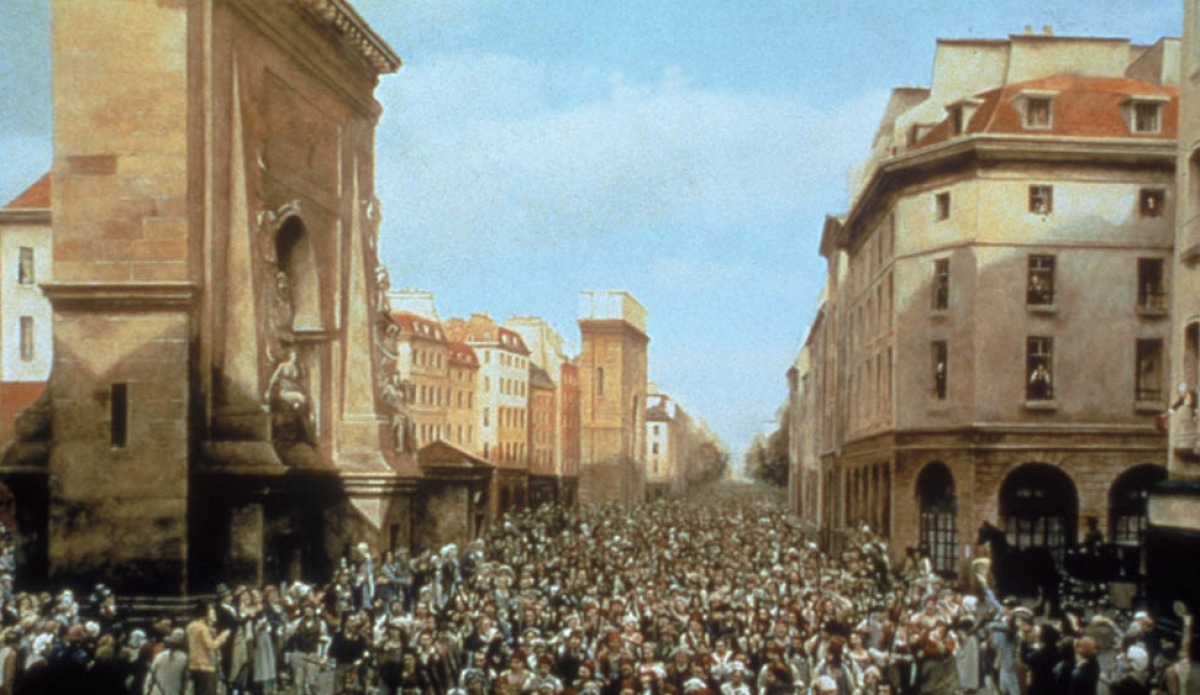
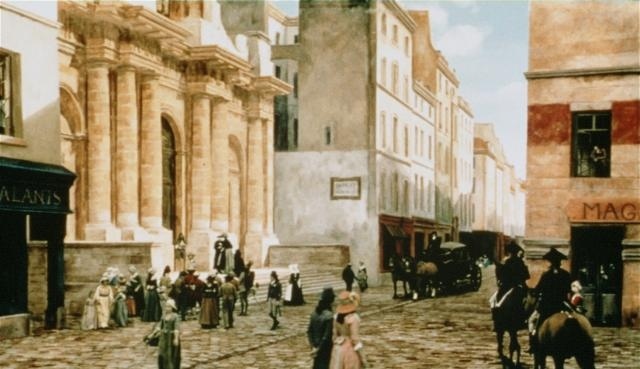
An aquarelle with delicate tones: noble facades, clear perspectives, only populated with some small time characters establishing the scale and animating the decor. Here abides Grace Elliot, the beautiful Englishwoman, but also and foremost the illustrious sweetness of living we always tend to ignore, since we haven’t lived before the Revolution. A lot of effort has been made to herald L’Anglaise et le Duc as an account of a political thinking, opposing the good Revolution – monarchic, liberal and enlightened: in short, the Revolution without revolution – with the bad one – revolutionary, Jacobin and terrorist. It doesn’t seem like Rohmer has spent a lot of energy defending this pious way of thinking, nor has he credited his heroin with an elaborated political vision. Leaving aside the classical opposition of the feminine law of the heart with the tortuous calculation of masculine reason, the politics of his film is completely visual: a catastrophe of a decor. It finds itself invaded with a multiplicity of people who are evidently not in their place there. It’s the definition itself of the people: those multiplying without any reason and proliferating where there is nothing to do. Old problem, comparable to those which fascinated Marx: what to do with all those people who are redundant in the light of what is required for housing service? If the theoretical response presents all sorts of difficulties, the visual response is well known: those who are redundant generally don’t look good and willingly elude their idleness by showing off heads on spikes. Of course these redundant hordes fatally end up surging back to the houses and pulling out the owners to detain them within reach of their drunken breaths and lecherous desires. Rohmer has been praised for courageously overturning the dominant opinion on the Revolution. In reality the boldness is quite limited: already some time ago Tocqueville, Augustin Cochin and Furet have taken the place of Mathiez and Soboul in the dominant opinion*. What is telling is rather the way in which Rohmer puts iconography in agreement with the opinion: the complex and contradictory popular figures, affected by the post ’68 era, are supplanted by a blunt return to the stereotypes of the huge popular animal: boorish, bawling and lecherous. Rohmer has also been praised for presenting Robespierre in a favorable light: after all, he releases the Englishwoman after being victim of obtuse informers. But “the Incorruptible” only lends his face to a repetitive episode: each time the plebs and its representatives threaten the Englishwoman, she is saved through the intervention of a man who has good manners and knows how to impose them on the brute plebs. All the visual politics of the film is there: in the evidence that educated people and good manners always go hand in hand, that the only crime, the unforgivable crime, is opening the gates for the furious surge of the multiple.

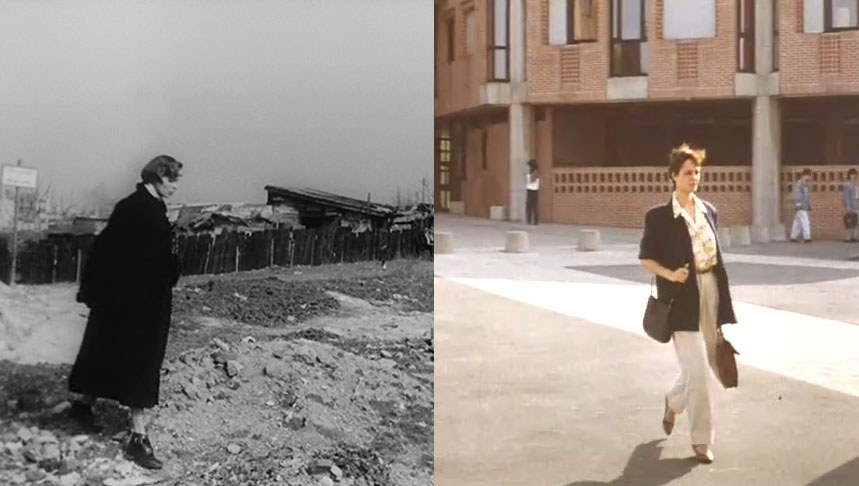
The maxim is not new. What is, by contrast, is the artistic and technical solution to the problem. For those people invading the beautiful tableaux, the technique offers a solution to discipline and finally dissolve them. The strings restricting them in the studio allows for their digitized image to be embedded flawlessly in the painted decor. For those who, two centuries ago, deviously wallowed in the decors of elegant life, the digital technique offers a a way to put them back in their place, to animate or delete their image at will. Of course this doesn’t work without some kind of retraction in regards to the idea of cinematographic modernity itself. The studio voyages of the beautiful Englishwoman between the hotel and her painted land house, like her devotion for the insignificant Champcenetz, close off the era of the camera in the streets, exemplified by the suburban voyage of another “foreigner”: the wanderings of Ingrid Bergman / Irène in Europa 51 at the end of the bus line, in the land of factories, lumpen-proletariat and prostitutes. This voyage in reverse was already imagined in the first shot of Conte de printemps, where we see the heroine cunningly leaving her school in the northern banlieu. But the voyage in reverse here is not only fictional. It is profoundly esthetic. L’Anglaise et le Duc marks, rather than the farewell to a Revolution that has never been Rohmer’s affair, a farewell to Rossellini, to a certain idea of cinematographic modernity associated with the liberty of the wandering camera and the truth of bodies in their place.

europa-conte.jpg

2. Substraction

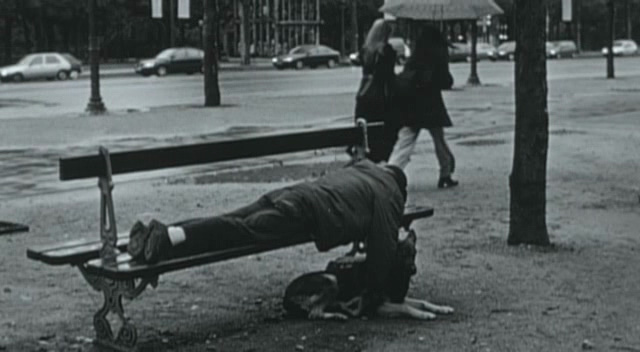
Godard, he remains loyal to the streets. It could even be said that he returns to them in Eloge de l’amour, leaving the shores of Lac Léman for the streets of Paris, even returning to the cinematographic color of the streets, for him and his characters to dwell in: the black and white of A bout de souffle and Bande à part, of Roma, città aperta and Europa 51. For him, in contrast to Rohmer, the streets cannot present any threat. What the streets allow to encounter, except for the homeless tramps one stumbles upon or the fugitive silhouettes evoking Balzac, is utterly the absence of the people. It is well known, they are always further away, just like the heroin in the film – the only actress suitable for the film, the tainted love who disappears, leaving only a book in a bag behind. Like her, it is in vain that we look for them there, beyond the city gates, on those dead end tracks where the legion of the damned cleans the trains at night, at a time when footsteps resonate in the deserted canteens. This is also the lesson of the long shots on the island of Seguin*, in front of which linger the maker of the film that won’t be made and the actress that won’t be in it. It was here that in 1968 students came to fraternize with the workers who had taken refuge in their fortress. Today the fortress is empty, its people parodied by a group of gardeners, carrying spades and rakes by way of sickles and hammers, metonymized by the passage of a barge on the river and the music of a song from L’Atalante*. The music is faded, the gardeners are disabled, and the empty fortress gives way to a night asylum where misery without a face seeks shelter, where a bewildered old Jew is gently rinsed under a shower, leaving the spectator free to bring to mind other “shower rooms”, in the same way other trains might come to mind when seeing the ones coming solemnly to a halt on the end tracks.

The people is missing. You don’t need Klee or Deleuze to know. It goes back even further, to the times of Marx who, in The Holy Family, dismissed the people of Eugène Sue* – that is to say, antecedently, the people of Rohmer. It was Marx who made the people with unspeakable features into a name without a face. The people is what is not there yet, not in the right place, never ascribable to the place and time where anxieties and dreams await. This is what the good marxist Francis Jeanson already tried to convey, on the dawn of ’68, to the little brainless “Chinoise” during a train ride in the outskirts of Paris*. There is no reason to despair for that matter. It is this absence that gives way to the power of phrases and the charm of refrains – their equivocation in itself: the small melody of the absent people brings us fluently from the song of L’Atalante to the Testament written by the convict Brasillach in imitation of Villon*, and of which the accents here call to mind Léo Ferré singing Aragon*. It is also this absence dismantling fictions. History withholds histories, Godard doesn’t stop telling us, taking here as witness a forgotten and confiscated Resistance. And what else is History but the linking of master signifiers? The bemoaning is in fact the flip-side of a complicity. The melancholic only lives off the substraction he denounces. The default of presence, the rupture of History, the lack of bodies of the people, all this is necessary for the beauty of the gesture, of the image, of the phrase opening and never finishing the praise of love. If History is worn out, if the people is not there, fiction won’t be there either – this collection of obscene images and phrases that always lie.

3. Division

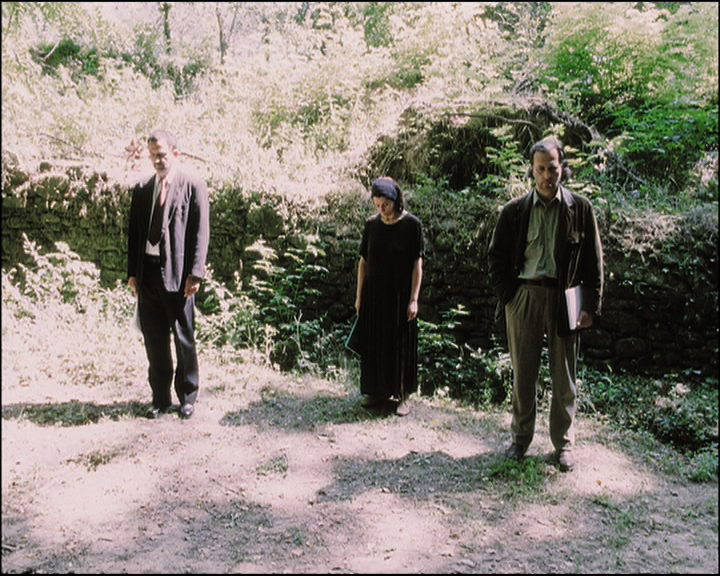
This melancholy of art has no merit for the Straubs. Yet for them too the people are made out of words and phrases. But phrases are not the beings without bodies that every mouth in Godard’s work can claim – and more often than not a mouth that is absent. Here phrases are rather propositions that are always verifiable, always conveyed by bodies that are accountable. “Workers, peasants, we are…”: the “subject” of Operai, Contadini is offered by the words opening the last verse of the Internationale. But the subjects that these words appoint are there, embodied. Which doesn’t mean that the habitus of the characters authenticates them. Even if the countrywoman wears a scarf, the chief a leather jacket and the doctor a suit, no truth of the words is produced by these accessories. The insistence with which we are shown these notebooks decorated with colored signs and these eyes mostly lowered in order to read them, at other times raised, as if to defy those accusing the word of lying, amply demonstrates it: the truth of words stems entirely from the text and the way in which the readers account for it. The people is what is spoken by bodies taking its part. And, of course, everything plays out in the specificity of this embodiment. One words resumes this: division. This is the specific idea of the people that Jean-Marie Straub and Danièle Huilet have retained from the times of Mao and Brecht. The people is not simply the subject abiding the ordeal of division in the difficulty of struggle (the “contradictions among the people”). It is the subject defined by division, proven by it. The people is what divides itself, standing together and asserting itself in its division.

The narrative of the argument is seemingly not original. Peasant’s respect for the earth, the seasons and the rhythms of the body, against worker’s fever for cement, electricity and exploit. The rigor of the chiefs, in charge of tomorrow, against the complaisance of individuals with everyday needs and grieves. Women’s irony towards the childish desire of men to find in them a mirror to attest to their bravery. It has been repeatedly told in chronicles and invested in bodies in fictions. Surely Vittorini’s prose already gives the chronicle of the divided people a dimension of Hölderin-like drama. Remains the straubian singularity stemming from the dispositive of talking bodies, ensuring embodiment to the detriment of fiction. The four groups of talking bodies are here at the same time the Brechtian craftsmen of a dialectical explication and the Virgilian witnesses of an idyll: the struggle of the worker’s fire and the peasant’s earth, epitomized at length, is resolved in the flame crackling with laurels, cooking the ricotta to be shared fraternally. The dialectical war is transformed – like in Vittorini’s work and, of course also in Pavese’s Dialoghi con Leucò – in a mythological mise-en-scène of conflicting forces. The mythologization of dialectics usually brings about some pessimist gap where the earth figures the inviolable withdrawal of nocturnal forces, of which the resistance forfeits the Promethean fire to futile smoke or devastating flame. Already Dalla Nube alla Resistenza had a tendency to inverse the Pavesian movement from history to myth. Here the rigor of dialectics and the melancholy of myth is resolved en oratorio, affirming the salvation by the division of voices. The commune of workers-peasants does not end due to its empirical failure, but is rather suspended in the evocation of an unitary incursion in search for laurels. Earth and fire are reconciled in light air. The final movement of the camera on the wooded hills, even though it doesn’t show us laurels, leaves us in the overture of reconciled elements and available horizon. This is the lesson proposed by the filmmakers: nothing has changed of what the words say, as long as the bodies stand at their service. The readjusted look, as if defying the officer or the judge demanding accountability from those bodies speaking of their illusions, gains the confidence once put into words by Mallarmé: “we were two, so my mind declares”*

——————————————————————————————————————————————————————-
Translated by Stoffel Debuysere (Please contact me if you can improve the translation).

In the context of the research project “Figures of Dissent (Cinema of Politics, Politics of Cinema)”
KASK / School of Arts

translator’s notes
* The “revisionism” of the likes of François Furet and his antecessors Alexis de Tocqueville and Augustin Cochin, breaking with the “committed” tradition of Albert Mathiez and Albert Soboul, boils down to the dismissal of the revolutionary significance of 1789, instead presenting it as a series of historical facts. This trend has been confronted head on by Rancière, Badiou and others.
* The Renault motor car factory in Paris, at Boulogne-Billancourt on the island of Seguin, about 3 km downstream from the Eiffel Tower, was an icon of 20th century manufacturing industry in Europe. The factory became a symbol of the working class movement in France. It was occupied in 1936 by workers supporting the Popular Front, and was prominent in the agitations of 1968, when the philosopher Jean-Paul Sartre (1905-80) spoke to workers at the factory gates. It was completely closed down in 1992.
* The song in Jean Vigo’s L’Atalante (1934) is ‘Le Chaland qui passe’, which is the French version of the Italian song ‘Parlami d’amore Mariu’s, written by Vittorio de Sica for his 1932 film Gli Uomini, che Mascalzoni. Due to the success of the song, Vigo’s film would later also be released under the song’s title.
* Eugène Sue’s novel ‘Les Mystères de Paris’, a successful mixture of moralizing melodrama and social criticism, was first published in 1842–43. The book was mostly praised for drawing the attention of the prosperous classes to the misery which they tried to ignore, amongst others in a periodical called ‘Die Allgemeine Literaturzeitung’, founded by Bruno Bauer, a leading figure among the “Young Hegelians.” The reviews were written by a young man called Szeliga, who took Sue very seriously, and sought to give his views the sanction of the Hegelian philosophy. Marx and Engels’ ‘La sainte famille’, published in 1845, was intended as a general attack on the ideas of Bauer and Szeliga. Two long chapters of the book, written by Marx himself, are given over to a destructive analysis of the moral and social ideals recommended in ‘Les Mystères de Paris’.
* Leo Ferre chante Aragon (1961) was one of Ferré’s most popular albums. The songs were based on texts by Louis Aragon, poet, novelist, editor and a long-time member of the Communist Party. See here for the links between Aragon and Godard.
* According to Godard “the days of [Vichy propaganda minister and Milice member Phillipe] Henriot’s assassination (in 1944) and of the execution of Robert Brasillach, the right-wing critic and novelist and anti-Semitic, pro-Nazi propagandist (in 1945) were days of mourning in the Godard house.” Brasillach was also the author, with Maurice Bardèche, of the first Histoire du cinéma (1935), “the only one I ever read”, says Godard. It is no surprise then that he emerges in Histoire(s) du cinéma. Towards the end of part 1A ‘All the histories’ (1998 re-edit), Godard uses footage of a condemned prisoner being tied to a post, superimposing words taken from Aragon’s ‘The Lilacs and the Roses’. The sequence continues with images of a different execution, and words from a resistance poem by Paul Eluard; on the soundtrack is also a voice singing some lines from Brasillach’s ‘Testament d’un Homme Condamné’, which is inspired by the ‘Testament’ of another French poet, François Villon. Eloge de l’amour also features a reading of Brasillach’s “Testament”. For a discussion on this topic, see here.
* French philosopher Francis Jeanson, known for his involvement with National Liberation Front (FLN) militants during the Algerian War of Independence, has a part in Godard’s La Chinoise, in which he has a discussion with Anne Wiazemsky, playing a naive student extremist. See Rancière’s ‘The Red of La Chinoise.
* “Nous fumes deux, je le maintiens” is taken from Stéphane Mallarmé’s ‘Prose pour des Esseintes‘. See also Rancière’s Mallarmé: La politique de la sirène and Politique de la Literature. Alain Badiou wrote about this poem that “at issue is to establish an intelligible Place, a pure multiple, naturally one drawn and composed in the light”.

Prose
(For des Esseintes)

Hyperbole! can you not rise
from my memory triumph-crowned,
today a magic scrawl which lies
in a book that is iron-bound:

for by my science I instil
the hymn of spiritual hearts
in the work of my patient will,
atlases, herbals, sacred arts.

Sister, we strolled and set our faces
(we were two, so my mind declares)
toward various scenic places,
comparing your own charms with theirs.

The reign of confidence grows troubled
when, for no reason, it is stated
of this noon region, which our doubled
unconsciousness has penetrated,

that its site, soil of hundredfold
irises (was it real? how well
they know) bears no name that the gold
trumpet of Summertime can tell.

Yes, in an isle the air had charged
not with mere visions but with sight
every flower spread out enlarged
at no word that we could recite.

And so immense they were, that each
was usually garlanded
with a clear contour, and this breach
parted it from the garden bed.

(translation by E. H. and A. M. Blackmore)

The Filmmaker, the People and the Government

anglaise-et-le-duc.jpg

By Jacques Rancière

Originally published as ‘O cineasta, o povo e o governo‘ in Folha de São Paulo, August 2001. English version appeared in ‘Chronicles of consensual times’ (Continuum, 2010). Translated by Steve Corcoran.

Among the feature films of the Venice Film Festival is L’Anglaisse et le Duc, a period piece by Eric Rohmer, inspired by the memoir of an aristocratic Englishwoman living under the French revolution. Rumours have it that the Italian festival is thus paying tribute to a film that the French selectors of the Festival of Cannes allegedly rejected for reasons of political correctness. A scent of scandal and of repression never does any harm to a film but this time it calls for reflection. For what reason would it be compromising today to film Revolution in general and the French Revolution in particular from the viewpoint of aristocrats? For decades, French children have devoured – without any damage having been done to Republican and revolutionary values – the stories of the Mouron Rouge, a heroic English aristocrat who saves gentle nobles from the clutches of the ferocious popular brutes. And since the 1980s the theses of Francois Furet, largely inspired by the counter-revolutionary tradition, have dominated revolutionary historiography and intellectual opinion in France. One does not therefore see what considerations of political correctness would prevent the showing of bloodthirsty revolutionaries today. And one suspects that those who make Rohmer to be the artistic flag-bearers of a France that is finally confronting its revolutionary phantoms by simply using the classic trick of presenting the dominant vision of things as a minority viewpoint, a victim of persecution in a horrible ‘plot by intellectuals’.

But if there is a politics in this film, perhaps it plays out elsewhere than in these flag fights. Rohmer has never tried to pass himself off as a man of the left. And he maintains that he did not want to make a militant film. Indeed, the story of Grace Elliot’s adventures in the revolutionary torment is little concerned to judge the causes and effects of the Revolution. By way of doctrine, it presents only two commonplaces of political and historical fiction. The first contrasts moral and affective fidelity to the tortuous calculations of politics. In this way, the English Lady embodies the feminine and unthinking virtue of fidelity yo the persecuted Royal family, in the face of the masculine vice of calculating self-interest, represented by the Duke of Orleans, one of the King’s cousins and a man who is prepared to make any compromise to serve his own dynastic interests, including voting for the death of his cousin. The second commonplace opposes the good manners of evolved people to the eternal uncouthness of the bestial populace. Some used to counterpose the correctness of German officers to the sadism of the SS brutes. Similarly, Grace Elliot is continuously wrenched from the hands of the concupiscent and inebriated hordes by officers or commissaries, indeed by representatives of the people of Robespierre, to remind the populace of the sense of the laws and of the civility of worldly decency. So, if there is a political message in the film, it does not concern the legitimacy or the illegitimacy of revolutions. It boils down to the rather widespread, twofold idea that politics is a dirty thing and that this dirty thing must remain the preserve of those who have proper clothing and civil manners, that it must be placed out of reach of the street population.

anglaise_et_le_duc.jpg

Of course, Rohmer is not an ideologue. He is a filmmaker. But this is exactly where things become interesting. In his film, the relation between the proper and the dirty, between respectable people and the street crowd, is turned into a problem of occupying the image. This problem is raised and solved in aesthetic and technical terms which have an emblematic value. The film in fact has a pictorial backdrop, drawn from aquarelles representing the Paris at the end of the eighteenth century, with its aristocratic ‘sweetness of living’, which had just been drastically altered by the Revolution. All the exterior scenes and in particular the crowd scenes were filmed in the studio against a neutral background and were then inset into this painted canvas setting. This procedure is not merely an economic alternative to the costly reconstitution of decors from the epoch. It is also a manner of staging the people and of putting it back in its place. This setting, which is made for the passage of carriages, is best suited for the two or three picturesque characters that conventionally establish the scale of the monuments and inject some life into it. Only, at this point, the canvass in some sense opens up and instead of these genteel players there emerges a compact crowd, which, visibly, has no place being there. The visual arrangement of the mise-en-scene thus presents the allegory of the ‘bad’ politics: that where the streets normally designed for traffic between public edifices and private residences become the theatre in which the crowd of anonymous bit players improperly proclaims itself the political people.

But this arrangement corrects the excess that it manifests. These crowds of common men of sinister appearance, who invade the palaces of kings and the hotel of nobles, are assembled in the studio by the filmmaker between ropes fixed to prevent their digitalized images from entering inopportunely into the painted décor. Thus, the painted image, the studio and the digital camera combine their powers to resolve aesthetically a political problem, or rather the very problem of politics itself: the fact that these street people, though visibly not destined to do so, concern themselves with common affairs.

g8-genua.jpg

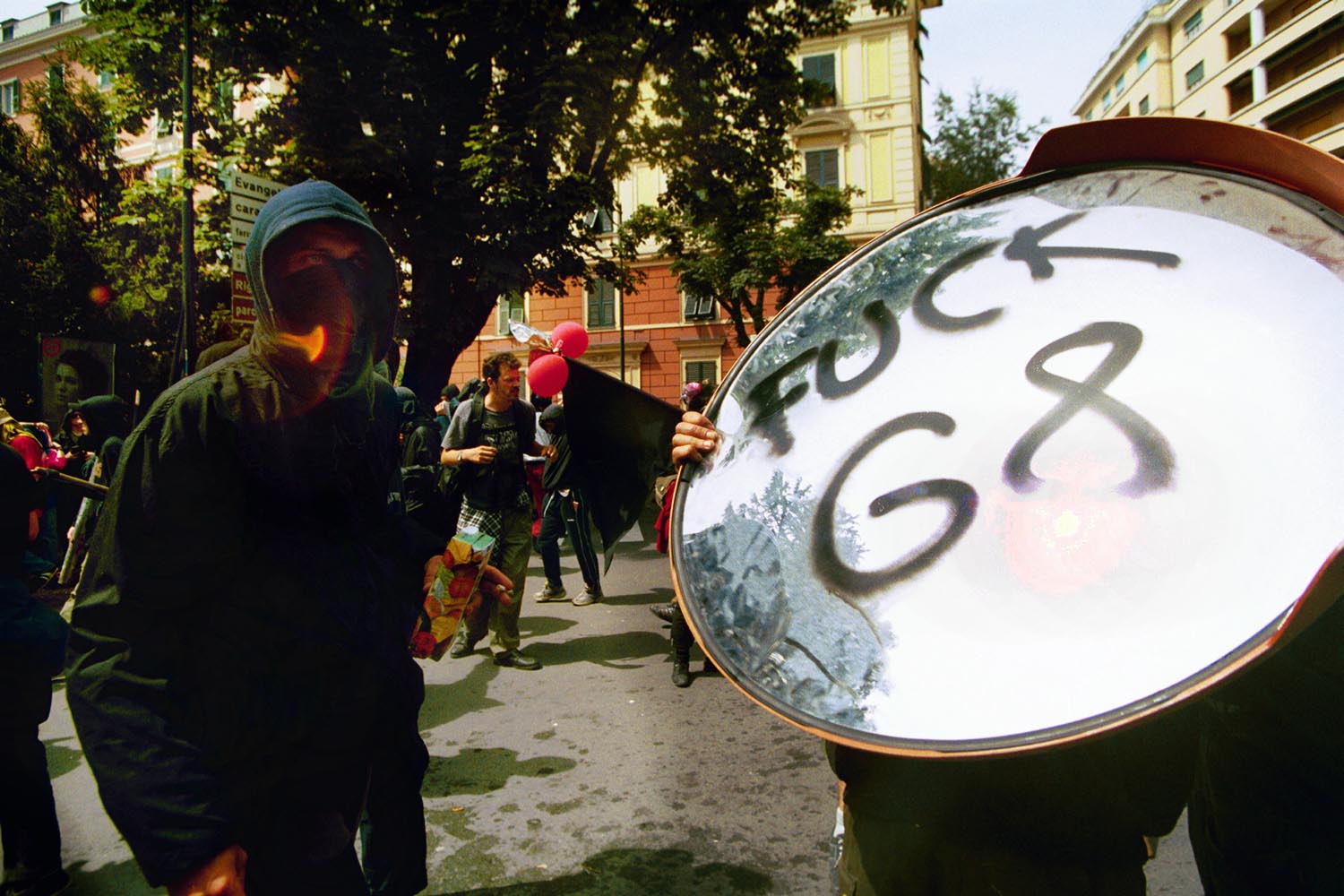
Things are evidently less easy for those we call politicians. And perhaps the Venice film jury, in beholding Rohmer’s framed and digitalized crowds, bore a compassionate thought for the statesmen of the G8 who had gathered at Genoa only 2 months beforehand. For the latter, who would like to govern the world in only having to deal with responsible ‘interlocutors’ – be they dictators of former KGBers like Putin – still have no ways of performing any studio channeling or digital dissolving on the crowds of demonstrators who persist in thinking that they are also part of the world and have a vocation to concern themselves with its affairs. Nor does showing demonstrators in hoods – the modern equivalent of the bestial face of rioters of yesteryear – suffice to put the people in its place. So it is necessary to entrust the police with the ‘aesthetic’ task of cleaning up the streets, in transforming historical towns into bunkers, in charging down demonstrators and in invading their Headquarters, and in much less civil manner than the Parisian Sectionaries in Rohmer’s film invade the dwelling of the Beautiful Englishwoman. According to the well-known joke, being unable to build cities in the country, the greats of this world have therefore decided to gather next time in the Canadian mountains, so that, far from the noises of the unwelcome crowd, they can realize their own dream, the current dream of governments: the direction between responsible men of a world without people.

godard-eloge.jpg

So, if Rohmer’s film provokes embarrassment, it is not because it clashes with the spirit of the times. On the contrary, it is because it is too comformist to this world, because, beneath its visually and ideologically retro appearance, it images in too direct a manner the contemporary dream of the world government of ‘competent’ people, delivered of all disturbances from the street. Once again, Rohmer is little concerned to play the flag-bearer for the final burial of revolutions. His politics is first and foremost aesthetic. His own ‘counter-revolution’ is circumscribed within the field of cinema. Though he never played at being a leftist, in the 1950’s he was one of the first champions of the Rosselinian revolution whose principles ended up paving the way for the ‘New Waves’: bid farewell to the studios and go into the streets with the cameras on the search for contemporary inhabitants of the world, chasing all the unforeseen events that make up their material, sentimental and possibly political itineraries. Following the mobile camera of New Wave filmmakers, students of the 1960s set out to discover the social world of their time and invaded the streets of Paris and a few other metropolises. Again, this link between an aesthetic of the cinema and a way of practicing politics is also evoked by Godard’s last film, Eloge de l’amour, in which the camera travels through the streets of Paris, visits the night cleaners of trains as though it were a leftist handing out pamphlets, and places itself meditatively before the building, today deserted, of the erstwhile ‘worker fortress’ at the Renault factories. As for Rohmer, he turned away from the hazards of the streets very early on to dedicate himself to the ups and downs of sentiment in socially protected microcosms, but all the same without renouncing Rosselinian realism. The avowed artificialism which corresponds, in L’Anglaise et le duc, to a historic broadening of the set, today works as an aesthetic manifesto symbolically closing an age of cinema. It is in this, more than in any ideological measure, that he is in agreement with the desire to close, finally, an age which wanted to return to the streets and render politics to all.

Untimely Flowers

dahlia.png

By Jacques Rancière

Originally published as ‘Fleurs intempestives (la communion solennelle)‘, Cahiers du Cinéma, no. 278 (July 1977), as part of the series ‘Sur la fiction de gauche’ (“on the fiction of the left”).

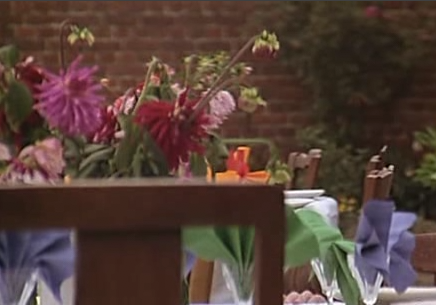
Why have these vases of dahlias on the banquet tables in La Communion solennelle (Réné Féret) caught my eye from the very first shot? Why have I recognized in them the return of an old exasperation, the same one that struck me, at the time of Joli Mai, while watching Chris Marker, forerunner of today’s leftist voyeurism, walking his camera in the courtyards of the popular neighborhoods and kindly congratulating a brave housewife on her plants: “What about thoughts”, he said more or less, “are they hard to cultivate?”. Beneath my derision in calling to mind ample plants of thoughts growing all by themselves on the stones of my doorstep, there was something else: the feeling that their relation to flowers could reveal something about the enterprise of the friends/voyeurs of the people.

We need to look into the history of leftism to make out what this “something” means: a certain anxiety behind the visit to the people, offers of love addressed to them, requests to be instructed by them: something that we at the same time wanted and didn’t want to know about them: a family affair that was a bit different than those we were constantly pestered with and that Chris Marker’s Q&A allowed us to discern: no longer the question of children: where do children come from? but the question of intellectuals who know all about what is to know about the naivety of children: where do cabbages come from?

Love for the people, question of cabbages, place of a fundamental quid pro quo of which the formula was given to me during a meeting of intellectuals of the Gauche prolétarienne*, at the height of the great love for the brave folks and household sowers of our French people’s thoughts. The meeting, as often, took place in an apartment a bit too luxurious in a neighborhood a bit too beautiful and, as was custom, the participants made clear by their observations that this context wasn’t theirs. In this way one of them turned to a vase of blue anemones: “How fake!” He sighed, “blue poppies!”. This anecdote might help to define the intellectual friend of the people: the one who takes real anemones for fake poppies and thinks that refuting florists will lead to the flowers growing in the people’s wheat fields. So it didn’t surprise me to find, a few years later, the same intellectual developing this quid pro quo into a philosophy of the people, weaved together like a rhetorical flower arrangement of fake-real poppies obtained by refuting the fake-fake poppies.

Just as I wasn’t surprised that the disappointments experienced on the terrain of the love for the people and the question of cabbages have brought about this fold towards the family novel, that takes on two figures: gauchiste psychoanalysm questioning the Father’s love according to the principle of serving the people; ethnologism of the left eager to transform, by way of village chronicles and people’s recollections, the voyeurist relation to the people in a relation of heritage and – throwing back the question “where do children come from” not to the law but to the peasant’s essence disrupting it – to find, while identifying precisely with the children whose origin has been told to us, the occasion of finding at the same time the table served with cooked cabbage.

There we have indeed the answer to a question that I asked last year in Cahiers: how to unite the perspectives on a fiction of the type “do we come from there?” Don’t the particularities of our national history oblige us to substitute its representation with a family picture? The filmmakers of the “Programme Commun”* who need this unifying image have provided us with a solution in proposing a fiction of origin that can always be folded back on the family picture: familiarization of the heroic history (L’Affiche Rouge*) or historization of the family picture (La Communion solennelle), in which the accordion of memory opens up from a place of communion where the past folds back on the present and the characters fold back on the actors, where the chronicle of heroes identifies with that of anti-heroes: place of recollection and recognition where the tables are served for the festivities.

la_communion_solennelle.jpg

The family story/picture makes it possible for the “memory of the people” to avert the cuts dividing the conscience of the left. Still the trap that is set up for us has to be disrupted. Féret tells us these are only his family pictures. Just browse through them and compose your own. So what actually functions in La Communion solennelle is a certain family-form and a certain photo-form, but not at all the family photo. What we are shown is precisely always what is behind the family photo: the real of adultery behind the cliché of marriage, passing notes hidden from the husband, nocturnal visits to the fiancé hidden from the father, desires passed on from the wife to her sister or her cousin: games in which some are not allowed to see or hear and others respond to gazes signifying desire. What organizes the space of the visible in La Communion solennelle is not the arrangement of bodies turned towards the family operator, it is the voyeurist dispositif – pushed towards its vaudevillian limits – of the preparation for sexual spectacle. In fact the reference to the family photo simply has the function of denial. Because a certain politics takes place precisely in this look attached to the back of the photo, but a politics which only draws it strength from its denial: (it is only a family photo)

This false family photo is in fact a certain idea of family which is also a certain idea of France: that of the young left laying claim to the heritage of the profound France. In the representation of the continuity of family which is at the same time an irrepressible deviance of bodies, in this naturalism of vivid sexual force which makes up the fabric of the family novel, a certain history makes itself known: that which renders visible in the contemporary bourgeois and petit-bourgeois France the blood and essence of farmers slowly performing their daily tasks, greedy salesmen working and earning, archetypical family of miners and workers, rooted in the natural family. New ideology of the left which, rather than reclaiming the old fashioned principles and flags, wants to prevail in its naturality, renewing its blood with the earthly essence of cabbage planters and child sowers. This is what is proposed by the new spectacle of the left: an image of the human thickness of the people/nation/family of which we have to feel heirs. The present of the Communion is that in which, by way of actualization of historical bodies, we absorb the flesh and the blood of people: Eucharist of people clearly signified in the film by the raising of the champagne glass by the communiant who repeats the raising of the beer glass devoted to the first descent of galibots* in the mine. Work initiation, sexual initiation, political initiation. We absorb the people’s substance of the child who descends for us, if not in hell, at least in the mines. Communion: celebration of springtime, sacrament of youth which is at the same time a celebration of harvest and plucking time.

That’s where we find the dahlias again. Flowers well in their place, we could say, prolific and opulent flowers, as well in their place in the florists windows as in the farmers courtyards and workers gardens. To tell the truth, Féret hardly seems concerned. The screenplay only mentions flowers in the paragraph planting the ideological setting: communion, springtime, child, flowers, lovely time of May (joli Mai), lovely family photo: try it yourself, as you are invited to do, and the difficulties will start: because of the dahlias, because the dahlia is not a flower of springtime but a flower of summertime. More precisely, it is planted around the time of communions and they start to flourish around the time of harvest. In fact, you only have to take a look at the other side of the road to the golden trimmed fields. The harvest has already been done. Obviously because the bread that is on the communion’s table had to be baked.

What does all of this mean for the miserable dahlias? Communions take place in May and the film was shot in August? Films are made when possible and given the expense of shooting it’s all the better to do it during the summer months. And then again, art transfigures reality and does what it wants in its own right. Don’t you know we play Wagner in blue overalls now?

Of course! Of course! If one can film in August, there’s not point in waiting for the next month of May. Only the question has to be asked the other way around: why does the family gathering which is the occasion of this family novel have to be a communion? Why not a marriage? Why a child’s festivity which is a celebration of initiation and growth? Why a sacrament that can only take place in the lovely month of May?

If we can play Wagner in overalls why couldn’t we make the dahlias blossom in May? But is there no confusion of genres here? Doesn’t the leftist culture demonstrate itself today under the guise of two great complementary figures? There is the great culture we put “in all its states” and then there is the family photo, image of the forgotten of the great culture, the works and the days, the seasons and the festivities of people that we relish faithfully. In today’s voyeurist/ethnologist frenzy, how can we not feel in the long run a certain perplexity in seeing the light at the end of summer lightening up the springtime festivities of the people?

Who then, we? Maybe the gardeners would find something wrong in the family photo. But the leftist culture is not made for gardeners. It is intellectuals showing each other this family photo which is the family photo of the people. More precisely the affair plays out between those who think of themselves as the heirs of the last great springtime celebration and those who are preparing the next electoral harvest, between those “children of May” exhausting themselves, in the struggle against the Easter anemones, in search for the poppies of June and those who want to grow the dahlias of the harvest in May. This out-of-season ethnology is perhaps the way to bring together their perspectives, to unify the class of those who know so much about children and so little about cabbages, about an image that at the same time displays and denies the ideology of the new son of the people: our forefathers have sowed and planted; it’s up to us, their flesh and blood, to harvest the ripe wheat.

How reap the harvest of May? How reap the harvest in May? This is what is at stake for all those games of identification: my family, your family, our people, their programme.

——————————————————————————————————————————————————————-
Translated by Stoffel Debuysere (Please contact me if you can improve the translation).

In the context of the research project “Figures of Dissent (Cinema of Politics, Politics of Cinema)”
KASK / School of Arts

translator’s notes
* La Gauche prolétarienne (GP): a maoist organisation that reclaimed the heritage of the UJC (Union des jeunesses communistes marxistes-léninistes) in the aftermath of May 1968.
* Programme commun refers to a reform program that was signed on 27 juin 1972 by the leftist Parties in France.
* L’Affiche Rouge (Frank Cassenti, 1976). See also Rancière’s ‘Le compromis culturel historique’, in Les révoltes logiques, 1978, translated as “The Cultural Historic Compromise” in The Intellectual and His People: Staging the People Volume 2 (Verso, 2011).
* galibots: name given to the child miners in the 19th century.

Towards a Political Cinema

rio3.jpg

By Jean-Luc Godard

Originally published as ‘Pour un cinéma politique’ in Gazette du Cinema (September 1950). English version is available in ‘Godard on Godard’, edited by Jean Narboni (The Viking Press, 1972). Translated by Tom Milne.

One afternoon towards the end of a Gaumont newsreel, my eyes widened in pleasure: the young German Communists were parading on the occasion of the May Day Rally. Space was suddenly lines of lips and bodies, time the rising of fists in the air. On the faces of these young Saint Sebastians one saw the smile which has haunted the faces of happiness from the archaic Kores down to the Soviet cinema. One felt for Siegfried the same love as that which bound him to Limoges. (1) Purely through the force of propaganda which animated them, these young people were beautiful. ‘The beautiful bodies of twenty-year-olds which should go naked.’ (2)

Yes, the great Soviet actors speak in the name of the Party, but like Hermione (3) of her longings and Lear of his madness. Their gestures are meaningful only in so far as they repeat some primordial action. Like Kierkegaard’s ethician, a political cinema is always rooted in repetition: artistic creation simply repeats cosmogonic creation, being simply the double of history. The actor infallibly becomes what he once was, the priest. The Fall of Berlin and The Battle of Stalingrad are Masses for a consummation.

young-guards-2.png

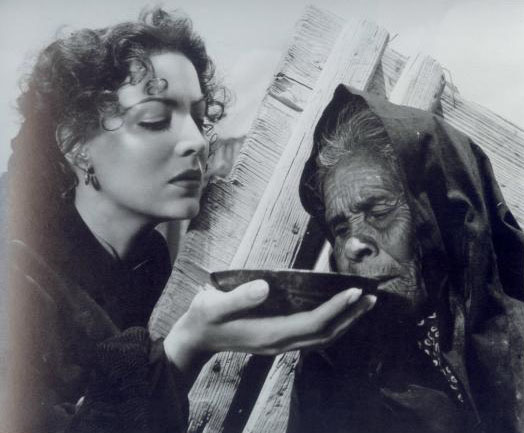
In relation to history, the Soviet actor interprets his role (his social character) in two ways: as saint, or as hero. Corresponding to these two basic agencies are two major currents in the Soviet cinema: the cinema of exhortation and the cinema of revolution, the static and the dynamic. ‘In the former the expression outweighs the content, and in the latter the content outweighs the expression’ (Marx). Whereas in Michurin or The Rainbow the plot takes first place and so articulates the movements of the characters, in Zoya and Ivan the Terrible ‘the consciousness of self which transforms a class into a historical actor forms part of the revolutionary act. It engages itself in the drama of History through the spontaneous and passionate poetry of the event’ (H. Rosenberg). And the reason I admire The Young Guard so deeply is that it oscillates between these two poles, a heart beating ceaselessly between the cult of the Absolute and the cult of Action. One remarkable shot sums up not only the aesthetic of Sergei Gerasimov (who tells his actors he will not be content unless he finds both Rastignac and Julien Sorel (4) in them) but perhaps of the whole Soviet cinema: a young girl in front of her door, in interminable silence, tries to suppress the tears which finally burst violently forth, a sudden apparition of life. Here the idea of a shot (doubtless not unconnected with the Soviet economy plans) (5) takes on its real function of sign, indicating something in whose place it appears. And it is curious that this sign acquires formal beauty only at the moment of its defeat:* the village fleeing before the invader, the arrival of the Germans, shown in a single shot with fantastic virtuosity, the death of the young people, intensified in effect by repeating the same camera movement five times. These moments are brief, but their very swiftness seems everlasting, ‘as the child creates a world out of a single image’. (By what strange chance are these heroes in their darkest hours arrayed in the vestments of our childhood? Zoya barefoot in the snow, Ivan rolling at the feet of the Boyars, Maria Felix with revolver in hand to prevent the great sacrilege, the violation of this woman who is as much part of us as the earth.)

ivan2.png

Aside from the Soviet cinema, there are few films revealing such deep political experience. No doubt only Russia feels at this moment that the images moving across its screens are those of its own destiny. (Another significant shot in The Young Guard shows a young girl unable to cry because she is a poor actress, but one look at her actress-comrades weeping for the sacred cause is enough to bring tears flooding to her cheeks.) If one excepts the Giralducian Kuhle Wampe by Brecht and Dudow,

(0 dark young girl
Why do you weep so
A young officer in Hitler’s guard
Has ensnared my heart)

the Nazi propaganda film might be defined in these words by Georges Sorel:(6) ‘an arrangement of images capable of provoking instinctive feelings corresponding to the manifestations of the war engaged . . . against modem society’. It is impossible to forget Hitlerjunge Quex, certain sequences from Leni Riefenstahl’s films, some fantastic newsreels from the Occupation, the baleful ugliness of Der Ewige Jude. This was not the first time that art was born of coercion. The last few seconds of Fascist joy may be seen through the bewildered smile of a small boy (Germany Year Zero).(7)

rio2.png

The last shot of Rio Escondido: the face of Maria Felix, the face of a dead woman whom the voice of the President of the Mexican Republic covers with glory. In dealing constantly with birth and death, political cinema acknowledges the flesh, and metamorphoses the holy word without difficulty. Unhappy film-makers of France who lack scenarios, how is it that you have not yet made films about the tax system, the death of Philippe Henriot,(8) the marvellous life of Danielle Casanova ?(9)

* As Brice Parain notes: ‘the sign forces us to see an object through its significance’. (10)

zoya.jpg

——————————————————————————————————————————————————————-

Translator’s notes
Most of the films referred to in this article are Russian: The Rainbow (Mark Donskoi, 1944), Zoya (Leo Arnstam, 1944), Ivan the Terrible (Sergei Eisenstein, 1944-46), Michurin (Alexander Dovzhenko, 1947), The Young Guard (Sergei Gerasimov, 1947), The Fall of Berlin (Mikhail Chiaureli, 1949), and Battle of Stalingrad (Vladimir Petrov, 1950). Hitlerjunge Quex (Hans Steinhoff, 1 933) and Der Ewige Jude ( Fritz Hippler, 1940), both German, are two of the most notorious Nazi propaganda films, the former anti-communist, the latter anti-Semitic; while Leni Riefenstahl directed the equally notorious Triumph of the Will and the Berlin Olympics film of 1936. Kuhle Wampe, on the other hand, was notorious as the only German film of that time (1932) to be communist in inspiration. Written by Bertolt Brecht and Ernst Ottwalt, directed by Slatan Dudow, Kuhle Wampe (shown in the West as Whither Germany?) was an independent German production partly financed by the Russian company Mezhrabpom. Promptly banned on political grounds, it was subsequently passed subject to cuts. The odd film out in this political catalogue is Rio Escondido: a Mexican film directed by Emilio Fernandez in 1947, it is a heavy-breathing melodrama with Maria Felix piling on the histrionics as a schoolteacher who devotes her life to conquering illiteracy among the Indians.

(1) ‘Siegfried . . . Limoges’: A reference to Jean Giraudoux’s novel Siegfried et le Limousin (which he later turned into a play, Siegfried). It is about a French soldier (from Limoges) in the First World War who, wounded and amnesiac, is assumed by the Germans to be German and re-educated accordingly. Later, when his true identity is discovered, he is asked to choose between his two countries, France and Germany.
(2) ‘The beautiful bodies of twenty-year-olds . . . ‘: A line from Arthur Rimbaud’s poem, Les Soeurs de Charite, which Godard has put into the plural (in Rimbaud’s original it reads : ‘Le beau corps de vingt ans qui devrait aller nu’).
(3) ‘Hennione’: in Racine’s Andromaque. Hennione, loved by Orestes, is hopelessly in love with Pyrrhus, who loves Andromache, whose insistence on remaining faithful to the dead Hector sparks off the holocaust of the play.
(4) ‘ Rastignac . . . Julien Sorel ‘: The first is a character in Balzac’s Le Père Goriot, the second in Stendhal’s Le Rouge et le Noir.
(5) ‘Soviet economy plans’: A joke lost in translation, since the French for ‘shot’ is ‘plan’,
(6) ‘Georges Sorel’: French social philosopher ( 1847- 1922). Largely self-taught, he was a follower of the Anarchist philosophy of Proudhon and Bakunin, denying the concept of progress and instead advocating a ‘heroic conception of life’, At first on the Left as a champion of the Syndicalist cause, he later veered to the extreme right-wing nationalism of l’Action française. The Fascist movements in Germany and Italy were inspired by his system of a Corporate State, and by his idea of a heroic myth used to arouse public opinion.
(7) ‘ Germany Year Zero’: Roberto Rossellini’s 1948 film, Germania, Anno Zero, is set in the ruins of Berlin after the Second World War. The protagonist is a twelve-year-old boy who is driven by the chaos round him to delinquency, patricide, and finally suicide.
(8) ‘ Philippe Henriot’: Executed as a Nazi collaborator after the liberation of Paris in 1944. In the 1930s, as Oeputy for Bordeaux, Henriot had been one of the leading anti-Semitic witchhunters in the Stavisky affair; in the 1920s, at a time when the conflict between the Catholic militants (right wing) and anti-clericalists (left wing) had a distinct political bias, he was one of the chief spokesmen for the National Catholic Federation.
(9) ‘ Danielle Casanova’ : A heroine of the French Resistance during the Second World War.
(10) ‘Brice Parain’: A contemporary French philosopher, particularly concerned with problems of language, once described by Sartre as a man who is ‘word-sick and wants to be cured’, He later made a personal appearance in Vivre sa Vie as the philosopher who talks to Nana in the care about truth, error and the problems of linguistic communication .